MATLAB程序,用于三维点云的最小二乘拟合,支持平面、球面和二次曲面拟合,并提供可视化功能。
matlab
classdef PointCloudFitter
    % 三维点云最小二乘拟合类
    % 支持平面、球面、二次曲面拟合

    properties
        points;          % 输入点云数据 (N×3矩阵)
        fittedModel;     % 拟合模型参数
        residuals;       % 残差
        modelType;       % 模型类型 ('plane', 'sphere', 'quadric')
        fittingError;    % 拟合误差
    end

    methods
        function obj = PointCloudFitter(points)
            % 构造函数
            % 输入: points - N×3矩阵,每行表示一个点的[x,y,z]坐标
            obj.points = points;
            obj.modelType = '';
            obj.fittedModel = [];
            obj.residuals = [];
            obj.fittingError = inf;
        end

        function obj = fitPlane(obj)
            % 最小二乘平面拟合
            % 平面方程: ax + by + cz + d = 0
            % 输出: 更新obj.fittedModel = [a,b,c,d] (归一化法向量)

            points = obj.points;
            n = size(points, 1); % 点数

            % 计算质心
            centroid = mean(points, 1);

            % 去中心化
            centeredPoints = points - centroid;

            % 计算协方差矩阵
            covMat = (centeredPoints' * centeredPoints) / (n-1);

            % 特征值分解
            [V, D] = eig(covMat);

            % 最小特征值对应的特征向量即为法向量
            [~, idx] = min(diag(D));
            normal = V(:, idx);

            % 归一化法向量
            normal = normal / norm(normal);

            % 计算d: ax+by+cz+d=0 => d = -(a*x0+b*y0+c*z0)
            a = normal(1);
            b = normal(2);
            c = normal(3);
            d = -dot(normal, centroid);

            % 存储模型参数
            obj.fittedModel = [a, b, c, d];
            obj.modelType = 'plane';

            % 计算残差
            distances = abs(a*points(:,1) + b*points(:,2) + c*points(:,3) + d) / sqrt(a^2 + b^2 + c^2);
            obj.residuals = distances;
            obj.fittingError = mean(distances.^2);
        end

        function obj = fitSphere(obj)
            % 最小二乘球面拟合
            % 球面方程: (x-a)^2 + (y-b)^2 + (z-c)^2 = r^2
            % 输出: 更新obj.fittedModel = [a,b,c,r] (球心坐标和半径)

            points = obj.points;
            n = size(points, 1); % 点数

            % 构建线性方程组
            A = zeros(n, 4);
            b = zeros(n, 1);

            for i = 1:n
                x = points(i, 1);
                y = points(i, 2);
                z = points(i, 3);

                A(i, :) = [2*x, 2*y, 2*z, 1];
                b(i) = x^2 + y^2 + z^2;
            end

            % 最小二乘求解
            params = A \ b;

            % 提取参数
            a = params(1);
            b = params(2);
            c = params(3);
            r_sq = params(4) + a^2 + b^2 + c^2;

            % 计算半径
            r = sqrt(r_sq);

            % 存储模型参数
            obj.fittedModel = [a, b, c, r];
            obj.modelType = 'sphere';

            % 计算残差
            distances = sqrt((points(:,1)-a).^2 + (points(:,2)-b).^2 + (points(:,3)-c).^2) - r;
            obj.residuals = distances;
            obj.fittingError = mean(distances.^2);
        end

        function obj = fitQuadricSurface(obj)
            % 最小二乘二次曲面拟合
            % 二次曲面方程: ax² + by² + cz² + dxy + exz + fyz + gx + hy + iz + j = 0
            % 输出: 更新obj.fittedModel = [a,b,c,d,e,f,g,h,i,j]

            points = obj.points;
            n = size(points, 1); % 点数

            % 构建线性方程组
            A = zeros(n, 10);
            for i = 1:n
                x = points(i, 1);
                y = points(i, 2);
                z = points(i, 3);

                A(i, :) = [x^2, y^2, z^2, x*y, x*z, y*z, x, y, z, 1];
            end

            % 使用SVD求解最小二乘问题
            [~, ~, V] = svd(A);
            params = V(:, end); % 最小奇异值对应的右奇异向量

            % 存储模型参数
            obj.fittedModel = params';
            obj.modelType = 'quadric';

            % 计算残差
            a = params(1); b = params(2); c = params(3); d = params(4);
            e = params(5); f = params(6); g = params(7); h = params(8);
            i_val = params(9); j = params(10);

            distances = a*points(:,1).^2 + b*points(:,2).^2 + c*points(:,3).^2 + ...
                       d*points(:,1).*points(:,2) + e*points(:,1).*points(:,3) + ...
                       f*points(:,2).*points(:,3) + g*points(:,1) + ...
                       h*points(:,2) + i_val*points(:,3) + j;

            obj.residuals = distances;
            obj.fittingError = mean(distances.^2);
        end

        function obj = fitBestModel(obj)
            % 尝试多种模型并返回最佳拟合
            models = {'plane', 'sphere', 'quadric'};
            bestError = inf;

            for i = 1:length(models)
                switch models{i}
                    case 'plane'
                        tempObj = PointCloudFitter(obj.points);
                        tempObj = tempObj.fitPlane();
                    case 'sphere'
                        tempObj = PointCloudFitter(obj.points);
                        tempObj = tempObj.fitSphere();
                    case 'quadric'
                        tempObj = PointCloudFitter(obj.points);
                        tempObj = tempObj.fitQuadricSurface();
                end

                if tempObj.fittingError < bestError
                    bestError = tempObj.fittingError;
                    obj.fittedModel = tempObj.fittedModel;
                    obj.modelType = tempObj.modelType;
                    obj.residuals = tempObj.residuals;
                    obj.fittingError = tempObj.fittingError;
                end
            end
        end

        function visualize(obj)
            % 可视化点云和拟合结果
            figure('Name', '点云最小二乘拟合', 'NumberTitle', 'off');
            hold on;
            grid on;
            axis equal;
            view(3);
            xlabel('X');
            ylabel('Y');
            zlabel('Z');
            title(sprintf('点云拟合 (%s)', obj.modelType));

            % 绘制原始点云
            scatter3(obj.points(:,1), obj.points(:,2), obj.points(:,3), 10, 'b', 'filled');

            % 绘制拟合结果
            switch obj.modelType
                case 'plane'
                    obj.visualizePlane();
                case 'sphere'
                    obj.visualizeSphere();
                case 'quadric'
                    obj.visualizeQuadric();
                otherwise
                    error('未知模型类型');
            end

            % 绘制残差分布
            figure('Name', '残差分布', 'NumberTitle', 'off');
            histogram(obj.residuals, 50);
            xlabel('残差');
            ylabel('频数');
            title(sprintf('%s拟合残差分布', obj.modelType));
            grid on;
        end

        function visualizePlane(obj)
            % 可视化拟合平面
            params = obj.fittedModel;
            a = params(1); b = params(2); c = params(3); d = params(4);

            % 创建网格
            [x, y] = meshgrid(linspace(min(obj.points(:,1)), max(obj.points(:,1)), 10), ...
                             linspace(min(obj.points(:,2)), max(obj.points(:,2)), 10));

            % 计算z值 (如果c ≠ 0)
            if abs(c) > 1e-6
                z = (-a*x - b*y - d) / c;
                surf(x, y, z, 'FaceAlpha', 0.5, 'EdgeColor', 'none', 'FaceColor', 'r');
            elseif abs(a) > 1e-6 % 平面平行于z轴
                z = linspace(min(obj.points(:,3)), max(obj.points(:,3)), 10);
                y = (-a*x - c*z - d) / b;
                surf(x, y, reshape(repmat(z, 10, 1), 10, 10), 'FaceAlpha', 0.5, 'EdgeColor', 'none', 'FaceColor', 'r');
            else % 平面平行于y轴
                z = linspace(min(obj.points(:,3)), max(obj.points(:,3)), 10);
                x_grid = (-b*y - c*z - d) / a;
                surf(reshape(repmat(x_grid, 10, 1), 10, 10), y, z, 'FaceAlpha', 0.5, 'EdgeColor', 'none', 'FaceColor', 'r');
            end
        end

        function visualizeSphere(obj)
            % 可视化拟合球面
            params = obj.fittedModel;
            center = params(1:3);
            radius = params(4);

            % 创建球面网格
            [x, y, z] = sphere(50);
            x = x * radius + center(1);
            y = y * radius + center(2);
            z = z * radius + center(3);

            % 绘制球面
            surf(x, y, z, 'FaceAlpha', 0.5, 'EdgeColor', 'none', 'FaceColor', 'r');
        end

        function visualizeQuadric(obj)
            % 可视化二次曲面(简化为椭球)
            params = obj.fittedModel;
            a = params(1); b = params(2); c = params(3); d = params(4);
            e = params(5); f = params(6); g = params(7); h = params(8);
            i_val = params(9); j = params(10);

            % 简化处理:假设为椭球
            figure;
            fimplicit3(@(x,y,z) a*x.^2 + b*y.^2 + c*z.^2 + d*x.*y + e*x.*z + f*y.*z + ...
                      g*x + h*y + i_val*z + j, ...
                      [-1 1 -1 1 -1 1]*max(max(abs(obj.points))));
            title('二次曲面拟合');
            xlabel('X'); ylabel('Y'); zlabel('Z');
            grid on;
            axis equal;
        end

        function report(obj)
            % 输出拟合报告
            fprintf('\n===== 点云拟合报告 =====\n');
            fprintf('模型类型: %s\n', obj.modelType);
            fprintf('拟合误差(RMSE): %.6f\n', sqrt(obj.fittingError));
            fprintf('最大残差: %.6f\n', max(abs(obj.residuals)));
            fprintf('最小残差: %.6f\n', min(abs(obj.residuals)));
            fprintf('平均残差: %.6f\n', mean(abs(obj.residuals)));
            fprintf('残差标准差: %.6f\n', std(obj.residuals));

            switch obj.modelType
                case 'plane'
                    fprintf('\n平面参数: ax + by + cz + d = 0\n');
                    fprintf('a = %.6f, b = %.6f, c = %.6f, d = %.6f\n', obj.fittedModel);
                    fprintf('法向量: [%.6f, %.6f, %.6f]\n', obj.fittedModel(1:3));

                case 'sphere'
                    fprintf('\n球面参数: (x-a)^2 + (y-b)^2 + (z-c)^2 = r^2\n');
                    fprintf('球心: (%.6f, %.6f, %.6f)\n', obj.fittedModel(1:3));
                    fprintf('半径: %.6f\n', obj.fittedModel(4));

                case 'quadric'
                    fprintf('\n二次曲面参数: ax² + by² + cz² + dxy + exz + fyz + gx + hy + iz + j = 0\n');
                    labels = {'a', 'b', 'c', 'd', 'e', 'f', 'g', 'h', 'i', 'j'};
                    for k = 1:10
                        fprintf('%s = %.6f\n', labels{k}, obj.fittedModel(k));
                    end
            end
            fprintf('========================\n');
        end

        function runDemo()
            % 运行演示
            fprintf('三维点云最小二乘拟合演示\n');

            % 生成示例点云
            fprintf('生成示例点云...\n');

            % 平面点云
            [x, y] = meshgrid(linspace(-1, 1, 50), linspace(-1, 1, 50));
            z = 0.5*x + 0.3*y + 0.2 + 0.05*randn(size(x));
            planePoints = [x(:), y(:), z(:)];

            % 球面点云
            [x_s, y_s, z_s] = sphere(50);
            spherePoints = [x_s(:)*0.8+0.5, y_s(:)*0.8+0.5, z_s(:)*0.8+0.5];
            spherePoints = spherePoints + 0.02*randn(size(spherePoints));

            % 椭球点云
            [x_e, y_e, z_e] = ellipsoid(0, 0, 0, 1, 0.7, 0.5, 50);
            ellipsoidPoints = [x_e(:), y_e(:), z_e(:)];
            ellipsoidPoints = ellipsoidPoints + 0.03*randn(size(ellipsoidPoints));

            % 平面拟合演示
            fprintf('\n=== 平面拟合演示 ===\n');
            planeFitter = PointCloudFitter(planePoints);
            planeFitter = planeFitter.fitPlane();
            planeFitter.visualize();
            planeFitter.report();

            % 球面拟合演示
            fprintf('\n=== 球面拟合演示 ===\n');
            sphereFitter = PointCloudFitter(spherePoints);
            sphereFitter = sphereFitter.fitSphere();
            sphereFitter.visualize();
            sphereFitter.report();

            % 二次曲面拟合演示
            fprintf('\n=== 二次曲面拟合演示 ===\n');
            quadricFitter = PointCloudFitter(ellipsoidPoints);
            quadricFitter = quadricFitter.fitQuadricSurface();
            quadricFitter.visualize();
            quadricFitter.report();

            % 自动选择最佳模型
            fprintf('\n=== 自动选择最佳模型演示 ===\n');
            % 添加一些噪声点
            noisyPoints = [planePoints; 0.5*randn(20,3)];
            autoFitter = PointCloudFitter(noisyPoints);
            autoFitter = autoFitter.fitBestModel();
            autoFitter.visualize();
            autoFitter.report();
        end
    end
end
使用示例
1. 基本使用
matlab
% 生成随机点云
points = rand(100, 3) * 10;

% 创建拟合器
fitter = PointCloudFitter(points);

% 拟合平面
fitter = fitter.fitPlane();

% 可视化结果
fitter.visualize();

% 输出报告
fitter.report();
2. 拟合球面
matlab
% 生成球面点云
[x, y, z] = sphere(100);
points = [x(:)*2+3, y(:)*2-1, z(:)*1.5+2] + 0.1*randn(100^2, 3);

% 创建拟合器
fitter = PointCloudFitter(points);

% 拟合球面
fitter = fitter.fitSphere();

% 可视化结果
fitter.visualize();

% 输出报告
fitter.report();
3. 拟合二次曲面
matlab
% 生成椭球点云
[x, y, z] = ellipsoid(0, 0, 0, 2, 1, 0.5, 100);
points = [x(:), y(:), z(:)] + 0.1*randn(100^2, 3);

% 创建拟合器
fitter = PointCloudFitter(points);

% 拟合二次曲面
fitter = fitter.fitQuadricSurface();

% 可视化结果
fitter.visualize();

% 输出报告
fitter.report();
4. 自动选择最佳模型
matlab
% 生成混合点云
planePoints = [rand(100,2)*10, 0.5*rand(100,1)*10];
spherePoints = [randn(100,3)*0.5 + [5,5,5]];
points = [planePoints; spherePoints];

% 创建拟合器
fitter = PointCloudFitter(points);

% 自动选择最佳模型
fitter = fitter.fitBestModel();

% 可视化结果
fitter.visualize();

% 输出报告
fitter.report();
5. 运行演示
matlab
% 运行内置演示
PointCloudFitter.runDemo();
算法原理
1. 平面拟合
平面方程:ax+by+cz+d=0ax+by+cz+d=0ax+by+cz+d=0
最小二乘解法:
- 计算点云质心:centroid=1N∑i=1Npicentroid=\frac{1}{N}{∑_{i=1}^Np_i}centroid=N1∑i=1Npi
- 去中心化:pi′=pi−centroidp_i^′=p_i−centroidpi′=pi−centroid
- 计算协方差矩阵:C=1N−1∑i=1Npi′pi′TC=\frac{1}{N−1}∑_{i=1}^Np_i^′p_i^{′T}C=N−11∑i=1Npi′pi′T
- 对协方差矩阵进行特征值分解
- 最小特征值对应的特征向量即为平面法向量 n=a,b,cTn=a,b,c^Tn=a,b,cT
- 计算 d=−nT⋅centroidd=−n^T⋅centroidd=−nT⋅centroid
2. 球面拟合
球面方程:(x−a)2+(y−b)2+(z−c)2=r2(x−a)^2+(y−b)^2+(z−c)^2=r^2(x−a)2+(y−b)2+(z−c)2=r2
最小二乘解法:
-
展开方程:x2+y2+z2=2ax+2by+2cz+(r2−a2−b2−c2)x^2+y^2+z^2=2ax+2by+2cz+(r^2−a^2−b^2−c^2)x2+y2+z2=2ax+2by+2cz+(r2−a2−b2−c2)
-
令 d=r2−a2−b2−c2d=r^2−a^2−b^2−c^2d=r2−a2−b2−c2,得:2ax+2by+2cz+d=x2+y2+z22ax+2by+2cz+d=x^2+y^2+z^22ax+2by+2cz+d=x2+y2+z2
-
构建线性方程组:Ax=bAx=bAx=b
-
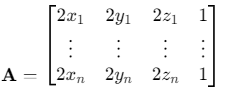
-
x=a,b,c,dTx=a,b,c,d^Tx=a,b,c,dT
-
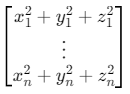
-
-
求解 x=(ATA)−1ATbx=(A^TA)^{−1}A^Tbx=(ATA)−1ATb
-
计算半径:r=a2+b2+c2+dr=a^2+b^2+c^2+dr=a2+b2+c2+d
3. 二次曲面拟合
二次曲面方程:ax2+by2+cz2+dxy+exz+fyz+gx+hy+iz+j=0ax^2+by^2+cz^2+dxy+exz+fyz+gx+hy+iz+j=0ax2+by2+cz2+dxy+exz+fyz+gx+hy+iz+j=0
最小二乘解法:
-
构建线性方程组:Ax=0Ax=0Ax=0
-

-
x=a,b,c,d,e,f,g,h,i,jTx=a,b,c,d,e,f,g,h,i,j^Tx=a,b,c,d,e,f,g,h,i,jT
-
-
使用SVD求解:xxx对应最小奇异值的右奇异向量
参考代码 最小二乘MATLAB程序,适合用于三维点云的最小二乘拟合 www.youwenfan.com/contentcss/112903.html
扩展功能
1. 鲁棒拟合(RANSAC)
matlab
function obj = robustFitPlane(obj, maxIterations, distanceThreshold)
    % 使用RANSAC进行鲁棒平面拟合
    % 输入:
    %   maxIterations - 最大迭代次数
    %   distanceThreshold - 距离阈值

    bestInliers = [];
    bestModel = [];
    bestError = inf;
    n = size(obj.points, 1);

    for iter = 1:maxIterations
        % 随机选择3个点
        sampleIdx = randperm(n, 3);
        samplePts = obj.points(sampleIdx, :);

        % 拟合平面
        tempFitter = PointCloudFitter(samplePts);
        tempFitter = tempFitter.fitPlane();
        model = tempFitter.fittedModel;

        % 计算所有点到平面的距离
        a = model(1); b = model(2); c = model(3); d = model(4);
        distances = abs(a*obj.points(:,1) + b*obj.points(:,2) + c*obj.points(:,3) + d) / sqrt(a^2 + b^2 + c^2);

        % 统计内点
        inliers = find(distances < distanceThreshold);
        numInliers = length(inliers);

        % 更新最佳模型
        if numInliers > bestInliers
            bestInliers = inliers;
            bestModel = model;
            bestError = mean(distances(inliers).^2);
        end
    end

    % 使用所有内点重新拟合
    if ~isempty(bestInliers)
        inlierPts = obj.points(bestInliers, :);
        finalFitter = PointCloudFitter(inlierPts);
        finalFitter = finalFitter.fitPlane();
        obj.fittedModel = finalFitter.fittedModel;
        obj.modelType = 'plane';
        obj.residuals = finalFitter.residuals;
        obj.fittingError = finalFitter.fittingError;
    else
        obj.fittedModel = bestModel;
        obj.modelType = 'plane';
        obj.residuals = distances;
        obj.fittingError = bestError;
    end
end
2. 加权最小二乘
matlab
function obj = weightedFitPlane(obj, weights)
    % 加权最小二乘平面拟合
    % 输入: weights - 权重向量 (N×1)

    points = obj.points;
    n = size(points, 1);

    % 计算加权质心
    centroid = sum(bsxfun(@times, points, weights), 1) / sum(weights);

    % 去中心化
    centeredPoints = bsxfun(@minus, points, centroid);

    % 构建加权协方差矩阵
    W = diag(weights);
    covMat = centeredPoints' * W * centeredPoints / (sum(weights) - 1);

    % 特征值分解
    [V, D] = eig(covMat);

    % 最小特征值对应的特征向量即为法向量
    [~, idx] = min(diag(D));
    normal = V(:, idx);

    % 归一化法向量
    normal = normal / norm(normal);

    % 计算d
    a = normal(1); b = normal(2); c = normal(3);
    d = -dot(normal, centroid);

    % 存储模型参数
    obj.fittedModel = [a, b, c, d];
    obj.modelType = 'plane';

    % 计算残差
    distances = abs(a*points(:,1) + b*points(:,2) + c*points(:,3) + d) / sqrt(a^2 + b^2 + c^2);
    obj.residuals = distances;
    obj.fittingError = mean(weights .* distances.^2);
end
3. 点云法线估计
matlab
function normals = estimateNormals(obj, k)
    % 估计点云法线
    % 输入: k - 近邻点数
    % 输出: normals - 法线向量 (N×3)

    n = size(obj.points, 1);
    normals = zeros(n, 3);

    for i = 1:n
        % 计算当前点到所有点的距离
        dists = sum((obj.points - obj.points(i, :)).^2, 2);

        % 找到k个最近邻
        [~, idx] = mink(dists, k+1); % 包括自身
        idx = idx(2:end); % 排除自身

        % 使用近邻点拟合平面
        neighborPts = obj.points(idx, :);
        tempFitter = PointCloudFitter(neighborPts);
        tempFitter = tempFitter.fitPlane();

        % 获取法线
        normal = tempFitter.fittedModel(1:3);
        normals(i, :) = normal;
    end

    % 统一法线方向
    refVector = mean(obj.points, 1) - obj.points;
    dotProducts = sum(bsxfun(@times, normals, refVector), 2);
    flipIdx = dotProducts < 0;
    normals(flipIdx, :) = -normals(flipIdx, :);
end
应用场景
- 逆向工程
- 从扫描点云重建CAD模型
- 曲面拟合与重建
- 零件尺寸测量
- 机器人导航
- 环境建模
- 障碍物检测
- 路径规划
- 计算机视觉
- 三维重建
- 运动恢复结构(SFM)
- 目标识别
- 地理信息系统
- 地形建模
- 数字高程模型(DEM)
- 建筑物提取
- 医学成像
- 器官表面重建
- 牙齿矫正
- 假体设计
程序适用于各种三维点云处理任务,从简单的平面检测到复杂的曲面重建,为工程应用和科学研究提供可靠的工具。