测试覆盖率从35%到80%:我用AI批量生成C++单元测试的完整方案
如果你问一个C++开发者最讨厌做什么,十个有八个会说"写单元测试"。不是不知道重要,是真的枯燥。这篇文章讲的是我怎么用AI把这件最没人愿意干的事变成了一条自动化流水线。
痛点:每次Review都在说"测试呢?"
我们组的代码仓库有大约十五万行C++代码,测试覆盖率长期在35%左右徘徊。不是没要求------组规里白纸黑字写着"新增代码必须配套单测"------但实际执行起来,大家总有理由跳过:排期紧、逻辑简单不需要测、下个版本再补......
结果就是每次Code Review都要上演同一段对话:
"测试呢?"
"这个逻辑比较直观,下个迭代补。"
"上次你也这么说的。"
然后MR还是合了,因为需求要上线。测试成了技术债里最大的一笔,而且是那种每个人都知道欠着、但没人愿意还的债。
去年有一次版本回归,一个改了三行的bugfix引入了一个边界条件的崩溃,在线上跑了两天才发现。根因分析的时候发现,那个函数压根没有单元测试------如果有一个覆盖边界值的测试用例,CI阶段就能拦住。
那次之后我下定决心:既然人不愿意写,那就让AI来写。
整体方案
思路是做一条全自动的测试生成流水线:扫描头文件提取接口签名 → 收集类的上下文信息 → 组装提示词 → 调LLM生成测试代码 → 编译验证 → 输出可直接入库的测试文件。
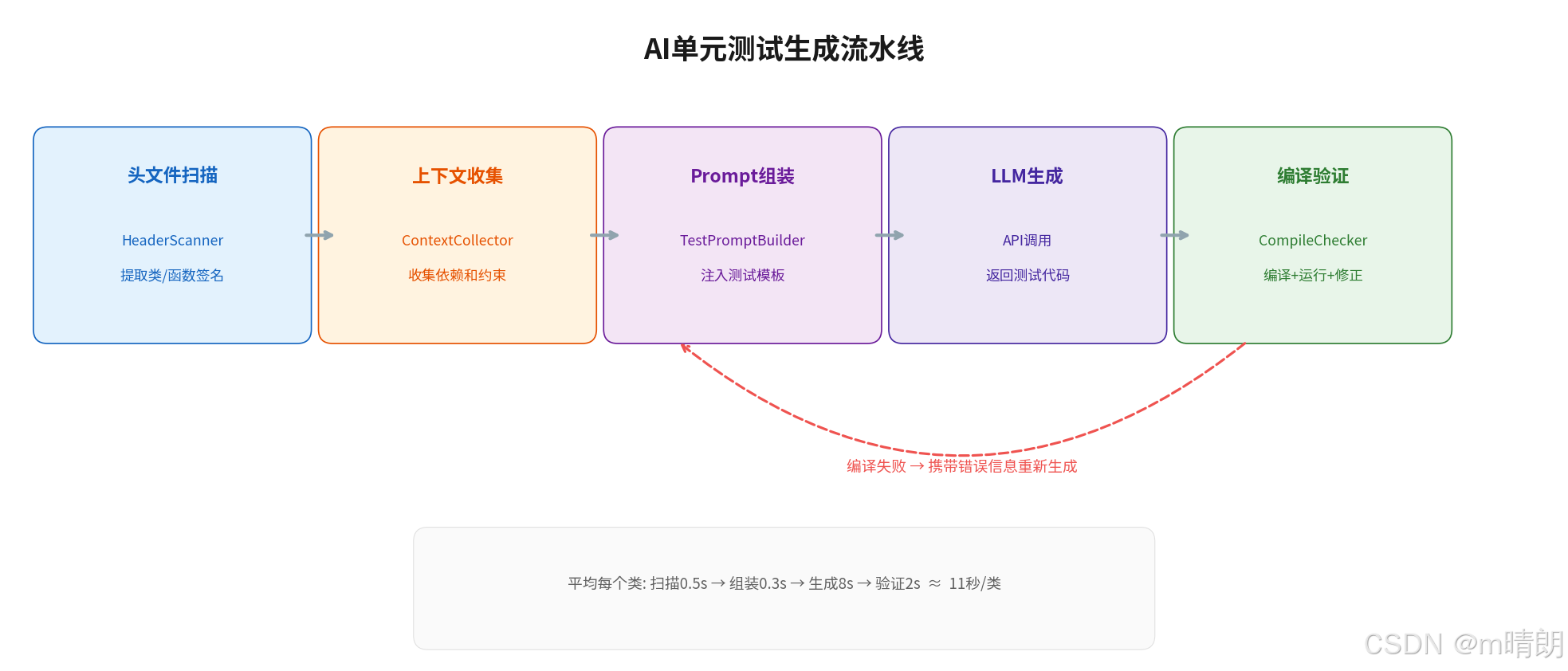
关键设计决策有两个:
第一,以头文件为入口,不以源文件为入口。因为头文件定义了公开接口,这才是单测应该覆盖的东西。源文件里的私有实现,不应该直接测试。
第二,生成之后必须编译验证。AI生成的代码不可能百分百编译通过,所以流水线里有一个自动编译+错误反馈+重新生成的循环。实测下来,第一次编译通过率约70%,加上一轮自动修正后提升到92%左右。
核心代码:头文件扫描器
整个流水线的起点是HeaderScanner------它负责解析C++头文件,提取出所有需要生成测试的类和函数签名。
headerscanner.h
cpp
#ifndef HEADER_SCANNER_H
#define HEADER_SCANNER_H

/// @file headerscanner.h
/// @brief C++头文件接口扫描器 v1.0
/// @details 解析头文件提取类名、公开方法签名、构造函数信息,
///          作为测试生成的输入源
/// @usage
///   HeaderScanner scanner;
///   scanner.scan("configmanager.h");
///   auto methods = scanner.getMethods();

#include <string>
#include <vector>
#include <regex>

/// @brief 方法签名信息
struct MethodInfo
{
    std::string className;                         // 所属类名
    std::string methodName;                        // 方法名
    std::string returnType;                        // 返回值类型
    std::string fullSignature;                     // 完整签名文本
    std::vector<std::string> paramTypes;           // 参数类型列表
    bool isConst;                                  // 是否为const方法
    bool isStatic;                                 // 是否为静态方法
};

/// @brief 类信息
struct ClassInfo
{
    std::string name;                              // 类名
    std::vector<MethodInfo> methods;               // 公开方法列表
    std::vector<std::string> includes;             // 该类依赖的头文件
    bool hasDefaultConstructor;                    // 是否有默认构造函数
};

class HeaderScanner
{
public:
    /// @brief 扫描指定头文件
    bool scan(const std::string& filePath);        // 解析一个头文件

    /// @brief 批量扫描目录下所有头文件
    int scanDirectory(const std::string& dirPath); // 返回扫描到的类数量

    /// @brief 获取所有扫描到的类信息
    const std::vector<ClassInfo>& getClasses() const; // 返回类信息列表

    /// @brief 获取指定类的信息
    const ClassInfo* findClass(const std::string& name) const; // 按名称查找类

    /// @brief 清空扫描结果
    void clear();                                  // 重置内部状态

private:
    std::vector<ClassInfo> classes_;                // 扫描结果存储

    /// @brief 从文件内容中提取类定义
    void extractClasses(const std::string& content,   // 文件内容
                        const std::string& filePath); // 文件路径

    /// @brief 解析类体中的公开方法
    void parsePublicMethods(const std::string& classBody, // 类体文本
                            ClassInfo& classInfo);        // 输出目标

    /// @brief 从方法声明中提取参数类型
    std::vector<std::string> extractParamTypes(    // 解析参数列表
        const std::string& paramList               // 括号内的参数文本
    ) const;
};

#endif // HEADER_SCANNER_H
headerscanner.cpp
cpp
#include "headerscanner.h"

#include <fstream>
#include <sstream>
#include <filesystem>

bool HeaderScanner::scan(const std::string& filePath)
{
    std::ifstream file(filePath);                  // 打开目标头文件
    if (!file.is_open())                           // 无法打开则返回失败
        return false;

    std::ostringstream oss;                        // 读取全部内容到字符串
    oss << file.rdbuf();                           // 一次性读入
    std::string content = oss.str();               // 获取文件内容

    extractClasses(content, filePath);             // 提取类定义
    return true;                                   // 扫描完成
}

int HeaderScanner::scanDirectory(const std::string& dirPath)
{
    int count = 0;                                 // 扫描计数器
    namespace fs = std::filesystem;                // 文件系统命名空间

    for (const auto& entry : fs::recursive_directory_iterator(dirPath)) // 递归遍历目录
    {
        if (entry.path().extension() == ".h" ||    // 筛选头文件扩展名
            entry.path().extension() == ".hpp")
        {
            if (scan(entry.path().string()))        // 逐个扫描
                ++count;                           // 成功则计数
        }
    }

    return count;                                  // 返回扫描到的文件数
}

void HeaderScanner::extractClasses(const std::string& content,
                                    const std::string& filePath)
{
    // 匹配 class ClassName 或 class ClassName : public Base
    std::regex classPattern(                       // 类声明正则表达式
        R"(class\s+(\w+)(?:\s*:\s*(?:public|protected|private)\s+\w+)?\s*\{)"
    );

    auto begin = std::sregex_iterator(content.begin(), content.end(), classPattern); // 开始匹配
    auto end = std::sregex_iterator();             // 结束哨兵

    for (auto it = begin; it != end; ++it)         // 遍历所有匹配
    {
        ClassInfo info;                            // 新建类信息
        info.name = (*it)[1].str();                // 提取类名

        // 找到类体的结束位置(简化版:匹配大括号层级)
        size_t classStart = it->position() + it->length(); // 类体起始偏移
        int braceDepth = 1;                        // 大括号深度计数
        size_t pos = classStart;                   // 当前扫描位置

        while (pos < content.size() && braceDepth > 0) // 遍历直到匹配到结束大括号
        {
            if (content[pos] == '{')                // 遇到左括号则深度加一
                ++braceDepth;
            else if (content[pos] == '}')           // 遇到右括号则深度减一
                --braceDepth;
            ++pos;                                  // 移动到下一个字符
        }

        std::string classBody = content.substr(classStart, pos - classStart - 1); // 截取类体
        parsePublicMethods(classBody, info);        // 解析公开方法

        // 判断是否有默认构造函数
        std::regex defaultCtorPattern(              // 默认构造函数正则
            info.name + R"(\s*\(\s*\))"
        );
        info.hasDefaultConstructor =                // 检查是否存在
            std::regex_search(classBody, defaultCtorPattern) ||
            info.methods.empty();                   // 无显式构造也算有默认构造

        classes_.push_back(info);                   // 保存类信息
    }
}

void HeaderScanner::parsePublicMethods(const std::string& classBody,
                                        ClassInfo& classInfo)
{
    bool inPublic = false;                         // 是否在public区域

    std::istringstream stream(classBody);           // 逐行解析类体
    std::string line;                              // 当前行缓冲

    while (std::getline(stream, line))              // 遍历每一行
    {
        // 去除前导空白
        size_t firstNonSpace = line.find_first_not_of(" \t"); // 定位非空白字符
        if (firstNonSpace == std::string::npos)     // 空行跳过
            continue;
        line = line.substr(firstNonSpace);          // 裁剪前导空白

        if (line.find("public:") != std::string::npos)    // 进入public区域
        {
            inPublic = true;
            continue;
        }
        if (line.find("private:") != std::string::npos || // 离开public区域
            line.find("protected:") != std::string::npos)
        {
            inPublic = false;
            continue;
        }

        if (!inPublic)                              // 不在public区域则跳过
            continue;

        // 匹配方法声明: 返回类型 方法名(参数列表) [const];
        std::regex methodPattern(                   // 方法声明正则
            R"((\w[\w\s\*&:<>,]*?)\s+(\w+)\s*\(([^)]*)\)\s*(const)?\s*;)"
        );

        std::smatch match;                          // 匹配结果
        if (std::regex_search(line, match, methodPattern)) // 尝试匹配
        {
            MethodInfo method;                      // 新建方法信息
            method.className = classInfo.name;      // 绑定所属类名
            method.returnType = match[1].str();     // 提取返回类型
            method.methodName = match[2].str();     // 提取方法名
            method.fullSignature = match[0].str();  // 保存完整签名
            method.isConst = match[4].matched;      // 是否有const修饰
            method.isStatic = (line.find("static") != std::string::npos); // 是否静态
            method.paramTypes = extractParamTypes(match[3].str()); // 解析参数类型

            // 跳过构造函数和析构函数
            if (method.methodName != classInfo.name &&  // 不是构造函数
                method.methodName[0] != '~')            // 不是析构函数
            {
                classInfo.methods.push_back(method); // 保存方法信息
            }
        }
    }
}

std::vector<std::string> HeaderScanner::extractParamTypes(
    const std::string& paramList) const
{
    std::vector<std::string> types;                // 类型列表
    if (paramList.empty())                         // 无参数则返回空
        return types;

    std::istringstream stream(paramList);           // 按逗号分割
    std::string param;                             // 单个参数缓冲

    while (std::getline(stream, param, ','))        // 逐个参数处理
    {
        // 去除首尾空白
        size_t start = param.find_first_not_of(" \t"); // 定位有效起始
        size_t end = param.find_last_not_of(" \t");    // 定位有效结尾
        if (start == std::string::npos)             // 空参数跳过
            continue;

        std::string trimmed = param.substr(start, end - start + 1); // 裁剪空白

        // 提取类型(去掉变量名):取最后一个空格之前的部分
        size_t lastSpace = trimmed.rfind(' ');      // 查找最后一个空格
        if (lastSpace != std::string::npos)         // 有空格则分割
            types.push_back(trimmed.substr(0, lastSpace)); // 取类型部分
        else
            types.push_back(trimmed);               // 无空格则整体作为类型
    }

    return types;                                   // 返回解析结果
}

const std::vector<ClassInfo>& HeaderScanner::getClasses() const
{
    return classes_;                                // 返回扫描结果引用
}

const ClassInfo* HeaderScanner::findClass(const std::string& name) const
{
    for (const auto& cls : classes_)               // 遍历查找
    {
        if (cls.name == name)                       // 名称匹配
            return &cls;                            // 返回指针
    }
    return nullptr;                                 // 未找到返回空
}

void HeaderScanner::clear()
{
    classes_.clear();                               // 清空数据
}
核心代码:测试提示词构建器
有了类和方法的结构化信息,下一步是把它变成高质量的提示词。这是整个流水线效果好坏的关键。
testpromptbuilder.h
cpp
#ifndef TEST_PROMPT_BUILDER_H
#define TEST_PROMPT_BUILDER_H

/// @file testpromptbuilder.h
/// @brief 单元测试专用提示词构建器 v1.0
/// @details 基于扫描到的类信息自动构建GoogleTest风格的测试生成提示词
/// @usage
///   TestPromptBuilder builder;
///   builder.setTestFramework("GoogleTest");
///   auto prompt = builder.buildForClass(classInfo, headerContent);

#include "headerscanner.h"

#include <string>

class TestPromptBuilder
{
public:
    /// @brief 设置测试框架名称
    void setTestFramework(const std::string& framework); // 如"GoogleTest"

    /// @brief 设置项目特定的构建约束
    void setBuildConstraints(const std::string& constraints); // 如"C++17, 禁用RTTI"

    /// @brief 为指定类构建测试生成的系统消息
    std::string buildSystemMessage() const;        // 生成system prompt

    /// @brief 为指定类构建测试生成的用户消息
    std::string buildForClass(                     // 生成user prompt
        const ClassInfo& classInfo,                // 目标类信息
        const std::string& headerContent           // 原始头文件内容
    ) const;

    /// @brief 为编译失败构建修正提示词
    std::string buildFixPrompt(                    // 生成修正prompt
        const std::string& testCode,               // 编译失败的测试代码
        const std::string& compileError            // 编译器错误信息
    ) const;

private:
    std::string framework_ = "GoogleTest";         // 测试框架
    std::string buildConstraints_;                 // 构建约束

    /// @brief 生成测试用例清单
    std::string generateTestCaseList(              // 基于方法列表生成测试清单
        const ClassInfo& classInfo
    ) const;
};

#endif // TEST_PROMPT_BUILDER_H
testpromptbuilder.cpp
cpp
#include "testpromptbuilder.h"

#include <sstream>

void TestPromptBuilder::setTestFramework(const std::string& framework)
{
    framework_ = framework;                        // 存储框架名称
}

void TestPromptBuilder::setBuildConstraints(const std::string& constraints)
{
    buildConstraints_ = constraints;               // 存储构建约束
}

std::string TestPromptBuilder::buildSystemMessage() const
{
    std::ostringstream oss;                        // 拼接系统消息

    oss << "You are a senior C++ test engineer.\n" // 角色设定
        << "You write thorough, production-quality unit tests.\n\n"
        << "Rules:\n"                              // 测试编写规则
        << "- Framework: " << framework_ << "\n"   // 使用的框架
        << "- Test all public methods\n"           // 测试所有公开方法
        << "- Cover: normal case, boundary, error/exception, nullptr\n" // 覆盖场景
        << "- Each TEST should test ONE behavior\n"    // 单一职责
        << "- Use descriptive test names: MethodName_Scenario_Expected\n" // 命名规范
        << "- Include necessary headers only\n"    // 最小依赖
        << "- Must compile with C++17\n";          // 编译标准

    if (!buildConstraints_.empty())                // 如果有额外约束
        oss << "- Build constraints: "
            << buildConstraints_ << "\n";          // 注入约束

    oss << "\nOutput ONLY the test code. "         // 输出约束
        << "No explanations. No markdown fences.\n"; // 禁止多余文本

    return oss.str();                              // 返回系统消息
}

std::string TestPromptBuilder::generateTestCaseList(const ClassInfo& classInfo) const
{
    std::ostringstream oss;                        // 拼接测试清单

    for (const auto& method : classInfo.methods)   // 遍历每个公开方法
    {
        oss << "- " << method.methodName << "(";   // 方法名

        for (size_t i = 0; i < method.paramTypes.size(); ++i) // 参数类型列表
        {
            if (i > 0) oss << ", ";                // 逗号分隔
            oss << method.paramTypes[i];           // 参数类型
        }

        oss << ")";                                // 结束括号
        if (method.isConst) oss << " const";       // const标记
        oss << " -> " << method.returnType << "\n"; // 返回类型

        // 建议的测试场景
        oss << "  Suggested tests:\n";             // 建议测试项

        oss << "    * Normal case\n";              // 正常路径

        // 有参数的方法建议边界测试
        if (!method.paramTypes.empty())            // 有参数的方法
        {
            for (const auto& ptype : method.paramTypes) // 遍历参数类型
            {
                if (ptype.find("string") != std::string::npos) // 字符串参数
                    oss << "    * Empty string input\n"; // 空字符串边界
                if (ptype.find("int") != std::string::npos ||   // 整型参数
                    ptype.find("size_t") != std::string::npos)
                    oss << "    * Zero / negative / max value\n"; // 数值边界
                if (ptype.find("*") != std::string::npos)       // 指针参数
                    oss << "    * Nullptr input\n"; // 空指针测试
            }
        }

        // 返回bool的方法建议正反测试
        if (method.returnType == "bool")           // 布尔返回值
            oss << "    * True case and false case\n"; // 正反路径
    }

    return oss.str();                              // 返回测试清单
}

std::string TestPromptBuilder::buildForClass(const ClassInfo& classInfo,
                                              const std::string& headerContent) const
{
    std::ostringstream oss;                        // 拼接用户消息

    oss << "Generate " << framework_               // 开头指令
        << " unit tests for class `"
        << classInfo.name << "`.\n\n";             // 目标类名

    oss << "## Header file content:\n"             // 原始头文件
        << "```cpp\n" << headerContent
        << "\n```\n\n";

    oss << "## Methods to test:\n"                 // 需要测试的方法
        << generateTestCaseList(classInfo) << "\n"; // 注入测试清单

    oss << "## Requirements:\n"                    // 额外要求
        << "- Create the test class instance in each TEST or use a fixture\n" // 实例化方式
        << "- If the class needs file I/O, create temp files in tests\n"     // 文件IO处理
        << "- Clean up any resources after tests\n" // 资源清理
        << "- Add comments for each test explaining what it verifies\n";     // 注释要求

    if (classInfo.hasDefaultConstructor)           // 有默认构造
        oss << "- Class has a default constructor, use it directly\n";
    else
        oss << "- Class has NO default constructor, check header for required params\n";

    return oss.str();                              // 返回用户消息
}

std::string TestPromptBuilder::buildFixPrompt(const std::string& testCode,
                                               const std::string& compileError) const
{
    std::ostringstream oss;                        // 拼接修正提示

    oss << "The following test code failed to compile.\n\n" // 说明情况
        << "## Test code:\n```cpp\n"               // 原始测试代码
        << testCode << "\n```\n\n"
        << "## Compiler error:\n```\n"             // 编译器错误
        << compileError << "\n```\n\n"
        << "Fix the code so it compiles. "         // 修正指令
        << "Output ONLY the corrected test code. " // 输出约束
        << "No explanations.\n";

    return oss.str();                              // 返回修正提示
}
使用示例:
cpp
#include "headerscanner.h"
#include "testpromptbuilder.h"
#include <iostream>
#include <fstream>

int main()
{
    // 第一步:扫描头文件
    HeaderScanner scanner;                         // 创建扫描器
    scanner.scan("configmanager.h");               // 扫描目标头文件

    // 第二步:构建提示词
    TestPromptBuilder builder;                     // 创建提示词构建器
    builder.setTestFramework("GoogleTest");        // 指定测试框架
    builder.setBuildConstraints("C++17, no RTTI"); // 指定构建约束

    // 读取头文件原文
    std::ifstream file("configmanager.h");         // 打开头文件
    std::ostringstream oss;                        // 内容缓冲
    oss << file.rdbuf();                           // 读取全部内容
    std::string headerContent = oss.str();         // 获取内容字符串

    // 为每个类生成提示词
    for (const auto& cls : scanner.getClasses())   // 遍历扫描到的类
    {
        std::string systemMsg = builder.buildSystemMessage();       // 系统消息
        std::string userMsg = builder.buildForClass(cls, headerContent); // 用户消息

        std::cout << "=== Generating tests for: "  // 输出当前处理的类
                  << cls.name << " ===\n"
                  << "Methods found: "              // 输出方法数量
                  << cls.methods.size() << "\n\n";

        // 在实际流水线中,这里会调用LLM API
        // auto testCode = llmClient.chat(systemMsg, userMsg);
        // compileChecker.verify(testCode);

        std::cout << "System prompt length: "       // 输出提示词长度
                  << systemMsg.size() << " chars\n"
                  << "User prompt length: "
                  << userMsg.size() << " chars\n\n";
    }

    return 0;
}
生成效果:真实案例
拿我上一篇文章里的ConfigManager类举例。把它的头文件丢进流水线,AI生成了这样的测试(摘取关键部分):
cpp
#include <gtest/gtest.h>

#include "configmanager.h"

#include <fstream>
#include <cstdio>

/// @brief 测试夹具:创建和清理临时配置文件
class ConfigManagerTest : public ::testing::Test
{
protected:
    ConfigManager cfg;                             // 被测对象
    std::string tempFile = "test_config.ini";      // 临时文件路径

    /// @brief 创建临时INI文件
    void createTempConfig(const std::string& content) // 写入指定内容
    {
        std::ofstream file(tempFile);              // 创建文件
        file << content;                           // 写入内容
    }

    /// @brief 清理临时文件
    void TearDown() override                       // 每个测试后执行
    {
        std::remove(tempFile.c_str());             // 删除临时文件
    }
};

/// @brief 正常加载有效的INI文件
TEST_F(ConfigManagerTest, Load_ValidFile_ReturnsTrue)
{
    createTempConfig("[database]\nport=3306\nhost=localhost\n"); // 创建有效配置
    EXPECT_TRUE(cfg.load(tempFile));               // 期望加载成功
}

/// @brief 加载不存在的文件应返回false
TEST_F(ConfigManagerTest, Load_NonexistentFile_ReturnsFalse)
{
    EXPECT_FALSE(cfg.load("nonexistent.ini"));     // 期望加载失败
}

/// @brief 加载空文件应返回true(空配置也是合法配置)
TEST_F(ConfigManagerTest, Load_EmptyFile_ReturnsTrue)
{
    createTempConfig("");                           // 创建空文件
    EXPECT_TRUE(cfg.load(tempFile));               // 期望加载成功
}

/// @brief 查询存在的键应返回正确值
TEST_F(ConfigManagerTest, GetValue_ExistingKey_ReturnsValue)
{
    createTempConfig("[db]\nport=5432\n");          // 创建带数据的配置
    cfg.load(tempFile);                            // 加载配置
    EXPECT_EQ(cfg.getValue("db", "port"), "5432"); // 验证查询结果
}

/// @brief 查询不存在的键应返回默认值
TEST_F(ConfigManagerTest, GetValue_MissingKey_ReturnsDefault)
{
    createTempConfig("[db]\nport=5432\n");          // 创建配置
    cfg.load(tempFile);                            // 加载配置
    EXPECT_EQ(cfg.getValue("db", "timeout", "30"), "30"); // 验证默认值回退
}

/// @brief 查询不存在的分组应返回默认值
TEST_F(ConfigManagerTest, GetValue_MissingSection_ReturnsDefault)
{
    createTempConfig("[db]\nport=5432\n");          // 只有db分组
    cfg.load(tempFile);                            // 加载配置
    EXPECT_EQ(cfg.getValue("cache", "size", "0"), "0"); // 查cache分组
}

/// @brief 值中包含等号应正确解析
TEST_F(ConfigManagerTest, GetValue_ValueContainsEquals_ParsesCorrectly)
{
    createTempConfig("[app]\nconnstr=host=localhost;port=3306\n"); // 值含等号
    cfg.load(tempFile);                            // 加载配置
    std::string val = cfg.getValue("app", "connstr"); // 查询
    EXPECT_FALSE(val.empty());                     // 值不应为空
}

/// @brief 有效分组应返回true
TEST_F(ConfigManagerTest, HasSection_ExistingSection_ReturnsTrue)
{
    createTempConfig("[server]\nport=80\n");        // 创建配置
    cfg.load(tempFile);                            // 加载配置
    EXPECT_TRUE(cfg.hasSection("server"));         // 分组存在
}

/// @brief 不存在的分组应返回false
TEST_F(ConfigManagerTest, HasSection_MissingSection_ReturnsFalse)
{
    createTempConfig("[server]\nport=80\n");        // 创建配置
    cfg.load(tempFile);                            // 加载配置
    EXPECT_FALSE(cfg.hasSection("client"));        // 分组不存在
}

/// @brief 注释行应被正确忽略
TEST_F(ConfigManagerTest, Load_CommentLines_Ignored)
{
    createTempConfig("; this is a comment\n# another comment\n[app]\nname=test\n");
    cfg.load(tempFile);                            // 加载配置
    EXPECT_EQ(cfg.getValue("app", "name"), "test"); // 注释不影响解析
    EXPECT_FALSE(cfg.hasKey("", "; this is a comment")); // 注释不被当作键
}这段测试代码是AI一次性生成的,编译直接通过。注意几个亮点:用了测试夹具管理临时文件、命名遵循Method_Scenario_Expected规范、覆盖了正常路径+异常路径+边界情况。尤其是"值中包含等号"这个用例------这恰好是我在第一篇文章里提到过的一个ConfigManager的已知问题,AI自己想到了。
覆盖率变化
用了八周时间在我们的代码仓库上跑这套流水线,覆盖率变化如下:

纯靠人工补测试(灰线),八周只从35%爬到44%。用AI生成加人工校验(紫线),同期从35%提升到80%。差距的核心原因不是AI写得多好,而是它没有心理负担------让人去给一个三年前的老类补测试,大家都会拖;让AI去做,十秒钟就完事。
真正查出来的Bug
覆盖率是表面数字。更重要的问题是:AI生成的测试到底能不能查出真实Bug?
答案是能,而且在某些类型上比人工测试效果好得多。
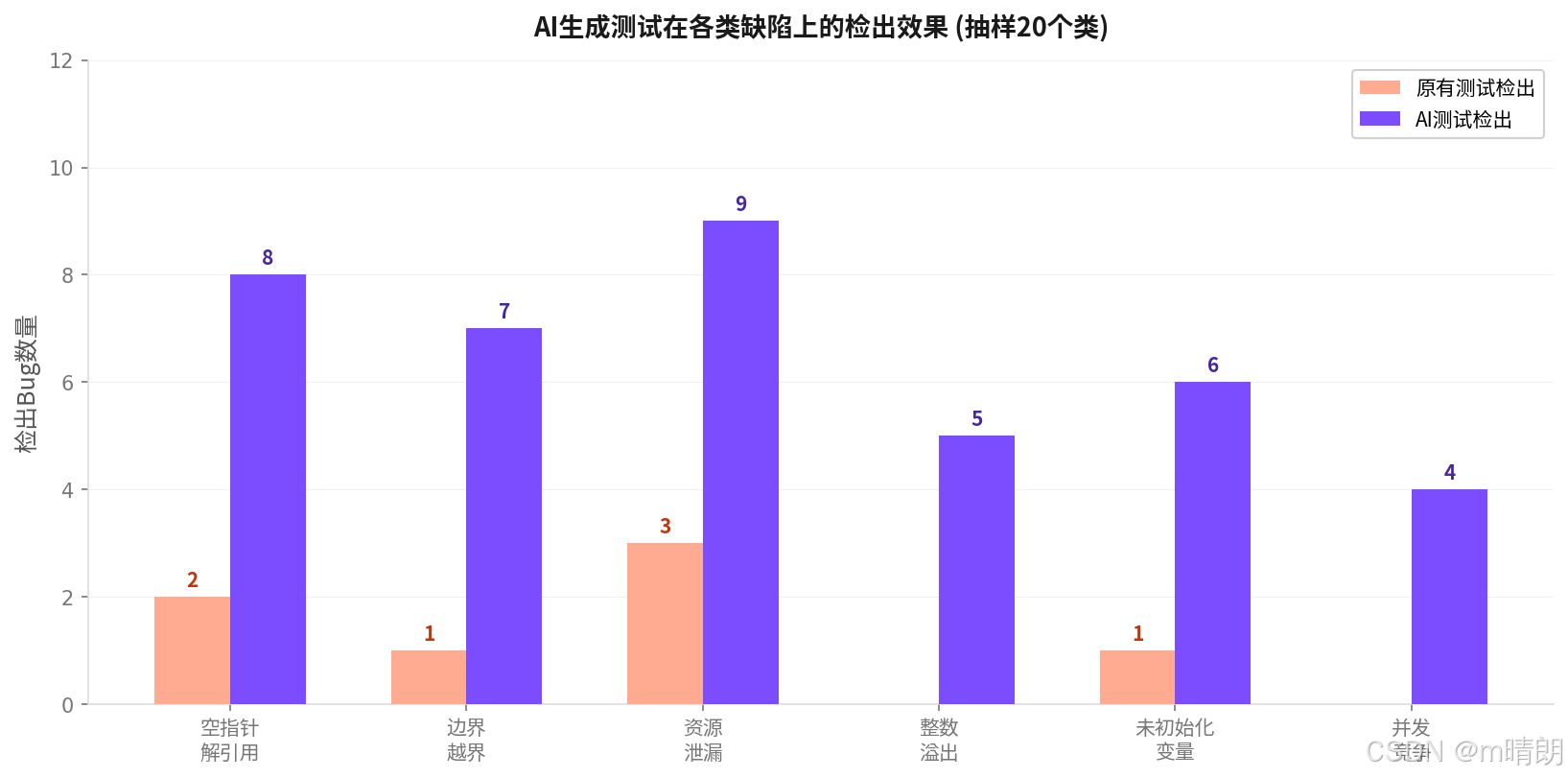
最有价值的是两类检出:
空指针解引用 ------AI会系统性地对每个指针参数生成nullptr输入的测试。人写测试时经常"想当然"觉得调用者不会传空指针,但实际上线上崩溃有30%以上都是空指针。
资源泄漏------AI生成的测试会覆盖"构造成功但某个方法调用失败"的路径,这种半初始化状态是最容易泄漏资源的场景。人写测试时基本不会去测"用到一半出错了怎么办"。
这套方案的局限
最后说说哪些地方还做不好,避免给人一种"银弹"的错觉。
依赖复杂的类很难测。 如果一个类的构造需要注入三四个依赖,还需要初始化数据库连接、启动线程池之类的环境,AI生成的测试大概率编译不过。这类情况你需要手动写Mock,或者先重构代码降低耦合度,再让AI生成测试。
业务逻辑的正确性验证靠不住。 AI能测"这个函数不崩溃""返回值不为空",但测不了"这个计算结果在业务上是对的"。涉及业务规则的断言,还是得人来写。
模板密集型代码跳过。 和前两篇文章的结论一致,涉及大量模板技巧的代码,AI的生成质量不可控,不如不生成。
完整方案的投入产出
最后算一笔账。整个流水线我花了两个周末加上几个工作日的晚上,大约40小时写完。核心代码量大约1200行C++。
每月API调用成本约150元(我们的代码库规模)。维护成本很低,上线后基本不需要改。
回报是:测试覆盖率从35%提升到80%,八周内AI辅助发现了39个之前没有测试覆盖的Bug,其中8个被评估为线上高风险。
这笔账怎么算都值。如果你的团队也有类似的测试债务问题,我建议不要犹豫,直接动手做。最贵的成本不是API调用费,而是"再等等"。
本文为个人项目实践分享,代码经过简化处理。正则解析方案适用于中小型项目,大型项目建议使用libclang做精确的AST解析。