#include <chrono>

auto start = std::chrono::high_resolution_clock::now();
// 执行操作
auto end = std::chrono::high_resolution_clock::now();
auto duration = std::chrono::duration_cast<std::chrono::nanoseconds>(end - start);
8. 代码实现比较
cpp复制代码
#include <iostream>
#include <vector>
#include <string>
#include <algorithm>
#include <cstring>
#include <chrono>
#include <cmath>
#include <string_view>
#include <utility>
#include <random>

class Timer {
private:
    std::chrono::high_resolution_clock::time_point start_time;
    std::string name;
    int iterations;

public:
    Timer(const std::string& test_name, int iters)
        : name(test_name), iterations(iters) {
        start_time = std::chrono::high_resolution_clock::now();
    }

    ~Timer() {
        auto end_time = std::chrono::high_resolution_clock::now();
        auto duration = std::chrono::duration_cast<std::chrono::nanoseconds>(
            end_time - start_time
        ).count();

        double avg_time_ns = static_cast<double>(duration) / iterations;
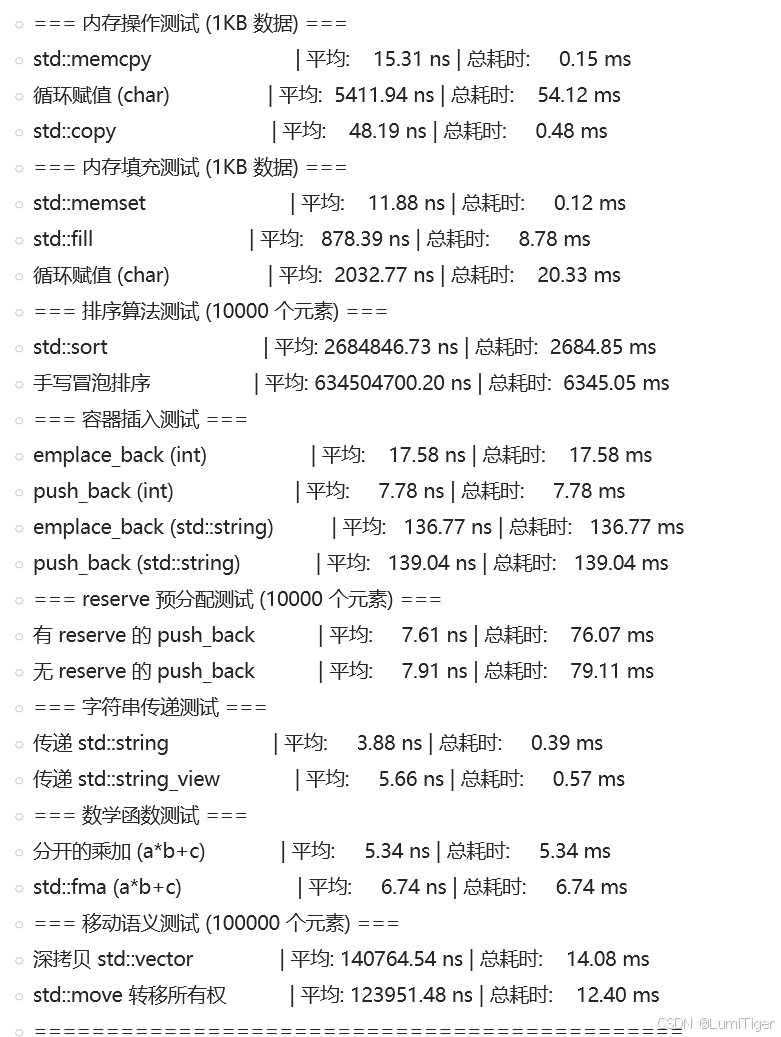
        std::printf("%-35s | 平均: %8.2f ns | 总耗时: %8.2f ms\n",
                   name.c_str(), avg_time_ns, duration / 1e6);
    }
};

template<typename T>
void do_not_optimize(T&& value) {
    asm volatile("" : : "r,m"(value) : "memory");
}

std::vector<int> generate_random_vector(int size) {
    std::vector<int> v(size);
    std::random_device rd;
    std::mt19937 gen(rd());
    std::uniform_int_distribution<> dis(1, 1000000);

    for (int& x : v) {
        x = dis(gen);
    }
    return v;
}

void test_memory_copy(int iterations, int size) {
    std::vector<char> src(size, 0x55);
    std::vector<char> dst(size);

    {
        Timer t("std::memcpy", iterations);
        for (int i = 0; i < iterations; ++i) {
            std::memcpy(dst.data(), src.data(), size);
            do_not_optimize(dst[0]);
        }
    }

    {
        Timer t("循环赋值 (char)", iterations);
        for (int i = 0; i < iterations; ++i) {
            for (int j = 0; j < size; ++j) {
                dst[j] = src[j];
            }
            do_not_optimize(dst[0]);
        }
    }

    {
        Timer t("std::copy", iterations);
        for (int i = 0; i < iterations; ++i) {
            std::copy(src.begin(), src.end(), dst.begin());
            do_not_optimize(dst[0]);
        }
    }
}

void test_memory_fill(int iterations, int size) {
    std::vector<char> buffer(size);

    {
        Timer t("std::memset", iterations);
        for (int i = 0; i < iterations; ++i) {
            std::memset(buffer.data(), 0, size);
            do_not_optimize(buffer[0]);
        }
    }

    {
        Timer t("std::fill", iterations);
        for (int i = 0; i < iterations; ++i) {
            std::fill(buffer.begin(), buffer.end(), 0);
            do_not_optimize(buffer[0]);
        }
    }

    {
        Timer t("循环赋值 (char)", iterations);
        for (int i = 0; i < iterations; ++i) {
            for (int j = 0; j < size; ++j) {
                buffer[j] = 0;
            }
            do_not_optimize(buffer[0]);
        }
    }
}

void test_sorting(int iterations, int size) {
    auto original = generate_random_vector(size);

    {
        std::vector<int> v = original;
        Timer t("std::sort", iterations);
        for (int i = 0; i < iterations; ++i) {
            std::sort(v.begin(), v.end());
            do_not_optimize(v[0]);
            std::shuffle(v.begin(), v.end(), std::mt19937(std::random_device{}()));
        }
    }

    {
        std::vector<int> v = original;
        Timer t("手写冒泡排序", iterations / 100); // 冒泡太慢,减少迭代次数
        for (int i = 0; i < iterations / 100; ++i) {
            for (int j = 0; j < size - 1; ++j) {
                for (int k = 0; k < size - j - 1; ++k) {
                    if (v[k] > v[k + 1]) {
                        std::swap(v[k], v[k + 1]);
                    }
                }
            }
            do_not_optimize(v[0]);
            std::shuffle(v.begin(), v.end(), std::mt19937(std::random_device{}()));
        }
    }
}

void test_container_insert(int iterations) {
    const int elements_per_iter = 1000;

    {
        Timer t("emplace_back (int)", iterations * elements_per_iter);
        for (int i = 0; i < iterations; ++i) {
            std::vector<int> v;
            v.reserve(elements_per_iter);
            for (int j = 0; j < elements_per_iter; ++j) {
                v.emplace_back(j);
            }
            do_not_optimize(v.size());
        }
    }

    {
        Timer t("push_back (int)", iterations * elements_per_iter);
        for (int i = 0; i < iterations; ++i) {
            std::vector<int> v;
            v.reserve(elements_per_iter);
            for (int j = 0; j < elements_per_iter; ++j) {
                v.push_back(j);
            }
            do_not_optimize(v.size());
        }
    }

    {
        Timer t("emplace_back (std::string)", iterations * elements_per_iter);
        for (int i = 0; i < iterations; ++i) {
            std::vector<std::string> v;
            v.reserve(elements_per_iter);
            for (int j = 0; j < elements_per_iter; ++j) {
                v.emplace_back("hello" + std::to_string(j));
            }
            do_not_optimize(v.size());
        }
    }

    {
        Timer t("push_back (std::string)", iterations * elements_per_iter);
        for (int i = 0; i < iterations; ++i) {
            std::vector<std::string> v;
            v.reserve(elements_per_iter);
            for (int j = 0; j < elements_per_iter; ++j) {
                v.push_back("hello" + std::to_string(j));
            }
            do_not_optimize(v.size());
        }
    }
}

void test_reserve(int iterations, int size) {
    {
        Timer t("有 reserve 的 push_back", iterations * size);
        for (int i = 0; i < iterations; ++i) {
            std::vector<int> v;
            v.reserve(size);
            for (int j = 0; j < size; ++j) {
                v.push_back(j);
            }
            do_not_optimize(v.size());
        }
    }

    {
        Timer t("无 reserve 的 push_back", iterations * size);
        for (int i = 0; i < iterations; ++i) {
            std::vector<int> v;
            for (int j = 0; j < size; ++j) {
                v.push_back(j);
            }
            do_not_optimize(v.size());
        }
    }
}

void test_string_view(int iterations) {
    std::string long_string(1000, 'a');

    auto process_string = [](const std::string& s) {
        return s.size();
    };

    auto process_string_view = [](std::string_view sv) {
        return sv.size();
    };

    {
        Timer t("传递 std::string", iterations);
        for (int i = 0; i < iterations; ++i) {
            auto result = process_string(long_string);
            do_not_optimize(result);
        }
    }

    {
        Timer t("传递 std::string_view", iterations);
        for (int i = 0; i < iterations; ++i) {
            auto result = process_string_view(long_string);
            do_not_optimize(result);
        }
    }
}

void test_math_functions(int iterations) {
    std::vector<double> a(iterations);
    std::vector<double> b(iterations);
    std::vector<double> c(iterations);

    std::random_device rd;
    std::mt19937 gen(rd());
    std::uniform_real_distribution<> dis(0.0, 1.0);

    for (int i = 0; i < iterations; ++i) {
        a[i] = dis(gen);
        b[i] = dis(gen);
        c[i] = dis(gen);
    }

    {
        Timer t("分开的乘加 (a*b+c)", iterations);
        double result = 0.0;
        for (int i = 0; i < iterations; ++i) {
            result += a[i] * b[i] + c[i];
        }
        do_not_optimize(result);
    }

    {
        Timer t("std::fma (a*b+c)", iterations);
        double result = 0.0;
        for (int i = 0; i < iterations; ++i) {
            result += std::fma(a[i], b[i], c[i]);
        }
        do_not_optimize(result);
    }
}

void test_move_semantics(int iterations, int size) {
    {
        Timer t("深拷贝 std::vector", iterations);
        for (int i = 0; i < iterations; ++i) {
            std::vector<int> src(size, 42);
            std::vector<int> dst = src; // 深拷贝
            do_not_optimize(dst.size());
        }
    }

    {
        Timer t("std::move 转移所有权", iterations);
        for (int i = 0; i < iterations; ++i) {
            std::vector<int> src(size, 42);
            std::vector<int> dst = std::move(src); // 移动,O(1)
            do_not_optimize(dst.size());
        }
    }
}

int main() {
    std::cout << "=============================================" << std::endl;
    std::cout << "C++ 标准函数性能对比测试" << std::endl;
    std::cout << "编译选项: -O3" << std::endl;
    std::cout << "=============================================" << std::endl << std::endl;

    const int ITERATIONS = 10000;
    const int SMALL_SIZE = 1024;
    const int MEDIUM_SIZE = 10000;
    const int LARGE_SIZE = 100000;

    std::cout << "=== 内存操作测试 (1KB 数据) ===" << std::endl;
    test_memory_copy(ITERATIONS, SMALL_SIZE);
    std::cout << std::endl;

    std::cout << "=== 内存填充测试 (1KB 数据) ===" << std::endl;
    test_memory_fill(ITERATIONS, SMALL_SIZE);
    std::cout << std::endl;

    std::cout << "=== 排序算法测试 (10000 个元素) ===" << std::endl;
    test_sorting(ITERATIONS / 10, MEDIUM_SIZE);
    std::cout << std::endl;

    std::cout << "=== 容器插入测试 ===" << std::endl;
    test_container_insert(ITERATIONS / 10);
    std::cout << std::endl;

    std::cout << "=== reserve 预分配测试 (10000 个元素) ===" << std::endl;
    test_reserve(ITERATIONS / 10, MEDIUM_SIZE);
    std::cout << std::endl;

    std::cout << "=== 字符串传递测试 ===" << std::endl;
    test_string_view(ITERATIONS * 10);
    std::cout << std::endl;

    std::cout << "=== 数学函数测试 ===" << std::endl;
    test_math_functions(ITERATIONS * 100);
    std::cout << std::endl;

    std::cout << "=== 移动语义测试 (100000 个元素) ===" << std::endl;
    test_move_semantics(ITERATIONS / 100, LARGE_SIZE);
    std::cout << std::endl;

    std::cout << "=============================================" << std::endl;
    std::cout << "测试完成!" << std::endl;
    std::cout << "=============================================" << std::endl;

    return 0;
}