- 🍨 本文为🔗365天深度学习训练营 中的学习记录博客
- 🍖 原作者:K同学啊
一、前期准备
python
import matplotlib.pyplot as plt
import numpy as np
import tensorflow as tf
from tensorflow.keras import layers, models, Input

# 1. 设置 GPU 环境
gpus = tf.config.list_physical_devices('GPU')
print("Found GPUs:", gpus)

# 2. 导入数据
data_dir = './J1_data'
img_height = 224
img_width = 224
batch_size = 32

train_ds = tf.keras.utils.image_dataset_from_directory(
    data_dir,
    validation_split=0.2,
    subset="training",
    seed=123,
    image_size=(img_height, img_width),
    batch_size=batch_size)

val_ds = tf.keras.utils.image_dataset_from_directory(
    data_dir,
    validation_split=0.2,
    subset="validation",
    seed=123,
    image_size=(img_height, img_width),
    batch_size=batch_size)

class_names = train_ds.class_names
print(f"识别目标类别: {class_names}")

AUTOTUNE = tf.data.AUTOTUNE
train_ds = train_ds.cache().shuffle(1000).prefetch(buffer_size=AUTOTUNE)
val_ds = val_ds.cache().prefetch(buffer_size=AUTOTUNE)
二、核心:构建 ResNet 的残差块
python
# 2.1 恒等块 (Identity Block) - 输入输出维度一致时使用
def identity_block(input_tensor, kernel_size, filters):
    filters1, filters2, filters3 = filters

    # 主路径
    x = layers.Conv2D(filters1, (1, 1))(input_tensor)
    x = layers.BatchNormalization()(x)
    x = layers.Activation('relu')(x)

    x = layers.Conv2D(filters2, kernel_size, padding='same')(x)
    x = layers.BatchNormalization()(x)
    x = layers.Activation('relu')(x)

    x = layers.Conv2D(filters3, (1, 1))(x)
    x = layers.BatchNormalization()(x)

    # 核心:抄近道(Skip Connection),将输入直接加到输出上
    x = layers.add([x, input_tensor])
    x = layers.Activation('relu')(x)
    return x

# 2.2 卷积块 (Conv Block) - 输入输出维度不一致时使用,近道上也加个卷积核调整维度
def conv_block(input_tensor, kernel_size, filters, strides=(2, 2)):
    filters1, filters2, filters3 = filters

    # 主路径
    x = layers.Conv2D(filters1, (1, 1), strides=strides)(input_tensor)
    x = layers.BatchNormalization()(x)
    x = layers.Activation('relu')(x)

    x = layers.Conv2D(filters2, kernel_size, padding='same')(x)
    x = layers.BatchNormalization()(x)
    x = layers.Activation('relu')(x)

    x = layers.Conv2D(filters3, (1, 1))(x)
    x = layers.BatchNormalization()(x)

    # 近道路径(Shortcut)
    shortcut = layers.Conv2D(filters3, (1, 1), strides=strides)(input_tensor)
    shortcut = layers.BatchNormalization()(shortcut)

    # 将两条路的结果相加
    x = layers.add([x, shortcut])
    x = layers.Activation('relu')(x)
    return x
三、拼装完整的 ResNet-50 模型
python
def ResNet50(input_shape=(224, 224, 3), classes=len(class_names)):
    img_input = Input(shape=input_shape)

    # Stage 1: 预处理层
    x = layers.Conv2D(64, (7, 7), strides=(2, 2), padding='same')(img_input)
    x = layers.BatchNormalization()(x)
    x = layers.Activation('relu')(x)
    x = layers.MaxPooling2D((3, 3), strides=(2, 2), padding='same')(x)

    # Stage 2: (1个卷积块 + 2个恒等块)
    x = conv_block(x, 3, [64, 64, 256], strides=(1, 1))
    x = identity_block(x, 3, [64, 64, 256])
    x = identity_block(x, 3, [64, 64, 256])

    # Stage 3: (1个卷积块 + 3个恒等块)
    x = conv_block(x, 3, [128, 128, 512])
    x = identity_block(x, 3, [128, 128, 512])
    x = identity_block(x, 3, [128, 128, 512])
    x = identity_block(x, 3, [128, 128, 512])

    # Stage 4: (1个卷积块 + 5个恒等块)
    x = conv_block(x, 3, [256, 256, 1024])
    x = identity_block(x, 3, [256, 256, 1024])
    x = identity_block(x, 3, [256, 256, 1024])
    x = identity_block(x, 3, [256, 256, 1024])
    x = identity_block(x, 3, [256, 256, 1024])
    x = identity_block(x, 3, [256, 256, 1024])

    # Stage 5: (1个卷积块 + 2个恒等块)
    x = conv_block(x, 3, [512, 512, 2048])
    x = identity_block(x, 3, [512, 512, 2048])
    x = identity_block(x, 3, [512, 512, 2048])

    # 分类头
    x = layers.GlobalAveragePooling2D()(x)
    x = layers.Dense(classes, activation='softmax')(x)

    model = models.Model(img_input, x, name='resnet50_complete')
    return model

model = ResNet50()

model.summary()

model.compile(optimizer='adam',
              loss=tf.keras.losses.SparseCategoricalCrossentropy(from_logits=False),
              metrics=['accuracy'])
四、动态学习率与正式训练
python
def adjust_learning_rate(epoch):
    if epoch < 10:
        return 1e-3
    elif epoch < 20:
        return 1e-4
    else:
        return 1e-5

lr_schedule = tf.keras.callbacks.LearningRateScheduler(adjust_learning_rate)

epochs = 15
print("\n开始训练完整版 ResNet-50 模型")
history = model.fit(
    train_ds,
    validation_data=val_ds,
    epochs=epochs,
    callbacks=[lr_schedule]
)
五、结果可视化与评估
python
acc = history.history['accuracy']
val_acc = history.history['val_accuracy']
loss = history.history['loss']
val_loss = history.history['val_loss']
epochs_range = range(epochs)

plt.figure(figsize=(12, 4))
plt.subplot(1, 2, 1)
plt.plot(epochs_range, acc, label='Training Accuracy')
plt.plot(epochs_range, val_acc, label='Validation Accuracy')
plt.legend(loc='lower right')
plt.title('Training and Validation Accuracy')

plt.subplot(1, 2, 2)
plt.plot(epochs_range, loss, label='Training Loss')
plt.plot(epochs_range, val_loss, label='Validation Loss')
plt.legend(loc='upper right')
plt.title('Training and Validation Loss')
plt.show()

print("\n完整版 ResNet-50 最终评估结果")
model.evaluate(val_ds, verbose=2)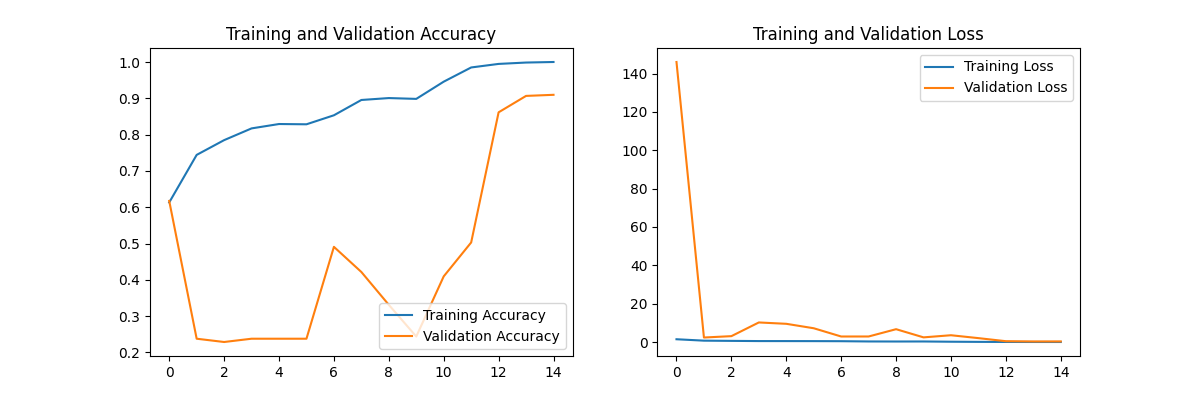
六、总结
什么是残差(Residual) ?
在深度网络中,假设某层的理想映射为 H(x),输入为 x,则残差 F(x)=H(x)−x。残差网络通过引入短接连接(Skip Connection),将网络的学习目标从学习完整的 H(x) 转变为学习残差 F(x)。
残差的本质是目标函数的重构。它将"直接拟合目标特征"转换成了"拟合输入与目标之间的差异"。这种转换使得网络在冗余层中极易实现"恒等映射"(只需让 F(x)→0),从而彻底解决了网络加深导致的梯度消失和网络退化问题,使训练上百层甚至上千层的超深网络成为可能。
举例来说,假设你现在的成绩是 90 分(这就是输入 x)。你的终极目标是考 95 分(这就是理想输出 H(x))。
那么,残差 F(x) 就是你需要额外努力补足的那 5 分(即 95−90=5)。
在传统的 CNN(比如 VGG-16)里,每一层都在试图直接学会怎么考出 95 分(直接学习完整的 H(x))。
但是在 ResNet 里,网络学会了"偷懒",它说:"既然你已经有 90 分的底子了,我就只学怎么再加 5 分就好了。"
所以,数学公式表达就是:理想输出 = 残差 + 输入
即:H(x)=F(x)+x
让一个学霸从 90 分考到 95 分,只需要让他做两道压轴题(学习差值 F(x));但如果让他把初中高中的知识从头到尾再学一遍来保证能考 95 分(学习完整映射 H(x)),他不仅会累死,还可能学串了退步到 80 分。
神经网络也是一样,学习一个微小的"变化量",远比从头学习一个复杂的"完整特征"要容易得多。
并且,假如网络已经足够深,前面几十层已经提取到了非常完美的特征(已经考了 100 分了),后面的层其实什么都不用做,保持原样传递下去就行。
在传统网络里,让经过了一堆 ReLU 激活函数和卷积的复杂网络去学习"什么都不做"(让输出等于输入),在数学上是极其困难的。
但在 ResNet 里,因为 H(x)=F(x)+x,如果网络发现特征已经很完美了,它只需要把残差 F(x) 的权重全部变成 0,那么 H(x) 就完美等于 x。对于神经网络来说,把一堆权重变成 0,非常简单。
模块化搭建思想:我们不再像以前那样把所有层"一锅乱炖",而是学会了将网络封装成标准的积木模块:输入输出维度一致的 identity_block(恒等块),以及需要调整维度的 conv_block(卷积块)。利用这些基础积木,我们堆叠出了深达 50 层的 ResNet-50 完整架构,真正掌握了工业界复杂大模型的构建范式。
动态学习率 (Learning Rate Schedule):面对千万级参数量的庞大网络,固定学习率根本行不通。所以我们编写adjust_learning_rate函数,让学习率随着 Epoch 的增加自动阶梯式减小。
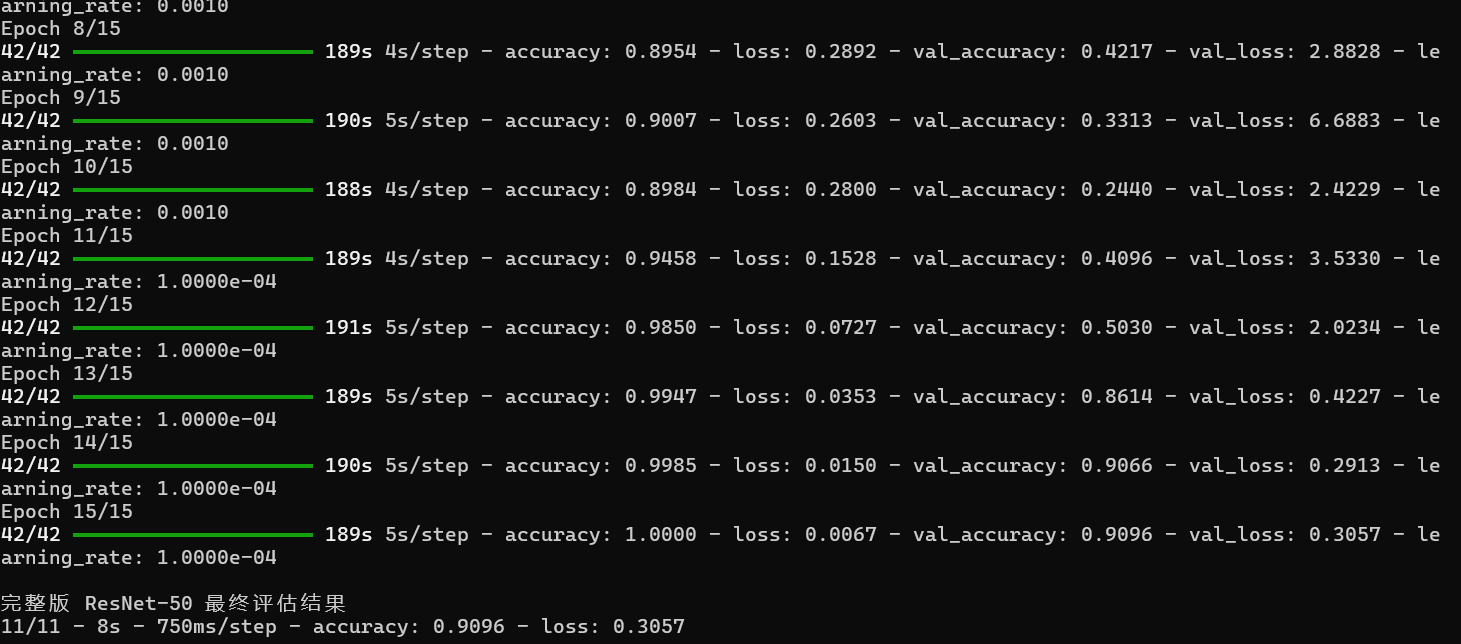
正是这种"前期大步探索,后期小步微调"的动态策略,拯救了我们在前 10 轮中 Loss 爆炸、准确率震荡的模型,最终奇迹般地拉升到了 90% 以上的高准确率。
实验结果 :观察前 10 个 Epoch 的曲线图,出现了一个极其吓人的现象:训练集极好,验证集极差,蓝线(训练准确率)一直在稳步攀升,但橙线(验证准确率)却在 0.2 到 0.4 之间剧烈震荡,甚至一度暴跌。Loss 值从最开始的 Validation Loss 居然飙到了 140 多。
但在 Epoch 11 的时候,代码里的 lr_schedule 触发了,学习率从 0.001 骤降到了 0.0001。就在学习率下降的下一轮(Epoch 12),验证集准确率(橙线)瞬间从 0.4 狂飙到了 0.86。随后稳步上升,最终定格在极佳的 0.9096。
所以以后训练大模型,最好不要用固定学习率。前期用大学习率(0.001)让模型在巨大的参数空间里快速狂奔、寻找大致方向(即使震荡也没关系);中后期必须调小学习率,让模型在最优解附近小心翼翼地"稳稳降落"。如果没有那一波学习率衰减,这个模型就彻底废了。
并且,"迁移学习"才是终极解法。手搭并从零训练 ResNet-50 耗时太长且极不稳定。遇到实际项目,直接加载在 ImageNet 上预训练好的权重(Transfer Learning),站在巨人的肩膀上微调,既省算力又稳定。