【离散化算法】
注:只是新手的笔记,慎看!!!欢迎大佬指错
问题引入:
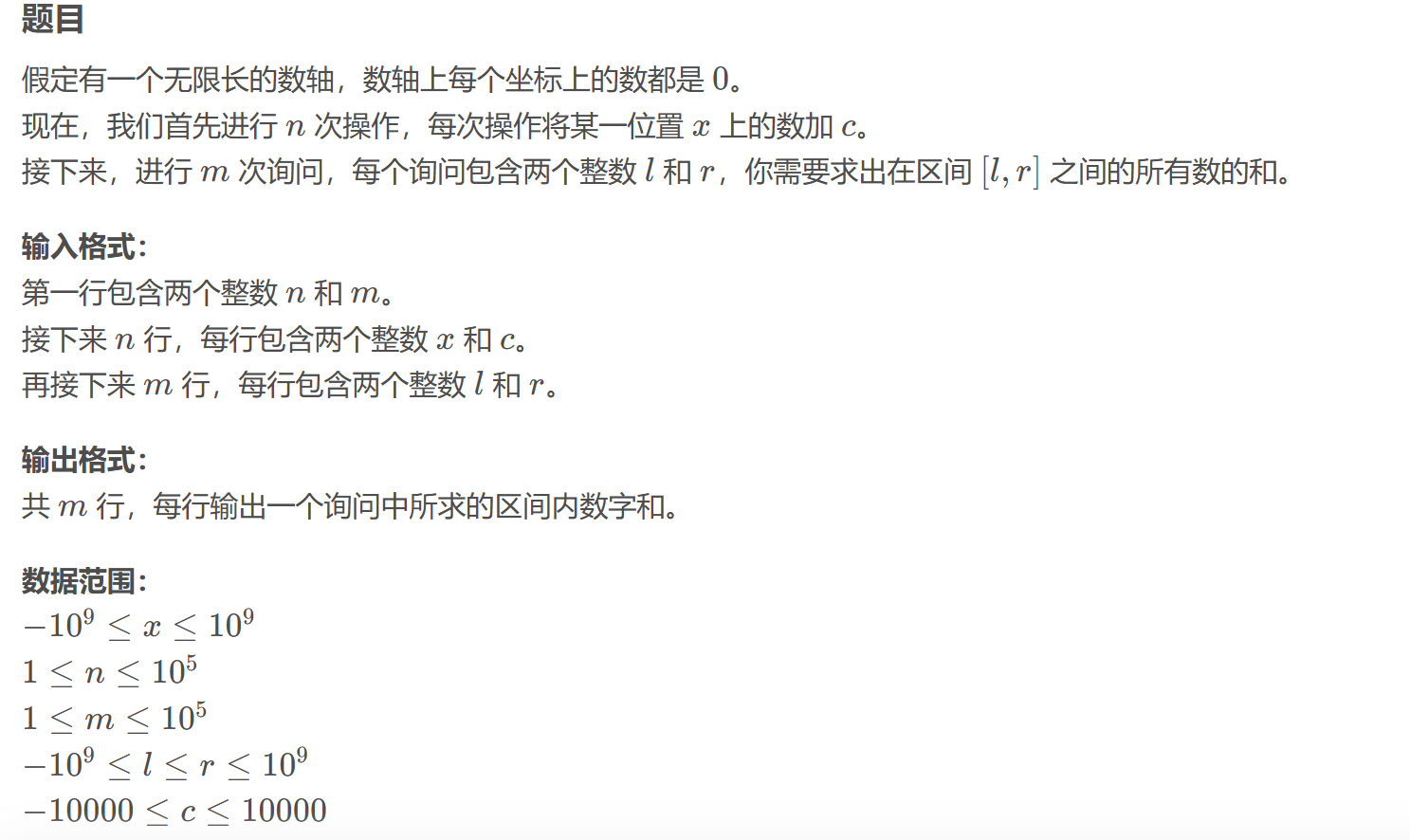
感觉?...感觉可以模拟n次操作,再取前缀和啊
但是 l 和 r 可以取到1e9,显然不行
这时便可以使用离散化!
可以观察到虽然 l r 可以取到1e9,但是n只有1e5,所以显然只有一部分的点可以被操作到,我们就可以只关注那些被操作的,用一个数组记录下来
比如输入x1=1 c1=2,x2=3 c2=2,x3=3 c3=4, x4=7 c4=5
我们发现只有1,3,7被操作了,所以我们先存1,3,3,7 然后去重就能得到被操作的数
这样我们就可以将时间复杂度降到 n 了
代码:(推荐好文中有详解)
cpp
#include <bits/stdc++.h>
#define int long long
#define all(x) begin(x),end(x)
using namespace std;

void solve()
{
	int n,m;
	cin>>n>>m;
	vector <pair<int,int>> pr,rl;
	vector <int> pos,s(300005),a(300005);//x,l,r都要存,所以开3e5

	for(int i=1;i<=n;i++)
	{
		int x,c;
		cin>>x>>c;
		pr.push_back({x,c});
		pos.push_back(x);
	}
	for(int i=1;i<=m;i++)
	{
		int l,r;
		cin>>l>>r;
		rl.push_back({l,r});
		pos.push_back(l);
		pos.push_back(r);
	}

	sort(all(pos));
	pos.erase(unique(all(pos)),pos.end());//排序去重

	for(auto x:pr )
	{
		int t=x.first;
		auto it=lower_bound(pos.begin(),pos.end(),t)-pos.begin();//二分找到该数下标
		a[it]+=x.second;
	}

	s[0]=a[0];
	for(int i=1;i<=pos.size();i++)//前缀和
	{
		s[i]=s[i-1]+a[i];
	}

	for(auto x:rl )
	{
		int l=x.first;
		int r=x.second;

		auto it=lower_bound(all(pos),l)-pos.begin();
		auto ip=lower_bound(all(pos),r)-pos.begin();

		if(it==0)
		{
			cout<<s[ip]<<endl;
		}else cout<<s[ip]-s[it-1]<<endl;

	}

}
【离散化 + 差分】
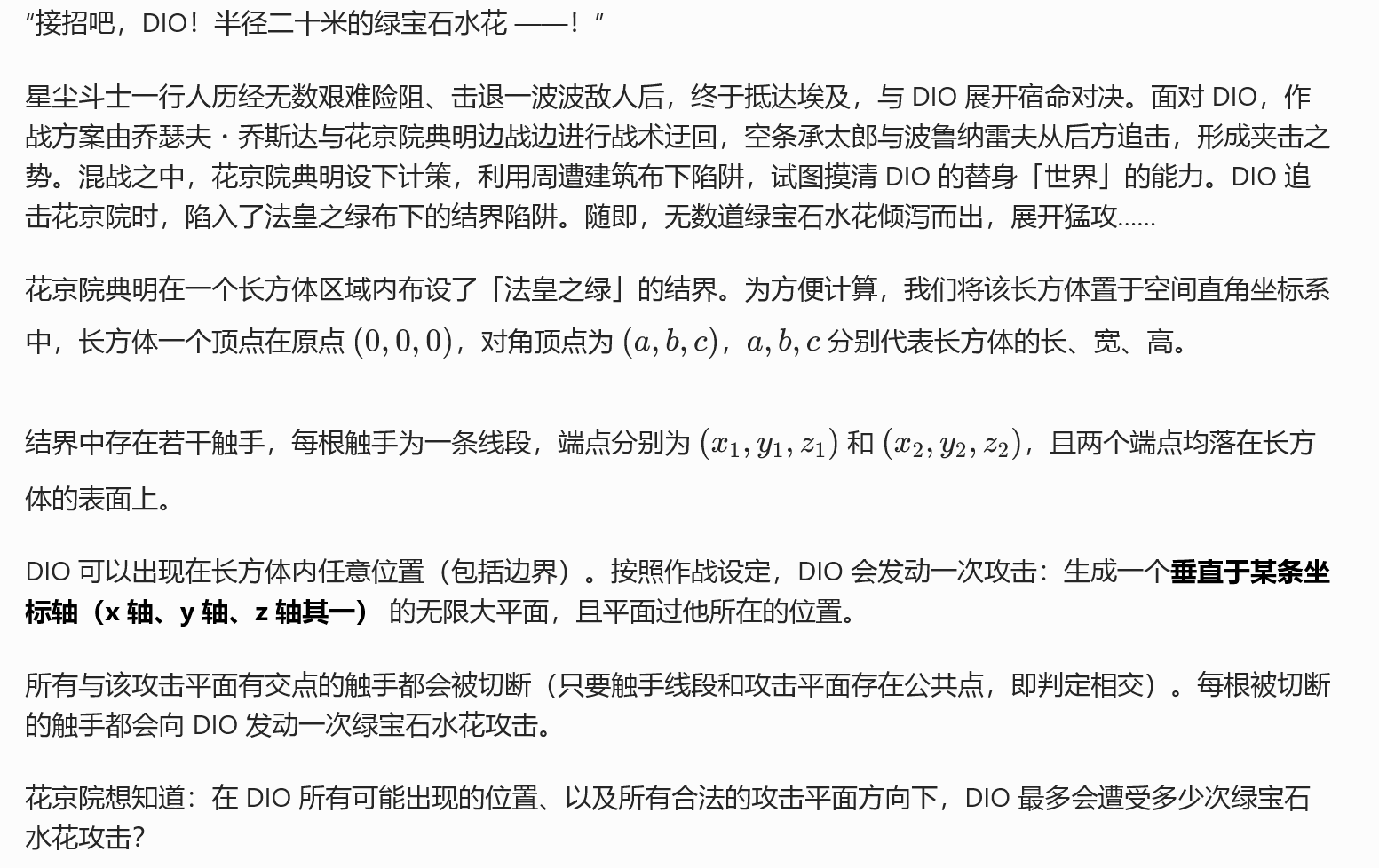
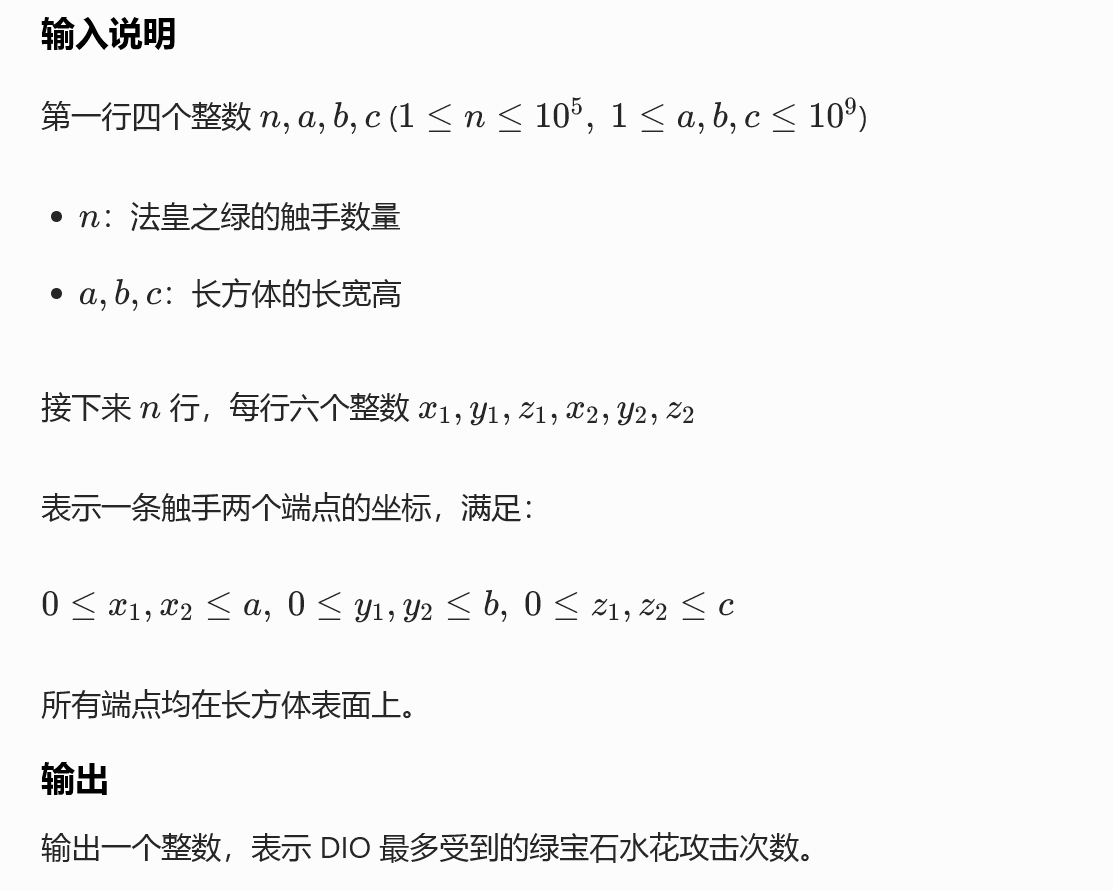
简述:给定三维空间中 n 条线段,所有线段端点都在给定长方体表面上。求:存在一个垂直于某条坐标轴的平面,最多能与多少条线段相交。线段与平面相交的定义:线段与平面存在至少一个公共点。
我们分析单一维度x轴
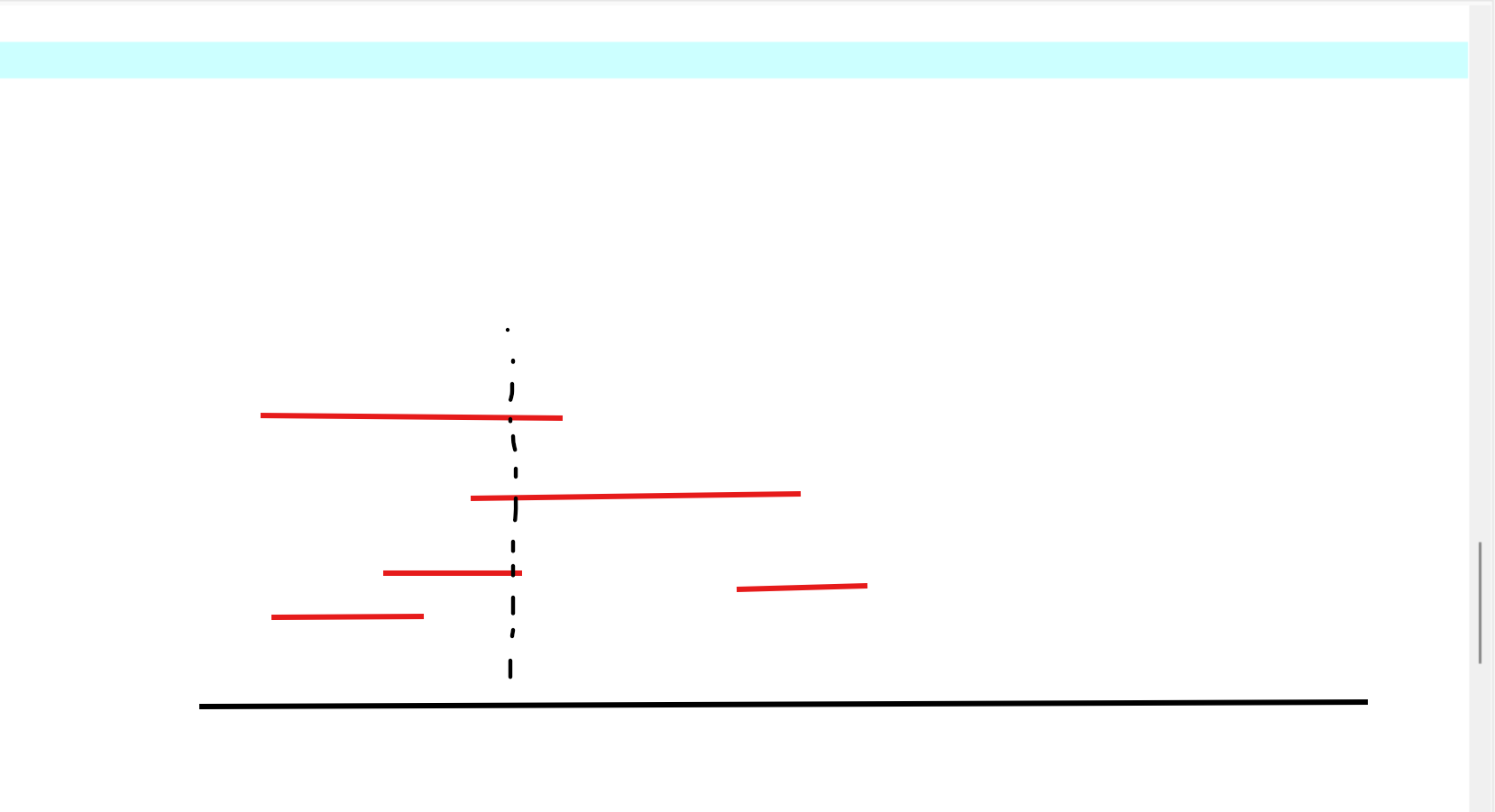
就是说重叠线段最多的是多少,这里明显是3
这里第一思路是差分,但是可以到1e9,不行,所以要离散化
我们对要操作的点记录下来,再进行差分
思路和上题差不多,但是要掌握差分
代码:可以用函数,但是我当时没注意
cpp
#include <bits/stdc++.h>
#define int long long
#define all(x) begin(x),end(x)
using namespace std;

int n,a,b,c;
vector <pair<int,int>> xy1,xy2,xy3;
vector <int> h(200005),pos,s(200005);


void solve()
{
    cin>>n>>a>>b>>c;
	for(int i=0;i<n;i++)
	{
		int x1,y1,z1,x2,y2,z2;
		cin>>x1>>y1>>z1>>x2>>y2>>z2;
		xy1.push_back({x1,x2});
		xy2.push_back({y1,y2});
		xy3.push_back({z1,z2});
	}
	//xy1
	for(auto p:xy1 )
	{
		int x=p.first;
		int y=p.second;
		pos.push_back(x);
		pos.push_back(y);
	}

	sort(all(pos));
	pos.erase(unique(all(pos)),pos.end());

	for(auto p:xy1 )
	{
		int x=p.first;
		int y=p.second;

		if(x>y) swap(x,y);

		int it=lower_bound(all(pos),x)-pos.begin();
		int ip=lower_bound(all(pos),y)-pos.begin();

		h[it]++;
		h[ip+1]--;

	}

	s[0]=h[0];
	for(int i=1;i<pos.size()+100;i++)
	{
		s[i]=s[i-1]+h[i];
	}

	int cns_1=-1;

	for(auto x:s )
	{
		cns_1=max(cns_1,x);
	}

	fill(all(s),0);
	pos.clear();
	fill(all(h),0);

	//xy2

	for(auto p:xy2 )
	{
		int x=p.first;
		int y=p.second;

		pos.push_back(x);
		pos.push_back(y);
	}

	sort(all(pos));
	pos.erase(unique(all(pos)),pos.end());

	for(auto p:xy2 )
	{
		int x=p.first;
		int y=p.second;

		if(x>y) swap(x,y);

		int it=lower_bound(all(pos),x)-pos.begin();
		int ip=lower_bound(all(pos),y)-pos.begin();

		h[it]++;
		h[ip+1]--;

	}

	s[0]=h[0];
	for(int i=1;i<pos.size()+100;i++)
	{
		s[i]=s[i-1]+h[i];
	}

	int cns_2=-1;

	for(auto x:s )
	{
		cns_2=max(cns_2,x);
	}

	fill(all(s),0);
	pos.clear();
	fill(all(h),0);

	//xy3

	for(auto p:xy3 )
	{
		int x=p.first;
		int y=p.second;

		pos.push_back(x);
		pos.push_back(y);
	}

	sort(all(pos));
	pos.erase(unique(all(pos)),pos.end());

	for(auto p:xy3 )
	{
		int x=p.first;
		int y=p.second;

		if(x>y) swap(x,y);

		int it=lower_bound(all(pos),x)-pos.begin();
		int ip=lower_bound(all(pos),y)-pos.begin();

		h[it]++;
		h[ip+1]--;

	}

	s[0]=h[0];
	for(int i=1;i<pos.size()+100;i++)
	{
		s[i]=s[i-1]+h[i];
	}

	int cns_3=-1;

	for(auto x:s )
	{
		cns_3=max(cns_3,x);
	}

	cout<<max({cns_1,cns_2,cns_3});

}

signed main()
{
	int t=1;
	//cin>>t;
	while(t--)
	{
		solve();
	}
	return 0;
}