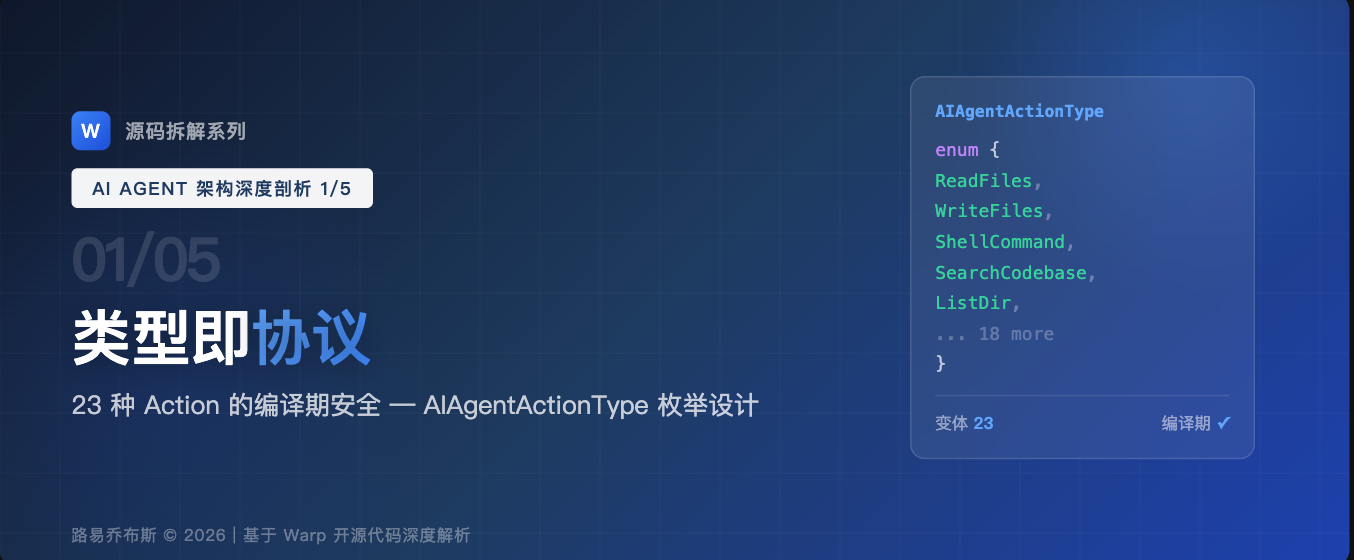
这是「拆解 Warp AI Agent」系列的第一篇。全系列 5 篇,从 Warp 源码提炼 7 个可复用的 AI Agent 架构模式。本文聚焦最底层的设计决策:为什么用 Rust 类型系统来定义 Agent 的工具协议,而不是 JSON Schema?
一、问题:AI Agent 的工具调用,出错率有多高?
构建 AI Agent 时,工具调用(Tool Call)是最容易出错的一环:
- LLM 返回了不存在的工具名 --- 调用端没有对应处理器
- 参数类型错误 --- 传了字符串但期望整数
- 结果类型不匹配 --- 工具返回了 A 类型但 Agent 期望 B 类型
- 取消状态遗漏 --- 用户取消后某个工具忘了处理 cancelled 状态
这些问题在 Python/TypeScript 等动态类型语言中,只能在运行时通过 try-catch 兜底。Warp 的选择不同------让编译器替你检查。
二、六层架构全景
先看全貌,再聚焦第一层:
┌──────────────────────────────────────────────────────────────┐
│ Layer 6: Agent SDK / Harness    (Oz, Claude, Gemini CLI)     │
├──────────────────────────────────────────────────────────────┤
│ Layer 5: Ambient Agents         (后台任务, 自动执行)          │
├──────────────────────────────────────────────────────────────┤
│ Layer 4: Conversation / Task    (对话状态机, Todo, CodeReview)│
├──────────────────────────────────────────────────────────────┤
│ Layer 3: Action Model           (风险分级, 队列调度)          │
├──────────────────────────────────────────────────────────────┤
│ Layer 2: MCP Protocol           (Transport, Provider, 重连)   │
├──────────────────────────────────────────────────────────────┤
│ Layer 1: Core Primitives  ◄─── 本篇焦点                      │
│   AIAgentActionType (23种) + AIAgentActionResultType          │
│   DiffValidation + Citation + ContentHash                     │
└──────────────────────────────────────────────────────────────┘
第一层是整个 Agent 系统的地基。如果 Action 定义有漏洞,上面五层都建在沙滩上。
三、AIAgentActionType:23 种 Action,编译期穷举
3.1 完整枚举
rust
// crates/ai/src/agent/action/mod.rs (827行)
#[derive(Debug, Clone, Eq, PartialEq, EnumDiscriminants)]
pub enum AIAgentActionType {
    // Shell 操作
    RequestCommandOutput {
        command: String,
        is_read_only: Option<bool>,    // LLM 判断是否只读
        is_risky: Option<bool>,        // LLM 判断是否有风险
        wait_until_completion: bool,
        uses_pager: Option<bool>,
        rationale: Option<String>,     // AI 的执行理由
        citations: Vec<AIAgentCitation>,
    },
    WriteToLongRunningShellCommand {
        block_id: BlockId,
        input: bytes::Bytes,
        mode: AIAgentPtyWriteMode,     // Raw / Line / Block
    },

    // 文件操作
    ReadFiles(ReadFilesRequest),
    UploadArtifact(UploadArtifactRequest),
    RequestFileEdits { file_edits: Vec<FileEdit>, title: Option<String> },

    // 搜索操作
    SearchCodebase(SearchCodebaseRequest),
    Grep { queries: Vec<String>, path: String },
    FileGlob { patterns: Vec<String>, path: Option<String> },
    FileGlobV2 { patterns: Vec<String>, search_dir: Option<String> },

    // MCP 操作
    ReadMCPResource { server_id: Option<Uuid>, name: String, uri: Option<String> },
    CallMCPTool { server_id: Option<Uuid>, name: String, input: serde_json::Value },

    // 文档操作
    ReadDocuments(ReadDocumentsRequest),
    EditDocuments(EditDocumentsRequest),
    CreateDocuments(CreateDocumentsRequest),

    // 交互操作
    AskUserQuestion { questions: Vec<AskUserQuestionItem> },

    // 协作操作
    StartAgent {
        version: StartAgentVersion,
        name: String,
        prompt: String,
        execution_mode: StartAgentExecutionMode,
        lifecycle_subscription: Option<Vec<LifecycleEventType>>,
    },
    SendMessageToAgent { addresses: Vec<String>, subject: String, message: String },

    // 其他
    SuggestNewConversation { message_id: String },
    SuggestPrompt(SuggestPromptRequest),
    InitProject,
    OpenCodeReview,
    ReadShellCommandOutput { block_id: BlockId, delay: Option<ShellCommandDelay> },
    UseComputer(UseComputerRequest),
    InsertCodeReviewComments { repo_path: PathBuf, comments: Vec<InsertReviewComment>, base_branch: Option<String> },
    RequestComputerUse(RequestComputerUseRequest),
    ReadSkill(ReadSkillRequest),
    FetchConversation { conversation_id: String },
    TransferShellCommandControlToUser { reason: String },
}关键设计:
is_read_only和is_risky由 LLM 自己标注------让 AI 自己评估风险等级,而不是由宿主事后判断rationale字段要求 LLM 给出执行理由,用于 UI 展示和审计citations追踪每条 Action 的来源,确保可追溯
3.2 为什么不用 JSON Schema?
Claude Code 和大部分 Agent 框架用 JSON Schema 定义工具:
json
{
  "name": "read_file",
  "parameters": {
    "type": "object",
    "properties": {
      "path": { "type": "string" }
    }
  }
}
这种方式的问题:
| 问题 | JSON Schema | Rust Enum |
|---|---|---|
| 新增工具忘记加处理器 | 运行时报错 | 编译报错 |
| 参数类型不匹配 | 运行时解析 | 编译期检查 |
| 取消状态遗漏 | 容易漏处理 | match 穷举强制覆盖 |
| 重构时遗漏调用点 | 需要全局搜索 | 编译器自动定位 |
四、cancelled_result():穷举的力量
Warp 为每种 Action 类型定义了 cancelled_result() 方法:
rust
impl AIAgentActionType {
    pub fn cancelled_result(&self) -> AIAgentActionResultType {
        match self {
            Self::RequestCommandOutput { .. } =>
                AIAgentActionResultType::RequestCommandOutput(
                    RequestCommandOutputResult::CancelledBeforeExecution,
                ),
            Self::CallMCPTool { .. } =>
                AIAgentActionResultType::CallMCPTool(CallMCPToolResult::Cancelled),
            Self::ReadFiles(..) =>
                AIAgentActionResultType::ReadFiles(ReadFilesResult::Cancelled),
            Self::UseComputer(..) =>
                AIAgentActionResultType::UseComputer(UseComputerResult::Cancelled),
            // ... 23 种变体,每种都有对应的 Cancelled 结果
            // 新增 Action 时,如果忘记加这一行,编译器会报错!
        }
    }
}
这是整个设计最精妙的部分 :Rust 的 match 要求穷举所有变体。新增一种 Action 类型时,如果你忘记在 cancelled_result() 中添加对应分支,编译直接失败。
对比 Python 的实现:
python
# Python: 忘记处理新 Action 的 cancelled 状态?
# 没有任何提示,直到运行时才发现
def cancelled_result(self):
    if self.type == "RequestCommandOutput":
        return RequestCommandOutputResult(cancelled=True)
    elif self.type == "ReadFiles":
        return ReadFilesResult(cancelled=True)
    # 忘了 CallMCPTool?没关系,走 else 分支返回 None...
    # 然后在某个不相关的角落崩了
五、三态结果模型:Success / Error / Cancelled
每个 Action 的结果都有三个状态:
rust
// crates/ai/src/agent/action_result/mod.rs
pub enum AIAgentActionResultType {
    RequestCommandOutput(RequestCommandOutputResult),
    ReadFiles(ReadFilesResult),
    CallMCPTool(CallMCPToolResult),
    // ...
}

// 每种 Result 内部都有三态:
pub enum RequestCommandOutputResult {
    Success { output: String, exit_code: i32, ... },
    Error { message: String, ... },
    CancelledBeforeExecution,
}
rust
impl AIAgentActionResultType {
    pub fn is_successful(&self) -> bool { ... }
    pub fn is_failed(&self) -> bool { ... }
    pub fn is_cancelled(&self) -> bool { ... }
}
为什么 Cancelled 是一等公民? 因为在 Agent 场景中,取消不是异常------是常态。用户随时可能取消一个正在执行的命令、拒绝一个文件编辑、中止一个 MCP 调用。如果把 Cancelled 当作 Error 的子集,会导致:
- 取消统计和错误统计混淆
- 取消后的恢复逻辑和错误恢复逻辑耦合
- 无法区分"我主动停了"和"出了问题"
六、StartAgentExecutionMode:本地与远程的统一抽象
rust
pub enum StartAgentExecutionMode {
    Local {
        /// None = Warp 内置 Agent
        /// Some("claude") = 委托给 Claude CLI
        /// Some("gemini") = 委托给 Gemini CLI
        harness_type: Option<String>,
    },
    Remote {
        environment_id: String,
        skill_references: Vec<SkillReference>,
        model_id: String,
        computer_use_enabled: bool,
        worker_host: String,
        harness_type: String,
        title: String,
    },
}
注意 Local { harness_type: Option<String> } 这个设计------同一个 enum 统一了"用 Warp 自己的 Agent"和"委托给 Claude/Gemini CLI"两种执行路径。这让上层代码不需要关心 Agent 跑在本地还是远程、用的是自己的引擎还是第三方 CLI。
七、与业界方案对比
| 维度 | Warp (Rust Enum) | Claude Code (JSON Schema) | Hermes Agent (TypeScript) | OpenAI Function Call |
|---|---|---|---|---|
| 工具定义 | 编译期枚举 | JSON Schema | 运行时注册 | JSON Schema |
| 类型安全 | 编译期保证 | 运行时校验 | 运行时校验 | 运行时校验 |
| 取消处理 | 穷举覆盖 | 按需处理 | 按需处理 | 无内置支持 |
| 新增工具遗忘 | 编译报错 | 运行时 404 | 运行时 404 | 运行时 404 |
| 风险自评 | is_read_only/is_risky | 无内置 | 无内置 | 无内置 |
| 执行理由 | rationale 字段 | 无内置 | 无内置 | 无内置 |
Warp 的核心优势:把 Agent 工具协议的安全检查从运行时左移到了编译期。在 Rust 项目中,这意味着:
如果代码能编译通过,那么工具调用的类型安全就已经保证了。
八、可复用模式:Type-Driven Tool Protocol
提炼为通用模式:
┌─────────────────────────────────────────┐
│         Type-Driven Tool Protocol        │
├─────────────────────────────────────────┤
│ 1. 用代数数据类型(ADT)定义所有工具       │
│    - 每个 variant = 一种工具             │
│    - 每个 variant 的字段 = 工具参数       │
│                                          │
│ 2. 用 ADT 定义所有结果                   │
│    - 三态: Success / Error / Cancelled   │
│    - cancelled_result() 穷举覆盖         │
│                                          │
│ 3. 用 match 穷举保证覆盖率              │
│    - 新增工具 → 编译器强制补全所有分支   │
│    - 消除"忘记处理"类 bug                │
│                                          │
│ 4. LLM 自评风险等级                      │
│    - is_read_only + is_risky 字段        │
│    - 让 AI 自己标注,不依赖人工判断       │
└─────────────────────────────────────────┘
在非 Rust 语言中的变体:
- TypeScript : 用 discriminated union + exhaustive switch(
never类型兜底) - Python : 用
@dataclass+match(Python 3.10+) + exhaustive check 函数 - Go: 用 interface + type switch(无编译期穷举保证,需要代码生成辅助)
九、总结
| 模式 | 实现 | 核心价值 |
|---|---|---|
| Type-Driven Tool Protocol | AIAgentActionType 23 变体枚举 |
编译期保证工具类型安全 |
| Exhaustive Cancellation | cancelled_result() match 穷举 |
新增 Action 不会遗漏取消处理 |
| Three-State Result | Success/Error/Cancelled 三态 | 取消是一等公民,不与错误混淆 |
| LLM Self-Rating | is_read_only + is_risky + rationale |
AI 自己评估风险,无需人工标注 |
一句话总结 :Warp 用 Rust 的类型系统把"工具协议"从运行时约定变成了编译期约束------能编译就能跑,跑起来就不会在工具类型上出错。
系列导航:
- (一)类型即协议 ← 你在这里
- (二)风险分级执行
- (三)对话状态机
- (四)Merkle Tree 增量索引
- (五)跨生态联邦