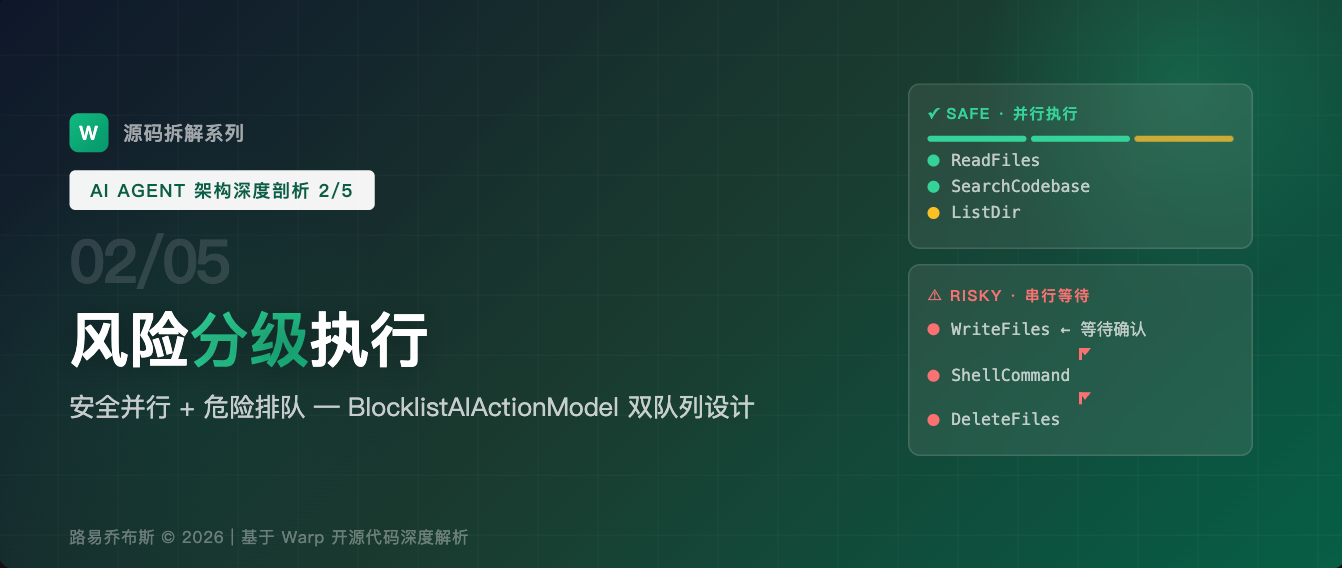
系列第二篇。上篇讲了 Action 的类型安全设计,本篇看这些 Action 怎么被调度执行 ------Warp 的
BlocklistAIActionModel实现了一个精巧的风险分级执行引擎:只读操作并行跑,危险操作串行排队等用户确认。
一、问题:AI 一次返回多个 Action,怎么调度?
LLM 的一个回复可能包含多个工具调用:
用户:帮我在 src/ 下找到所有 TODO 注释并修复

AI 回复:
  1. Grep("TODO", path="src/")          ← 只读搜索
  2. ReadFiles("src/main.rs")           ← 只读读取
  3. RequestFileEdits([替换 TODO])      ← 写入编辑
  4. RequestCommandOutput("cargo test") ← 执行命令
4 个 Action,风险等级完全不同。如何调度?
- 粗暴方案:全部串行执行 → 慢,只读操作被写操作阻塞
- 粗暴方案:全部并行执行 → 危险!用户还没确认编辑,测试就已经跑起来了
- Warp 方案 :风险分级 + 阶段调度
二、BlocklistAIActionModel:四队列架构
rust
// app/src/ai/blocklist/action_model.rs
pub struct BlocklistAIActionModel {
    executor: ModelHandle<BlocklistAIActionExecutor>,

    /// 等待预处理的 Action(解析、校验)
    pending_preprocessed_actions: HashMap<AIConversationId, PendingPreprocessedActions>,

    /// 等待执行的 Action 队列(FIFO)
    pending_actions: HashMap<AIConversationId, VecDeque<AIAgentAction>>,

    /// 正在执行的 Action(按阶段分组)
    running_actions: HashMap<AIConversationId, RunningActions>,

    /// 已完成的 Action 结果
    finished_action_results: HashMap<AIConversationId, Vec<Arc<AIAgentActionResult>>>,

    /// 保持 Action 原始顺序(并行执行后结果需重新排序)
    action_order: HashMap<AIConversationId, HashMap<AIAgentActionId, usize>>,

    /// 历史结果(跨 Exchange 累积)
    past_action_results: HashMap<AIAgentActionId, Arc<AIAgentActionResult>>,
}
数据流:
LLM 返回 Actions
    │
    ▼
pending_preprocessed_actions  ← 预处理(解析参数、校验)
    │
    ▼
pending_actions               ← 排队等待
    │
    ├─ 并行阶段 ──▶ running_actions (Parallel)
    │                   │
    │                   ▼ (所有并行 Action 完成后)
    │               sort_finished_results ← 按原始顺序重排结果
    │
    └─ 串行阶段 ──▶ running_actions (Serial)
                        │
                        ▼ (一个一个执行,等用户确认)
                    finished_action_results
三、RunningActionPhase:并行 vs 串行的判定
rust
// app/src/ai/blocklist/action_model/execute.rs
pub(super) enum RunningActionPhase {
    /// 屏障操作,必须独占执行
    Serial,
    /// 同一兼容组内的操作可以并行
    Parallel(ParallelExecutionPolicy),
}

pub(super) enum ParallelExecutionPolicy {
    /// 只读、仅查本地上下文的操作,可以安全并行
    ReadOnlyLocalContext,
}
3.1 哪些操作可以并行?
rust
impl BlocklistAIActionExecutor {
    pub fn action_phase(&self, action: &AIAgentAction, ctx: &AppContext) -> RunningActionPhase {
        match &action.action {
            // ✅ 并行:只读 + 本地上下文
            AIAgentActionType::ReadFiles(..)
            | AIAgentActionType::SearchCodebase(..)
            | AIAgentActionType::ReadSkill(_) =>
                RunningActionPhase::Parallel(ParallelExecutionPolicy::ReadOnlyLocalContext),

            // ✅ 条件并行:Grep/FileGlob 需要运行时判断
            AIAgentActionType::Grep { .. }
                if self.grep_executor.as_ref(ctx).can_execute_in_parallel(ctx) =>
                RunningActionPhase::Parallel(ParallelExecutionPolicy::ReadOnlyLocalContext),

            AIAgentActionType::FileGlob { .. } | AIAgentActionType::FileGlobV2 { .. }
                if self.file_glob_executor.as_ref(ctx).can_execute_in_parallel(ctx) =>
                RunningActionPhase::Parallel(ParallelExecutionPolicy::ReadOnlyLocalContext),

            // ❌ 串行:所有写操作、命令执行、MCP 调用
            _ => RunningActionPhase::Serial,
        }
    }
}规则很清晰:只有纯只读 + 纯本地的操作才能并行。任何涉及写入、命令执行、远程调用的操作都是串行。
3.2 阶段切换规则
rust
fn can_start_action_with_current_phase(
    current_phase: RunningActionPhase,
    next_phase: RunningActionPhase,
    can_autoexecute: bool,
) -> bool {
    match current_phase {
        // 串行阶段:屏障,不允许新 Action 加入
        RunningActionPhase::Serial => false,
        // 并行阶段:只有同组 + 可自动执行才允许加入
        RunningActionPhase::Parallel(group) => {
            next_phase == RunningActionPhase::Parallel(group) && can_autoexecute
        }
    }
}
执行循环的核心逻辑:
rust
fn try_to_execute_available_actions(&mut self, conversation_id: AIConversationId, ctx: ...) {
    loop {
        let front_action = self.pending_actions.get(&conversation_id).and_then(|q| q.front());

        // 如果当前有正在执行的阶段,检查新 Action 能否加入
        if let Some(current_phase) = self.action_execution_phase(conversation_id) {
            if !self.can_start_action_in_current_phase(&front_action, conversation_id, current_phase, ctx) {
                return; // 等当前阶段完成
            }
        }

        // 执行下一个 Action
        let result = self.start_pending_action_by_id(&front_action.id, conversation_id, false, ctx);

        // 如果启动了串行 Action,必须等它完成
        if matches!(result, StartedAction::Async { phase: RunningActionPhase::Serial }) {
            return;
        }
        // 并行 Action 可以继续循环,尝试启动更多
    }
}
四、20+ 独立执行器:每个工具一个
BlocklistAIActionExecutor 不是一个大 switch,而是 20+ 个独立执行器 的组合:
| 执行器 | Action 类型 | 阶段 |
|---|---|---|
ShellCommandExecutor |
RequestCommandOutput | Serial |
RequestFileEditsExecutor |
RequestFileEdits | Serial |
SearchCodebaseExecutor |
SearchCodebase | Parallel |
AskUserQuestionExecutor |
AskUserQuestion | Serial |
StartAgentExecutor |
StartAgent | Serial |
| Grep/FileGlob 执行器 | Grep, FileGlob | 条件并行 |
| MCP 执行器 | CallMCPTool, ReadMCPResource | Serial |
| Computer Use 执行器 | UseComputer, RequestComputerUse | Serial |
好处:每个执行器只关心自己的 Action 类型,状态隔离,不会互相干扰。新增执行器不需要修改现有代码。
五、LLM 自评风险:is_read_only + is_risky
回到第一篇提到的 RequestCommandOutput:
rust
RequestCommandOutput {
    command: String,
    is_read_only: Option<bool>,  // LLM 标注:只读?
    is_risky: Option<bool>,      // LLM 标注:有风险?
    rationale: Option<String>,   // LLM 给出的执行理由
    ...
}设计意图:让 LLM 在生成 Action 时就评估风险,而不是由宿主事后判断。这有几个好处:
- UI 可以直接展示风险等级 --- "AI 认为这个命令是只读的" / "AI 认为这个命令有风险"
- 自动执行策略基于 LLM 自评 --- 只读命令自动执行,有风险命令等用户确认
- 审计日志 --- 每个操作都有 AI 的"理由",事后可追溯
与 Claude Code 的对比 :Claude Code 的自动执行策略基于硬编码的工具名(read_file 自动,write_file 需确认),而 Warp 让 LLM 自己判断------同一个 RequestCommandOutput,ls 可以自动执行,rm -rf 需要确认。
六、并行结果的顺序保证
并行执行会导致结果乱序,但 Agent 期望按原始顺序接收结果。Warp 的解法:
rust
pub struct BlocklistAIActionModel {
    /// 记录每个 Action 在原始列表中的位置
    action_order: HashMap<AIConversationId, HashMap<AIAgentActionId, usize>>,
}

fn sort_finished_results(&mut self, conversation_id: AIConversationId) {
    if let Some(action_order) = self.action_order.get(&conversation_id) {
        if let Some(finished_results) = self.finished_action_results.get_mut(&conversation_id) {
            finished_results.sort_by_key(|result| {
                action_order.get(&result.action_id).copied().unwrap_or(usize::MAX)
            });
        }
    }
}执行过程:
原始顺序: [ReadFiles(0), Grep(1), ReadFiles(2)]
并行执行: ReadFiles(0) + Grep(1) 同时启动
完成顺序: Grep(1) 先完成, ReadFiles(0) 后完成
排序还原: [ReadFiles(0), Grep(1), ReadFiles(2)] ← 保持原始顺序
七、阶段排空机制
并行阶段的所有 Action 完成后,才会推进到下一个阶段:
rust
// Action 完成回调
fn handle_action_finished(&mut self, ...) {
    // 把结果加入完成列表
    self.finished_action_results.entry(conversation_id).or_default().push(result);

    // 检查当前阶段是否还有运行中的 Action
    if self.running_actions.get(&conversation_id).is_some_and(|r| !r.is_empty()) {
        // 阶段未排空,等待其他并行 Action 完成
        return;
    }

    // 阶段排空 → 排序结果 → 尝试启动下一阶段
    self.sort_finished_results(conversation_id);
    self.try_to_execute_available_actions(conversation_id, ctx);
}时间线:
t0: [ReadFiles, Grep] ← 并行启动
t1: Grep 完成 ← 阶段未排空,等待
t2: ReadFiles 完成 ← 阶段排空!排序结果
t3: [RequestFileEdits] ← 串行启动(需要用户确认)
t4: 用户确认
t5: [cargo test] ← 串行启动八、与业界方案对比
| 维度 | Warp | Claude Code | Cursor | GitHub Copilot |
|---|---|---|---|---|
| 调度模型 | 分阶段(并行+串行) | 串行 | 串行 | 串行 |
| 只读并行 | ✅ 自动 | ❌ | ❌ | ❌ |
| 风险标注 | LLM 自评 | 硬编码 | 硬编码 | 无 |
| 执行理由 | rationale 字段 | 无 | 无 | 无 |
| 结果重排序 | 自动 | 不需要(串行) | 不需要 | 不需要 |
| 独立执行器 | 20+ | 单体 | 单体 | 单体 |
Warp 是唯一支持只读操作并行执行的终端 Agent。
九、可复用模式:Risk-Graded Execution
┌─────────────────────────────────────────┐
│       Risk-Graded Execution Engine       │
├─────────────────────────────────────────┤
│ 1. Action 分类                           │
│    - ReadOnlyLocalContext → Parallel     │
│    - 其他 → Serial                       │
│                                          │
│ 2. 阶段调度                              │
│    - 同组并行 Action 可同时执行           │
│    - 串行 Action 是屏障,必须独占         │
│    - 阶段排空后才推进到下一阶段           │
│                                          │
│ 3. LLM 自评风险                          │
│    - is_read_only + is_risky             │
│    - rationale 审计字段                  │
│                                          │
│ 4. 结果重排序                            │
│    - 记录原始顺序                        │
│    - 并行完成后按原始顺序排回             │
│                                          │
│ 5. 独立执行器                            │
│    - 每种 Action 类型一个执行器           │
│    - 新增执行器不影响现有代码             │
└─────────────────────────────────────────┘
十、总结
Warp 的执行引擎回答了一个核心问题:AI Agent 既要效率(并行读文件),又要安全(危险操作排队确认),如何兼得?
答案是风险分级:
- 编译期:Action 类型确保参数安全(上篇)
- 调度期:风险分级决定并行/串行(本篇)
- 执行期:独立执行器隔离状态
- 完成期:结果重排序保证顺序一致性
一句话总结:只读并行提速、危险串行保安全、LLM 自评风险、阶段排空才推进------Warp 的执行引擎用最小的复杂度实现了"又快又安全"。
系列导航:
- (一)类型即协议
- (二)风险分级执行 ← 你在这里
- (三)对话状态机
- (四)Merkle Tree 增量索引
- (五)跨生态联邦