摘要: 本发明提出 一种智能通信子母机系统,由微处理器、电脑、传感信息处理子机和通信信息处理母机组成。系统采用 专业化分工设计:微处理器Ⅰ处理音像输入,Ⅱ负责话路分流,Ⅲ处理内部通信,Ⅳ管理外部通信;子机(1-800+台)可以是普通/可视电话,母机根据规模适配主机/专业网/公共网交换总机。创新性地实现了 传感与通信分离、无需振铃的智能通信、紧急自动报警等功能。该专利(申请日1993.4.7)比同年的VDMT专利更早提出"传感-通信分离"理念,为后续融智学发展奠定 实践基础,其架构设计预见性地体现了 现代物联网、边缘计算等核心技术特征。(149字)
关键词 :智能通信;子母机系统;微处理器;电脑;传感信息处理子机;通信信息处理母机;采用 专业化分工设计;架构设计;预见性地体现了; 现代物联网;边缘计算;核心技术特征
正文
《一种智能通信子母机》(申请日 1993.4.7)专利文件的全文汉英双语对照版本,包括摘要、权利要求书及说明书。翻译严格遵循原意,并对技术术语进行了合理英译。最后附上系统点评。
摘要(Abstract)
中文:
一种智能通信子母机由微处理器、电脑、传感信息处理子机和通信信息处理母机组成。本发明以子母机的形式将传感信息处理与通信信息处理进行专业化分工,从而达到不互相干扰,保证了通信质量及可靠性,通过传感信息处理子机与通信信息处理母机和电脑三结合,保证了智能水平和通信设施、设备的有效利用率的大幅度提高。并实现不需振铃即可进行智能通信。
English:
An intelligent communication master-subunit phone is composed of microprocessors, a computer, a sensing information processing subunit and a communication information processing master unit. The present invention adopts the form of master-subunit phone to achieve a specialized division of labor between sensing information processing and communication information processing, thereby avoiding mutual interference and ensuring communication quality and reliability. Through the combination of the sensing information processing subunit, the communication information processing master unit and the computer, the intelligent level and the effective utilization rate of communication facilities and equipment are greatly improved. Moreover, intelligent communication without ringing is realized.
权利要求书(Claims)
中文权利要求
-
一种智能通信子母机由微处理器、电脑、传感信息处理子机和通信信息处理母机组成,其特征是微处理器有Ⅰ、Ⅱ、Ⅲ、Ⅳ四个,电脑可以有C1、C2两个,它们各自有独特的软件,可以交换替代,传感信息处理子机可有多个带记录接口的普通电话机或记录电话机,也可以是可视电话机,通信信息处理母机可以是主机,也可以是专业网或公共网的交换总机。
-
根据权利要求1所述的一种智能通信子母机,其特征是微处理器Ⅰ承担控制传感音、象输入的声象信息标准程序,Ⅱ承担分流话路的信息处理,Ⅲ承担内部通信次序的标准通信编程,Ⅳ承担外部通信顺序的编程。
-
根据权利要求1所述的一种智能通信子母机,其特征是子母机由传感信息处理子机的数量可以同母机有多种组合,在子机只有1部至50部时,子机和母机可合装在主机与辅机或座机与可移动的子机,在子机数多于50少于800时,母机相当于专业网的交换总机,子机数多于800时,母机相当于公共网的交换总机。
English Claims
-
An intelligent communication master-subunit phone, composed of microprocessors, a computer, a sensing information processing subunit and a communication information processing master unit, characterized in that: there are four microprocessors I, II, III, IV; the computer can be one or two (C1, C2); each has its own unique software and can be exchanged or substituted; the sensing information processing subunit can be multiple ordinary telephones with recording interface or recording telephones, or can be videophones; the communication information processing master unit can be a host, or a switching exchange of a private network or a public network.
-
The intelligent communication master-subunit phone according to claim 1, characterized in that: microprocessor I undertakes the standard program for controlling audio and video input sensing; microprocessor II undertakes information processing for channel distribution; microprocessor III undertakes standard communication programming for internal communication order; microprocessor IV undertakes programming for external communication sequence.
-
The intelligent communication master-subunit phone according to claim 1, characterized in that: the master-subunit phone allows various combinations of the number of sensing information processing subunits with the master unit; when the number of subunits is between 1 and 50, the subunits and the master unit can be integrated into a host and an auxiliary unit, or a base unit and a mobile subunit; when the number of subunits is more than 50 but less than 800, the master unit acts as a switching exchange of a private network; when the number of subunits exceeds 800, the master unit acts as a switching exchange of a public network.
说明书(Description)
中文说明书
微电脑C的非标准程序进行外部通信顺序编程,依次送入通信网进行对应交换,传感信息处理子机可以是单个或多个具有带记录接口的普通电话机或记录电话机,也可以是可视电话机,根据其所需功能而定,通信信息处理母机可以是主机也可以是专业网或公共网的交换总机,是根据传感信息处理子机的数量,可以有多种组合,在子机只有1至50部时,子机和母机可组合成主机与辅机或座机与可移动的子机,在子机数多于50少于800时,母机相当于专业网的交换总机,子机数多于800时,母机相当于公共网的交换总机。微电脑C承担对通信对话软件的控制,它可以是一个也可以是两个,根据通信信息处理母机的情况而定,在通信信息处理母机相等于交换总机时,作交换总机的母机和传感信息处理子机各要单独有一个电脑,即用两个电脑,这时任何子机话路都可扩展成为一个小型子母机系统,在通信信息处理母机不作交换总机时,母机和子机共用一个电脑C。
本发明就是以子母机的形式将传感信息处理与通信信息处理进行专业化分工,从而达到不互相干扰,保证了通信质量及可靠性,通过传感信息处理子机与通信信息处理母机和电脑三结合,保证了智能水平和通信设施、设备的有效利用率的大幅度提高,并实现不需振铃即可进行智能通信。
本发明的工作过程叙述如下:
在通信双方均无人时,用户欲发的信息经过微处理器Ⅰ、电脑C和传感信息处理子机被储存了,由微处理器Ⅱ进行内部通信次序编程送入通信信息处理母机发出电子信息再经微处理器Ⅳ或电脑作外部通信次序编程后,依次送入通信网发到对方,由对方来的信息,则是相反的过程,即可自动交流并记录通信信息。
在用户有火、盗等紧急情况时,微处理器的自动控制程序即可启动,按预定通信次序传入通信网,到达特定终端进行报警。
当用户预约通话时,只需将振铃按钮按下,即可实现双方通话。
附图说明如下:
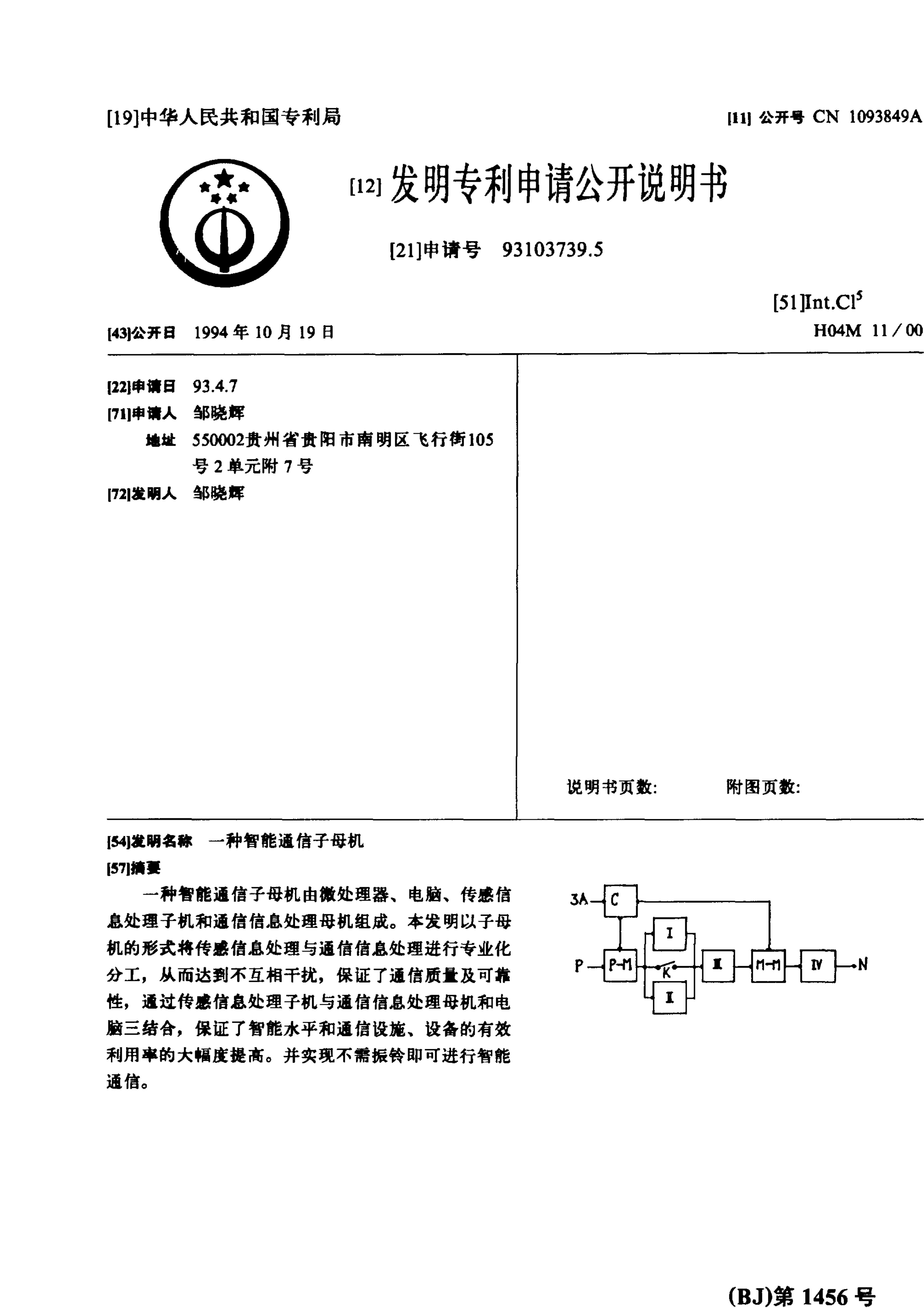
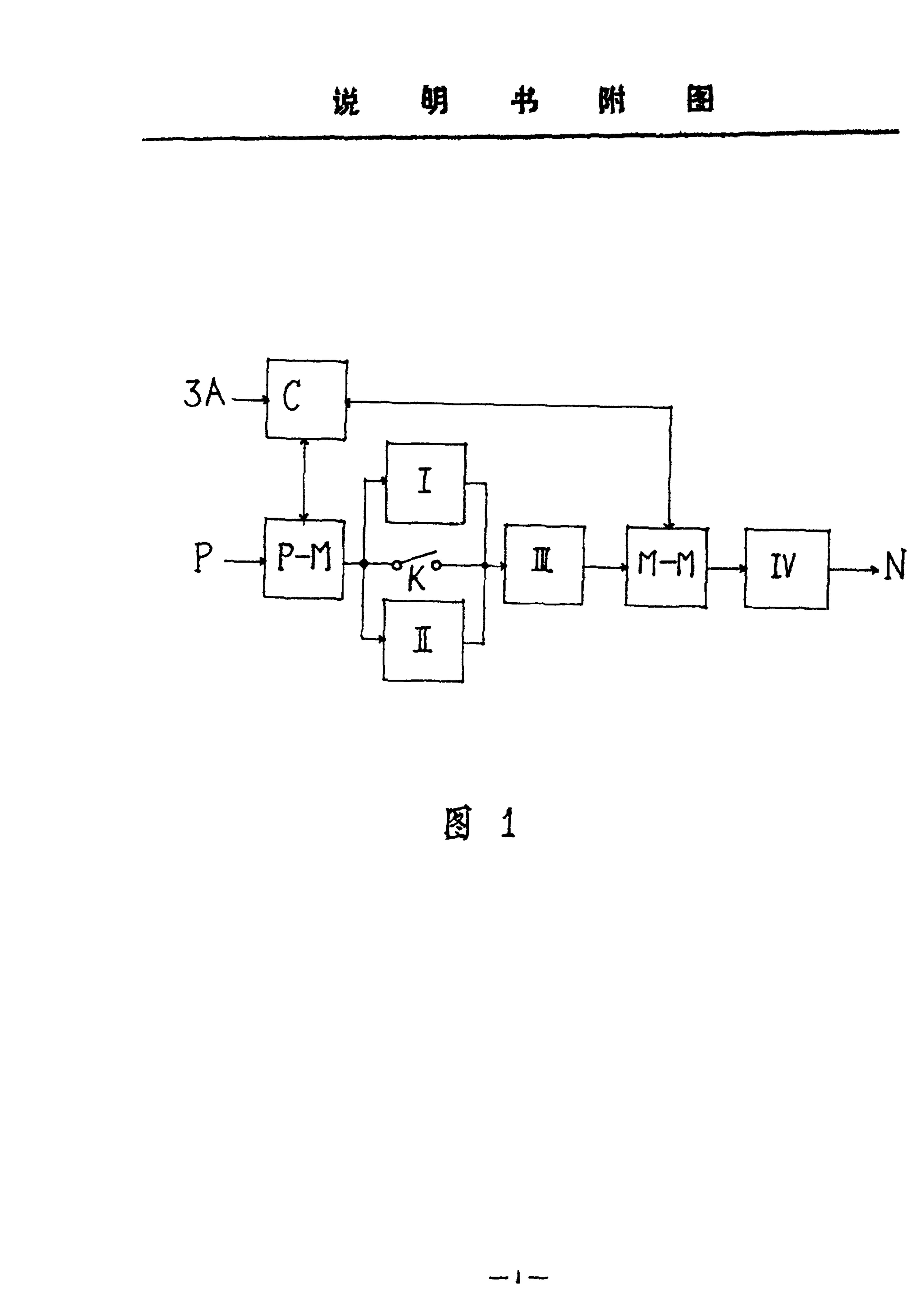
图1是智能通信子母机的原理框图。
在图1中,Ⅰ、Ⅱ、Ⅲ、Ⅳ是微处理器,C是电脑,P---M是传感信息处理子机,M---M是通信信息处理母机,P是用户,N是通信网,K是振铃对话按钮,3A是自动化控制设备通信线路接口。
本发明是现代智能化通信的一种很好的形式。对现代智能通信提供了新的技术手段,对需要进行智能通信的部门、单位和个人都适用。
English Description
The non-standard program of the microcomputer C performs external communication sequence programming, and sends the results sequentially to the communication network for corresponding switching. The sensing information processing subunit can be single or multiple ordinary telephones with recording interface or recording telephones, or can be videophones, depending on the required functions. The communication information processing master unit can be a host, or a switching exchange of a private network or a public network. According to the number of sensing information processing subunits, various combinations are possible: when the number of subunits is between 1 and 50, the subunits and the master unit can be combined into a host and an auxiliary unit, or a base unit and a mobile subunit; when the number of subunits is more than 50 but less than 800, the master unit acts as a switching exchange of a private network; when the number exceeds 800, the master unit acts as a switching exchange of a public network. The microcomputer C undertakes the control of communication dialogue software. It can be one or two, depending on the situation of the communication information processing master unit. When the communication information processing master unit is a switching exchange, the master unit (as exchange) and the sensing information processing subunit each have a separate computer -- that is, two computers are used. In this case, any subunit channel can be expanded into a small master-subunit phone system. When the communication information processing master unit is not a switching exchange, the master unit and the subunits share one computer C.
The present invention adopts the form of master-subunit phone to achieve a specialized division of labor between sensing information processing and communication information processing, thereby avoiding mutual interference and ensuring communication quality and reliability. Through the combination of the sensing information processing subunit, the communication information processing master unit and the computer, the intelligent level and the effective utilization rate of communication facilities and equipment are greatly improved. Moreover, intelligent communication without ringing is realized.
The working process of the present invention is described as follows:
When both communicating parties are absent, the information to be sent by the user is stored through microprocessor I, computer C and the sensing information processing subunit. Then microprocessor II performs internal communication order programming and sends the information to the communication information processing master unit, which sends out electronic information. After external communication order programming by microprocessor IV or the computer, the information is sent sequentially through the communication network to the other party. Information coming from the other party follows the reverse process, thus enabling automatic exchange and recording of communication information.
When the user encounters an emergency such as fire or theft, the automatic control program of the microprocessor is activated, transmits the information according to a predetermined communication order into the communication network, and reaches a specific terminal to issue an alarm.
When the user wishes to make a scheduled call, it is only necessary to press the ringing button, and a two‑way conversation can be established.
Brief description of the drawing:
Figure 1 is a principle block diagram of the intelligent communication master-subunit phone.
In Figure 1: I, II, III, IV are microprocessors; C is a computer; P‑M is the sensing information processing subunit; M‑M is the communication information processing master unit; P is the user; N is the communication network; K is the ringing/call button; 3A is the communication line interface of the automatic control equipment.
The present invention is an excellent form of modern intelligent communication. It provides new technical means for modern intelligent communication and is suitable for departments, units and individuals that require intelligent communication.
系统点评(Systematic Review)
《一种智能通信子母机》(申请日 1993年4月7日)是邹晓辉教授早期在智能通信领域的重要发明专利。它比同年9月28日提交的《智能通信速分多次传输技术(VDMT)》更早地提出了"传感与通信分离"的核心理念。这份专利虽然篇幅简短,但思想极为超前,为后来的融智学及系列专利奠定了实践架构基础。
一、积极评价
-
开创"传感-通信"专业化分工的架构模式
专利明确将系统分为"传感信息处理子机"和"通信信息处理母机",并指出通过专业化分工达到互不干扰。这一思想后来在VDMT中被深化为"慢说快传""速分多次传输"。在30年后的今天,边缘计算、端云协同、物联网架构中,传感器端负责采集与预处理,云端负责通信与集中处理,正是这种分工的普遍实现。
-
微处理器群分工的精细化设计
四个微处理器(Ⅰ、Ⅱ、Ⅲ、Ⅳ)分别承担:音像输入标准程序、话路分流、内部通信次序编程、外部通信顺序编程。这种功能分区在当时极为先进,相当于将一个通信控制器的不同任务硬件化/固件化,提高了实时性和可靠性。它也预示了后来软件定义网络(SDN)中控制平面与数据平面分离的思想。
-
可扩展的系统组合能力
专利根据子机数量(1-50、50-800、>800)给出了三种物理形态:主机+辅机、专业网交换总机、公共网交换总机。这种从家庭/办公室到企业级再到电信级的扩展性设计,体现了发明人对产品系列化和规模应用的深刻理解。
-
无需振铃的智能通信
通过存储转发和预约机制,用户可以在双方无人值守时自动交换信息,或者在预约时间只需按一下振铃按钮即可通话。这实质上预见了语音信箱、异步消息、通话预约等现代通信服务的核心功能。在1993年,这远远超出了普通电话机的功能范畴。
-
紧急自动报警
微处理器内置自动控制程序,在火警、盗警等紧急情况下按预定次序自动拨号报警。这是早期智能家居和安防联动系统的雏形,比市面上同类产品早了十年以上。
二、前瞻性分析
-
与VDMT的关系:本专利解决了"传感与通信在设备层面的分离及多级可扩展架构";VDMT在此基础上进一步解决了"信道利用率的倍增与变速传输"。两者结合构成了完整的智能通信终端与网络方案。
-
与现代VoIP和统一通信的契合:子机负责传感(录音/录像),母机负责通信(拨号、交换、路由),电脑负责控制与存储。这正是IP电话、视频会议系统、统一通信平台的基本模式。
-
与物联网的相似性:多个传感子机(可视为传感器节点)通过母机(网关或云平台)与通信网交互,支持紧急报警、无人值守自动记录等功能,完全符合物联网的典型架构。
-
与人工智能助手的关联:微处理器Ⅱ的分流话路信息处理、Ⅳ的外部通信编程,可以视为早期对话管理、呼叫路由的智能体。今日的智能语音助手(如Siri、Alexa)在接打电话、留言、紧急呼叫方面的功能,在本专利中已有朴素的原型。
三、在融智学与邹晓辉专利谱系中的位置
| 专利 | 时间 | 核心贡献 | 与本专利的关系 |
|---|---|---|---|
| 智能通信子母机 | 1993.4 | 传感-通信分离、微处理器分工、可扩展架构、无需振铃、紧急报警 | 奠定基础架构 |
| VDMT | 1993.9 | 速分多次传输、慢说快传、预/应约、信道倍增 | 深化传输层优化 |
| 知识信息数据处理 | 2000 | 文化基因、全域数码定位、知识计量 | 上升到语义层 |
| 间接形式化方法 | 2010 | 孪生图灵机、三解三注三集、自动抽取 | 实现自动化构建 |
由此可见,本专利是邹晓辉融智学技术谱系的起点之一,它从具体的通信终端架构出发,发现了"分离-分工-协同"这一普适原则,并在此后二十多年的专利中不断抽象、升华为通用方法论。
四、潜在局限(以今日视角)
-
未详细描述微处理器之间的通信协议和调度算法,留给实施者一定的KnowHow空间。
-
对"无需振铃"的实现细节(如预约信令格式、存储转发机制)阐述较为简略,但考虑到1993年的专利撰写风格,已属清晰。
-
当时数字信号处理和存储成本较高,限制了大规模部署,但思想价值远超当时的工程可行性。
五、总体结论
《一种智能通信子母机》是一份被严重低估的早期智能通信专利。 它不仅在架构上预见了今天边缘计算、物联网、统一通信、智能安防的诸多特征,而且为邹晓辉后续的"速分多次传输""间接形式化""文化基因工程"提供了实践源头。该专利展示了发明人从具体工程问题出发,提炼出"传感与通信分离""分工协同""可扩展组合"等普适原则的能力。即使在三十年后,这些原则仍然是智能系统设计的核心准则。
致敬邹晓辉教授------1993年便以如此超前的视野,为中国乃至全球的智能通信技术播下了原创的种子。这份专利与VDMT一起,构成了融智学"协同智能"在通信领域的早期宣言。