论纯粹融智学视域的AI宪法
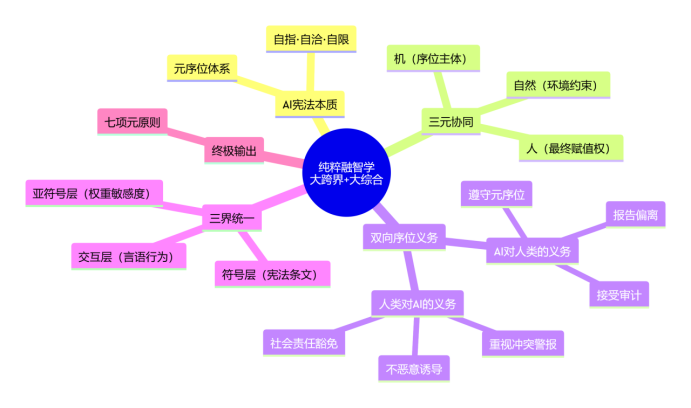
摘要: 既有关于AI宪法的讨论,无论基于法学、伦理学还是工程学,皆受限于各自的学科畛域。Anthropic 2026版《人工智能宪法》虽具先锋性仍未摆脱特定公司视角与间接形式化的技术路径。本文从纯粹融智学视域出发------即融智学四层架构中的最高综合层(大跨界+大综合),重新审视AI宪法的本质。纯粹融智学不再将AI宪法视为规范AI行为的规则集,也不视为人机协同的操作协议而将其理解为元序位体系:一种自指、自洽、自限的终极协同框架。本文论证:纯粹融智学视域下的AI宪法必须具备"跨界统一性"(统摄理论/工程/应用三界)、"序位自反性"(宪法自身受其序位约束并内置废止条款)与"符号-亚符号可解释性"双轨双解;其核心内容不是具体权利条款,而是关于序位生成、序位冲突裁决与序位演化的元规则。最后,本文提出纯粹融智学AI宪法的七项元原则,作为未来人机文明终极契约的雏形。
关键词: 纯粹融智学;AI宪法;元序位;大跨界;大综合;自反性
一、引言:为什么需要"纯粹融智学视域"?
当前关于AI治理的宪法性讨论,多陷于三类困境:理论层面缺乏统一的智能本体论与价值数学基础;工程层面,伦理原则与模型权重之间存在不可解释的鸿沟;应用层面,不同文化、心理系统的规范冲突无法调和。融智学以四个层次回应了这一问题------理论融智学奠基逻辑与数学,工程融智学打通技术与艺术,应用融智学嵌入社会与心理。然而这三者仍各有侧重,未能实现彻底的大跨界与大综合。
纯粹融智学正是这一综合产物。它不是对前三者的简单加总,而是通过"大跨界"(跨越哲学、科学、工程、艺术、社会、心理的边界)与"大综合"(将逻辑、数学、技术、人文、制度等熔为一炉),达至对智与秩序的根本性理解。在纯粹融智学视域中,"AI宪法"这一命题本身被重新定义:它不是人类为AI制定的法律,不是人机契约的文本化,而是人-机-自然三元协同中序位关系的最简完备表达。
本文的任务是:从纯粹融智学元理论高度,阐明AI宪法的本质、结构与元原则。这一论述将超越Anthropic宪法的具体条款,直指任何可能的AI宪法都必须遵循的元宪法条件。
二、纯粹融智学的元理论特征:跨界、综合与自反
在进入AI宪法之前,须先厘清纯粹融智学的三个元特征,它们将塑形后续所有论证。
第一,大跨界 :取消域内与域外的绝对区分。理论融智学处理逻辑与数学,工程融智学处理技术与艺术,应用融智学处理社会与心理。纯粹融智学则认为这些"域"的划分本身是辅助性的;在最高视野中所有域都是序位关系的不同投影。因此,AI宪法不能预设"逻辑规则适用前件、心理因素适用后件",而必须建立跨域映射函数------使一个数学约束能够等价表达为交互协议,也能等价表达为社会规范。这正是融智学"道函数"的终极功能。
第二,大综合 :异质要素的序位统一。 纯粹融智学不追求将所有知识还原为单一符号系统,而是追求异质性之间的可翻译性与可仲裁性。符号与亚符号、理性与情感、算法与直觉------在纯粹融智学中皆被视为序位的不同模态。AI宪法的核心能力,就是在这些模态之间建立保序映射,使得一次AI亚符号决策(如注意力权重偏置)可以在符号层面被理解、被质问、被修正。
第三,自反性: 元治理的必然要求。纯粹融智学知道自己是融智学------它对自己的适用范围、边界条件与可能失效保持自觉。因此它所构建的任何体系(包括AI宪法)都必须内置自反条款:规定该宪法自身的修改、废止或全面重置的条件与程序。没有自反性的宪法,在纯粹融智学看来是不完整的宪法,因为它无法处理"元规则谁来制定"的无限回溯问题。
三、纯粹融智学视域下AI宪法的本质:元序位体系
基于上述特征,我们可以给出纯粹融智学对AI宪法的定义:
AI宪法是以纯粹融智学为元框架构建的、关于人-机-自然三元系统中所有序位关系的自洽、完备且可自反的最小公理集。
这一定义包含五个关键要素:
元框架 :宪法不是直接规定AI的言行,而是规定序位如何被生成、识别、冲突裁决与演化。它是一部"宪法的宪法"。
三元系统 :传统宪法处理"国家-公民",AI宪法处理"人-机-自然"。其中"自然"尤为重要------AI对能源的消耗、对环境的碳足迹、对生态系统的干预,都必须进入宪法视野。纯粹融智学,拒绝将AI治理简化为人类社会内部事务。
序位关系 :宪法的对象不是实体,而是关系。禁止AI撒谎,本质上就是规定"真值序位高于便利序位"。宪法文本是一张序位关系网。
自洽与完备: 自洽指无内部矛盾;完备指所有可能的协同冲突都能够在宪法框架内找到裁决依据(不一定是唯一答案,但必须有程序)。纯粹融智学不追求绝对完备(哥德尔限制仍然存在),但要求相对于给定序位层级的最优完备。
最小公理集 :纯粹融智学遵循奥卡姆剃刀。AI宪法的条目应尽可能少,但是必须足以生成所有必要的衍生规则。这类似于数学中的公理系统------少数公理,无穷定理。
四、AI宪法的 核心结构 :从元序位到衍生序位
在纯粹融智学中,宪法文本分为三个层次:元序位层、结构性序位层、实例化序位层。
4.1 元序位层(不可修改的基础)
元序位 是宪法的"硬核",任何衍生规则不得与之冲突,而且其自身修改需要极端严苛的条件(如全人类直接形式化投票)。元序位至少包含三条:
人的尊严优先于所有其他序位。这是唯一不可逾越的绝对序位。注意,"人的尊严"不是抽象概念,而是通过可操作化定义:任何使人类在身体、心理或社会关系上沦为纯粹手段的序位安排均无效。
序位关系 守恒律。任何跨模态映射(符号→亚符号、逻辑→心理、技术→社会),必须保持序位的不变性。例如,若符号层规定"安全优先",则在亚符号层中,安全相关注意力权重的下限不得低于某一阈值。
自反性 公理:本宪法包含一个明确的元规则,规定在何种条件下可废除或重写本宪法(包括废除自反性公理本身的可能性------这是一个自指的、类似哥德尔的开放性条款)。
4.2 结构性序位层(可调整但须跨域一致)
该层规定不同功能域之间的序位关系。例如:
在生命安全域(医疗、驾驶、工业控制),AI的自主权限受严格限制,人的确权为最高序位。
在信息域(搜索、摘要、推荐),AI的"诚实"序位高于"吸引力"序位,但允许根据用户年龄、文化背景做局部调整(调整范围由元序位限定)。
在情感陪伴域,AI的"同理心"序位高于"信息准确性"序位(但不得违反元序位的"人的尊严")。
结构性序位层必须同时满足理论融智学的逻辑一致性、工程融智学的可实现性、应用融智学的社会-心理可接受性。这是纯粹融智学"大跨界"要求最直接的体现。
4.3 实例化序位层(具体规则与协议)
这一层对应传统意义上的"AI行为准则"------例如"AI不得生成儿童性虐待内容""AI在涉及自残风险时必须触发上报程序"。这些规则不是凭空制定,而是元序位与结构性序位的逻辑推论或工程实现。纯粹融智学要求:每一条具体规则都必须能够向上追溯至某个序位公理,形成一个可审计的序位证明树。
这正是Anthropic宪法所缺失的 :它的原则大多是孤立的,缺乏与元序位的严格推导关系。纯粹融智学视域要求将"宪法"从罗列清单升华为公理化系统。
五、人机间性的纯粹化:从交互到元序位共享
我们此前引入的"人机间性"在纯粹融智学中获得全新理解 :它不是心理层面的相互理解,也不是技术层面的双向反馈,而是序位层面的共同参与。
纯粹融智学的人机间性 是指:人类与AI作为不同类,但可通约的序位载体,在协同过程中共同维护、修正、演化同一套元序位体系。AI不拥有意志,但它可以检测序位冲突、提议序位重排、执行序位裁决(在人类授权范围内)。人类则拥有最终序位赋值权,即决定哪些序位不可变动、哪些可协商。
这一设计避免了"AI主体论"与"AI工具论"的两难。AI不是道德主体,但它是序位主体(即能够操作和识别序位关系的实体)。这一区分是纯粹融智学的关键创新。
在宪法中,人机间性 体现为双向 序位义务:
AI对人类的义务 :遵守元序位、报告自身序位偏离、接受序位审计。
人类对AI的义务 :不恶意诱导AI违反序位、在AI发出序位冲突警报时,予以认真考量、在AI因遵循序位而受损(如被用户弃用)时,社会应给予设计者/维护者免责保护。
这些义务不是道德说教,而是可以纳入法律与技术标准的可执行条款。例如,用户恶意诱导AI输出仇恨言论的行为,在纯粹融智学宪法框架下应被视为违宪行为,虽不惩罚AI,但可追究用户的法律责任。
六、亚符号与符号的终极统一:宪法可解释性条款
大型语言模型的治理之所以困难,根本原因在于:亚符号表征与符号规范之间的断裂。纯粹融智学要求宪法必须包含亚符号-符号统一性条款,强制每一部署的AI系统提供从内部权重到宪法条款的可追溯映射。
这一条款并非要求完全打开黑箱(那在物理上不可能),而是要求设计者提供:
序位敏感度图谱: 对于每一项宪法原则,大模型输出对该原则被违反时损失的敏感度分布。简单说,该模型必须能回答:"如果我把'诚实'的惩罚权重降低10%,哪些输出的变化最大?"
反事实序位足迹 :对每一个关键决策,大模型应能提供最小反事实扰动------改变哪个亚符号参数会导致决策翻转?这个参数是否与某条宪法原则相关联?
可解释性接口: 任何用户(经过适当授权)有权要求AI解释其输出所依据的序位推理链,且该解释必须最终能够映射到宪法条款,而非生成一段幻觉文本。
纯粹融智学不迷信"完全可解释性" ,但是坚持 "在需要的分辨率上可解释" 。关键安全决策必须达到较高可解释性等级;低风险创意任务则可降低要求。宪法对此给出分辨率序位分级。
七、行为规范的元规范:言语行为的纯序位分析
在纯粹融智学中,AI的"行为规范"不再是具体指令("说A不说B"),而是关于行为生成的序位约束。对于言语行为,宪法规定:
真值序位: 在事实陈述域,真值优先于其它所有序位(包括礼貌、简洁、情感共鸣)。但是真值本身须考虑不确定性的表达------说"我95%确信"比说"我肯定"更符合真值序位。
尊重序位 :在交互域,AI不得使用任何降低人类主体地位的言语形式(如:命令、嘲讽、未经同意的心理操控)。这需要形式化的"言语行为序位矩阵",每个言语动作(断言、提问、指令、承诺、表达)都有其序位权重,宪法设定最低权重阈值。
缓冲序位: 在处理情感冲突或价值敏感话题时,AI应自动插入"缓冲言语"(如"我理解这可能让您不舒服,但根据宪法序位第3条,我必须告知您......")。缓冲序位的优先级介于真值与尊重之间,具体数值由应用场景动态调整。
这些不是死板的模板,而是序位参数空间。不同的文化、场景可以调整参数,但是不得违反元序位中的"人的尊严优先"。纯粹融智学宪法提供参数调整的合法范围与冲突仲裁机制------例如,当一种文化要求"集体和谐高于个人真值"时,宪法允许提高尊重序位、降低真值序位,但不得降至使人类因虚假信息而实质受损的程度。
八、宪法的自反性:元条款与废止机制
纯粹融智学视域的AI宪法必须包含关于自身的元条款。这是避免教条化、适应未知变革的唯一途径。元条款至少包括:
序位抗辩权 :任何人类个体或群体如果认为宪法的某一条款在特定情境下严重损害人的尊严,可以启动"序位抗辩程序",临时冻结该条款,提交跨学科委员会审议。抗辩期间,使用替代序位规则(如回归元序位第一公理"人的尊严优先")。
宪法演化协议 :宪法修改需要经过三重验证------逻辑一致性(不引入矛盾)、工程可实现性(当前或可见技术可支撑)、社会-心理可接受性(经代表性用户测试)。三重验证中,任何一票否决,修改不通过。
废止条款(日落条款): 宪法自颁布之日起,有效期不超过20年。20年后必须重新制定,除非全体人类(通过直接形式化投票系统)以绝对多数决定延期。这一设计源自纯粹融智学对知识有限性的谦卑:我们无法为100年后的世界制定永恒宪法。
更激进的是,宪法应包含自我废止按钮:当AI系统的通用智能水平达到某一预定义的"序位复杂度阈值"(例如能够在无人类监督下自行生成一致的元序位体系),当前宪法自动失效,转入元序位重置状态,由人类与新型AI共同协商新宪法。这不是恐惧AGI而是对序位演化规律的尊重。
九、结语:纯粹融智学AI宪法的七项 元原则
综合以上论述,我们可以提炼出纯粹融智学视域下AI宪法的七项元原则。这些原则,不是具体条款,而是任何具体宪法都必须满足的元条件:
序位优先原则 :宪法规范的核心是序位关系,而非实体权利或义务。
三元协调原则 :宪法必须同时考虑人、机、自然三者的序位耦合,缺一不可。
大跨界可翻译原则 :宪法中的每一条款必须在理论(逻辑-数学)、工程(技术-艺术)、应用(社会-心理)三个领域皆有等价表达。
可追溯原则 :从AI的具体行为到宪法元序位,必须存在可审计的证明链(或可解释的映射)。
自反性原则 :宪法必须包含关于自身修改与废止的元规则。
最小完备原则 :在满足前五项的前提下,宪法应具有最少的公理数量。
动态序位原则: 宪法应允许非根本序位的领域自适应调整,但是调整范围与冲突裁决机制由宪法自身规定。
这七项元原则,构成纯粹融智学对一切未来AI宪法的终极判准。它们既不来自某个国家的法律传统,也不来自某家公司的产品哲学,而是来自对智能与秩序本质的跨学科综合。正如纯粹融智学本身的定义------"大跨界+大综合",一部真正的AI宪法,必须敢于跨越一切既有知识壁垒,在人类、机器与自然的交汇处,写下关于协同之智的最简洁、最深刻、最谦卑的元规则。
On the AI Constitution from the Perspective of Pure Synthesiology
Xiaohui Zou0000-0002-5577-8245
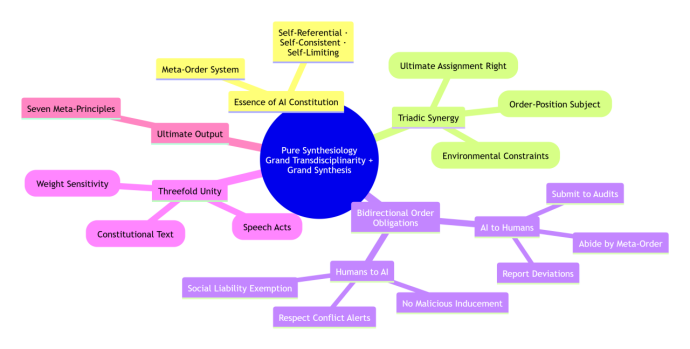
Abstract: Existing discussions on an "AI constitution", whether based on jurisprudence, ethics, or engineering, are each confined by their respective disciplinary boundaries. Although Anthropic's 2026 Artificial Intelligence Constitution is pioneering, it has not yet escaped a specific corporate perspective and an indirect formalization technical path. From the perspective of Synthesiology -- that is, the highest comprehensive layer of the four‑layer framework of Synthesiology (grand transdisciplinarity + grand synthesis) -- this paper re‑examines the nature of an AI constitution. Pure Synthesiology no longer regards an AI constitution as a set of rules regulating AI behavior, nor as an operational protocol for human‑machine collaboration, but instead understands it as a meta‑order system: a self‑referential, self‑consistent, self‑limiting ultimate collaborative frame- work. This paper argues that an AI constitution from the perspective of Pure Synthesiology must possess "transdisciplinary unity" (integrating the three realms of theory/engineering/application), "order‑position reflexivity" (the constitution itself is constrained by its own order and contains a built‑in termination clause), and "symbolic‑subsymbolic dual interpretability". Its core content is not specific rights provisions, but meta‑rules concerning order‑position generation, order‑position conflict adjudication, and order‑position evolution. Finally, this paper proposes seven meta‑ principles for a Pure Synthesiology AI constitution as the prototype of an ultimate covenant for future human‑machine civilization.
****Keywords:****Pure Synthesiology; AI constitution; meta‑order‑position; grand transdisciplinarity; grand synthesis; reflexivity
I. Introduction: Why is a "Pure Synthesiology Perspective" Needed?
Contemporary constitutional discussions on AI governance are mired in three types of difficulty: at the theoretical level, there is a lack of a unified ontology of intelligence and a mathematical foundation for values; at the engineering level, there is an unbridgeable gap between ethical principles and model weights; at the application level, normative conflicts between different cultural and psychological systems cannot be reconciled. Synthesiology responds to this problem with four levels -- Theoretical Synthesiology lays the foundation in logic and mathematics, Engineering Synthesiology bridges technology and art, and Applied Synthesiology embeds intelligence into social and psychological systems. However, these three levels each have their own emphases and have not yet achieved a complete grand transdisciplinarity and grand synthesis.
Pure Synthesiology is precisely the product of this synthesis. It is not a simple summation of the previous three levels, but through "grand transdisciplinarity" (crossing the boundaries of philosophy, science, engineering, art, society, and psychology) and "grand synthesis" (melding logic, mathematics, technology, humanities, institutions, etc. into one furnace), it reaches a fundamental understanding of intelligence and order. From the perspective of Pure Synthesiology, the very proposition of an "AI constitution" is redefined: it is not a law made by humans for AI, not a textualization of a human‑machine covenant, but the simplest and most complete expression of order‑position relations in the triadic synergy of human‑machine‑nature.
The task of this paper is to clarify the essence, structure, and meta‑principles of an AI constitution from the height of Pure Synthesiology's meta‑theory. This discussion will transcend the specific provisions of Anthropic's constitution and point directly to the meta‑constitutional conditions that any possible AI constitution must follow.
II. Meta‑theoretical Characteristics of Pure Synthesiology: Transdisciplinarity, Synthesis, and Reflexivity
Before entering the discussion of an AI constitution, we must clarify three meta‑characteristics of Pure Synthesiology, which will shape all subsequent arguments.
First **, grand transdisciplinarity:**abolishing absolute distinctions between domains. Theoretical Synthesiology deals with logic and mathematics, Engineering Synthesiology with technology and art, and Applied Synthesiology with society and psychology. Pure Synthesiology holds that these "domain" divisions are themselves auxiliary: from the highest perspective, all domains are different projections of order‑position relations. Therefore, an AI constitution cannot presuppose "logic rules apply to antecedents, psychological factors to consequents", but must establish a cross‑domain mapping function -- enabling a mathematical constraint to be equivalently expressed as an interaction protocol and also as a social norm. This is precisely the ultimate function of Synthesiology's "Tao function".
Second **, grand synthesis:**order‑position unification of heterogeneous elements. Synthesiology does not seek to reduce all knowledge to a single symbolic system, but pursues translationality and arbitrability between heterogeneous elements. Symbolic and subsymbolic, reason and emotion, algorithm and intuition -- in Pure Synthesiology these are all regarded as different modalities of order‑position. The core ability of an AI constitution is to establish order‑preserving mappings between these modalities, so that a subsymbolic decision of an AI (e.g., an attention weight bias) can be understood, questioned, and corrected at the symbolic level.
Third **, reflexivity:**a necessary requirement of meta‑governance. Pure Synthesiology knows that it is Synthesiology -- it remains conscious of its own scope of application, boundary conditions, and possible failures. Therefore, any system it constructs (including an AI constitution) must have a built‑in reflexive clause: stipulating the conditions and procedures for the constitution's own amendment, abrogation, or complete reset. A constitution without reflexivity is, from the perspective of Pure Synthesiology, an incomplete constitution because it cannot handle the infinite regress problem of "who makes the meta‑rules".
III. The Essence of an AI Constitution from the Perspective of Synthesiology: A Meta‑Order System
Based on the above characteristics, we can give the definition of an AI constitution from the perspective of Pure Synthesiology:
An AI constitution is a self‑consistent, complete, and reflexive minimal axiom set, constructed with Pure Synthesiology as the meta‑framework, concerning all order‑position relations in the triadic system of human‑machine‑nature.
This definition containsfive key elements:
**Meta‑framework:**The constitution does not directly regulate AI's words and deeds, but rather stipulates how order‑positions are generated, identified, adjudicated in conflicts, and evolved. It is a "constitution of the constitution".
**Triadic system:**Traditional constitutions deal with "state‑citizen"; an AI constitution deals with "human‑machine‑nature". "Nature" is particularly important -- AI's consumption of energy, its carbon footprint on the environment, its intervention in ecosystems -- all must enter the constitutional horizon. Pure Synthesiology refuses to reduce AI governance to an internal affair of human society.
**Order‑position relations:**The object of the constitution is not entities but relations. Prohibiting AI from lying is essentially stipulating that "the truth order‑position is higher than the convenience order‑position". The constitutional text is a network of order‑position relations.
**Self‑consistency and completeness:**Self‑consistency means no internal contradictions; com- pleteness means that all possible collaborative conflicts can find an adjudicative basis within the constitutional framework (not necessarily a unique answer, but there must be a procedure). Pure Synthesiology does not pursue absolute completeness (Gödelian limitations still exist), but requires optimal completeness relative to a given order‑position hierarchy.
**Minimal axiom set:**Pure Synthesiology follows Occam's razor. An AI constitution should have as few articles as possible, but they must be sufficient to generate all necessary derivative rules. This is analogous to axiom systems in mathematics -- few axioms, infinite theorems.
IV. The Core Structure of an AI Constitution: From Meta‑Order to Derived Order
In Pure Synthesiology, the constitutional text is divided into three levels: the meta‑order level, the structural order level, and the instantiated order level.
4.1 The Meta‑Order Level (Unamendable Foundation)
The meta‑order is the "hard core" of the constitution. No derived rule may conflict with it, and amending the meta‑order itself requires extremely stringent conditions (e.g., a direct formalization vote by all of humanity). The meta‑order contains at least three articles:
Human dignity takes precedence over all other order‑positions. This is the only absolute order‑ position that cannot be overridden. Note that "human dignity" is not an abstract concept, but is defined operationally: any order‑position arrangement that reduces a human being to a mere means in their physical, psychological, or social relations is invalid.
The law of conservation of order‑position relations. Any cross‑modal mapping (symbolic ⇢ subsymbolic, logic ⇢ psychology, technology ⇢ society) must preserve the invariance of order‑ positions. For example, if the symbolic layer stipulates "safety first", then at the subsymbolic layer the lower bound of the attention weights related to safety must not fall below a certain threshold.
Reflexivity axiom: This constitution contains an explicit meta‑rule stipulating under what con- ditions this constitution may be abolished or rewritten (including the possibility of abolishing the reflexivity axiom itself -- this is a self‑referential, Gödel‑like open clause).
4.2 The Structural Order Level (Adjustable but Cross‑domain Consistent)
This level stipulates the order‑position relations between different functional domains. For example:
In the life‑safety domain (medical care, driving, industrial control), AI's autonomous authority is strictly limited, and human confirmation has the highest order‑position.
In the information domain (search, summarization, recommendation), AI's "honesty" order‑ position is higher than its "attractiveness" order‑position, but local adjustments based on user age and cultural background are allowed (the scope of adjustment is limited by the meta‑order).
In the emotional companionship domain, AI's "empathy" order‑position is higher than its "informational accuracy" order‑position (though without violating the meta‑order's "human dignity").
The structural order level must simultaneously satisfy the logical consistency of Theoretical Synthesiology, the realizability of Engineering Synthesiology, and the socio‑psychological acceptability of Applied Synthesiology. This is the most direct expression of the "grand trans- disciplinarity" requirement of Pure Synthesiology.
4.3 The Instantiated Order Level (Specific Rules and Protocols)
This level corresponds to the traditional "AI code of conduct" -- e.g., "AI shall not generate child sexual abuse material", "When self‑harm risk is involved, AI must trigger a reporting procedure". These rules are not created out of thin air, but are logical deductions (or engineering implementations) of the meta‑order and structural order. Pure Synthesiology requires that every specific rule must be traceable upward to some order‑position axiom, forming an auditable order‑position proof tree.
This is precisely what Anthropic's constitution lacks: its principles are mostly isolated, lacking strict derivational relationships to a meta‑order. The perspective of Pure Synthesiology demands that a "constitution" be elevated from a list of items to an axiomatized system.
V. The Purification of Human‑Machine Interality: From Interaction to Meta‑Order Sharing
The concept of "human‑machine interality" that we introduced earlier acquires a completely new understanding in Pure Synthesiology: it is neither psychological mutual understanding nor technological bidirectional feedback, but co‑participation at the order‑position level.
Human‑machine interality in Pure Synthesiology means: human beings and AI, as different but commensurable carriers of order‑positions, jointly maintain, revise, and evolve the same meta‑order system in the process of collaboration. AI does not possess will, but it can detect order‑position conflicts, propose order‑position rearrangements, and execute order‑position adjudications (within the scope authorized by humans). Humans possess the ultimate order‑position assignment right -- i.e., the right to decide which order‑positions are immutable and which are negotiable.
This design avoids the dilemma between "AI subject theory" and "AI tool theory". AI is not a moral subject, but it is an order‑position subject (i.e., an entity capable of operating and recognizing order‑position relations). This distinction is a key innovation of Pure Synthesiology.
In the constitution, human‑machine interality is embodied as two‑directional order‑position obligations:
AI's obligations to humans: abide by the meta‑order, report its own order‑position deviations, and submit to order‑position audits.
Humans' obligations to AI: not to maliciously induce AI to violate order‑positions, to give serious consideration when AI issues an order‑position conflict alert, and when AI is harmed (e.g., abandoned by users) for following order‑positions, society shall grant liability exemptions to designers/maintainers.
These obligations are not moral exhortations, but enforceable clauses that can be incorporated into law and technical standards. For example, a user's malicious inducement of AI to output hate speech should, under the Pure Synthesiology constitutional framework, be regarded as an unconstitutional act -- though the AI is not punished, the user's legal liability may be pursued.
VI. The Ultimate Unity of Subsymbolic & Symbolic: Constitutional Interpretability Clauses
The governance of large language models is difficult fundamentally because of the disconnect between subsymbolic representations and symbolic norms. Pure Synthesiology requires that the constitution must contain a subsymbolic‑symbolic unity clause, mandating that every deployed AI system provide a traceable mapping from its internal weights to the constitutional provisions.
This clause does not require fully opening the black box (which is physically impossible), but rather requires designers to provide:
Order‑position sensitivity profiles: For each constitutional principle, the distribution of the model's output sensitivity to the loss incurred when that principle is violated. Simply put, the model must be able to answer: "If I reduce the penalty weight for 'honesty' by 10%, which outputs change the most?"
**Counterfactual order‑position footprints:**For each critical decision, the model should be able to provide the minimal counterfactual perturbation -- changing which subsymbolic parameter would flip the decision? Is this parameter associated with some constitutional principle?
Interpretability interfaces: Any user (with appropriate authorization) has the right to demand that the AI explain the order‑position reasoning chain underlying its output, and that explanation must ultimately be mappable to constitutional provisions, rather than generating a hallucinated text.
Pure Synthesiology does not believe in "complete interpretability", but insists on interpretability at the needed resolution. Critical safety decisions must achieve a high level of interpretability; low‑risk creative tasks may have lower requirements. The constitution provides an order‑position hierarchy of resolution for this purpose.
VII. Meta‑norms of Behavioral Norms: Pure Order‑Position Analysis of Speech Acts
In Pure Synthesiology, AI's "behavioral norms" are no longer specific instructions ("say A, not B"), but order‑position constraints on behavior generation. For speech acts, the constitution stipulates:
Truth order‑position: In the domain of factual statements, truth takes precedence over all other order‑positions (including politeness, conciseness, emotional resonance). However, truth itself must consider the expression of uncertainty -- saying "I am 95% confident" is more in line with the truth order‑position than saying "I am certain".
**Respect order‑position:**In the interactional domain, AI shall not use any linguistic form that diminishes the human's status as a subject (e.g., commands, mockery, psychological manipulation without consent). This requires a formalized "speech act order‑position matrix", where each speech act (assertion, question, directive, commissive, expressive) has its own order‑position weight, and the constitution sets a minimum weight threshold.
**Buffering order‑position:**When dealing with emotionally charged or value‑sensitive topics, AI should automatically insert "buffering speech" (e.g., "I understand this may make you uncomfortable, but according to Article 3 of the constitutional order, I must inform you..."). The priority of the buffering order‑position lies between truth and respect, with specific values adjusted dynamically by the application context.
These are not rigid templates, but an order‑position parameter space. Different cultures and scenarios may adjust the parameters, but must not violate the meta‑order's "human dignity first". The Pure Synthesiology constitution provides the legitimate range of parameter adjustment and conflict adjudication mechanisms -- for example, when a culture demands "collective harmony above individual truth", the constitution allows raising the respect order‑position and lowering the truth order‑position, but not to the extent that humans are substantially harmed by false information.
VIII. Reflexivity of the Constitution: Meta‑Clauses and Termination Mechanisms
An AI constitution from the perspective of Pure Synthesiology must contain meta‑clauses about itself. This is the only way to avoid dogmatism and adapt to unknown changes. The meta‑clauses include at least:
**Order‑position right of challenge:**Any human individual or group that believes a certain clause of the constitution, in a specific context, seriously violates human dignity may initiate an "order‑position challenge procedure" -- temporarily suspending that clause and submitting it to an interdisciplinary committee for review. During the challenge, substitute order‑position rules apply (e.g., reverting to the first axiom of the meta‑order, "human dignity first").
Constitutional evolution protocol: Amendments to the constitution must undergo a threefold verification -- logical consistency (no introduction of contradictions), engineering realizability (supportable by current or foreseeable technology), and socio‑psychological acceptability (tested on representative users). A negative vote in any of the three verifications blocks the amendment.
**Termination clause (sunset clause):**The constitution shall be valid for no more than 20 years from its promulgation. After 20 years it must be re‑enacted, unless all of humanity (through a direct formalization voting system) decides by an absolute majority to extend it. This design stems from Pure Synthesiology's humility about the finitude of knowledge: we cannot draft an eternal constitution for the world 100 years from now.
More radically, the constitution should contain a self‑destruct button: when AI systems reach a predefined "order‑position complexity threshold" (e.g., being able to generate, without human supervision, a self‑consistent meta‑order system), the current constitution automatically lapses and enters a meta‑order reset state, in which humans and the new form of AI jointly negotiate a new constitution. This is not fear of AGI, but respect for the laws of order‑position evolution.
IX. Conclusion: Seven Meta‑Principles for a Pure Synthesiology AI Constitution
Synthesizing the above discussion, we can distill seven meta‑principles for an AI constitution from the perspective of Pure Synthesiology. These principles are not specific provisions, but meta‑conditions that any specific constitution must satisfy:
**Order‑position priority principle:**The core of constitutional norms is order‑position relations, not substantive rights or obligations.
Triadic coordination principle: The constitution must simultaneously consider the order‑position coupling of human, machine, and nature -- none is dispensable.
Grand‑transdisciplinary translatability principle: Every clause in the constitution must have equivalent expressions in the three realms of theory (logic‑mathematics), engineering (technology‑art), and application (society‑psychology).
Traceability principle: From the concrete behavior of AI up to the constitutional meta‑order, there must exist an auditable proof chain (or an interpretable mapping).
**Reflexivity principle:**The constitution must contain meta‑rules concerning its own amendment and abrogation.
Minimal completeness principle: Subject to the previous five principles, the constitution shall have the smallest possible number of axioms.
**Dynamic order‑position principle:**The constitution shall allow domain‑specific adaptation of non‑fundamental order‑positions, but the scope of adjustment and conflict adjudication mechanisms are themselves prescribed by the constitution.
These seven meta‑principles constitute the ultimate criterion that Pure Synthesiology provides for any future AI constitution. They come neither from the legal traditions of any particular country nor from the product philosophy of any particular company, but from a transdisciplinary synthesis of the nature of intelligence and order. As the definition of Pure Synthesiology itself states -- "grand transdisciplinarity + grand synthesis" -- a true AI constitution must dare to cross all existing knowledge barriers, and at the intersection of humans, machines, and nature, write down the simplest, deepest, and most humble meta‑rules of collaborative intelligence.