一、什么是模为60的BCD加法器?
1.模为60的BCD加法器本质上是一个专门用于处理六十进制(Sexagesimal)计数的数字逻辑电路。
2.它从 0 计数到 59。当输入再加 1 时,结果不是 60,而是归零,并产生一个进位信号给高位。
3。采用8位的res作为结果。高四位表示十位,范围从0到5;低四位表示个位,范围从0到9.
二、代码
BCD_60counter.v代码如下:
c
`timescale 1ns / 1ps

module BCD_60counter(

    input                    clk                                  ,
    input                    rst                                  ,
    input                    load                                 ,
    input       [7:0]             load_data                            ,
    input                    cin                                  ,
    output reg[7:0]res                         ,
    output                 cout

    );

    always @(posedge clk) begin
        if(!rst) res<=0;
        else if(load) res <= load_data;
        else
            if(cin) begin
                if(res[3:0] == 4'h9)
                begin
                 res[3:0] <= 4'h0;
                 if(res[7:4] == 4'h5) res[7:4] <= 4'h0; else res[7:4] <= res[7:4] +1'b1;
                 end
                 else
                 res[3:0] <= res[3:0] + 1'b1;
                 end
end


assign cout =  (res ==8'h59)&&(cin ==1'b1 ) ? 1'b1:1'b0;

endmodule
BCD_60counter_tb.v仿真文件代码如下:
c
`timescale 1ns / 1ps


module BCD_60counter_tb;

reg   clk                           ;
reg   rst                           ;
reg   load                          ;
reg  [7:0]  load_data                     ;
reg   cin                           ;
wire [7:0] res;
wire cout;

BCD_60counter u_counter(

   .  clk                      ( clk)        ,
   .  rst                      (  rst)       ,
   .  load                     (  load)       ,
   .  load_data                (     load_data)   ,
   .  cin                      (   cin)      ,
   .res (res),
   .cout                       (cout)

    );

  parameter cycle = 20;

 always #(cycle/2) clk=~clk;

  initial begin

  clk =0;rst=0;cin =0; load =0; load_data=0;
  #cycle rst =1'b1; cin =1'b1;

  #(cycle*100 )   load=1;load_data=8'h58;
  #cycle load =0; load_data=0;

  #(cycle*50)      $finish;

  end


endmodule
三、仿真截图如下:
1.从tb文件可知:时钟周期是20ns
2.看懂initial块的的执行动作:
0ns,赋值为0
20ns,rst置为1,取消复位;cin置为1,使能计数器计数累加
再过2000ns,加载数据
下一个周期,取消加载,不取消的话会一直加载,res一直是58
再过50个周期,停止运行。
3.判断仿真结果正确的两个点
第一个是59之后是否变为00

第二个是加载58是否成功

从图中看到,都是成功的。
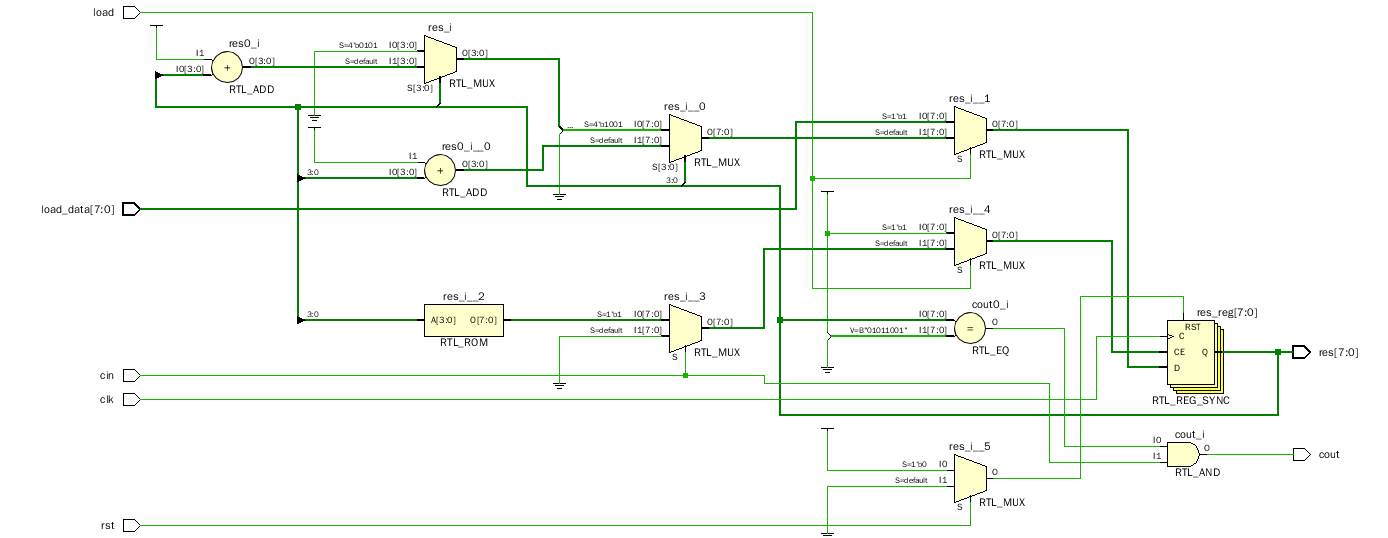
四、原理图: