向量检索技术与相似度算法:深度解析 ANN 索引
前言
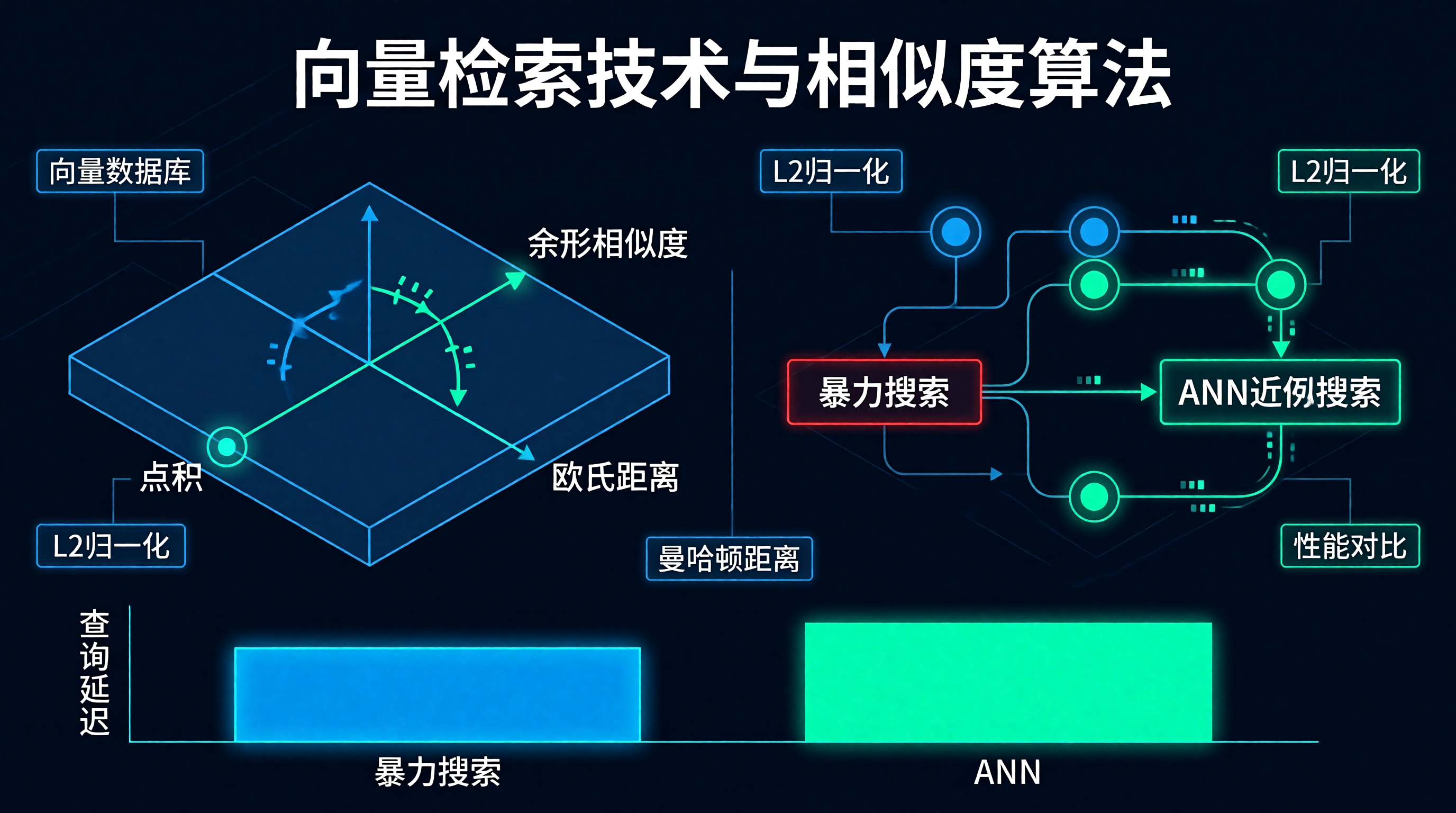
向量检索是 RAG系统和语义搜索的核心技术。当我们需要从海量向量中找到与查询最相似的结果时,精确的 KNN(K-Nearest Neighbors)搜索在数据量大时会变得极其缓慢。近似最近邻(ANN,Approximate Nearest Neighbors)算法通过允许一定的精度损失,换取了大幅的性能提升。
我之前在项目中对比测试了多种向量检索算法和向量数据库,对这些技术有了深入理解。今天分享一些核心原理和实战经验。
向量相似度度量
常用距离度量
python
import numpy as np

def cosine_similarity(a: np.ndarray, b: np.ndarray) -> float:
    """余弦相似度:[-1, 1],1 表示完全相同"""
    return np.dot(a, b) / (np.linalg.norm(a) * np.linalg.norm(b))

def euclidean_distance(a: np.ndarray, b: np.ndarray) -> float:
    """欧氏距离:[0, +∞),0 表示完全相同"""
    return np.linalg.norm(a - b)

def dot_product(a: np.ndarray, b: np.ndarray) -> float:
    """点积:未归一化,适用于已归一化的向量"""
    return np.dot(a, b)

def manhattan_distance(a: np.ndarray, b: np.ndarray) -> float:
    """曼哈顿距离:[0, +∞)"""
    return np.sum(np.abs(a - b))

# 选择建议
"""
- 余弦相似度:最常用,关注方向而非大小
- 欧氏距离:关注绝对差异,适合图像特征
- 点积:计算最快,但需要向量已归一化
"""
内积与余弦的关系
python
# 对于 L2 归一化的向量:
# cosine_similarity(a, b) = dot_product(a, b)

def normalize_l2(x: np.ndarray) -> np.ndarray:
    """L2 归一化"""
    norm = np.linalg.norm(x, axis=-1, keepdims=True)
    return x / (norm + 1e-8)  # 避免除零
ANN 算法详解
1. 暴力搜索(Brute Force)
python
def brute_force_search(
    query: np.ndarray,
    database: np.ndarray,
    k: int
) -> tuple:
    """暴力搜索(基准方法)"""
    # 计算所有距离
    distances = np.linalg.norm(database - query, axis=1)

    # 找 top-k
    top_k_idx = np.argsort(distances)[:k]

    return top_k_idx, distances[top_k_idx]

# 时间复杂度:O(N * D),N 为向量数,D 为维度
# 优点:精确、无额外内存
# 缺点:慢
2. LSH(Locality-Sensitive Hashing)
LSH 通过哈希函数将相似的向量映射到相同的"桶":
python
class LSH:
    """LSH 近似最近邻"""

    def __init__(self, num_hash_tables: int = 8, hash_size: int = 12):
        self.num_hash_tables = num_hash_tables
        self.hash_size = hash_size
        self.hash_tables = [defaultdict(list) for _ in range(num_hash_tables)]
        self.random_planes = None

    def _init_planes(self, dim: int):
        """初始化随机超平面"""
        np.random.seed(42)
        self.random_planes = [
            np.random.randn(self.hash_size, dim)
            for _ in range(self.num_hash_tables)
        ]

    def _hash(self, vectors: np.ndarray, planes: np.ndarray) -> np.ndarray:
        """计算哈希值"""
        projections = vectors @ planes.T  # (N, hash_size)
        return (projections > 0).astype(int)

    def fit(self, vectors: np.ndarray):
        """构建索引"""
        self._init_planes(vectors.shape[1])

        for i, planes in enumerate(self.random_planes):
            hashes = self._hash(vectors, planes)

            for j, h in enumerate(hashes):
                bucket_key = tuple(h)
                self.hash_tables[i][bucket_key].append(j)

    def search(self, query: np.ndarray, k: int = 10) -> list:
        """搜索"""
        candidates = set()

        for planes in self.random_planes:
            h = tuple(self._hash(query, planes)[0])
            candidates.update(self.hash_tables[planes.index(planes)][h])

        # 在候选集中暴力搜索
        return list(candidates)[:k]
3. HNSW(Hierarchical Navigable Small World)
HNSW 是目前最流行的 ANN 算法:
python
class HNSWNode:
    """HNSW 节点"""

    def __init__(self, vector: np.ndarray, id: int):
        self.vector = vector
        self.id = id
        self.connections = {}  # level -> [node_ids]
        self.entry_point = None

class HNSW:
    """HNSW 实现"""

    def __init__(
        self,
        m: int = 16,           # 节点最大连接数
        ef_construction: int = 200,  # 构建时搜索范围
        max_level: int = 16
    ):
        self.m = m
        self.ef_construction = ef_construction
        self.max_level = max_level
        self.nodes = {}
        self.entry_point = None
        self.top_level = 0

    def _distance(self, a: np.ndarray, b: np.ndarray) -> float:
        """欧氏距离"""
        return np.linalg.norm(a - b)

    def _search_layer(
        self,
        query: np.ndarray,
        ep: int,
        ef: int,
        level: int
    ) -> list:
        """单层搜索"""
        visited = {ep}
        candidates = [(self._distance(query, self.nodes[ep].vector), ep)]
        result = [(self._distance(query, self.nodes[ep].vector), ep)]

        while candidates:
            dist, current = heapq.heappop(candidates)

            # 获取结果中的最远距离
            result_dist = result[0][0] if len(result) >= ef else float('inf')

            if dist > result_dist:
                break

            # 遍历邻居
            for neighbor_id in self.nodes[current].connections.get(level, []):
                if neighbor_id in visited:
                    continue
                visited.add(neighbor_id)

                dist = self._distance(query, self.nodes[neighbor_id].vector)

                if dist < result_dist or len(result) < ef:
                    heapq.heappush(candidates, (dist, neighbor_id))
                    heapq.heappushpop(result, (dist, neighbor_id))

        return result

    def _select_neighbors(
        self,
        query: np.ndarray,
        node_id: int,
        level: int,
        m: int
    ) -> list:
        """选择最近的 m 个邻居"""
        neighbors = self.nodes[node_id].connections.get(level, [])
        distances = [
            (self._distance(query, self.nodes[n].vector), n)
            for n in neighbors
        ]

        return [n for _, n in heapq.nsmallest(m, distances)]

    def insert(self, vector: np.ndarray, id: int):
        """插入向量"""
        # 随机选择层级(指数衰减)
        level = int(np.random.exponential(self.max_level - 1))
        level = min(level, self.top_level + 1)

        # 创建节点
        self.nodes[id] = HNSWNode(vector, id)

        # 如果是第一个节点
        if self.entry_point is None:
            self.nodes[id].level = level
            self.entry_point = id
            self.top_level = level
            return

        # 从顶层向下搜索
        ep = self.entry_point
        for l in range(self.top_level, level, -1):
            ep = self._search_layer(
                vector, ep, 1, l
            )[0][1]

        # 从 level 层开始插入
        for l in range(level, -1, -1):
            neighbors = self._search_layer(vector, ep, self.ef_construction, l)
            ep = neighbors[0][1]

            # 更新连接
            selected = self._select_neighbors(vector, ep, l, self.m)
            self.nodes[ep].connections.setdefault(l, []).extend(selected)

            # 限制连接数
            if len(self.nodes[ep].connections[l]) > self.m:
                self.nodes[ep].connections[l] = self._select_neighbors(
                    vector, ep, l, self.m
                )

    def search(self, query: np.ndarray, k: int = 10) -> list:
        """搜索"""
        ep = self.entry_point

        # 从顶层向下找到入口点
        for l in range(self.top_level, 0, -1):
            ep = self._search_layer(query, ep, 1, l)[0][1]

        # 最底层搜索
        results = self._search_layer(query, ep, k, 0)

        return [(id, dist) for dist, id in sorted(results, key=lambda x: x[0])[:k]]
4. IVF(Inverted File Index)
IVF 通过聚类将向量空间划分:
python
class IVF:
    """倒排索引"""

    def __init__(self, nlist: int = 100, nprobe: int = 10):
        self.nlist = nlist
        self.nprobe = nprobe
        self.centroids = None
        self.inverted_index = defaultdict(list)

    def fit(self, vectors: np.ndarray):
        """构建索引"""
        # K-Means 聚类
        from sklearn.cluster import MiniBatchKMeans

        kmeans = MiniBatchKMeans(n_clusters=self.nlist, random_state=42)
        kmeans.fit(vectors)

        self.centroids = kmeans.cluster_centers_
        labels = kmeans.labels_

        # 构建倒排索引
        for i, label in enumerate(labels):
            self.inverted_index[label].append(i)

    def search(self, query: np.ndarray, k: int = 10) -> list:
        """搜索"""
        # 1. 找到最近的 nprobe 个聚类中心
        distances = np.linalg.norm(self.centroids - query, axis=1)
        nearest_clusters = np.argsort(distances)[:self.nprobe]

        # 2. 在这些聚类中搜索
        all_candidates = []
        for cluster_id in nearest_clusters:
            all_candidates.extend(self.inverted_index[cluster_id])

        # 3. 暴力搜索候选集
        # (实际实现需要获取向量并计算距离)
        results = [(id, 0.0) for id in all_candidates[:k]]

        return results
主流向量数据库对比
| 数据库 | 索引类型 | 优势 | 劣势 |
|---|---|---|---|
| Milvus | HNSW, IVF, PQ | 功能全面 | 资源占用大 |
| Qdrant | HNSW | 性能好 | 相对较新 |
| Weaviate | HNSW | 混合搜索 | 文档复杂 |
| Pinecone | 闭源 | 托管方便 | 成本高 |
| Chroma | HNSW (近似) | 轻量易用 | 不适合生产 |
索引参数调优
HNSW 参数
python
# HNSW 配置建议
hnsw_config = {
    "M": 16,               # 建议范围 8-64
                            # M 越大,召回率越高,但内存和构建时间也越大

    "efConstruction": 200, # 建议范围 100-400
                            # 构建时的搜索范围,越大索引质量越好,但构建越慢

    "efSearch": 100,      # 建议范围 50-400
                            # 搜索时的搜索范围,越大召回率越高,但延迟也越高

    "distance_type": "COSine"  # 或 "EUCLIDEAN"
}

# 调优建议
"""
1. 召回率优先 → 提高 M 和 efSearch
2. 延迟优先 → 降低 M 和 efSearch
3. 内存受限 → 降低 M 或使用 PQ
"""
PQ 参数
python
pq_config = {
    "M": 64,      # 子空间数,通常设为 64 或 96
    "bits": 8,    # 每子空间位数,通常为 8

    # 参数影响
    # - M * bits 越小,压缩率越高,精度越低
    # - M 越大,精度越高,但索引越大
}
实战建议
选择合适的索引
python
def select_index_type(data_size: int, dim: int, requirement: str) -> str:
    """根据需求选择索引类型"""

    if requirement == "highest_recall":
        return "HNSW"

    if requirement == "low_memory":
        return "PQ"

    if requirement == "balanced":
        return "HNSW + PQ"

    if requirement == "fast_build":
        return "IVF"

    return "HNSW"  # 默认选择
性能优化技巧
python
class VectorSearchOptimizer:
    """向量搜索优化"""

    @staticmethod
    def batch_search_optimization():
        """批量搜索优化"""
        # 1. 使用批量接口而非循环单次查询
        # 2. 减少 Python GIL 影响
        # 3. 使用异步 I/O

        pass

    @staticmethod
    def memory_optimization():
        """内存优化"""
        # 1. 使用内存映射文件
        # 2. 量化向量
        # 3. 及时清理不需要的数据

        pass
总结
向量检索的核心是 ANN 算法:
- HNSW:目前最流行,性能和召回率平衡好
- LSH:适合稀疏向量或需要精确哈希的场景
- IVF:基于聚类,适合大规模数据
- PQ:高压缩率,适合内存受限场景
关键要点:
- 相似度度量选余弦相似度最通用
- HNSW 是首选索引类型
- 参数调优需要在精度和性能间平衡
- 根据数据规模和硬件选择合适的方案