在R中,可通过e1071或caret包实现朴素贝叶斯,下面采用c1071实现。
R
install.packages("e1071")  # 安装包
library(e1071)             # 加载包
数据集划分
R
data(iris)
set.seed(123)
train_index <- sample(1:nrow(iris), 0.7 * nrow(iris))
train_data <- iris[train_index, ]        #训练集
test_data <- iris[-train_index, ]        #测试集
训练模型
R
model <- naiveBayes(Species ~ ., data = train_data)Naive Bayes Classifier for Discrete Predictors
Call:
naiveBayes.default(x = X, y = Y, laplace = laplace)
#先验概率,34%是山鸢尾,30%是变色鸢尾,35%是维吉尼亚鸢尾
A-priori probabilities:
Y
setosa versicolor virginica
0.3428571 0.3047619 0.3523810
#条件概率,均值、标准差
#山鸢尾的花萼长度平均 4.97,波动小
#维吉尼亚鸢尾 平均 6.59,明显更大
Conditional probabilities:
Sepal.Length
Y ,1 ,2
setosa 4.966667 0.3741657
versicolor 5.971875 0.4887340
virginica 6.586486 0.7165357
Sepal.Width
Y ,1 ,2
setosa 3.394444 0.4049299
versicolor 2.787500 0.3250310
virginica 2.948649 0.3500965
Petal.Length
Y ,1 ,2
setosa 1.461111 0.1777282
versicolor 4.309375 0.4423977
virginica 5.529730 0.6235494
Petal.Width
Y ,1 ,2
setosa 0.2555556 0.1157447
versicolor 1.3500000 0.1951013
virginica 1.9945946 0.2613490
预测与评估
R
# 对测试集预测
pred <- predict(model, test_data)

# 查看前10个预测结果
head(pred, 10)

# 混淆矩阵
table(实际类别=test_data$Species, 预测类别=pred)

# 计算准确率
accuracy <- mean(pred == test_data$Species)
cat("模型准确率:", round(accuracy*100, 2), "%")
混淆矩阵
预测类别
实际类别 setosa versicolor virginica
setosa 14 0 0
versicolor 0 18 0
virginica 0 0 13
模型准确率: 100 %
参数调优
朴素贝叶斯的主要参数是拉普拉斯平滑(laplace),用于处理零概率问题。如果某个特征在某个类别里一次都没出现过 ,会算出: P(特征|类别) = 0,这个 0 会让整个分类概率直接变成 0 ,模型直接判断错误,出现零概率问题。
r
model <- naiveBayes(Species ~ ., data = train_data, laplace = 1)
可视化
R
library(ggplot2)

# 提取先验概率
prior <- data.frame(
  品种 = names(nb_model$apriori),
  概率 = as.numeric(nb_model$apriori)
)

# 画图
ggplot(prior, aes(x=品种, y=概率, fill=品种)) +
  geom_bar(stat="identity") +
  ggtitle("朴素贝叶斯:类别先验概率") +
  theme_minimal()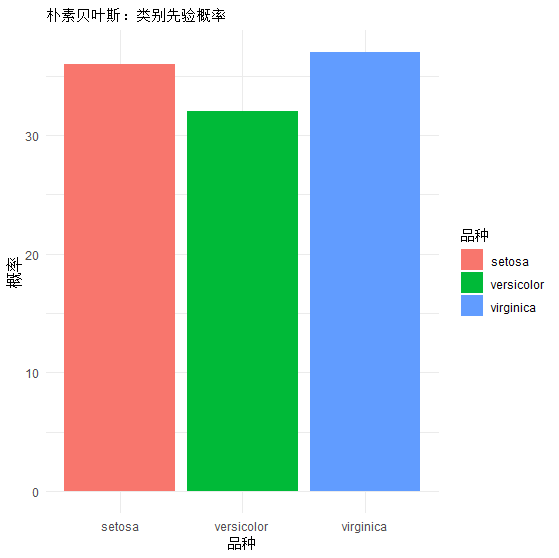
特征分布曲线
R
#朴素贝叶斯假设连续特征服从高斯分布,模型存了均值和标准差,可以画出每条特征的分布曲线!
# 以 Sepal.Length 为例
ggplot(iris, aes(x=Sepal.Length, fill=Species)) +
  geom_density(alpha=0.5) +
  ggtitle("花萼长度在3个品种上的分布") +
  theme_minimal()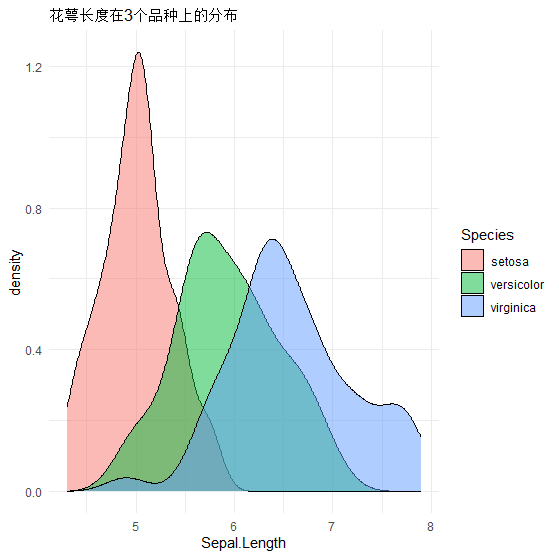
混淆矩阵热力图(模型准确率可视化)
R
# 预测
pred <- predict(nb_model, test_data)
cm <- table(真实=test_data$Species, 预测=pred)

# 画热力图
heatmap(cm, col=heat.colors(10), scale="none", margins=c(10,10))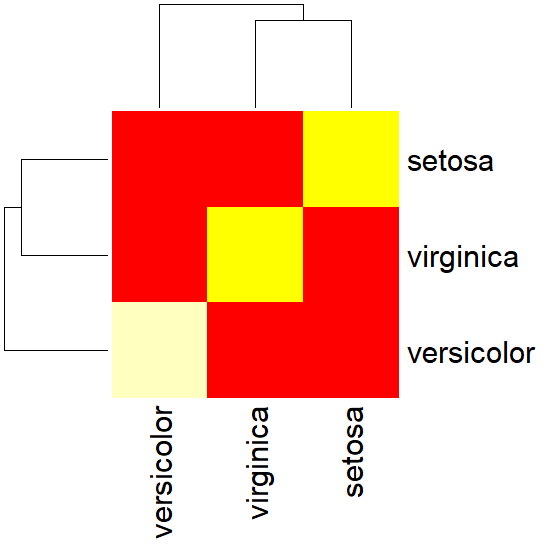
ggplot绘图
R
library(ggplot2)
library(reshape2)

# 1. 生成预测与混淆矩阵
pred <- predict(nb_model, test_data)
cm <- table(真实 = test_data$Species, 预测 = pred)

# 2. 转成长格式(ggplot2必须)
cm_df <- melt(cm)

# 3. 画高颜值热力图(这是最标准的版本)
ggplot(cm_df, aes(x = 预测, y = 真实)) +
  geom_tile(aes(fill = value), color = "white", linewidth = 1) +  # 白色格子线
  scale_fill_gradient(low = "#F8F9FA", high = "#4285F4") +        # 蓝白渐变(谷歌风)
  geom_text(aes(label = value), size = 6, fontface = "bold") +    # 显示数字
  labs(
    title = "朴素贝叶斯 混淆矩阵",
    subtitle = "测试集预测结果",
    x = "预测类别",
    y = "真实类别",
    fill = "样本数量"
  ) +
  theme_minimal(base_size = 14) +
  theme(
    plot.title = element_text(hjust = 0.5),
    plot.subtitle = element_text(hjust = 0.5),
    axis.text = element_text(size = 12),
    axis.title = element_text(size = 13)
  ) +
  coord_fixed()  # 正方形格子,更好看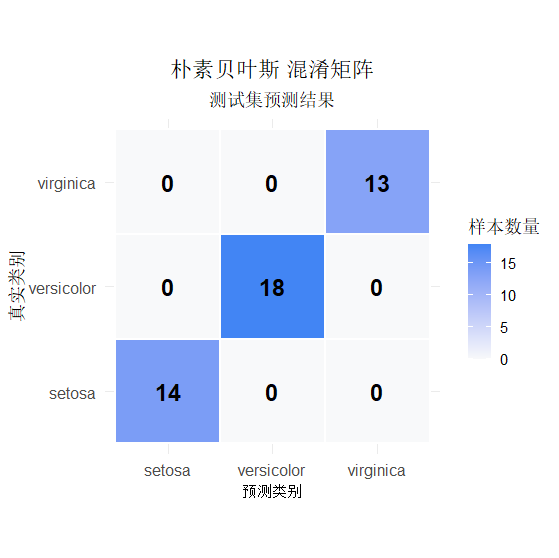
注意事项
- 特征独立性假设可能不成立,影响模型性能。
- 对连续型数据需离散化或假设分布(如高斯朴素贝叶斯)。
- 适用于高维数据,但需注意特征相关性。