关键字:舆情处理;金融;股票;行业;资讯分类;量化投研
在金融舆情监测、资讯复盘、量化投研与文本智能分析场景中,个股新闻与行业新闻的精准划分,是金融文本结构化处理的第一道核心关卡,也是舆情研判与行情逻辑拆解的基础前提。
In the scenarios of financial public opinion monitoring, information review, quantitative investment research, and intelligent text analysis, the precise classification of company-specific news and industry news is the first core checkpoint in the structured processing of financial texts, as well as the fundamental prerequisite for public opinion judgment and market logic analysis.
A股市场的信息传播具备碎片化、高频化、多样化特征,每日海量推送的政策资讯、企业公告、产业动态、市场解读混杂叠加,其中既有针对单一上市公司的个体经营消息,也有覆盖全产业链、全板块的行业共性信息。两类新闻的驱动逻辑、影响范围、行情持续性与资金传导路径截然不同,若无法有效区分,极易出现舆情归类错乱、热点逻辑误判、数据统计失真等问题,直接影响投研分析的准确性与舆情监测的有效性。
The information dissemination in the A-share market is characterized by fragmentation, high frequency, and diversity. Daily massive pushes of policy information, corporate announcements, industry dynamics, and market interpretations are mixed and superimposed. Among them, there are individual operational messages targeting specific listed companies, as well as industry-wide common information covering the entire industrial chain and sector. The driving logic, impact scope, trend sustainability, and capital transmission paths of these two types of news are fundamentally different. Failure to effectively distinguish them can easily lead to issues such as misclassification of public sentiment, misjudgment of hot-spot logic, and distortion of data statistics, directly affecting the accuracy of investment research analysis and the effectiveness of public opinion monitoring.
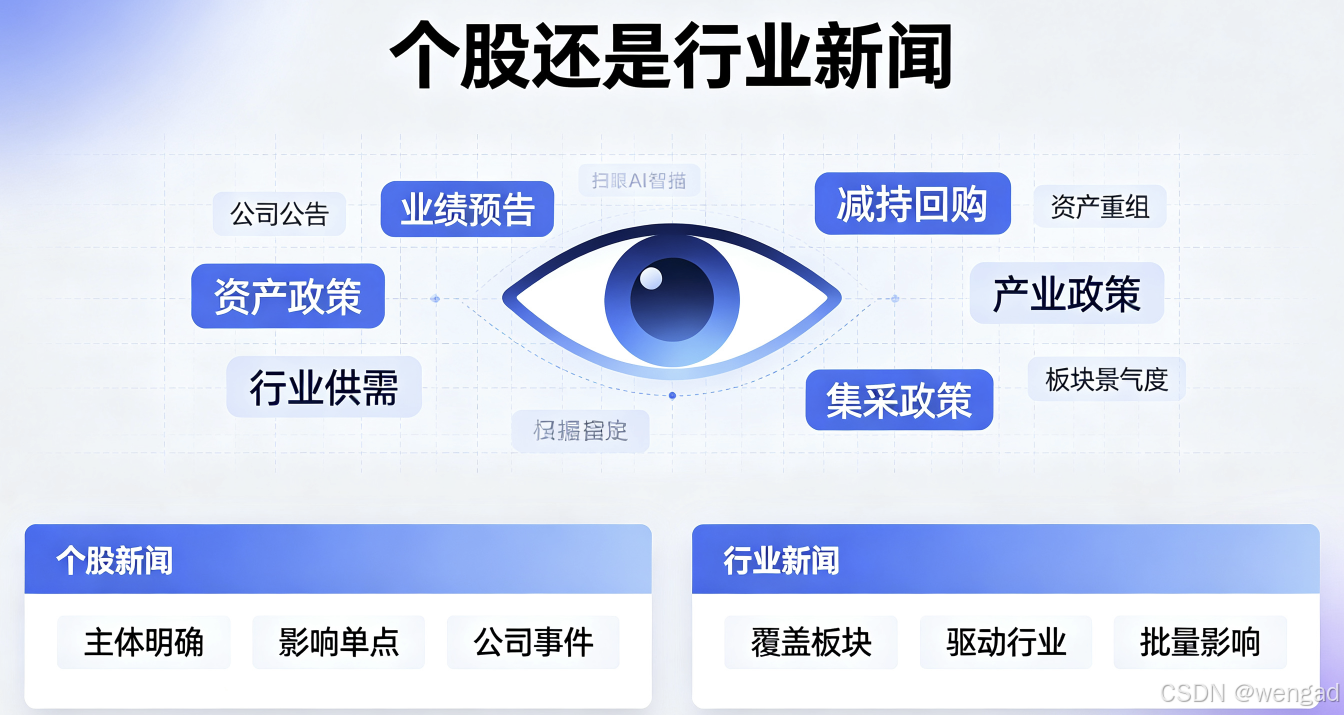
从市场运行逻辑来看,个股新闻属于微观个体事件,聚焦单家企业的经营变动,影响范围局限、行情带动性弱,大多对应自下而上的个股独立行情;而行业新闻属于宏观产业事件,依托政策调整、供需变化、技术迭代、行业景气度变动形成,能够重塑板块整体估值体系,带动产业链批量个股联动涨跌,具备更强的行情持续性与市场影响力。
From the perspective of market operation logic, company-specific news pertains to micro-level individual events, focusing on the operational changes of a single enterprise. Its impact is limited in scope and has weak momentum in driving market trends, mostly corresponding to independent stock movements driven by bottom-up factors. In contrast, industry news belongs to macro-level industrial events, formed based on policy adjustments, supply-demand changes, technological iterations, and shifts in industry sentiment. It can reshape the overall valuation system of a sector, driving synchronized movements of multiple stocks within the industrial chain, and possesses stronger trend sustainability and market influence.
在智能化文本处理落地过程中,人工甄别效率低下、标准不一,难以适配海量资讯的实时筛查需求,因此建立一套清晰、统一、可量化、可适配AI模型自动化识别的判定体系至关重要。
In the implementation of intelligent text processing, manual identification suffers from low efficiency and inconsistent standards, making it difficult to meet the real-time screening demands of massive information flows. Therefore, establishing a clear, unified, quantifiable, and AI-model-adaptable judgment system is crucial.
本文立足金融投研实际场景,梳理标准化区分规则,厘清两类新闻的核心边界,同时适配NER实体识别等智能技术落地,为金融资讯自动分类、舆情智能研判、投研数据结构化提供标准化依据。
This article is grounded in the practical scenarios of financial investment research. It organizes standardized differentiation rules, clarifies the core boundaries between the two types of news, and simultaneously adapts to the implementation of intelligent technologies such as NER (Named Entity Recognition). It aims to provide a standardized basis for the automatic classification of financial information, intelligent judgment of public opinion, and the structuring of investment research data.
请参考本人同名文章:金融文本判定指南:如何精准区分个股新闻与行业新闻