摘要 :你是否清楚一个 Spark 应用中到底有几个 Job?为什么
.collect()会触发 Job 而.map()不会?Application、Job、Stage、Task 之间的关系到底是什么?本文从四层执行层级全景图、Action 触发 Job 的源码链路、DAGScheduler 的 Stage 切分规则、多 Job 应用实战示例四个维度,配合 1 张原创深色架构图 + 完整源码分析,带你彻底理清 Spark 的执行层级体系。关键词:Spark Application, Job, Stage, Task, Action, DAGScheduler, SparkContext, 执行层级
一、开篇:你写的一个 Application 到底有几个 Job?
先看一段代码,你能准确说出它会产生几个 Job 吗?
scala
val lines = sc.textFile("hdfs:///data/words.txt")     // Transformation
val words = lines.flatMap(_.split(" "))                // Transformation
val pairs = words.map((_, 1))                          // Transformation
val counts = pairs.reduceByKey(_ + _)                  // Transformation

counts.collect()   // Action 1 → Job 0
counts.count()     // Action 2 → Job 1
counts.saveAsTextFile("hdfs:///output") // Action 3 → Job 2答案:3 个 Job 。因为每个 Action 算子都会触发一个新的 Job。而 textFile、flatMap、map、reduceByKey 都是 Transformation------它们只是构建 DAG,不触发任何计算。
二、执行层级全景图
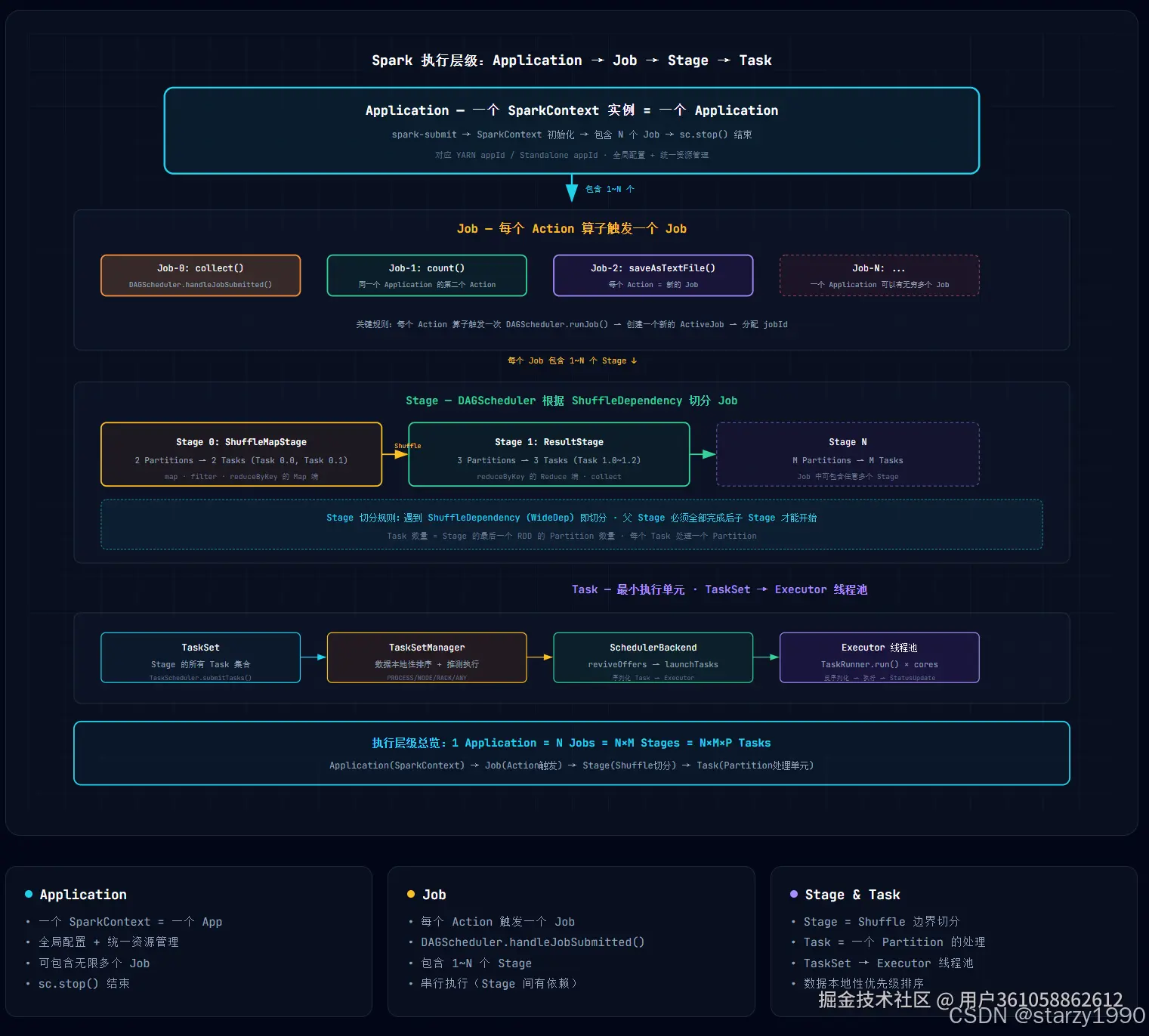
2.1 四层模型
scss
Application (SparkContext)
  │
  ├── Job-0 (调用 collect() 触发)
  │     ├── Stage 0 (ShuffleMapStage: 2 Tasks)
  │     └── Stage 1 (ResultStage: 3 Tasks)
  │
  ├── Job-1 (调用 count() 触发)
  │     ├── Stage 2 (ShuffleMapStage: 2 Tasks)
  │     └── Stage 3 (ResultStage: 3 Tasks)
  │
  └── Job-2 (调用 saveAsTextFile() 触发)
        ├── Stage 4 (ShuffleMapStage: 2 Tasks)
        └── Stage 5 (ResultStage: 3 Tasks)
三、Action 触发 Job 的源码链路 🔥
scala
// 源码:RDD.scala - collect()
def collect(): Array[T] = withScope {
  val results = sc.runJob(this, (iter: Iterator[T]) => iter.toArray)
  results.flatten
}

// 源码:RDD.scala - count()
def count(): Long = sc.runJob(this, Utils.getIteratorSize _).sum

// 源码:RDD.scala - saveAsTextFile()
def saveAsTextFile(path: String): Unit = {
  // ... 内部最终调用 sc.runJob()
}

// 核心链路
// Action → sc.runJob() → DAGScheduler.runJob()
//   → DAGScheduler.handleJobSubmitted()
//   → 创建 ActiveJob → Stage 切分 → submitStage()
3.1 哪些算子是 Action?
| 算子 | 返回类型 | 说明 |
|---|---|---|
collect() |
ArrayT | 拉取所有数据到 Driver |
count() |
Long | 计数 |
take(n) |
ArrayT | 取前 n 个 |
reduce(f) |
T | 聚合 |
foreach(f) |
Unit | 遍历 |
saveAsTextFile() |
Unit | 保存到文件 |
first() |
T | 取第一个 |
反直觉点 :reduceByKey 不是 Action!它是 Transformation,触发 Shuffle 但不触发 Job。
四、Stage 切分规则
scala
// 源码:DAGScheduler.scala
private def getMissingParentStages(stage: Stage): List[Stage] = {
  stage.rdd.dependencies.flatMap {
    case shufDep: ShuffleDependency[_, _, _] =>
      // WideDep → 切分 → 创建父 ShuffleMapStage
      getOrCreateShuffleMapStage(shufDep, stage.firstJobId)
    case _ => Nil  // NarrowDep → 不切分,保持在同一 Stage
  }.toList
}一句话规则:遇到 ShuffleDependency (Wide Dependency) 即切分 Stage。
五、多 Job 实战示例
scala
val rdd = sc.parallelize(1 to 1000, 4)  // 4 Partitions

// Job 1: count
println(s"Count: ${rdd.count()}")       // Action → Job-1
// Job 2: collect
val arr = rdd.collect()                 // Action → Job-2 (无 Shuffle, 1 Stage)
// Job 3: save
rdd.saveAsTextFile("hdfs:///output")    // Action → Job-3

// 总计: 3 个 Job, 3×1=3 个 ResultStage
scala
// 带 Shuffle 的场景
val rdd = sc.parallelize(1 to 1000, 4)
  .map(x => (x % 10, x))                // Narrow
  .groupByKey()                          // Wide! Stage 边界

rdd.count()  // Action → Job-1: Stage 0 (ShuffleMapStage) + Stage 1 (ResultStage)
六、Application/Job/Stage/Task 对比表
| 层级 | 定义 | 触发条件 | 数量 |
|---|---|---|---|
| Application | SparkContext 实例 | spark-submit | 1 |
| Job | 一个 Action 的完整计算 | Action 算子 | 1~N |
| Stage | Shuffle 边界切分的计算阶段 | ShuffleDependency | 每个 Job 1~N |
| Task | 处理一个 Partition 的最小单元 | Stage 内 Partition 数 | 每个 Stage 1~N |
七、总结
| 要点 | 总结 |
|---|---|
| 层级关系 | 1 App = N Jobs = N×M Stages = N×M×P Tasks |
| Job 触发 | 每个 Action 算子调用 sc.runJob() 创建新 Job |
| Stage 切分 | 遇到 ShuffleDependency 即切分 |
| Task 生成 | Stage 最后一个 RDD 的 Partition 数量 = Task 数 |
金句:Transformation 是"画图纸"(构建 DAG),Action 是"按下启动键"(触发 Job)。一个 Application 可以画无数张图纸,但只有按下的启动键才算数。
作者:starzy | AI Data Engineer / 大数据技术实践者
博客:blog.starzy.cn | GitHub:starzy1990.github.io
专注 AI Agent · LangGraph · RAG · 大数据架构 · 数据工程实践