首先贴出最重要的模型图
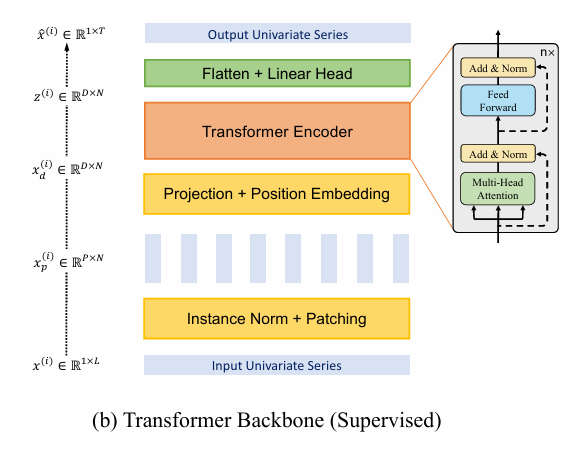
分别从两部分进行讲解
1.patch部分
2.Encoder部分
3.预测部分(Flatten部分)
1.patch部分
主要是class PatchTST_backbone
和TSTiEncoder(分patch主要核心)
2.Encoder部分
还是在PatchTST_backbone.py文件中
主要由TSTEncoderLayer和_MultiheadAttention类组成
2.1先给出TSTEncoderLayer主体代码
class TSTEncoderLayer(nn.Module):
    def __init__(self, q_len, d_model, n_heads, d_k=None, d_v=None, d_ff=256, store_attn=False,
                 norm='BatchNorm', attn_dropout=0, dropout=0., bias=True, activation="gelu", res_attention=False, pre_norm=False):
        super().__init__()
        assert not d_model%n_heads, f"d_model ({d_model}) must be divisible by n_heads ({n_heads})"
        d_k = d_model // n_heads if d_k is None else d_k
        d_v = d_model // n_heads if d_v is None else d_v

        # Multi-Head attention
        self.res_attention = res_attention
        self.self_attn = _MultiheadAttention(d_model, n_heads, d_k, d_v, attn_dropout=attn_dropout, proj_dropout=dropout, res_attention=res_attention)

        # Add & Norm
        self.dropout_attn = nn.Dropout(dropout)#随机丢弃
        if "batch" in norm.lower():
            self.norm_attn = nn.Sequential(Transpose(1,2), nn.BatchNorm1d(d_model), Transpose(1,2))
        else:
            self.norm_attn = nn.LayerNorm(d_model)#层归一化

        # Position-wise Feed-Forward
        self.ff = nn.Sequential(nn.Linear(d_model, d_ff, bias=bias),# d_model ->d_ff
                                get_activation_fn(activation),#gelu
                                nn.Dropout(dropout),#随机丢弃
                                nn.Linear(d_ff, d_model, bias=bias))#还原

        # Add & Norm
        self.dropout_ffn = nn.Dropout(dropout)
        if "batch" in norm.lower():
            self.norm_ffn = nn.Sequential(Transpose(1,2), nn.BatchNorm1d(d_model), Transpose(1,2))
        else:
            self.norm_ffn = nn.LayerNorm(d_model)

        self.pre_norm = pre_norm
        self.store_attn = store_attn


    def forward(self, src:Tensor, prev:Optional[Tensor]=None, key_padding_mask:Optional[Tensor]=None, attn_mask:Optional[Tensor]=None) -> Tensor:

        # Multi-Head attention sublayer
        if self.pre_norm:
            src = self.norm_attn(src)#层归一化
        ## Multi-Head attention
        if self.res_attention:#默认false
            src2, attn, scores = self.self_attn(src, src, src, prev, key_padding_mask=key_padding_mask, attn_mask=attn_mask)
        else:#三个src是Q,K,V self_attn -> _MultiheadAttention方法
            src2, attn = self.self_attn(src, src, src, key_padding_mask=key_padding_mask, attn_mask=attn_mask)
        if self.store_attn:
            self.attn = attn
        ## Add & Norm
        src = src + self.dropout_attn(src2) # Add: residual connection with residual dropout    #残差连接src是原本的内容
        if not self.pre_norm:
            src = self.norm_attn(src)

        # Feed-forward sublayer
        if self.pre_norm:
            src = self.norm_ffn(src)
        ## Position-wise Feed-Forward
        src2 = self.ff(src)
        ## Add & Norm
        src = src + self.dropout_ffn(src2) # Add: residual connection with residual dropout
        if not self.pre_norm:
            src = self.norm_ffn(src)#归一化

        if self.res_attention:#默认false
            return src, scores#一般不开
        else:
            return src
def __init__定义方法:多头注意力-Add Norm-Feed Forward-Add Norm
1.Multi-Head attention里调用了另一个类_MultiheadAttention,这也是多头注意力核心
        # Multi-Head attention
        self.res_attention = res_attention
        self.self_attn = _MultiheadAttention(d_model, n_heads, d_k, d_v, attn_dropout=attn_dropout, proj_dropout=dropout, res_attention=res_attention)
2.Add & Norm总结起来就两句,先随机丢弃,然后合并完后调用归一化
        # Add & Norm
        self.dropout_attn = nn.Dropout(dropout)#随机丢弃

        self.norm_attn = nn.LayerNorm(d_model)#层归一化
3.Feed Forward 他是先用Linear扩展d_model至更高维度,然后relu后随机丢弃一部分,然后Linear还原
        self.ff = nn.Sequential(nn.Linear(d_model, d_ff, bias=bias),# d_model ->d_ff
                                get_activation_fn(activation),#gelu
                                nn.Dropout(dropout),#随机丢弃
                                nn.Linear(d_ff, d_model, bias=bias))#还原
其余从def forward开始看
由于很多默认false所以总结起来就下面几段代码:
## Multi-Head attention
        else:#三个src是Q,K,V self_attn -> _MultiheadAttention方法
            src2, attn = self.self_attn(src, src, src, key_padding_mask=key_padding_mask, attn_mask=attn_mask)

## Add & Norm
        src = src + self.dropout_attn(src2) # Add: residual connection with residual dropout    #残差连接src是原本的内容
        if not self.pre_norm:
            src = self.norm_attn(src)#层归一化

## Position-wise Feed-Forward
        src2 = self.ff(src)

## Add & Norm
        src = src + self.dropout_attn(src2) # Add: residual connection with residual dropout    #残差连接src是原本的内容
        if not self.pre_norm:
            src = self.norm_attn(src)#层归一化

 return src
2.2给出_MultiheadAttention代码
首先给出参数解释:n_heads:多头量 d_model:维度 K和V都是空
class _MultiheadAttention(nn.Module):
    def __init__(self, d_model, n_heads, d_k=None, d_v=None, res_attention=False, attn_dropout=0., proj_dropout=0., qkv_bias=True, lsa=False):
        """Multi Head Attention Layer
        Input shape:
            Q:       [batch_size (bs) x max_q_len x d_model]
            K, V:    [batch_size (bs) x q_len x d_model]
            mask:    [q_len x q_len]
        """
        super().__init__()
        d_k = d_model // n_heads if d_k is None else d_k
        d_v = d_model // n_heads if d_v is None else d_v

        self.n_heads, self.d_k, self.d_v = n_heads, d_k, d_v

        self.W_Q = nn.Linear(d_model, d_k * n_heads, bias=qkv_bias)
        self.W_K = nn.Linear(d_model, d_k * n_heads, bias=qkv_bias)
        self.W_V = nn.Linear(d_model, d_v * n_heads, bias=qkv_bias)

        # Scaled Dot-Product Attention (multiple heads)
        self.res_attention = res_attention
        self.sdp_attn = _ScaledDotProductAttention(d_model, n_heads, attn_dropout=attn_dropout, res_attention=self.res_attention, lsa=lsa)

        # Poject output
        self.to_out = nn.Sequential(nn.Linear(n_heads * d_v, d_model), nn.Dropout(proj_dropout))


    def forward(self, Q:Tensor, K:Optional[Tensor]=None, V:Optional[Tensor]=None, prev:Optional[Tensor]=None,
                key_padding_mask:Optional[Tensor]=None, attn_mask:Optional[Tensor]=None):

        bs = Q.size(0)
        if K is None: K = Q
        if V is None: V = Q

        # Linear (+ split in multiple heads)
        q_s = self.W_Q(Q).view(bs, -1, self.n_heads, self.d_k).transpose(1,2)       # q_s    : [bs x n_heads x max_q_len x d_k]
        k_s = self.W_K(K).view(bs, -1, self.n_heads, self.d_k).permute(0,2,3,1)     # k_s    : [bs x n_heads x d_k x q_len] - transpose(1,2) + transpose(2,3)
        v_s = self.W_V(V).view(bs, -1, self.n_heads, self.d_v).transpose(1,2)       # v_s    : [bs x n_heads x q_len x d_v]

        # Apply Scaled Dot-Product Attention (multiple heads)
        if self.res_attention:
            output, attn_weights, attn_scores = self.sdp_attn(q_s, k_s, v_s, prev=prev, key_padding_mask=key_padding_mask, attn_mask=attn_mask)
        else:
            output, attn_weights = self.sdp_attn(q_s, k_s, v_s, key_padding_mask=key_padding_mask, attn_mask=attn_mask)
        # output: [bs x n_heads x q_len x d_v], attn: [bs x n_heads x q_len x q_len], scores: [bs x n_heads x max_q_len x q_len]

        # back to the original inputs dimensions
        output = output.transpose(1, 2).contiguous().view(bs, -1, self.n_heads * self.d_v) # output: [bs x q_len x n_heads * d_v]
        output = self.to_out(output)

        if self.res_attention: return output, attn_weights, attn_scores
        else: return output, attn_weights
首先处理维度,讲d_model展平为n_heads × d_k维度,前者是多头数
        d_k = d_model // n_heads if d_k is None else d_k#Q,K维度
d_v = d_model // n_heads if d_v is None else d_v#V维度然后计算矩阵:混合后的batch,patch数量,多头数,d_k
        self.W_Q = nn.Linear(d_model, d_k * n_heads, bias=qkv_bias)#算Q [bs x q_len x n_heads x d_k]
        self.W_K = nn.Linear(d_model, d_k * n_heads, bias=qkv_bias)#算K
        self.W_V = nn.Linear(d_model, d_v * n_heads, bias=qkv_bias)#算V
点积注意力(就是transformer源码)
        self.sdp_attn = _ScaledDotProductAttention(d_model, n_heads, attn_dropout=attn_dropout, res_attention=self.res_attention, lsa=lsa)
#调用了点积注意力
输出
self.to_out = nn.Sequential(nn.Linear(n_heads * d_v, d_model), nn.Dropout(proj_dropout))#还原维度+丢弃一部分从def forward开始看流程
首先分配QKV,K,V复制Q的内容
        bs = Q.size(0)
        if K is None: K = Q
        if V is None: V = Q
做矩阵运算,QKV采用不同方式做
        # Linear (+ split in multiple heads)
        q_s = self.W_Q(Q).view(bs, -1, self.n_heads, self.d_k).transpose(1,2)       # q_s    : [bs x n_heads x max_q_len x d_k]
        k_s = self.W_K(K).view(bs, -1, self.n_heads, self.d_k).permute(0,2,3,1)     # k_s    : [bs x n_heads x d_k x q_len] - transpose(1,2) + transpose(2,3)
        v_s = self.W_V(V).view(bs, -1, self.n_heads, self.d_v).transpose(1,2)       # v_s    : [bs x n_heads x q_len x d_v]

做之前维度是[bs x q_len x d_model]
Q先拆分d_model维度变为n_heads x d_k,然后置换q_len和n_heads
K拆分d_model维度,然后换成了bs x n_heads x d_k x q_len
V拆分维度,然后同Q
然后做点积(调用_ScaledDotProductAttention新类后面放上来)
output, attn_weights = self.sdp_attn(q_s, k_s, v_s, key_padding_mask=key_padding_mask, attn_mask=attn_mask)最后输出
        # back to the original inputs dimensions
        output = output.transpose(1, 2).contiguous().view(bs, -1, self.n_heads * self.d_v) # output: [bs x q_len x n_heads * d_v]
        output = self.to_out(output)#还原维度+丢弃一部分
2.3给出_ScaledDotProductAttention代码(transformer)
class _ScaledDotProductAttention(nn.Module):
    r"""Scaled Dot-Product Attention module (Attention is all you need by Vaswani et al., 2017) with optional residual attention from previous layer
    (Realformer: Transformer likes residual attention by He et al, 2020) and locality self sttention (Vision Transformer for Small-Size Datasets
    by Lee et al, 2021)"""

    def __init__(self, d_model, n_heads, attn_dropout=0., res_attention=False, lsa=False):
        super().__init__()
        self.attn_dropout = nn.Dropout(attn_dropout)
        self.res_attention = res_attention
        head_dim = d_model // n_heads
        self.scale = nn.Parameter(torch.tensor(head_dim ** -0.5), requires_grad=lsa)
        self.lsa = lsa

    def forward(self, q:Tensor, k:Tensor, v:Tensor, prev:Optional[Tensor]=None, key_padding_mask:Optional[Tensor]=None, attn_mask:Optional[Tensor]=None):
        '''
        Input shape:
            q               : [bs x n_heads x max_q_len x d_k]
            k               : [bs x n_heads x d_k x seq_len]
            v               : [bs x n_heads x seq_len x d_v]
            prev            : [bs x n_heads x q_len x seq_len]
            key_padding_mask: [bs x seq_len]
            attn_mask       : [1 x seq_len x seq_len]
        Output shape:
            output:  [bs x n_heads x q_len x d_v]
            attn   : [bs x n_heads x q_len x seq_len]
            scores : [bs x n_heads x q_len x seq_len]
        '''

        # Scaled MatMul (q, k) - similarity scores for all pairs of positions in an input sequence
        attn_scores = torch.matmul(q, k) * self.scale      # attn_scores : [bs x n_heads x max_q_len x q_len]

        # Add pre-softmax attention scores from the previous layer (optional)
        if prev is not None: attn_scores = attn_scores + prev

        # Attention mask (optional)
        if attn_mask is not None:                                     # attn_mask with shape [q_len x seq_len] - only used when q_len == seq_len
            if attn_mask.dtype == torch.bool:
                attn_scores.masked_fill_(attn_mask, -np.inf)
            else:
                attn_scores += attn_mask

        # Key padding mask (optional)
        if key_padding_mask is not None:                              # mask with shape [bs x q_len] (only when max_w_len == q_len)
            attn_scores.masked_fill_(key_padding_mask.unsqueeze(1).unsqueeze(2), -np.inf)

        # normalize the attention weights
        attn_weights = F.softmax(attn_scores, dim=-1)                 # attn_weights   : [bs x n_heads x max_q_len x q_len]
        attn_weights = self.attn_dropout(attn_weights)

        # compute the new values given the attention weights
        output = torch.matmul(attn_weights, v)                        # output: [bs x n_heads x max_q_len x d_v]

        if self.res_attention: return output, attn_weights, attn_scores
        else: return output, attn_weights
forward开始看:
第一句就是核心
attn_scores = torch.matmul(q, k) * self.scale # attn_scores : [bs x n_heads x max_q_len x q_len]也就是下图的QK/根号d

其他的都没开,默认做上图接下来的softmax
# normalize the attention weights
        attn_weights = F.softmax(attn_scores, dim=-1)                 # attn_weights   : [bs x n_heads x max_q_len x q_len]
        attn_weights = self.attn_dropout(attn_weights)
接下来×V
        # compute the new values given the attention weights
        output = torch.matmul(attn_weights, v)                        # output: [bs x n_heads x max_q_len x d_v]
3.Flatten部分
最后Flatten_Head类
class Flatten_Head(nn.Module):
    def __init__(self, individual, n_vars, nf, target_window, head_dropout=0):
        super().__init__()

        self.individual = individual
        self.n_vars = n_vars

        if self.individual:
            self.linears = nn.ModuleList()
            self.dropouts = nn.ModuleList()
            self.flattens = nn.ModuleList()
            for i in range(self.n_vars):
                self.flattens.append(nn.Flatten(start_dim=-2))
                self.linears.append(nn.Linear(nf, target_window))
                self.dropouts.append(nn.Dropout(head_dropout))
        else:
            self.flatten = nn.Flatten(start_dim=-2)
            self.linear = nn.Linear(nf, target_window)
            self.dropout = nn.Dropout(head_dropout)

    def forward(self, x):                                 # x: [bs x nvars x d_model x patch_num]
        if self.individual:
            x_out = []
            for i in range(self.n_vars):
                z = self.flattens[i](x[:,i,:,:])          # z: [bs x d_model * patch_num]
                z = self.linears[i](z)         # z: [bs x target_window]
                z = self.dropouts[i](z)
                x_out.append(z)
            x = torch.stack(x_out, dim=1)                 # x: [bs x nvars x target_window]
        else:
            x = self.flatten(x)
            x = self.linear(x)
            x = self.dropout(x)
        return x
依旧拆分,其中论文提供了通道独立和通道混合两种方法:
主要集中在下面代码中,标注已在代码写出
其中flattens做的是一个个取通道,linears做的预测,dropouts扔一点,stack拼接通道得到最终的预测
    def forward(self, x):                                 # x: [bs x nvars x d_model x patch_num]
        if self.individual:#开启通道独立情况
            x_out = []
            for i in range(self.n_vars):#一个个取通道
                z = self.flattens[i](x[:,i,:,:])          # z: [bs x d_model * patch_num]
                z = self.linears[i](z)   #用d_model * patch_num做预测输出target_window       # z: [bs x target_window]
                z = self.dropouts[i](z)  #随机扔一点
                x_out.append(z)
            x = torch.stack(x_out, dim=1) #7个通道拼回去                # x: [bs x nvars x target_window]
题外:
论文提供了M,S,MS三种,分别代表只有单变量,多变量但通道独立,多变量并且通道混合的情况,论文中默认开启的是S
如果你想自己复现 S 或 MS,只要改两行:
# S版本(单变量)
c_in=1, n_vars=1

# MS版本(多变量共享)
individual=False   # ← 只改这一行就行!