(十)自然语言处理笔记------基于Bert的文本分类的项目
- 实验数据集介绍:
- 实验1:基于Bert的文本分类项目
- [实验2:基于Bert + TextCNN 的文本分类项目](#实验2:基于Bert + TextCNN 的文本分类项目)
- [实验3:基于Bert + BiLSTM的文本分类项目](#实验3:基于Bert + BiLSTM的文本分类项目)
- [实验4:基于Bert + RCNN的文本分类项目](#实验4:基于Bert + RCNN的文本分类项目)
- [实验5:基于Bert + DPCNN的文本分类项目](#实验5:基于Bert + DPCNN的文本分类项目)
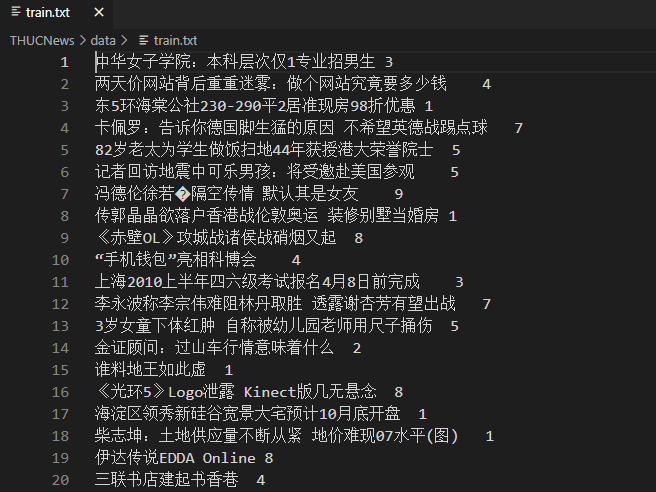
实验数据集介绍:
本博文采用的文本分类数据集主要包含七个类别,依次如下:
| 英文 | 中文 |
|---|---|
| finance | 财经 / 金融 |
| realty | 房地产 |
| stocks | 股票 |
| education | 教育 |
| science | 科学 |
| society | 社会 |
| politics | 政治 |
| sports | 体育 |
| game | 游戏 |
| entertainment | 娱乐 |
实验1:基于Bert的文本分类项目
模型结构:BERT + 全连接分类头

python
#!/usr/bin/python
# -*- coding: UTF-8 -*-


import torch
import torch.nn as nn
from pytorch_pretrained import BertModel, BertTokenizer

class Config(object):
    """
    配置参数
    """
    def __init__(self, dataset):
        self.model_name = 'BruceBert'
        # 训练集
        self.train_path = dataset + '/data/train.txt'
        # 测试集
        self.test_path = dataset + '/data/test.txt'
        # 校验集
        self.dev_path = dataset + '/data/dev.txt'
        # dataset
        self.datasetpkl = dataset + '/data/dataset.pkl'
        # 类别
        self.class_list = [ x.strip() for x in open(dataset + '/data/class.txt').readlines()]
        #模型训练结果
        self.save_path = dataset + '/saved_dict/' + self.model_name + '.ckpt'
        # 设备配置
        self.device = torch.device( 'cuda' if torch.cuda.is_available() else 'cpu')

        # 若超过1000bacth效果还没有提升,提前结束训练
        self.require_improvement = 1000

        # 类别数
        self.num_classes = len(self.class_list)
        # epoch数
        self.num_epochs = 200   # 训练轮次
        # batch_size
        self.batch_size = 512    # 批次数目
        # 每句话处理的长度(短填,长切)
        self.pad_size = 32
        # 学习率
        self.learning_rate = 1e-5
        # bert预训练模型位置
        self.bert_path = 'bert_pretrain'
        # bert切词器
        self.tokenizer = BertTokenizer.from_pretrained(self.bert_path)
        # bert隐层层个数
        self.hidden_size = 768


class Model(nn.Module):

    def __init__(self, config):
        super(Model, self).__init__()
        self.bert = BertModel.from_pretrained(config.bert_path)
        for param in self.bert.parameters():
            param.requires_grad = True  # 是否进行微调,微调:true;不微调:false
        self.fc = nn.Linear(config.hidden_size, config.num_classes)

    def forward(self, x):
        # x [ids, seq_len, mask]
        context = x[0] #对应输入的句子 shape[128,32]   [batch_size,序列长度]
        mask = x[2] #对padding部分进行mask shape[128,32]
        _, pooled = self.bert(context, attention_mask=mask, output_all_encoded_layers=False) #shape [128,768]
        out = self.fc(pooled) # shape [128,10]
        return out
python
Input IDs (batch_size, seq_len)
        │
        ├── Attention Mask (batch_size, seq_len)
        │
        ▼
┌─────────────────────────────┐
│        BERT Encoder          │
│  - Embedding + Transformer  │
│  - 输出隐藏状态 & CLS池化   │
└─────────────────────────────┘
        │
        ▼
   pooled_output (CLS)
   (batch_size, 768)
        │
        ▼
┌─────────────────────────────┐
│     Linear 全连接层          │
│   Linear(768 → num_classes) │
└─────────────────────────────┘
        │
        ▼
 logits (batch_size, num_classes)
测试结果:
python
Test Loss: 0.32, Test Acc:90.42%
Precision, Recall and F1-Score
               precision    recall  f1-score   support

      finance     0.8613    0.9070    0.8836      1000
       realty     0.9127    0.9310    0.9218      1000
       stocks     0.8348    0.8390    0.8369      1000
    education     0.9603    0.9180    0.9387      1000
      science     0.8918    0.8080    0.8478      1000
      society     0.8974    0.9010    0.8992      1000
     politics     0.8900    0.8820    0.8860      1000
       sports     0.9623    0.9710    0.9667      1000
         game     0.9180    0.9520    0.9347      1000
entertainment     0.9156    0.9330    0.9242      1000

     accuracy                         0.9042     10000
    macro avg     0.9044    0.9042    0.9040     10000
 weighted avg     0.9044    0.9042    0.9040     10000

Confusion Maxtrix
[[907  15  49   3   5   4  10   2   0   5]
 [ 16 931  16   1   3  11   5   6   3   8]
 [ 73  28 839   0  26   2  21   4   5   2]
 [  6   3   1 918   8  26  17   2   5  14]
 [ 16  10  52   3 808  20  18   1  52  20]
 [  7  15   6  13   8 901  25   3  10  12]
 [ 19   7  28  10  14  23 882   3   3  11]
 [  1   2   3   1   2   3   5 971   1  11]
 [  0   3   9   3  23   2   3   2 952   3]
 [  8   6   2   4   9  12   5  15   6 933]]
实验2:基于Bert + TextCNN 的文本分类项目
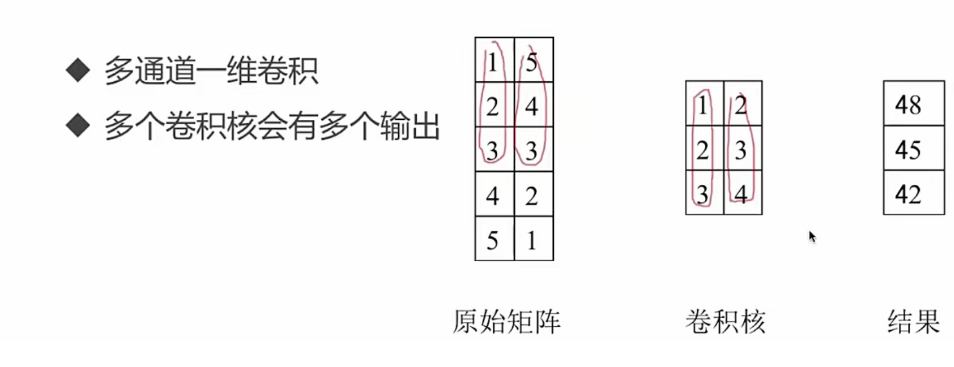
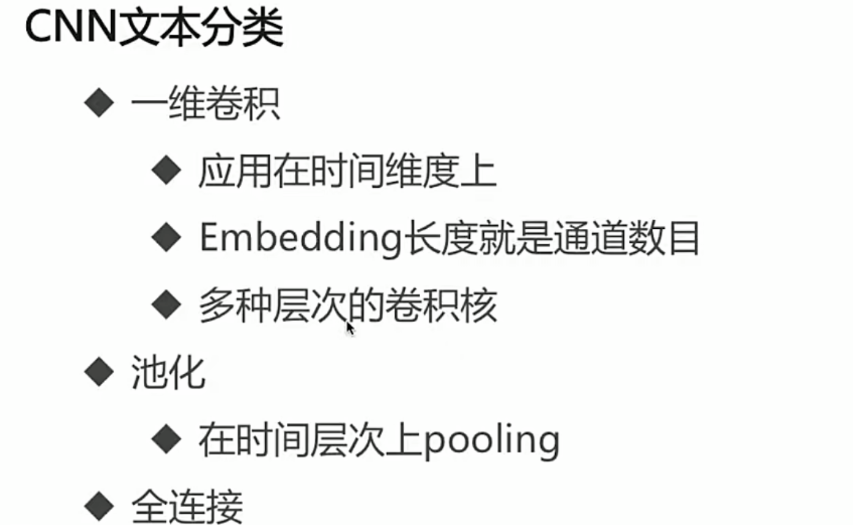
TextCNN 结构详解:
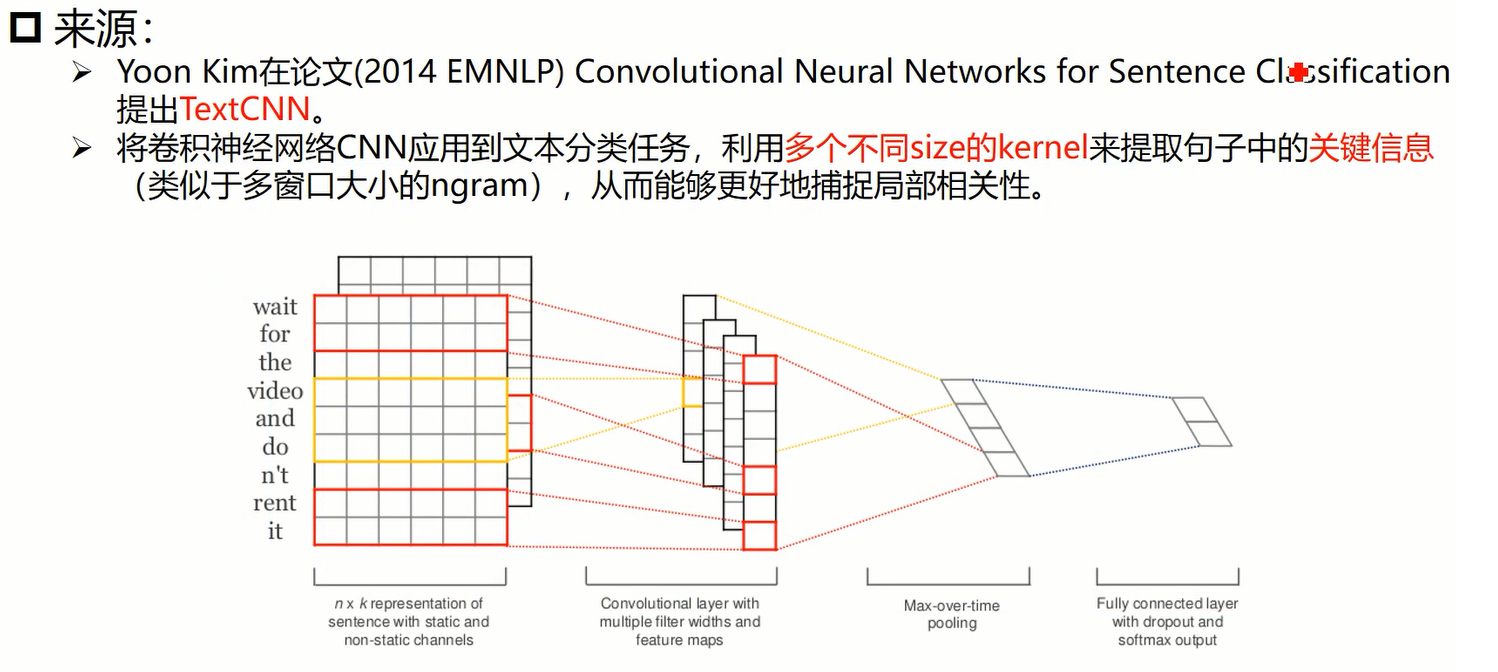
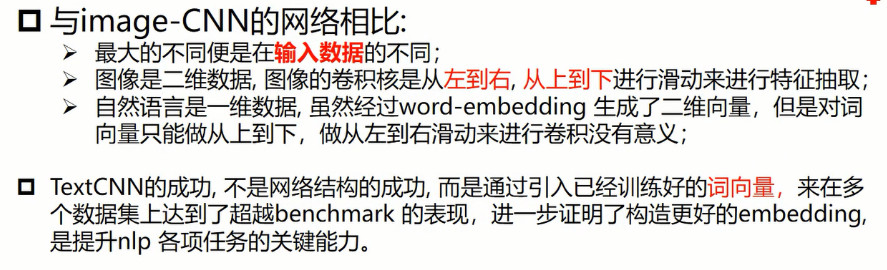
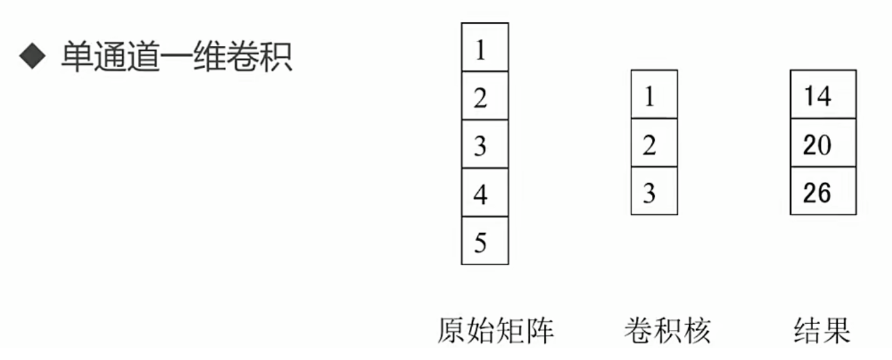
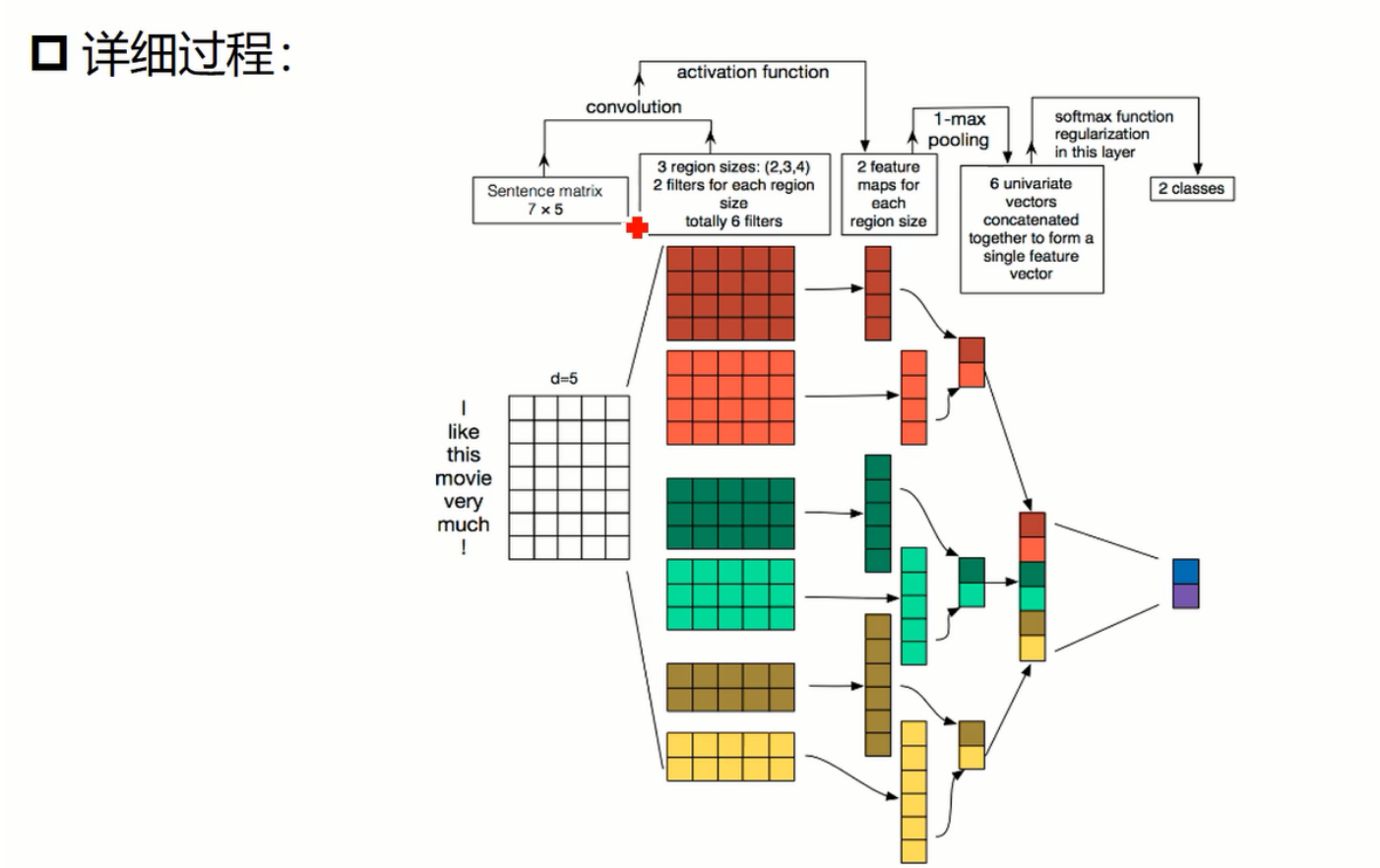
模型结构:

python
Input IDs (batch, seq_len)
Attention Mask
        │
        ▼
┌─────────────────────────────┐
│            BERT             │
│  输出 token embeddings      │
│  (batch, seq_len, 768)      │
└─────────────────────────────┘
        │
        ▼
unsqueeze(1)
(batch, 1, seq_len, 768)
        │
        ▼
┌───────────────┬───────────────┬───────────────┐
│ Conv2d k=2    │ Conv2d k=3    │ Conv2d k=4    │
│ (1→256)       │ (1→256)       │ (1→256)       │
└───────────────┴───────────────┴───────────────┘
        │
        ▼
ReLU + MaxPool1d
        │
        ▼
(每路输出: batch, 256)
        │
        ▼
Concatenate
(batch, 256×3 = 768)
        │
        ▼
Dropout
        │
        ▼
Linear → 分类
(batch, num_classes)
python
#!/usr/bin/python
# -*- coding: UTF-8 -*-

import torch
import torch.nn as nn
import torch.nn.functional as F
from pytorch_pretrained import BertModel, BertTokenizer

class Config(object):

    """配置参数"""
    def __init__(self, dataset):
        # 模型名称
        self.model_name="BruceBertCNN"
        # 训练集
        self.train_path = dataset + '/data/train.txt'
        # 校验集
        self.dev_path = dataset + '/data/dev.txt'
        # 测试集
        self.test_path = dataset + '/data/test.txt'
        #dataset
        self.datasetpkl = dataset + '/data/dataset.pkl'
        # 类别名单
        self.class_list = [ x.strip() for x in open(dataset + '/data/class.txt').readlines()]

        #模型保存路径
        self.save_path = dataset + '/saved_dict/' + self.model_name + '.ckpt'
        # 运行设备
        self.device = torch.device('cuda' if torch.cuda.is_available() else 'cpu')
        # 若超过1000bacth效果还没有提升,提前结束训练
        self.require_improvement= 1000
        # 类别数量
        self.num_classes = len(self.class_list)
        # epoch数
        self.num_epochs = 200
        # batch_size
        self.batch_size = 512
        # 序列长度
        self.pad_size = 32
        # 学习率
        self.learning_rate = 1e-5
        # 预训练位置
        self.bert_path = './bert_pretrain'
        # bert的 tokenizer
        self.tokenizer = BertTokenizer.from_pretrained((self.bert_path))
        # Bert的隐藏层数量
        self.hidden_size = 768
        # 卷积核尺寸
        self.filter_sizes = (2,3,4)
        # 卷积核数量
        self.num_filters = 256
        # droptout
        self.dropout = 0.5

class Model(nn.Module):
    def __init__(self, config):
        super(Model, self).__init__()
        self.bert = BertModel.from_pretrained(config.bert_path)
        for param in self.bert.parameters():
            param.requires_grad = True   # 是否进行微调:微调:True,不微调:False

        self.convs = nn.ModuleList(
             [nn.Conv2d(in_channels=1, out_channels=config.num_filters, kernel_size=(k, config.hidden_size)) for k in config.filter_sizes]
        )

        self.droptout = nn.Dropout(config.dropout)

        self.fc = nn.Linear(config.num_filters * len(config.filter_sizes), config.num_classes)   # 其其之前经过一次 torch.cat 操作

    def conv_and_pool(self, x, conv):
        x = conv(x)     # (批次数,1,32,768)---->(批次数,256,31,1)
        x = F.relu(x)
        x = x.squeeze(3)    #  (批次数,256,31,1) ---->(批次数,256,31)
        size = x.size(2)   # torch.Size([512, 256, 31])   size=31
        x = F.max_pool1d(x, size)    # torch.Size([512, 256, 31])------> torch.Size([512, 256, 1])
        x = x.squeeze(2)     # torch.Size([512, 256])
        return x


    def forward(self, x):
        # x [ids, seq_len, mask]
        context = x[0] #对应输入的句子 shape[128,32]
        mask = x[2] #对padding部分进行mask shape[128,32]
        encoder_out, pooled = self.bert(context, attention_mask = mask, output_all_encoded_layers = False) #shape [128,768]
        out = encoder_out.unsqueeze(1)  # 增加了一个通道的维度  shape由【批次数,序列长度,嵌入维度数】变为【批次数,通道数(1),序列长度,嵌入维度数】
        out = torch.cat([self.conv_and_pool(out, conv)for conv in self.convs], 1)   # 经过三次拼接后 shape变为torch.Size([512, 768])
        out = self.droptout(out)
        out = self.fc(out)
        return out   # 【批次数,类别数】


"""

nn.Conv2d(
    in_channels=1,
    out_channels=config.num_filters,   # 例如 256
    kernel_size=(k, config.hidden_size) # (k, 768)
)


假设:
config.hidden_size = 768(BERT-base)
k 是某个 filter size,比如 k = 2, 3, 4
stride = 1(默认)
padding = 0(默认)
dilation = 1(默认)

| k | 输出高度 |
| - | ---- |
| 2 | 31   |
| 3 | 30   |
| 4 | 29   |

你注释里的 31,说明这一层用的是:
k=2

归纳一下,就是二维卷积输出计算公式
nn.Conv2d(in_channels=1, out_channels=config.num_filters, kernel_size=(k, config.hidden_size))
"""
python
Test Loss:  0.3, Test Acc:90.34%
Precision, Recall and F1-Score
               precision    recall  f1-score   support

      finance     0.9180    0.8620    0.8891      1000
       realty     0.9083    0.9310    0.9195      1000
       stocks     0.8429    0.8260    0.8343      1000
    education     0.9464    0.9360    0.9412      1000
      science     0.8457    0.8440    0.8448      1000
      society     0.8701    0.9240    0.8962      1000
     politics     0.8866    0.8760    0.8813      1000
       sports     0.9836    0.9620    0.9727      1000
         game     0.9222    0.9360    0.9290      1000
entertainment     0.9133    0.9370    0.9250      1000

     accuracy                         0.9034     10000
    macro avg     0.9037    0.9034    0.9033     10000
 weighted avg     0.9037    0.9034    0.9033     10000

Confusion Maxtrix
[[862  21  68   5   9  12  14   1   3   5]
 [ 10 931  11   4   8  15   5   1   4  11]
 [ 47  29 826   1  51   7  29   3   4   3]
 [  1   1   1 936   7  25  12   1   3  13]
 [  2   9  40   6 844  23  15   1  40  20]
 [  1  11   1  13   8 924  19   0  10  13]
 [  9  12  27  13  17  28 876   1   5  12]
 [  1   2   2   3   5   7  10 962   0   8]
 [  2   4   3   4  37   5   3   2 936   4]
 [  4   5   1   4  12  16   5   6  10 937]]
使用时间: 0:00:05
Test Loss:  0.3, Test Acc:90.34%
实验3:基于Bert + BiLSTM的文本分类项目

python
Input IDs (batch, seq_len)
Attention Mask
        │
        ▼
┌──────────────────────────────┐
│             BERT             │
│ token embeddings             │
│ (batch, seq_len, 768)        │
└──────────────────────────────┘
        │
        ▼
┌──────────────────────────────┐
│        BiLSTM (2 layers)     │
│ hidden_size = 256 × 2        │
│ (batch, seq_len, 512)        │
└──────────────────────────────┘
        │
        ▼
Take last time step
(batch, 512)
        │
        ▼
Dropout
        │
        ▼
Linear → 分类
(batch, num_classes)
python
#!/usr/bin/python
# -*- coding: UTF-8 -*-


import torch
import torch.nn as nn
from pytorch_pretrained import BertModel, BertTokenizer

class Config(object):
    """配置参数"""
    def __init__(self, dataset):
        # 模型名称
        self.model_name = "BruceBertRNN"
        # 训练集
        self.train_path = dataset + '/data/train.txt'
        # 校验集
        self.dev_path = dataset + '/data/dev.txt'
        # 测试集
        self.test_path = dataset + '/data/test.txt'
        # dataset
        self.datasetpkl = dataset + '/data/dataset.pkl'
        # 类别名单
        self.class_list = [x.strip() for x in open(dataset + '/data/class.txt').readlines()]

        # 模型保存路径
        self.save_path = dataset + '/saved_dict/' + self.model_name + '.ckpt'
        # 运行设备
        self.device = torch.device('cuda' if torch.cuda.is_available() else 'cpu')
        # 若超过1000bacth效果还没有提升,提前结束训练
        self.require_improvement = 1000
        # 类别数量
        self.num_classes = len(self.class_list)
        # epoch数
        self.num_epochs = 200
        # batch_size
        self.batch_size = 128
        # 序列长度
        self.pad_size = 32
        # 学习率
        self.learning_rate = 1e-5
        # 预训练位置
        self.bert_path = './bert_pretrain'
        # bert的 tokenizer
        self.tokenizer = BertTokenizer.from_pretrained((self.bert_path))
        # Bert的隐藏层数量
        self.hidden_size = 768
        # RNN隐层层数量
        self.rnn_hidden = 256
        # rnn数量
        self.num_layers = 2
        # droptout
        self.dropout = 0.5

class Model(nn.Module):

    def __init__(self, config):
        super(Model, self).__init__()
        self.bert = BertModel.from_pretrained(config.bert_path)
        for param in self.bert.parameters():
            param.requires_grad = True

        self.lstm = nn.LSTM(config.hidden_size, config.rnn_hidden, config.num_layers, batch_first=True, dropout=config.dropout, bidirectional=True)  # nn.LSTM(输入特征维度,输出特征维度,隐藏层数)

        self.dropout = nn.Dropout(config.dropout)

        self.fc = nn.Linear(config.rnn_hidden * 2, config.num_classes)  # config.rnn_hidden * 2:因为是双向的LSTM

    def forward(self,x):
        # x [ids, seq_len, mask]
        context = x[0]  # 对应输入的句子 shape[128,32]
        mask = x[2]  # 对padding部分进行mask shape[128,32]
        encoder_out, text_cls = self.bert(context, attention_mask = mask, output_all_encoded_layers = False)
        out, _ = self.lstm(encoder_out)
        out = self.dropout(out)
        out = out[:,-1,:]  # 是提取每个样本序列最后一个时间步的输出   【批次,序列长度,数据维度】
        out = self.fc(out)
        return out
实验4:基于Bert + RCNN的文本分类项目
BERT + BiLSTM + MaxPool(RCNN 思想) 的文本分类模型。它融合了 上下文建模(BERT)+ 序列建模(RNN)+ 全局池化(CNN/RCNN)

python
Input IDs + Attention Mask
        │
        ▼
┌──────────────────────────────┐
│             BERT             │
│ (batch, seq_len, 768)        │
└──────────────────────────────┘
        │
        ▼
┌──────────────────────────────┐
│        BiLSTM (2 layers)     │
│ (batch, seq_len, 512)        │
└──────────────────────────────┘
        │
        ▼
ReLU
(batch, seq_len, 512)
        │
        ▼
Permute → (batch, 512, seq_len)
        │
        ▼
MaxPool1d (kernel = seq_len)
(batch, 512, 1)
        │
        ▼
Squeeze
(batch, 512)
        │
        ▼
Linear → 分类
(batch, num_classes)
python
#!/usr/bin/python
# -*- coding: UTF-8 -*-
# 微信公众号 AI壹号堂 欢迎关注
# Author 杨博

import torch
import torch.nn as nn
import torch.nn.functional as F
from pytorch_pretrained import BertModel, BertTokenizer

class Config(object):
    """配置参数"""
    def __init__(self, dataset):
        # 模型名称
        self.model_name = "BruceBertRCNN"
        # 训练集
        self.train_path = dataset + '/data/train.txt'
        # 校验集
        self.dev_path = dataset + '/data/dev.txt'
        # 测试集
        self.test_path = dataset + '/data/test.txt'
        # dataset
        self.datasetpkl = dataset + '/data/dataset.pkl'
        # 类别名单
        self.class_list = [x.strip() for x in open(dataset + '/data/class.txt').readlines()]

        # 模型保存路径
        self.save_path = dataset + '/saved_dict/' + self.model_name + '.ckpt'
        # 运行设备
        self.device = torch.device('cuda' if torch.cuda.is_available() else 'cpu')
        # 若超过1000bacth效果还没有提升,提前结束训练
        self.require_improvement = 1000
        # 类别数量
        self.num_classes = len(self.class_list)
        # epoch数
        self.num_epochs = 200
        # batch_size
        self.batch_size = 512
        # 序列长度
        self.pad_size = 32
        # 学习率
        self.learning_rate = 1e-5
        # 预训练位置
        self.bert_path = './bert_pretrain'
        # bert的 tokenizer
        self.tokenizer = BertTokenizer.from_pretrained((self.bert_path))
        # Bert的隐藏层数量
        self.hidden_size = 768
        # RNN隐层层数量
        self.rnn_hidden = 256
        # rnn数量
        self.num_layers = 2
        # droptout
        self.dropout = 0.5

class Model(nn.Module):
    def __init__(self, config):
        super(Model, self).__init__()
        self.bert = BertModel.from_pretrained(config.bert_path)
        for param in self.bert.parameters():
            param.requires_grad = True
        self.lstm = nn.LSTM(config.hidden_size, config.rnn_hidden, config.num_layers, bidirectional=True, batch_first=True, dropout=config.dropout)
        self.maxpool = nn.MaxPool1d(config.pad_size)
        self.fc = nn.Linear(config.rnn_hidden*2, config.num_classes)


    def forward(self, x):
        context = x[0]
        mask = x[2]
        encoder_out, text_cls = self.bert(context, attention_mask = mask, output_all_encoded_layers=False)
        out, _ = self.lstm(encoder_out)
        out = F.relu(out)
        out = out.permute(0,2,1)
        out = self.maxpool(out)
        out = out.squeeze()
        out = self.fc(out)
        return out
实验5:基于Bert + DPCNN的文本分类项目
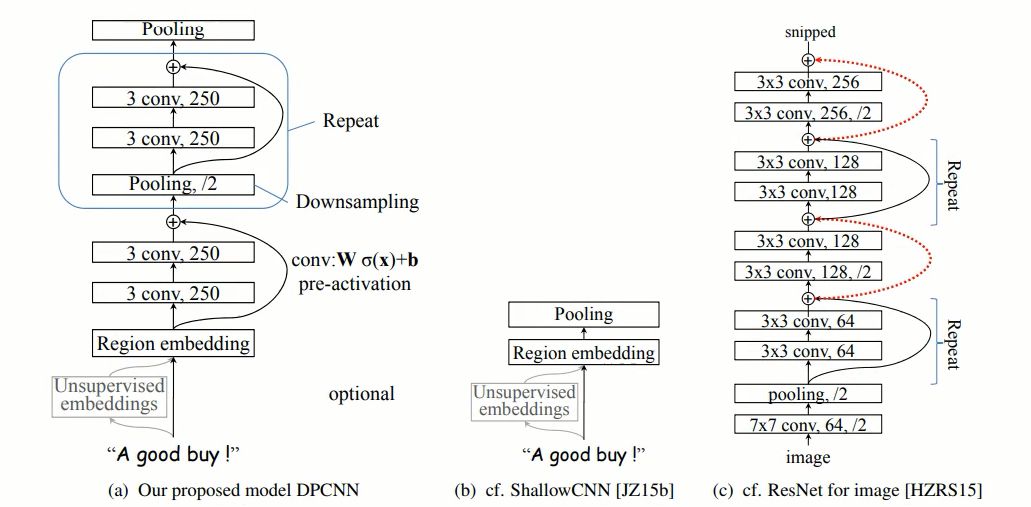
python
输入文本 token ids [batch, seq_len]
         │
         ▼
     BERT 编码层
  encoder_out: [batch, seq_len, hidden_size=768]
         │
         ▼
   unsqueeze -> [batch, 1, seq_len, hidden_size]
         │
         ▼
   conv_region (3xhidden_size, out_channels=250)
   输出: [batch, 250, seq_len-3+1, 1]
         │
         ▼
     padd1 + ReLU
         │
         ▼
       conv (3x1)
         │
         ▼
     padd1 + ReLU
         │
         ▼
       conv (3x1)
         │
         ▼
       while seq_len > 2:
           _block:
               ┌───────────────┐
               │ padding       │
               │ max_pool (3x1)│
               │ conv → ReLU   │
               │ conv → ReLU   │
               │ + 残差连接(px) │
               └───────────────┘
         │
         ▼
      squeeze -> [batch, num_filters=250]
         │
         ▼
      全连接层 fc
         │
         ▼
      输出 logits [batch, num_classes]
python
#!/usr/bin/python
# -*- coding: UTF-8 -*-
# 微信公众号 AI壹号堂 欢迎关注
# Author 杨博

import torch
import torch.nn as nn
import torch.nn.functional as F
from pytorch_pretrained import BertModel, BertTokenizer

class Config(object):
    """配置参数"""
    def __init__(self, dataset):
        # 模型名称
        self.model_name = "BruceBertDPCNN"
        # 训练集
        self.train_path = dataset + '/data/train.txt'
        # 校验集
        self.dev_path = dataset + '/data/dev.txt'
        # 测试集
        self.test_path = dataset + '/data/test.txt'
        # dataset
        self.datasetpkl = dataset + '/data/dataset.pkl'
        # 类别名单
        self.class_list = [x.strip() for x in open(dataset + '/data/class.txt').readlines()]

        # 模型保存路径
        self.save_path = dataset + '/saved_dict/' + self.model_name + '.ckpt'
        # 运行设备
        self.device = torch.device('cuda' if torch.cuda.is_available() else 'cpu')
        # 若超过1000bacth效果还没有提升,提前结束训练
        self.require_improvement = 1000
        # 类别数量
        self.num_classes = len(self.class_list)
        # epoch数
        self.num_epochs = 3
        # batch_size
        self.batch_size = 128
        # 序列长度
        self.pad_size = 32
        # 学习率
        self.learning_rate = 1e-5
        # 预训练位置
        self.bert_path = './bert_pretrain'
        # bert的 tokenizer
        self.tokenizer = BertTokenizer.from_pretrained((self.bert_path))
        # Bert的隐藏层数量
        self.hidden_size = 768
        # RNN隐层层数量
        self.rnn_hidden = 256
        # 卷积核数量
        self.num_filters = 250
        # droptout
        self.dropout = 0.5


class Model(nn.Module):
    def __init__(self, config):
        super(Model, self).__init__()
        self.bert = BertModel.from_pretrained(config.bert_path)
        for param in self.bert.parameters():
            param.requires_grad = True

        self.conv_region = nn.Conv2d(1, config.num_filters, (3, config.hidden_size))

        self.conv = nn.Conv2d(config.num_filters, config.num_filters, (3, 1))

        self.max_pool = nn.MaxPool2d(kernel_size=(3,1), stride=2)

        self.padd1 = nn.ZeroPad2d((0,0,1,1))
        self.padd2 = nn.ZeroPad2d((0,0,0,1))
        self.relu = nn.ReLU()

        self.fc = nn.Linear(config.num_filters, config.num_classes)

    def forward(self, x):
        context = x[0]
        mask = x[2]
        encoder_out, text_cls = self.bert(context, attention_mask = mask, output_all_encoded_layers = False)
        out = encoder_out.unsqueeze(1) #[batch_size, 1, seq_len, embed]
        out = self.conv_region(out) #[batch_size, 250, seq_len-3+1, 1]

        out = self.padd1(out) #[batch_size, 250, seq_len,1]
        out = self.relu(out)
        out = self.conv(out) #[batch_size, 250, seq_len-3+1,1]
        out = self.padd1(out)  # [batch_size, 250, seq_len,1]
        out = self.relu(out)
        out = self.conv(out)  # [batch_size, 250, seq_len-3+1,1]
        while out.size()[2] > 2:
            out = self._block(out)
        out = out.squeeze()
        out = self.fc(out)
        return out

    def _block(self, x):
        x = self.padd2(x)
        px = self.max_pool(x)
        x = self.padd1(px)
        x = self.relu(x)
        x = self.conv(x)
        x = self.padd1(x)
        x = self.relu(x)
        x = self.conv(x)
        x = x + px
        return x