二叉搜索树
左子树<=根,右子树>=根
根据需求不同,等于的元素可能会被去重也可能会被留下
这样查找一个数就可以只遍历一次,数大选哪个右走,小往左走
查找效率:ologn~on
改进:AVL树,红黑树,B树系列,查找效率:ologn
模拟实现(不多插入相同元素)
一.Key结构
1. 节点的定义
cpp
template<class K>
struct bsnode
{
    K _key;
    bsnode* _left;
    bsnode* _right;
    bsnode(const K& key)
        :_key(key)
        ,_left(nullptr)
        ,_right(nullptr)
    {}
};
2. 成员
cpp
typedef bsnode<K> node;
node* _root = nullptr;这样,可以不用写构造函数3. 二叉树的插入
cpp
bool insert(const K& key)
{
    if (_root == nullptr)
    {
        _root = new node(key);
        return 1;
    }
    node* cur = _root;
    node* par = nullptr;
    while (cur != nullptr)
    {
        if (cur->_key < key)
        {
            par = cur;
            cur = cur->_right;
        }
        else if (cur->_key > key)
        {
            par = cur;
            cur = cur->_left;
        }
        else
        {
            return 0;
        }
    }
    node* newnode = new node(key);
    if (par->_key < key)
    {
        par->_right = newnode;
    }
    else
    {
        par->_left = newnode;
    }
    return 1;
}方案:定一个cur的指针,当根节点小于插入元素,向右走,大于则向左走
如果已经有这个数了,则返回false
如果cur为空,则构造一个节点,和cur最后一次经过的节点连接,返回true
那么,cur已经指向空了,怎么才能知道cur最后一次经过的节点?
在额外弄一个par指针尾随cur即可
4. 树排序
二叉搜索树的中序遍历(左->中->右)的特点:为从小到大的数组
因此,可以中序遍历得到有序数组,叫做树排序
cpp
void inorder()
{
    _inorder(_root);
}

void _inorder(node* root)
{
    if (root == nullptr)return;
    _inorder(root->_left);
    std::cout << root->_key << " ";
    _inorder(root->_right);
}
5. 查找
和插入同理,但是要找的值大于节点向右走,小于往左走
cpp
bool find(const K& _key)
{
    node* cur = _root;
    while (cur)
    {
        if (_key < cur->_key)
        {
            cur = cur->_left;
        }
        else if (_key > cur->_key)
        {
            cur = cur->_right;
        }
        else
        {
            return 1;
        }
    }
    return 0;
}
6. 删除(重要)
删除的集中情况(设删除节点的名称为M)
-
M子节点左右均空:直接删除即可
-
M子节点一个为空:M父节点指向M的一个子节点,再删除M
-
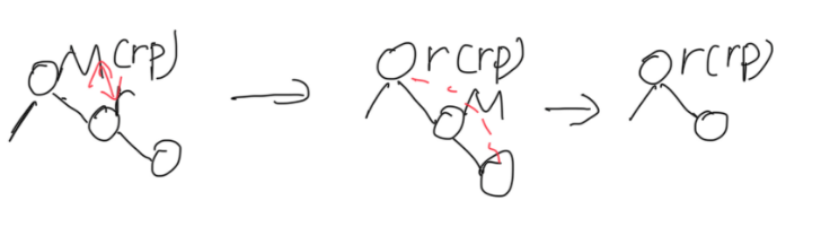
M左右节点都为空:
替换删除法:将M节点用下面的节点交换,再删除下面的数字节点
那么和哪个节点交换既可以做到快速删除又可以做到保持左子树<=根,右子树>=根的性质呢
和左子树的最右节点(最大节点)或右子树的最左节点(最小节点)
(1)删除快速:由于两个情况都是最左或最右节点,因此一定满足删除方案1或2,因此删除简单
(2)由于两个情况要么是小的最大,要么是大的最小,因此性质也是满足的
下面用右边最左来演示
cpp
bool erase(const K& _key)
{
    node* par = nullptr;
    node* cur = _root;
    while (cur)
    {
        if (cur->_key < key)
        {
            par = cur;
            cur = cur->_right;
        }
        else if (cur->_key > key)
        {
            par = cur;
            cur = cur->_left;
        }
        else
        {
            if (cur->_left == nullptr)
            {
                if (cur == _root)
                {
                    _root = cur->_right;
                }
                else
                {
                    if (par->_left == cur)
                    {
                        par->_left = cur->_right;
                    }
                    else
                    {
                        par->_right = cur->_right;
                    }
                }
                delete cur;
            }
            else if (cur->_right == nullptr)
            {
                if (cur == _root)
                {
                    _root = cur->_left;
                }
                else
                {
                    if (par->_left == cur)
                    {
                        par->_left = cur->_left;
                    }
                    else
                    {
                        par->_right = cur->_left;
                    }
                }
                delete cur;
            }
            else
            {
                node* rp = cur;
                node* r = cur->_right;
                while (r->_left)
                {
                    rp = r;
                    r = r->_left;
                }
                cur->_key = r->_key;
                if (rp->_left == r)
                {
                    rp->_left = r->_right;
                }
                else
                {
                    rp->_right = r->_right;
                }
                delete r;
            }
            return 1;
        }
    }
    return 0;
}
代码逻辑
-
先找值为val的节点(找不到返回0),设找到的节点为M
-
节点M左为空:
(1)节点M为根节点:直接将右节点设为根节点(有没有右节点都无所谓)
(2)M不为根节点:
A.M为左节点:M根节点连接M右节点,删M
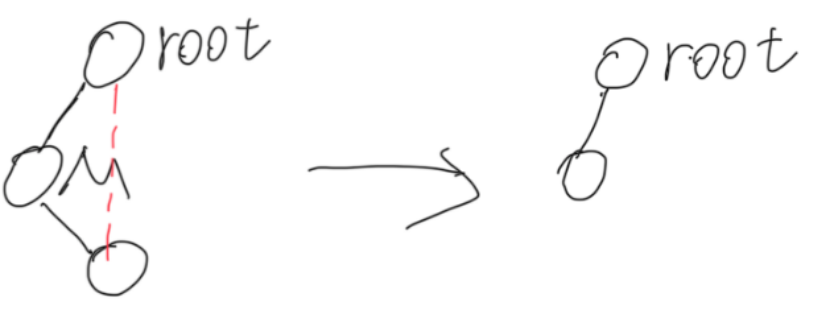
B.M为右节点:M根节点连接M右节点,删M
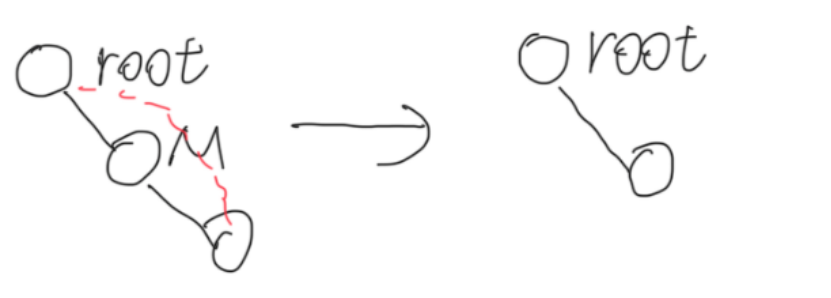
-
节点M右为空,同上:
(1)节点M为根节点:直接将左节点设为根节点
(2)M不为根节点:
A.M为左节点:M根节点连接M左节点,删M
B.M为右节点:M根节点连接M左节点,删M
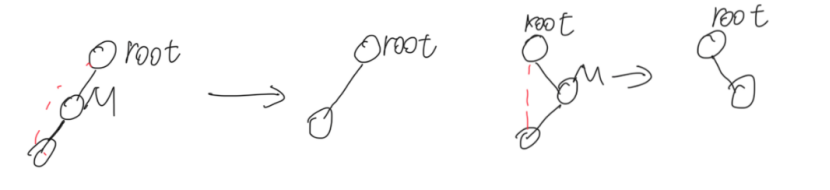
-
M左右都不为空(即else)
先去寻找右子树的最左节点(设为r,r的父节点设为rp)
由于r为最左节点,因此左边不会有子节点
(1)正常情况:r为rp左节点
交换r和M的值,再删r节点连rp和r子节点
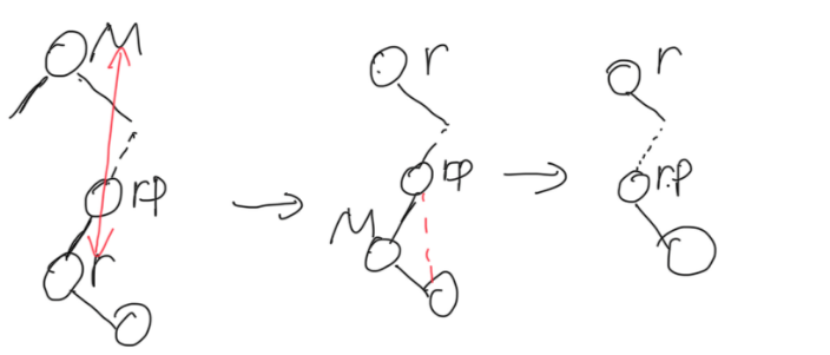
(2)反常情况:M的子节点只有右节点
此时M就是rp,r为rp右节点,和正常情况恰好相反
交换r和M的值,再删r节点连rp和r子节点
二.Key-value结构
由于二叉树不一定每一个成员代表的都是1,因此用value记录数值
所有程序和key结构一样,只是模板,节点构造函数多了value而已
cpp
template<class K,class V>
struct bsnode
{
    K _key;
    V _val;
    bsnode* _left;
    bsnode* _right;
    bsnode(const K& key,const V& val)
        :_key(key)
        ,_val(val)
        ,_left(nullptr)
        ,_right(nullptr)
    {
    }
};
三.构造,析构函数
1. 前序遍历拷贝构造
先拷贝值,再拷贝子节点
由于拷贝构造无法递归,因此先写前序遍历再复用
递归函数
cpp
node* copy(node* root)
{
    if (root == nullptr)return nullptr;
    node* newroot = new node(root->_key, root->_val);
    newroot->_left = copy(root->_left);
    newroot->_right = copy(root->_right);
    return newroot;
}
拷贝构造
cpp
bstree(const bstree& t)
{
    _root = copy(t._root);
}
由于写了拷贝构造就不会生成默认构造,因此强制生成
cpp
bstree() = default;2. 后序析构函数
先析构子节点,再析构自身
由于析构无法递归,因此先写前序遍历再复用
cpp
void destroy(node*root)
{
    if (root==nullptr)
    {
        return;
    }
    destroy(root->_left);
    destroy(root->_right);
    delete root;
    root = nullptr;
}

~bstree()
{
    destroy(_root);
    _root = nullptr;
}
3. 赋值重载
现代写法,直接交换,再销毁原来的
cpp
bstree&operator=(bstree t)
{
    std::swap(_root, t._root);
    return *this;
}
代码
cpp
#include<iostream>
#include<assert.h>


namespace key
{
	template<class K>
	struct bsnode
	{
		K _key;
		bsnode* _left;
		bsnode* _right;
		bsnode(const K&key)
			:_key(key )
			,_left(nullptr)
			,_right(nullptr)
		{ }
	};

	template<class K>
	class bstree
	{
	public:
		typedef bsnode<K> node;
		bool insert(const K& key)
		{
			if (_root == nullptr)
			{
				_root = new node(key);
				return 1;
			}
			node* cur = _root;
			node* par = nullptr;
			while (cur != nullptr)
			{
				if (cur->_key < key)
				{
					par = cur;
					cur = cur->_right;
				}
				else if (cur->_key > key)
				{
					par = cur;
					cur = cur->_left;
				}
				else
				{
					return 0;
				}
			}
			node* newnode = new node(key);
			if (par->_key < key)
			{
				par->_right = newnode;
			}
			else
			{
				par->_left = newnode;
			}
			return 1;
		}
		void inorder()
		{
			_inorder(_root);
		}
		//bool find(const K& val)
		//{
		//	node* cur = _root;
		//}
		bool find(int _key)
		{
			node* cur = _root;
			while (cur)
			{
				if (_key < cur->_key)
				{
					cur = cur->_left;
				}
				else if (_key > cur->_key)
				{
					cur = cur->_right;
				}
				else
				{
					return 1;
				}
			}
			return 0;
		}
		bool erase(int key)
		{
			node* par = nullptr;
			node* cur = _root;
			while (cur)
			{
				if (cur->_key < key)
				{
					par = cur;
					cur = cur->_right;
				}
				else if (cur->_key > key)
				{
					par = cur;
					cur = cur->_left;
				}
				else
				{
					if (cur->_left == nullptr)
					{
						if (cur == _root)
						{
							_root = cur->_right;
						}
						else
						{
							if (par->_left == cur)
							{
								par->_left = cur->_right;
							}
							else
							{
								par->_right = cur->_right;
							}
						}
						delete cur;
					}
					else if (cur->_right == nullptr)
					{
						if (cur == _root)
						{
							_root = cur->_left;
						}
						else
						{
							if (par->_left == cur)
							{
								par->_left = cur->_left;
							}
							else
							{
								par->_right = cur->_left;
							}
						}
						delete cur;
					}
					else
					{
						node* rp = cur;
						node* r = cur->_right;
						while (r->_left)
						{
							rp = r;
							r = r->_left;
						}
						cur->_key = r->_key;
						if (rp->_left == r)
						{
							rp->_left = r->_right;
						}
						else
						{
							rp->_right = r->_right;
						}
						delete r;
					}
					return 1;
				}
			}
			return 0;
		}

	private:
		void _inorder(node* root)
		{
			if (root == nullptr)return;
			_inorder(root->_left);
			std::cout << root->_key << " ";
			_inorder(root->_right);
		}
		node* _root = nullptr;
	};
}


namespace key_value
{
	template<class K,class V>
	struct bsnode
	{
		K _key;
		V _val;
		bsnode* _left;
		bsnode* _right;
		bsnode(const K& key,const V& val)
			:_key(key)
			,_val(val)
			, _left(nullptr)
			, _right(nullptr)
		{
		}
	};

	template<class K,class V>
	class bstree
	{
	public:
		typedef bsnode<K,V> node;
		bstree(const bstree& t)
		{
			_root = copy(t._root);
		}
		bstree() = default;
		bstree&operator=(bstree t)
		{
			std::swap(_root, t._root);

			return *this;
		}
		bool insert(const K& key, const V& val)
		{
			if (_root == nullptr)
			{
				_root = new node(key,val);
				return 1;
			}
			node* cur = _root;
			node* par = nullptr;
			while (cur != nullptr)
			{
				if (cur->_key < key)
				{
					par = cur;
					cur = cur->_right;
				}
				else if (cur->_key > key)
				{
					par = cur;
					cur = cur->_left;
				}
				else
				{
					return 0;
				}
			}
			node* newnode = new node(key,val);
			if (par->_key < key)
			{
				par->_right = newnode;
			}
			else
			{
				par->_left = newnode;
			}
			return 1;
		}
		void inorder()
		{
			_inorder(_root);
		}
		//bool find(const K& val)
		//{
		//	node* cur = _root;
		//}
		node* find(const K& _key)
		{
			node* cur = _root;
			while (cur)
			{
				if (_key < cur->_key)
				{
					cur = cur->_left;
				}
				else if (_key > cur->_key)
				{
					cur = cur->_right;
				}
				else
				{
					return cur;
				}
			}
			return nullptr;
		}
		bool erase(const K& key)
		{
			node* par = nullptr;
			node* cur = _root;
			while (cur)
			{
				if (cur->_key < key)
				{
					par = cur;
					cur = cur->_right;
				}
				else if (cur->_key > key)
				{
					par = cur;
					cur = cur->_left;
				}
				else
				{
					if (cur->_left == nullptr)
					{
						if (cur == _root)
						{
							_root = cur->_right;
						}
						else
						{
							if (par->_left == cur)
							{
								par->_left = cur->_right;
							}
							else
							{
								par->_right = cur->_right;
							}
						}
						delete cur;
					}
					else if (cur->_right == nullptr)
					{
						if (cur == _root)
						{
							_root = cur->_left;
						}
						else
						{
							if (par->_left == cur)
							{
								par->_left = cur->_left;
							}
							else
							{
								par->_right = cur->_left;
							}
						}
						delete cur;
					}
					else
					{
						node* rp = cur;
						node* r = cur->_right;
						while (r->_left)
						{
							rp = r;
							r = r->_left;
						}
						cur->_key = r->_key;
						cur->_val = r->_val;
						if (rp->_left == r)
						{
							rp->_left = r->_right;
						}
						else
						{
							rp->_right = r->_right;
						}
						delete r;
					}
					return 1;
				}
			}
			return 0;
		}
		~bstree()
		{
			destroy(_root);
			_root = nullptr;
		}

	private:
		node* copy(node* root)
		{
			if (root == nullptr)return nullptr;
			node* newroot = new node(root->_key, root->_val);
			newroot->_left = copy(root->_left);
			newroot->_right = copy(root->_right);
			return newroot;
		}
		void _inorder(node* root)
		{
			if (root == nullptr)return;
			_inorder(root->_left);
			std::cout << root->_key << ":" << root->_val << " ";
			_inorder(root->_right);
		}
		void destroy(node*root)
		{
			if (root==nullptr)
			{
				return;
			}
			destroy(root->_left);
			destroy(root->_right);
			delete root;
			root = nullptr;
		}
		node* _root = nullptr;
	};
}