简介 :FCN图像分割的开山之作,全卷积化网络,模型由卷积层、池化层组成(没有全连接层),可以接受任意大小的输入。通过特征提取网络得到(_,512,7,7)的深层特征后恢复到原始尺寸的分割预测效果。
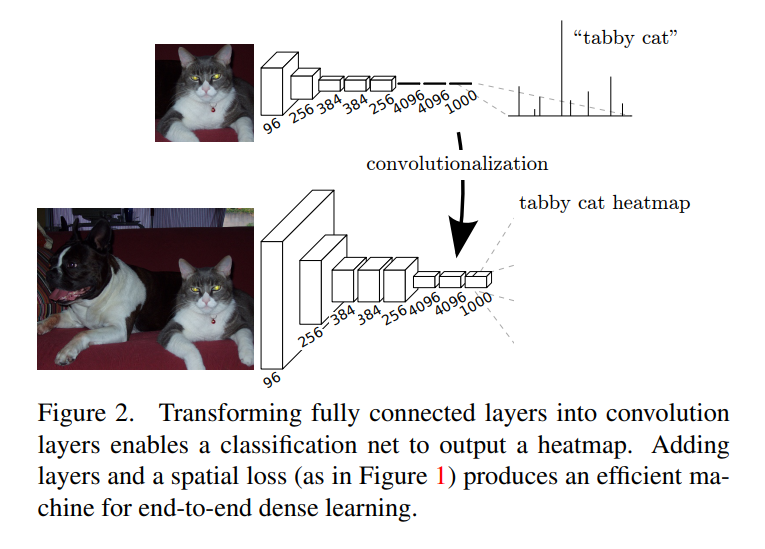
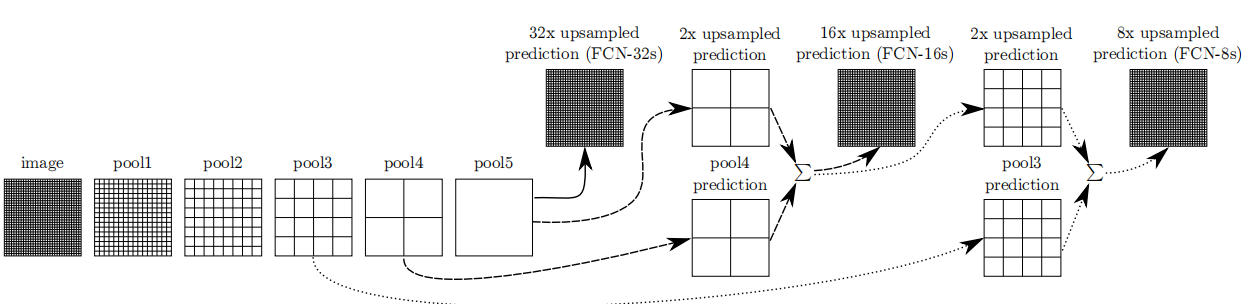
作者对比三种结构,FCN32s、FCN16s、FCN8s
FCN-32s: 直接上采样32倍
FCN-16s: 融合1次跳跃连接 + 上采样16倍
FCN-8s: 融合2次跳跃连接 + 上采样8倍
模型结构-FCN8s
分割头
python
class _FCNHead(nn.Module):
    '''
    FCN分割头模块 - 将主干网络提取的特征映射到分割类别空间
    作用:
        1. 将高维特征(512维)降维到与类别数匹配的维度
        2. 通过额外的卷积层进一步融合特征,提升分割精度
        3. 作为FCN模型中的解码器头部
    参数:
        in_channels: 输入特征图的通道数,通常为512(VGG最后一层输出)
        out_channels: 输出通道数,等于分割的类别数(如PASCAL VOC的21类)
        norm_layer: 归一化层类型,默认为BatchNorm2d
    '''
    def __init__(self, in_channels, out_channels, norm_layer=nn.BatchNorm2d, **kwargs):
        super(_FCNHead, self).__init__()

        # 中间通道数:将输入通道数压缩到1/4,作为中间表示
        inter_channels = in_channels // 4

        # 定义分割头的网络块
        self.block = nn.Sequential(
            nn.Conv2d(in_channels=in_channels,
                      out_channels=inter_channels,
                      kernel_size=3,  # 使用3×3卷积核(非1×1)可以融合空间上下文信息
                      padding=1,      # padding=1保持特征图尺寸不变
                      bias=False),    # bias=False因为后续有BatchNorm,bias参数冗余

            norm_layer(inter_channels),   # 2. 归一化层:加速训练,稳定梯度
            nn.ReLU(inplace=True),
            nn.Dropout(0.1),  # 正则化, 随机丢弃10%的神经元,增强模型泛化能力
            nn.Conv2d(inter_channels, out_channels, 1)   # 1×1卷积层:通道数映射到类别数
        )

    def forward(self, x):
        """
         x:  例如:(1, 512, 16, 16)
        返回: 例如:(1, 21, 16, 16),每个位置有21个类别的得分
        """
        return self.block(x)
FCN主网络
python
class FCN8s(nn.Module):
    """
        1. 融合pool3(8倍下采样)、pool4(16倍下采样)、pool5(32倍下采样)三个层次的特征
        2. 两次跳跃连接,逐步上采样,获得精细的分割结果
        3. 输出相对于输入下采样8倍(8s的含义)
    """
    def __init__(self, nclass, backbone='vgg16', aux=False, pretrained_base=True,
                 norm_layer=nn.BatchNorm2d, **kwargs):
        super(FCN8s, self).__init__()
        self.aux = aux  # 是否使用辅助损失

        # 加载并拆分VGG16主干网络
        if backbone == 'vgg16':
            self.pretrained = vgg16(pretrained=pretrained_base).features # 只使用VGG的卷积部分(features)
        else:
            raise RuntimeError('unknown backbone: {}'.format(backbone))

        # 将VGG的卷积层拆分为三个部分,对应三个下采样级别, VGG16 features共有31层(0-30)
        self.pool3 = nn.Sequential(*self.pretrained[:17])    # 层0-16: Conv1_1 ~ Conv3_3 (第3个池化层前)
        self.pool4 = nn.Sequential(*self.pretrained[17:24])  # 层17-23: Conv4_1 ~ Conv4_3 (第4个池化层前)
        self.pool5 = nn.Sequential(*self.pretrained[24:])    # 层24-30: Conv5_1 ~ Conv5_3+MaxPool5

        # 分割头
        self.head = _FCNHead(512, nclass, norm_layer)

        # 跳跃连接的1x1卷积 - 调整浅层特征的通道数
        self.score_pool3 = nn.Conv2d(256, nclass, 1)  # pool3输出256通道
        self.score_pool4 = nn.Conv2d(512, nclass, 1)  # pool4输出512通道

        # 辅助输出头(可选) - 用于训练时的辅助监督
        if aux:
            self.auxlayer = _FCNHead(512, nclass, norm_layer)

        # 标识需要特殊训练处理的模块,可设定不同的学习率
        self.__setattr__('exclusive',
                         ['head', 'score_pool3', 'score_pool4', 'auxlayer'] if aux
                         else ['head', 'score_pool3', 'score_pool4'])

    def forward(self, x):
        """
        x:   输入图像,形状为(batch_size, 3, H, W)
        返回: 分割结果,形状为(batch_size, nclass, H, W)
        """
        # ========== 阶段1:特征提取 ==========
        pool3 = self.pool3(x)      # 提取pool3特征 (下采样8倍)  → (batch, 256, H/8, W/8)
        pool4 = self.pool4(pool3)  # 提取pool4特征 (下采样16倍) → (batch, 512, H/16, W/16)
        pool5 = self.pool5(pool4)  # 提取pool5特征 (下采样32倍) → (batch, 512, H/32, W/32)

        outputs = []  # 存储所有输出,主要方便查看中间结果,可以没有
        # ========== 阶段2:三个层次的特征预测 ==========
        score_fr = self.head(pool5)            # 深层特征预测 → (batch, nclass, H/32, W/32)
        score_pool4 = self.score_pool4(pool4)  # 中层特征预测 → (batch, nclass, H/16, W/16)
        score_pool3 = self.score_pool3(pool3)  # 浅层特征预测 → (batch, nclass, H/8, W/8)

        # ========== 阶段3:第一次融合 (pool5 + pool4) ==========
        # 将深层特征上采样2倍到pool4的分辨率, 深层语义 + 中层细节
        upscore2 = F.interpolate(score_fr, score_pool4.size()[2:], mode='bilinear', align_corners=True)
        fuse_pool4 = upscore2 + score_pool4    # → (batch, nclass, H/16, W/16)

        # ========== 阶段4:第二次融合 (fuse_pool4 + pool3) ==========
        # 将融合后的特征上采样2倍到pool3的分辨率, 中层融合特征 + 浅层细节
        upscore_pool4 = F.interpolate(fuse_pool4, score_pool3.size()[2:],  mode='bilinear', align_corners=True)
        fuse_pool3 = upscore_pool4 + score_pool3  # → (batch, nclass, H/8, W/8)

        # ========== 阶段5:最终上采样 ==========
        # 将融合了三个层次的特征上采样8倍到原始输入尺寸
        out = F.interpolate(fuse_pool3, x.size()[2:], mode='bilinear', align_corners=True)
        outputs.append(out)

        # ========== 阶段6:辅助输出 (可选) ==========
        if self.aux:
            # 直接从pool5特征预测并上采样32倍
            auxout = self.auxlayer(pool5)
            auxout = F.interpolate(auxout, x.size()[2:], mode='bilinear', align_corners=True)
            outputs.append(auxout)  # 辅助输出
        return tuple(outputs)  # 返回元组: (主输出, 辅助输出) 或 (主输出,)
损失函数与评估指标
逐像素的交叉熵损失(Pixel-wise Cross-Entropy Loss)
python
class CrossEntropyLoss2d(_WeightedLoss):
    """
    Standard pytorch weighted nn.CrossEntropyLoss
    """
    def __init__(self, weight=None, ignore_label=255, reduction='mean'):
        super(CrossEntropyLoss2d, self).__init__()
        self.loss = nn.CrossEntropyLoss(weight, ignore_index=ignore_label, reduction=reduction)

    def forward(self, output, target):
        """
        Forward pass
        :param output: torch.tensor (NxC)
        :param target: torch.tensor (N)
        :return: scalar
        """
        return self.loss(output, target)
评估指标,论文用到MeanIU、pixel acc、mean acc、 f.w.IU
python
"""
Reference to https://github.com/jfzhang95/pytorch-deeplab-xception/blob/master/utils/metrics.py
Add metrics: Precision、Recall、F1-Score
"""
import numpy as np
np.seterr(divide='ignore', invalid='ignore')
__all__ = ['SegmentationMetric']

"""
confusionMetric  # 注意:此处横着代表预测值,竖着代表真实值,与之前介绍的相反
P\L     P    N
P      TP    FP
N      FN    TN
sum(axis=0) TP+FN
sum(axis=1) TP+FP
np.diag().sum() TP+TN
"""
class SegmentationMetric(object):
    def __init__(self, numClass):
        self.numClass = numClass
        self.confusionMatrix = np.zeros((self.numClass,)*2)

    def pixelAccuracy(self):
        # return all class overall pixel accuracy
        #  PA = acc = (TP + TN) / (TP + TN + FP + FN)
        acc = np.diag(self.confusionMatrix).sum() /  self.confusionMatrix.sum()
        return acc

    def meanPixelAccuracy(self):
        # return each category pixel accuracy(A more accurate way to call it precision)
        # acc = TP / (TP + FP)
        Cpa = np.diag(self.confusionMatrix) / self.confusionMatrix.sum(axis=1)
        Mpa = np.nanmean(Cpa)  # 求各类别Cpa的平均
        return Mpa, Cpa  # 返回的是一个列表值,如:[0.90, 0.80, 0.96],表示类别1 2 3各类别的预测准确率

    def meanIntersectionOverUnion(self):
        # Intersection = TP ;Union = TP + FP + FN
        # Ciou = TP / (TP + FP + FN)
        intersection = np.diag(self.confusionMatrix) # 取对角元素的值,返回列表
        union = np.sum(self.confusionMatrix, axis=1) + np.sum(self.confusionMatrix, axis=0) - np.diag(self.confusionMatrix) # axis = 1表示混淆矩阵行的值,返回列表; axis = 0表示取混淆矩阵列的值,返回列表

        Ciou = (intersection / np.maximum(1.0, union))   # 返回列表,其值为各个类别的Ciou
        mIoU = np.nanmean(Ciou)  # 求各类别Ciou的平均
        return mIoU, Ciou

    def Frequency_Weighted_Intersection_over_Union(self):
        # FWIOU =     [(TP+FN)/(TP+FP+TN+FN)] *[TP / (TP + FP + FN)]
        freq = np.sum(self.confusionMatrix, axis=1) / np.sum(self.confusionMatrix)
        iu = np.diag(self.confusionMatrix) / (
                np.sum(self.confusionMatrix, axis=1) + np.sum(self.confusionMatrix, axis=0) -
                np.diag(self.confusionMatrix))
        FWIoU = (freq[freq > 0] * iu[freq > 0]).sum()
        return FWIoU

    def precision(self):
        # precision = TP / (TP+FP)
        precision = np.diag(self.confusionMatrix) / np.sum(self.confusionMatrix, axis=1)
        return precision

    def recall(self):
        # recall = TP / (TP+FN)
        recall = np.diag(self.confusionMatrix) / np.sum(self.confusionMatrix, axis=0)
        return recall

    def genConfusionMatrix(self, imgPredict, imgLabel): # 同FCN中score.py的fast_hist()函数
        # remove classes from unlabeled pixels in gt image and predict
        mask = (imgLabel >= 0) & (imgLabel < self.numClass)
        label = self.numClass * imgLabel[mask].astype('int') + imgPredict[mask]
        count = np.bincount(label, minlength=self.numClass**2)
        confusionMatrix = count.reshape(self.numClass, self.numClass)
        return confusionMatrix

    def addBatch(self, imgPredict, imgLabel):
        assert imgPredict.shape == imgLabel.shape
        self.confusionMatrix += self.genConfusionMatrix(imgPredict, imgLabel)

    def reset(self):
        self.confusionMatrix = np.zeros((self.numClass, self.numClass))

if __name__ == '__main__':
    imgPredict = np.array([0, 0, 1, 1, 2, 2]) # 可直接换成预测图片
    imgLabel = np.array([0, 0, 1, 1, 1, 2]) # 可直接换成标注图片
    metric = SegmentationMetric(3) # 3表示有3个分类,有几个分类就填几
    metric.addBatch(imgPredict, imgLabel)
    pa = metric.pixelAccuracy()
    mpa = metric.meanPixelAccuracy()
    fwIU = metric.Frequency_Weighted_Intersection_over_Union()
    mIoU, per = metric.meanIntersectionOverUnion()
    print('pa is : %f' % pa)
    print('fwiu is : %f' % fwIU) # 列表
    print('mpa is : %f' % mpa[0], mpa[1])
    print('mIoU is : %f' % mIoU, per)
FCN32s、FCN16s、FCN8s全部
python
import torch
import torch.nn as nn
import torch.nn.functional as F
from vgg import vgg16
class _FCNHead(nn.Module):
    '''
    FCN分割头模块 - 将主干网络提取的特征映射到分割类别空间
    作用:
        1. 将高维特征(512维)降维到与类别数匹配的维度
        2. 通过额外的卷积层进一步融合特征,提升分割精度
        3. 作为FCN模型中的解码器头部
    参数:
        in_channels: 输入特征图的通道数,通常为512(VGG最后一层输出)
        out_channels: 输出通道数,等于分割的类别数(如PASCAL VOC的21类)
        norm_layer: 归一化层类型,默认为BatchNorm2d
    '''
    def __init__(self, in_channels, out_channels, norm_layer=nn.BatchNorm2d, **kwargs):
        super(_FCNHead, self).__init__()

        # 中间通道数:将输入通道数压缩到1/4,作为中间表示
        inter_channels = in_channels // 4

        # 定义分割头的网络块
        self.block = nn.Sequential(
            nn.Conv2d(in_channels=in_channels,
                      out_channels=inter_channels,
                      kernel_size=3,  # 使用3×3卷积核(非1×1)可以融合空间上下文信息
                      padding=1,      # padding=1保持特征图尺寸不变
                      bias=False),    # bias=False因为后续有BatchNorm,bias参数冗余

            norm_layer(inter_channels),   # 2. 归一化层:加速训练,稳定梯度
            nn.ReLU(inplace=True),
            nn.Dropout(0.1),  # 正则化, 随机丢弃10%的神经元,增强模型泛化能力
            nn.Conv2d(inter_channels, out_channels, 1)   # 1×1卷积层:通道数映射到类别数
        )

    def forward(self, x):
        """
         x:  例如:(1, 512, 16, 16)
        返回: 例如:(1, 21, 16, 16),每个位置有21个类别的得分
        """
        return self.block(x)

class FCN32s(nn.Module):
    def __init__(self, nclass, backbone='vgg16', aux=False, pretrained_base=True,
                 norm_layer=nn.BatchNorm2d, **kwargs):

        super(FCN32s, self).__init__()
        self.aux = aux

        # 只加载VGG16的卷积部分(去除全连接层)
        if backbone == 'vgg16':
            self.pretrained = vgg16(pretrained=pretrained_base).features
        else:
            raise RuntimeError('unknown backbone: {}'.format(backbone))

        # 分割头(1x1卷积)
        self.head = _FCNHead(512, nclass, norm_layer=norm_layer)

        if aux:
            self.auxlayer = _FCNHead(512, nclass, norm_layer=norm_layer)
        self.__setattr__('exclusive', ['head', 'auxlayer'] if aux else ['head'])

    def forward(self, x):
        # ([1, 3, 224, 224])
        size = x.size()[2:]

        # VGG16特征提取器(固定权重) conv1~conv5 下采样32倍
        pool5 = self.pretrained(x)  # ([1, 512, 7, 7])
        outputs = []

        # 分割头将其分割到目标的类别数
        out = self.head(pool5)      # ([1, 21, 7, 7])

        # 上采样32倍
        out = F.interpolate(out, size=size, mode='bilinear', align_corners=True)   # ([1, 21, 224, 224])
        outputs.append(out)

        if self.aux:
            auxout = self.auxlayer(pool5)
            auxout = F.interpolate(auxout, size=size, mode='bilinear', align_corners=True)
            outputs.append(auxout)
        return tuple(outputs)

class FCN16s(nn.Module):
    def __init__(self, nclass, backbone='vgg16', aux=False, pretrained_base=True,
                 norm_layer=nn.BatchNorm2d, **kwargs):
        super(FCN16s, self).__init__()
        self.aux = aux
        if backbone == 'vgg16':
            self.pretrained = vgg16(pretrained=pretrained_base).features
        else:
            raise RuntimeError('unknown backbone: {}'.format(backbone))
        self.pool4 = nn.Sequential(*self.pretrained[:24])     # vgg 00~23层
        self.pool5 = nn.Sequential(*self.pretrained[24:])     # vgg 24~30层
        self.head = _FCNHead(512, nclass, norm_layer=norm_layer)
        self.score_pool4 = nn.Conv2d(512, nclass, 1)   # 跳跃连接模块
        if aux:
            self.auxlayer = _FCNHead(512, nclass, norm_layer=norm_layer)
        self.__setattr__('exclusive', ['head', 'score_pool4', 'auxlayer'] if aux else ['head', 'score_pool4'])

    def forward(self, x):
        # input size 1 3 224 224
        # vgg 特征提取
        pool4 = self.pool4(x)       # (_, 512, 14, 14)   ← 下采样16倍, 较浅特征,细节丰富
        pool5 = self.pool5(pool4)   # (_, 512, 7, 7)   ← 下采样32倍, 深层特征,语义丰富

        # 分别进行类别预测
        outputs = []
        score_fr = self.head(pool5)            # (nclass, 7, 7) 深层预测
        score_pool4 = self.score_pool4(pool4)  # (nclass, 14, 14) 浅层预测

        # 第一次上采样:深层特征上采样2倍到浅层分辨率
        upscore2 = F.interpolate(score_fr, score_pool4.size()[2:], mode='bilinear', align_corners=True)   # (_, nclass, 14, 14)

        # 特征融合:深层语义 + 浅层细节
        fuse_pool4 = upscore2 + score_pool4  # (_, nclass, 14, 14)

        # 最终上采样:16倍到原图尺寸
        out = F.interpolate(fuse_pool4, x.size()[2:], mode='bilinear', align_corners=True)  # (_, nclass, 224, 224)

        outputs.append(out)

        if self.aux:
            auxout = self.auxlayer(pool5)
            auxout = F.interpolate(auxout, x.size()[2:], mode='bilinear', align_corners=True)
            outputs.append(auxout)
        return tuple(outputs)


class FCN8s(nn.Module):
    """
        1. 融合pool3(8倍下采样)、pool4(16倍下采样)、pool5(32倍下采样)三个层次的特征
        2. 两次跳跃连接,逐步上采样,获得精细的分割结果
        3. 输出相对于输入下采样8倍(8s的含义)
    """

    def __init__(self, nclass, backbone='vgg16', aux=False, pretrained_base=True,
                 norm_layer=nn.BatchNorm2d, **kwargs):
        super(FCN8s, self).__init__()
        self.aux = aux  # 是否使用辅助损失

        # 加载并拆分VGG16主干网络
        if backbone == 'vgg16':
            self.pretrained = vgg16(pretrained=pretrained_base).features # 只使用VGG的卷积部分(features)
        else:
            raise RuntimeError('unknown backbone: {}'.format(backbone))

        # 将VGG的卷积层拆分为三个部分,对应三个下采样级别, VGG16 features共有31层(0-30)
        self.pool3 = nn.Sequential(*self.pretrained[:17])    # 层0-16: Conv1_1 ~ Conv3_3 (第3个池化层前)
        self.pool4 = nn.Sequential(*self.pretrained[17:24])  # 层17-23: Conv4_1 ~ Conv4_3 (第4个池化层前)
        self.pool5 = nn.Sequential(*self.pretrained[24:])    # 层24-30: Conv5_1 ~ Conv5_3+MaxPool5

        # 分割头
        self.head = _FCNHead(512, nclass, norm_layer)

        # 跳跃连接的1x1卷积 - 调整浅层特征的通道数
        self.score_pool3 = nn.Conv2d(256, nclass, 1)  # pool3输出256通道
        self.score_pool4 = nn.Conv2d(512, nclass, 1)  # pool4输出512通道

        # 辅助输出头(可选) - 用于训练时的辅助监督
        if aux:
            self.auxlayer = _FCNHead(512, nclass, norm_layer)

        # 标识需要特殊训练处理的模块,可设定不同的学习率
        self.__setattr__('exclusive',
                         ['head', 'score_pool3', 'score_pool4', 'auxlayer'] if aux
                         else ['head', 'score_pool3', 'score_pool4'])

    def forward(self, x):
        """
        x:   输入图像,形状为(batch_size, 3, H, W)
        返回: 分割结果,形状为(batch_size, nclass, H, W)
        """
        # ========== 阶段1:特征提取 ==========
        pool3 = self.pool3(x)      # 提取pool3特征 (下采样8倍)  → (batch, 256, H/8, W/8)
        pool4 = self.pool4(pool3)  # 提取pool4特征 (下采样16倍) → (batch, 512, H/16, W/16)
        pool5 = self.pool5(pool4)  # 提取pool5特征 (下采样32倍) → (batch, 512, H/32, W/32)

        outputs = []  # 存储所有输出,主要方便查看中间结果,可以没有
        # ========== 阶段2:三个层次的特征预测 ==========
        score_fr = self.head(pool5)            # 深层特征预测 → (batch, nclass, H/32, W/32)
        score_pool4 = self.score_pool4(pool4)  # 中层特征预测 → (batch, nclass, H/16, W/16)
        score_pool3 = self.score_pool3(pool3)  # 浅层特征预测 → (batch, nclass, H/8, W/8)

        # ========== 阶段3:第一次融合 (pool5 + pool4) ==========
        # 将深层特征上采样2倍到pool4的分辨率, 深层语义 + 中层细节
        upscore2 = F.interpolate(score_fr, score_pool4.size()[2:], mode='bilinear', align_corners=True)
        fuse_pool4 = upscore2 + score_pool4    # → (batch, nclass, H/16, W/16)

        # ========== 阶段4:第二次融合 (fuse_pool4 + pool3) ==========
        # 将融合后的特征上采样2倍到pool3的分辨率, 中层融合特征 + 浅层细节
        upscore_pool4 = F.interpolate(fuse_pool4, score_pool3.size()[2:],  mode='bilinear', align_corners=True)
        fuse_pool3 = upscore_pool4 + score_pool3  # → (batch, nclass, H/8, W/8)

        # ========== 阶段5:最终上采样 ==========
        # 将融合了三个层次的特征上采样8倍到原始输入尺寸
        out = F.interpolate(fuse_pool3, x.size()[2:], mode='bilinear', align_corners=True)
        outputs.append(out)

        # ========== 阶段6:辅助输出 (可选) ==========
        if self.aux:
            # 直接从pool5特征预测并上采样32倍
            auxout = self.auxlayer(pool5)
            auxout = F.interpolate(auxout, x.size()[2:], mode='bilinear', align_corners=True)
            outputs.append(auxout)  # 辅助输出
        return tuple(outputs)  # 返回元组: (主输出, 辅助输出) 或 (主输出,)

if __name__ == '__main__':
    from thop import profile
    device = torch.device('cpu')
    model = FCN8s(21)
    # model = FCN16s(21)
    # model = FCN32s(21)
    model = model.to(device)

    input = torch.randn(1, 3, 224, 224)
    input = input.to(device)

    flops, params = profile(model, inputs=(input, ))
    print('FLOPs = ' + str(flops / 1000 ** 3) + 'G')
    print('Params = ' + str(params / 1000 ** 2) + 'M')