🍉 CSDN 叶庭云:https://yetingyun.blog.csdn.net/
✅ 这个 Python 脚本(约 300 行代码量 )实现了一个大语言模型权重文件哈希校验工具 ,主要功能包括:
-
跨平台支持,同时支持从 HuggingFace 或 ModelScope 平台获取模型仓库中权重文件元数据的基准 SHA256 哈希值 ,把 "远端元数据 hash" 当作可信基线,避免 "再下载一遍算 hash",跨平台抽象:统一入口
get_llm_weight_file_hashes(),正则筛选权重分片,减少不必要的元数据/校验开销; -
计算本地文件的 SHA256 哈希值 (支持大文件内存优化,用大
chunk顺序读取,例如 8MB ~ 64MB,减少系统调用次数); -
打印 "远程应该有但本地缺失" 的文件 ,校验本地文件哈希是否与远程文件的哈希一致 ,进度条显示计算进度;
-
提供命令行 CLI 传参及调用、"权重文件名:哈希值" 对应数据保存 / 加载功能。
✨ 代码优点:
-
健壮的错误处理:对 API 调用、文件读取都有异常捕获
-
灵活过滤:支持正则表达式和 LFS 过滤
-
用户友好:提供命令行参数说明、文件的哈希预览,进度条显示计算进度
环境配置,需 pip install 安装第三方依赖库如下:
bash
modelscope==1.33.0
huggingface_hub==1.1.7
requests==2.32.5
Python 源码如下:
python
import os
import re
import sys
import json
import hashlib
import argparse
from typing import Dict, Optional
import requests
from tqdm import tqdm

try:
    from huggingface_hub import HfApi
except ImportError:
    HfApi = None

try:
    from modelscope.hub.api import HubApi
except ImportError:
    HubApi = None


def get_llm_weight_file_hashes(
    platform: str,
    repo_name: str,
    file_pattern: Optional[str] = None,
    lfs_only: bool = True,
) -> Dict[str, str]:
    if platform == "huggingface":
        return _get_huggingface_hashes(repo_name, file_pattern, lfs_only)
    elif platform == "modelscope":
        return _get_modelscope_hashes(repo_name, file_pattern, lfs_only)
    else:
        raise ValueError(
            f"目前不支持的平台: {platform}, 请使用 'huggingface' 或 'modelscope'"
        )


def _get_huggingface_hashes(
    repo_name: str,
    file_pattern: Optional[str] = None,
    lfs_only: bool = True,
) -> Dict[str, str]:
    if HfApi is None:
        raise ImportError("需安装好 huggingface_hub: pip install huggingface_hub")

    api = HfApi()
    print(f"正在从 HuggingFace 获取仓库 {repo_name} 的元数据...")

    try:
        model_info = api.model_info(repo_name, files_metadata=True)
    except requests.exceptions.RequestException as e:
        print(f"网络错误: {e}")
        return {}
    except Exception as e:
        print(f"获取元数据失败: {type(e).__name__}: {e}")
        return {}

    sha256_dict = {}
    pattern = re.compile(file_pattern) if file_pattern else None

    for file_info in model_info.siblings:
        filename = file_info.rfilename

        if pattern and not pattern.match(filename):
            continue
        if lfs_only and not file_info.lfs:
            continue

        if file_info.lfs:
            sha256_hash = file_info.lfs.get("sha256", None)
            sha256_dict[filename] = sha256_hash
        else:
            # 非 LFS 文件不提供 SHA256, blob_id 是 Git SHA1
            print(f"提醒: 文件 {filename} 不是 LFS 文件, 无法获取 SHA256 哈希")
            continue

    return sha256_dict


def _get_modelscope_hashes(
    repo_name: str,
    file_pattern: Optional[str] = None,
    lfs_only: bool = True,
) -> Dict[str, str]:
    if HubApi is None:
        raise ImportError("请安装 modelscope: pip install modelscope")

    api = HubApi()
    print(f"正在从 ModelScope 获取仓库 {repo_name} 的元数据...")

    sha256_dict = {}
    pattern = re.compile(file_pattern) if file_pattern else None

    # 获取模型文件列表 (递归获取所有文件)
    try:
        files = api.get_model_files(repo_name, recursive=True)
    except Exception as e:
        print(f"获取文件列表失败: {e}")
        return {}

    for file_info in files:
        if file_info.get("Type", "") == "tree":
            continue
        if lfs_only and not file_info.get("IsLFS"):
            continue

        filename = file_info.get("Path", "")
        if pattern and not pattern.match(filename):
            continue

        sha256_hash = next(
            (v for k, v in file_info.items() if k.lower() == "sha256"), None
        )
        sha256_dict[filename] = sha256_hash

    return sha256_dict


def calculate_file_sha256(file_path: str, chunk_size: int = 33554432) -> str:
    sha256_hash = hashlib.sha256()

    with open(file_path, "rb") as f:
        for byte_block in iter(lambda: f.read(chunk_size), b""):
            sha256_hash.update(byte_block)

    return sha256_hash.hexdigest()


def verify_file(
    file_path: str,
    expected_hashes: Dict[str, str],
    filename: str,
) -> bool:
    if not expected_hashes:
        print("错误: 没有提供预期哈希字典")
        return False

    expected_hash = expected_hashes[filename]
    print(f"正在计算 {filename} 的 SHA256, 文件较大请稍候...")

    try:
        actual_hash = calculate_file_sha256(file_path)
    except Exception as e:
        print(f"❌ 计算或读取错误: {e}")
        return False

    print(f"预期 SHA256: {expected_hash}")
    print(f"实际 SHA256: {actual_hash}")

    if actual_hash == expected_hash:
        print("✅ 校验通过: 文件完整且一致!")
        return True
    else:
        print("❌ 校验失败: 文件可能已损坏或被篡改!")
        return False


def print_hashes_preview(hashes: Dict[str, str], preview_count: int = 3):
    sorted_keys = sorted(hashes.keys())
    if not sorted_keys:
        print("没有找到任何文件")
        return

    print(f"\n共找到 {len(hashes)} 个文件的 SHA256:")
    print(f"预览前 {preview_count} 个:")
    for key in sorted_keys[:preview_count]:
        print(f"  '{key}': '{hashes[key]}'")

    if len(sorted_keys) > preview_count * 2:
        print("  ...")
        print(f"预览后 {preview_count} 个:")
        for key in sorted_keys[-preview_count:]:
            print(f"  '{key}': '{hashes[key]}'")
    elif len(sorted_keys) > preview_count:
        for key in sorted_keys[preview_count:]:
            print(f"  '{key}': '{hashes[key]}'")


def main():
    parser = argparse.ArgumentParser(
        description="获取大模型权重文件的 SHA256 哈希值并进行文件校验"
    )
    parser.add_argument(
        "-p",
        "--platform",
        choices=["huggingface", "modelscope"],
        type=str,
        default="huggingface",
        help="模型平台 (默认: huggingface) ",
    )
    parser.add_argument(
        "-r",
        "--repo_name",
        required=True,
        type=str,
        help="模型仓库名称, 格式通常为 组织/模型名, 如 'zai-org/GLM-4.7'",
    )
    parser.add_argument(
        "-f",
        "--file_pattern",
        type=str,
        default=r"model-\d{5}-of-\d{5}\.safetensors",
        help="文件名匹配正则表达式, 如 r'model-\d{5}-of-\d{5}\.safetensors'",
    )
    parser.add_argument(
        "-a",
        "--all_files",
        action="store_true",
        help="默认只获取 LFS 文件的哈希 (不触发 all_files)",
    )
    parser.add_argument(
        "-w",
        "--weight_filepath",
        type=str,
        default="",
        help="传入本地文件夹 (存放模型权重文件的目录)",
    )
    parser.add_argument(
        "-o",
        "--output_hashes_dict",
        type=str,
        default="weight_sha256.json",
        help="保存哈希字典数据到 JSON 文件",
    )
    parser.add_argument(
        "-e",
        "--existed_hashes_dict",
        type=str,
        help="本地已保存的哈希字典数据 JSON 文件",
    )
    parser.add_argument(
        "-n",
        "--nums_preview",
        type=int,
        default=3,
        help="预览显示的文件数量 (默认: 3) ",
    )
    args = parser.parse_args()
    hashes = dict()

    if args.existed_hashes_dict:
        with open(args.existed_hashes_dict, "r") as f:
            hashes = json.load(f)
    else:
        # 本地若无哈希字典数据, 还需获取权重文件: 哈希值字典数据
        hashes = get_llm_weight_file_hashes(
            args.platform,
            args.repo_name,
            args.file_pattern,
            lfs_only=not args.all_files,
        )
        print_hashes_preview(hashes, args.nums_preview)

        if args.output_hashes_dict:
            with open(args.output_hashes_dict, "w") as f:
                json.dump(hashes, f, indent=2, ensure_ascii=False)
            print(f"\n哈希字典已保存到 {args.output_hashes_dict}")

    if not hashes:
        print("错误: 无法获取哈希字典, 无法进行校验! ")
        sys.exit(1)

    if os.path.isfile(args.weight_filepath):
        raise ValueError("错误: -w 参数应为权重文件夹路径, 而不是单个文件路径! ")

    # 检查本地缺失文件
    local_files_set = set(os.listdir(args.weight_filepath))
    missing_files = []
    for file_ in hashes.keys():
        if file_ not in local_files_set:
            missing_files.append(file_)
    print(f"⚠️ 提醒: 本地缺少文件: {missing_files}")

    check_files = [
        file_ for file_ in os.listdir(args.weight_filepath) if file_ in hashes.keys()
    ]
    if args.weight_filepath and os.path.isdir(args.weight_filepath):
        failed_files = []
        for file_ in tqdm(check_files):
            print(f"\n正在校验 {file_} ...")
            success = verify_file(
                os.path.join(args.weight_filepath, file_), hashes, file_
            )
            if not success:
                failed_files.append(file_)
        failed_files.sort()
        print(
            f"\n权重文件校验完成, {len(failed_files)} 个文件校验失败: \n{failed_files}"
        )
    else:
        raise ValueError(f"错误: {args.weight_filepath} 不是有效的目录路径! ")


if __name__ == "__main__":
    main()
测试命令如下:
bash
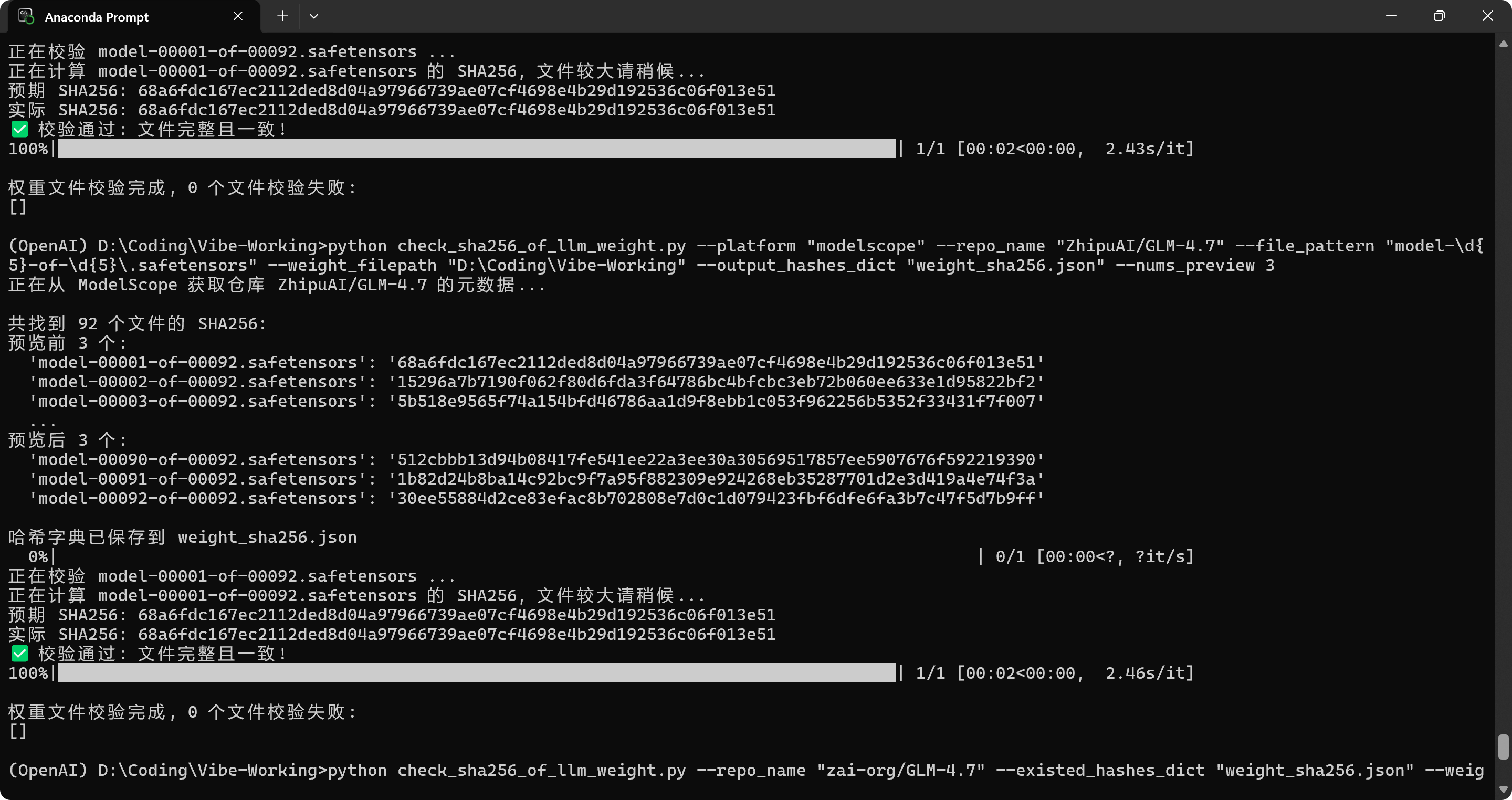
python check_sha256_of_llm_weight.py --platform "huggingface" --repo_name "zai-org/GLM-4.7" --file_pattern "model-\d{5}-of-\d{5}\.safetensors" --weight_filepath "D:\Coding\Vibe-Working" --output_hashes_dict "weight_sha256.json" --nums_preview 3

python check_sha256_of_llm_weight.py --platform "modelscope" --repo_name "ZhipuAI/GLM-4.7" --file_pattern "model-\d{5}-of-\d{5}\.safetensors" --weight_filepath "D:\Coding\Vibe-Working" --output_hashes_dict "weight_sha256.json" --nums_preview 3

python check_sha256_of_llm_weight.py --repo_name "zai-org/GLM-4.7" --existed_hashes_dict "weight_sha256.json" --weight_filepath "D:\Coding\Vibe-Working"
以 HuggingFace 和 ModelScope 的 GLM-4.7 仓库为例,测试结果如下:
实现过程中遇到的问题及解决:
-
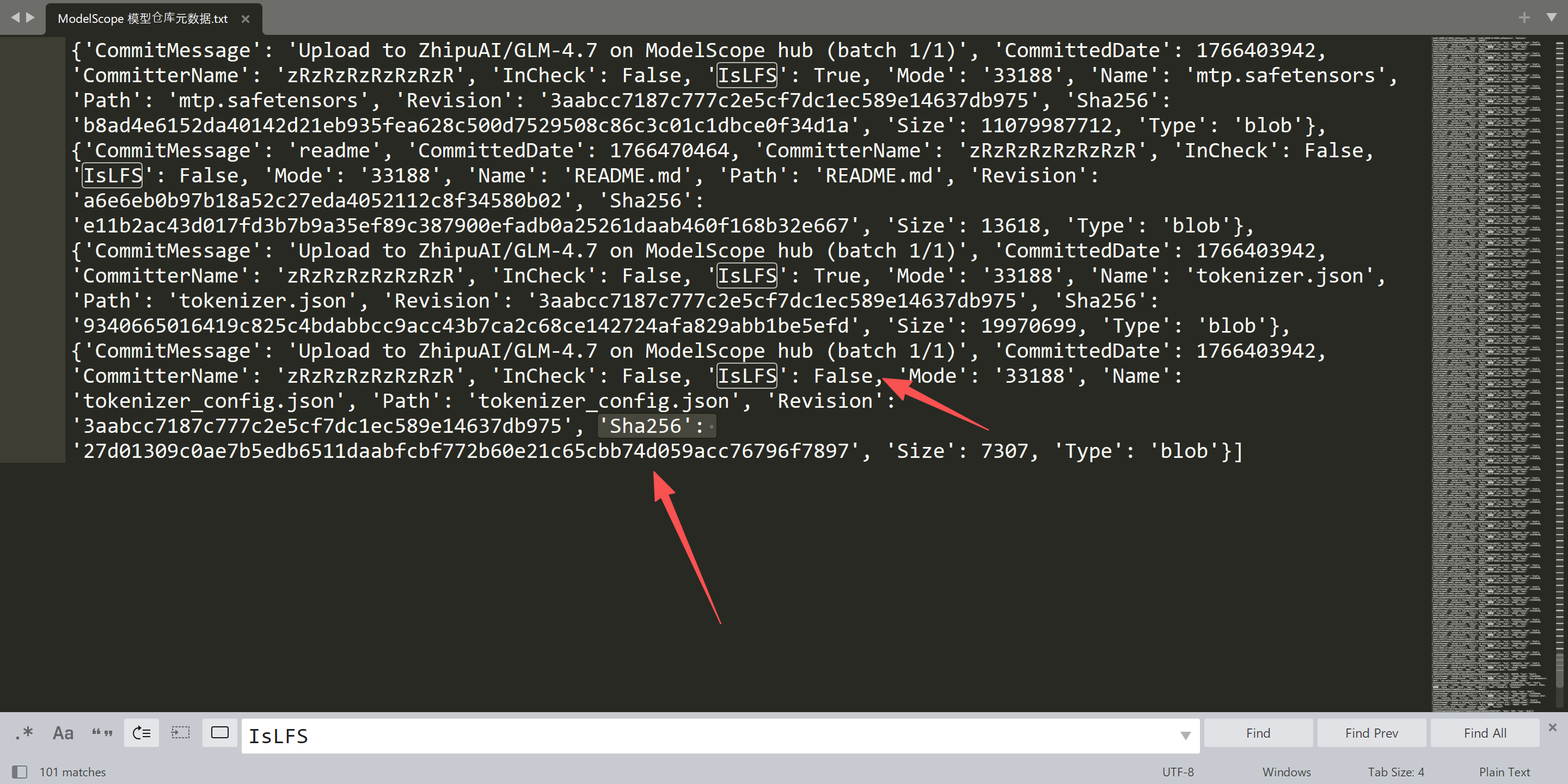
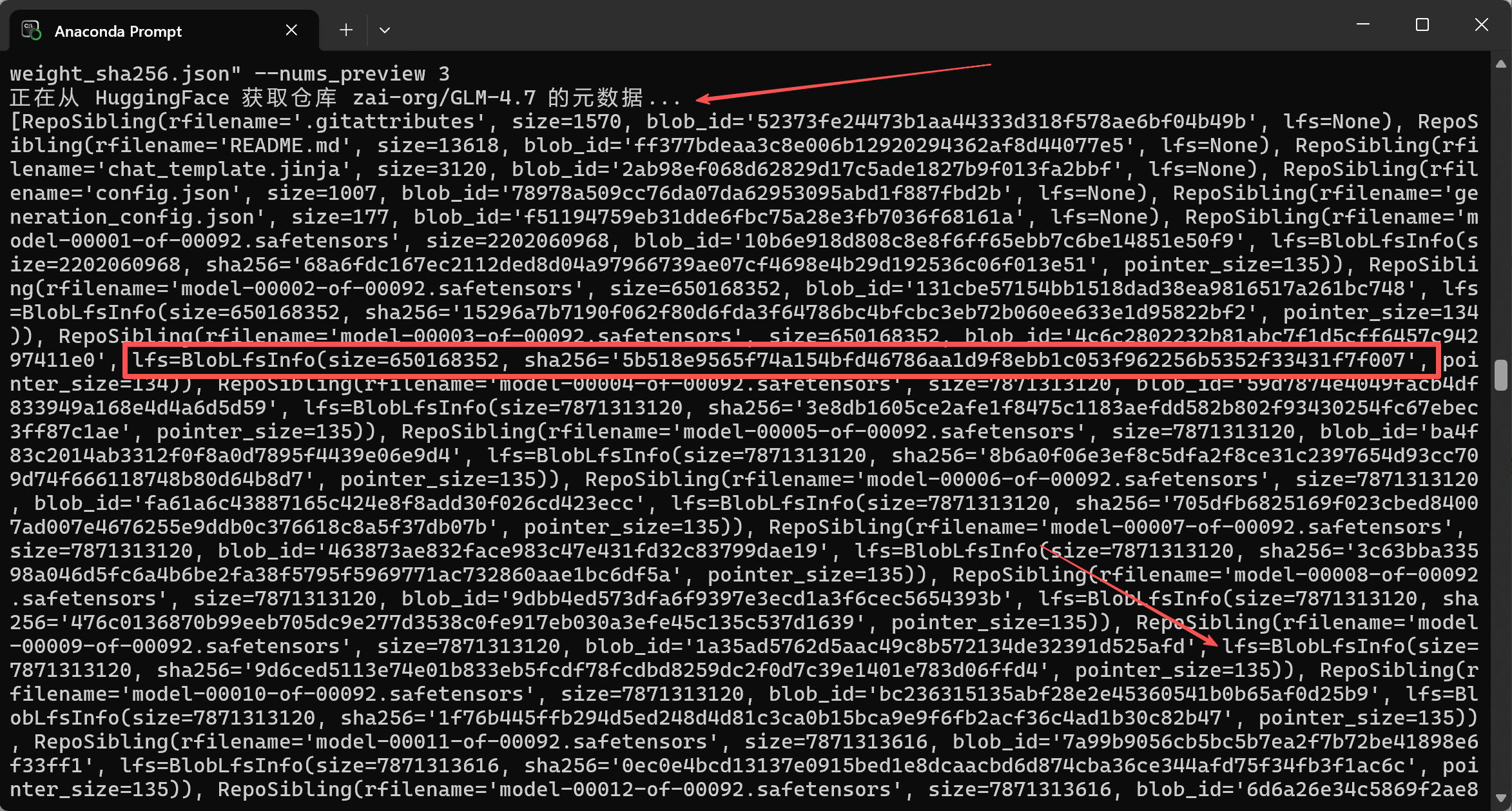
不同平台的 "元数据" 不一致 ,且 LFS / 非 LFS 的哈希来源不同,需仔细观察数据和实现正确的条件判断,确保程序逻辑正确。
-
ModelScope 的文件结构与字段名更 "松散",返回的 dict 键名、层级、是否包含 sha256 可能随 API 版本 / 模型类型变化。用了大小写不敏感匹配。
-
大模型权重文件尺寸大,考虑 GB 级文件的 hash 计算性能与稳定性。
-
注意:如果在服务器上运行这个 Python 脚本,可能遇到网络问题报错,也可以在办公电脑上(Proxy 配置好了,能正常访问 HuggingFace 和 ModelScope)运行脚本把 "权重文件名:哈希值" 对应数据保存为本地 JSON 文件,再传到服务器上用于校验即可。