文章目录
go语言并非传统意义上的面向对象的语言,他不像Java或者C++一样有类、继承等一些特性,但是我们也可以借助go语言中的struct和interface来实现这种面向对象的编程。
go语言中interface其实就是一组方法声明 ,任何类型的对象实现了接口的全部方法就是这个接口的一个实现。
interface的底层原理
空接口interface{}
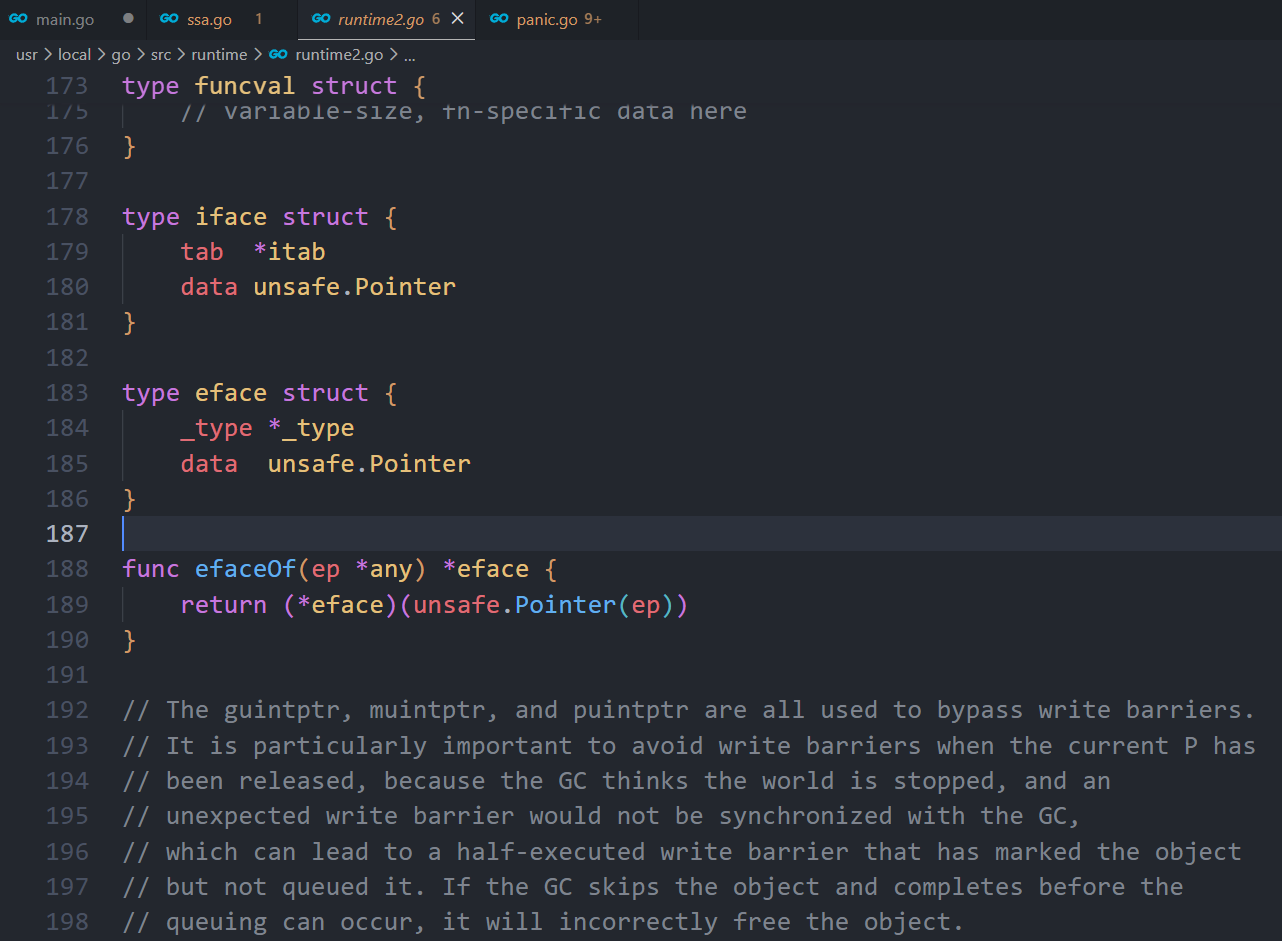
没有定义任何方法的接口为空接口,空接口可以接收任意数据类型 ,就是说可以将任意类型的数据赋值给一个空接口,空接口的结构定义位于 src/runtime/runtime2.go 定义如下:
go
type eface struct {
	_type *_type
	data  unsafe.Pointer
}
_type: 指向接口的动态类型元数据,即接口变量的类型
data: 指向接口的动态值,data是一个指向变量本身的指针
_type是什么
_type 是 go 里面所有类型的一个抽象,里面包含了类型的大小、哈希、对齐以及类型编号等信息,决定了data如何解析和操作。
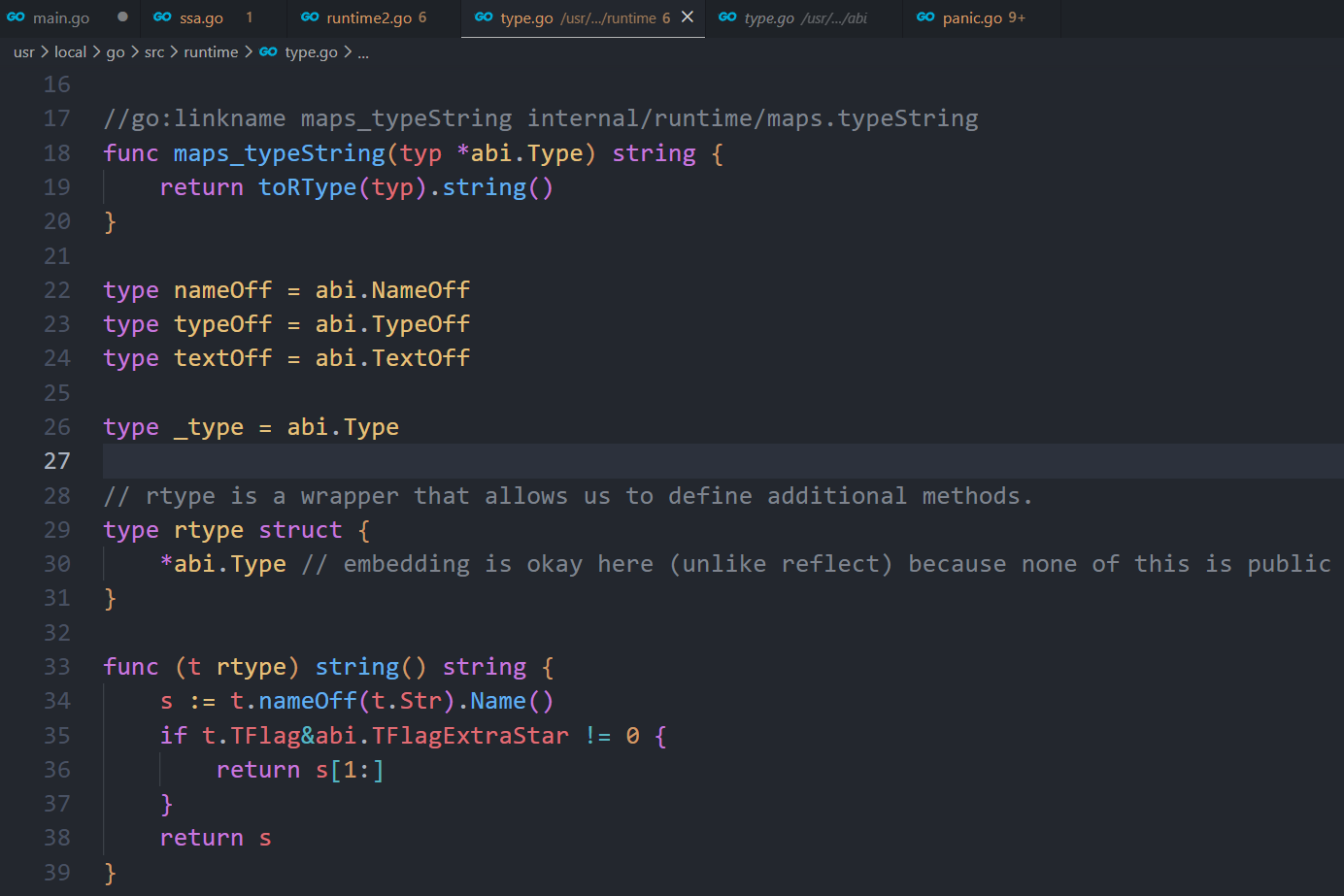
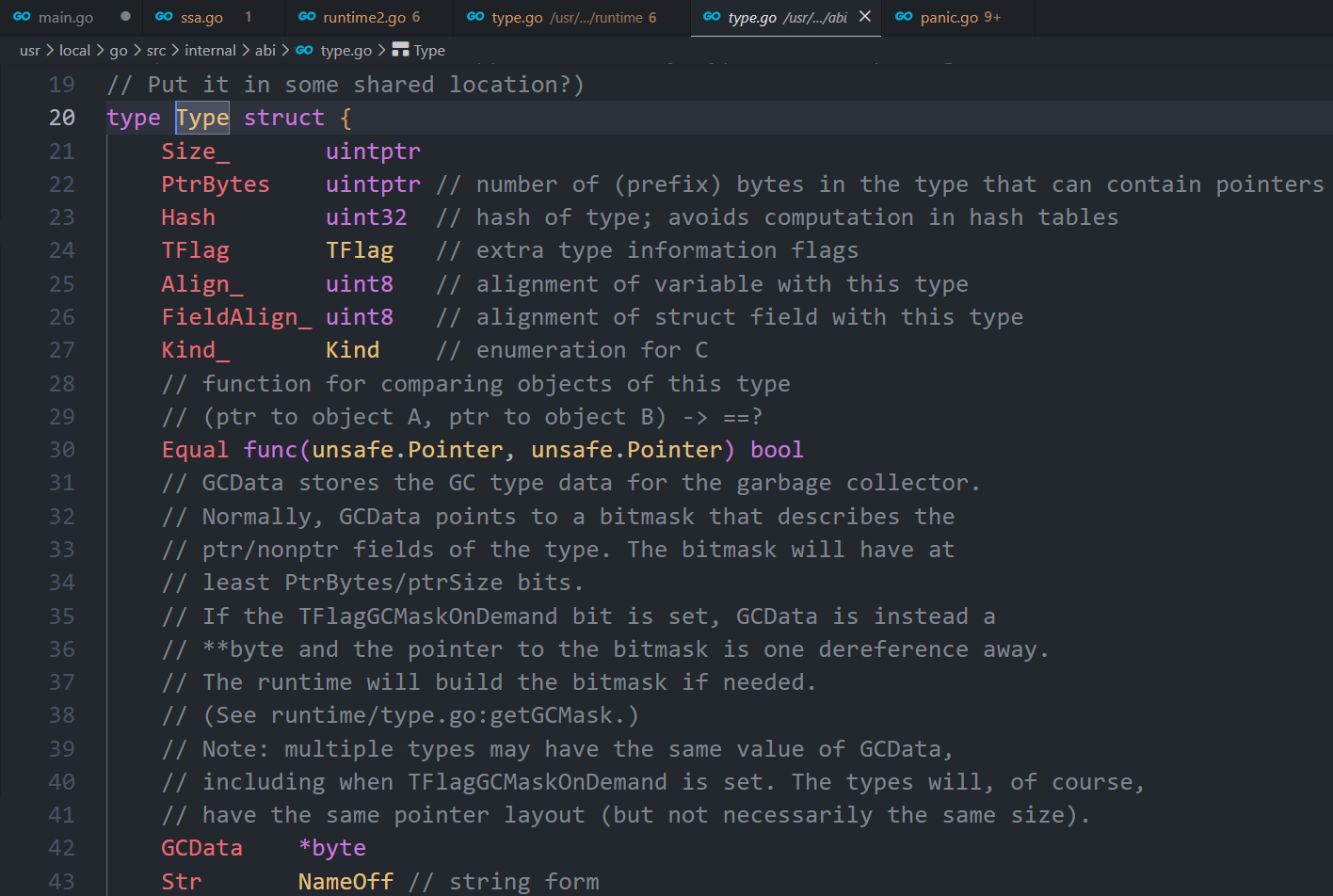
Go语言中几乎所有的数据结构都可以抽象成 _type 。关于 _type 的定义在源文件 /usr/local/go/src/internal/abi/type.go 具体定义如下:
go
// Type is the runtime representation of a Go type.
//
// Be careful about accessing this type at build time, as the version
// of this type in the compiler/linker may not have the same layout
// as the version in the target binary, due to pointer width
// differences and any experiments. Use cmd/compile/internal/rttype
// or the functions in compiletype.go to access this type instead.
// (TODO: this admonition applies to every type in this package.
// Put it in some shared location?)
type Type struct {
	Size_       uintptr	// 数据类型占用的空间大小
	// 前缀持有所有指针的内存大小
	PtrBytes    uintptr // number of (prefix) bytes in the type that can contain pointers
	// 类型的hash值
	Hash        uint32  // hash of type; avoids computation in hash tables
	// 信息标志
	TFlag       TFlag   // extra type information flags
	// 这种类型在内存中的对齐方式
	Align_      uint8   // alignment of variable with this type
	FieldAlign_ uint8   // alignment of struct field with this type
	// 类型编号
	Kind_       Kind    // enumeration for C
	// function for comparing objects of this type
	// (ptr to object A, ptr to object B) -> ==?
	// 类型的比较函数
	Equal func(unsafe.Pointer, unsafe.Pointer) bool
	// GCData stores the GC type data for the garbage collector.
	// Normally, GCData points to a bitmask that describes the
	// ptr/nonptr fields of the type. The bitmask will have at
	// least PtrBytes/ptrSize bits.
	// If the TFlagGCMaskOnDemand bit is set, GCData is instead a
	// **byte and the pointer to the bitmask is one dereference away.
	// The runtime will build the bitmask if needed.
	// (See runtime/type.go:getGCMask.)
	// Note: multiple types may have the same value of GCData,
	// including when TFlagGCMaskOnDemand is set. The types will, of course,
	// have the same pointer layout (but not necessarily the same size).
	GCData    *byte
	Str       NameOff // string form
	PtrToThis TypeOff // type for pointer to this type, may be zero
}
type _type 变成了 src/internal/abi/type.go 中 type Type struct 这个结构体的别名,且所有成员全部变为 public
什么是动态类型和动态值呢,举个例子
go
package main

import "fmt"

type Apple struct {
    PhoneName string
}

func main() {

    a := Apple{PhoneName: "apple"}
    var efc interface{}
    efc = a
    fmt.Println(efc)
}
这里在var efc interface{}定义了一个接口类型实例efc,此时还未对efc赋值,它的结构如下图所示:
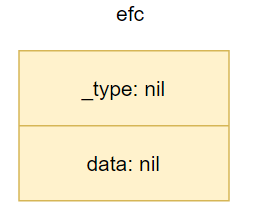
在efc = a,对efc赋值了一个Apple类型的变量之后,其底层结构表现如下图所示:
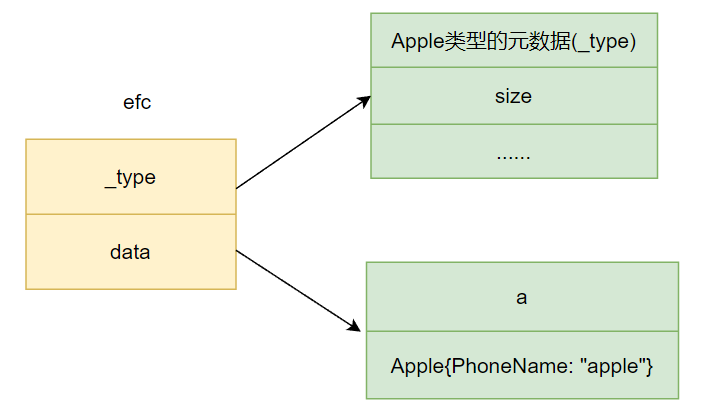
其中_type指针指向a变量的类型元数据,data指针指向a变量的值
非空接口
包含方法列表的接口就是非空接口,例如下面定义的接口Phone就是一个非空接口:
go
type Phone interface {
    Call()
}
非空接口的底层实现和空接口有所不同,因为其多了方法列表,在底层实现中显然我们需要有地方来存储方法列表,非空接口的结构定义位于src/runtime/runtime2.go,定义如下:
go
type iface struct {
	tab  *itab
	data unsafe.Pointer
}tab:指向一个itab的结构,itab结构里面存储值接口要求的方法列表和 data对应动态类型信息
data:指向接口的动态值,这里跟空接口一样
下面看一下itab的结构定义,itab结构定义在src/runtime/runtime2.go,定义如下:
go
type itab = abi.ITab
// The first word of every non-empty interface type contains an *ITab.
// It records the underlying concrete type (Type), the interface type it
// is implementing (Inter), and some ancillary information.
//
// allocated in non-garbage-collected memory
type ITab struct {
	Inter *InterfaceType
	Type  *Type
	Hash  uint32     // copy of Type.Hash. Used for type switches.
	Fun   [1]uintptr // variable sized. fun[0]==0 means Type does not implement Inter.
}inter:指向interfacetype结构的指针,interfacetype结构记录了这个接口类型的描述信息,主要是接口的方法列表
_type:实际类型的指针,指向_type结构,_type结构保存了接口的动态类型信息 ,跟空接口的_type一样,即赋值给这个接口的具体类型信息的元数据
hash:该类型的hash值,itab中的hash和itab._type中的hash相等,其实是从itab._type中拷贝出来的,目的是用于快速判断类型是否相等。它就是把 Type.Hash 复制到 itab.Hash,做"局部缓存",让 hot path 更快。【hot path = 跑得最勤的那条路,优化它最值。】
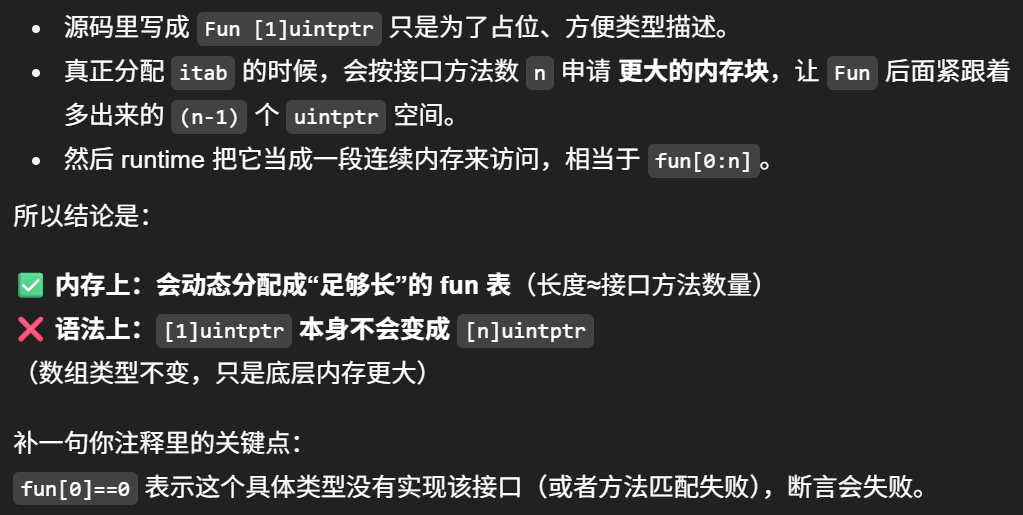
Fun:Fun是一个指针数组,里面保存了实现该接口的实际类型(只包含接口中的方法)地址 ,这些方法地址实际上是从interfacetype结构中的mhdr拷贝出来的,为了在调用的时候快速定位到方法。如果该接口对应的动态类型没有实现接口的所有方法,那么itab.Fun0=0,表示断言失败,该类型不能赋值给该接口。运行时,Fun长度会动态分配。
是 runtime 用变长结构体(尾部数组 / flexible array member) 的玩法:
interfacetype 保存了接口自身的元信息,下面看一下interfacetype结构
go
type InterfaceType struct {
	Type		// 类型信息
	// 包路径
	PkgPath Name      // import path
	// 接口的方法列表
	Methods []Imethod // sorted by hash
}
这里主要关注的是Methods 这个字段,定义的接口的方法里表就保存在Methods 数组里
下面还是通过例子看一下,赋值一个非空接口对应的底层结构变化
go
package main

import "fmt"

type Apple struct {
	PhoneName string
}

func (a Apple) Call() {
	fmt.Printf("%s有打电话功能\n", a.PhoneName)
}

func (a Apple) SendMessage() {
	fmt.Printf("%s有发短信功能\n", a.PhoneName)
}

func (a Apple) SendEmail() {
	fmt.Printf("%s有发邮件功能\n", a.PhoneName)
}

type Phone interface {
	Call()
	SendMessage()
}

func main() {
	a := Apple{PhoneName: "apple"}
	var ifc Phone
	ifc = a
	fmt.Println(ifc)
}
go
root@GoLang:~/proj/goforjob# go run main.go
{apple}
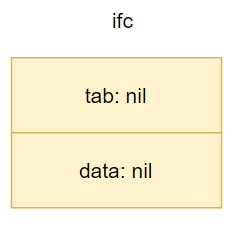
在程序var ifc Phone,赋值之前,ifc的结构如下图所示:
在ifc = a,给ifc赋值一个包含方法的结构体a之后,ifc的结构如下图:
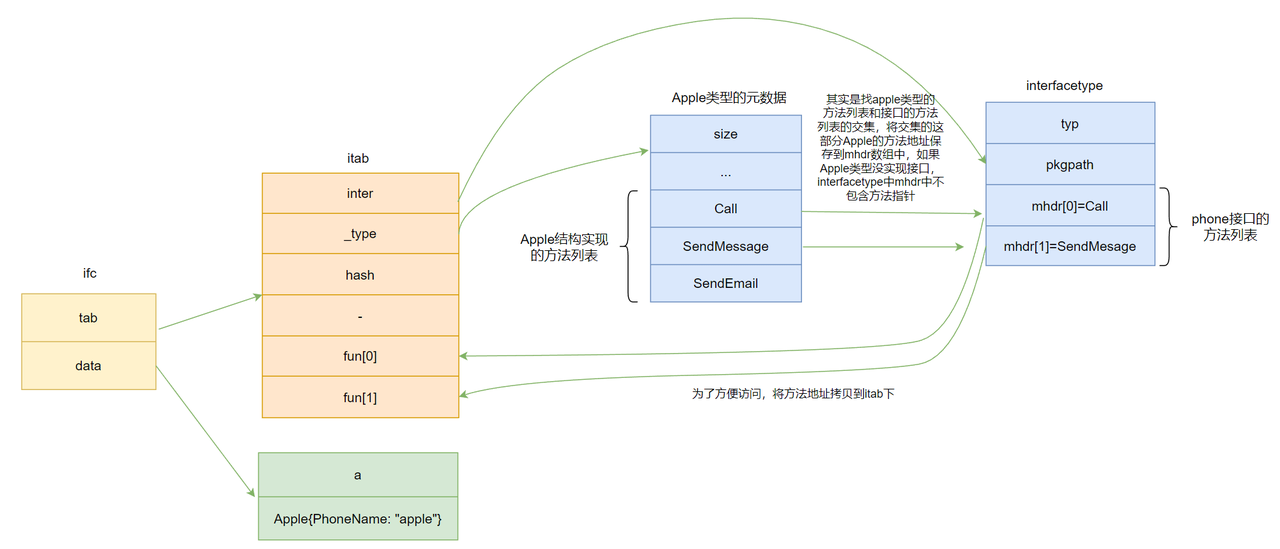
赋值过程中,data指针其实还是和空接口一样指向具体类型值,这里指向变量a。tab指针则是指向itab这个结构体,itab结构创建的创建主要分为3部分:
-
_type字段保存接口的动态类型信息,本例中,_type指针指向Apple类型的元数据
-
inter保存接口自身的一些信息,这里重要处理方法列表,本质上其实是求接口类型(Phone)和具体类型(Apple)的方法列表的交集,将具体类型(Apple)这部分交集的方法地址也保存到interfacetype的mhdr数组中,假设具体类型(Apple)没有实现接口(Phone),那么这里mhdr数组将不包含任何方法的指针
-
最后再将mhdr数组中的方法地址拷贝到itab的fun数组中,方便调用方法的时候快速找到方法地址,如果具体类型(Apple)没有实现接口(Phone),那么这里itab.fun0=0
itab缓存
在给一个非空接口赋值的时候,itab里面主要是保存具体类型的类型元数据和方法列表,但是我们在给接口赋值的时候,我们可以赋值多个类型相同的动态类型,比如我们可以有如下代码:
go
var ifc Phone
a := Apple{PhoneName: "apple1"}
b := Apple{PhoneName: "apple2"}
c := Apple{PhoneName: "apple3"}
ifc = a
ifc = b
ifc = c同类型的接口多次赋值,虽然具体类型的值不同,但是他们的类型相同,方法列表也相同,显然这个itab结构体是可以被复用的,如果我们每次都创建一个新的itab的话,性能无疑会大大下降。所以可以把用到的itab结构体缓存起来,每个非空的interface的接口类型和具体类型就可以唯一确定一个类型的itab
同类型反复赋值给同一个非空接口,itab 会缓存复用;变的是 data,不变的是 tab。
itabTable
go语言采用itabTable这个结构来缓存所有的itab结构,itabTable的结构定义在 src/runtime/iface.go,定义如下:
go
// Note: change the formula in the mallocgc call in itabAdd if you change these fields.
type itabTableType struct {
	// entries数组的长度
	size    uintptr             // length of entries array. Always a power of 2.
	// 当前数组中实际itab的数量
	count   uintptr             // current number of filled entries.
	// 数组,可以当做hash的思想(哈希表)
	entries [itabInitSize]*itab // really [size] large
}
itabTable实际用来存储itab结构的其实是这个entries结构,entries 是一个hash表,key为接口类型与实际类型分别哈希后的异或值
go
func itabHashFunc(inter *interfacetype, typ *_type) uintptr {
	// compiler has provided some good hash codes for us.
	return uintptr(inter.Type.Hash ^ typ.Hash)
}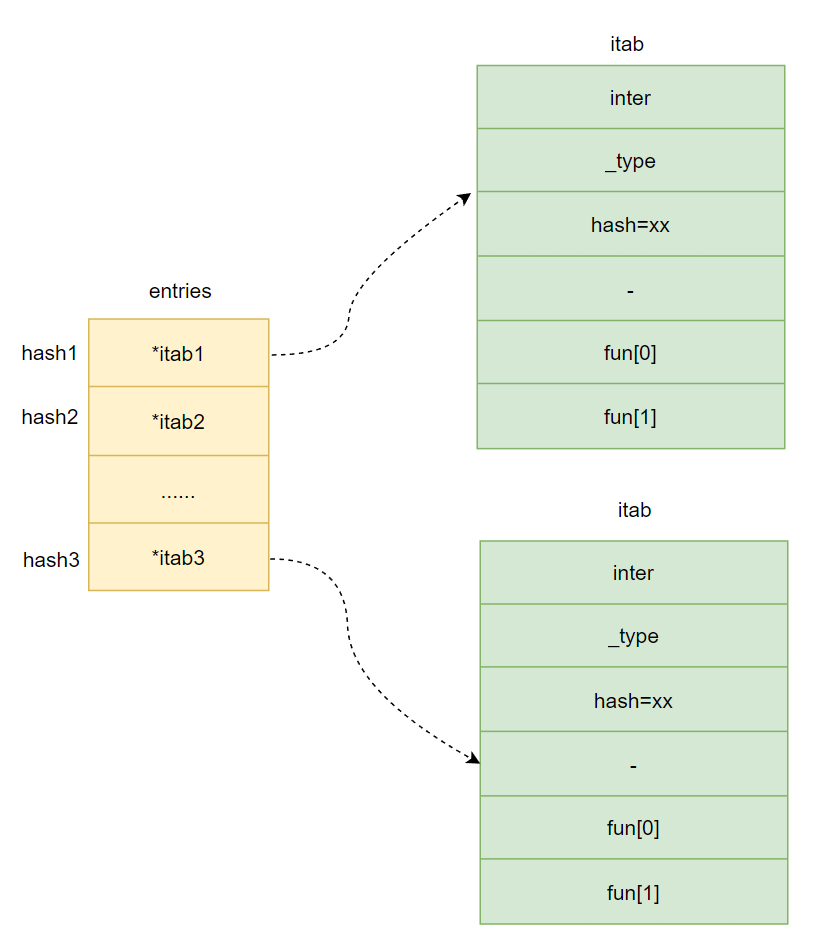
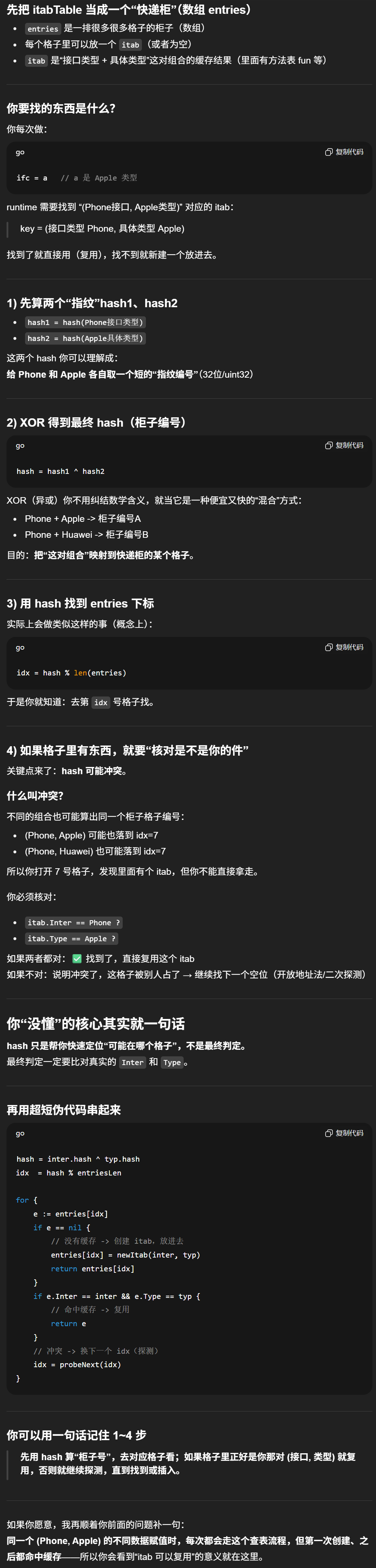
我们在查找一个itab是否存在的时候,
-
先计算接口类型的哈希值hash1和实际类型的哈希值hash2
-
hash1与hash2做异或运算得到最终哈希值hash
-
在entries数组中找到下标为hash的位置
-
如果能查询到对应的itab指针(这里需要比较接口类型和实际类型,因为可能出现产生hash冲突,槽位被占用的情况),就直接拿来使用。若没有就要再创建,然后添加到itabTable中。
对于hash冲突问题,采用的是开放地址法,根据计算的空位发现槽位被占用,则采用二次寻址法在数组后面寻找空位插入
之后我会持续更新,如果喜欢我的文章,请记得一键三连哦,点赞关注收藏,你的每一个赞每一份关注每一次收藏都将是我前进路上的无限动力 !!!↖(▔▽▔)↗感谢支持!