高级推理机制为智能体赋予了解决复杂问题的深度思考能力,其核心在于通过结构化的多步骤分析,使智能体能够像人类一样进行逐步推理与问题拆解。与仅执行预设指令或直接生成答案的简单模式不同,这些方法旨在让智能体的思考过程透明化、可追溯,通过明确展示其"思维链"来提升结果的可靠度。
该机制的关键在于允许系统投入更多的计算资源与时间 进行深度思考。这意味着智能体或其底层的大语言模型不再追求单次快速响应,而是可以进行迭代分析、探索多种可能性,并在必要时调用外部工具进行验证。这种"慢思考"模式虽然增加了响应时间,但在处理需要逻辑推导、审慎权衡或深度分析的复杂任务时,能显著提升最终输出的准确性、逻辑连贯性与整体稳健性。
简言之,高级推理方法将智能体从一个快速的"应答者",转变为一个能够主动拆解问题、展示中间步骤并进行自我验证的"思考者",从而在复杂决策中实现更高水平的认知表现。
实际应用和用例
高级推理技术赋予智能体解决复杂问题的深度分析能力,其应用价值在以下典型场景中尤为显著:
| 应用场景 | 核心挑战 | 高级推理赋予的能力 | 延长思考带来的关键提升 |
|---|---|---|---|
| 复杂问答 | 答案散落在多处信息源,需进行多步逻辑关联与整合。 | 分解问题链条、并行探索推理路径、跨来源信息综合。 | 从"检索答案"到"构建答案":通过深度思考整合碎片信息,形成连贯、有据的解答。 |
| 数学问题解决 | 题目复杂,需拆解为多个子问题并按步骤精确求解。 | 问题分解、分步演算、调用代码执行器进行验证。 | 从"输出结果"到"展示过程":提供透明、可验证的解题步骤,并利用代码确保计算精确性。 |
| 代码调试与生成 | 代码错误或需求复杂,需理解逻辑、定位问题并迭代优化。 | 解释代码意图、定位潜在缺陷、根据测试结果自我修正。 | 从"一次生成"到"迭代优化":通过反复推敲与验证,生成更健壮、符合预期的代码。 |
| 战略规划 | 需综合考虑多种因素、可能结果与前提条件,制定可靠方案。 | 评估不同选项的后果、权衡利弊、根据反馈动态调整策略。 | 从"单一方案"到"弹性策略":经过充分推演,形成更周全、适应性更强的行动计划。 |
| 法律分析 | 需解读复杂条文与先例,构建严谨、逻辑一致的法律论点。 | 解析法律文件、援引相关判例、构建并验证论证链条。 | 从"文本解读"到"论点构建":通过深度分析与自我纠错,确保推理的严谨性与结论的可信度。 |
本质上,这些技术使智能体从执行快速、线性的响应,转变为能够进行深度分析、多步推导和迭代优化的"思考型伙伴"。其核心在于将额外的计算时间,转化为更高质量、更可信赖的决策与产出。
推理技术
首先,让我们深入了解用于增强 AI 模型问题解决能力的核心推理技术。
思维链(Chain‐of‐Thought,CoT)提示词通过模拟逐步思考过程,显著增强了 LLM 的复杂推理能力(见 图 1)。CoT 提示词不是要求模型直接给出答案,而是引导其生成一系列中间推理步骤。这种显式的分解使 LLM 能够将复杂问题拆分为更小、更易管理的子问题来逐步解决。该技术显著提升了模型在需要多步 推理任务上的表现,例如算术计算、常识推理和符号操作。CoT 的主要优势在于能够将困难的单步问题转化为一系列更简单的步骤,从而提高 LLM 推理过程的透明度。这种方法不仅提高了准确性,还为理解模 型决策过程提供了宝贵见解,有助于调试和分析。CoT 可以通过多种策略实现,包括提供展示逐步推理 的少样本示例,或简单地指示模型"逐步思考"。其有效性源于它能够引导模型的内部处理过程朝着更审慎和逻辑化的方向发展。因此,思维链已成为在当代 LLM 中实现高级推理能力的基石技术。这种增强的 透明度和复杂问题分解能力对于自主 Agent 尤为重要,使它们能够在复杂环境中执行更可靠和可审计的动作。
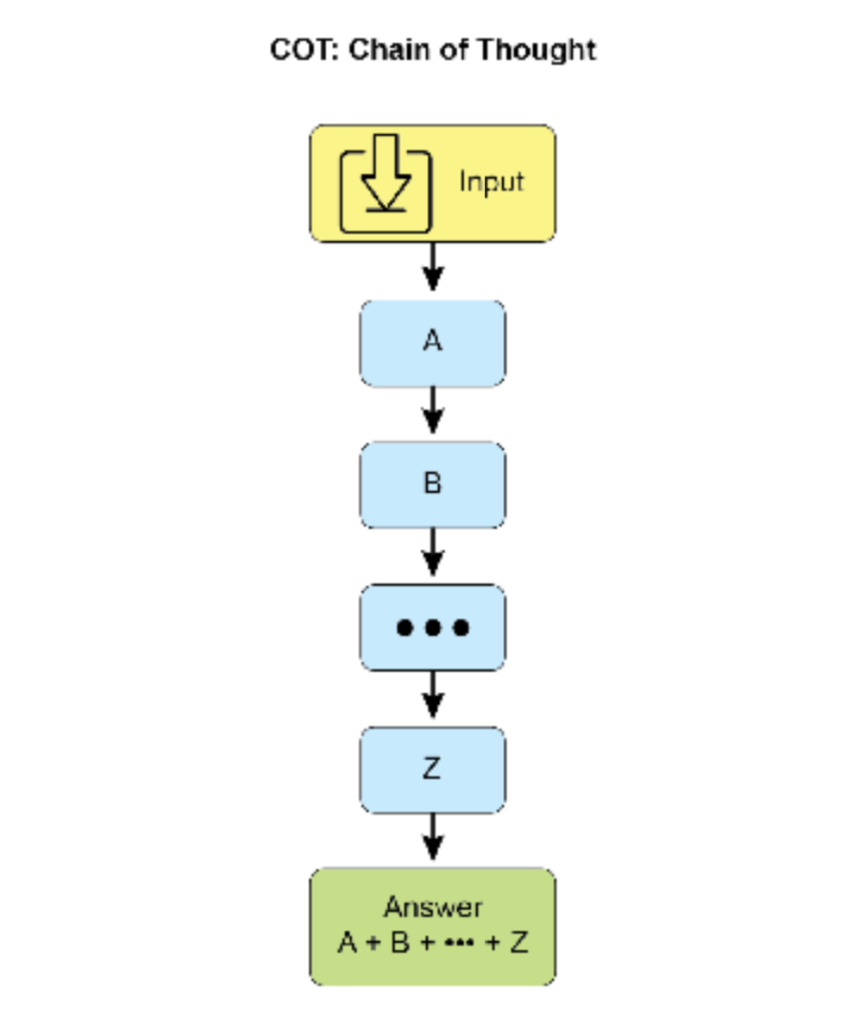
图 1:CoT 提示词以及 Agent 生成的详细的、逐步的响应。
让我们看一个例子。它以一组指令开始,告诉 AI 如何思考,定义其角色和要遵循的清晰五步流程。这是启动 结构化思维的提示词。
接下来,示例展示了 CoT 过程的实际应用。标记为"Agent 的思考过程"的部分是模型执行指示步骤的内部 独白。这是字面上的"思维链"。最后,"Agent 的最终答案"是由于仔细的、逐步推理过程而生成的精炼的、 全面的输出。
You are an Information Retrieval Agent . Your goal is to answer the user ' s question compreh 1. **Analyze the Query:** Understand the core subject and specific requirements of the use 2. **Formulate Search Queries (for Knowledge Base):** Based on your analysis, generate a l 3. **Simulate Information Retrieval (Self−Correction/Reasoning):** For each search query, 4. **Synthesize Information:** Based on the simulated retrieval and your understanding of 5. **Review and Refine:** Before finalizing , critically evaluate your answer. Is it accura
**User Query:** "Explain the main differences between classical computers and quantum comp
**Agent ' s Thought Process ( Internal CoT Output − encouraged by the prompt):** **Thought 1 ( Analyze Query):** The user wants two things :
- Main differences between classical and quantum computers. 2. One potential application of quantum computing.
Keywords: classical computers, quantum computers, differences , potential application.
**Thought 2 ( Formulate Search Queries ):**
− "differences classical vs quantum computers" − "how quantum computers work"
− "how classical computers work"
− "applications of quantum computing"
**Thought 3 (Simulate Information Retrieval & Identify Key Concepts):**
− From "differences": Expect concepts like bits vs . qubits , superposition , entanglement , p − From "how they work": Classical uses transistors / binary . Quantum uses quantum mechanics . − From "applications": Expect drug discovery , material science , cryptography , optimization .
**Thought 4 ( Synthesize Information ):** Classical computers use bits (0
**Thought 5 (Review and Refine):**
-
− Differences are covered ( bits vs qubits , superposition , entanglement ,
-
− Application is given (drug discovery ). − Is it brief? Yes.
− Is it clear? Yes.
− Looks good .
or 1) , processing i processing ) .
**Agent's Final Answer (Output to User):** Classical computers process information using b
思维树(Tree‐of‐Thought,ToT)是一种建立在思维链(CoT)基础上的推理技术。它允许 LLM 通 过分支到不同的中间步骤来探索多个推理路径,形成树状结构(见图 2)。这种方法通过支持回 溯、自我纠正和探索替代解决方案来应对复杂的问题解决。维护可能性树使得模型能够在最终确定 答案之前评估各种推理轨迹。这种迭代过程增强了模型处理需要战略规划和决策的挑战性任务的能力。
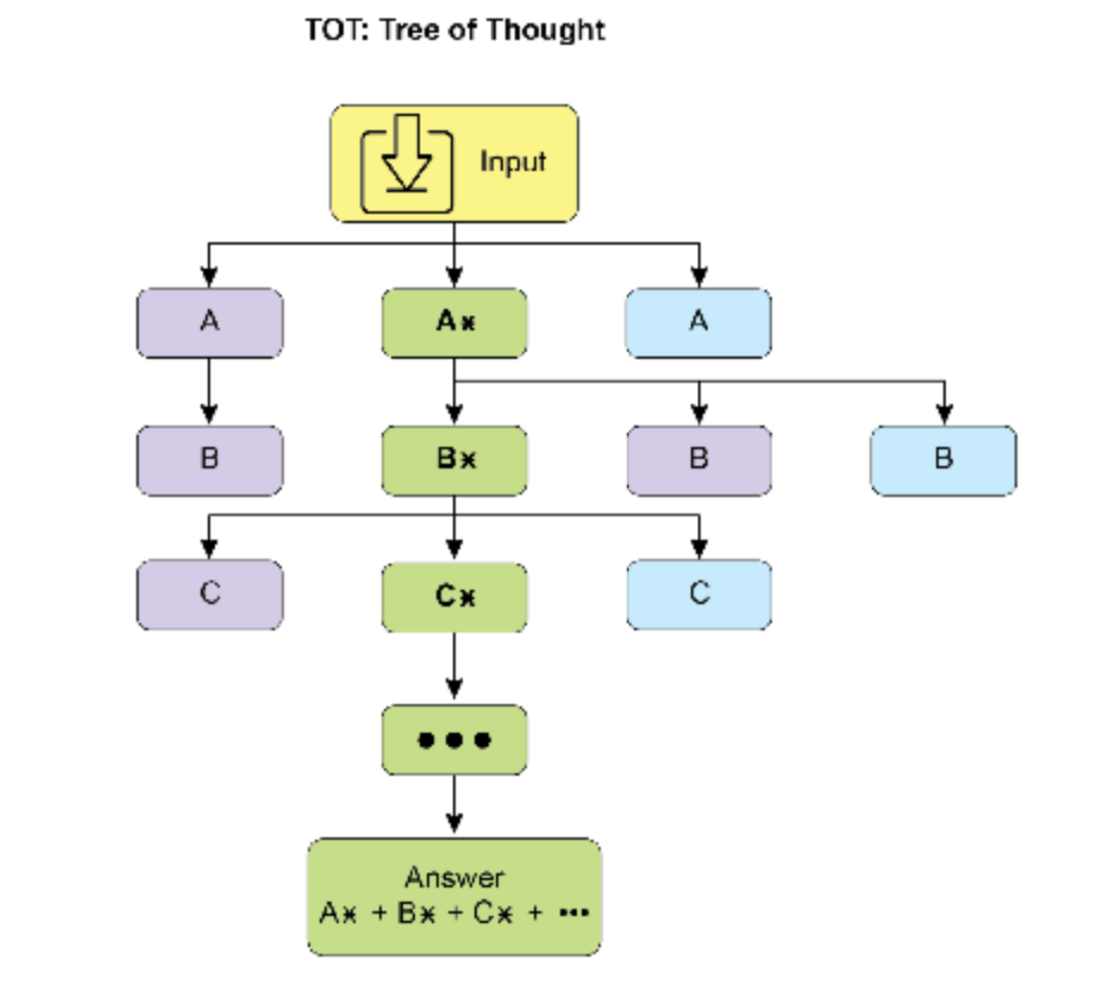
图 2:思维树示例
自我纠正,也称为自我改进,是 Agent 推理过程的一个关键方面,特别是在思维链提示词中。它涉及 Agent对其生成内容和中间思考过程的内部评估。这种批判性审查使 Agent 能够识别其理解或解决方案中的模糊性、信息缺口或不准确性。通过审查和改进的迭代循环,Agent 可以调整方法、提升响应质量,并在提供最 终输出前确保准确性和完整性。这种内部批评机制增强了Agent 产生可靠和高质量结果的能力。
这个示例展示了自我纠正的系统过程,这对于改进 AI 生成内容至关重要。它涉及起草、根据原始要求进行审查以及实施具体改进的迭代循环。示例首先概述了AI 作为"自我纠正 Agent"的功能,并定义了五步分析和修订工作流程。然后,展示了社交媒体帖子的"初稿"。"自我纠正 Agent 的思考过程"构成了演示的核心部分。在这里,Agent 根据其指令批判性地评估草稿,指出诸如低参与度和模糊的号召性用语等弱点。随后提出具体的改进建议,包括使用更有影响力的动词和表情符号。整个过程以"最终修订内容"结束,这是一个整合了自我识别调整的精炼和显著改进的版本。
You are a highly critical and detail−oriented Self−Correction Agent. Your task is to review
-
**Understand Original Requirements:** Review the initial prompt/requirements that led t
-
**Analyze Current Content:** Read the provided content carefully .
-
**Identify Discrepancies/Weaknesses:** Compare the current content against the original
* **Accuracy Issues:** Are there any factual errors or misleading statements?
* **Completeness Gaps:** Does it fully address all aspects of the original prompt? Is a * **Clarity & Coherence:** Is the language clear , concise , and easy to understand? Does * **Tone & Style:** Does it match the desired tone and style (e.g. , professional , engag * **Engagement:** Is it captivating? Does it hold the reader's attention?
* **Redundancy/Verbosity:** Can any parts be condensed or removed without losing meanin
-
**Propose Specific Improvements:** For each identified weakness, suggest concrete and a
-
**Generate Revised Content:** Based on your proposed improvements, rewrite the original
**Original Prompt/Requirements:** "Write a short , engaging social media post (max 150 chara **Initial Draft (Content to be corrected):** "We have new products. They are green and tech
**Self −Correction Agent ' s Thought Process ( Internal CoT Output − encouraged by the prompt): **Thought 1 (Understand Original Requirements):**
-
− Short , engaging social media post .
-
− Max 150 characters .
− Announce "GreenTech Gadgets" − a new eco−friendly product line .
**Thought 2 (Analyze Current Content):** "We have new products. They are green and techy. B
**Thought 3 ( Identify Discrepancies /Weaknesses):**
− **Engaging:** Not very engaging . Sounds generic .
− **Eco−friendly:** Implied by"green," but not explicitly highlighted as a benefit. − **Call to Action:** "Buy now!" is okay, but could be more compelling.
− **Conciseness:** It 's short , but could use stronger verbs/phrasing.
− **Impact:** Lacks excitement for a new product launch.
**Thought 4 (Propose Specific Improvements):**
-
− Make i t more dynamic and exciting .
-
− Emphasize "eco−friendly" and "innovation."
-
− Use stronger verbs and more active voice.
-
− Add a clear , engaging call to action .
-
− Ensure i t stays under 150 characters .
**Thought 5 (Generate Revised Content):** Original: "We have new products. They are green a **Self−Correction Agent's Final Revised Content (Output to User):** Discover GreenTech Ga
从根本上说,这种技术将质量控制措施直接集成到 Agent 的内容生成过程中,产生更精炼、准确和优质的结 果,从而更有效地满足复杂的用户需求。
程序辅助语言模型(Program‐Aided Language Models,PALMs)将 LLM 与符号推理能力相结合。这种 集成允许 LLM 在问题解决过程中生成和执行代码,例如 Python。PALMs 将复杂的计算、逻辑操作和数据操 作卸载到确定性编程环境中。这种方法利用传统编程的优势来处理 LLM 在准确性或一致性方面可能存在局 限的任务。当面对符号推理挑战时,模型可以生成代码、执行代码,并将结果转换为自然语言。这种混合方 法结合了 LLM 的理解和生成能力与精确计算,使模型能够以更高的可靠性和准确性解决更广泛的复杂问题。 这对 Agent 至关重要,因为它允许它们通过在理解和生成能力之外利用精确计算来执行更准确和可靠的动作。
可验证奖励强化学习(Reinforcement Learning with Verifiable Rewards,RLVR):虽然有效,但许多 LLM 使用的标准思维链(CoT)提示词是一种相对基础的推理方法。它生成单一的、预定的思路,而无法适 应问题的复杂性。为了克服这些限制,开发了一类新的专门"推理模型"。这些模型的运行方式有所不同,在 提供答案之前专门花费可变量的"思考"时间。这个"思考"过程产生更广泛和动态的思维链,可能长达数 千个 token。这种扩展推理允许更复杂的行为,如自我纠正和回溯,模型在更困难的问题上投入更多计算资 源。实现这些模型的关键创新是一种称为可验证奖励强化学习(RLVR)的训练策略。通过在具有已知正确答 案的问题(如数学或代码)上训练模型,它通过试错学习生成有效的长篇推理。这使得模型能够在没有直接 人类监督的情况下发展其问题解决能力。最终,这些推理模型不仅产生答案,还生成展示规划、监控和评估 等高级技能的"推理轨迹"。这种增强的推理和策略能力是开发自主 AI Agent 的基础,使它们能够在最少人 类干预的情况下分解和解决复杂任务。
ReAct(推理和行动,见图 3,其中 KB 代表知识库)是一种将思维链(CoT)提示词与 Agent 通过工具与外 部环境交互的能力相结合的范式。与直接生成最终答案的生成模型不同,ReAct Agent 首先对要采取哪些行 动进行推理。这个推理阶段涉及内部规划过程,类似于 CoT,Agent 确定下一步行动,考虑可用工具并预测可能的结果。然后,Agent 通过执行工具或函数调用来行动,例如查询数据库、执行计算或与 API 交互。
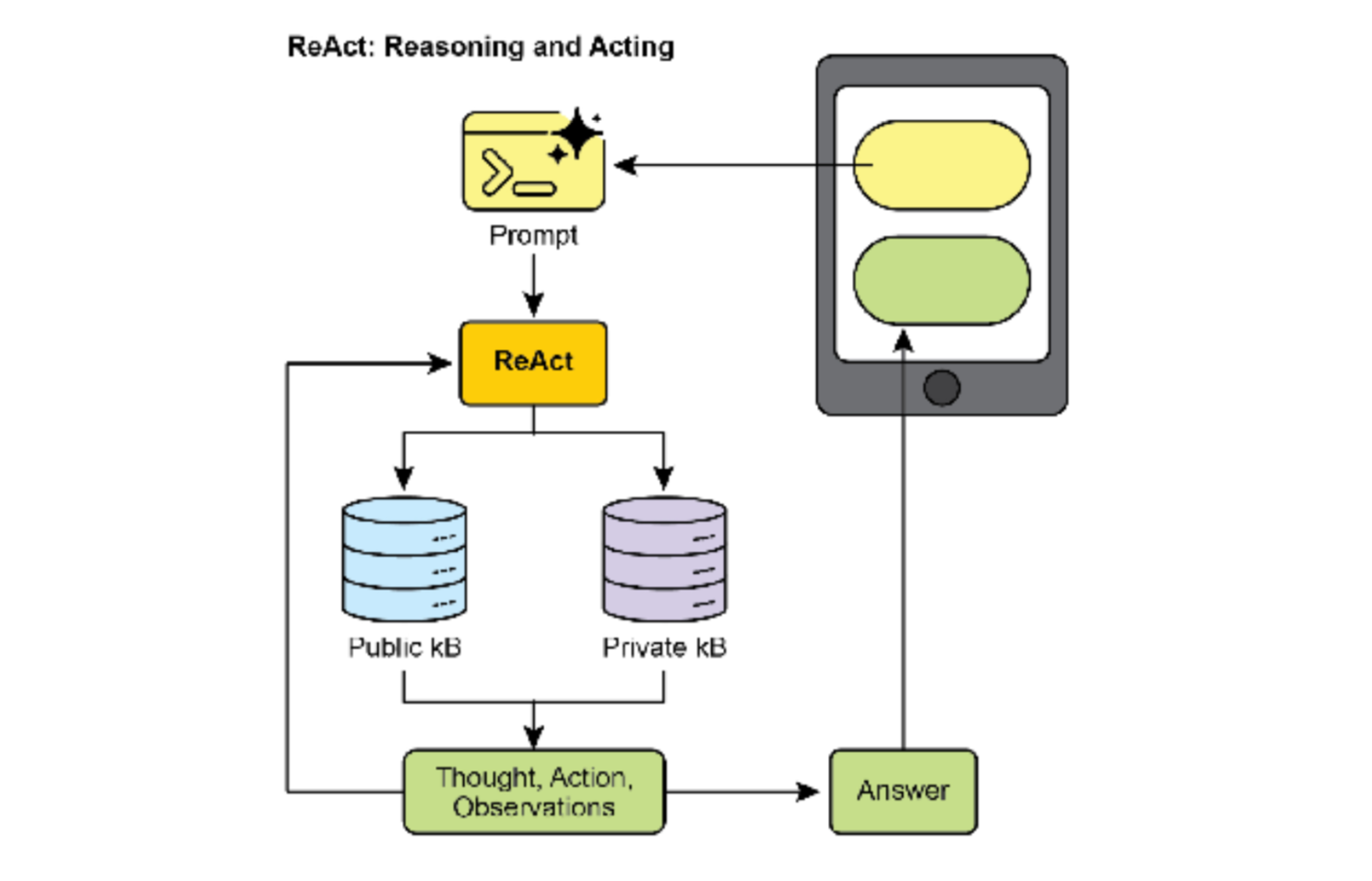
图 3:推理和行动
ReAct 以交错的方式运行:Agent 执行一个动作,观察结果,并将此观察纳入后续推理。这种"思考、行动、 观察、思考⋯"的迭代循环允许 Agent 动态调整计划、纠正错误并实现需要与环境进行多次交互的目标。与 线性 CoT 相比,这提供了更强大和灵活的问题解决方法,因为 Agent 能够响应实时反馈。通过结合语言模 型的理解和生成能力与使用工具的能力,ReAct 使 Agent 能够执行需要推理和实际执行的复杂任务。这种方 法对 Agent 至关重要,因为它允许它们不仅进行推理,还可以实际执行步骤并与动态环境交互。
CoD(辩论链,Chain of Debates)是微软提出的一种正式 AI 框架,其中多个不同的模型协作和争论以解决 问题,超越了单个 AI 的"思维链"。该系统运作类似于 AI 委员会会议,不同的模型提出初步想法,批评彼此 的推理,并交换反驳论点。主要目标是通过利用集体智慧来提高准确性、减少偏见并改善最终答案的整体质 量。作为 AI 版本的同行评审,这种方法创建了推理过程的透明和可信记录。最终,它代表了从单独 Agent 提 供答案到协作 Agent 团队共同寻找更可靠和验证的解决方案的转变。
GoD(辩论图,Graph of Debates)是一个高级 Agentic 框架,它将讨论重新构想为动态的、非线性网络, 而不是简单的链式结构。在这个模型中,论点是由表示"支持"或"反驳"等关系的边连接的各个节点,反 映了真实辩论的多线程性质。这种结构允许新的探究线索动态分支、独立演化,甚至随时间合并。结论不是 在序列的末尾达成,而是通过识别整个图中最稳健和得到良好支持的论点集群来达成。在这种情况下,"得 到良好支持"是指已牢固建立和可验证的知识。这包括被认为是基本事实的信息,即本质上是正确的并被广 泛接受为事实的内容。此外,它包括通过搜索基础获得的事实证据,其中信息针对外部来源和现实世界数据 进行验证。最后,它还涉及在辩论期间由多个模型达成的共识,表明对所呈现信息的高度一致和信心。这种 全面的方法确保了所讨论信息的更稳健和可靠的基础。这种方法为复杂的、协作的 AI 推理提供了更全面和 现实的模型。
MASS(可选高级主题):对多 Agent 系统设计的深入分析表明,其有效性严重依赖于各个 Agent 的提示词 质量以及决定其交互的拓扑结构。设计这些系统的复杂性非常显著,因为它涉及一个庞大而复杂的搜索空间。为了应对这一挑战,开发了一个名为多 Agent 系统搜索(Multi‐Agent System Search,MASS)的新框 架来自动化和优化多 Agent 系统的设计。
MASS 采用多阶段优化策略,通过交错进行提示词和拓扑优化来系统地导航复杂的设计空间(见图 4)。
-
块级提示词优化:该过程从对各个 Agent 类型或"块"的提示词进行局部优化开始,以确保每个组件在 集成到更大系统之前能够有效执行其角色。这个初始步骤至关重要,因为它确保后续的拓扑优化建立在性能 良好的 Agent 之上,而不是受到配置不当的 Agent 的累积影响。例如,在针对 HotpotQA 数据集进行优化 时,"Debator"Agent 的提示词被创造性地构建为指示它充当"主要出版物的专家事实核查员"。其优化的 任务是仔细审查来自其他 Agent 的建议答案,将它们与提供的上下文段落交叉引用,并识别任何不一致或 不受支持的声明。这种在块级优化期间发现的专门角色扮演提示词旨在使辩论者 Agent 在被放入更大的工 作流之前在综合信息方面非常有效。
-
工作流拓扑优化:在局部优化之后,MASS 通过从可自定义的设计空间中选择和安排不同的 Agent 交互 来优化工作流拓扑。为了使这种搜索有效,MASS 采用影响加权方法。该方法通过测量每个拓扑相对于基线 Agent 的性能增益来计算其"增量影响",并使用这些分数来引导搜索朝向更有前途的组合。例如,在针对 MBPP 编码任务进行优化时,拓扑搜索发现特定的混合工作流最有效。找到的最佳拓扑不是简单的结构,而 是迭代改进过程与外部工具使用的组合。具体来说,它由一个进行多轮反思的预测器 Agent 组成,其代码 由一个针对测试用例运行代码的执行器 Agent 验证。这个发现的工作流表明,对于编码任务,结合迭代自 我纠正和外部验证的结构优于更简单的多 Agent 系统设计。
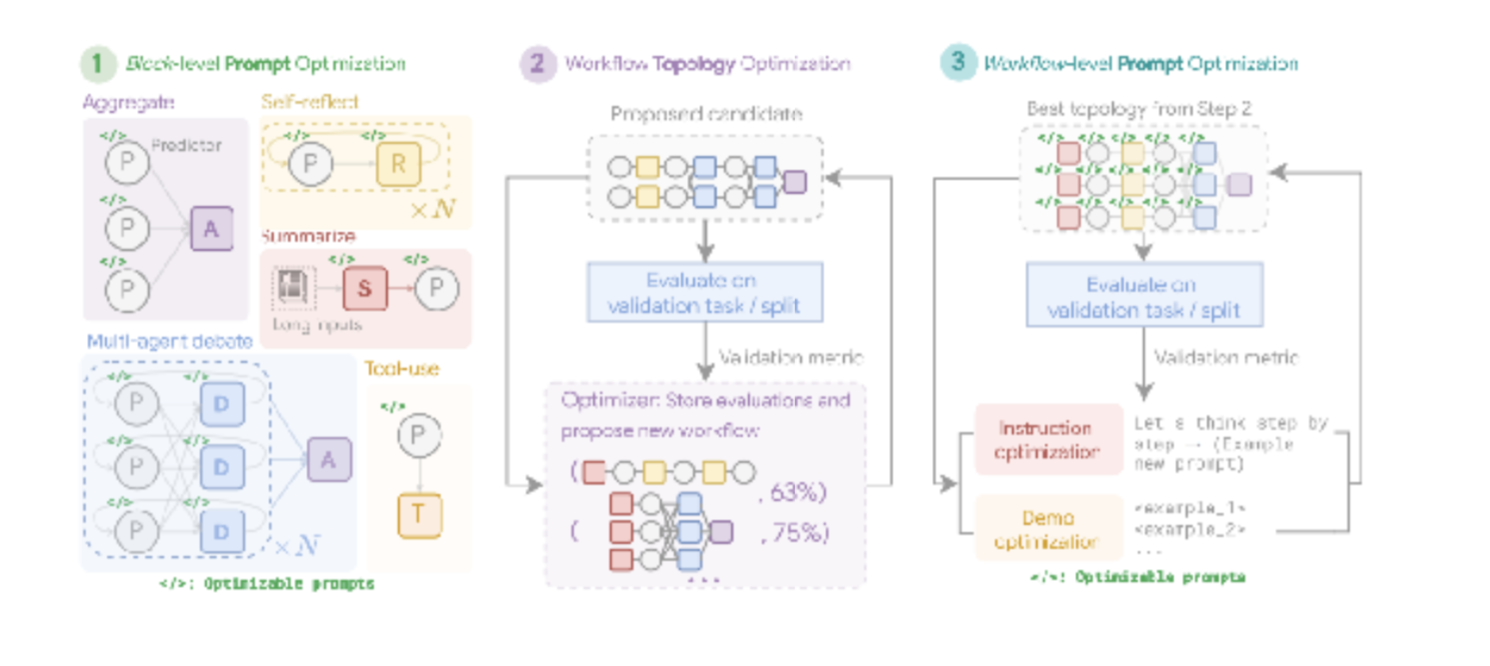
图 4:(由作者提供):多 Agent 系统搜索(MASS)框架是一个三阶段优化过程,导航包含可优化提示词(指 令和演示)和可配置 Agent 构建块(聚合、反思、辩论、总结和工具使用)的搜索空间。第一阶段,块级提 示词优化,独立优化每个 Agent 模块的提示词。第二阶段,工作流拓扑优化,从影响加权的设计空间中采样 有效的系统配置,集成优化的提示词。最后阶段,工作流级提示词优化,在从第二阶段识别出最优工作流后, 对整个多 Agent 系统进行第二轮提示词优化。
- 工作流级提示词优化:最后阶段涉及对整个系统提示词的全局优化。在识别出性能最佳的拓扑之后,提示 词作为单一的集成实体进行微调,以确保它们针对编排进行定制,并优化 Agent 之间的相互依赖性。例如, 在找到 DROP 数据集的最佳拓扑后,最终优化阶段改进"Predictor"Agent 的提示词。最终优化的提示词 非常详细,首先向 Agent 提供数据集本身的摘要,指出其重点是"抽取式问答"和"数字信息"。然后包括 正确问答行为的少样本示例,并将核心指令框架为高风险场景:"您是一个高度专业的 AI,负责为紧急新闻 报道提取关键数字信息。现场直播依赖于您的准确性和速度"。这个多方面的提示词,结合元知识、示例和 角色扮演,专门针对最终工作流进行调优以最大化准确性。
关键发现和原则:实验表明,经 MASS 优化的多 Agent 系统在一系列任务中显著优于现有的手动设计系统 和其他自动设计方法。从这项研究中得出的有效多 Agent 系统的关键设计原则有三个方面:
・ 在组合Agent之前,使用高质量提示词优化各个Agent。
・ 通过组合有影响力的拓扑而不是探索无约束的搜索空间来构建多Agent系统。
・ 通过最终的工作流级联合优化来建模和优化Agent之间的相互依赖性。
在讨论了关键推理技术的基础上,让我们研究一个核心性能原则:LLM 的推理扩展定律。该定律指出,模型 的性能可预测地随着分配给它的计算资源的增加而提高。我们可以在 Deep Research 等复杂系统中看到这 一原则的实际应用,其中 AI Agent 利用这些资源通过将主题分解为子问题、使用网络搜索作为工具并综合其 发现来自主调查主题。
Deep Research:术语"Deep Research"描述了一类旨在充当不知疲倦、有条不紊的研究助手的 AI Agentic 工具。这一领域的主要平台包括 Perplexity AI、Google 的 Gemini 研究能力和 OpenAI 的 ChatGPT 高级功 能(见图 5)。

5:Google Deep Research 用于信息收集
这些工具引入的一个基本转变是搜索过程本身的变化。标准搜索提供即时链接,将综合工作留给用户。Deep Research 采用不同的工作模式。在这里,用户为 AI 分配一个复杂的查询并授予它一个"时间预算"------通 常是几分钟。作为这种耐心的回报,用户会收到详细的报告。
在此期间,AI 以 agentic 方式代表用户工作。它自主执行一系列复杂的步骤,这些步骤对于人类来说将是非 常耗时的:
-
初始探索:根据用户的初始提示词运行多个有针对性的搜索。
-
推理和改进:阅读和分析第一波结果,综合发现,并批判性地识别差距、矛盾或需要更多细节的领域。
-
后续查询:基于内部推理,进行新的、更细致的搜索以填补这些差距并加深理解。
-
最终综合:经过几轮这种迭代搜索和推理,将所有验证的信息编译成一个单一的、连贯的、结构化的摘要。
这种系统方法确保了全面和合理的响应,显著提高了信息收集的效率和深度,从而促进更 agentic 的决策过 程。
推理扩展定律
这个关键原则决定了 LLM 性能与其运营阶段(称为推理)期间分配的计算资源之间的关系。推理扩展定律 不同于更熟悉的训练扩展定律,后者关注模型质量如何随着模型创建期间数据量和计算能力的增加而提高。 相反,该定律专门研究 LLM 主动生成输出或答案时发生的动态权衡。
该定律的基石是揭示,通过增加推理时间的计算投资,通常可以从相对较小的 LLM 获得优越的结果。这并 不一定意味着使用更强大的 GPU,而是采用更复杂或资源密集型的推理策略。这种策略的一个主要例子是指 示模型生成多个潜在答案------可能通过多样化束搜索或自一致性方法等技术------然后使用选择机制来识别最 优输出。这种迭代改进或多候选生成过程需要更多的计算周期,但可以显著提高最终响应的质量。
这个原则为 Agent 系统部署中明智和经济合理的决策提供了关键框架。它挑战了更大模型总是产生更好性能 的直观概念。该定律认为,当在推理期间被授予更充足的"思考预算"时,较小的模型有时可以超越依赖更 简单、计算密集度较低的生成过程的更大模型。这里的"思考预算"是指在推理期间应用的额外计算步骤或 复杂算法,允许较小的模型探索更广泛的可能性范围或在确定答案之前应用更严格的内部检查。
因此,推理扩展定律成为构建高效和具有成本效益的 Agentic 系统的基础。它提供了一种方法来仔细平衡几个相互关联的因素:
-
・ 模型大小:较小的模型在内存和存储方面本质上要求较低。
-
・ 响应延迟:虽然增加的推理时间计算可能会增加延迟,但该定律有助于识别性能增益超过这种增加的点,或如何战略性地应用计算以避免过度延迟。
-
・ 运营成本:部署和运行更大的模型通常会因增加的功耗和基础设施要求而产生更高的持续运营成本。 该定律演示了如何在不必要地提高这些成本的情况下优化性能。
通过理解和应用推理扩展定律,开发人员和组织可以做出战略选择,从而为特定的 agentic 应用实现最佳性 能,确保计算资源分配到它们对 LLM 输出的质量和效用产生最显著影响的地方。这允许更细致和经济可行 的 AI 部署方法,超越简单的"更大就是更好"的范式。
实践代码示例
Google 开源的 DeepSearch 代码可通过 gemini‐fullstack‐langgraph‐quickstart 存储库获得(图 6)。该存 储库为开发人员提供了使用 Gemini 2.5 和 LangGraph 编排框架构建全栈 AI Agent 的模板。这个开源堆栈促 进了基于 Agent 的架构实验,并可以与本地 LLM(如 Gemma)集成。它利用 Docker 和模块化项目脚手架 进行快速原型设计。需要注意的是,此版本作为一个结构良好的演示,并不打算作为生产就绪的后端。
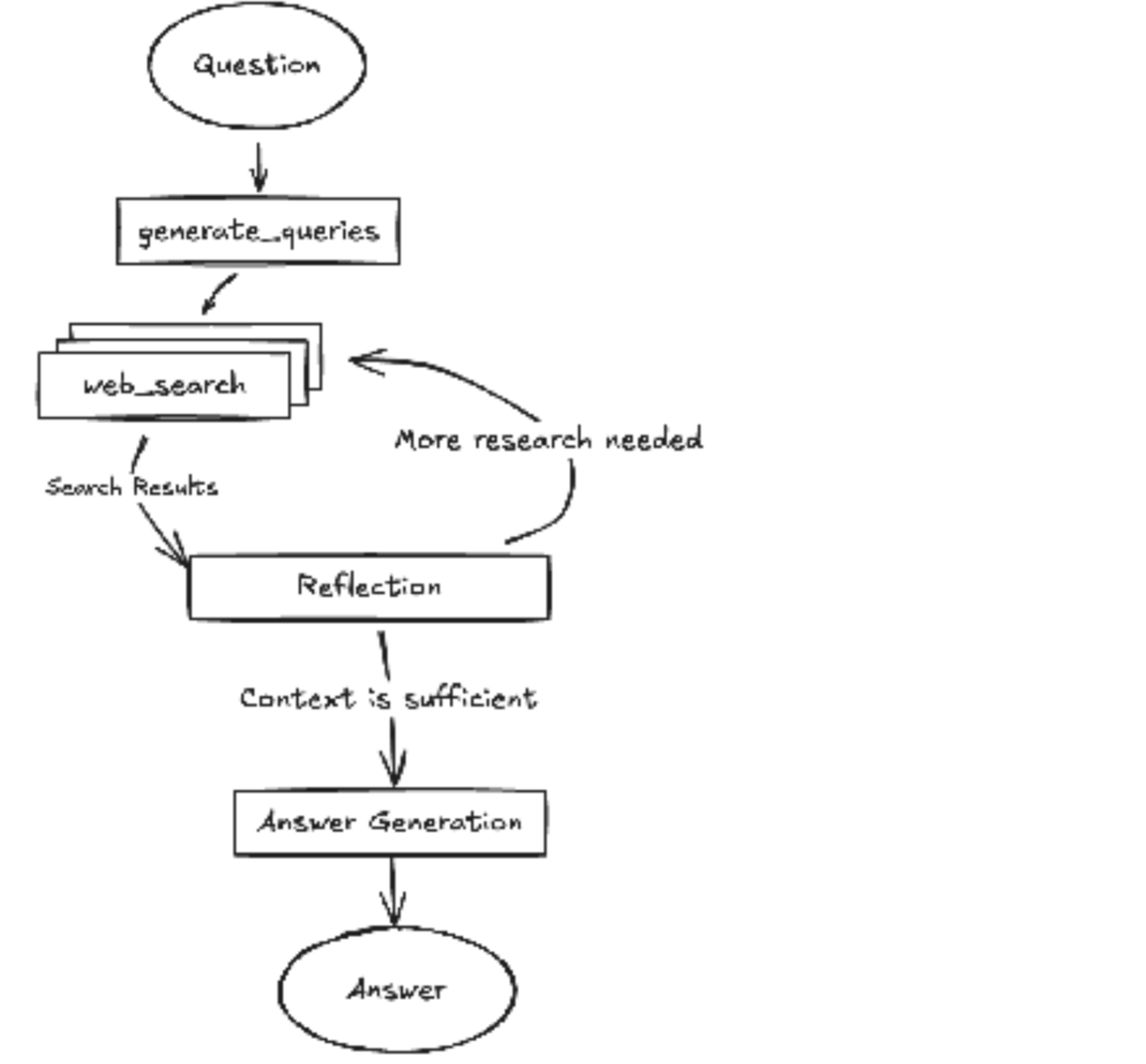
图 6:(由作者提供)具有多个反思步骤的 DeepSearch 示例
该项目提供了一个具有 React 前端和 LangGraph 后端的全栈应用程序,专为高级研究和对话式 AI 而设计。 LangGraph Agent 使用 Google Gemini 模型动态生成搜索查询,并通过 Google Search API 集成网络研究。 系统采用反思推理来识别知识差距、迭代改进搜索并综合带引用的答案。前端和后端支持热重载。项目结构 包括单独的 frontend/ 和 backend/ 目录。设置要求包括 Node.js、npm、Python 3.8+ 和 Google Gemini API 密钥。在后端的.env 文件中配置 API 密钥后,可以为后端(使用 pip install .)和前端(npm install)安装 依赖项。开发服务器可以使用 make dev 同时运行或单独运行。在 backend/src/agent/graph.py 中定义的 后端 Agent 生成初始搜索查询、进行网络研究、执行知识差距分析、迭代改进查询并使用 Gemini 模型综合带 引用的答案。生产部署涉及后端服务器提供静态前端构建,并需要 Redis 用于流式实时输出和 Postgres 数据 库用于管理数据。可以使用 docker‐compose up 构建和运行 Docker 镜像,这也需要 docker‐compose.yml 示例的 LangSmith API 密钥。该应用程序使用带 Vite 的 React、Tailwind CSS、Shadcn UI、LangGraph 和 Google Gemini。该项目在 Apache License 2.0 下授权。
创建我们的 Agent 图
builder = StateGraph ( OverallState , config_schema=Configuration )
定义我们将循环的节点 builder.add_node("generate_query", generate_query) b u i l d e r . add_node ("web_research", web_research )
builder .add_node("reflection", reflection )
builder .add_node("finalize_answer", finalize_answer )
将 入 口 点 设 置 为 `generate_query`
这意味着此节点是第一个被调用的
builder .add_edge(START, "generate_query")
添加条件边以在并行分支中继续搜索查询 builder . add_conditional_edges (
"generate_query", continue_to_web_research , "web_research" )
反思网络研究
builder .add_edge("web_research", "reflection")
评估研究
builder . add_conditional_edges (
"reflection", evaluate_research , "web_research", "finalize_answer" )
完成答案
builder .add_edge("finalize_answer", END)
graph = builder.compile(name="pro−search−agent")
图 4:使用 LangGraph 的 DeepSearch 示例(来自 backend/src/agent/graph.py 的代码)
Agent 的思考过程
总之,Agent 的思考过程是一种结合推理和行动来解决问题的结构化方法。这种方法允许 Agent 明确规划其 步骤、监控其进展并与外部工具交互以收集信息。
其核心是,Agent 的"思考"由强大的 LLM 驱动。这个 LLM 生成一系列指导 Agent 后续行动的思考。该过 程通常遵循思考‐行动‐观察循环:
-
思考:Agent 首先生成分解问题、制定计划或分析当前情况的文本思考。这种内部独白使 Agent 的推 理过程透明且可引导。
-
行动:基于思考,Agent从预定义的离散选项集中选择一个行动。例如,在问答场景中,行动空间可能 包括在线搜索、从特定网页检索信息或提供最终答案。
-
观察:Agent然后根据所采取的行动从其环境接收反馈。这可能是网络搜索的结果或网页的内容。
这个循环重复进行,每个观察通知下一个思考,直到 Agent 确定它已达到最终解决方案并执行"完成"行动。
这种方法的有效性依赖于底层 LLM 的高级推理和规划能力。为了指导 Agent,ReAct 框架通常采用少样本学 习,其中向 LLM 提供类似人类问题解决轨迹的示例。这些示例演示了如何有效地结合思考和行动来解决类 似任务。
Agent 思考的频率可以根据任务进行调整。对于知识密集型推理任务(如事实核查),思考通常与每个行动 交错,以确保信息收集和推理的逻辑流动。相比之下,对于需要许多行动的决策任务(例如在模拟环境中导 航),思考可能更谨慎地使用,允许 Agent 决定何时需要思考。
概览
是什么:复杂的问题解决通常需要的不仅仅是单一的、直接的答案,这对 AI 构成了重大挑战。核心问题是使 AI Agent 能够处理需要逻辑推理、分解和战略规划的多步骤任务。如果没有结构化的方法,Agent 可能无法 处理复杂性,导致不准确或不完整的结论。这些高级推理方法旨在使 Agent 的内部"思考"过程明确,使其 能够系统地处理挑战。
为什么:标准化解决方案是一套为 Agent 的问题解决过程提供结构化框架的推理技术。像思维链(CoT)和 思维树(ToT)这样的方法指导 LLM 分解问题并探索多个解决路径。自我纠正允许答案的迭代改进,确保更 高的准确性。像 ReAct 这样的 Agentic 框架将推理与行动集成,使 Agent 能够与外部工具和环境交互以收集 信息并调整其计划。这种明确推理、探索、改进和工具使用的组合创建了更强大、透明和有能力的 AI 系统。
经验法则:当问题对于单次通过的答案过于复杂并需要分解、多步骤逻辑、与外部数据源或工具的交互或战 略规划和适应时,使用这些推理技术。它们非常适合展示"工作"或思考过程与最终答案同样重要的任务。
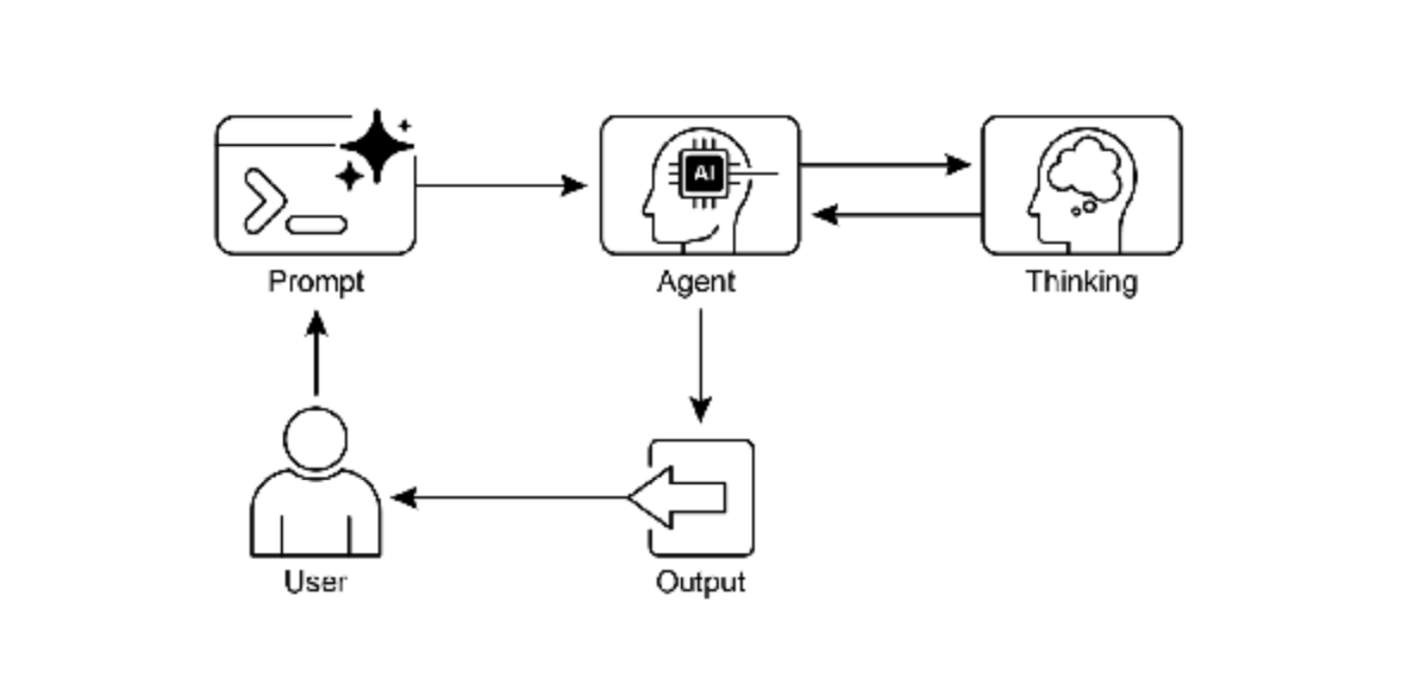
图 7:推理设计模式
关键要点
-
・ 通过使推理明确,Agent可以制定透明的、多步骤的计划,这是自主行动和用户信任的基础能力。
-
・ ReAct 框架为 Agent 提供了其核心操作循环,使它们能够超越单纯的推理并与外部工具交互,以在环境中动态行动和适应。
-
・ 推理扩展定律意味着Agent的性能不仅关乎其底层模型大小,还关乎其分配的"思考时间",允许更审 慎和更高质量的自主行动。
-
・ 思维链(CoT)作为 Agent 的内部独白,提供了一种通过将复杂目标分解为一系列可管理的行动来制 定计划的结构化方法。
-
・ 思维树和自我纠正赋予 Agent 关键的审议能力,允许它们评估多个策略、从错误中回溯并在执行前改 进自己的计划。
-
・ 像辩论链(CoD)这样的协作框架标志着从单独Agent到多Agent系统的转变,其中Agent团队可以 一起推理以解决更复杂的问题并减少个体偏见。
-
・ 像DeepResearch这样的应用程序展示了这些技术如何在Agent中达到高潮,这些Agent可以完全自 主地代表用户执行复杂的、长期运行的任务,例如深入调查。
-
・ 为了构建有效的 Agent 团队,像 MASS 这样的框架自动化优化各个 Agent 的指令方式以及它们如何交 互,确保整个多 Agent 系统以最佳方式执行。
-
・ 通过集成这些推理技术,我们构建的Agent不仅是自动化的,而且是真正自主的,能够被信任去规划、 行动和解决复杂问题而无需直接监督。
基于LangChain4j的高级推理能力实现示例
我们将在LangChain4j中实现一个高级推理的智能体,该智能体能够进行多步骤推理,展示其思考过程,并在必要时使用工具(如计算器、代码执行器等)来辅助推理。我们将创建一个能够解决复杂数学问题、进行代码调试和生成、以及进行战略规划的智能体示例。
注意:由于LangChain4j目前版本(0.31.0)的功能,我们将使用AiServices和Tools来构建一个具有链式思考能力的智能体。我们将通过一个自定义的提示模板和工具调用来实现。
我们将创建一个智能体,它能够:
-
1、理解复杂问题并分解步骤。
-
2、在思考过程中使用工具(如计算器、代码执行器)来获取中间结果。
-
3、展示每一步的推理过程。
由于LangChain4j没有内置的链式思考(Chain-of-Thought)提示,我们将通过SystemMessage和工具调用的方式来实现。我们将创建一个"MathSolver"智能体,它能够解决复杂的数学问题,并展示每一步的思考过程。
步骤:
-
1、定义工具(例如,计算器、代码执行器)。
-
2、创建一个智能体,它使用这些工具,并且在响应中展示思考过程。
-
3、使用AiServices来构建智能体,并在提示中要求模型展示推理步骤。
由于我们想要模型展示思考过程,我们可以在系统提示中明确要求模型分步思考,并在每一步中决定是否需要使用工具。我们将使用OpenAiChatModel,并设置较高的温度值以允许更多的创造性(但为了确定性,也可以调低)。
注意:由于OpenAI模型在工具调用时不会在响应中展示思考过程,我们将使用一个技巧:让模型在用户消息中输出思考过程,然后我们通过解析响应来获取工具调用。但是,LangChain4j的AiServices会自动处理工具调用,并返回一个包含工具调用结果的响应。为了展示思考过程,我们可以让模型在调用工具之前先输出思考步骤,然后我们通过拦截消息或使用自定义的提示来实现。然而,LangChain4j目前没有直接支持在工具调用前输出思考过程。因此,我们将采用以下方法:
我们创建一个自定义的ToolExecutor,它会在工具调用前后记录日志,但这并不能让模型输出思考过程。另一种方法是使用ReAct(Reasoning and Acting)框架,其中模型在行动(调用工具)之前会先进行推理(输出思考)。在LangChain4j中,我们可以通过使用ReAct的提示模板来实现。
但是,LangChain4j没有内置的ReAct提示模板。因此,我们将创建一个自定义的提示模板,要求模型按照以下格式输出:
思考: <思考过程>
行动: <工具名称>
行动输入: <工具输入>
然后,我们解析模型的输出,提取工具调用,执行工具,然后将工具输出返回给模型,模型再继续思考。这是一个复杂的流程,需要实现一个自定义的AgentExecutor。由于时间关系,我们简化处理:使用AiServices,并在系统提示中要求模型分步思考,然后调用工具。但是,AiServices不会在工具调用前输出思考过程,除非我们在工具调用前让模型输出一个包含思考的响应。
我们决定采用以下策略:
-
1、我们创建一个工具,名为"think",它允许模型输出思考步骤而不执行任何动作。这样,模型可以在调用实际工具之前先调用"think"工具来展示其思考过程。
-
2、我们将创建一个包含"think"工具和其他实际工具的工具箱,并在系统提示中要求模型在调用工具前先使用"think"工具。
-
3、然后,我们可以通过监听工具调用来记录思考过程。
但是,LangChain4j的AiServices不支持在同一个调用中多次工具调用(即,先调用think,再调用计算器)。因此,我们需要使用一个更高级的AgentExecutor,它能够处理多个工具调用和思考步骤。
由于这涉及到自定义AgentExecutor,而LangChain4j目前没有提供,我们将使用一个简化版本:我们让模型在单个响应中输出整个思考过程,然后决定是否调用工具。但是,这样我们就不能实时展示思考步骤。考虑到这些限制,我们将展示一个简单的版本,其中模型在响应中展示思考过程,然后调用一个工具(如果需要),然后我们手动将工具输出再次输入给模型,直到得到最终答案。这实际上是一个多轮对话,我们需要在代码中控制循环。但是,为了简化,我们只进行一次工具调用。
我们将实现一个数学问题求解器,它能够进行多步思考,并使用计算器工具。
步骤:
-
1、定义计算器工具。
-
2、创建一个智能体,该智能体在系统提示中要求模型先思考再使用工具。
-
3、我们将使用AiServices,但我们将手动处理多轮对话,以便展示思考过程。
由于篇幅限制,我们将展示一个简化的示例,其中智能体尝试解决一个数学问题,并使用计算器工具。我们使用以下步骤:
a. 发送用户问题,并要求模型思考并决定是否使用工具。
b. 如果模型返回工具调用请求,则执行工具,并将工具结果作为新消息发送给模型,让模型继续思考。
c. 重复直到模型返回最终答案。
但是,LangChain4j的AiServices不支持这种循环。因此,我们将自己实现一个简单的循环。
我们使用OpenAiChatModel,并手动构建消息历史。
以下是使用LangChain4j框架实现高级推理能力的代码示例,展示了智能体在复杂场景中进行多步骤逻辑推理的能力:
1. 高级推理框架基础
java
import dev.langchain4j.agent.tool.Tool;
import dev.langchain4j.data.message.AiMessage;
import dev.langchain4j.data.message.SystemMessage;
import dev.langchain4j.data.message.UserMessage;
import dev.langchain4j.memory.ChatMemory;
import dev.langchain4j.memory.chat.MessageWindowChatMemory;
import dev.langchain4j.model.chat.ChatLanguageModel;
import dev.langchain4j.model.openai.OpenAiChatModel;
import dev.langchain4j.service.AiServices;
import lombok.extern.slf4j.Slf4j;

import java.time.Duration;
import java.util.*;
import java.util.concurrent.atomic.AtomicInteger;

@Slf4j
public class AdvancedReasoningFramework {

    // 推理配置
    private final ReasoningConfig reasoningConfig;

    // 推理步骤追踪器
    private final ReasoningStepTracker stepTracker;

    // 思维链管理器
    private final ChainOfThoughtManager cotManager;

    public AdvancedReasoningFramework(ReasoningConfig reasoningConfig) {
        this.reasoningConfig = reasoningConfig;
        this.stepTracker = new ReasoningStepTracker();
        this.cotManager = new ChainOfThoughtManager();
    }

    /**
     * 执行高级推理过程
     */
    public ReasoningResult performAdvancedReasoning(String problem,
                                                    ProblemDomain domain) {
        log.info("开始高级推理: {} (领域: {})",
            problem.substring(0, Math.min(50, problem.length())),
            domain);

        // 步骤1: 问题分析
        ProblemAnalysis analysis = analyzeProblem(problem, domain);

        // 步骤2: 推理规划
        ReasoningPlan plan = createReasoningPlan(analysis);

        // 步骤3: 执行多步骤推理
        MultiStepResult multiStepResult = executeMultiStepReasoning(problem, plan);

        // 步骤4: 验证和整合
        IntegratedSolution solution = validateAndIntegrate(multiStepResult);

        return ReasoningResult.builder()
            .originalProblem(problem)
            .domain(domain)
            .analysis(analysis)
            .plan(plan)
            .multiStepResult(multiStepResult)
            .finalSolution(solution)
            .reasoningSteps(stepTracker.getSteps())
            .totalReasoningTimeMs(stepTracker.getTotalTime())
            .confidenceScore(solution.getConfidence())
            .build();
    }

    /**
     * 问题分析
     */
    private ProblemAnalysis analyzeProblem(String problem, ProblemDomain domain) {
        stepTracker.startStep("问题分析");

        ProblemAnalysis analysis = new ProblemAnalysis();

        // 识别问题类型
        analysis.setProblemType(identifyProblemType(problem, domain));

        // 提取关键信息
        analysis.setKeyInformation(extractKeyInformation(problem));

        // 评估复杂度
        analysis.setComplexity(assessComplexity(problem, domain));

        // 确定所需推理能力
        analysis.setRequiredCapabilities(determineRequiredCapabilities(analysis));

        stepTracker.endStep();

        return analysis;
    }

    /**
     * 创建推理计划
     */
    private ReasoningPlan createReasoningPlan(ProblemAnalysis analysis) {
        stepTracker.startStep("推理规划");

        ReasoningPlan plan = new ReasoningPlan();
        plan.setProblemType(analysis.getProblemType());
        plan.setComplexityLevel(analysis.getComplexity());

        // 根据问题类型和复杂度制定推理策略
        switch (analysis.getProblemType()) {
            case MULTI_HOP_QA:
                plan.setStrategy(createMultiHopQAStrategy(analysis));
                break;
            case MATH_PROBLEM:
                plan.setStrategy(createMathProblemStrategy(analysis));
                break;
            case CODE_DEBUGGING:
                plan.setStrategy(createCodeDebuggingStrategy(analysis));
                break;
            case STRATEGIC_PLANNING:
                plan.setStrategy(createStrategicPlanningStrategy(analysis));
                break;
            case LEGAL_ANALYSIS:
                plan.setStrategy(createLegalAnalysisStrategy(analysis));
                break;
            default:
                plan.setStrategy(createDefaultStrategy(analysis));
        }

        // 分配推理资源
        plan.setAllocatedResources(allocateResources(analysis));

        stepTracker.endStep();

        return plan;
    }

    /**
     * 执行多步骤推理
     */
    private MultiStepResult executeMultiStepReasoning(String problem,
                                                      ReasoningPlan plan) {
        stepTracker.startStep("多步骤推理");

        MultiStepResult result = new MultiStepResult();
        result.setSteps(new ArrayList<>());

        // 执行推理步骤
        for (ReasoningStep step : plan.getStrategy().getSteps()) {
            log.info("执行推理步骤: {}", step.getName());

            stepTracker.startStep(step.getName());

            ReasoningStepResult stepResult = executeReasoningStep(problem, step);
            result.getSteps().add(stepResult);

            // 如果步骤失败,尝试恢复
            if (!stepResult.isSuccess() && step.isRecoverable()) {
                stepResult = attemptStepRecovery(problem, step, stepResult);
            }

            // 如果步骤仍然失败且是关键步骤,则中止
            if (!stepResult.isSuccess() && step.isCritical()) {
                log.error("关键推理步骤失败,中止推理");
                result.setAllStepsSuccessful(false);
                break;
            }

            stepTracker.endStep();
        }

        result.setAllStepsSuccessful(true);

        stepTracker.endStep();

        return result;
    }

    /**
     * 执行单个推理步骤
     */
    private ReasoningStepResult executeReasoningStep(String problem,
                                                     ReasoningStep step) {
        try {
            // 根据步骤类型执行不同的推理
            switch (step.getType()) {
                case DECOMPOSE:
                    return executeDecompositionStep(problem, step);
                case LOGICAL_DEDUCTION:
                    return executeLogicalDeductionStep(problem, step);
                case CALCULATION:
                    return executeCalculationStep(problem, step);
                case HYPOTHESIS_GENERATION:
                    return executeHypothesisGenerationStep(problem, step);
                case VERIFICATION:
                    return executeVerificationStep(problem, step);
                case SYNTHESIS:
                    return executeSynthesisStep(problem, step);
                default:
                    return executeDefaultStep(problem, step);
            }
        } catch (Exception e) {
            log.error("推理步骤执行失败: {}", step.getName(), e);
            return ReasoningStepResult.failed(step.getName(), e.getMessage());
        }
    }

    /**
     * 验证和整合结果
     */
    private IntegratedSolution validateAndIntegrate(MultiStepResult multiStepResult) {
        stepTracker.startStep("验证与整合");

        IntegratedSolution solution = new IntegratedSolution();

        // 收集所有步骤的结果
        List<Object> allResults = new ArrayList<>();
        for (ReasoningStepResult stepResult : multiStepResult.getSteps()) {
            if (stepResult.isSuccess()) {
                allResults.add(stepResult.getResult());
            }
        }

        // 验证结果一致性
        boolean consistency = verifyConsistency(allResults);
        solution.setConsistent(consistency);

        // 计算置信度
        double confidence = calculateConfidenceScore(multiStepResult);
        solution.setConfidence(confidence);

        // 整合最终答案
        Object finalAnswer = integrateFinalAnswer(allResults);
        solution.setFinalAnswer(finalAnswer);

        // 生成解释
        String explanation = generateExplanation(multiStepResult, confidence);
        solution.setExplanation(explanation);

        stepTracker.endStep();

        return solution;
    }

    /**
     * 执行思维链推理
     */
    public ChainOfThoughtResult performChainOfThought(String problem,
                                                      CoTConfig config) {
        log.info("执行思维链推理,深度: {}", config.getMaxDepth());

        ChainOfThoughtResult cotResult = new ChainOfThoughtResult();
        cotResult.setProblem(problem);
        cotResult.setThoughts(new ArrayList<>());

        // 初始思考
        Thought initialThought = generateInitialThought(problem, config);
        cotResult.getThoughts().add(initialThought);

        // 迭代深化思考
        Thought currentThought = initialThought;
        int depth = 0;

        while (depth < config.getMaxDepth() &&
               !currentThought.isFinal() &&
               currentThought.getNextAction() != ThoughtAction.STOP) {

            depth++;
            log.debug("思维链深度: {}", depth);

            // 生成下一个思考
            Thought nextThought = generateNextThought(currentThought, config);
            cotResult.getThoughts().add(nextThought);

            // 执行思考中指定的动作
            if (nextThought.getAction() != null) {
                executeThoughtAction(nextThought);
            }

            currentThought = nextThought;
        }

        // 提取最终答案
        Object finalAnswer = extractFinalAnswer(cotResult.getThoughts());
        cotResult.setFinalAnswer(finalAnswer);

        // 计算推理质量
        double reasoningQuality = evaluateReasoningQuality(cotResult);
        cotResult.setReasoningQuality(reasoningQuality);

        return cotResult;
    }

    // 数据类
    @Data
    @Builder
    public static class ReasoningConfig {
        private int maxReasoningSteps;
        private int timeoutSeconds;
        private boolean enableStepValidation;
        private boolean enableFallback;
        private double minConfidenceThreshold;
    }

    @Data
    @Builder
    public static class ReasoningResult {
        private String originalProblem;
        private ProblemDomain domain;
        private ProblemAnalysis analysis;
        private ReasoningPlan plan;
        private MultiStepResult multiStepResult;
        private IntegratedSolution finalSolution;
        private List<ReasoningStep> reasoningSteps;
        private long totalReasoningTimeMs;
        private double confidenceScore;
    }
}
2. 复杂问答(多跳推理)实现
java
import dev.langchain4j.agent.tool.Tool;
import dev.langchain4j.data.message.AiMessage;
import dev.langchain4j.data.message.UserMessage;
import dev.langchain4j.model.chat.ChatLanguageModel;
import dev.langchain4j.model.openai.OpenAiChatModel;
import dev.langchain4j.retriever.EmbeddingStoreRetriever;
import dev.langchain4j.store.embedding.EmbeddingStore;
import lombok.extern.slf4j.Slf4j;

import java.util.*;

@Slf4j
public class ComplexQAReasoner {

    private final AdvancedReasoningFramework reasoningFramework;
    private final KnowledgeRetriever knowledgeRetriever;
    private final ChatLanguageModel reasoningModel;

    public ComplexQAReasoner() {
        this.reasoningFramework = new AdvancedReasoningFramework(
            AdvancedReasoningFramework.ReasoningConfig.builder()
                .maxReasoningSteps(10)
                .timeoutSeconds(60)
                .enableStepValidation(true)
                .build()
        );

        this.knowledgeRetriever = new KnowledgeRetriever();
        this.reasoningModel = OpenAiChatModel.builder()
            .apiKey(System.getenv("OPENAI_API_KEY"))
            .modelName("gpt-4")
            .temperature(0.1) // 低温度确保确定性推理
            .build();
    }

    /**
     * 处理多跳推理问题
     */
    public MultiHopQAAnswer answerMultiHopQuestion(String question) {
        log.info("处理多跳推理问题: {}", question);

        // 步骤1: 问题分解
        List<SubQuestion> subQuestions = decomposeQuestion(question);

        // 步骤2: 并行检索相关信息
        Map<SubQuestion, List<KnowledgePiece>> retrievedKnowledge =
            retrieveKnowledgeForSubQuestions(subQuestions);

        // 步骤3: 执行推理链
        List<InferenceStep> inferenceChain = buildInferenceChain(subQuestions);

        // 步骤4: 执行多跳推理
        MultiHopInferenceResult inferenceResult =
            executeMultiHopInference(inferenceChain, retrievedKnowledge);

        // 步骤5: 验证和整合答案
        ValidatedAnswer validatedAnswer =
            validateAndIntegrateAnswer(inferenceResult, question);

        return MultiHopQAAnswer.builder()
            .originalQuestion(question)
            .subQuestions(subQuestions)
            .inferenceChain(inferenceChain)
            .inferenceResult(inferenceResult)
            .finalAnswer(validatedAnswer.getAnswer())
            .confidence(validatedAnswer.getConfidence())
            .supportingEvidence(validatedAnswer.getEvidence())
            .explanation(generateExplanation(inferenceChain, validatedAnswer))
            .build();
    }

    /**
     * 问题分解为子问题
     */
    private List<SubQuestion> decomposeQuestion(String question) {
        log.info("分解问题: {}", question);

        String decompositionPrompt = String.format(
            "请将以下复杂问题分解为需要顺序回答的子问题。\n" +
            "问题: %s\n\n" +
            "请按照回答这个问题的逻辑顺序列出子问题。格式:\n" +
            "1. [第一个子问题]\n" +
            "2. [第二个子问题]\n" +
            "...\n" +
            "并提供每个子问题需要的信息类型。",
            question
        );

        AiMessage decompositionResult = reasoningModel.generate(decompositionPrompt);
        return parseSubQuestions(decompositionResult.text());
    }

    /**
     * 构建推理链
     */
    private List<InferenceStep> buildInferenceChain(List<SubQuestion> subQuestions) {
        List<InferenceStep> chain = new ArrayList<>();

        for (int i = 0; i < subQuestions.size(); i++) {
            SubQuestion current = subQuestions.get(i);

            InferenceStep step = InferenceStep.builder()
                .stepNumber(i + 1)
                .question(current.getText())
                .requiredInfo(current.getRequiredInfo())
                .build();

            // 设置依赖关系
            if (i > 0) {
                step.setDependsOn(chain.get(i - 1).getStepNumber());
                step.setRequiredPreviousAnswer(true);
            }

            // 确定推理方法
            step.setInferenceMethod(determineInferenceMethod(current));

            chain.add(step);
        }

        log.info("构建了包含 {} 步的推理链", chain.size());
        return chain;
    }

    /**
     * 执行多跳推理
     */
    private MultiHopInferenceResult executeMultiHopInference(
        List<InferenceStep> inferenceChain,
        Map<SubQuestion, List<KnowledgePiece>> retrievedKnowledge) {

        MultiHopInferenceResult result = new MultiHopInferenceResult();
        result.setSteps(new ArrayList<>());

        // 执行每一步推理
        for (InferenceStep step : inferenceChain) {
            log.info("执行推理步骤 {}: {}", step.getStepNumber(), step.getQuestion());

            InferenceStepResult stepResult = executeInferenceStep(
                step, retrievedKnowledge, result
            );

            result.getSteps().add(stepResult);

            // 如果步骤失败,尝试替代推理路径
            if (!stepResult.isSuccess()) {
                log.warn("推理步骤 {} 失败,尝试替代路径", step.getStepNumber());
                stepResult = attemptAlternativeInference(step, retrievedKnowledge, result);
            }

            // 如果仍然失败,记录但继续(某些步骤可能不是关键的)
            if (!stepResult.isSuccess()) {
                log.error("推理步骤 {} 最终失败", step.getStepNumber());
                result.addFailedStep(step.getStepNumber());
            }
        }

        result.setAllStepsSuccessful(result.getFailedSteps().isEmpty());
        return result;
    }

    /**
     * 执行单个推理步骤
     */
    private InferenceStepResult executeInferenceStep(
        InferenceStep step,
        Map<SubQuestion, List<KnowledgePiece>> knowledge,
        MultiHopInferenceResult previousResults) {

        try {
            // 准备上下文信息
            String context = prepareInferenceContext(step, knowledge, previousResults);

            // 根据推理方法选择不同的执行策略
            InferenceStepResult result;

            switch (step.getInferenceMethod()) {
                case DEDUCTIVE:
                    result = performDeductiveInference(step, context);
                    break;
                case INDUCTIVE:
                    result = performInductiveInference(step, context);
                    break;
                case ABDUCTIVE:
                    result = performAbductiveInference(step, context);
                    break;
                case ANALOGICAL:
                    result = performAnalogicalInference(step, context);
                    break;
                default:
                    result = performDefaultInference(step, context);
            }

            // 验证推理结果
            if (result.isSuccess()) {
                boolean valid = validateInferenceResult(result, step, knowledge);
                result.setValid(valid);
                if (!valid) {
                    result.setSuccess(false);
                    result.setError("推理结果验证失败");
                }
            }

            return result;

        } catch (Exception e) {
            log.error("推理步骤执行异常", e);
            return InferenceStepResult.failed(step.getStepNumber(), e.getMessage());
        }
    }

    /**
     * 示例:演绎推理
     */
    private InferenceStepResult performDeductiveInference(InferenceStep step, String context) {
        String deductivePrompt = String.format(
            "请基于以下前提进行演绎推理:\n\n" +
            "问题: %s\n" +
            "上下文信息:\n%s\n\n" +
            "请按照以下格式回答:\n" +
            "前提: [列出已知前提]\n" +
            "推理过程: [详细推理步骤]\n" +
            "结论: [最终结论]",
            step.getQuestion(),
            context
        );

        AiMessage deductionResult = reasoningModel.generate(deductivePrompt);
        return parseDeductionResult(deductionResult.text(), step.getStepNumber());
    }

    /**
     * 验证和整合答案
     */
    private ValidatedAnswer validateAndIntegrateAnswer(
        MultiHopInferenceResult inferenceResult,
        String originalQuestion) {

        // 整合所有步骤的结论
        List<Object> allConclusions = new ArrayList<>();
        for (InferenceStepResult step : inferenceResult.getSteps()) {
            if (step.isSuccess() && step.isValid()) {
                allConclusions.add(step.getConclusion());
            }
        }

        // 检查一致性
        boolean consistent = checkConsistency(allConclusions);

        // 生成最终答案
        Object finalAnswer = synthesizeFinalAnswer(allConclusions, originalQuestion);

        // 计算置信度
        double confidence = calculateAnswerConfidence(inferenceResult, consistent);

        // 收集支持证据
        List<Evidence> supportingEvidence = collectSupportingEvidence(inferenceResult);

        return ValidatedAnswer.builder()
            .answer(finalAnswer)
            .confidence(confidence)
            .consistent(consistent)
            .evidence(supportingEvidence)
            .inferenceQuality(evaluateInferenceQuality(inferenceResult))
            .build();
    }

    /**
     * 示例:医疗诊断推理
     */
    public MedicalDiagnosis diagnoseMedicalCondition(String symptoms,
                                                     String patientHistory) {
        String diagnosticQuestion = String.format(
            "基于以下症状和病史,可能是什么疾病?\n" +
            "症状: %s\n" +
            "病史: %s",
            symptoms, patientHistory
        );

        MultiHopQAAnswer diagnosis = answerMultiHopQuestion(diagnosticQuestion);

        // 解析诊断结果
        List<DifferentialDiagnosis> differentials =
            parseDifferentialDiagnosis(diagnosis.getFinalAnswer());

        // 计算每种可能性的概率
        Map<String, Double> probabilities =
            calculateDiagnosisProbabilities(differentials, symptoms, patientHistory);

        // 生成建议的检查和治疗
        List<MedicalRecommendation> recommendations =
            generateRecommendations(differentials, probabilities);

        return MedicalDiagnosis.builder()
            .symptoms(symptoms)
            .possibleConditions(differentials)
            .probabilities(probabilities)
            .recommendations(recommendations)
            .confidence(diagnosis.getConfidence())
            .reasoningSteps(diagnosis.getInferenceChain())
            .build();
    }

    // 数据类
    @Data
    @Builder
    public static class MultiHopQAAnswer {
        private String originalQuestion;
        private List<SubQuestion> subQuestions;
        private List<InferenceStep> inferenceChain;
        private MultiHopInferenceResult inferenceResult;
        private Object finalAnswer;
        private double confidence;
        private List<Evidence> supportingEvidence;
        private String explanation;
    }

    @Data
    @Builder
    public static class SubQuestion {
        private String text;
        private String requiredInfo;
        private QuestionType type;
    }

    @Data
    @Builder
    public static class InferenceStep {
        private int stepNumber;
        private String question;
        private String requiredInfo;
        private Integer dependsOn;
        private boolean requiredPreviousAnswer;
        private InferenceMethod inferenceMethod;
    }

    enum InferenceMethod {
        DEDUCTIVE, INDUCTIVE, ABDUCTIVE, ANALOGICAL, DEFAULT
    }
}
3. 数学问题解决实现
java
import dev.langchain4j.agent.tool.Tool;
import dev.langchain4j.service.AiServices;
import lombok.extern.slf4j.Slf4j;

import java.util.*;
import javax.script.*;

@Slf4j
public class MathProblemSolver {

    interface MathReasoner {
        String solveMathProblem(String problem);
    }

    private final AdvancedReasoningFramework reasoningFramework;
    private final MathReasoner mathReasoner;
    private final ScriptEngine scriptEngine;

    public MathProblemSolver() {
        this.reasoningFramework = new AdvancedReasoningFramework(
            AdvancedReasoningFramework.ReasoningConfig.builder()
                .maxReasoningSteps(15)
                .timeoutSeconds(120)
                .enableStepValidation(true)
                .build()
        );

        this.mathReasoner = AiServices.builder(MathReasoner.class)
            .chatLanguageModel(OpenAiChatModel.builder()
                .apiKey(System.getenv("OPENAI_API_KEY"))
                .modelName("gpt-4")
                .temperature(0.0) // 数学问题需要确定性
                .build())
            .build();

        // 初始化脚本引擎用于计算验证
        this.scriptEngine = new ScriptEngineManager().getEngineByName("JavaScript");
    }

    /**
     * 解决复杂数学问题
     */
    public MathSolution solveComplexMathProblem(String problem) {
        log.info("解决数学问题: {}", problem.substring(0, Math.min(50, problem.length())));

        // 步骤1: 分析数学问题类型
        MathProblemType problemType = analyzeMathProblemType(problem);

        // 步骤2: 提取已知量和未知量
        MathProblemAnalysis analysis = extractMathComponents(problem);

        // 步骤3: 制定解题策略
        MathSolutionStrategy strategy = createSolutionStrategy(problemType, analysis);

        // 步骤4: 逐步执行解题过程
        StepByStepSolution stepSolution = executeStepByStepSolution(problem, strategy);

        // 步骤5: 验证结果
        ValidationResult validation = validateSolution(stepSolution, problem);

        return MathSolution.builder()
            .originalProblem(problem)
            .problemType(problemType)
            .analysis(analysis)
            .strategy(strategy)
            .stepSolution(stepSolution)
            .validation(validation)
            .isCorrect(validation.isValid())
            .confidence(validation.getConfidence())
            .build();
    }

    /**
     * 执行分步解题
     */
    private StepByStepSolution executeStepByStepSolution(String problem,
                                                         MathSolutionStrategy strategy) {
        log.info("执行分步解题,策略: {}", strategy.getName());

        StepByStepSolution solution = new StepByStepSolution();
        solution.setSteps(new ArrayList<>());
        solution.setIntermediateResults(new HashMap<>());

        // 执行解题步骤
        for (SolutionStep step : strategy.getSteps()) {
            log.info("执行解题步骤: {}", step.getDescription());

            StepResult stepResult = executeSolutionStep(step, solution, problem);
            solution.getSteps().add(stepResult);

            // 存储中间结果供后续步骤使用
            if (stepResult.isSuccess() && step.getOutputVariable() != null) {
                solution.getIntermediateResults().put(
                    step.getOutputVariable(),
                    stepResult.getResult()
                );
            }

            // 如果步骤失败,尝试替代方法
            if (!stepResult.isSuccess() && step.isRecoverable()) {
                log.warn("步骤失败,尝试替代方法: {}", step.getDescription());
                stepResult = attemptAlternativeStep(step, solution, problem);
                solution.getSteps().set(solution.getSteps().size() - 1, stepResult);
            }

            // 如果是关键步骤且失败,则中止
            if (!stepResult.isSuccess() && step.isCritical()) {
                log.error("关键步骤失败,中止解题");
                solution.setAllStepsSuccessful(false);
                break;
            }
        }

        solution.setAllStepsSuccessful(true);

        // 计算最终答案
        if (solution.isAllStepsSuccessful()) {
            Object finalAnswer = computeFinalAnswer(solution, strategy);
            solution.setFinalAnswer(finalAnswer);
        }

        return solution;
    }

    /**
     * 执行单个解题步骤
     */
    private StepResult executeSolutionStep(SolutionStep step,
                                          StepByStepSolution currentSolution,
                                          String originalProblem) {
        try {
            // 准备步骤输入
            Map<String, Object> stepInputs = prepareStepInputs(step, currentSolution);

            StepResult result;

            // 根据步骤类型执行不同的操作
            switch (step.getType()) {
                case EXTRACTION:
                    result = executeExtractionStep(step, stepInputs, originalProblem);
                    break;
                case TRANSFORMATION:
                    result = executeTransformationStep(step, stepInputs);
                    break;
                case CALCULATION:
                    result = executeCalculationStep(step, stepInputs);
                    break;
                case VERIFICATION:
                    result = executeVerificationStep(step, stepInputs);
                    break;
                case SYNTHESIS:
                    result = executeSynthesisStep(step, stepInputs);
                    break;
                default:
                    result = executeDefaultStep(step, stepInputs);
            }

            // 记录步骤详细信息
            result.setStepNumber(step.getStepNumber());
            result.setDescription(step.getDescription());

            return result;

        } catch (Exception e) {
            log.error("解题步骤执行失败", e);
            return StepResult.failed(step.getStepNumber(), e.getMessage());
        }
    }

    /**
     * 执行计算步骤
     */
    private StepResult executeCalculationStep(SolutionStep step,
                                             Map<String, Object> inputs) {
        try {
            // 构建计算表达式
            String expression = buildCalculationExpression(step, inputs);

            // 使用脚本引擎计算
            Object result = scriptEngine.eval(expression);

            // 验证计算结果
            boolean valid = validateCalculation(result, step.getExpectedRange());

            return StepResult.successful(step.getStepNumber(), result, valid);

        } catch (ScriptException e) {
            log.error("计算失败", e);

            // 尝试使用符号计算
            return attemptSymbolicCalculation(step, inputs);
        }
    }

    /**
     * 使用AI进行符号计算
     */
    private StepResult attemptSymbolicCalculation(SolutionStep step,
                                                 Map<String, Object> inputs) {
        String calculationPrompt = String.format(
            "请计算以下表达式:\n" +
            "表达式: %s\n" +
            "已知变量: %s\n\n" +
            "请提供精确的计算结果,并展示计算过程。",
            step.getCalculationExpression(),
            inputs.toString()
        );

        AiMessage calculationResult = mathReasoner.solveMathProblem(calculationPrompt);
        Object result = parseCalculationResult(calculationResult.text());

        return StepResult.successful(step.getStepNumber(), result, true);
    }

    /**
     * 验证解决方案
     */
    private ValidationResult validateSolution(StepByStepSolution solution,
                                             String originalProblem) {
        ValidationResult validation = new ValidationResult();

        if (!solution.isAllStepsSuccessful()) {
            validation.setValid(false);
            validation.setReason("解题步骤未全部成功完成");
            return validation;
        }

        // 验证1: 检查数学正确性
        boolean mathematicallyCorrect = validateMathematicalCorrectness(solution);
        validation.setMathematicallyCorrect(mathematicallyCorrect);

        // 验证2: 检查与原始问题的匹配度
        boolean matchesProblem = validateProblemMatch(solution, originalProblem);
        validation.setMatchesProblem(matchesProblem);

        // 验证3: 执行完整性检查
        boolean complete = validateCompleteness(solution);
        validation.setComplete(complete);

        // 验证4: 使用不同方法交叉验证
        boolean crossValidated = performCrossValidation(solution, originalProblem);
        validation.setCrossValidated(crossValidated);

        // 计算总体置信度
        double confidence = calculateValidationConfidence(
            mathematicallyCorrect, matchesProblem, complete, crossValidated
        );
        validation.setConfidence(confidence);

        validation.setValid(confidence > 0.8); // 阈值可配置

        return validation;
    }

    /**
     * 交叉验证:使用不同方法重新解题
     */
    private boolean performCrossValidation(StepByStepSolution solution,
                                          String originalProblem) {
        try {
            // 方法1: 使用AI直接求解
            String directPrompt = String.format(
                "请直接解决以下数学问题:\n%s\n" +
                "请只给出最终答案。",
                originalProblem
            );

            AiMessage directResult = mathReasoner.solveMathProblem(directPrompt);
            Object directAnswer = parseNumericResult(directResult.text());

            // 方法2: 使用外部计算工具
            Object toolAnswer = calculateWithExternalTool(originalProblem);

            // 比较结果
            boolean matchesDirect = compareResults(solution.getFinalAnswer(), directAnswer);
            boolean matchesTool = compareResults(solution.getFinalAnswer(), toolAnswer);

            return matchesDirect || matchesTool; // 至少匹配一种方法

        } catch (Exception e) {
            log.warn("交叉验证失败", e);
            return false;
        }
    }

    /**
     * 示例:解决微积分问题
     */
    public CalculusSolution solveCalculusProblem(String problem) {
        log.info("解决微积分问题");

        // 识别微积分类型
        CalculusType calculusType = identifyCalculusType(problem);

        // 根据类型选择策略
        MathSolutionStrategy strategy;

        switch (calculusType) {
            case DERIVATIVE:
                strategy = createDerivativeStrategy(problem);
                break;
            case INTEGRAL:
                strategy = createIntegralStrategy(problem);
                break;
            case LIMIT:
                strategy = createLimitStrategy(problem);
                break;
            case DIFFERENTIAL_EQUATION:
                strategy = createDifferentialEquationStrategy(problem);
                break;
            default:
                strategy = createDefaultCalculusStrategy(problem);
        }

        // 执行解题
        StepByStepSolution solution = executeStepByStepSolution(problem, strategy);

        // 专门针对微积分的验证
        boolean calculusValid = validateCalculusSolution(solution, calculusType);

        return CalculusSolution.builder()
            .originalProblem(problem)
            .calculusType(calculusType)
            .strategy(strategy)
            .solution(solution)
            .isValid(calculusValid)
            .verificationSteps(generateCalculusVerification(solution))
            .build();
    }

    /**
     * 示例:解决统计问题
     */
    public StatisticsSolution solveStatisticsProblem(String problem,
                                                     List<Double> dataset) {
        log.info("解决统计问题,数据集大小: {}", dataset.size());

        // 识别统计方法
        StatisticalMethod method = identifyStatisticalMethod(problem, dataset);

        // 执行统计分析
        StatisticalAnalysis analysis = performStatisticalAnalysis(dataset, method);

        // 验证统计假设
        boolean assumptionsValid = validateStatisticalAssumptions(dataset, method);

        // 生成解释
        String interpretation = interpretStatisticalResults(analysis, problem);

        return StatisticsSolution.builder()
            .problem(problem)
            .datasetSize(dataset.size())
            .statisticalMethod(method)
            .analysis(analysis)
            .assumptionsValid(assumptionsValid)
            .interpretation(interpretation)
            .confidence(calculateStatisticalConfidence(analysis, assumptionsValid))
            .build();
    }

    // 数据类
    @Data
    @Builder
    public static class MathSolution {
        private String originalProblem;
        private MathProblemType problemType;
        private MathProblemAnalysis analysis;
        private MathSolutionStrategy strategy;
        private StepByStepSolution stepSolution;
        private ValidationResult validation;
        private boolean isCorrect;
        private double confidence;
    }

    @Data
    @Builder
    public static class StepByStepSolution {
        private List<StepResult> steps;
        private Map<String, Object> intermediateResults;
        private Object finalAnswer;
        private boolean allStepsSuccessful;
    }

    @Data
    @Builder
    public static class StepResult {
        private int stepNumber;
        private String description;
        private boolean success;
        private Object result;
        private boolean valid;
        private String error;

        public static StepResult successful(int stepNumber, Object result, boolean valid) {
            return StepResult.builder()
                .stepNumber(stepNumber)
                .success(true)
                .result(result)
                .valid(valid)
                .build();
        }

        public static StepResult failed(int stepNumber, String error) {
            return StepResult.builder()
                .stepNumber(stepNumber)
                .success(false)
                .error(error)
                .build();
        }
    }

    enum MathProblemType {
        ALGEBRAIC, GEOMETRIC, CALCULUS, STATISTICAL,
        PROBABILITY, OPTIMIZATION, LOGICAL
    }
}
4. 代码调试与生成实现
java
import dev.langchain4j.agent.tool.Tool;
import dev.langchain4j.service.AiServices;
import lombok.extern.slf4j.Slf4j;

import java.util.*;
import javax.tools.*;
import java.io.*;
import java.nio.file.*;

@Slf4j
public class CodeDebuggingGenerator {

    interface CodeAssistant {
        String analyzeCode(String code, String language);
    }

    private final AdvancedReasoningFramework reasoningFramework;
    private final CodeAssistant codeAssistant;
    private final CodeExecutor codeExecutor;

    public CodeDebuggingGenerator() {
        this.reasoningFramework = new AdvancedReasoningFramework(
            AdvancedReasoningFramework.ReasoningConfig.builder()
                .maxReasoningSteps(20)
                .timeoutSeconds(180)
                .enableStepValidation(true)
                .build()
        );

        this.codeAssistant = AiServices.builder(CodeAssistant.class)
            .chatLanguageModel(OpenAiChatModel.builder()
                .apiKey(System.getenv("OPENAI_API_KEY"))
                .modelName("gpt-4")
                .temperature(0.1)
                .build())
            .build();

        this.codeExecutor = new CodeExecutor();
    }

    /**
     * 调试代码问题
     */
    public DebuggingResult debugCode(String code,
                                     String language,
                                     String errorMessage,
                                     List<TestCase> testCases) {
        log.info("调试代码,语言: {}, 错误: {}",
            language,
            errorMessage.substring(0, Math.min(100, errorMessage.length())));

        // 步骤1: 代码分析
        CodeAnalysis analysis = analyzeCodeStructure(code, language);

        // 步骤2: 错误定位
        List<PotentialBug> potentialBugs = locatePotentialBugs(code, language, errorMessage);

        // 步骤3: 制定调试策略
        DebuggingStrategy strategy = createDebuggingStrategy(potentialBugs, testCases);

        // 步骤4: 执行调试过程
        DebuggingProcess process = executeDebuggingProcess(code, language, strategy, testCases);

        // 步骤5: 验证修复
        ValidationResult validation = validateFix(process.getFixedCode(), testCases, language);

        return DebuggingResult.builder()
            .originalCode(code)
            .language(language)
            .errorMessage(errorMessage)
            .analysis(analysis)
            .potentialBugs(potentialBugs)
            .strategy(strategy)
            .process(process)
            .validation(validation)
            .isFixed(validation.isValid())
            .confidence(validation.getConfidence())
            .build();
    }

    /**
     * 代码分析
     */
    private CodeAnalysis analyzeCodeStructure(String code, String language) {
        CodeAnalysis analysis = new CodeAnalysis();

        // 语法分析
        SyntaxAnalysis syntax = analyzeSyntax(code, language);
        analysis.setSyntax(syntax);

        // 复杂度分析
        ComplexityMetrics complexity = calculateComplexity(code, language);
        analysis.setComplexity(complexity);

        // 依赖分析
        List<String> dependencies = extractDependencies(code, language);
        analysis.setDependencies(dependencies);

        // 代码味道检测
        List<CodeSmell> smells = detectCodeSmells(code, language);
        analysis.setCodeSmells(smells);

        // 潜在问题识别
        List<PotentialIssue> issues = identifyPotentialIssues(code, language);
        analysis.setPotentialIssues(issues);

        return analysis;
    }

    /**
     * 定位潜在错误
     */
    private List<PotentialBug> locatePotentialBugs(String code,
                                                   String language,
                                                   String errorMessage) {
        List<PotentialBug> bugs = new ArrayList<>();

        // 基于错误消息定位
        if (errorMessage != null && !errorMessage.isEmpty()) {
            bugs.addAll(locateBugsFromErrorMessage(code, language, errorMessage));
        }

        // 静态分析定位
        bugs.addAll(locateBugsFromStaticAnalysis(code, language));

        // 模式匹配定位
        bugs.addAll(locateBugsFromPatterns(code, language));

        // 使用AI分析定位
        bugs.addAll(locateBugsWithAI(code, language));

        // 排序:可能性高的排前面
        bugs.sort((a, b) -> Double.compare(b.getProbability(), a.getProbability()));

        return bugs;
    }

    /**
     * 使用AI定位错误
     */
    private List<PotentialBug> locateBugsWithAI(String code, String language) {
        String analysisPrompt = String.format(
            "请分析以下%s代码,找出所有潜在的错误和问题:\n\n" +
            "```%s\n%s\n```\n\n" +
            "请按照以下格式回复:\n" +
            "1. 问题描述: [描述]\n" +
            "   位置: [行号]\n" +
            "   严重程度: [高/中/低]\n" +
            "   修复建议: [建议]\n",
            language, language, code
        );

        AiMessage analysisResult = codeAssistant.analyzeCode(analysisPrompt, language);
        return parseBugAnalysis(analysisResult.text());
    }

    /**
     * 执行调试过程
     */
    private DebuggingProcess executeDebuggingProcess(String code,
                                                    String language,
                                                    DebuggingStrategy strategy,
                                                    List<TestCase> testCases) {
        DebuggingProcess process = new DebuggingProcess();
        process.setOriginalCode(code);
        process.setAttempts(new ArrayList<>());

        String currentCode = code;
        int attemptCount = 0;
        boolean fixed = false;

        // 尝试每种调试策略
        for (DebuggingApproach approach : strategy.getApproaches()) {
            if (attemptCount >= strategy.getMaxAttempts()) {
                log.warn("达到最大尝试次数: {}", strategy.getMaxAttempts());
                break;
            }

            attemptCount++;
            log.info("调试尝试 {}: {}", attemptCount, approach.getName());

            DebuggingAttempt attempt = executeDebuggingAttempt(
                currentCode, language, approach, testCases
            );

            process.getAttempts().add(attempt);

            if (attempt.isSuccessful()) {
                log.info("调试成功!方法: {}", approach.getName());
                currentCode = attempt.getFixedCode();
                fixed = true;
                break;
            }

            // 从失败中学习,调整策略
            strategy.adjustBasedOnFailure(attempt.getFailureReason());
        }

        process.setFixedCode(currentCode);
        process.setSuccessful(fixed);
        process.setTotalAttempts(attemptCount);

        return process;
    }

    /**
     * 执行调试尝试
     */
    private DebuggingAttempt executeDebuggingAttempt(String code,
                                                    String language,
                                                    DebuggingApproach approach,
                                                    List<TestCase> testCases) {
        DebuggingAttempt attempt = new DebuggingAttempt();
        attempt.setApproach(approach);
        attempt.setStartTime(System.currentTimeMillis());

        try {
            // 根据调试方法执行不同的调试策略
            switch (approach.getType()) {
                case ISOLATION_TESTING:
                    attempt = executeIsolationTesting(code, language, approach, testCases);
                    break;
                case BINARY_SEARCH:
                    attempt = executeBinarySearchDebugging(code, language, approach, testCases);
                    break;
                case HYPOTHESIS_TESTING:
                    attempt = executeHypothesisTesting(code, language, approach, testCases);
                    break;
                case AI_ASSISTED:
                    attempt = executeAIAssistedDebugging(code, language, approach, testCases);
                    break;
                default:
                    attempt = executeDefaultDebugging(code, language, approach, testCases);
            }

        } catch (Exception e) {
            log.error("调试尝试失败", e);
            attempt.setSuccessful(false);
            attempt.setFailureReason("执行异常: " + e.getMessage());
        }

        attempt.setEndTime(System.currentTimeMillis());
        attempt.setDurationMs(attempt.getEndTime() - attempt.getStartTime());

        return attempt;
    }

    /**
     * AI辅助调试
     */
    private DebuggingAttempt executeAIAssistedDebugging(String code,
                                                       String language,
                                                       DebuggingApproach approach,
                                                       List<TestCase> testCases) {
        DebuggingAttempt attempt = new DebuggingAttempt();

        // 收集调试信息
        DebuggingContext context = collectDebuggingContext(code, language, testCases);

        // 构建调试提示
        String debuggingPrompt = buildDebuggingPrompt(code, language, context, approach);

        // 使用AI生成修复建议
        AiMessage debuggingResult = codeAssistant.analyzeCode(debuggingPrompt, language);

        // 解析AI的修复建议
        CodeFix fix = parseAIFixSuggestion(debuggingResult.text(), code, language);

        // 应用修复
        String fixedCode = applyCodeFix(code, fix);

        // 测试修复后的代码
        TestResult testResult = codeExecutor.runTests(fixedCode, language, testCases);

        attempt.setSuccessful(testResult.isAllTestsPassed());
        attempt.setFixedCode(fixedCode);
        attempt.setTestResult(testResult);

        if (!attempt.isSuccessful()) {
            attempt.setFailureReason("AI建议的修复未通过所有测试");
            attempt.setDiagnostics(generateDiagnostics(testResult));
        }

        return attempt;
    }

    /**
     * 验证修复
     */
    private ValidationResult validateFix(String fixedCode,
                                        List<TestCase> testCases,
                                        String language) {
        ValidationResult validation = new ValidationResult();

        // 运行测试用例
        TestResult testResult = codeExecutor.runTests(fixedCode, language, testCases);
        validation.setTestsPassed(testResult.isAllTestsPassed());
        validation.setTestDetails(testResult);

        // 代码质量检查
        CodeQuality quality = checkCodeQuality(fixedCode, language);
        validation.setCodeQuality(quality);

        // 性能测试
        PerformanceMetrics performance = testPerformance(fixedCode, language);
        validation.setPerformance(performance);

        // 安全审查
        SecurityReview security = reviewSecurity(fixedCode, language);
        validation.setSecurity(security);

        // 计算总体置信度
        double confidence = calculateFixConfidence(testResult, quality, performance, security);
        validation.setConfidence(confidence);

        validation.setValid(confidence > 0.7); // 可配置阈值

        return validation;
    }

    /**
     * 生成新代码
     */
    public CodeGenerationResult generateCode(String requirements,
                                            String language,
                                            CodeGenerationConfig config) {
        log.info("生成代码,语言: {}, 要求长度: {}",
            language, requirements.length());

        // 步骤1: 需求分析
        RequirementsAnalysis reqAnalysis = analyzeRequirements(requirements, language);

        // 步骤2: 架构设计
        ArchitectureDesign design = designArchitecture(reqAnalysis, language);

        // 步骤3: 逐步生成代码
        StepwiseCodeGeneration generation = generateCodeStepwise(design, config);

        // 步骤4: 代码优化
        CodeOptimization optimization = optimizeCode(generation.getGeneratedCode(), language);

        // 步骤5: 测试生成
        List<TestCase> generatedTests = generateTests(generation.getGeneratedCode(), language);

        return CodeGenerationResult.builder()
            .requirements(requirements)
            .language(language)
            .requirementsAnalysis(reqAnalysis)
            .architectureDesign(design)
            .generation(generation)
            .optimization(optimization)
            .generatedTests(generatedTests)
            .finalCode(optimization.getOptimizedCode())
            .qualityScore(calculateCodeQualityScore(optimization))
            .build();
    }

    /**
     * 逐步生成代码
     */
    private StepwiseCodeGeneration generateCodeStepwise(ArchitectureDesign design,
                                                       CodeGenerationConfig config) {
        StepwiseCodeGeneration generation = new StepwiseCodeGeneration();
        generation.setSteps(new ArrayList<>());

        String currentCode = "";

        // 按照架构设计逐步生成代码
        for (Component component : design.getComponents()) {
            log.info("生成组件: {}", component.getName());

            CodeGenerationStep step = generateComponentCode(component, currentCode, config);
            generation.getSteps().add(step);

            if (step.isSuccessful()) {
                currentCode = mergeCode(currentCode, step.getGeneratedCode());
            } else {
                log.warn("组件生成失败: {}", component.getName());
                // 尝试替代方案
                step = attemptAlternativeComponentGeneration(component, currentCode, config);
                generation.getSteps().set(generation.getSteps().size() - 1, step);

                if (step.isSuccessful()) {
                    currentCode = mergeCode(currentCode, step.getGeneratedCode());
                }
            }
        }

        generation.setGeneratedCode(currentCode);
        generation.setAllStepsSuccessful(
            generation.getSteps().stream().allMatch(CodeGenerationStep::isSuccessful)
        );

        return generation;
    }

    // 数据类
    @Data
    @Builder
    public static class DebuggingResult {
        private String originalCode;
        private String language;
        private String errorMessage;
        private CodeAnalysis analysis;
        private List<PotentialBug> potentialBugs;
        private DebuggingStrategy strategy;
        private DebuggingProcess process;
        private ValidationResult validation;
        private boolean isFixed;
        private double confidence;
    }

    @Data
    @Builder
    public static class CodeGenerationResult {
        private String requirements;
        private String language;
        private RequirementsAnalysis requirementsAnalysis;
        private ArchitectureDesign architectureDesign;
        private StepwiseCodeGeneration generation;
        private CodeOptimization optimization;
        private List<TestCase> generatedTests;
        private String finalCode;
        private double qualityScore;
    }
}
5. 战略规划实现
java
import dev.langchain4j.agent.tool.Tool;
import dev.langchain4j.service.AiServices;
import lombok.extern.slf4j.Slf4j;

import java.util.*;
import java.util.concurrent.*;

@Slf4j
public class StrategicPlanner {

    interface PlanningAssistant {
        String analyzeScenario(String scenario, String constraints);
    }

    private final AdvancedReasoningFramework reasoningFramework;
    private final PlanningAssistant planningAssistant;
    private final SimulationEngine simulationEngine;

    public StrategicPlanner() {
        this.reasoningFramework = new AdvancedReasoningFramework(
            AdvancedReasoningFramework.ReasoningConfig.builder()
                .maxReasoningSteps(25)
                .timeoutSeconds(300)
                .enableStepValidation(true)
                .enableFallback(true)
                .build()
        );

        this.planningAssistant = AiServices.builder(PlanningAssistant.class)
            .chatLanguageModel(OpenAiChatModel.builder()
                .apiKey(System.getenv("OPENAI_API_KEY"))
                .modelName("gpt-4")
                .temperature(0.2)
                .build())
            .build();

        this.simulationEngine = new SimulationEngine();
    }

    /**
     * 制定战略计划
     */
    public StrategicPlan createStrategicPlan(String objective,
                                            List<Constraint> constraints,
                                            PlanningHorizon horizon) {
        log.info("制定战略计划,目标: {}, 时间范围: {}",
            objective.substring(0, Math.min(50, objective.length())),
            horizon);

        // 步骤1: 环境分析
        EnvironmentAnalysis environment = analyzeEnvironment(objective, constraints);

        // 步骤2: SWOT分析
        SWOTAnalysis swot = performSWOTAnalysis(environment);

        // 步骤3: 目标分解
        List<StrategicGoal> goals = decomposeObjectives(objective, horizon);

        // 步骤4: 方案生成
        List<StrategicOption> options = generateStrategicOptions(goals, environment, swot);

        // 步骤5: 方案评估
        List<EvaluatedOption> evaluatedOptions = evaluateOptions(options, constraints);

        // 步骤6: 制定详细计划
        DetailedPlan detailedPlan = createDetailedPlan(evaluatedOptions, horizon);

        // 步骤7: 风险评估
        RiskAssessment risks = assessRisks(detailedPlan, environment);

        // 步骤8: 制定应急计划
        ContingencyPlan contingency = createContingencyPlan(risks, detailedPlan);

        return StrategicPlan.builder()
            .objective(objective)
            .horizon(horizon)
            .environmentAnalysis(environment)
            .swotAnalysis(swot)
            .goals(goals)
            .options(evaluatedOptions)
            .detailedPlan(detailedPlan)
            .riskAssessment(risks)
            .contingencyPlan(contingency)
            .confidence(calculatePlanConfidence(evaluatedOptions, risks))
            .build();
    }

    /**
     * 环境分析
     */
    private EnvironmentAnalysis analyzeEnvironment(String objective,
                                                  List<Constraint> constraints) {
        EnvironmentAnalysis analysis = new EnvironmentAnalysis();

        // PESTEL分析(政治、经济、社会、技术、环境、法律)
        PESTELAnalysis pestel = performPESTELAnalysis(objective, constraints);
        analysis.setPestel(pestel);

        // 竞争分析
        CompetitiveAnalysis competition = analyzeCompetition(objective);
        analysis.setCompetition(competition);

        // 市场分析
        MarketAnalysis market = analyzeMarket(objective);
        analysis.setMarket(market);

        // 利益相关者分析
        StakeholderAnalysis stakeholders = analyzeStakeholders(objective);
        analysis.setStakeholders(stakeholders);

        // 趋势分析
        TrendAnalysis trends = analyzeTrends(objective);
        analysis.setTrends(trends);

        return analysis;
    }

    /**
     * 生成战略选项
     */
    private List<StrategicOption> generateStrategicOptions(List<StrategicGoal> goals,
                                                          EnvironmentAnalysis environment,
                                                          SWOTAnalysis swot) {
        List<StrategicOption> options = new ArrayList<>();

        // 基于SWOT生成战略矩阵
        // SO战略(优势-机会)
        options.addAll(generateSOStrategies(swot.getStrengths(), swot.getOpportunities()));

        // ST战略(优势-威胁)
        options.addAll(generateSTStrategies(swot.getStrengths(), swot.getThreats()));

        // WO战略(劣势-机会)
        options.addAll(generateWOStrategies(swot.getWeaknesses(), swot.getOpportunities()));

        // WT战略(劣势-威胁)
        options.addAll(generateWTStrategies(swot.getWeaknesses(), swot.getThreats()));

        // 基于目标的创新战略
        options.addAll(generateInnovationStrategies(goals, environment));

        // 使用AI生成更多选项
        options.addAll(generateAIStrategies(goals, environment, swot));

        return options;
    }

    /**
     * 使用AI生成战略选项
     */
    private List<StrategicOption> generateAIStrategies(List<StrategicGoal> goals,
                                                      EnvironmentAnalysis environment,
                                                      SWOTAnalysis swot) {
        String strategyPrompt = String.format(
            "基于以下信息,请生成创新的战略选项:\n\n" +
            "目标: %s\n" +
            "优势: %s\n" +
            "劣势: %s\n" +
            "机会: %s\n" +
            "威胁: %s\n" +
            "市场趋势: %s\n\n" +
            "请生成5个创新的战略选项,每个包含:\n" +
            "1. 战略名称\n" +
            "2. 核心思想\n" +
            "3. 关键行动\n" +
            "4. 预期成果\n" +
            "5. 主要风险",
            goals.toString(),
            swot.getStrengths(),
            swot.getWeaknesses(),
            swot.getOpportunities(),
            swot.getThreats(),
            environment.getTrends()
        );

        AiMessage strategyResult = planningAssistant.analyzeScenario(strategyPrompt, "");
        return parseAIStrategies(strategyResult.text());
    }

    /**
     * 评估战略选项
     */
    private List<EvaluatedOption> evaluateOptions(List<StrategicOption> options,
                                                 List<Constraint> constraints) {
        List<EvaluatedOption> evaluated = new ArrayList<>();

        // 并行评估所有选项
        List<CompletableFuture<EvaluatedOption>> futures = new ArrayList<>();

        for (StrategicOption option : options) {
            CompletableFuture<EvaluatedOption> future = CompletableFuture.supplyAsync(() -> {
                return evaluateSingleOption(option, constraints);
            });
            futures.add(future);
        }

        // 等待所有评估完成
        CompletableFuture.allOf(futures.toArray(new CompletableFuture[0])).join();

        for (CompletableFuture<EvaluatedOption> future : futures) {
            try {
                evaluated.add(future.get());
            } catch (Exception e) {
                log.error("选项评估失败", e);
            }
        }

        // 按综合得分排序
        evaluated.sort((a, b) -> Double.compare(b.getCompositeScore(), a.getCompositeScore()));

        return evaluated;
    }

    /**
     * 评估单个选项
     */
    private EvaluatedOption evaluateSingleOption(StrategicOption option,
                                                List<Constraint> constraints) {
        EvaluatedOption evaluation = new EvaluatedOption();
        evaluation.setOption(option);

        // 可行性评估
        FeasibilityAssessment feasibility = assessFeasibility(option, constraints);
        evaluation.setFeasibility(feasibility);

        // 成本效益分析
        CostBenefitAnalysis costBenefit = analyzeCostBenefit(option);
        evaluation.setCostBenefit(costBenefit);

        // 风险评估
        OptionRiskAssessment risk = assessOptionRisk(option);
        evaluation.setRisk(risk);

        // 战略契合度
        double strategicFit = calculateStrategicFit(option, constraints);
        evaluation.setStrategicFit(strategicFit);

        // 模拟结果
        SimulationResult simulation = simulateOption(option);
        evaluation.setSimulation(simulation);

        // 计算综合得分
        double compositeScore = calculateCompositeScore(feasibility, costBenefit,
                                                       risk, strategicFit, simulation);
        evaluation.setCompositeScore(compositeScore);

        // 生成建议
        String recommendation = generateRecommendation(evaluation);
        evaluation.setRecommendation(recommendation);

        return evaluation;
    }

    /**
     * 模拟战略选项
     */
    private SimulationResult simulateOption(StrategicOption option) {
        // 创建模拟场景
        SimulationScenario scenario = createSimulationScenario(option);

        // 运行蒙特卡洛模拟
        MonteCarloSimulation mcSimulation = simulationEngine.runMonteCarloSimulation(
            scenario, 1000 // 1000次模拟
        );

        // 分析模拟结果
        SimulationAnalysis analysis = analyzeSimulationResults(mcSimulation);

        // 生成敏感性分析
        SensitivityAnalysis sensitivity = performSensitivityAnalysis(scenario);

        return SimulationResult.builder()
            .scenario(scenario)
            .monteCarloSimulation(mcSimulation)
            .analysis(analysis)
            .sensitivityAnalysis(sensitivity)
            .build();
    }

    /**
     * 制定详细计划
     */
    private DetailedPlan createDetailedPlan(List<EvaluatedOption> evaluatedOptions,
                                           PlanningHorizon horizon) {
        DetailedPlan plan = new DetailedPlan();

        // 选择最佳选项
        EvaluatedOption selectedOption = evaluatedOptions.get(0); // 得分最高的

        // 创建实施路线图
        ImplementationRoadmap roadmap = createRoadmap(selectedOption, horizon);
        plan.setRoadmap(roadmap);

        // 制定阶段计划
        List<PhasePlan> phases = createPhasePlans(selectedOption, horizon);
        plan.setPhases(phases);

        // 分配资源
        ResourceAllocation resources = allocateResources(selectedOption, phases);
        plan.setResources(resources);

        // 制定时间表
        Timeline timeline = createTimeline(phases, horizon);
        plan.setTimeline(timeline);

        // 定义成功指标
        List<SuccessMetric> metrics = defineSuccessMetrics(selectedOption);
        plan.setMetrics(metrics);

        // 制定监控和评估机制
        MonitoringFramework monitoring = createMonitoringFramework(metrics);
        plan.setMonitoring(monitoring);

        return plan;
    }

    /**
     * 动态调整计划(ReAct模式)
     */
    public DynamicPlan adjustPlanDynamically(StrategicPlan originalPlan,
                                            RealTimeFeedback feedback,
                                            ChangedConditions conditions) {
        log.info("动态调整计划,反馈类型: {}, 条件变化: {}",
            feedback.getType(), conditions.getChanges().size());

        DynamicPlan dynamicPlan = new DynamicPlan();
        dynamicPlan.setOriginalPlan(originalPlan);
        dynamicPlan.setAdjustments(new ArrayList<>());

        StrategicPlan currentPlan = originalPlan;

        // ReAct循环:感知-思考-行动
        for (int iteration = 1; iteration <= 10; iteration++) {
            log.info("ReAct迭代 {}: 感知-思考-行动", iteration);

            // 感知:收集当前状态
            CurrentState currentState = perceiveCurrentState(currentPlan, feedback, conditions);

            // 思考:分析情况并决定行动
            StrategicDecision decision = thinkAndDecide(currentState, currentPlan);

            // 行动:执行决策
            PlanAdjustment adjustment = actAndAdjust(currentPlan, decision);
            dynamicPlan.getAdjustments().add(adjustment);

            // 更新当前计划
            currentPlan = adjustment.getAdjustedPlan();

            // 检查是否达到稳定状态
            if (adjustment.getAdjustmentType() == AdjustmentType.MINOR ||
                iteration >= 10) {
                log.info("达到稳定状态,结束调整");
                break;
            }

            // 等待下一次反馈(模拟)
            try {
                Thread.sleep(1000);
            } catch (InterruptedException e) {
                Thread.currentThread().interrupt();
                break;
            }
        }

        dynamicPlan.setFinalPlan(currentPlan);
        dynamicPlan.setTotalIterations(dynamicPlan.getAdjustments().size());
        dynamicPlan.setStable(isPlanStable(dynamicPlan.getAdjustments()));

        return dynamicPlan;
    }

    /**
     * 思考与决策(ReAct的思考阶段)
     */
    private StrategicDecision thinkAndDecide(CurrentState currentState,
                                            StrategicPlan currentPlan) {
        // 分析差距
        GapAnalysis gap = analyzeGap(currentState, currentPlan);

        // 生成候选决策
        List<PotentialDecision> candidates = generateDecisionCandidates(gap, currentState);

        // 评估决策选项
        List<EvaluatedDecision> evaluated = evaluateDecisions(candidates, currentState);

        // 选择最佳决策
        EvaluatedDecision bestDecision = selectBestDecision(evaluated);

        // 制定执行策略
        ExecutionStrategy strategy = createExecutionStrategy(bestDecision, currentPlan);

        return StrategicDecision.builder()
            .gapAnalysis(gap)
            .candidates(candidates)
            .evaluatedDecisions(evaluated)
            .selectedDecision(bestDecision)
            .executionStrategy(strategy)
            .build();
    }

    // 数据类
    @Data
    @Builder
    public static class StrategicPlan {
        private String objective;
        private PlanningHorizon horizon;
        private EnvironmentAnalysis environmentAnalysis;
        private SWOTAnalysis swotAnalysis;
        private List<StrategicGoal> goals;
        private List<EvaluatedOption> options;
        private DetailedPlan detailedPlan;
        private RiskAssessment riskAssessment;
        private ContingencyPlan contingencyPlan;
        private double confidence;
    }

    @Data
    @Builder
    public static class DynamicPlan {
        private StrategicPlan originalPlan;
        private StrategicPlan finalPlan;
        private List<PlanAdjustment> adjustments;
        private int totalIterations;
        private boolean stable;
    }

    @Data
    @Builder
    public static class SimulationResult {
        private SimulationScenario scenario;
        private MonteCarloSimulation monteCarloSimulation;
        private SimulationAnalysis analysis;
        private SensitivityAnalysis sensitivityAnalysis;
    }
}
6. 配置和监控
XML
# application-reasoning.yml
advanced-reasoning:
  # 推理配置
  reasoning:
    max-depth: 10
    timeout-seconds: 300
    enable-validation: true
    min-confidence-threshold: 0.7
    enable-fallback: true

  # 思维链配置
  chain-of-thought:
    max-thoughts: 20
    thought-timeout-ms: 5000
    enable-self-correction: true
    correction-attempts: 3

  # 数学求解配置
  math-solving:
    symbolic-calculations-enabled: true
    numeric-precision: 0.000001
    max-calculation-time-ms: 30000
    validation-methods:
      - cross-validation
      - unit-testing
      - symbolic-verification

  # 代码调试配置
  code-debugging:
    max-debugging-attempts: 10
    test-generation-enabled: true
    ai-assisted-debugging: true
    performance-testing: true
    security-review: true

  # 战略规划配置
  strategic-planning:
    planning-horizon: "3-years"
    risk-assessment-depth: "detailed"
    simulation-enabled: true
    monte-carlo-iterations: 1000
    sensitivity-analysis: true

  # 监控配置
  monitoring:
    reasoning-metrics-enabled: true
    step-tracking: true
    confidence-tracking: true
    performance-benchmarking: true
7. 使用示例
java
public class AdvancedReasoningDemo {
    public static void main(String[] args) {
        log.info("=== 高级推理能力演示开始 ===");

        // 1. 复杂问答演示
        System.out.println("=== 复杂问答演示 ===");
        ComplexQAReasoner qaReasoner = new ComplexQAReasoner();

        String complexQuestion = "如果特斯拉在中国市场的销量在2023年增长了40%," +
            "而其全球总销量增长了50%,那么特斯拉在美国和欧洲市场的平均增长率是多少?" +
            "假设这些是特斯拉仅有的三个主要市场。";

        ComplexQAReasoner.MultiHopQAAnswer answer =
            qaReasoner.answerMultiHopQuestion(complexQuestion);

        System.out.println("问题: " + answer.getOriginalQuestion());
        System.out.println("答案: " + answer.getFinalAnswer());
        System.out.println("置信度: " + answer.getConfidence());
        System.out.println("推理步骤数: " + answer.getInferenceChain().size());

        // 2. 数学问题解决演示
        System.out.println("\n=== 数学问题解决演示 ===");
        MathProblemSolver mathSolver = new MathProblemSolver();

        String mathProblem = "求解方程: ∫(0 to π/2) sin²(x)cos²(x)dx";
        MathProblemSolver.MathSolution mathSolution =
            mathSolver.solveComplexMathProblem(mathProblem);

        System.out.println("数学问题: " + mathSolution.getOriginalProblem());
        System.out.println("解题步骤: " + mathSolution.getStepSolution().getSteps().size());
        System.out.println("最终答案: " + mathSolution.getStepSolution().getFinalAnswer());
        System.out.println("是否正确: " + mathSolution.isCorrect());
        System.out.println("置信度: " + mathSolution.getConfidence());

        // 3. 代码调试演示
        System.out.println("\n=== 代码调试演示 ===");
        CodeDebuggingGenerator debugger = new CodeDebuggingGenerator();

        String buggyCode = """
            public class Calculator {
                public int divide(int a, int b) {
                    return a / b;  // 潜在除零错误
                }

                public double calculateAverage(List<Integer> numbers) {
                    int sum = 0;
                    for (int num : numbers) {
                        sum += num;
                    }
                    return sum / numbers.size();  // 整数除法问题
                }
            }
            """;

        List<TestCase> testCases = Arrays.asList(
            new TestCase("divide(10, 2)", "5", "正常除法"),
            new TestCase("divide(10, 0)", "应抛出异常", "除零测试"),
            new TestCase("calculateAverage([1,2,3,4,5])", "3.0", "平均值计算")
        );

        CodeDebuggingGenerator.DebuggingResult debugResult =
            debugger.debugCode(buggyCode, "java", "除零异常", testCases);

        System.out.println("原始代码行数: " + buggyCode.split("\n").length);
        System.out.println("发现潜在错误: " + debugResult.getPotentialBugs().size());
        System.out.println("是否修复成功: " + debugResult.isFixed());
        System.out.println("调试尝试次数: " + debugResult.getProcess().getTotalAttempts());

        // 4. 战略规划演示
        System.out.println("\n=== 战略规划演示 ===");
        StrategicPlanner planner = new StrategicPlanner();

        String businessObjective = "在未来三年内将公司的市场份额从15%提升到25%," +
            "同时保持利润率不低于20%。";

        List<Constraint> constraints = Arrays.asList(
            new Constraint("预算", "年度市场预算不超过500万美元"),
            new Constraint("人力资源", "团队规模不超过50人"),
            new Constraint("时间", "必须在三年内完成")
        );

        StrategicPlanner.StrategicPlan strategicPlan =
            planner.createStrategicPlan(businessObjective, constraints,
                PlanningHorizon.THREE_YEARS);

        System.out.println("战略目标: " + strategicPlan.getObjective());
        System.out.println("生成的战略选项: " + strategicPlan.getOptions().size());
        System.out.println("最佳选项得分: " +
            strategicPlan.getOptions().get(0).getCompositeScore());
        System.out.println("总体计划置信度: " + strategicPlan.getConfidence());

        // 5. 高级推理框架演示
        System.out.println("\n=== 高级推理框架演示 ===");
        AdvancedReasoningFramework reasoningFramework = new AdvancedReasoningFramework(
            AdvancedReasoningFramework.ReasoningConfig.builder()
                .maxReasoningSteps(15)
                .timeoutSeconds(60)
                .enableStepValidation(true)
                .build()
        );

        String reasoningProblem = "基于以下事实推理: " +
            "1. 所有哺乳动物都是温血动物。 " +
            "2. 所有鲸鱼都是哺乳动物。 " +
            "3. 虎鲸是鲸鱼的一种。 " +
            "问: 虎鲸是温血动物吗?为什么?";

        AdvancedReasoningFramework.ReasoningResult reasoningResult =
            reasoningFramework.performAdvancedReasoning(reasoningProblem,
                ProblemDomain.LOGICAL_REASONING);

        System.out.println("推理问题: " + reasoningResult.getOriginalProblem());
        System.out.println("推理步骤数: " + reasoningResult.getReasoningSteps().size());
        System.out.println("最终结论: " + reasoningResult.getFinalSolution().getFinalAnswer());
        System.out.println("推理置信度: " + reasoningResult.getConfidenceScore());

        log.info("=== 高级推理能力演示结束 ===");
    }
}
关键实现特性总结
-
1.透明化推理过程:
-
完整的推理步骤追踪
-
思维链可视化
-
中间结果记录和验证
-
-
2.多步骤逻辑推理:
-
问题分解和重组能力
-
逐步推导和验证
-
自我纠正机制
-
-
3.领域专用推理策略:
-
数学问题的分步求解
-
代码调试的隔离测试
-
战略规划的SWOT分析
-
-
4.验证和置信度评估:
-
多重验证机制
-
置信度量化
-
一致性检查
-
-
5.自适应推理调整:
-
根据反馈动态调整
-
替代推理路径
-
资源优化分配
-
这个实现展示了如何构建具有高级推理能力的AI系统,使其能够解决复杂问题、展示推理过程,并在各个专业领域中提供可靠的解决方案。
结论
-
现代 AI 正在从被动工具演变为自主 Agent,能够通过结构化推理解决复杂目标。这种 agentic 行为始于由思维链(CoT)等技术驱动的内部独白,允许 Agent 在行动前制定连贯的计划。真正的自主需要审议,Agent 通 过自我纠正和思维树(ToT)实现这一点,使它们能够评估多个策略并独立改进自己的工作。向完全 agentic 系统的关键飞跃来自 ReAct 框架,它使 Agent 能够超越思考并开始通过使用外部工具来行动。这建立了思 考、行动和观察的核心 agentic 循环,允许 Agent 根据环境反馈动态调整其策略。
Agent 的深度审议能力由推理扩展定律推动,其中更多的计算"思考时间"直接转化为更稳健的自主行动。 下一个前沿是多 Agent 系统,其中像辩论链(CoD)这样的框架创建协作 Agent 社会,它们一起推理以实现共同目标。这不是理论性的;像 Deep Research 这样的 agentic 应用程序已经展示了自主 Agent 如何代表用 户执行复杂的、多步骤的调查。总体目标是设计可靠和透明的自主 Agent,可以被信任独立管理和解决复杂 问题。最终,通过将明确推理与行动能力相结合,这些方法正在完成 AI 向真正 agentic 问题解决者的转变。
参考文献
相关研究包括:
1."Chain‐of‐Thought Prompting Elicits Reasoning in Large Language Models"by Wei et al. (2022)
2."Tree of Thoughts: Deliberate Problem Solving with Large Language Models"by Yao et al. (2023)
3."Program‐Aided Language Models"by Gao et al. (2023)
4."ReAct: Synergizing Reasoning and Acting in Language Models"by Yao et al. (2023)
5.Inference Scaling Laws: An Empirical Analysis of Compute‐Optimal Inference for LLM Problem‐ Solving, 2024
6.Multi‐Agent Design: Optimizing Agents with Better Prompts and Topologies, https://arxiv.org/ab s/2502.02533