uboot移植第三方源码miniz
概述:本文意在通过移植第三方miniz开源库,为在uboot移植其他开源库的代码,作为思路参考。
一 下载源码
源码链接:https://github.com/richgel999/miniz/releases/tag/3.1.0
源码里面包含readme文件可以去看看,在这里我用我的一些思考来快速,移植自己想要的解压功能。
二 移植源码前的准备
解压完以后,可以看到有这两个文件,直接将这两个文件复制粘贴到ubuntu22里面去,如图所示:
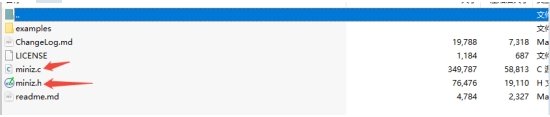
为了快速把这两个源码文件用起来,我们思路是在ubuntu22下,写一个调用使用这个里面的inflate函数来进行解压。可以看到下面的源码
#include <stdio.h>
#include <stdlib.h>
#include <string.h>
#include <stdint.h>
#include <sys/stat.h>
#include <sys/types.h>
#include <errno.h>
#include <unistd.h>
#include "miniz.h" // 假设 miniz.h 已包含 ZIP 支持(miniz_zip.h)
/* 创建目录(递归) */
int create_directory(const char *path)
{
char tmp[1024];
char *p = NULL;
size_t len;
snprintf(tmp, sizeof(tmp), "%s", path);
len = strlen(tmp);
if (tmp[len - 1] == '/')
tmp[len - 1] = '\0';
for (p = tmp + 1; *p; p++) {
if (*p == '/') {
*p = '\0';
if (mkdir(tmp, 0755) != 0 && errno != EEXIST) {
return -1;
}
*p = '/';
}
}
if (mkdir(tmp, 0755) != 0 && errno != EEXIST) {
return -1;
}
return 0;
}
/* 从路径提取目录部分 */
void extract_directory(const char *filepath, char *dir_buf, size_t buf_size)
{
const char *last_slash = strrchr(filepath, '/');
if (last_slash) {
size_t dir_len = last_slash - filepath;
if (dir_len >= buf_size) dir_len = buf_size - 1;
strncpy(dir_buf, filepath, dir_len);
dir_buf[dir_len] = '\0';
} else {
dir_buf[0] = '\0';
}
}
/* 打印 ZIP 目录结构 */
void print_directory_structure(mz_zip_archive *zip_archive)
{
mz_uint num_files = mz_zip_reader_get_num_files(zip_archive);
printf("\n========================================\n");
printf("ZIP Directory Structure\n");
printf("========================================\n");
printf("Total entries: %u\n\n", num_files);
printf("%-50s %12s %12s %6s %s\n",
"Filename", "Compressed", "Uncompressed", "Method", "Type");
printf("%-50s %12s %12s %6s %s\n",
"--------", "----------", "------------", "------", "----");
for (mz_uint i = 0; i < num_files; i++) {
mz_zip_archive_file_stat file_stat;
if (!mz_zip_reader_file_stat(zip_archive, i, &file_stat)) continue;
const char *method = (file_stat.m_method == 0) ? "Store" :
(file_stat.m_method == 8) ? "Deflate" : "Other";
const char *type = file_stat.m_is_directory ? "DIR" : "FILE";
printf("%-50s %12lu %12lu %6s %s\n",
file_stat.m_filename,
(unsigned long)file_stat.m_comp_size,
(unsigned long)file_stat.m_uncomp_size,
method,
type);
}
printf("\n");
}
/* 解压所有文件(streaming) */
int extract_all_files(const char *zip_filename, const char *output_dir)
{
mz_zip_archive zip_archive;
memset(&zip_archive, 0, sizeof(zip_archive));
// 默认 flags = 0:miniz 默认 streaming,不 mmap 大文件
if (!mz_zip_reader_init_file(&zip_archive, zip_filename, 0)) {
fprintf(stderr, "Failed to initialize ZIP reader for %s\n", zip_filename);
return -1;
}
mz_uint num_files = mz_zip_reader_get_num_files(&zip_archive);
printf("\n========================================\n");
printf("Extracting to: %s\n", output_dir);
printf("========================================\n\n");
create_directory(output_dir);
int success = 0, failed = 0;
for (mz_uint i = 0; i < num_files; i++) {
mz_zip_archive_file_stat file_stat;
if (!mz_zip_reader_file_stat(&zip_archive, i, &file_stat)) {
failed++;
continue;
}
char output_path[1024];
snprintf(output_path, sizeof(output_path), "%s/%s", output_dir, file_stat.m_filename);
if (file_stat.m_is_directory) {
if (create_directory(output_path) == 0) {
printf("Created directory: %s\n", output_path);
success++;
} else {
fprintf(stderr, "Failed to create directory: %s\n", output_path);
failed++;
}
continue;
}
// 创建父目录
char dir_path[1024];
extract_directory(output_path, dir_path, sizeof(dir_path));
if (dir_path[0] != '\0') {
create_directory(dir_path);
}
printf("Extracting: %s\n", file_stat.m_filename);
printf(" Output: %s\n", output_path);
// Streaming 提取到文件(miniz 内部 chunk-by-chunk 解压写盘)
if (mz_zip_reader_extract_to_file(&zip_archive, i, output_path, 0)) {
printf(" Extracted OK (%lu bytes uncompressed)\n", (unsigned long)file_stat.m_uncomp_size);
success++;
} else {
fprintf(stderr, " Extraction failed: %s\n", file_stat.m_filename);
failed++;
}
}
mz_zip_reader_end(&zip_archive);
printf("\n========================================\n");
printf("Extraction Summary\n");
printf("========================================\n");
printf("Success: %d\n", success);
printf("Failed: %d\n", failed);
printf("Total: %d\n", success + failed);
return (failed == 0) ? 0 : -1;
}
/* 主函数 */
int main(int argc, char *argv[])
{
const char *zip_filename;
const char *output_dir = "extracted";
if (argc < 2) {
fprintf(stderr, "Usage: %s <zip_file> [output_directory]\n", argv[0]);
return 1;
}
zip_filename = argv[1];
if (argc >= 3) {
output_dir = argv[2];
}
printf("ZIP Extractor (miniz Streaming Mode)\n");
printf("ZIP file: %s\n", zip_filename);
printf("Output: %s\n\n", output_dir);
mz_zip_archive zip_archive;
memset(&zip_archive, 0, sizeof(zip_archive));
if (!mz_zip_reader_init_file(&zip_archive, zip_filename, 0)) {
fprintf(stderr, "Failed to open ZIP file: %s\n", zip_filename);
return 1;
}
// 打印目录结构
print_directory_structure(&zip_archive);
// 提取所有文件
int result = extract_all_files(zip_filename, output_dir);
mz_zip_reader_end(&zip_archive);
if (result == 0) {
printf("\nExtraction completed successfully!\n");
} else {
printf("\nExtraction completed with errors.\n");
}
return result;
}通过上述代码,我们可以直接将他和miniz.c一起编译,可以迅速得到一个实现解压zip文件的可执行文件
gcc *c -o miniz -g./miniz demo.zip
执行程序后可以看到可以实现解压文件
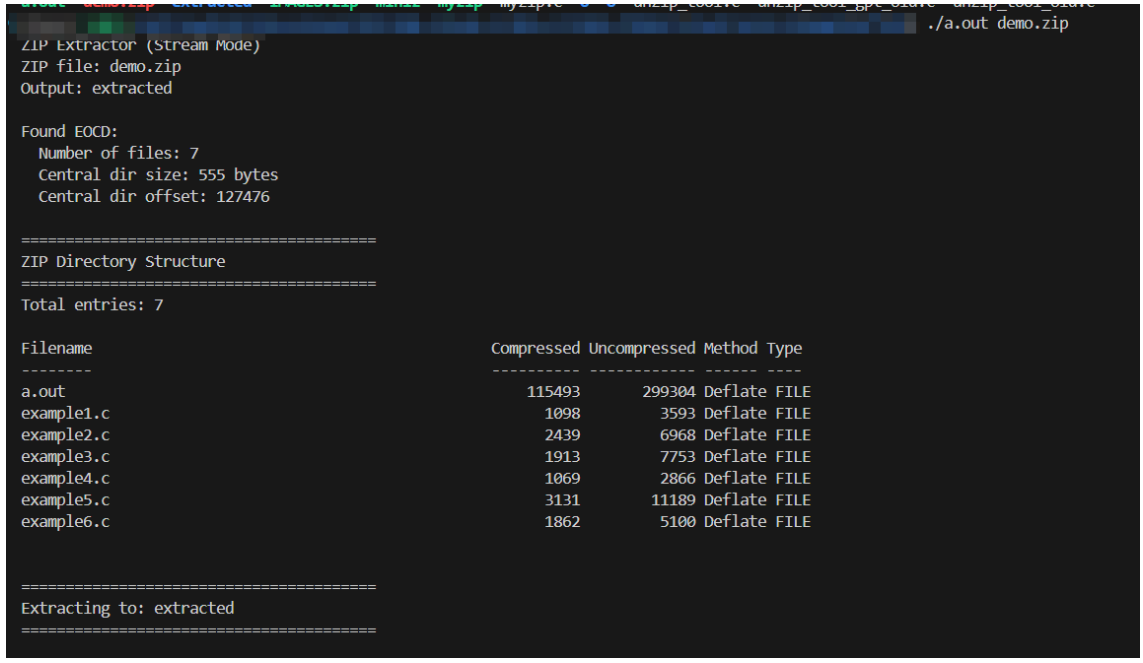
能正常解压后,我们可以通过gdb去查询他调用了哪些代码,通过他调用的最后一个函数,然后通过gdb bt命令查看他的调用栈,这个就是我们移植的线索。
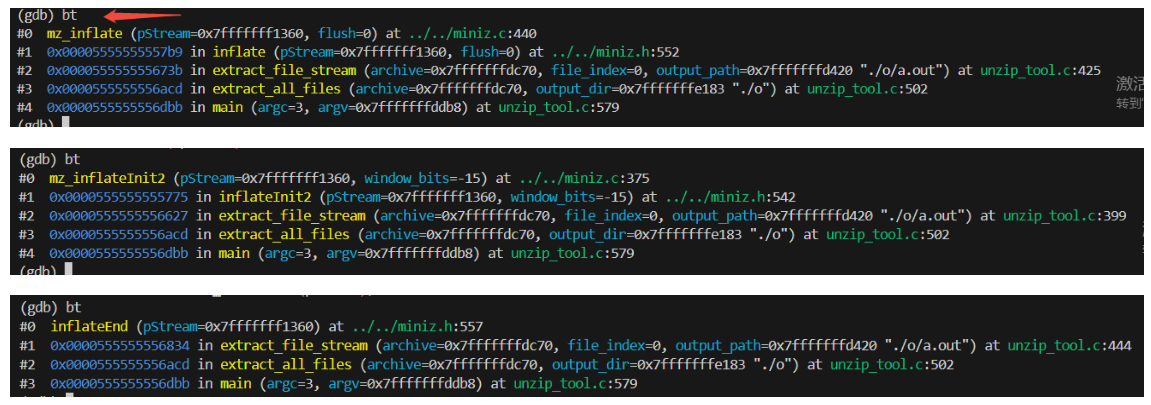
通过这三个线索,我们就可以快速找出我们需要的函数,当然我们是从最后调用函数开始移植的,所以在移植第一个函数的时候,会报找不到很多定义,现在就可以根据这些找不到定义的变量或者函数,把他一一移植到新的c文件去。当然也需要修改数据类型,一般通用库都会使用typedef来搞一个通用的移植,这样可以跨平台移植。
c
#ifndef NEW_MINIZ_H
#define NEW_MINIZ_H
#include <common.h>
#include <linux/types.h>
#include <malloc.h>
#include <linux/string.h>
typedef unsigned char mz_uint8;
typedef int16_t mz_int16;
typedef uint16_t mz_uint16;
typedef uint32_t mz_uint32;
typedef uint32_t mz_uint;
typedef int64_t mz_int64;
typedef uint64_t mz_uint64;
typedef int mz_bool;
typedef unsigned long mz_ulong;
typedef mz_uint64 tinfl_bit_buf_t;
#define Z_OK MZ_OK
#define Z_STREAM_END MZ_STREAM_END
#define Z_STREAM_ERROR MZ_STREAM_ERROR
#define Z_DATA_ERROR MZ_DATA_ERROR
#define Z_MEM_ERROR MZ_MEM_ERROR
#define Z_BUF_ERROR MZ_BUF_ERROR
#define Z_NO_FLUSH MZ_NO_FLUSH
#define Z_FINISH MZ_FINISH
#define MZ_ASSERT(x) ((void)0)
#define MZ_FALSE (0)
#define MZ_TRUE (1)
#define MZ_MAX(a, b) (((a) > (b)) ? (a) : (b))
#define MZ_MIN(a, b) (((a) < (b)) ? (a) : (b))
#define MZ_CLEAR_OBJ(obj) memset(&(obj), 0, sizeof(obj))
#define MZ_CLEAR_ARR(obj) memset((obj), 0, sizeof(obj))
#define MZ_CLEAR_PTR(obj) memset((obj), 0, sizeof(*obj))
#define MZ_READ_LE16(p) ((mz_uint32)(((const mz_uint8 *)(p))[0]) | ((mz_uint32)(((const mz_uint8 *)(p))[1]) << 8U))
#define MZ_READ_LE32(p) ((mz_uint32)(((const mz_uint8 *)(p))[0]) | ((mz_uint32)(((const mz_uint8 *)(p))[1]) << 8U) | ((mz_uint32)(((const mz_uint8 *)(p))[2]) << 16U) | ((mz_uint32)(((const mz_uint8 *)(p))[3]) << 24U))
#define MZ_MALLOC(x) malloc(x)
#define MZ_FREE(x) free(x)
#define MZ_REALLOC(p, x) realloc(p, x)
#define MZ_MACRO_END while (0)
#define tinfl_init(r) \
do \
{ \
(r)->m_state = 0; \
} \
MZ_MACRO_END
#define tinfl_get_adler32(r) (r)->m_check_adler32
#define TINFL_MEMCPY(d, s, l) memcpy(d, s, l)
#define TINFL_MEMSET(p, c, l) memset(p, c, l)
#define TINFL_CR_BEGIN \
switch (r->m_state) \
{ \
case 0:
#define TINFL_CR_RETURN(state_index, result) \
do \
{ \
status = result; \
r->m_state = state_index; \
goto common_exit; \
case state_index:; \
} \
MZ_MACRO_END
#define TINFL_CR_RETURN_FOREVER(state_index, result) \
do \
{ \
for (;;) \
{ \
TINFL_CR_RETURN(state_index, result); \
} \
} \
MZ_MACRO_END
#define TINFL_CR_FINISH }
#define TINFL_GET_BYTE(state_index, c) \
do \
{ \
while (pIn_buf_cur >= pIn_buf_end) \
{ \
TINFL_CR_RETURN(state_index, (decomp_flags & TINFL_FLAG_HAS_MORE_INPUT) ? TINFL_STATUS_NEEDS_MORE_INPUT : TINFL_STATUS_FAILED_CANNOT_MAKE_PROGRESS); \
} \
c = *pIn_buf_cur++; \
} \
MZ_MACRO_END
#define TINFL_NEED_BITS(state_index, n) \
do \
{ \
mz_uint c; \
TINFL_GET_BYTE(state_index, c); \
bit_buf |= (((tinfl_bit_buf_t)c) << num_bits); \
num_bits += 8; \
} while (num_bits < (mz_uint)(n))
#define TINFL_SKIP_BITS(state_index, n) \
do \
{ \
if (num_bits < (mz_uint)(n)) \
{ \
TINFL_NEED_BITS(state_index, n); \
} \
bit_buf >>= (n); \
num_bits -= (n); \
} \
MZ_MACRO_END
#define TINFL_GET_BITS(state_index, b, n) \
do \
{ \
if (num_bits < (mz_uint)(n)) \
{ \
TINFL_NEED_BITS(state_index, n); \
} \
b = bit_buf & ((1 << (n)) - 1); \
bit_buf >>= (n); \
num_bits -= (n); \
} \
MZ_MACRO_END
/* TINFL_HUFF_BITBUF_FILL() is only used rarely, when the number of bytes remaining in the input buffer falls below 2. */
/* It reads just enough bytes from the input stream that are needed to decode the next Huffman code (and absolutely no more). It works by trying to fully decode a */
/* Huffman code by using whatever bits are currently present in the bit buffer. If this fails, it reads another byte, and tries again until it succeeds or until the */
/* bit buffer contains >=15 bits (deflate's max. Huffman code size). */
#define TINFL_HUFF_BITBUF_FILL(state_index, pLookUp, pTree) \
do \
{ \
temp = pLookUp[bit_buf & (TINFL_FAST_LOOKUP_SIZE - 1)]; \
if (temp >= 0) \
{ \
code_len = temp >> 9; \
if ((code_len) && (num_bits >= code_len)) \
break; \
} \
else if (num_bits > TINFL_FAST_LOOKUP_BITS) \
{ \
code_len = TINFL_FAST_LOOKUP_BITS; \
do \
{ \
temp = pTree[~temp + ((bit_buf >> code_len++) & 1)]; \
} while ((temp < 0) && (num_bits >= (code_len + 1))); \
if (temp >= 0) \
break; \
} \
TINFL_GET_BYTE(state_index, c); \
bit_buf |= (((tinfl_bit_buf_t)c) << num_bits); \
num_bits += 8; \
} while (num_bits < 15);
/* TINFL_HUFF_DECODE() decodes the next Huffman coded symbol. It's more complex than you would initially expect because the zlib API expects the decompressor to never read */
/* beyond the final byte of the deflate stream. (In other words, when this macro wants to read another byte from the input, it REALLY needs another byte in order to fully */
/* decode the next Huffman code.) Handling this properly is particularly important on raw deflate (non-zlib) streams, which aren't followed by a byte aligned adler-32. */
/* The slow path is only executed at the very end of the input buffer. */
/* v1.16: The original macro handled the case at the very end of the passed-in input buffer, but we also need to handle the case where the user passes in 1+zillion bytes */
/* following the deflate data and our non-conservative read-ahead path won't kick in here on this code. This is much trickier. */
#define TINFL_HUFF_DECODE(state_index, sym, pLookUp, pTree) \
do \
{ \
int temp; \
mz_uint code_len, c; \
if (num_bits < 15) \
{ \
if ((pIn_buf_end - pIn_buf_cur) < 2) \
{ \
TINFL_HUFF_BITBUF_FILL(state_index, pLookUp, pTree); \
} \
else \
{ \
bit_buf |= (((tinfl_bit_buf_t)pIn_buf_cur[0]) << num_bits) | (((tinfl_bit_buf_t)pIn_buf_cur[1]) << (num_bits + 8)); \
pIn_buf_cur += 2; \
num_bits += 16; \
} \
} \
if ((temp = pLookUp[bit_buf & (TINFL_FAST_LOOKUP_SIZE - 1)]) >= 0) \
code_len = temp >> 9, temp &= 511; \
else \
{ \
code_len = TINFL_FAST_LOOKUP_BITS; \
do \
{ \
temp = pTree[~temp + ((bit_buf >> code_len++) & 1)]; \
} while (temp < 0); \
} \
sym = temp; \
bit_buf >>= code_len; \
num_bits -= code_len; \
} \
MZ_MACRO_END
enum
{
TINFL_MAX_HUFF_TABLES = 3,
TINFL_MAX_HUFF_SYMBOLS_0 = 288,
TINFL_MAX_HUFF_SYMBOLS_1 = 32,
TINFL_MAX_HUFF_SYMBOLS_2 = 19,
TINFL_FAST_LOOKUP_BITS = 10,
TINFL_FAST_LOOKUP_SIZE = 1 << TINFL_FAST_LOOKUP_BITS
};
enum
{
MZ_NO_FLUSH = 0,
MZ_PARTIAL_FLUSH = 1,
MZ_SYNC_FLUSH = 2,
MZ_FULL_FLUSH = 3,
MZ_FINISH = 4,
MZ_BLOCK = 5
};
/* Return status codes. MZ_PARAM_ERROR is non-standard. */
enum
{
MZ_OK = 0,
MZ_STREAM_END = 1,
MZ_NEED_DICT = 2,
MZ_ERRNO = -1,
MZ_STREAM_ERROR = -2,
MZ_DATA_ERROR = -3,
MZ_MEM_ERROR = -4,
MZ_BUF_ERROR = -5,
MZ_VERSION_ERROR = -6,
MZ_PARAM_ERROR = -10000
};
enum
{
TINFL_FLAG_PARSE_ZLIB_HEADER = 1,
TINFL_FLAG_HAS_MORE_INPUT = 2,
TINFL_FLAG_USING_NON_WRAPPING_OUTPUT_BUF = 4,
TINFL_FLAG_COMPUTE_ADLER32 = 8
};
#define MINIZ_EXPORT
// MINIZ_EXPORT void *tinfl_decompress_mem_to_heap(const void *pSrc_buf, size_t src_buf_len, size_t *pOut_len, int flags);
#define TINFL_LZ_DICT_SIZE 32768
typedef enum
{
/* This flags indicates the inflator needs 1 or more input bytes to make forward progress, but the caller is indicating that no more are available. The compressed data */
/* is probably corrupted. If you call the inflator again with more bytes it'll try to continue processing the input but this is a BAD sign (either the data is corrupted or you called it incorrectly). */
/* If you call it again with no input you'll just get TINFL_STATUS_FAILED_CANNOT_MAKE_PROGRESS again. */
TINFL_STATUS_FAILED_CANNOT_MAKE_PROGRESS = -4,
/* This flag indicates that one or more of the input parameters was obviously bogus. (You can try calling it again, but if you get this error the calling code is wrong.) */
TINFL_STATUS_BAD_PARAM = -3,
/* This flags indicate the inflator is finished but the adler32 check of the uncompressed data didn't match. If you call it again it'll return TINFL_STATUS_DONE. */
TINFL_STATUS_ADLER32_MISMATCH = -2,
/* This flags indicate the inflator has somehow failed (bad code, corrupted input, etc.). If you call it again without resetting via tinfl_init() it it'll just keep on returning the same status failure code. */
TINFL_STATUS_FAILED = -1,
/* Any status code less than TINFL_STATUS_DONE must indicate a failure. */
/* This flag indicates the inflator has returned every byte of uncompressed data that it can, has consumed every byte that it needed, has successfully reached the end of the deflate stream, and */
/* if zlib headers and adler32 checking enabled that it has successfully checked the uncompressed data's adler32. If you call it again you'll just get TINFL_STATUS_DONE over and over again. */
TINFL_STATUS_DONE = 0,
/* This flag indicates the inflator MUST have more input data (even 1 byte) before it can make any more forward progress, or you need to clear the TINFL_FLAG_HAS_MORE_INPUT */
/* flag on the next call if you don't have any more source data. If the source data was somehow corrupted it's also possible (but unlikely) for the inflator to keep on demanding input to */
/* proceed, so be sure to properly set the TINFL_FLAG_HAS_MORE_INPUT flag. */
TINFL_STATUS_NEEDS_MORE_INPUT = 1,
/* This flag indicates the inflator definitely has 1 or more bytes of uncompressed data available, but it cannot write this data into the output buffer. */
/* Note if the source compressed data was corrupted it's possible for the inflator to return a lot of uncompressed data to the caller. I've been assuming you know how much uncompressed data to expect */
/* (either exact or worst case) and will stop calling the inflator and fail after receiving too much. In pure streaming scenarios where you have no idea how many bytes to expect this may not be possible */
/* so I may need to add some code to address this. */
TINFL_STATUS_HAS_MORE_OUTPUT = 2
} tinfl_status;
struct tinfl_decompressor_tag
{
mz_uint32 m_state, m_num_bits, m_zhdr0, m_zhdr1, m_z_adler32, m_final, m_type, m_check_adler32, m_dist, m_counter, m_num_extra, m_table_sizes[TINFL_MAX_HUFF_TABLES];
tinfl_bit_buf_t m_bit_buf;
size_t m_dist_from_out_buf_start;
mz_int16 m_look_up[TINFL_MAX_HUFF_TABLES][TINFL_FAST_LOOKUP_SIZE];
mz_int16 m_tree_0[TINFL_MAX_HUFF_SYMBOLS_0 * 2];
mz_int16 m_tree_1[TINFL_MAX_HUFF_SYMBOLS_1 * 2];
mz_int16 m_tree_2[TINFL_MAX_HUFF_SYMBOLS_2 * 2];
mz_uint8 m_code_size_0[TINFL_MAX_HUFF_SYMBOLS_0];
mz_uint8 m_code_size_1[TINFL_MAX_HUFF_SYMBOLS_1];
mz_uint8 m_code_size_2[TINFL_MAX_HUFF_SYMBOLS_2];
mz_uint8 m_raw_header[4], m_len_codes[TINFL_MAX_HUFF_SYMBOLS_0 + TINFL_MAX_HUFF_SYMBOLS_1 + 137];
};
typedef struct tinfl_decompressor_tag tinfl_decompressor;
typedef struct
{
tinfl_decompressor m_decomp;
mz_uint m_dict_ofs, m_dict_avail, m_first_call, m_has_flushed;
int m_window_bits;
mz_uint8 m_dict[TINFL_LZ_DICT_SIZE];
tinfl_status m_last_status;
} inflate_state;
typedef void *(*mz_alloc_func)(void *opaque, size_t items, size_t size);
typedef void (*mz_free_func)(void *opaque, void *address);
typedef void *(*mz_realloc_func)(void *opaque, void *address, size_t items, size_t size);
#define MZ_DEFAULT_WINDOW_BITS 15
typedef struct mz_stream_s //left
{
const unsigned char *next_in; /* pointer to next byte to read */
unsigned int avail_in; /* number of bytes available at next_in */
mz_ulong total_in; /* total number of bytes consumed so far */
unsigned char *next_out; /* pointer to next byte to write */
unsigned int avail_out; /* number of bytes that can be written to next_out */
mz_ulong total_out; /* total number of bytes produced so far */
char *msg; /* error msg (unused) */
struct mz_internal_state *state; /* internal state, allocated by zalloc/zfree */
mz_alloc_func zalloc; /* optional heap allocation function (defaults to malloc) */
mz_free_func zfree; /* optional heap free function (defaults to free) */
void *opaque; /* heap alloc function user pointer */
int data_type; /* data_type (unused) */
mz_ulong adler; /* adler32 of the source or uncompressed data */
mz_ulong reserved; /* not used */
} mz_stream;
typedef mz_stream *mz_streamp;
// #define MINIZ_EXPORT
// extern MINIZ_EXPORT void *miniz_def_alloc_func(void *opaque, size_t items, size_t size);
// extern MINIZ_EXPORT void miniz_def_free_func(void *opaque, void *address);
// extern MINIZ_EXPORT void *miniz_def_realloc_func(void *opaque, void *address, size_t items, size_t size);
int mz_inflateInit2(mz_streamp pStream, int window_bits);
int mz_inflate(mz_streamp pStream, int flush);
int mz_inflateEnd(mz_streamp pStream);
static int inflateInit2(mz_streamp pStream, int window_bits)
{
return mz_inflateInit2(pStream, window_bits);
}
static int inflate(mz_streamp pStream, int flush)
{
return mz_inflate(pStream, flush);
}
static int inflateEnd(mz_streamp pStream)
{
return mz_inflateEnd(pStream);
}
#endif // NEW_MINIZ_H
// #ifndef NEW_MINIZ_C
// #define NEW_MINIZ_C
// #endif
c
#include "new_miniz.h"
static void tinfl_clear_tree(tinfl_decompressor *r)
{
if (r->m_type == 0)
MZ_CLEAR_ARR(r->m_tree_0);
else if (r->m_type == 1)
MZ_CLEAR_ARR(r->m_tree_1);
else
MZ_CLEAR_ARR(r->m_tree_2);
}
void mz_free(void *p)
{
MZ_FREE(p);
}
void *miniz_def_alloc_func(void *opaque, size_t items, size_t size)
{
(void)opaque, (void)items, (void)size;
return MZ_MALLOC(items * size);
}
void miniz_def_free_func(void *opaque, void *address)
{
(void)opaque, (void)address;
MZ_FREE(address);
}
void *miniz_def_realloc_func(void *opaque, void *address, size_t items, size_t size)
{
(void)opaque, (void)address, (void)items, (void)size;
return MZ_REALLOC(address, items * size);
}
int mz_inflateInit2(mz_streamp pStream, int window_bits)
{
inflate_state *pDecomp;
if (!pStream)
return MZ_STREAM_ERROR;
if ((window_bits != MZ_DEFAULT_WINDOW_BITS) && (-window_bits != MZ_DEFAULT_WINDOW_BITS))
return MZ_PARAM_ERROR;
pStream->data_type = 0;
pStream->adler = 0;
pStream->msg = NULL;
pStream->total_in = 0;
pStream->total_out = 0;
pStream->reserved = 0;
if (!pStream->zalloc)
pStream->zalloc = miniz_def_alloc_func;//分配函数没有实现
if (!pStream->zfree)
pStream->zfree = miniz_def_free_func;//释放函数没有实现
pDecomp = (inflate_state *)pStream->zalloc(pStream->opaque, 1, sizeof(inflate_state));
if (!pDecomp)
return MZ_MEM_ERROR;
pStream->state = (struct mz_internal_state *)pDecomp;
tinfl_init(&pDecomp->m_decomp);
pDecomp->m_dict_ofs = 0;
pDecomp->m_dict_avail = 0;
pDecomp->m_last_status = TINFL_STATUS_NEEDS_MORE_INPUT;
pDecomp->m_first_call = 1;
pDecomp->m_has_flushed = 0;
pDecomp->m_window_bits = window_bits;
return MZ_OK;
}
tinfl_status tinfl_decompress(tinfl_decompressor *r, const mz_uint8 *pIn_buf_next, size_t *pIn_buf_size, mz_uint8 *pOut_buf_start, mz_uint8 *pOut_buf_next, size_t *pOut_buf_size, const mz_uint32 decomp_flags)
{
static const mz_uint16 s_length_base[31] = { 3, 4, 5, 6, 7, 8, 9, 10, 11, 13, 15, 17, 19, 23, 27, 31, 35, 43, 51, 59, 67, 83, 99, 115, 131, 163, 195, 227, 258, 0, 0 };
static const mz_uint8 s_length_extra[31] = { 0, 0, 0, 0, 0, 0, 0, 0, 1, 1, 1, 1, 2, 2, 2, 2, 3, 3, 3, 3, 4, 4, 4, 4, 5, 5, 5, 5, 0, 0, 0 };
static const mz_uint16 s_dist_base[32] = { 1, 2, 3, 4, 5, 7, 9, 13, 17, 25, 33, 49, 65, 97, 129, 193, 257, 385, 513, 769, 1025, 1537, 2049, 3073, 4097, 6145, 8193, 12289, 16385, 24577, 0, 0 };
static const mz_uint8 s_dist_extra[32] = { 0, 0, 0, 0, 1, 1, 2, 2, 3, 3, 4, 4, 5, 5, 6, 6, 7, 7, 8, 8, 9, 9, 10, 10, 11, 11, 12, 12, 13, 13 };
static const mz_uint8 s_length_dezigzag[19] = { 16, 17, 18, 0, 8, 7, 9, 6, 10, 5, 11, 4, 12, 3, 13, 2, 14, 1, 15 };
static const mz_uint16 s_min_table_sizes[3] = { 257, 1, 4 };
mz_int16 *pTrees[3];
mz_uint8 *pCode_sizes[3];
tinfl_status status = TINFL_STATUS_FAILED;
mz_uint32 num_bits, dist, counter, num_extra;
tinfl_bit_buf_t bit_buf;
const mz_uint8 *pIn_buf_cur = pIn_buf_next, *const pIn_buf_end = pIn_buf_next + *pIn_buf_size;
mz_uint8 *pOut_buf_cur = pOut_buf_next, *const pOut_buf_end = pOut_buf_next ? pOut_buf_next + *pOut_buf_size : NULL;
size_t out_buf_size_mask = (decomp_flags & TINFL_FLAG_USING_NON_WRAPPING_OUTPUT_BUF) ? (size_t)-1 : ((pOut_buf_next - pOut_buf_start) + *pOut_buf_size) - 1, dist_from_out_buf_start;
/* Ensure the output buffer's size is a power of 2, unless the output buffer is large enough to hold the entire output file (in which case it doesn't matter). */
if (((out_buf_size_mask + 1) & out_buf_size_mask) || (pOut_buf_next < pOut_buf_start))
{
*pIn_buf_size = *pOut_buf_size = 0;
return TINFL_STATUS_BAD_PARAM;
}
pTrees[0] = r->m_tree_0;
pTrees[1] = r->m_tree_1;
pTrees[2] = r->m_tree_2;
pCode_sizes[0] = r->m_code_size_0;
pCode_sizes[1] = r->m_code_size_1;
pCode_sizes[2] = r->m_code_size_2;
num_bits = r->m_num_bits;
bit_buf = r->m_bit_buf;
dist = r->m_dist;
counter = r->m_counter;
num_extra = r->m_num_extra;
dist_from_out_buf_start = r->m_dist_from_out_buf_start;
TINFL_CR_BEGIN
bit_buf = num_bits = dist = counter = num_extra = r->m_zhdr0 = r->m_zhdr1 = 0;
r->m_z_adler32 = r->m_check_adler32 = 1;
if (decomp_flags & TINFL_FLAG_PARSE_ZLIB_HEADER)
{
TINFL_GET_BYTE(1, r->m_zhdr0);
TINFL_GET_BYTE(2, r->m_zhdr1);
counter = (((r->m_zhdr0 * 256 + r->m_zhdr1) % 31 != 0) || (r->m_zhdr1 & 32) || ((r->m_zhdr0 & 15) != 8));
if (!(decomp_flags & TINFL_FLAG_USING_NON_WRAPPING_OUTPUT_BUF))
counter |= (((1U << (8U + (r->m_zhdr0 >> 4))) > 32768U) || ((out_buf_size_mask + 1) < (size_t)((size_t)1 << (8U + (r->m_zhdr0 >> 4)))));
if (counter)
{
TINFL_CR_RETURN_FOREVER(36, TINFL_STATUS_FAILED);
}
}
do
{
TINFL_GET_BITS(3, r->m_final, 3);
r->m_type = r->m_final >> 1;
if (r->m_type == 0)
{
TINFL_SKIP_BITS(5, num_bits & 7);
for (counter = 0; counter < 4; ++counter)
{
if (num_bits)
TINFL_GET_BITS(6, r->m_raw_header[counter], 8);
else
TINFL_GET_BYTE(7, r->m_raw_header[counter]);
}
if ((counter = (r->m_raw_header[0] | (r->m_raw_header[1] << 8))) != (mz_uint)(0xFFFF ^ (r->m_raw_header[2] | (r->m_raw_header[3] << 8))))
{
TINFL_CR_RETURN_FOREVER(39, TINFL_STATUS_FAILED);
}
while ((counter) && (num_bits))
{
TINFL_GET_BITS(51, dist, 8);
while (pOut_buf_cur >= pOut_buf_end)
{
TINFL_CR_RETURN(52, TINFL_STATUS_HAS_MORE_OUTPUT);
}
*pOut_buf_cur++ = (mz_uint8)dist;
counter--;
}
while (counter)
{
size_t n;
while (pOut_buf_cur >= pOut_buf_end)
{
TINFL_CR_RETURN(9, TINFL_STATUS_HAS_MORE_OUTPUT);
}
while (pIn_buf_cur >= pIn_buf_end)
{
TINFL_CR_RETURN(38, (decomp_flags & TINFL_FLAG_HAS_MORE_INPUT) ? TINFL_STATUS_NEEDS_MORE_INPUT : TINFL_STATUS_FAILED_CANNOT_MAKE_PROGRESS);
}
n = MZ_MIN(MZ_MIN((size_t)(pOut_buf_end - pOut_buf_cur), (size_t)(pIn_buf_end - pIn_buf_cur)), counter);
TINFL_MEMCPY(pOut_buf_cur, pIn_buf_cur, n);
pIn_buf_cur += n;
pOut_buf_cur += n;
counter -= (mz_uint)n;
}
}
else if (r->m_type == 3)
{
TINFL_CR_RETURN_FOREVER(10, TINFL_STATUS_FAILED);
}
else
{
if (r->m_type == 1)
{
mz_uint8 *p = r->m_code_size_0;
mz_uint i;
r->m_table_sizes[0] = 288;
r->m_table_sizes[1] = 32;
TINFL_MEMSET(r->m_code_size_1, 5, 32);
for (i = 0; i <= 143; ++i)
*p++ = 8;
for (; i <= 255; ++i)
*p++ = 9;
for (; i <= 279; ++i)
*p++ = 7;
for (; i <= 287; ++i)
*p++ = 8;
}
else
{
for (counter = 0; counter < 3; counter++)
{
TINFL_GET_BITS(11, r->m_table_sizes[counter], "\05\05\04"[counter]);
r->m_table_sizes[counter] += s_min_table_sizes[counter];
}
MZ_CLEAR_ARR(r->m_code_size_2);
for (counter = 0; counter < r->m_table_sizes[2]; counter++)
{
mz_uint s;
TINFL_GET_BITS(14, s, 3);
r->m_code_size_2[s_length_dezigzag[counter]] = (mz_uint8)s;
}
r->m_table_sizes[2] = 19;
}
for (; (int)r->m_type >= 0; r->m_type--)
{
int tree_next, tree_cur;
mz_int16 *pLookUp;
mz_int16 *pTree;
mz_uint8 *pCode_size;
mz_uint i, j, used_syms, total, sym_index, next_code[17], total_syms[16];
pLookUp = r->m_look_up[r->m_type];
pTree = pTrees[r->m_type];
pCode_size = pCode_sizes[r->m_type];
MZ_CLEAR_ARR(total_syms);
TINFL_MEMSET(pLookUp, 0, sizeof(r->m_look_up[0]));
tinfl_clear_tree(r);
for (i = 0; i < r->m_table_sizes[r->m_type]; ++i)
total_syms[pCode_size[i]]++;
used_syms = 0, total = 0;
next_code[0] = next_code[1] = 0;
for (i = 1; i <= 15; ++i)
{
used_syms += total_syms[i];
next_code[i + 1] = (total = ((total + total_syms[i]) << 1));
}
if ((65536 != total) && (used_syms > 1))
{
TINFL_CR_RETURN_FOREVER(35, TINFL_STATUS_FAILED);
}
for (tree_next = -1, sym_index = 0; sym_index < r->m_table_sizes[r->m_type]; ++sym_index)
{
mz_uint rev_code = 0, l, cur_code, code_size = pCode_size[sym_index];
if (!code_size)
continue;
cur_code = next_code[code_size]++;
for (l = code_size; l > 0; l--, cur_code >>= 1)
rev_code = (rev_code << 1) | (cur_code & 1);
if (code_size <= TINFL_FAST_LOOKUP_BITS)
{
mz_int16 k = (mz_int16)((code_size << 9) | sym_index);
while (rev_code < TINFL_FAST_LOOKUP_SIZE)
{
pLookUp[rev_code] = k;
rev_code += (1 << code_size);
}
continue;
}
if (0 == (tree_cur = pLookUp[rev_code & (TINFL_FAST_LOOKUP_SIZE - 1)]))
{
pLookUp[rev_code & (TINFL_FAST_LOOKUP_SIZE - 1)] = (mz_int16)tree_next;
tree_cur = tree_next;
tree_next -= 2;
}
rev_code >>= (TINFL_FAST_LOOKUP_BITS - 1);
for (j = code_size; j > (TINFL_FAST_LOOKUP_BITS + 1); j--)
{
tree_cur -= ((rev_code >>= 1) & 1);
if (!pTree[-tree_cur - 1])
{
pTree[-tree_cur - 1] = (mz_int16)tree_next;
tree_cur = tree_next;
tree_next -= 2;
}
else
tree_cur = pTree[-tree_cur - 1];
}
tree_cur -= ((rev_code >>= 1) & 1);
pTree[-tree_cur - 1] = (mz_int16)sym_index;
}
if (r->m_type == 2)
{
for (counter = 0; counter < (r->m_table_sizes[0] + r->m_table_sizes[1]);)
{
mz_uint s;
TINFL_HUFF_DECODE(16, dist, r->m_look_up[2], r->m_tree_2);
if (dist < 16)
{
r->m_len_codes[counter++] = (mz_uint8)dist;
continue;
}
if ((dist == 16) && (!counter))
{
TINFL_CR_RETURN_FOREVER(17, TINFL_STATUS_FAILED);
}
num_extra = "\02\03\07"[dist - 16];
TINFL_GET_BITS(18, s, num_extra);
s += "\03\03\013"[dist - 16];
TINFL_MEMSET(r->m_len_codes + counter, (dist == 16) ? r->m_len_codes[counter - 1] : 0, s);
counter += s;
}
if ((r->m_table_sizes[0] + r->m_table_sizes[1]) != counter)
{
TINFL_CR_RETURN_FOREVER(21, TINFL_STATUS_FAILED);
}
TINFL_MEMCPY(r->m_code_size_0, r->m_len_codes, r->m_table_sizes[0]);
TINFL_MEMCPY(r->m_code_size_1, r->m_len_codes + r->m_table_sizes[0], r->m_table_sizes[1]);
}
}
for (;;)
{
mz_uint8 *pSrc;
for (;;)
{
if (((pIn_buf_end - pIn_buf_cur) < 4) || ((pOut_buf_end - pOut_buf_cur) < 2))
{
TINFL_HUFF_DECODE(23, counter, r->m_look_up[0], r->m_tree_0);
if (counter >= 256)
break;
while (pOut_buf_cur >= pOut_buf_end)
{
TINFL_CR_RETURN(24, TINFL_STATUS_HAS_MORE_OUTPUT);
}
*pOut_buf_cur++ = (mz_uint8)counter;
}
else
{
int sym2;
mz_uint code_len;
if (num_bits < 30)
{
bit_buf |= (((tinfl_bit_buf_t)MZ_READ_LE32(pIn_buf_cur)) << num_bits);
pIn_buf_cur += 4;
num_bits += 32;
}
if ((sym2 = r->m_look_up[0][bit_buf & (TINFL_FAST_LOOKUP_SIZE - 1)]) >= 0)
code_len = sym2 >> 9;
else
{
code_len = TINFL_FAST_LOOKUP_BITS;
do
{
sym2 = r->m_tree_0[~sym2 + ((bit_buf >> code_len++) & 1)];
} while (sym2 < 0);
}
counter = sym2;
bit_buf >>= code_len;
num_bits -= code_len;
if (counter & 256)
break;
if ((sym2 = r->m_look_up[0][bit_buf & (TINFL_FAST_LOOKUP_SIZE - 1)]) >= 0)
code_len = sym2 >> 9;
else
{
code_len = TINFL_FAST_LOOKUP_BITS;
do
{
sym2 = r->m_tree_0[~sym2 + ((bit_buf >> code_len++) & 1)];
} while (sym2 < 0);
}
bit_buf >>= code_len;
num_bits -= code_len;
pOut_buf_cur[0] = (mz_uint8)counter;
if (sym2 & 256)
{
pOut_buf_cur++;
counter = sym2;
break;
}
pOut_buf_cur[1] = (mz_uint8)sym2;
pOut_buf_cur += 2;
}
}
if ((counter &= 511) == 256)
break;
num_extra = s_length_extra[counter - 257];
counter = s_length_base[counter - 257];
if (num_extra)
{
mz_uint extra_bits;
TINFL_GET_BITS(25, extra_bits, num_extra);
counter += extra_bits;
}
TINFL_HUFF_DECODE(26, dist, r->m_look_up[1], r->m_tree_1);
num_extra = s_dist_extra[dist];
dist = s_dist_base[dist];
if (num_extra)
{
mz_uint extra_bits;
TINFL_GET_BITS(27, extra_bits, num_extra);
dist += extra_bits;
}
dist_from_out_buf_start = pOut_buf_cur - pOut_buf_start;
if ((dist == 0 || dist > dist_from_out_buf_start || dist_from_out_buf_start == 0) && (decomp_flags & TINFL_FLAG_USING_NON_WRAPPING_OUTPUT_BUF))
{
TINFL_CR_RETURN_FOREVER(37, TINFL_STATUS_FAILED);
}
pSrc = pOut_buf_start + ((dist_from_out_buf_start - dist) & out_buf_size_mask);
if ((MZ_MAX(pOut_buf_cur, pSrc) + counter) > pOut_buf_end)
{
while (counter--)
{
while (pOut_buf_cur >= pOut_buf_end)
{
TINFL_CR_RETURN(53, TINFL_STATUS_HAS_MORE_OUTPUT);
}
*pOut_buf_cur++ = pOut_buf_start[(dist_from_out_buf_start++ - dist) & out_buf_size_mask];
}
continue;
}
while (counter > 2)
{
pOut_buf_cur[0] = pSrc[0];
pOut_buf_cur[1] = pSrc[1];
pOut_buf_cur[2] = pSrc[2];
pOut_buf_cur += 3;
pSrc += 3;
counter -= 3;
}
if (counter > 0)
{
pOut_buf_cur[0] = pSrc[0];
if (counter > 1)
pOut_buf_cur[1] = pSrc[1];
pOut_buf_cur += counter;
}
}
}
} while (!(r->m_final & 1));
/* Ensure byte alignment and put back any bytes from the bitbuf if we've looked ahead too far on gzip, or other Deflate streams followed by arbitrary data. */
/* I'm being super conservative here. A number of simplifications can be made to the byte alignment part, and the Adler32 check shouldn't ever need to worry about reading from the bitbuf now. */
TINFL_SKIP_BITS(32, num_bits & 7);
while ((pIn_buf_cur > pIn_buf_next) && (num_bits >= 8))
{
--pIn_buf_cur;
num_bits -= 8;
}
bit_buf &= ~(~(tinfl_bit_buf_t)0 << num_bits);
MZ_ASSERT(!num_bits); /* if this assert fires then we've read beyond the end of non-deflate/zlib streams with following data (such as gzip streams). */
if (decomp_flags & TINFL_FLAG_PARSE_ZLIB_HEADER)
{
for (counter = 0; counter < 4; ++counter)
{
mz_uint s;
if (num_bits)
TINFL_GET_BITS(41, s, 8);
else
TINFL_GET_BYTE(42, s);
r->m_z_adler32 = (r->m_z_adler32 << 8) | s;
}
}
TINFL_CR_RETURN_FOREVER(34, TINFL_STATUS_DONE);
TINFL_CR_FINISH
common_exit:
/* As long as we aren't telling the caller that we NEED more input to make forward progress: */
/* Put back any bytes from the bitbuf in case we've looked ahead too far on gzip, or other Deflate streams followed by arbitrary data. */
/* We need to be very careful here to NOT push back any bytes we definitely know we need to make forward progress, though, or we'll lock the caller up into an inf loop. */
if ((status != TINFL_STATUS_NEEDS_MORE_INPUT) && (status != TINFL_STATUS_FAILED_CANNOT_MAKE_PROGRESS))
{
while ((pIn_buf_cur > pIn_buf_next) && (num_bits >= 8))
{
--pIn_buf_cur;
num_bits -= 8;
}
}
r->m_num_bits = num_bits;
r->m_bit_buf = bit_buf & ~(~(tinfl_bit_buf_t)0 << num_bits);
r->m_dist = dist;
r->m_counter = counter;
r->m_num_extra = num_extra;
r->m_dist_from_out_buf_start = dist_from_out_buf_start;
*pIn_buf_size = pIn_buf_cur - pIn_buf_next;
*pOut_buf_size = pOut_buf_cur - pOut_buf_next;
if ((decomp_flags & (TINFL_FLAG_PARSE_ZLIB_HEADER | TINFL_FLAG_COMPUTE_ADLER32)) && (status >= 0))
{
const mz_uint8 *ptr = pOut_buf_next;
size_t buf_len = *pOut_buf_size;
mz_uint32 i, s1 = r->m_check_adler32 & 0xffff, s2 = r->m_check_adler32 >> 16;
size_t block_len = buf_len % 5552;
while (buf_len)
{
for (i = 0; i + 7 < block_len; i += 8, ptr += 8)
{
s1 += ptr[0], s2 += s1;
s1 += ptr[1], s2 += s1;
s1 += ptr[2], s2 += s1;
s1 += ptr[3], s2 += s1;
s1 += ptr[4], s2 += s1;
s1 += ptr[5], s2 += s1;
s1 += ptr[6], s2 += s1;
s1 += ptr[7], s2 += s1;
}
for (; i < block_len; ++i)
s1 += *ptr++, s2 += s1;
s1 %= 65521U, s2 %= 65521U;
buf_len -= block_len;
block_len = 5552;
}
r->m_check_adler32 = (s2 << 16) + s1;
if ((status == TINFL_STATUS_DONE) && (decomp_flags & TINFL_FLAG_PARSE_ZLIB_HEADER) && (r->m_check_adler32 != r->m_z_adler32))
status = TINFL_STATUS_ADLER32_MISMATCH;
}
return status;
}
int mz_inflate(mz_streamp pStream, int flush)
{
inflate_state *pState;
mz_uint n, first_call, decomp_flags = TINFL_FLAG_COMPUTE_ADLER32;
size_t in_bytes, out_bytes, orig_avail_in;
tinfl_status status;
if ((!pStream) || (!pStream->state))
return MZ_STREAM_ERROR;
if (flush == MZ_PARTIAL_FLUSH)
flush = MZ_SYNC_FLUSH;
if ((flush) && (flush != MZ_SYNC_FLUSH) && (flush != MZ_FINISH))
return MZ_STREAM_ERROR;
pState = (inflate_state *)pStream->state;
if (pState->m_window_bits > 0)
decomp_flags |= TINFL_FLAG_PARSE_ZLIB_HEADER;
orig_avail_in = pStream->avail_in;
first_call = pState->m_first_call;
pState->m_first_call = 0;
if (pState->m_last_status < 0)
return MZ_DATA_ERROR;
if (pState->m_has_flushed && (flush != MZ_FINISH))
return MZ_STREAM_ERROR;
pState->m_has_flushed |= (flush == MZ_FINISH);
if ((flush == MZ_FINISH) && (first_call))
{
/* MZ_FINISH on the first call implies that the input and output buffers are large enough to hold the entire compressed/decompressed file. */
decomp_flags |= TINFL_FLAG_USING_NON_WRAPPING_OUTPUT_BUF;
in_bytes = pStream->avail_in;
out_bytes = pStream->avail_out;
status = tinfl_decompress(&pState->m_decomp, pStream->next_in, &in_bytes, pStream->next_out, pStream->next_out, &out_bytes, decomp_flags);
pState->m_last_status = status;
pStream->next_in += (mz_uint)in_bytes;
pStream->avail_in -= (mz_uint)in_bytes;
pStream->total_in += (mz_uint)in_bytes;
pStream->adler = tinfl_get_adler32(&pState->m_decomp);
pStream->next_out += (mz_uint)out_bytes;
pStream->avail_out -= (mz_uint)out_bytes;
pStream->total_out += (mz_uint)out_bytes;
if (status < 0)
return MZ_DATA_ERROR;
else if (status != TINFL_STATUS_DONE)
{
pState->m_last_status = TINFL_STATUS_FAILED;
return MZ_BUF_ERROR;
}
return MZ_STREAM_END;
}
/* flush != MZ_FINISH then we must assume there's more input. */
if (flush != MZ_FINISH)
decomp_flags |= TINFL_FLAG_HAS_MORE_INPUT;
if (pState->m_dict_avail)
{
n = MZ_MIN(pState->m_dict_avail, pStream->avail_out);
memcpy(pStream->next_out, pState->m_dict + pState->m_dict_ofs, n);
pStream->next_out += n;
pStream->avail_out -= n;
pStream->total_out += n;
pState->m_dict_avail -= n;
pState->m_dict_ofs = (pState->m_dict_ofs + n) & (TINFL_LZ_DICT_SIZE - 1);
return ((pState->m_last_status == TINFL_STATUS_DONE) && (!pState->m_dict_avail)) ? MZ_STREAM_END : MZ_OK;
}
for (;;)
{
in_bytes = pStream->avail_in;
out_bytes = TINFL_LZ_DICT_SIZE - pState->m_dict_ofs;
status = tinfl_decompress(&pState->m_decomp, pStream->next_in, &in_bytes, pState->m_dict, pState->m_dict + pState->m_dict_ofs, &out_bytes, decomp_flags);
pState->m_last_status = status;
pStream->next_in += (mz_uint)in_bytes;
pStream->avail_in -= (mz_uint)in_bytes;
pStream->total_in += (mz_uint)in_bytes;
pStream->adler = tinfl_get_adler32(&pState->m_decomp);
pState->m_dict_avail = (mz_uint)out_bytes;
n = MZ_MIN(pState->m_dict_avail, pStream->avail_out);
memcpy(pStream->next_out, pState->m_dict + pState->m_dict_ofs, n);
pStream->next_out += n;
pStream->avail_out -= n;
pStream->total_out += n;
pState->m_dict_avail -= n;
pState->m_dict_ofs = (pState->m_dict_ofs + n) & (TINFL_LZ_DICT_SIZE - 1);
if (status < 0)
return MZ_DATA_ERROR; /* Stream is corrupted (there could be some uncompressed data left in the output dictionary - oh well). */
else if ((status == TINFL_STATUS_NEEDS_MORE_INPUT) && (!orig_avail_in))
return MZ_BUF_ERROR; /* Signal caller that we can't make forward progress without supplying more input or by setting flush to MZ_FINISH. */
else if (flush == MZ_FINISH)
{
/* The output buffer MUST be large to hold the remaining uncompressed data when flush==MZ_FINISH. */
if (status == TINFL_STATUS_DONE)
return pState->m_dict_avail ? MZ_BUF_ERROR : MZ_STREAM_END;
/* status here must be TINFL_STATUS_HAS_MORE_OUTPUT, which means there's at least 1 more byte on the way. If there's no more room left in the output buffer then something is wrong. */
else if (!pStream->avail_out)
return MZ_BUF_ERROR;
}
else if ((status == TINFL_STATUS_DONE) || (!pStream->avail_in) || (!pStream->avail_out) || (pState->m_dict_avail))
break;
}
return ((status == TINFL_STATUS_DONE) && (!pState->m_dict_avail)) ? MZ_STREAM_END : MZ_OK;
}
int mz_inflateEnd(mz_streamp pStream)
{
if (!pStream)
return MZ_STREAM_ERROR;
if (pStream->state)
{
pStream->zfree(pStream->opaque, pStream->state);
pStream->state = NULL;
}
return MZ_OK;
}把上述两个文件,放在uboot的源码的include和lib下,然后修改Makefile就可以正常编译了,到这里已经移植成功