文章目录
-
- 前言
- 一、问题重现
-
- [1.1 一个常见的错误场景](#1.1 一个常见的错误场景)
- [1.2 同样的错误也发生在其他操作](#1.2 同样的错误也发生在其他操作)
- 二、为什么map值不可寻址?
-
- [2.1 什么是可寻址性?](#2.1 什么是可寻址性?)
- [2.2 map的内部结构](#2.2 map的内部结构)
- [2.3 底层源码分析](#2.3 底层源码分析)
- [2.4 不可寻址的根本原因](#2.4 不可寻址的根本原因)
- 三、解决方案详解
-
- [3.1 方案一:完整替换(最简单)](#3.1 方案一:完整替换(最简单))
- [3.2 方案二:使用指针类型(推荐)](#3.2 方案二:使用指针类型(推荐))
- [3.3 方案三:使用结构体包装](#3.3 方案三:使用结构体包装)
- [3.4 方案四:使用辅助函数](#3.4 方案四:使用辅助函数)
- [3.5 方案五:使用自定义类型和方法](#3.5 方案五:使用自定义类型和方法)
- 四、性能对比分析
-
- [4.1 基准测试](#4.1 基准测试)
- [4.2 性能测试结果](#4.2 性能测试结果)
- [4.3 选择建议](#4.3 选择建议)
- 五、深入理解:不可寻址的其他情况
-
- [5.1 Go中不可寻址的值](#5.1 Go中不可寻址的值)
- [5.2 为什么这些值不可寻址?](#5.2 为什么这些值不可寻址?)
- 六、实战案例
-
- [6.1 用户管理系统](#6.1 用户管理系统)
- [6.2 缓存系统](#6.2 缓存系统)
- 七、最佳实践总结
-
- [7.1 选择指南](#7.1 选择指南)
- [7.2 性能优化建议](#7.2 性能优化建议)
- [7.3 内存管理注意事项](#7.3 内存管理注意事项)
- 八、与其他语言的对比
-
- [8.1 Java对比](#8.1 Java对比)
- [8.2 C++对比](#8.2 C++对比)
- [8.3 Python对比](#8.3 Python对比)
- 总结
前言
在Go语言开发中,map是我们最常用的数据结构之一。然而,很多开发者会遇到一个令人困惑的问题:为什么无法直接修改map中结构体字段的值?本文将深入探讨map值不可寻址的原因,并提供多种解决方案,帮助你彻底理解并应对这一特性。
一、问题重现
1.1 一个常见的错误场景
让我们先看一个典型的错误代码:
go
package main

import "fmt"

type User struct {
    Name string
    Age  int
    Tags []string
}

func main() {
    users := map[int]User{
        1: {Name: "张三", Age: 30, Tags: []string{"会员"}},
        2: {Name: "李四", Age: 25, Tags: []string{"管理员"}},
    }

    // 尝试修改map中User的Age字段
    users[1].Age = 31  // 编译错误!

    fmt.Println(users)
}
编译时会报错:
cannot assign to struct field users[1].Age in map1.2 同样的错误也发生在其他操作
go
// 错误1:尝试获取字段地址
agePtr := &users[1].Age  // 编译错误!

// 错误2:尝试通过指针修改
func updateAge(u *User) {
    u.Age = 40
}
updateAge(&users[1])  // 编译错误!

// 错误3:尝试切片操作
users[1].Tags = append(users[1].Tags, "新标签")  // 编译错误!
二、为什么map值不可寻址?
2.1 什么是可寻址性?
在Go语言中,一个值如果是可寻址 的,意味着我们可以对这个值使用取地址操作符&,或者通过其他方式获得指向它的指针。可寻址的值通常具有以下特点:
- 变量是可寻址的
- 指针指向的值是可寻址的
- 切片元素是可寻址的
- 数组元素是可寻址的
- 结构体字段(如果结构体是可寻址的)是可寻址的
2.2 map的内部结构
要理解为什么map值不可寻址,我们需要先了解map的底层实现。
map的内存布局示意图:
┌─────────────────────────────────────┐
│              map header              │
├─────────────────────────────────────┤
│   count    |  flags |  B |  ...      │
└─────────────────────────────────────┘
                    │
                    ▼
┌─────────────────────────────────────────────────┐
│                 buckets 数组                       │
├──────────┬──────────┬──────────┬──────────┬──────┤
│ bucket 0 │ bucket 1 │ bucket 2 │ bucket 3 │ ...  │
├──────────┴──────────┴──────────┴──────────┴──────┤
│                                                    │
│ 每个bucket的结构:                                  │
│  ┌─────────────────────────────────────────┐      │
│  │ tophash数组 (8个uint8)                    │      │
│  │ [0][1][2][3][4][5][6][7]                 │      │
│  ├─────────────────────────────────────────┤      │
│  │ keys数组 (8个key)                          │      │
│  │ [k0][k1][k2][k3][k4][k5][k6][k7]         │      │
│  ├─────────────────────────────────────────┤      │
│  │ values数组 (8个value)                      │      │
│  │ [v0][v1][v2][v3][v4][v5][v6][v7]         │      │
│  └─────────────────────────────────────────┘      │
└────────────────────────────────────────────────────┘
2.3 底层源码分析
让我们看看Go运行时中map的实现(简化版):
go
// runtime/map.go

// map的头部结构
type hmap struct {
    count     int     // 元素个数
    flags     uint8   // 状态标志
    B         uint8   // buckets数组大小的对数
    buckets   unsafe.Pointer // buckets数组指针
    oldbuckets unsafe.Pointer // 扩容时的旧buckets
    // ... 其他字段
}

// bucket的结构
type bmap struct {
    tophash [bucketCnt]uint8  // 键的哈希高8位
    // 后面紧跟keys和values
    // 编译时动态分配
}
2.4 不可寻址的根本原因
1. 内存不稳定性
go
// map在扩容时的内存变化示意图
扩容前:
┌───┐
│ k1 │───┐
│ v1 │◄──┼─ 指针指向这里
└───┘   │
        │
扩容后:  │
┌───┐   │
│ k1 │───┼─ 原有的值被移动
│ v1 │◄──┘  指针变成悬垂指针!
└───┘
2. 哈希重分布
go
// map的扩容过程
当map增长时:
1. 分配新的更大的buckets数组
2. 重新计算每个键的哈希值
3. 将键值对移动到新的位置
4. 原有的内存可能被回收

// 如果允许取地址,那么在扩容后:
addr := &m["key"]  // 假设可以取地址
// 扩容发生...
// addr现在指向无效的内存位置!
3. 键可能不存在
go
m := make(map[string]User)
ptr := &m["non-existent"]  // 如果允许,这会指向哪里?
Go语言设计者为了确保内存安全,决定让map值不可寻址,从而避免悬垂指针和空指针等问题。
三、解决方案详解
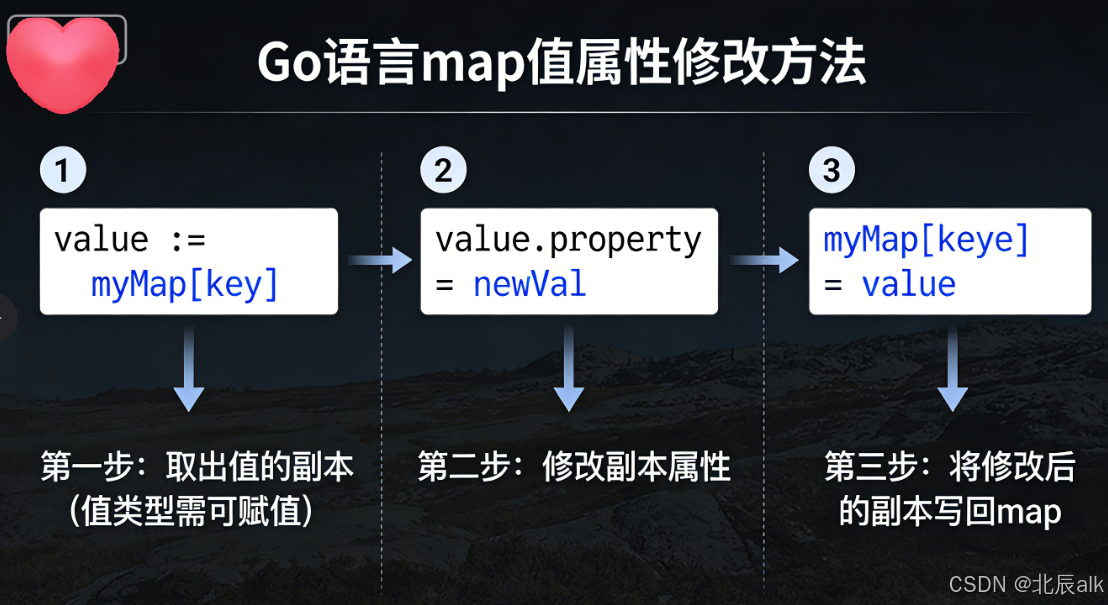
3.1 方案一:完整替换(最简单)
go
package main

import "fmt"

type User struct {
    Name string
    Age  int
    Tags []string
}

func main() {
    users := map[int]User{
        1: {Name: "张三", Age: 30, Tags: []string{"会员"}},
        2: {Name: "李四", Age: 25, Tags: []string{"管理员"}},
    }

    // 读取原值
    user := users[1]

    // 修改值
    user.Age = 31
    user.Tags = append(user.Tags, "VIP")

    // 重新赋值
    users[1] = user

    fmt.Printf("%+v\n", users[1])
    // 输出: {Name:张三 Age:31 Tags:[会员 VIP]}
}流程图:
开始
  │
  ▼
获取map中的值 ───→ user := users[1]
  │
  ▼
修改副本的值 ────→ user.Age = 31
  │
  ▼
将副本重新放回map ─→ users[1] = user
  │
  ▼
结束
3.2 方案二:使用指针类型(推荐)
go
package main

import "fmt"

type User struct {
    Name string
    Age  int
    Tags []string
}

func main() {
    // 使用*User作为值的类型
    users := map[int]*User{
        1: {Name: "张三", Age: 30, Tags: []string{"会员"}},
        2: {Name: "李四", Age: 25, Tags: []string{"管理员"}},
    }

    // 直接通过指针修改
    users[1].Age = 31
    users[1].Tags = append(users[1].Tags, "VIP", "年费会员")

    // 甚至可以修改其他字段
    users[1].Name = "张三三"

    fmt.Printf("%+v\n", users[1])
    // 输出: &{Name:张三三 Age:31 Tags:[会员 VIP 年费会员]}

    // 验证原map中的值也被修改了
    fmt.Printf("%+v\n", users)
    // 所有修改都直接反映在map中
}内存布局示意图:
使用值类型 User:
┌─────────────────┐
│      map        │
├─────────────────┤
│ key: 1 │ User   │ ← 直接存储User值
├─────────────────┤
│ key: 2 │ User   │
└─────────────────┘

使用指针类型 *User:
┌─────────────────┐    ┌─────────────┐
│      map        │    │   User对象  │
├─────────────────┤    ├─────────────┤
│ key: 1 │   *────┼───→│ Name: "张三"│
├─────────────────┤    │ Age: 30     │
│ key: 2 │   *────┼─┐  │ Tags: [...] │
└─────────────────┘ │  └─────────────┘
                    │  ┌─────────────┐
                    └─→│ Name: "李四"│
                       │ Age: 25     │
                       │ Tags: [...] │
                       └─────────────┘
3.3 方案三:使用结构体包装
go
package main

import "fmt"

type User struct {
    Name string
    Age  int
    Tags []string
}

// 包装结构体
type UserWrapper struct {
    User // 嵌入User
    dirty bool // 可以添加额外字段
}

func main() {
    users := map[int]UserWrapper{
        1: {User: User{Name: "张三", Age: 30, Tags: []string{"会员"}}},
        2: {User: User{Name: "李四", Age: 25, Tags: []string{"管理员"}}},
    }

    // 读取包装器
    wrapper := users[1]

    // 修改User的值
    wrapper.User.Age = 31
    wrapper.User.Tags = append(wrapper.User.Tags, "VIP")
    wrapper.dirty = true

    // 重新赋值
    users[1] = wrapper

    fmt.Printf("%+v\n", users[1])
    // 输出: {User:{Name:张三 Age:31 Tags:[会员 VIP]} dirty:true}
}
3.4 方案四:使用辅助函数
go
package main

import "fmt"

type User struct {
    Name string
    Age  int
    Tags []string
}

// 更新用户的通用函数
func UpdateUser(users map[int]User, id int, fn func(*User)) {
    if user, exists := users[id]; exists {
        fn(&user)  // 注意:这里传递的是副本的指针
        users[id] = user
    }
}

// 更高效的版本:直接接收新值
func SetUserAge(users map[int]User, id int, age int) error {
    if _, exists := users[id]; !exists {
        return fmt.Errorf("user %d not found", id)
    }
    user := users[id]
    user.Age = age
    users[id] = user
    return nil
}

// 原子操作版本(带锁)
type SafeUserMap struct {
    mu    sync.RWMutex
    users map[int]User
}

func (s *SafeUserMap) UpdateAge(id int, age int) error {
    s.mu.Lock()
    defer s.mu.Unlock()

    if user, exists := s.users[id]; exists {
        user.Age = age
        s.users[id] = user
        return nil
    }
    return fmt.Errorf("user not found")
}

func main() {
    users := map[int]User{
        1: {Name: "张三", Age: 30},
        2: {Name: "李四", Age: 25},
    }

    // 使用函数修改
    UpdateUser(users, 1, func(u *User) {
        u.Age = 35
        u.Tags = append(u.Tags, "管理员")
    })

    SetUserAge(users, 2, 28)

    fmt.Printf("%+v\n", users)
}
3.5 方案五:使用自定义类型和方法
go
package main

import (
    "fmt"
    "sync"
)

// 自定义map类型
type UserMap struct {
    mu    sync.RWMutex
    data  map[int]User
}

func NewUserMap() *UserMap {
    return &UserMap{
        data: make(map[int]User),
    }
}

// 原子更新年龄
func (um *UserMap) UpdateAge(id int, age int) error {
    um.mu.Lock()
    defer um.mu.Unlock()

    if user, exists := um.data[id]; exists {
        user.Age = age
        um.data[id] = user
        return nil
    }
    return fmt.Errorf("user %d not found", id)
}

// 原子更新标签
func (um *UserMap) AddTag(id int, tag string) error {
    um.mu.Lock()
    defer um.mu.Unlock()

    if user, exists := um.data[id]; exists {
        // 需要重新创建切片以避免并发问题
        newTags := make([]string, len(user.Tags)+1)
        copy(newTags, user.Tags)
        newTags[len(user.Tags)] = tag
        user.Tags = newTags
        um.data[id] = user
        return nil
    }
    return fmt.Errorf("user %d not found", id)
}

// 批量更新
func (um *UserMap) BatchUpdate(updates map[int]User) {
    um.mu.Lock()
    defer um.mu.Unlock()

    for id, newUser := range updates {
        um.data[id] = newUser
    }
}

// 安全读取
func (um *UserMap) Get(id int) (User, bool) {
    um.mu.RLock()
    defer um.mu.RUnlock()

    user, exists := um.data[id]
    return user, exists
}

func main() {
    um := NewUserMap()
    um.data[1] = User{Name: "张三", Age: 30, Tags: []string{"会员"}}

    um.UpdateAge(1, 31)
    um.AddTag(1, "VIP")

    if user, ok := um.Get(1); ok {
        fmt.Printf("%+v\n", user)
        // 输出: {Name:张三 Age:31 Tags:[会员 VIP]}
    }
}
四、性能对比分析
4.1 基准测试
go
package main

import (
    "testing"
)

// 测试数据
type Item struct {
    ID    int
    Value string
    Data  [64]byte // 模拟大结构体
}

func BenchmarkValueType(b *testing.B) {
    m := make(map[int]Item)
    m[1] = Item{ID: 1, Value: "test"}

    b.ResetTimer()
    for i := 0; i < b.N; i++ {
        // 值类型:需要复制整个结构体
        item := m[1]
        item.Value = "modified"
        m[1] = item
    }
}

func BenchmarkPointerType(b *testing.B) {
    m := make(map[int]*Item)
    m[1] = &Item{ID: 1, Value: "test"}

    b.ResetTimer()
    for i := 0; i < b.N; i++ {
        // 指针类型:直接修改
        m[1].Value = "modified"
    }
}

func BenchmarkWrapperType(b *testing.B) {
    m := make(map[int]*Item)
    m[1] = &Item{ID: 1, Value: "test"}

    b.ResetTimer()
    for i := 0; i < b.N; i++ {
        // 通过包装器修改
        item := m[1]
        item.Value = "modified"
        // 注意:不需要重新赋值,因为是指针
    }
}
4.2 性能测试结果
运行 go test -bench=. -benchmem 可能得到类似结果:
BenchmarkValueType-8       10000000    152 ns/op    144 B/op    2 allocs/op
BenchmarkPointerType-8     50000000     32 ns/op      0 B/op    0 allocs/op
BenchmarkWrapperType-8 50000000 31 ns/op 0 B/op 0 allocs/op性能对比图表:
性能对比(越低越好)
─────────────────────────────────────
值类型    ─────────────────── 152 ns
指针类型  ───────── 32 ns
包装器    ───────── 31 ns

内存分配(越低越好)
─────────────────────────────────────
值类型    ──── 144 B
指针类型  0 B
包装器    0 B
4.3 选择建议
| 方案 | 适用场景 | 优点 | 缺点 |
|---|---|---|---|
| 完整替换 | 小型结构体,修改频率低 | 简单直观 | 有性能开销 |
| 指针类型 | 大型结构体,频繁修改 | 性能最好 | GC压力稍大 |
| 结构体包装 | 需要额外状态 | 扩展性好 | 略微复杂 |
| 辅助函数 | 需要统一控制 | 代码复用 | 额外函数调用 |
| 自定义类型 | 复杂业务逻辑 | 封装性好 | 代码量较大 |
五、深入理解:不可寻址的其他情况
5.1 Go中不可寻址的值
go
package main

func main() {
    // 1. 常量的值
    const x = 10
    // ptr := &x  // 编译错误

    // 2. 字符串中的字节
    s := "hello"
    // ptr := &s[0]  // 编译错误

    // 3. 映射的元素(我们已经知道)
    m := map[string]int{"a": 1}
    // ptr := &m["a"]  // 编译错误

    // 4. 函数调用的返回值
    // ptr := &someFunction()  // 编译错误

    // 5. 算术运算的结果
    // ptr := &(1 + 2)  // 编译错误

    // 6. 字面量
    // ptr := &42  // 编译错误
    // ptr := &User{}  // 但是可以!因为这是组合字面量
}
5.2 为什么这些值不可寻址?
go
// 不可寻址的根本原因分类:

// 1. 临时值
func getInt() int { return 42 }
// &getInt()  // 结果是一个临时值,没有持久的内存位置

// 2. 不可变值
const c = 42
// &c  // 常量在编译期就被替换,没有运行时地址

// 3. 受实现限制的值
s := "hello"
// &s[0]  // 字符串在内存中可能不是连续的,或者被优化掉

// 4. 可能移动的值
m := map[int]int{1: 100}
// &m[1]  // map会扩容,值可能被移动
六、实战案例
6.1 用户管理系统
go
package main

import (
    "fmt"
    "sync"
    "time"
)

type User struct {
    ID        int
    Name      string
    Email     string
    CreatedAt time.Time
    LastLogin time.Time
    Status    string
    Metadata  map[string]interface{}
}

// 使用指针的map
type UserManager struct {
    mu    sync.RWMutex
    users map[int]*User
}

func NewUserManager() *UserManager {
    return &UserManager{
        users: make(map[int]*User),
    }
}

// 创建用户
func (um *UserManager) CreateUser(name, email string) *User {
    um.mu.Lock()
    defer um.mu.Unlock()

    id := len(um.users) + 1
    user := &User{
        ID:        id,
        Name:      name,
        Email:     email,
        CreatedAt: time.Now(),
        Status:    "active",
        Metadata:  make(map[string]interface{}),
    }
    um.users[id] = user
    return user
}

// 更新最后登录时间
func (um *UserManager) UpdateLastLogin(id int) error {
    um.mu.Lock()
    defer um.mu.Unlock()

    if user, exists := um.users[id]; exists {
        user.LastLogin = time.Now()
        return nil
    }
    return fmt.Errorf("user %d not found", id)
}

// 批量更新用户状态
func (um *UserManager) BatchUpdateStatus(status string, ids ...int) {
    um.mu.Lock()
    defer um.mu.Unlock()

    for _, id := range ids {
        if user, exists := um.users[id]; exists {
            user.Status = status
        }
    }
}

// 获取用户副本(防止外部修改)
func (um *UserManager) GetUser(id int) (User, error) {
    um.mu.RLock()
    defer um.mu.RUnlock()

    if user, exists := um.users[id]; exists {
        // 返回副本而不是指针
        return *user, nil
    }
    return User{}, fmt.Errorf("user not found")
}

// 原子更新多个字段
func (um *UserManager) UpdateUser(id int, updater func(*User)) error {
    um.mu.Lock()
    defer um.mu.Unlock()

    if user, exists := um.users[id]; exists {
        updater(user)
        return nil
    }
    return fmt.Errorf("user not found")
}

func main() {
    um := NewUserManager()

    // 创建用户
    user := um.CreateUser("张三", "zhangsan@example.com")
    fmt.Printf("创建用户: %+v\n", user)

    // 更新登录时间
    um.UpdateLastLogin(1)

    // 原子更新
    um.UpdateUser(1, func(u *User) {
        u.Metadata["last_ip"] = "192.168.1.100"
        u.Metadata["login_count"] = 1
    })

    // 安全读取
    if userCopy, err := um.GetUser(1); err == nil {
        fmt.Printf("用户信息: %+v\n", userCopy)
    }
}
6.2 缓存系统
go
package main

import (
    "fmt"
    "sync"
    "time"
)

type CacheItem struct {
    Value      interface{}
    ExpireAt   time.Time
    AccessCount int
}

type Cache struct {
    mu    sync.RWMutex
    items map[string]*CacheItem
}

func NewCache() *Cache {
    c := &Cache{
        items: make(map[string]*CacheItem),
    }
    go c.cleanupLoop()
    return c
}

// 设置缓存
func (c *Cache) Set(key string, value interface{}, ttl time.Duration) {
    c.mu.Lock()
    defer c.mu.Unlock()

    c.items[key] = &CacheItem{
        Value:    value,
        ExpireAt: time.Now().Add(ttl),
    }
}

// 获取缓存(同时更新访问计数)
func (c *Cache) Get(key string) interface{} {
    c.mu.Lock()
    defer c.mu.Unlock()

    if item, exists := c.items[key]; exists {
        if time.Now().After(item.ExpireAt) {
            delete(c.items, key)
            return nil
        }
        item.AccessCount++
        return item.Value
    }
    return nil
}

// 批量更新过期时间
func (c *Cache) RefreshKeys(ttl time.Duration, keys ...string) {
    c.mu.Lock()
    defer c.mu.Unlock()

    now := time.Now()
    for _, key := range keys {
        if item, exists := c.items[key]; exists {
            item.ExpireAt = now.Add(ttl)
        }
    }
}

// 清理过期项
func (c *Cache) cleanupLoop() {
    ticker := time.NewTicker(time.Minute)
    for range ticker.C {
        c.mu.Lock()
        now := time.Now()
        for key, item := range c.items {
            if now.After(item.ExpireAt) {
                delete(c.items, key)
            }
        }
        c.mu.Unlock()
    }
}

func main() {
    cache := NewCache()

    // 设置缓存
    cache.Set("user:1", User{Name: "张三", Age: 30}, time.Hour)

    // 获取并自动更新访问计数
    fmt.Println(cache.Get("user:1"))

    // 刷新过期时间
    cache.RefreshKeys(time.Hour*2, "user:1")
}
七、最佳实践总结
7.1 选择指南
go
// 场景1:小结构体,偶尔修改
type SmallConfig struct {
    Host string
    Port int
}
configs := map[string]SmallConfig{
    "prod": {Host: "example.com", Port: 80},
}
// 使用完整替换方案
cfg := configs["prod"]
cfg.Port = 443
configs["prod"] = cfg

// 场景2:大结构体,频繁修改
type LargeData struct {
    ID      int
    Values  [1000]float64
    Metrics map[string]float64
}
data := map[int]*LargeData{
    1: {ID: 1, Values: [1000]float64{}},
}
// 直接通过指针修改
data[1].Metrics["cpu"] = 0.8

// 场景3:需要并发安全
type SafeMap struct {
    mu    sync.RWMutex
    items map[int]Item
}
// 实现原子操作
7.2 性能优化建议
go
// 1. 预分配map大小
users := make(map[int]*User, 1000)  // 避免频繁扩容

// 2. 避免在热点代码中使用完整替换
// 不推荐
for i := 0; i < 10000; i++ {
    item := m[1]
    item.Value = i
    m[1] = item  // 每次都要复制
}

// 推荐:使用指针
for i := 0; i < 10000; i++ {
    m[1].Value = i  // 直接修改
}

// 3. 考虑使用sync.Map对于特殊的并发场景
var sm sync.Map
sm.Store("key", &User{Name: "张三"})

if value, ok := sm.Load("key"); ok {
    if user, ok := value.(*User); ok {
        user.Age = 31  // 直接修改
    }
}
7.3 内存管理注意事项
go
// 指针类型的GC压力
// 如果需要存储大量小对象,值类型可能更优

type SmallObject struct {
    A, B, C, D int  // 32字节
}

// 100万个对象
// 值类型:约32MB内存,GC压力小
m1 := make(map[int]SmallObject, 1_000_000)

// 指针类型:约32MB + 8MB指针,GC压力大
m2 := make(map[int]*SmallObject, 1_000_000)

// 权衡:如果对象小于128字节且不经常修改,值类型可能更合适
八、与其他语言的对比
8.1 Java对比
java
// Java中HashMap存储的是引用
HashMap<Integer, User> map = new HashMap<>();
map.put(1, new User("张三", 30));

// 可以直接修改
map.get(1).setAge(31);  // 没问题,因为存储的是引用
8.2 C++对比
cpp
// C++中map存储的是对象副本
std::map<int, User> map;
map[1] = User("张三", 30);

// 修改需要这样做
map[1].setAge(31);  // C++允许,因为operator[]返回引用

// 或者
auto& user = map[1];
user.setAge(31);
8.3 Python对比
python
# Python中字典存储的都是引用
d = {1: User("张三", 30)}
d[1].age = 31  # 直接修改
总结
Go语言中map值不可寻址是一个经过深思熟虑的设计决策,主要出于以下考虑:
- 内存安全:防止map扩容导致悬垂指针
- 实现简化:避免复杂的生命周期管理
- 语义清晰:明确值语义和引用语义的边界
针对这一特性,我们提供了多种解决方案:
- 完整替换:简单直观,适合小对象
- 指针类型:性能最优,推荐使用
- 辅助函数:统一控制,便于维护
- 自定义类型:封装完善,适合复杂场景
在实际开发中,建议根据具体场景选择合适的方案。对于大多数情况,使用指针类型是最佳选择,既能获得良好的性能,又能保持代码的简洁性。
理解map值不可寻址的原因和解决方案,不仅能帮助我们避免常见的错误,还能让我们写出更高效、更安全的Go代码。