系列文章目录
- 【3D AICG 系列-1】Trellis v1 和 Trellis v2 的区别和改进
- 【3D AICG 系列-2】Trellis 2 的O-voxel (上) Shape: Flexible Dual Grid
- 【3D AICG 系列-3】Trellis 2 的O-voxel (下) Material: Volumetric Surface Attributes
- 【3D AICG 系列-4】Trellis 2 的Shape SLAT Flow Matching DiT 训练流程
- 【3D AICG 系列-5】Trellis 2 的 Pipeline 推理流程的各个中间结果和形状
- 【3D AICG 系列-6】OmniPart 训练流程梳理
- 【3D AICG 系列-7】PartUV 代码流程深度解析
- 【3D AICG 系列-8】PartUV 流程图详解
- 【3D AICG 系列-9】Trellis2 推理流程图超详细介绍
- 【3D-AICG 系列-10】Trellis v2 只在 512/1024上训却能生成 1536
- 【3D-AICG 系列-11】Trellis 2 的 Shape VAE 训练流程梳理
- 【3D-AICG 系列-12】Trellis 2 的 Shape VAE 的设计细节 Sparse Residual Autoencoding Layer
文章目录
- 系列文章目录
-
-
- 一、符号与变量对应
- [二、第一阶段损失 L s 1 \mathcal{L}{s1} Ls1(公式 6)](#二、第一阶段损失 L s 1 \mathcal{L}{s1} Ls1(公式 6))
-
- [1. λ v ∥ v ^ − v ∥ 2 2 \lambda_v \|\hat{v}-v\|_2^2 λv∥v^−v∥22(对偶顶点 MSE)](#1. λ v ∥ v ^ − v ∥ 2 2 \lambda_v |\hat{v}-v|_2^2 λv∥v^−v∥22(对偶顶点 MSE))
- [2. λ δ BCE ( δ ^ , δ ) \lambda_\delta \text{BCE}(\hat{\delta},\delta) λδBCE(δ^,δ)(对偶面标志 BCE)](#2. λ δ BCE ( δ ^ , δ ) \lambda_\delta \text{BCE}(\hat{\delta},\delta) λδBCE(δ^,δ)(对偶面标志 BCE))
- [3. λ ρ BCE ( ρ ^ , ρ ) \lambda_\rho \text{BCE}(\hat{\rho},\rho) λρBCE(ρ^,ρ)(剪枝/细分掩码 BCE)](#3. λ ρ BCE ( ρ ^ , ρ ) \lambda_\rho \text{BCE}(\hat{\rho},\rho) λρBCE(ρ^,ρ)(剪枝/细分掩码 BCE))
- [4. λ mat ∥ f ^ mat − f mat ∥ 1 \lambda_{\text{mat}}\|\hat{f}^{\text{mat}}-f^{\text{mat}}\|1 λmat∥f^mat−fmat∥1(材质 L1)](#4. λ mat ∥ f ^ mat − f mat ∥ 1 \lambda{\text{mat}}|\hat{f}{\text{mat}}-f{\text{mat}}|_1 λmat∥f^mat−fmat∥1(材质 L1))
- [5. λ K L L K L \lambda_{KL}\mathcal{L}{KL} λKLLKL](#5. λ K L L K L \lambda{KL}\mathcal{L}_{KL} λKLLKL)
- [三、第二阶段损失 L s 2 = L s 1 + L render \mathcal{L}{s2} = \mathcal{L}{s1} + \mathcal{L}{\text{render}} Ls2=Ls1+Lrender(公式 7)](#三、第二阶段损失 L s 2 = L s 1 + L render \mathcal{L}{s2} = \mathcal{L}{s1} + \mathcal{L}{\text{render}} Ls2=Ls1+Lrender(公式 7))
- 四、相机策略(浅近裁剪平面)
- [五、解耦潜在空间:材质以 shape 的细分结构为条件](#五、解耦潜在空间:材质以 shape 的细分结构为条件)
- 六、汇总表
-
本文是论文 3.2.2 VAE Training 与代码的逐项对应说明。
一、符号与变量对应
| 论文符号 | 含义 | 代码变量 / 说明 |
|---|---|---|
| v v v | 对偶顶点位置 | vertices(dual grid 顶点偏移,3 维) |
| δ \delta δ | 对偶面/边标志 | intersected(体素 3 条边是否被面穿过,3 维 bool) |
| ρ \rho ρ | 剪枝/细分掩码 | subdivision :上采样时"是否在该 coarse 下生成 8 个子体素"的 mask,即 subs_gt / subs |
| f mat f^{\text{mat}} fmat | 材质属性 | PBR VAE 的 x.feats(base_color, metallic, roughness, alpha 等) |
| v ^ \hat{v} v^ | 预测值 | decoder 输出:pred_vertice, pred_intersected, subs, 以及 PBR 的 y.feats |
二、第一阶段损失 L s 1 \mathcal{L}_{s1} Ls1(公式 6)
论文:
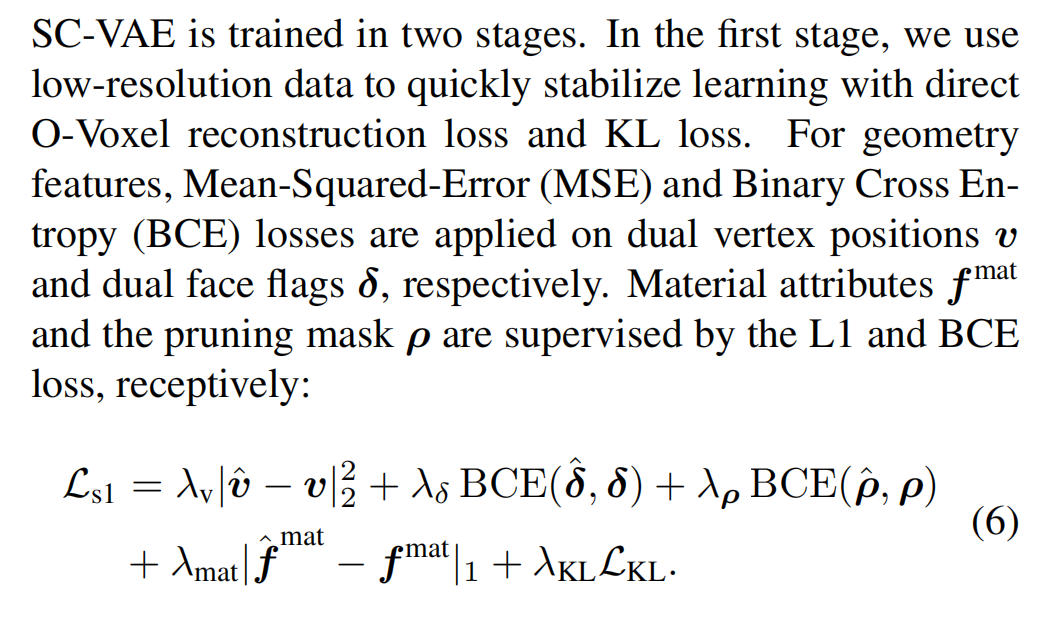
1. λ v ∥ v ^ − v ∥ 2 2 \lambda_v \|\hat{v}-v\|_2^2 λv∥v^−v∥22(对偶顶点 MSE)
代码: ShapeVaeTrainer,lambda_vertice(默认 0.01)
189:190:repo/TRELLIS.2/trellis2/trainers/vae/shape_vae.py
        if self.lambda_vertice > 0:
            terms["direct/vertice"] = F.mse_loss(pred_vertice.feats, vertices.feats)
terms["loss"] = terms["loss"] + self.lambda_vertice * terms["direct/vertice"]- 论文 v v v ↔
vertices.feats, v ^ \hat{v} v^ ↔pred_vertice.feats - 实现就是 MSE,等价于 ∥ v ^ − v ∥ 2 2 \|\hat{v}-v\|_2^2 ∥v^−v∥22 的 mean
2. λ δ BCE ( δ ^ , δ ) \lambda_\delta \text{BCE}(\hat{\delta},\delta) λδBCE(δ^,δ)(对偶面标志 BCE)
代码: lambda_intersected(默认 0.1)
186:188:repo/TRELLIS.2/trellis2/trainers/vae/shape_vae.py
        if self.lambda_intersected > 0:
            terms["direct/intersected"] = F.binary_cross_entropy_with_logits(pred_intersected.feats.flatten(), intersected.feats.flatten().float())
terms["loss"] = terms["loss"] + self.lambda_intersected * terms["direct/intersected"]- 论文 δ \delta δ ↔
intersected, δ ^ \hat{\delta} δ^ ↔pred_intersected(logits) - 用
binary_cross_entropy_with_logits即 BCE
3. λ ρ BCE ( ρ ^ , ρ ) \lambda_\rho \text{BCE}(\hat{\rho},\rho) λρBCE(ρ^,ρ)(剪枝/细分掩码 BCE)
代码: subdivision 预测的 BCE,lambda_subdiv(默认 0.1)
193:195:repo/TRELLIS.2/trellis2/trainers/vae/shape_vae.py
        for i, (sub_gt, sub) in enumerate(zip(subs_gt, subs)):
            terms[f"bce_sub{i}"] = F.binary_cross_entropy_with_logits(sub.feats, sub_gt.float())
terms["loss"] = terms["loss"] + self.lambda_subdiv * terms[f"bce_sub{i}"]- 论文 ρ \rho ρ ↔ 每层上采样的 GT subdivision
subs_gt(来自 encoder 下采样时的 spatial cache) - ρ ^ \hat{\rho} ρ^ ↔ decoder 每层预测的
subs - 多层累加,每层权重都是
lambda_subdiv
4. λ mat ∥ f ^ mat − f mat ∥ 1 \lambda_{\text{mat}}\|\hat{f}^{\text{mat}}-f^{\text{mat}}\|_1 λmat∥f^mat−fmat∥1(材质 L1)
代码: 在 PBR VAE 里,对应 direct regression 的 L1
175:181:repo/TRELLIS.2/trellis2/trainers/vae/pbr_vae.py
        if self.loss_type == 'l1':
            terms["l1"] = l1_loss(x.feats, y.feats)
            terms["loss"] = terms["loss"] + terms["l1"]
        elif self.loss_type == 'l2':
            terms["l2"] = l2_loss(x.feats, y.feats)
terms["loss"] = terms["loss"] + terms["l2"]- f mat f^{\text{mat}} fmat ↔
x.feats, f ^ mat \hat{f}^{\text{mat}} f^mat ↔y.feats - 论文写的是 L1,配置里用
loss_type='l1'时就是 ∥ f ^ mat − f mat ∥ 1 \|\hat{f}^{\text{mat}}-f^{\text{mat}}\|_1 ∥f^mat−fmat∥1
5. λ K L L K L \lambda_{KL}\mathcal{L}_{KL} λKLLKL
代码: 两个 VAE 都用同一形式的 KL
Shape VAE:
211:213:repo/TRELLIS.2/trellis2/trainers/vae/shape_vae.py
        terms["kl"] = 0.5 * torch.mean(mean.pow(2) + logvar.exp() - logvar - 1)
        terms["loss"] = terms["loss"] + self.lambda_kl * terms["kl"]
PBR VAE:
217:219:repo/TRELLIS.2/trellis2/trainers/vae/pbr_vae.py
        terms["kl"] = 0.5 * torch.mean(mean.pow(2) + logvar.exp() - logvar - 1)
terms["loss"] = terms["loss"] + self.lambda_kl * terms["kl"]- 即标准高斯先验的 KL: 1 2 ( μ 2 + e log σ 2 − log σ 2 − 1 ) \frac{1}{2}(\mu^2 + e^{\log\sigma^2} - \log\sigma^2 - 1) 21(μ2+elogσ2−logσ2−1)
- Shape 配置里
lambda_kl=1e-6,很小,符合"第一阶段以重建为主"的写法
三、第二阶段损失 L s 2 = L s 1 + L render \mathcal{L}{s2} = \mathcal{L}{s1} + \mathcal{L}_{\text{render}} Ls2=Ls1+Lrender(公式 7)
论文:第二阶段在 L s 1 \mathcal{L}_{s1} Ls1 上再加基于渲染的感知损失。
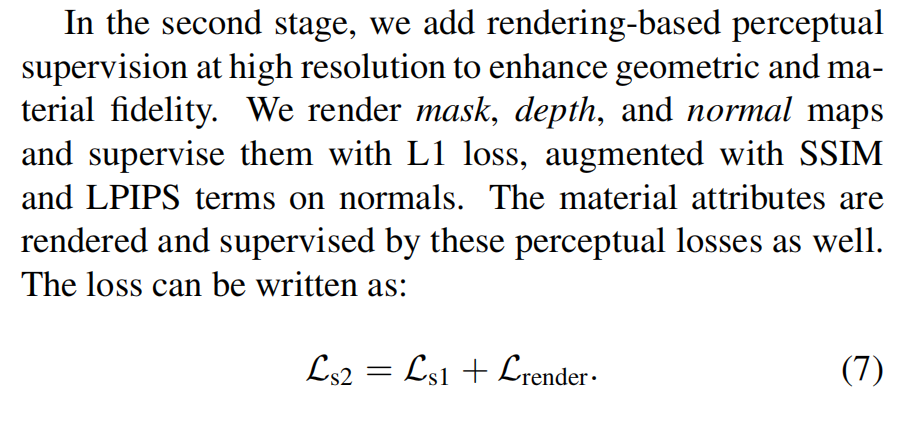
代码: 没有拆成两个训练阶段,而是在同一个 training_losses() 里同时算 direct + 渲染,对应"始终在用 L s 2 \mathcal{L}_{s2} Ls2":
197:209:repo/TRELLIS.2/trellis2/trainers/vae/shape_vae.py
        # rendering loss
        cameras = self._randomize_camera(len(mesh))
        gt_renders = self._render_batch(mesh, **cameras, return_types=['mask', 'normal', 'depth'])
        pred_renders = self._render_batch(recon, **cameras, return_types=['mask', 'normal', 'depth'])
        terms['render/mask'] = l1_loss(pred_renders['mask'], gt_renders['mask'])
        terms['render/depth'] = l1_loss(pred_renders['depth'], gt_renders['depth'])
        terms['render/normal/l1'] = l1_loss(pred_renders['normal'], gt_renders['normal'])
        terms['render/normal/ssim'] = 1 - ssim(pred_renders['normal'], gt_renders['normal'])
        terms['render/normal/lpips'] = lpips(pred_renders['normal'], gt_renders['normal'])
        terms['loss'] = terms["loss"] + \
                        self.lambda_mask * terms['render/mask'] + \
                        self.lambda_depth * terms['render/depth'] + \
                        self.lambda_normal * (terms['render/normal/l1'] + self.lambda_ssim * terms['render/normal/ssim'] + self.lambda_lpips * terms['render/normal/lpips'])
对应关系:
| 论文描述 | 代码 |
|---|---|
| 渲染 mask | return_types=['mask', ...],L1,权重 lambda_mask=1 |
| 渲染 depth | return_types=['depth', ...],L1,权重 lambda_depth=10 |
| 法线 L1 | terms['render/normal/l1'],权重 lambda_normal=1 |
| 法线 SSIM | terms['render/normal/ssim'],权重 lambda_normal * lambda_ssim(0.2) |
| 法线 LPIPS | terms['render/normal/lpips'],权重 lambda_normal * lambda_lpips(0.2) |
若要"只做第一阶段",可在配置里把 lambda_mask、lambda_depth、lambda_normal 设为 0,即退化为 L s 1 \mathcal{L}_{s1} Ls1。
材质 VAE 的"第二阶段"是渲染感知损失(base_color / MRA 的 SSIM+LPIPS):
208:214:repo/TRELLIS.2/trellis2/trainers/vae/pbr_vae.py
            terms['render/base_color/ssim'] = 1 - ssim(pred_base_color, gt_base_color)
            terms['render/base_color/lpips'] = lpips(pred_base_color, gt_base_color)
            terms['render/mra/ssim'] = 1 - ssim(pred_mra, gt_mra)
            terms['render/mra/lpips'] = lpips(pred_mra, gt_mra)
            terms['loss'] = terms["loss"] + \
                            self.lambda_render * (self.lambda_ssim * ... + self.lambda_lpips * ...)
对应论文里"材质也通过感知损失监督"。
四、相机策略(浅近裁剪平面)
论文:随机放置相机,并用浅的近裁剪平面"切开"物体表面,以建模内外结构。
代码: ShapeVaeTrainer._randomize_camera:
113:126:repo/TRELLIS.2/trellis2/trainers/vae/shape_vae.py
        r_min, r_max = self.camera_randomization_config['radius_range']
        k_min = 1 / r_max**2
        k_max = 1 / r_min**2
        ks = torch.rand(num_samples, device=self.device) * (k_max - k_min) + k_min
        radius = 1 / torch.sqrt(ks)
        fov = 2 * torch.arcsin(0.5 / radius)
        origin = radius.unsqueeze(-1) * F.normalize(torch.randn(num_samples, 3, device=self.device), dim=-1)
        extrinsics = utils3d.torch.extrinsics_look_at(origin, torch.zeros_like(origin), ...)
        intrinsics = utils3d.torch.intrinsics_from_fov_xy(fov, fov)
        near = [np.random.uniform(r - 1, r) for r in radius.tolist()]
        return { 'extrinsics': ..., 'intrinsics': ..., 'near': near }
radius_range: [2, 100]:相机到原点的距离在 2, 100 内随机(在 1/k 空间均匀)。- near 取在
[radius - 1, radius],即近平面紧贴相机、远平面far = near + 2,形成很薄的视锥,相当于用近平面"切"过物体,对应论文的 shallow near plane 和"切开表面、看到内外结构"。
五、解耦潜在空间:材质以 shape 的细分结构为条件
论文:两个解耦的 SC-VAE(shape + material),材质 VAE 上采样时以 shape VAE 的 subdivision structures 为条件。
代码: 推理时,纹理 decoder 显式接收 shape 的 subdivision 作为 guide_subs:
507:507:repo/TRELLIS.2/trellis2/pipelines/trellis2_image_to_3d_ours.py
ret = self.models['tex_slat_decoder'](slat, guide_subs=subs) * 0.5 + 0.5subs来自 shape 的 decoder 在上采样时返回的 subdivision 列表(每层"哪些 coarse 体素被细分为 8 个子体素")。- 纹理 decoder 若
pred_subdiv=False,则使用guide_subs决定在哪些位置做 channel→spatial 上采样,从而与 shape 的几何结构对齐。
Decoder 接口(支持 guide_subs):
478:479:repo/TRELLIS.2/trellis2/models/sc_vaes/sparse_unet_vae.py
    def forward(self, x: sp.SparseTensor, guide_subs: Optional[List[sp.SparseTensor]] = None, return_subs: bool = False) -> sp.SparseTensor:
assert guide_subs is None or self.pred_subdiv == False, "Only decoders with pred_subdiv=False can be used with guide_subs"因此:论文里的 "subdivision structures" = 代码里的 subs / `guide_subs;材质/纹理 decoder 在推理(和可选的训练)时按 shape 的细分结构做条件上采样。
六、汇总表
| 论文公式/概念 | 代码位置 | 配置/权重 |
|---|---|---|
| λ v ∣ v ^ − v ∣ 2 2 \lambda_v |\hat{v}-v|_2^2 λv∣v^−v∣22 | shape_vae.py L189-190 |
lambda_vertice=0.01 |
| λ δ BCE ( δ ^ , δ ) \lambda_\delta \text{BCE}(\hat{\delta},\delta) λδBCE(δ^,δ) | shape_vae.py 第186-188行 |
lambda_intersected=0.1 |
| λ ρ BCE ( ρ ^ , ρ ) \lambda_\rho \text{BCE}(\hat{\rho},\rho) λρBCE(ρ^,ρ) | shape_vae.py 第193-195行 |
lambda_subdiv=0.1 |
| λ mat ∣ f ^ mat − f mat ∣ 1 \lambda_{\text{mat}}|\hat{f}^{\text{mat}}-f^{\text{mat}}|_1 λmat∣f^mat−fmat∣1 | pbr_vae.py 第175-177行 |
loss_type='l1' |
| λ K L L K L \lambda_{KL}\mathcal{L}_{KL} λKLLKL | shape_vae.py 第211-213行;pbr_vae.py 第217-219行 |
lambda_kl=1e-6 |
| L render \mathcal{L}_{\text{render}} Lrender(mask/depth 损失) | shape_vae.py 第200-206行 |
lambda_mask=1、lambda_depth=10 |
| 法线 L1 + SSIM + LPIPS | shape_vae.py L202-208 |
lambda_normal=1, lambda_ssim/lpips=0.2 |
| 材质渲染感知损失 | pbr_vae.py L208-214 |
lambda_render, lambda_ssim, lambda_lpips |
| 随机相机 + 浅 near | shape_vae.py L113-126,camera_randomization_config |
radius_range=[2,100], near ∈ [r-1,r] |
| 材质以 subdivision 为条件 | tex_slat_decoder(..., guide_subs=subs),decoder forward(..., guide_subs=...) |
pipeline / sparse_unet_vae |
这样就把论文 3.2.2 的公式、两阶段、相机和"材质条件于 shape 细分结构"都和代码对上去了。