异或问题(XOR Question):从单层感知机到多层感知机
XOR问题是计算机科学和人工智能领域的经典问题,主要用于研究逻辑运算和神经网络的能力,其目标是让神经网络学会异或运算:
- 真值表
| 输入1 | 输入2 | 输出 |
|---|---|---|
| 0 | 0 | 0 |
| 1 | 0 | 1 |
| 0 | 1 | 1 |
| 1 | 1 | 0 |
认识XOR问题
XOR问题是线性不可分的,单层感知机学不会,必须有多层、非线性激活。下面我们来逐一学习其中的基本概念。
线性可分性
一、基础概念:线性决策边界
在深度学习中,分类问题的核心是找到一个决策边界(
Decision Boundary),将不同类别的样本分开。
- 线性决策边界:指可以用一条直线(二维平面)或一个平面(三维空间)来完美分隔不同类别的样本。
- 非线性决策边界:需要更复杂的曲线或曲面才能分隔样本。
二、线性可分问题(Linearly Separable)
1. 定义
如果存在一条直线(或超平面),使得所有正类样本 和负类样本 分别位于该直线的两侧,则称该问题是线性可分的。
2. 数学表示
假设样本特征为 x=x1,x2T,标签 y∈{+1,−1}。线性决策边界可表示为: wTx+b=0
其中 w是权重向量, b是偏置项。
分类规则为:
y={+1,wTx+b>0−1,wTx+b<0
即线性函数结果为正则为 +1,否则为 −1。
3. 示例
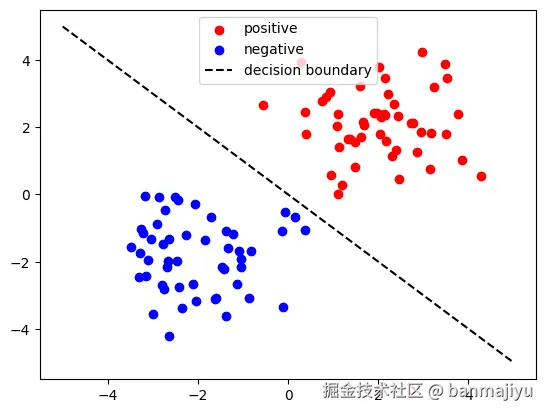
下图展示二维平面中的线性可分问题:
红色点(正类)和蓝色点(负类)可被一条直线完美分隔,是线性可分的。
python
import matplotlib.pyplot as plt
import numpy as np

# 生成线性可分数据
np.random.seed(0)
X_pos = np.random.randn(50, 2) + [2, 2]    # 正类样本
X_neg = np.random.randn(50, 2) + [-2, -2]  # 负类样本

# 绘制决策边界 w=[1,1], b=0
x_bound = np.linspace(-5, 5, 100)
y_bound = -x_bound  # w1*x1 + w2*x2 =0 → x2 = -x1

plt.scatter(X_pos[:,0], X_pos[:,1], c='red', label='positive')
plt.scatter(X_neg[:,0], X_neg[:,1], c='blue', label='negative')
plt.plot(x_bound, y_bound, 'k--', label='decision boundary')
plt.legend()
plt.show()
运行结果:
三、线性不可分问题(Linearly Inseparable)
1. 定义
如果不存在任何直线(或超平面)能完美分隔所有样本,则称该问题是线性不可分的。
2. 典型例子:异或问题(XOR)
异或问题的样本分布如下:
| 输入1 | 输入2 | 输出 |
|---|---|---|
| 0 | 0 | 0 |
| 1 | 0 | 1 |
| 0 | 1 | 1 |
| 1 | 1 | 0 |
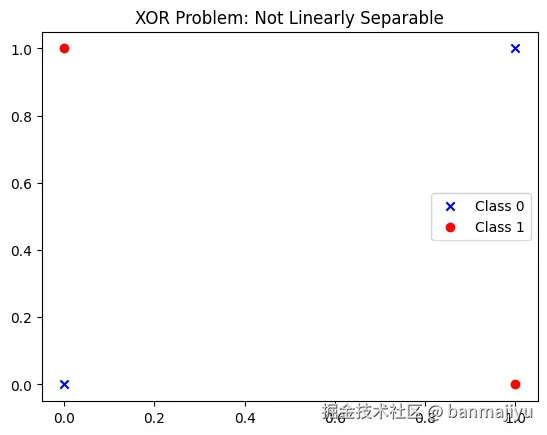
在二维平面上,样本点 (0,0)和 (1,1)属于一类, (0,1) 和 (1,0) 属于另一类。无法用一条直线分隔两类样本。
3. 可视化
python
# 异或问题数据
X_xor = np.array([[0, 0], [0, 1], [1, 0], [1, 1]])
y_xor = np.array([0, 1, 1, 0])

plt.scatter(X_xor[y_xor==0, 0], X_xor[y_xor==0, 1], c='blue', marker='x', label='Class 0')
plt.scatter(X_xor[y_xor==1, 0], X_xor[y_xor==1, 1], c='red', marker='o', label='Class 1')
plt.title('XOR Problem: Not Linearly Separable')
plt.legend()
plt.show()
运行结果:
单层感知机
接下来我们将动手解决上述问题,我们先从最简单的线性可分问题 开始。解决线性可分问题需要用到单层感知机,这也是深度学习中最基础的模型之一。
一、什么是单层感知机?
单层感知机是一种二分类线性模型,它的核心思想是模拟生物神经元的工作方式:
-
输入:接收多个信号(特征)
-
处理:对输入加权求和,再通过激活函数
-
输出:生成一个二值结果(如 0 / 1)
二、核心元件与数学原理
-
输入层(
Input Layer)-
作用:接收外部数据,例如 n个特征 x1,x2,...,xn
-
数学表示: x=x1,x2,...,xn
-
-
权重(
Weights)- 作用:每个输入对应一个权重 wi
- 数学表示: w=w1,w2,...,wn
-
偏置(
Bias)- 作用:调整模型的灵活性,类似截距项。
- 符号: b(可视为 w0 对应固定输入 x0=1)
-
加权求和(
Weighted Sum)- 计算:输入与权重的线性组合: z=i=1∑nwixi+b
- 向量形式: z=wTx+b (一个仿射变换)
-
激活函数(
Activation Function)-
作用:对信号作一次非线性变形。将连续值 z转换为二值输出(如 0 或 1 )。
-
常用函数:
-
阶跃函数(
Step Function): y={1,z>00,z⩽0 -
Sigmoid: f(z)=1+e−z1 -
ReLU: f(z)=max(0,z)
-
-
一个单层感知机就是一个神经元
三、决策边界
单层感知机的本质是找到一个线性决策边界:
-
功能:将输入空间划分为两个区域(如正类和负类)。
-
限制 :只能解决线性可分问题 (如
AND、OR逻辑),无法处理异或(XOR)。
四、训练:权重更新规则
通过迭代优化权重和偏置,使模型能够正确分类样本
步骤如下:
-
初始化:权重 w 和偏置 b设为小随机数或零。
-
遍历样本:对每个样本 (x(i),y(i)):
-
计算预测值: y^(i)=step(wTx(i)+b) (这里使用阶跃函数直接得到预测结果)
-
若预测错误( y^(i)=y(i)),更新参数: wnew:=wold+η⋅(y(i)−y^(i))⋅x(i) bnew:=bold+η⋅(y(i)−y^(i))
-
学习率: η(如 0.01),控制更新幅度。
-
更新参数的目的是使得损失最小。那么应该如何更新参数呢?
我们首先将结果标签转换为 y∈{−1,1}(这是感知机的常用表示),其中 −1对应原标签 0, +1对应原标签 1。
wTx+b=0相当于n维空间的一个超平面 , w为其法向量, b为其截距, x为空间中的点或向量。
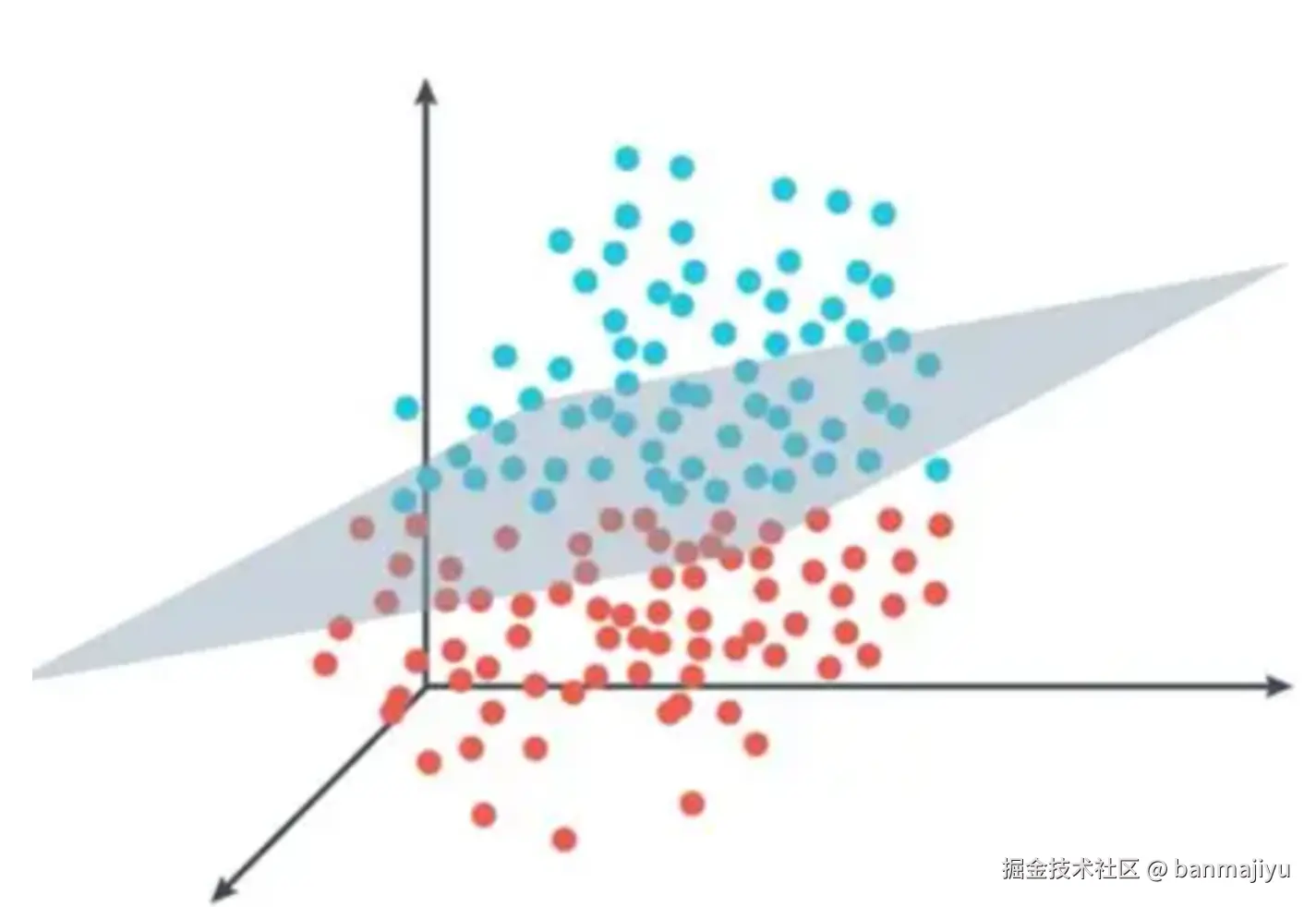
从几何角度来看,感知机就是 n维空间中的一个超平面,它把空间分为两部分。
我们将损失定义为误分类点到超平面的总距离。
点到平面的距离公式为:
d=∣∣w∣∣∣w⋅x+b∣
引入结果标签去掉绝对值,误分类点到超平面的距离为:
d=−yi∣∣w∣∣w⋅x+b
则误分类点到超平面的总距离为:
D=−∣∣w∣∣1i∑yi(w⋅xi+b)
忽略常数系数,定义感知机损失函数:
L(w,b)=max(0,−y(w⋅x+b))
- 如果分类正确,则 −y(w⋅x+b)<0,损失为 0
- 如果分类错误,则损失为正,且等于 −y(w⋅x+b)
这个损失函数是凸函数 ,可以用梯度下降 最小化。对参数求梯度(正确样本梯度为 0 不考虑):
L=−y(w⋅x+b)
求梯度:
∂w∂L=−yx ∂b∂L=−y
梯度下降更新:
w←w−η∂w∂L=w+η⋅(y(i)−y^(i))⋅x(i)
b←b−η∂b∂L=b+η⋅(y(i)−y^(i))
Rosenblatt证明了感知机收敛定理 :如果训练数据线性可分,那么以上更新规则在有限步内会找到一个能完全正确分类的解。
学习率 η 用于控制每次更新的"步长","步长"过大或过小都会降低训练效率。
五、代码实现
为了计算,我们首先导入numpy库:
python
import numpy as np接下来搭建单层感知机,我们将其封装到一个对象中:
python
class Perceptron:Perceptron是感知机 的意思。接着要对这个类进行初始化,对于一个感知机,要控制它的训练过程需要学习率 (learning_rate)和训练轮数 (epoch)这两个参数,由外界传入。其内部训练过程中还需要权重 (weight)和偏置 (bia)这两个内部参数,在训练过程中随时调整。
python
class Perceptron:
    def init(self, learning_rate=0.1, epochs=100):
        self.lr = learning_rate
        self.epochs = epochs
        self.weights = None
self.bias = None其中权重 和偏置 先置为空值 ,因为权重的尺寸由传入的训练集决定。学习率 默认为 0.1,训练轮数 默认为 100。接下来为感知机实现方法 ,主要有两个:训练和预测。训练函数是最主要的部分,需要传入训练集,并通过一个循环实现训练。以AND问题为例,其训练集为:
python
X = np.array([[0, 0], [0, 1], [1, 0], [1, 1]])
y = np.array([0, 0, 0, 1])X是输入数据 , y是对应的真实标签 。 X还是一个 4×2的NumPy数组矩阵,这里的 4代表有 4组训练数据, 2代表每组数据有 2个特征。训练集的尺寸信息可以用.shape方法获得:
python
def fit(self, X, y)
n_samples, n_features = X.shape接下来初始化权重 和偏置 。权重也是一个数组,需要与每一组训练数据X[i]点积,因此尺寸需要与X[i]相同,使用.zeros方法初始化为全 0。偏置是一个实数,初始化为 0:
python
def fit(self, X, y)
    n_samples, n_features = X.shape

    self.weights = np.zeros(n_features)
self.bias = 0下面进入正式的训练循环,但是差点忘了激活函数 还没有定义,这里使用最简单的阶跃激活函数:
python
def step_function(self, z):
return 1 if z >= 0 else 0训练过程是这样的:每次遍历样本时,先生成加权求和 的结果,然后经过激活函数得到预测值 。并根据更新规则更新参数,然后进入下一次循环。每遍历完所有样本计一个epoch,累积到指定epoch就完成训练:
python
def fit(self, X, y)
    n_samples, n_features = X.shape

    self.weights = np.zeros(n_features)
    self.bias = 0

    for epoch in range(self.epochs):    # epoch循环
        for i in range(n_samples):      # 遍历样本
            # 加权求和
            linear_output = np.dot(X[i], self.weights) + self.bias
            # 通过激活函数得到预测值
            y_predict = self.step_function(linear_output)
            # 若预测错误,则更新参数
            if y_predict != y[i]:
                # 先计算一个中间量,节省计算量
                update = self.lr * (y[i] - y_predict)
                # 更新权重和偏置
                self.weights += update * X[i]
                self.bias += update
这就是一个完整的训练函数。接下来实现预测函数,这里照抄训练函数的相同部分即可,唯一不同的是这里可以利用矩阵运算一次性得到所有结果并输出:
python
def predict(self, X)
    linear_output = np.dot(X, self.weights) + self.bias # 注意这里的线性输出是矩阵,刚才的是实数
return np.array([self.step_function(z) for z in linear_output]) # 调用激活函数并利用列表推导式生成及打包成数组下面是一个用Python实现的完整单层感知机:
python
import numpy as np

class Perceptron:
    def init(self, learning_rate=0.01, epochs=100):
        self.lr = learning_rate    # 学习率
        self.epochs = epochs       # 训练轮数
        self.weights = None        # 存储权重
        self.bias = None           # 存储偏置

    def step_function(self, z):
        """阶跃激活函数:z>=0时输出1,否则输出0"""
        return 1 if z >= 0 else 0

    def fit(self, X, y):
        """训练函数:X为特征矩阵,y为标签向量"""
        n_samples, n_features = X.shape

        # 初始化权重和偏置(全零或小随机数)
        self.weights = np.zeros(n_features)
        self.bias = 0

        # 开始迭代训练
        for epoch in range(self.epochs):
            for i in range(n_samples):
                # 计算加权求和:z = w·x + b
                linear_output = np.dot(X[i], self.weights) + self.bias

                # 通过激活函数得到预测值
                y_pred = self.step_function(linear_output)

                # 若预测错误,更新权重和偏置
                if y_pred != y[i]:
                    update = self.lr * (y[i] - y_pred)
                    self.weights += update * X[i]  # 更新权重:w_new = w_old + η·(y_true-y_pred)·x
                    self.bias += update            # 更新偏置:b_new = b_old + η·(y_true-y_pred)

    def predict(self, X):
        """预测函数:返回样本的预测类别"""
        linear_output = np.dot(X, self.weights) + self.bias
return np.array([self.step_function(z) for z in linear_output])假设我们训练一个感知机解决逻辑AND问题(输入全 1 时输出 1):
python
# 定义AND问题的数据:输入和标签
X = np.array([[0, 0], [0, 1], [1, 0], [1, 1]])
y = np.array([0, 0, 0, 1])

# 创建感知机并训练
perceptron = Perceptron(learning_rate=0.1, epochs=10)
perceptron.fit(X, y)

# 预测新样本
test_samples = np.array([[0, 0], [1, 1]])
print(perceptron.predict(testsamples))  # 输出:[0, 1]
输出结果:
python
[0 1]训练成功!
二分类概率输出
刚刚的代码训练了一个能解决逻辑
AND问题的单层感知机,但我们还想知道它对这个答案有多少把握。换言之,我们希望感知机输出的是概率而不是结果。为此,我们需要改造刚刚的代码。
一、修改激活函数
阶跃函数 y={1,z⩾00,z<0
只能给出 1 和 0 两个离散值,我们需要替换成能输出连续值的激活函数,例如Sigmoid:
yprob=1+e−z1
它是一个单调递增的函数,值域是 (0,1),输出连续的值,可解释为"是正类的概率"。
二、修改损失函数
现在感知机给出的答案没有绝对的对错之分了,所以参数更新规则也需要修改。现在我们需要一个能衡量"预测概率分布与真实标签 "差距的损失函数。
对于二分类,损失函数是二元交叉熵损失函数:
Loss(θ)=−n1i=1∑nyi⋅log(yi\^)+(1−yi)⋅log(1−yi\^)
这里 n指的是样本数量, log() 指的是自然对数函数。
二元交叉熵:
L=−y⋅log(yprob)+(1−y)⋅log(1−yprob)
直观理解:
- 如果真实标签 y=1,那么损失 L=−log(yprob)。 yprob越接近 1,损失越小。
- 如果真实标签 y=0,那么损失 L=−log(1−yprob)。 yprob越接近 1,损失越大。
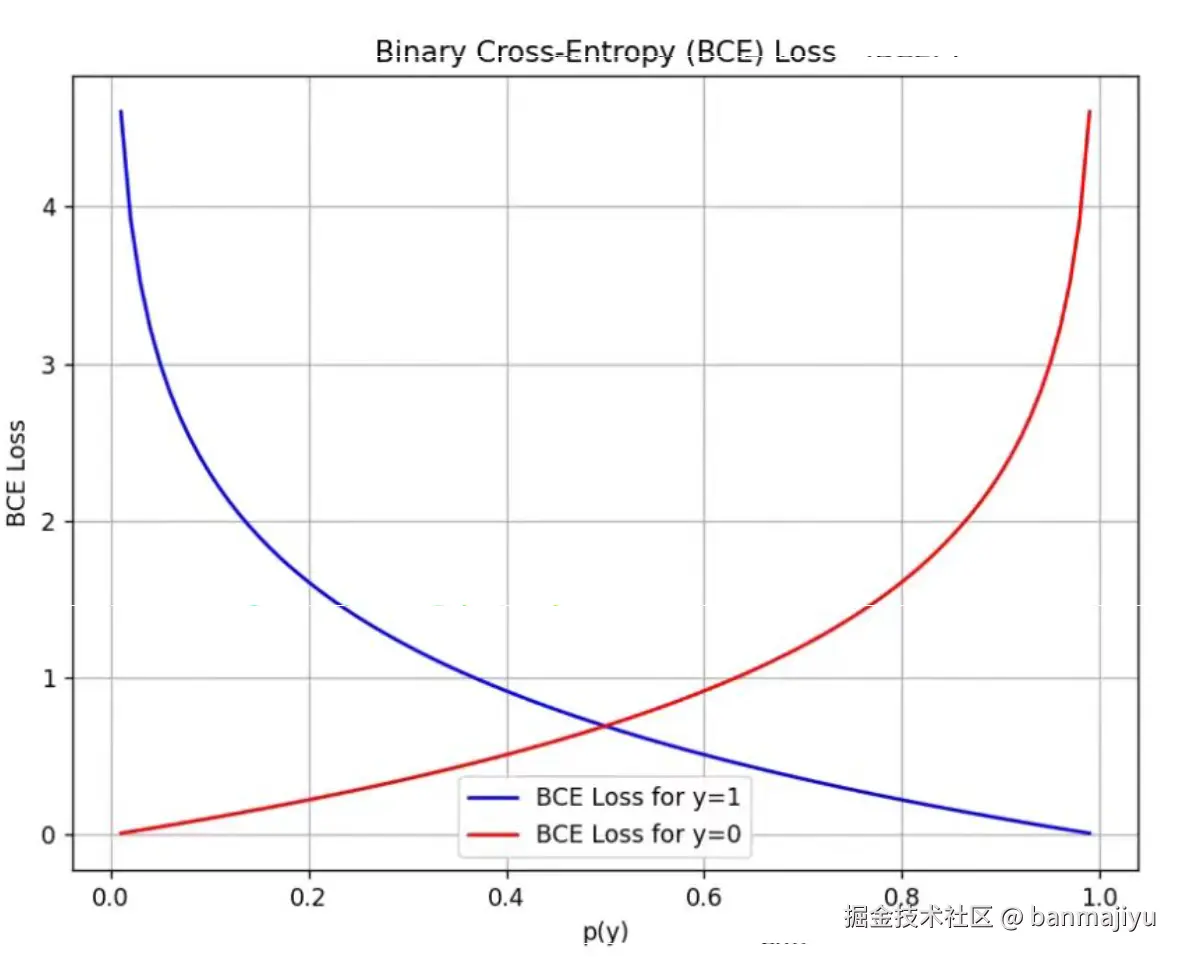
深度学习中的损失函数的统计学基础是极大似然估计 ,损失函数都是从最大似然估计开始推导的,不同数据分布会得出不同的损失函数。
二元交叉熵损失函数 ,本质上是二项分布下极大似然估计的负对数形式。它的目标是找到一组模型参数,使得我们观测到的样本数据同时出现的"可能性"最大。
给定观测数据 D={x1,x2,...,xn},我们要找到一个参数 θ,使得所有观测数据同时出现的联合概率 P(D∣θ) 最大,这个 θ 就是极大似然估计的估计值。PS:平常求概率的时候是不写参数的,因为参数(如硬币正面朝上的概率)是确定的,但这里参数是似然函数最终要求得的结果,所以这里就显式表明了参数的取值。
因为数据点通常独立同分布 ,联合概率等于每个数据点概率乘积:
L(θ)=P(D∣θ)=i=1∏nP(xi∣θ)
二分类问题中,样本的真实标签 y 的取值是 0 或 1,服从参数为 p 的二项分布:
P(Y=y∣p)=py⋅(1−p)1−y
也就是:
P(Y=1∣p)=p, P(Y=0∣p)=1−p
参数 p 是单层感知机的预测值 ,记作 y^。它是由输入 x 和参数 θ 计算出来的,表示模型预测该样本的真实标签为 1 的概率。
对于单个样本,其似然函数 表示样本数据在预测参数下发生的可能性,可以评判训练效果:
L(θ∣x,y)=P(Y=y^)=y^y⋅(1−y^)1−y
对于 n 个独立样本,联合似然是每个样本似然的乘积,整个数据集的似然函数:
L(θ)=i=1∏nyi^yi⋅(1−yi^)1−yi
乘积形式有诸多弊端,取对数,得到对数似然函数:
log(L(θ))=i=1∑nyi⋅log(yi\^)+(1−yi)⋅log(1−yi\^)
对数似然的相反数取平均值,得到二元交叉熵损失函数:
Loss(θ)=−n1log(L(θ))=−n1i=1∑nyi⋅log(yi\^)+(1−yi)⋅log(1−yi\^)
定义二元交叉熵为:
L=−y⋅log(yprob)+(1−y)⋅log(1−yprob)
似然函数表示观测数据在当前模型预测参数下发生的可能性。模型预测得越准,似然函数越大,损失越小。
三、修改训练方式(梯度下降)
我们需要对损失函数求梯度,然后更新 w和 b。
先求梯度:
dyprobdL=−(yproby−1−yprob1−y)
根据Sigmoid函数的定义:
dzdyprob=1−yprobyprob, dwdz=x, dbdz=1
根据链式法则:
dzdL=dyprobdL⋅dzdyprob=yprob−y
同理,
dwdL=(yprob−y)⋅x, dbdL=yprob−y
Sigmoid和二元交叉熵搭配,使得梯度恰好是(预测概率 - 真实标签)× 输入。
更新公式:
w−=learning_rate×(yprob−y)×x b−=learning_rate×(yprob−y)
这和感知机更新很像,但是感知机是在分错时才更新 ,而逻辑回归是每步都更新。
四、完整代码
python
import numpy as np

class LogisticRegression:
    def init(self, learning_rate=0.1, epochs=100):
        self.learning_rate = learning_rate  # 学习率
        self.epochs = epochs                # 迭代次数
        self.weights = None                 # 权重
        self.bias = None                    # 偏置

    def sigmoid(self, z):                   # Sigmoid函数
        return 1 / (1 + np.exp(-z))

    def fit(self, X, y):                    # 训练模型
        num_samples, num_features = X.shape # 样本数量和特征数量
        self.weights = np.zeros(num_features)   # 初始化权重
        self.bias = 0   # 初始化偏置

        for _ in range(self.epochs + 1):    # 迭代训练
            # 利用矩阵运算批量遍历样本
            linear_model = np.dot(X, self.weights) + self.bias  # 线性模型
            y_predicted = self.sigmoid(linear_model)    # 预测概率

            dw = (1 / num_samples) * np.dot(X.T, (y_predicted - y)) # 权重更新
            db = (1 / num_samples) * np.sum(y_predicted - y)    # 偏置更新

            self.weights -= self.learning_rate * dw # 更新权重
            self.bias -= self.learning_rate * db    # 更新偏置

            if _ % 100 == 0:  # 每100次迭代输出一次损失
                loss = -np.mean(y * np.log(y_predicted) + (1 - y) * np.log(1 - ypredicted))
                print(f'Epoch {}, Loss: {loss}, Weights: {self.weights}, Bias: {self.bias}, predicted: {y_predicted}')

    def predict(self, X):   # 预测新样本
        linear_model = np.dot(X, self.weights) + self.bias  # 线性模型
        y_predicted = self.sigmoid(linear_model)    # 预测概率
        y_predicted_cls = [i for i in y_predicted] # 分类结果
return np.array(y_predicted_cls) # 返回预测结果我们用它来训练一个OR问题:
python
# Example usage:
if name == "main":
    # dataset
    X = np.array([[0, 0],
                  [0, 1],
                  [1, 0],
                  [1, 1]])
    y = np.array([0, 1, 1, 1])  # labels

    model = LogisticRegression(epochs=1000, learning_rate=0.1)
    model.fit(X, y)
    predictions = model.predict(X)
    print("Predictions:", predictions)
输出结果:
python
Epoch 0, Loss: 0.6931471805599453, Weights: [0.025 0.025], Bias: 0.025, predicted: [0.5 0.5 0.5 0.5]
Epoch 100, Loss: 0.3422648179240876, Weights: [1.12179346 1.12179346], Bias: 0.3241873928250224, predicted: [0.58111698 0.80885348 0.80885348 0.92809543]
Epoch 200, Loss: 0.2668907776248633, Weights: [1.67965174 1.67965174], Bias: -0.028037186370862888, predicted: [0.49384689 0.83891033 0.83891033 0.96527318]
Epoch 300, Loss: 0.21739481429264515, Weights: [2.12500033 2.12500033], Bias: -0.336940396505239, predicted: [0.41722497 0.85652781 0.85652781 0.98030824]
Epoch 400, Loss: 0.18253957593342224, Weights: [2.50261016 2.50261016], Bias: -0.585446486877449, predicted: [0.35819515 0.8716802  0.8716802  0.98804998]
Epoch 500, Loss: 0.15679759961756431, Weights: [2.83028441 2.83028441], Bias: -0.7896551756986915, predicted: [0.31264419 0.88487511 0.88487511 0.99235967]
Epoch 600, Loss: 0.1370743652412334, Weights: [3.11907017 3.11907017], Bias: -0.962306596435656, predicted: [0.27673684 0.89619475 0.89619475 0.99489283]
Epoch 700, Loss: 0.1215219182866978, Weights: [3.37672399 3.37672399], Bias: -1.1117282082003561, predicted: [0.24780951 0.90584725 0.90584725 0.99645347]
Epoch 800, Loss: 0.1089723627417807, Weights: [3.60894888 3.60894888], Bias: -1.2433997965996983, predicted: [0.22406065 0.91408616 0.91408616 0.99745561]
Epoch 900, Loss: 0.09865242980397079, Weights: [3.82005709 3.82005709], Bias: -1.3610689169623034, predicted: [0.20424809 0.92115082 0.92115082 0.99812286]
Epoch 1000, Loss: 0.09003038954892699, Weights: [4.01338124 4.01338124], Bias: -1.4674033054431226, predicted: [0.18749206 0.92724619 0.92724619 0.9985814 ]
Predictions: [0.18733762 0.92730284 0.92730284 0.99858521]训练AND问题:
python
# Example usage:
if name == "main":
    # dataset
    X = np.array([[0, 0],
                  [0, 1],
                  [1, 0],
                  [1, 1]])
    y = np.array([0, 0, 0, 1])  # labels

    model = LogisticRegression(epochs=1000, learningrate=0.1)
    model.fit(X, y)
    predictions = model.predict(X)
    print("Predictions:", predictions)
输出结果:
python
Epoch 0, Loss: 0.6931471805599453, Weights: [0. 0.], Bias: -0.025, predicted: [0.5 0.5 0.5 0.5]
Epoch 100, Loss: 0.46240131259227135, Weights: [0.51290945 0.51290945], Bias: -1.2534222714262722, predicted: [0.22346095 0.32331948 0.32331948 0.44238052]
Epoch 200, Loss: 0.3632692335353307, Weights: [1.02689924 1.02689924], Bias: -1.926427902775465, predicted: [0.12780757 0.28944671 0.28944671 0.53104471]
Epoch 300, Loss: 0.3018586895621536, Weights: [1.42642895 1.42642895], Bias: -2.4656161027608676, predicted: [0.07866    0.26156517 0.26156517 0.59507742]
Epoch 400, Loss: 0.25956392625978153, Weights: [1.75358999 1.75358999], Bias: -2.9204394490304124, predicted: [0.05135764 0.23764547 0.23764547 0.64220664]
Epoch 500, Loss: 0.22828521633076554, Weights: [2.03250361 2.03250361], Bias: -3.3154992464345603, predicted: [0.03516893 0.2172292  0.2172292  0.67874626]
Epoch 600, Loss: 0.20400582757628868, Weights: [2.27681838 2.27681838], Bias: -3.6658032435287673, predicted: [0.02502622 0.19973196 0.19973196 0.7081768 ]
Epoch 700, Loss: 0.1845024840587356, Weights: [2.4949078 2.4949078], Bias: -3.981140706476398, predicted: [0.01837648 0.1846283  0.1846283  0.73253796]
Epoch 800, Loss: 0.1684341099874634, Weights: [2.69228575 2.69228575], Bias: -4.268256220819802, predicted: [0.01385021 0.1714896  0.1714896  0.75311478]
Epoch 900, Loss: 0.1549360688551386, Weights: [2.87279509 2.87279509], Bias: -4.532013815281678, predicted: [0.01067119 0.15997482 0.15997482 0.77076718]
Epoch 1000, Loss: 0.1434211628893327, Weights: [3.03923779 3.03923779], Bias: -4.776054827817194, predicted: [0.00837825 0.14981323 0.14981323 0.78609892]
Predictions: [0.00835873 0.14971768 0.14971768 0.78624211]
五、调整
训练轮数
以
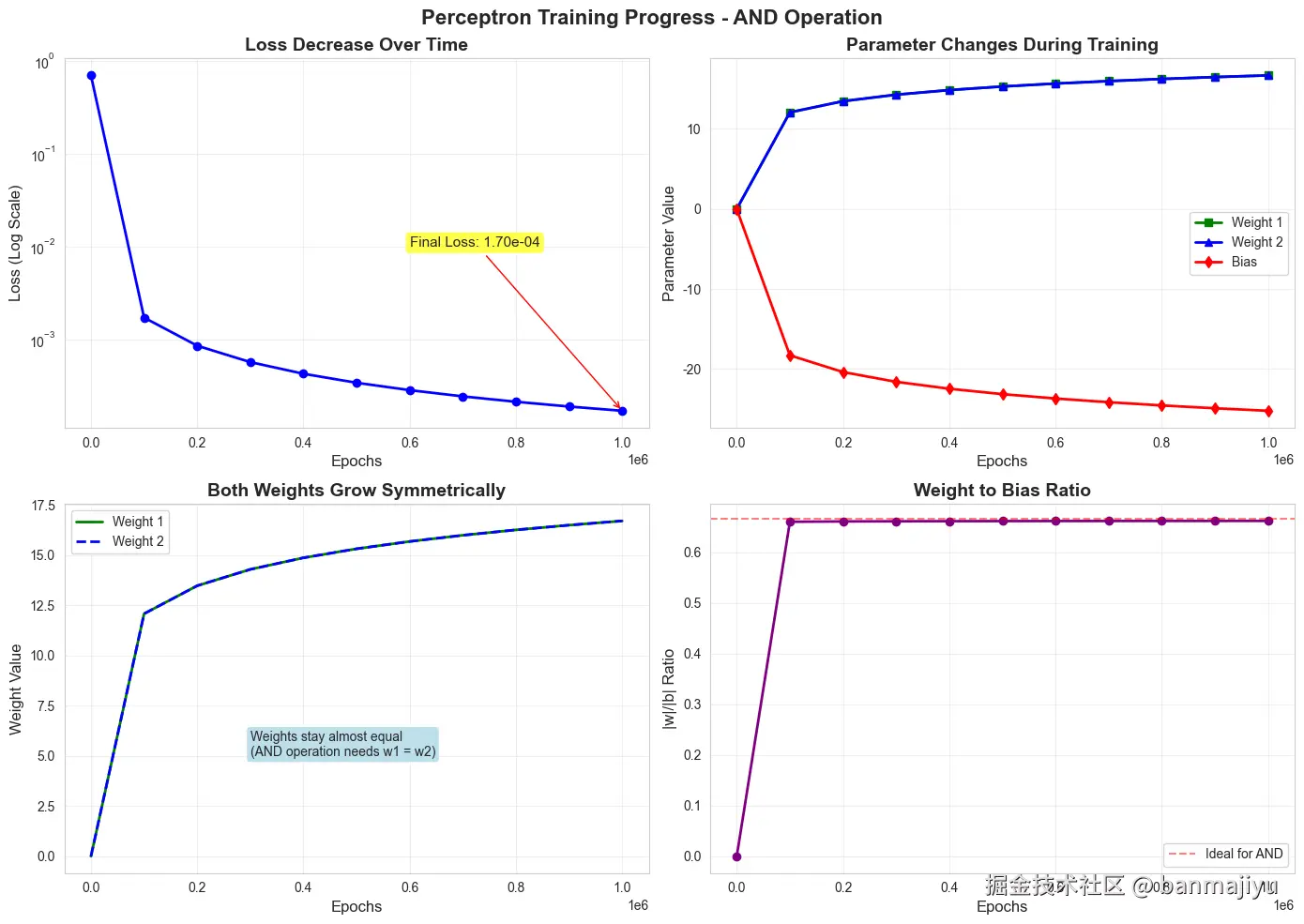
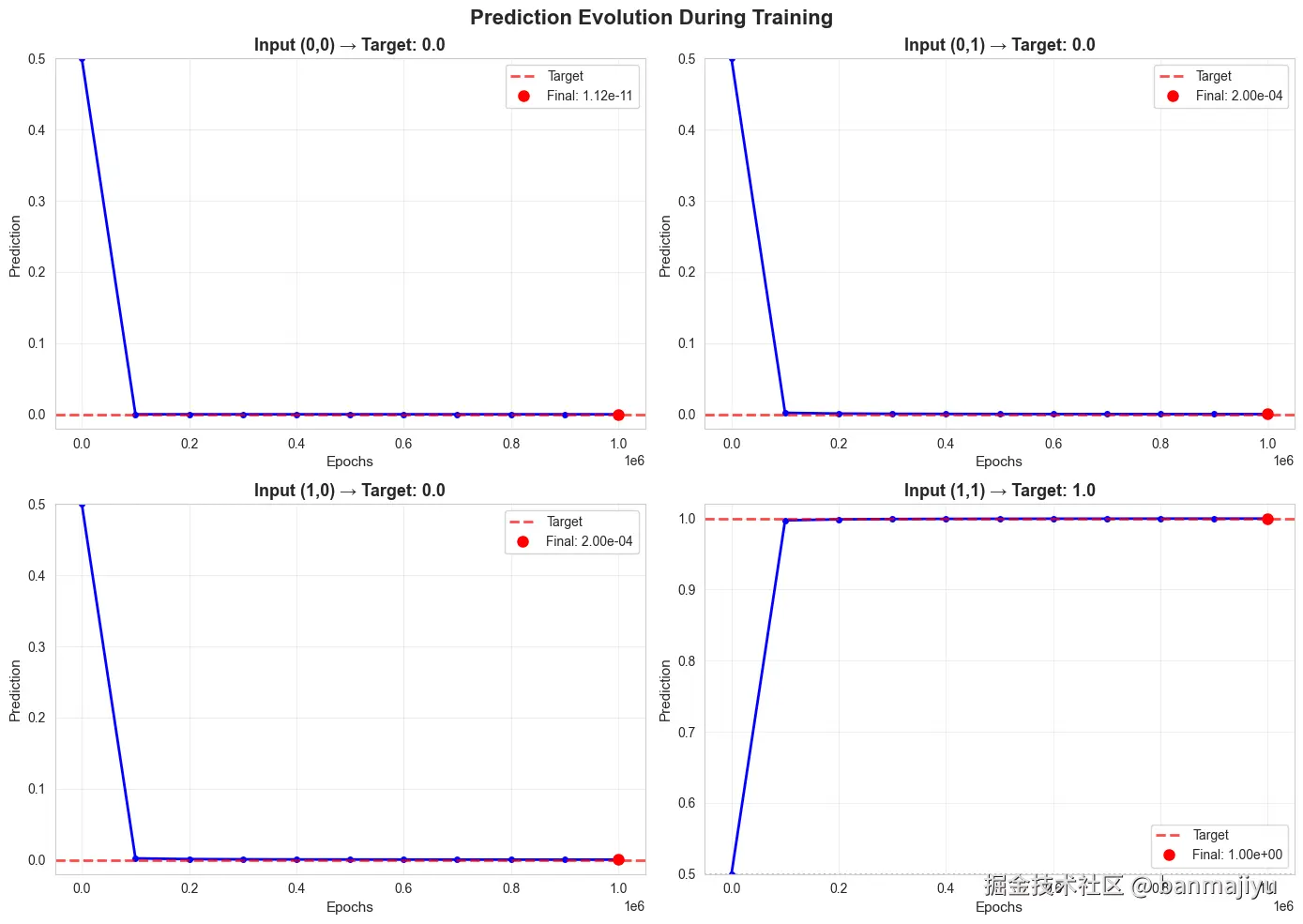
AND问题为例,将训练轮数改为 1000000轮,每 100000轮训练输出一次结果,如下:
python
Epoch 0, Loss: 0.6931471805599453, Weights: [0. 0.], Bias: -0.025, predicted: [0.5 0.5 0.5 0.5]
Epoch 100000, Loss: 0.0017135254130423991, Weights: [12.07442273 12.07442273], Bias: -18.28028667121314, predicted: [1.15076192e-08 2.01352286e-03 2.01352286e-03 9.97180996e-01]
Epoch 200000, Loss: 0.0008540609215053913, Weights: [13.46827331 13.46827331], Bias: -20.370853295163833, predicted: [1.42251667e-09 1.00418435e-03 1.00418435e-03 9.98594125e-01]
Epoch 300000, Loss: 0.0005686482917795434, Weights: [14.28216591 14.28216591], Bias: -21.59162287967754, predicted: [4.19644644e-10 6.68735073e-04 6.68735073e-04 9.99063763e-01]
Epoch 400000, Loss: 0.00042618526123873744, Weights: [14.85914749 14.85914749], Bias: -22.457060672544646, predicted: [1.76614248e-10 5.01246758e-04 5.01246758e-04 9.99298250e-01]
Epoch 500000, Loss: 0.00034079363305620255, Weights: [15.30646479 15.30646479], Bias: -23.128015908723395, predicted: [9.02886012e-11 4.00839271e-04 4.00839271e-04 9.99438822e-01]
Epoch 600000, Loss: 0.0002839043730732245, Weights: [15.6718262 15.6718262], Bias: -23.676044225842773, predicted: [5.21947492e-11 3.33939623e-04 3.33939623e-04 9.99532483e-01]
Epoch 700000, Loss: 0.00024328905189608215, Weights: [15.98065927 15.98065927], Bias: -24.139283972824206, predicted: [3.28430921e-11 2.86174300e-04 2.86174300e-04 9.99599355e-01]
Epoch 800000, Loss: 0.0002128388867211385, Weights: [16.24813277 16.24813277], Bias: -24.540486841549885, predicted: [2.19889055e-11 2.50361867e-04 2.50361867e-04 9.99649492e-01]
Epoch 900000, Loss: 0.0001891623721345687, Weights: [16.48402639 16.48402639], Bias: -24.894321536210516, predicted: [1.54360073e-11 2.22514882e-04 2.22514882e-04 9.99688478e-01]
Epoch 1000000, Loss: 0.00017022566760183658, Weights: [16.69501522 16.69501522], Bias: -25.210800188506223, predicted: [1.12483779e-11 2.00241938e-04 2.00241938e-04 9.99719661e-01]
Predictions: [1.12483441e-11 2.00241738e-04 2.00241738e-04 9.99719661e-01]
训练用时 7.3秒,详细分析如下:
-
模型收敛
-
损失函数持续下降 :损失(
Loss)从初始的约 0.693稳定下降至 0.00017,表明梯度下降算法工作正常,模型参数在不断优化。 -
预测值逼近理论值 :最终的预测结果 ≈0,0.0002,0.0002,0.9997,几乎等同于AND运算的真值表 0,0,0,1。
-
-
参数演变
-
权重对称增长 :两个权重(
Weights)在训练中始终保持相等,最终都约为 16.70。这完全合理,因为对于AND运算,两个输入特征( x1和 x2)具有同等重要性。 -
偏置大幅负向调整 :偏置(
Bias)从 −0.025变为 −25.21。这个很大的负值帮助模型在输入为 (0,0),(0,1),(1,0)时,将加权和压制到负数区间,使得sigmoid输出接近 0。
-
-
训练过程
-
初期 (
Epoch0):参数初始化为 0附近,输出均为 0.5,相当于随机猜测。 -
中期 (如
Epoch100k):损失迅速下降,预测值开始显现AND逻辑的轮廓。 -
后期 (
Epoch500k→1M):损失下降速度变缓,进入微调阶段。模型持续增大权重和偏置的绝对值,以驱使sigmoid函数的输出无限接近 0或 1,从而进一步减小损失。
-
可视化:
学习率
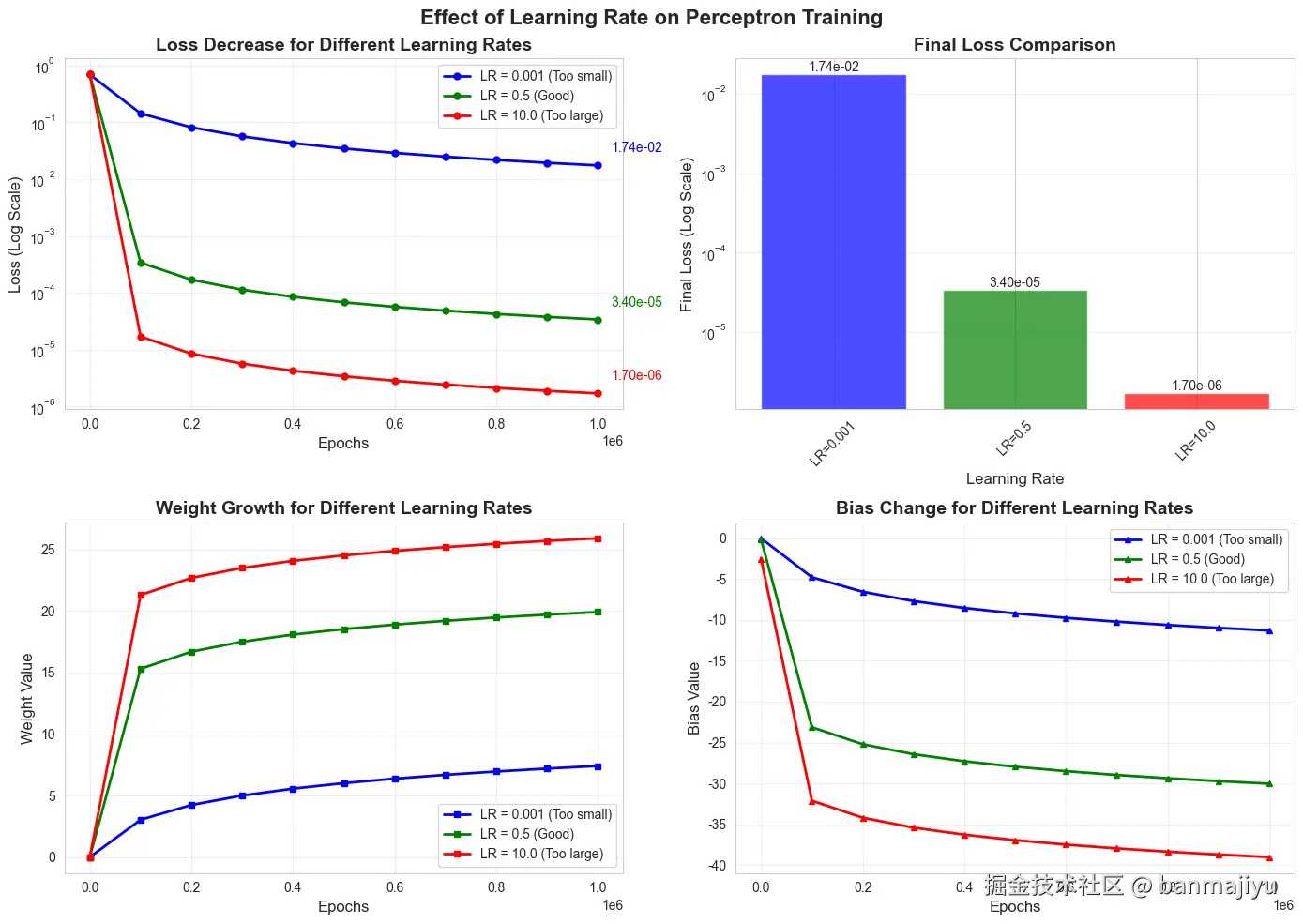
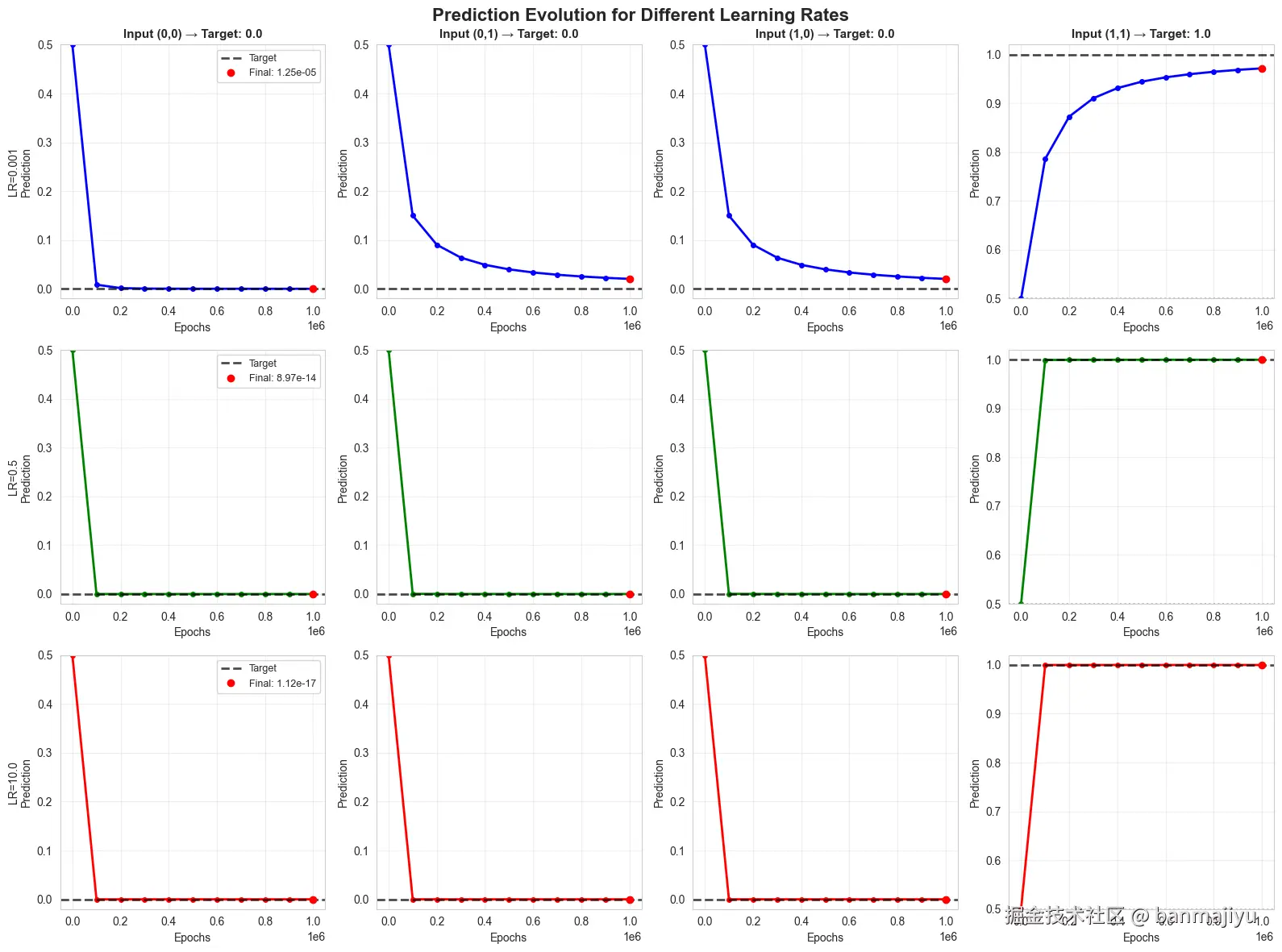
在刚刚训练的基础上,调整学习率为 0.001、 0.5、 10.0,结果如下:
python
===Learning rate: 0.001===
Epoch 0, Loss: 0.6931471805599453, Weights: [0. 0.], Bias: -0.00025, predicted: [0.5 0.5 0.5 0.5]
Epoch 100000, Loss: 0.14350630119487667, Weights: [3.03637282 3.03637282], Bias: -4.77184972987911, predicted: [0.00839385 0.14988932 0.14988932 0.78598429]
Epoch 200000, Loss: 0.08166141124133444, Weights: [4.2367081 4.2367081], Bias: -6.547040329576306, predicted: [0.00143232 0.09027123 0.09027123 0.87284722]
Epoch 300000, Loss: 0.056559316473414695, Weights: [5.00411178 5.00411178], Bias: -7.689883791945169, predicted: [4.57226574e-04 6.38183450e-02 6.38183450e-02 9.10384315e-01]
Epoch 400000, Loss: 0.04307253011634129, Weights: [5.56721754 5.56721754], Bias: -8.530492084519793, predicted: [1.97320344e-04 4.91129704e-02 4.91129704e-02 9.31114753e-01]
Epoch 500000, Loss: 0.034699854291060435, Weights: [6.01108681 6.01108681], Bias: -9.193904140467376, predicted: [1.01647480e-04 3.98175578e-02 3.98175578e-02 9.44184367e-01]
Epoch 600000, Loss: 0.029014140880282528, Weights: [6.37693375 6.37693375], Bias: -9.741100438933035, predicted: [5.88126121e-05 3.34343625e-02 3.34343625e-02 9.53147504e-01]
Epoch 700000, Loss: 0.024908812646655665, Weights: [6.68783334 6.68783334], Bias: -10.206337367707393, predicted: [3.69342969e-05 2.87903360e-02 2.87903360e-02 9.59663574e-01]
Epoch 800000, Loss: 0.02180930061451368, Weights: [6.9579869 6.9579869], Bias: -10.610740793726809, predicted: [2.46493099e-05 2.52648267e-02 2.52648267e-02 9.64607854e-01]
Epoch 900000, Loss: 0.019388415347494817, Weights: [7.19674494 7.19674494], Bias: -10.968239590717861, predicted: [1.72404282e-05 2.24997681e-02 2.24997681e-02 9.68484383e-01]
Epoch 1000000, Loss: 0.01744648186578177, Weights: [7.41058505 7.41058505], Bias: -11.28849247685743, predicted: [1.25160098e-05 2.02745412e-02 2.02745412e-02 9.71603354e-01]
Predictions: [1.25159717e-05 2.02745211e-02 2.02745211e-02 9.71603382e-01]
===Learning rate: 0.5===
Epoch 0, Loss: 0.6931471805599453, Weights: [0. 0.], Bias: -0.125, predicted: [0.5 0.5 0.5 0.5]
Epoch 100000, Loss: 0.00034078325774289646, Weights: [15.30654173 15.30654173], Bias: -23.128131313111425, predicted: [9.02803532e-11 4.00827071e-04 4.00827071e-04 9.99438839e-01]
Epoch 200000, Loss: 0.00017022284180639367, Weights: [16.69505643 16.69505643], Bias: -25.21086200947468, predicted: [1.12478177e-11 2.00238614e-04 2.00238614e-04 9.99719665e-01]
Epoch 300000, Loss: 0.00011343940872846477, Weights: [17.50681486 17.50681486], Bias: -26.428485898148118, predicted: [3.32857813e-12 1.33447668e-04 1.33447668e-04 9.99813173e-01]
Epoch 400000, Loss: 8.506247665863291e-05, Weights: [18.08262019 18.08262019], Bias: -27.292187009328256, predicted: [1.40332106e-12 1.00067621e-04 1.00067621e-04 9.99859905e-01]
Epoch 500000, Loss: 6.804138020102558e-05, Weights: [18.52918387 18.52918387], Bias: -27.962028408320233, predicted: [7.18204243e-13 8.00449198e-05 8.00449198e-05 9.99887937e-01]
Epoch 600000, Loss: 5.6696194752500084e-05, Weights: [18.89401763 18.89401763], Bias: -28.50927629810481, predicted: [4.15509343e-13 6.66987930e-05 6.66987930e-05 9.99906622e-01]
Epoch 700000, Loss: 4.859361465153441e-05, Weights: [19.20245887 19.20245887], Bias: -28.97193619207216, predicted: [2.61607291e-13 5.71670392e-05 5.71670392e-05 9.99919966e-01]
Epoch 800000, Loss: 4.251731256003311e-05, Weights: [19.46962893 19.46962893], Bias: -29.372689818942614, predicted: [1.75228411e-13 5.00188985e-05 5.00188985e-05 9.99929974e-01]
Epoch 900000, Loss: 3.779168431031443e-05, Weights: [19.70528006 19.70528006], Bias: -29.72616535772023, predicted: [1.23052903e-13 4.44596443e-05 4.44596443e-05 9.99937756e-01]
Epoch 1000000, Loss: 3.401142913063264e-05, Weights: [19.91607027 19.91607027], Bias: -30.042349765450773, predicted: [8.96963099e-14 4.00125059e-05 4.00125059e-05 9.99943982e-01]
Predictions: [8.96960408e-14 4.00124658e-05 4.00124658e-05 9.99943983e-01]
===Learning rate: 10.0===
Epoch 0, Loss: 0.6931471805599453, Weights: [0. 0.], Bias: -2.5, predicted: [0.5 0.5 0.5 0.5]
Epoch 100000, Loss: 1.700081895673019e-05, Weights: [21.30298324 21.30298324], Bias: -32.12271509481572, predicted: [1.12019884e-14 2.00007286e-05 2.00007286e-05 9.99971999e-01]
Epoch 200000, Loss: 8.500258629958978e-06, Weights: [22.68931547 22.68931547], Bias: -34.202211376766336, predicted: [1.40015090e-15 1.00002455e-05 1.00002455e-05 9.99986000e-01]
Epoch 300000, Loss: 5.666795624017699e-06, Weights: [23.50026181 23.50026181], Bias: -35.4186302107126, predicted: [4.14847699e-16 6.66679228e-06 6.66679228e-06 9.99990666e-01]
Epoch 400000, Loss: 4.25007813009538e-06, Weights: [24.0756351 24.0756351], Bias: -36.28168979891588, predicted: [1.75011096e-16 5.00007724e-06 5.00007724e-06 9.99993000e-01]
Epoch 500000, Loss: 3.400052779115479e-06, Weights: [24.52192816 24.52192816], Bias: -36.95112918376485, predicted: [8.96047642e-17 4.00005270e-06 4.00005270e-06 9.99994400e-01]
Epoch 600000, Loss: 2.8333715605258275e-06, Weights: [24.8865755 24.8865755], Bias: -37.49810004814846, predicted: [5.18542359e-17 3.33337178e-06 3.33337178e-06 9.99995333e-01]
Epoch 700000, Loss: 2.4286004922126167e-06, Weights: [25.19488002 25.19488002], Bias: -37.96055673278328, predicted: [3.26543875e-17 2.85717226e-06 2.85717226e-06 9.99996000e-01]
Epoch 800000, Loss: 2.1250229006839423e-06, Weights: [25.46194527 25.46194527], Bias: -38.36115453597536, predicted: [2.18757975e-17 2.50002327e-06 2.50002327e-06 9.99996500e-01]
Epoch 900000, Loss: 1.8889074354947174e-06, Weights: [25.69751332 25.69751332], Bias: -38.714506558669086, predicted: [1.53640206e-17 2.22224114e-06 2.22224114e-06 9.99996889e-01]
Epoch 1000000, Loss: 1.7000153503880637e-06, Weights: [25.90823598 25.90823598], Bias: -39.030590506399825, predicted: [1.12003404e-17 2.00001571e-06 2.00001571e-06 9.99997200e-01]
Predictions: [1.12003068e-17 2.00001371e-06 2.00001371e-06 9.99997200e-01]
训练用时 22.0秒
核心结论
学习率是控制训练速度与稳定性的关键超参数。对于此AND运算任务:
-
学习率 =0.001:过小,导致收敛极其缓慢,未能充分学习。
-
学习率 =0.5:适中,收敛稳健有效,比之前 0.1的表现还要好。
-
学习率 =10.0:偏大,收敛速度最快,但带来了数值风险。
详细对比分析
| 分析维度 | 学习率 = 0.001 (过小) | 学习率 = 0.5 (适中) | 学习率 = 10.0 (偏大) | 对比与解读 |
|---|---|---|---|---|
| 1. 模型收敛 | 收敛不足 。100万轮后Loss仍高达 0.017,预测值( 0.00001,0.0203,0.0203,0.9716)远未逼近理论值( 0,0,0,1)。 |
收敛良好。Loss稳步降至3.4e-5,预测值(\~0, 0.00004, 0.00004, 0.99994)已极度接近理论值。 |
收敛最快。Loss降至1.7e-6(为0.5时的1/20),预测值最接近理论值。 |
学习率越大,单次参数更新步长越大,收敛至低Loss的速度越快。但 0.001的步长太小,参数更新"力气不足",无法有效逼近最优解。 |
| 2. 参数演变 | 参数增长缓慢:权重≈ 7.41,偏置≈ −11.29。绝对值较小,无法将sigmoid输出"推"向 0或 1的极端。 |
参数增长稳健:权重≈ 19.92,偏置≈ −30.04。通过持续调整,有效驱动了sigmoid的输出。 |
参数增长极大:权重≈ 25.91,偏置≈ −39.03。数值最大,这是用更大更新步长快速逼近最优解的副作用。 | 所有情况下权重始终保持对称( W1=W2),完美体现了AND运算中两个输入权值相等的特性。学习率越大,最终参数的绝对值越大。 |
| 3. 训练过程 | 损失曲线下降平缓,效率低下。需要远超 100万轮的迭代才可能达到其他学习率的效果。 | 损失曲线平滑、稳定下降,是理想的学习过程。与之前学习率 0.1的轨迹高度相似,只是步长稍大。 | 损失初期下降迅猛。但存在潜在风险:如此大的学习率在更复杂模型或数据上极易导致Loss震荡(来回跳跃)甚至发散,此处因问题简单而未显现。 |
展示了学习率作为"步幅"的核心作用:小步稳但慢,大步快但险。 |
可视化:
激活函数
我们想看看不同激活函数对训练的影响 ,但是每次修改激活函数都需要重新求导 + 修改代码。利用模块化的思想,我们定义一个
Activation类,它包含向前(原函数)和向后(导数)两部分。求导这一块可以丢给Vibe Coding:)
其次,交叉熵损失函数只适配Sigmoid函数,所以我们采用更通用的MSE损失函数。
MSE
均方误差 (
Mean Squared Error),也称为L2损失。它是机器学习中最常用的回归任务损失函数 之一,用于衡量模型预测值与真实值之间的差异。
1. 数学定义
对于一个有 m个样本的数据集:
MSE=m1i=1∑m(yi−y^i)2
-
yi:第 i 个样本的真实值
-
y^i:第 i个样本的预测值
-
公式先计算每个样本的预测误差(残差),然后平方 (使误差为正且放大较大误差),最后对所有样本取平均。
2. 直观理解
-
目标:MSE的值越小越好,完美预测时MSE为0。
-
特点:由于平方项,MSE对较大的误差(离群点)惩罚更重,这使得模型对异常值比较敏感。
-
可视化:它是一个平滑的、凸的抛物线形函数,有利于梯度下降等优化算法找到最小值。
3. 对比
之前的代码使用的是交叉熵损失 (Cross-Entropy Loss),它适用于分类问题(输出解释为概率)。而MSE是一种通用的损失函数。
| 对比维度 | 交叉熵损失 | 均方误差(MSE) |
|---|---|---|
| 主要用途 | 分类(特别是二分类、多分类 | 回归(预测连续值) |
| 输出要求 | 预测值必须在 (0,1)之间(如Sigmoid输出) |
预测值可以是任意实数(无范围限制) |
| 梯度特性 | 与Sigmoid结合时梯度简洁 (ypred−y) |
梯度形式简单通用 (ypred−y) |
| 在代码中的问题 | 若激活函数输出不在 (0,1)内(如ReLU负数、Tanh负值),log计算会出NaN |
对任何输出值都有效,不会因log计算而崩溃 |
4. 梯度公式
使用MSE时,损失函数对于第 i 个样本的梯度为:
∂y^i∂MSE=2(yi−y^i)
在实际的梯度下降中,常数因子 2 通常被吸收到学习率中,因此简化为:
yi−y^i
完整梯度:
∂wj∂Loss=m1(i=1∑m(yi−y^i))⋅∂zi∂y^i⋅xij ∂b∂Loss=m1(i=1∑m(yi−y^i))⋅∂zi∂y^i
其中 ∂zi∂y^i就是activation.backward(linear_model)。
总结
所以,如果想快速测试不同激活函数是否"能学",换成MSE是一个简单有效的调试策略 。但要获得最好的分类性能,对于二分类任务,Sigmoid + 交叉熵仍然是标准组合。
代码实现:
python
import numpy as np

class Activation:
    def forward(self, x):   # 前向传播
        raise NotImplementedError

    def backward(self, x):  # 反向传播
        raise NotImplementedError

# === 一大堆激活函数 ===

class Sigmoid(Activation):  # Sigmoid激活函数
    def forward(self, x):
        return 1 / (1 + np.exp(-x))

    def backward(self, x):
        s = self.forward(x)
        return s * (1 - s)

class ReLU(Activation): # ReLU激活函数
    def forward(self, x):
        return np.maximum(0, x)

    def backward(self, x):
        return np.where(x > 0, 1, 0)

class Tanh(Activation): # Tanh激活函数
    def forward(self, x):
        return np.tanh(x)

    def backward(self, x):
        t = self.forward(x)
        return 1 - t ** 2

class LeakyReLU(Activation):    # Leaky ReLU激活函数
    def init(self, alpha=0.01):
        self.alpha = alpha

    def forward(self, x):
        return np.where(x > 0, x, self.alpha * x)

    def backward(self, x):
        return np.where(x > 0, 1, self.alpha)

class Cube(Activation):  # Cube激活函数
    def forward(self, x):
        return x ** 3

    def backward(self, x):
        return 3 * x ** 2

class Arctan(Activation):    # Arctan激活函数
    def forward(self, x):
        return np.arctan(x)

    def backward(self, x):
        return 1 / (1 + x ** 2)

class Sine(Activation):  # Sine激活函数
    def forward(self, x):
        return np.sin(x)

    def backward(self, x):
        return np.cos(x)

class Step(Activation):  # Step激活函数
    def forward(self, x):
        return np.where(x >= 0, 1, 0)

    def backward(self, x):
        return np.zeros_like(x)

class Square(Activation):    # Square激活函数
    def forward(self, x):
        return x ** 2

    def backward(self, x):
        return 2 * x

class Random(Activation):    # Random激活函数
    def forward(self, x):
        return np.random.rand(*x.shape)

    def backward(self, x):
        return np.zeros_like(x)

class LogisticRegression:
    def init(self, learning_rate=0.1, epochs=100, activation=Sigmoid()):
        self.learning_rate = learning_rate
        self.epochs = epochs
        self.activation = activation
        self.weights = None
        self.bias = None

    # 修改fit方法如下:
    def fit(self, X, y):
        num_samples, num_features = X.shape
        self.weights = np.random.randn(num_features) * 0.01    #初始值优化
        self.bias = 0.0

        for epoch in range(self.epochs + 1):
            linear_model = np.dot(X, self.weights) + self.bias
            y_predicted = self.activation.forward(linear_model)
            error = y_predicted - y # 计算MSE误差

            grad_activation = self.activation.backward(linear_model)    # 激活函数的梯度
            dL_dz = error * grad_activation  # 链式法则

            dw = (1 / num_samples) * np.dot(X.T, dL_dz) # 权重的梯度
            db = (1 / num_samples) * np.sum(dL_dz)      # 偏置的梯度

            self.weights -= self.learning_rate * dw     # 更新权重
            self.bias -= self.learning_rate * db        # 更新偏置

            if epoch % (self.epochs // 10) == 0:        # 输出损失
                loss = np.mean(error ** 2)
                print(f'Epoch {epoch}, Loss: {loss}, Weights: {self.weights}, Bias: {self.bias}, predicted: {y_predicted}')


    def predict(self, X):
        linear_model = np.dot(X, self.weights) + self.bias
        y_predicted = self.activation.forward(linear_model)
        y_predicted_cls = [i for i in y_predicted]
        return np.array(y_predicted_cls)

# Example usage AND :
if name == "main":
    X = np.array([[0, 0],
                  [0, 1],
                  [1, 0],
                  [1, 1]])
    y = np.array([0, 0, 0, 1])  # labels

    activates = [Sigmoid(), ReLU(), Tanh(), LeakyReLU(), Cube(), Arctan(), Sine(), Step(), Square(), Random()]  # 不同的激活函数
    for activate in activates:
        print(f"\n===Activation: {activate.class.name}===")   # 输出当前激活函数
        model = LogisticRegression(epochs=10000, learning_rate=0.1, activation=activate)
        model.fit(X, y)
        predictions = model.predict(X)
        print(f"Predictions for {activate.class.name}: {predictions}")
这里面的激活函数比较多,有一些还是我瞎编的,它们长这样:
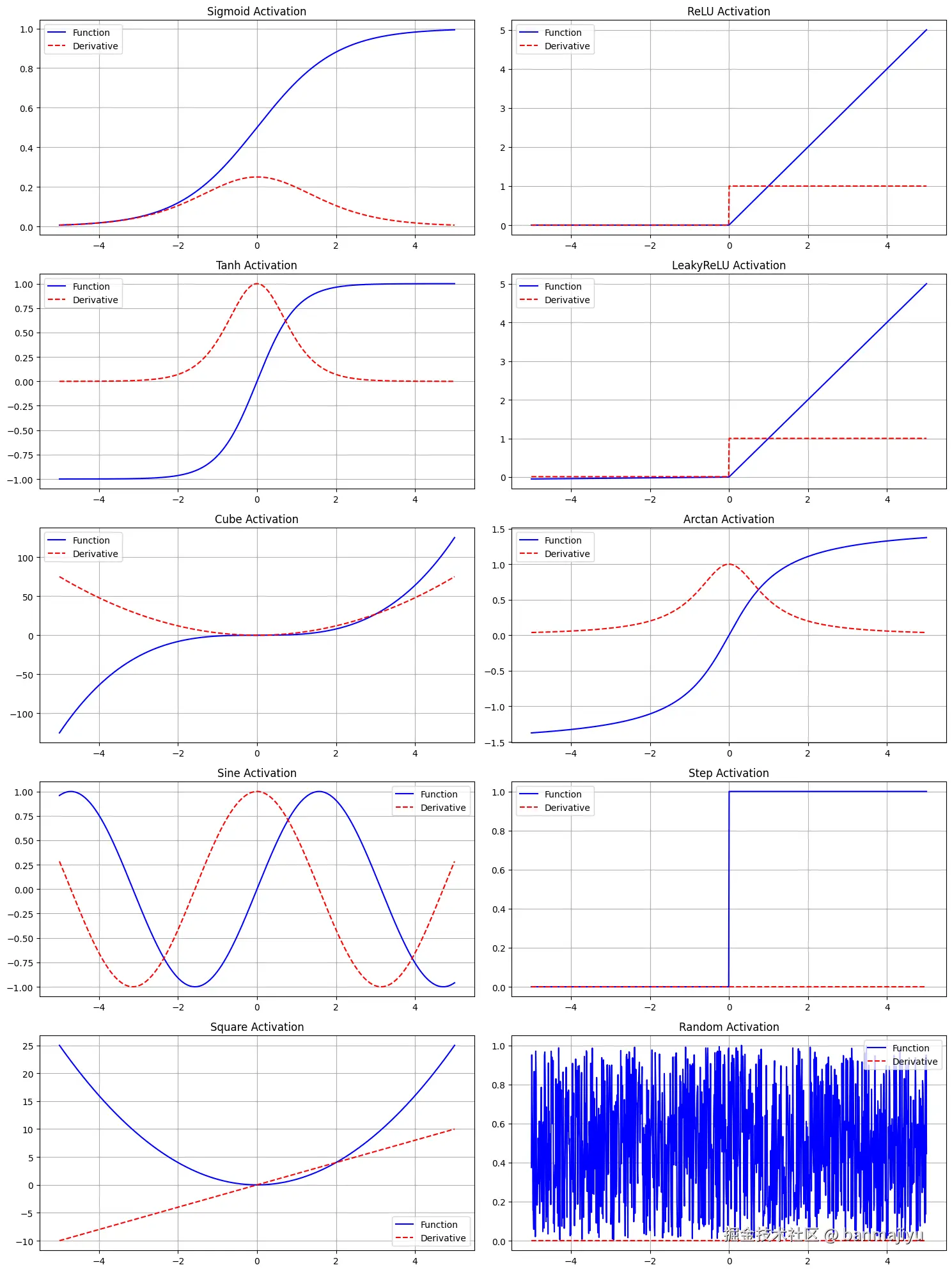
简介:
1. Sigmoid(标准激活函数)
-
数学形式: f(x)=1+e−x1
-
特性:
-
输出范围在 (0,1) 之间,像"挤压"函数
-
将任意实数映射到 0 到 1 的概率区间
-
导数为 f′(x)=f(x)⋅(1−f(x))
-
-
常见用途:
-
二分类问题的输出层(逻辑回归)
-
早期的神经网络隐藏层(现在较少使用)
-
-
缺点:
-
存在"梯度消失"问题:当 ∣x∣较大时,梯度接近 0
-
输出不是以 0 为中心的,可能导致训练变慢
-
-
形象比喻:像一个"渐变开关",从完全关闭(0)到完全打开(1)之间平滑过渡。
2. ReLU(标准激活函数)
-
数学形式: f(x)=max(0,x)
-
特性:
-
正数直接通过,负数变为 0
-
计算非常简单高效
-
导数: x>0 时为 1, x≤0时为 0
-
-
常见用途:
-
现代深度神经网络的默认选择
-
几乎所有的卷积神经网络和全连接网络隐藏层
-
-
优点:
-
缓解了梯度消失问题(正区间梯度恒为 1)
-
计算速度快(不需要指数运算)
-
稀疏激活(约 50%的神经元被激活)
-
-
缺点:
-
"死亡
ReLU"问题:负输入时梯度为 0,神经元可能永久失活 -
输出不是以0为中心的
-
3. Tanh(标准激活函数)
-
数学形式: f(x)=tanh(x)=ex+e−xex−e−x
-
特性:
-
输出范围在 (−1,1) 之间
-
以 0 为中心,比
Sigmoid更受欢迎 -
导数为 f′(x)=1−tanh2(x)
-
-
常见用途:
-
循环神经网络(
RNN)中常用 -
需要输出有正有负的场景
-
-
优点:
-
以 0 为中心,优化效果通常比
Sigmoid好 -
梯度比
Sigmoid更强(最大梯度为 1)
-
-
缺点:
- 仍然存在梯度消失问题(当 ∣x∣较大时)
4. Leaky ReLU(标准激活函数变体)
- 数学形式: f(x)={x,x>0αx,x⩽0
通常 α=0.01
-
特性:
-
解决死亡ReLU问题的改进版
-
负区间有小的斜率α,而不是完全为0
-
导数: x>0 时为 1, x≤0 时为 α
-
-
常见用途:
-
当担心ReLU神经元死亡时
-
特别是对初始化敏感的网络
-
-
优点:
-
解决了死亡ReLU问题
-
保持了ReLU的大部分优点
-
-
变体:还有
Parametric ReLU(PReLU, α可学习)、Randomized ReLU等
5. Cube(我瞎编的)
-
数学形式: f(x)=x3
-
特性:
-
简单的三次多项式
-
保持输入的符号(负输入得负输出,正输入得正输出)
-
导数为 f′(x)=3x2
-
-
潜在问题:
-
梯度爆炸风险:当 ∣x∣>1时,梯度快速增大
-
梯度消失风险:当 ∣x∣<1时,梯度很小
-
非线性太强,可能难以优化
-
-
研究意义:探索多项式激活函数的可能性,实际中很少使用
6. Arctan(还是我瞎编的)
-
数学形式: f(x)=arctan(x)
-
特性:
-
输出范围在 (−2π,2π)之间
-
平滑的S形曲线,类似
Sigmoid但范围更广 -
导数为 f′(x)=1+x21
-
-
优点:
-
计算相对简单(比
Sigmoid/Tanh少指数运算) -
输出有界,防止激活值过大
-
-
缺点:
-
梯度消失严重:当 ∣x∣较大时,梯度接近 0
-
在实际神经网络中很少使用
-
7. Sine(又是我瞎编的)
-
数学形式: f(x)=sin(x)
-
特性:
-
周期为 2π的振荡函数
-
输出范围在 −1,1 之间
-
导数为 f′(x)=cos(x)
-
-
独特性质:
-
周期性:不同的 x 可能得到相同的输出
-
无限多解:对于给定输出 y ,有无限多个 x 满足 sin(x)=y
-
-
潜在应用:
-
处理周期性数据(如信号处理)
-
理论研究中探索周期激活函数的特性
-
-
主要问题:
-
优化困难:梯度也在 −1 到 1 之间振荡
-
可能陷入局部振荡,难以收敛
-
8. Step(阶跃函数,基础但不实用的激活函数)
-
数学形式: f(x)={1,x>00,x⩽0
-
特性:
-
最简单的二值激活函数
-
也称为"单位阶跃函数"或"
Heaviside阶跃函数" -
导数在 x=0时为 0,在 x=0 处未定义
-
-
历史意义:
-
最早的人工神经元(感知机)使用此函数
-
Frank Rosenblatt的感知机(1958)使用此激活函数
-
-
致命缺点:
-
无法使用梯度下降:导数几乎处处为 0
-
无法进行反向传播学习
-
-
现代应用:
-
仅用于理论教学或特定的离散优化问题
-
在神经网络的实际训练中从不使用
-
9. Square(双是我瞎编的)
-
数学形式: f(x)=x2
-
特性:
-
简单的二次函数
-
总是非负输出(失去符号信息)
-
导数为 f′(x)=2x
-
-
问题:
-
符号丢失:负输入和正输入都得到正输出
-
梯度爆炸:当 ∣x∣较大时,梯度线性增长
-
非单调:不是单调函数,可能导致优化困难
-
-
潜在价值:
-
在某些特定的对称性检测任务中可能有用
-
理论研究中的对照实验
-
10. Random(叕是我瞎编的😂)
-
数学形式:每次前向传播时生成均匀分布的随机数 U(0,1)
-
特性:
-
完全忽略输入:输出与输入 x 无关
-
每次调用都产生新的随机数
-
导数为 0(因为没有可学习的关系)
-
-
这是什么鬼😂:
-
这实际上不是一个有效的激活函数
-
它破坏了神经网络的基本前提:输出应该是输入的函数
-
-
为什么存在:
-
可能作为"反例"或"基线"测试
-
演示如果没有激活函数(或激活函数失效)会发生什么
-
在教学中展示为什么激活函数需要是输入的确定函数
-
-
结果预测:
-
网络完全无法学习任何模式
-
权重更新是随机的(因为梯度方向随机)
-
纯属娱乐或测试框架的极端情况🤣
-
训练结果:
python
===Activation: Sigmoid===
Epoch 0, Loss: 0.25000092611954267, Weights: [0.00241735 0.00378633], Bias: -0.006269492222504486, predicted: [0.5        0.50095051 0.50060773 0.50155823]
Epoch 1000, Loss: 0.0944596668023508, Weights: [1.1533111  1.15352574], Bias: -1.955973219719276, predicted: [0.12402721 0.30956372 0.30951777 0.58669022]
Epoch 2000, Loss: 0.059342507126397645, Weights: [1.81421071 1.81425231], Bias: -2.8795553515206485, predicted: [0.0532118  0.2563415  0.25633355 0.67887591]
Epoch 3000, Loss: 0.04244503795960389, Weights: [2.26589322 2.26590371], Bias: -3.5355275860307978, predicted: [0.02833376 0.21935251 0.21935072 0.73028332]
Epoch 4000, Loss: 0.03251315255673547, Weights: [2.61066077 2.61066406], Bias: -4.041907016023551, predicted: [0.01726844 0.19292769 0.19292718 0.76481407]
Epoch 5000, Loss: 0.02606212211024169, Weights: [2.88798548 2.8879867 ], Bias: -4.451302760110763, predicted: [0.01153313 0.17318857 0.17318839 0.78993578]
Epoch 6000, Loss: 0.021587065559464505, Weights: [3.118719   3.11871952], Bias: -4.792900066901474, predicted: [0.00822282 0.15788119 0.15788112 0.80913951]
Epoch 7000, Loss: 0.018328942327454342, Weights: [3.31546126 3.3154615 ], Bias: -5.08471757342172, predicted: [0.00615421 0.14564588 0.14564585 0.82435132]
Epoch 8000, Loss: 0.015866402576175942, Weights: [3.48642116 3.48642128], Bias: -5.338627830705421, predicted: [0.00478063 0.13562315 0.13562314 0.83673494]
Epoch 9000, Loss: 0.013948780716040273, Weights: [3.63722897 3.63722904], Bias: -5.562829284210701, predicted: [0.00382403 0.12724606 0.12724605 0.84703797]
Epoch 10000, Loss: 0.012418682326926778, Weights: [3.77190017 3.77190021], Bias: -5.763195259016104, predicted: [0.00313182 0.12012651 0.12012651 0.85576351]
Predictions for Sigmoid: [0.00313122 0.12011992 0.12011992 0.85577157]

===Activation: ReLU===
Epoch 0, Loss: 0.25, Weights: [-0.01056155 -0.00261052], Bias: 0.0, predicted: [0. 0. 0. 0.]
Epoch 1000, Loss: 0.25, Weights: [-0.01056155 -0.00261052], Bias: 0.0, predicted: [0. 0. 0. 0.]
Epoch 2000, Loss: 0.25, Weights: [-0.01056155 -0.00261052], Bias: 0.0, predicted: [0. 0. 0. 0.]
Epoch 3000, Loss: 0.25, Weights: [-0.01056155 -0.00261052], Bias: 0.0, predicted: [0. 0. 0. 0.]
Epoch 4000, Loss: 0.25, Weights: [-0.01056155 -0.00261052], Bias: 0.0, predicted: [0. 0. 0. 0.]
Epoch 5000, Loss: 0.25, Weights: [-0.01056155 -0.00261052], Bias: 0.0, predicted: [0. 0. 0. 0.]
Epoch 6000, Loss: 0.25, Weights: [-0.01056155 -0.00261052], Bias: 0.0, predicted: [0. 0. 0. 0.]
Epoch 7000, Loss: 0.25, Weights: [-0.01056155 -0.00261052], Bias: 0.0, predicted: [0. 0. 0. 0.]
Epoch 8000, Loss: 0.25, Weights: [-0.01056155 -0.00261052], Bias: 0.0, predicted: [0. 0. 0. 0.]
Epoch 9000, Loss: 0.25, Weights: [-0.01056155 -0.00261052], Bias: 0.0, predicted: [0. 0. 0. 0.]
Epoch 10000, Loss: 0.25, Weights: [-0.01056155 -0.00261052], Bias: 0.0, predicted: [0. 0. 0. 0.]
Predictions for ReLU: [0. 0. 0. 0.]

===Activation: Tanh===
Epoch 0, Loss: 0.2517795840508127, Weights: [0.02746168 0.01927042], Bias: 0.02517628905913671, predicted: [ 0.         -0.00596666  0.00243455 -0.00353217]
Epoch 1000, Loss: 0.07822395248174475, Weights: [0.49070044 0.49070044], Bias: -0.24534865610195192, predicted: [-0.24054134  0.24054433  0.24054433  0.62675407]
Epoch 2000, Loss: 0.07822395247936782, Weights: [0.49070292 0.49070292], Bias: -0.24535145930358765, predicted: [-0.24054402  0.24054402  0.24054402  0.62675539]
Epoch 3000, Loss: 0.07822395247936781, Weights: [0.49070292 0.49070292], Bias: -0.24535145932872152, predicted: [-0.24054402  0.24054402  0.24054402  0.62675539]
Epoch 4000, Loss: 0.07822395247936781, Weights: [0.49070292 0.49070292], Bias: -0.24535145932872152, predicted: [-0.24054402  0.24054402  0.24054402  0.62675539]
Epoch 5000, Loss: 0.07822395247936781, Weights: [0.49070292 0.49070292], Bias: -0.24535145932872152, predicted: [-0.24054402  0.24054402  0.24054402  0.62675539]
Epoch 6000, Loss: 0.07822395247936781, Weights: [0.49070292 0.49070292], Bias: -0.24535145932872152, predicted: [-0.24054402  0.24054402  0.24054402  0.62675539]
Epoch 7000, Loss: 0.07822395247936781, Weights: [0.49070292 0.49070292], Bias: -0.24535145932872152, predicted: [-0.24054402  0.24054402  0.24054402  0.62675539]
Epoch 8000, Loss: 0.07822395247936781, Weights: [0.49070292 0.49070292], Bias: -0.24535145932872152, predicted: [-0.24054402  0.24054402  0.24054402  0.62675539]
Epoch 9000, Loss: 0.07822395247936781, Weights: [0.49070292 0.49070292], Bias: -0.24535145932872152, predicted: [-0.24054402  0.24054402  0.24054402  0.62675539]
Epoch 10000, Loss: 0.07822395247936781, Weights: [0.49070292 0.49070292], Bias: -0.24535145932872152, predicted: [-0.24054402  0.24054402  0.24054402  0.62675539]
Predictions for Tanh: [-0.24054402  0.24054402  0.24054402  0.62675539]

===Activation: LeakyReLU===
Epoch 0, Loss: 0.25007584551049644, Weights: [-0.01264564 -0.00202134], Bias: 0.00025007583547301384, predicted: [ 0.00000000e+00 -2.27138360e-05 -1.28957110e-04 -1.51670946e-04]
Epoch 1000, Loss: 5.2927938486298375e-05, Weights: [0.98709647 0.98709647], Bias: -0.9817348128367214, predicted: [-0.00981657  0.00538433  0.00538433  0.99242605]
Epoch 2000, Loss: 2.4997647353946023e-05, Weights: [0.99962766 0.99962766], Bias: -0.9994562789721012, predicted: [-9.99455228e-03  1.71685250e-04  1.71685250e-04  9.99798599e-01]
Epoch 3000, Loss: 2.4992503196942458e-05, Weights: [0.99979772 0.99979772], Bias: -0.9996967811565775, predicted: [-9.99696767e-03  1.00943273e-04  1.00943273e-04  9.99898653e-01]
Epoch 4000, Loss: 2.4992502249499728e-05, Weights: [0.99980003 0.99980003], Bias: -0.9997000450682826, predicted: [-9.99700045e-03  9.99832174e-05  9.99832174e-05  9.99900011e-01]
Epoch 5000, Loss: 2.4992502249325233e-05, Weights: [0.99980006 0.99980006], Bias: -0.9997000893635959, predicted: [-9.99700089e-03  9.99701883e-05  9.99701883e-05  9.99900030e-01]
Epoch 6000, Loss: 2.4992502249325202e-05, Weights: [0.99980006 0.99980006], Bias: -0.9997000899647376, predicted: [-9.99700090e-03  9.99700114e-05  9.99700114e-05  9.99900030e-01]
Epoch 7000, Loss: 2.4992502249325202e-05, Weights: [0.99980006 0.99980006], Bias: -0.999700089972893, predicted: [-9.9970009e-03  9.9970009e-05  9.9970009e-05  9.9990003e-01]
Epoch 8000, Loss: 2.4992502249325206e-05, Weights: [0.99980006 0.99980006], Bias: -0.9997000899729929, predicted: [-9.9970009e-03  9.9970009e-05  9.9970009e-05  9.9990003e-01]
Epoch 9000, Loss: 2.4992502249325206e-05, Weights: [0.99980006 0.99980006], Bias: -0.9997000899729929, predicted: [-9.9970009e-03  9.9970009e-05  9.9970009e-05  9.9990003e-01]
Epoch 10000, Loss: 2.4992502249325206e-05, Weights: [0.99980006 0.99980006], Bias: -0.9997000899729929, predicted: [-9.9970009e-03  9.9970009e-05  9.9970009e-05  9.9990003e-01]
Predictions for LeakyReLU: [-9.9970009e-03  9.9970009e-05  9.9970009e-05  9.9990003e-01]

===Activation: Cube===
Epoch 0, Loss: 0.25000004697016426, Weights: [ 0.00527862 -0.00982139], Bias: 1.5498741158811781e-06, predicted: [ 0.00000000e+00 -9.47816115e-07  1.46953117e-07 -9.39398641e-08]
Epoch 1000, Loss: 0.2500000056687841, Weights: [ 0.00604391 -0.0090561 ], Bias: 0.0007668393568271124, predicted: [ 4.50266807e-10 -5.69725811e-07  3.15819630e-07 -1.13373559e-08]
Epoch 2000, Loss: 0.2500000016608053, Weights: [ 0.00629518 -0.00880482], Bias: 0.0010181171310394612, predicted: [ 1.05482292e-09 -4.72189499e-07  3.91093332e-07 -3.32142272e-09]
Epoch 3000, Loss: 0.2500000006968277, Weights: [ 0.00642013 -0.00867987], Bias: 0.0011430682293705457, predicted: [ 1.49317190e-09 -4.28146870e-07  4.32597794e-07 -1.39347032e-09]
Epoch 4000, Loss: 0.2500000003556523, Weights: [ 0.00649488 -0.00860511], Bias: 0.0012178232978134473, predicted: [ 1.80588008e-09 -4.03158288e-07  4.58775626e-07 -7.11117981e-10]
Epoch 5000, Loss: 0.25000000020541285, Weights: [ 0.00654463 -0.00855536], Bias: 0.0012675713585682323, predicted: [ 2.03645428e-09 -3.87080896e-07  4.76767363e-07 -4.10637097e-10]
Epoch 6000, Loss: 0.2500000001291945, Weights: [ 0.00658012 -0.00851986], Bias: 0.0013030626458581261, predicted: [ 2.21240932e-09 -3.75876603e-07  4.89885665e-07 -2.58198395e-10]
Epoch 7000, Loss: 0.2500000000864845, Weights: [ 0.00660671 -0.00849327], Bias: 0.0013296577016542854, predicted: [ 2.35069760e-09 -3.67624230e-07  4.99871429e-07 -1.72776421e-10]
Epoch 8000, Loss: 0.25000000006071726, Weights: [ 0.00662738 -0.00847259], Bias: 0.0013503289098575298, predicted: [ 2.46207326e-09 -3.61294212e-07  5.07725684e-07 -1.21240350e-10]
Epoch 9000, Loss: 0.2500000000442594, Weights: [ 0.00664391 -0.00845606], Bias: 0.0013668571609993607, predicted: [ 2.55361382e-09 -3.56285511e-07  5.14064434e-07 -8.83230747e-11]
Epoch 10000, Loss: 0.2500000000332591, Weights: [ 0.00665743 -0.00844254], Bias: 0.0013803744991956, predicted: [ 2.63014193e-09 -3.52223822e-07  5.19287364e-07 -6.63213082e-11]
Predictions for Cube: [ 2.63021217e-09 -3.52220145e-07  5.19292127e-07 -6.63031904e-11]

===Activation: Arctan===
Epoch 0, Loss: 0.24126558320296862, Weights: [0.02519278 0.04123411], Bias: 0.024103693401520503, predicted: [0.         0.01711221 0.00066141 0.01777341]
Epoch 1000, Loss: 0.07678214225949234, Weights: [0.49819228 0.49819228], Bias: -0.2490943794364964, predicted: [-0.2441261   0.24412945  0.24412945  0.64176454]
Epoch 2000, Loss: 0.07678214225645766, Weights: [0.4981951 0.4981951], Bias: -0.24909754750487004, predicted: [-0.24412912  0.24412912  0.24412912  0.64176615]
Epoch 3000, Loss: 0.07678214225645766, Weights: [0.4981951 0.4981951], Bias: -0.2490975475368739, predicted: [-0.24412912  0.24412912  0.24412912  0.64176615]
Epoch 4000, Loss: 0.07678214225645766, Weights: [0.4981951 0.4981951], Bias: -0.2490975475368739, predicted: [-0.24412912  0.24412912  0.24412912  0.64176615]
Epoch 5000, Loss: 0.07678214225645766, Weights: [0.4981951 0.4981951], Bias: -0.2490975475368739, predicted: [-0.24412912  0.24412912  0.24412912  0.64176615]
Epoch 6000, Loss: 0.07678214225645766, Weights: [0.4981951 0.4981951], Bias: -0.2490975475368739, predicted: [-0.24412912  0.24412912  0.24412912  0.64176615]
Epoch 7000, Loss: 0.07678214225645766, Weights: [0.4981951 0.4981951], Bias: -0.2490975475368739, predicted: [-0.24412912  0.24412912  0.24412912  0.64176615]
Epoch 8000, Loss: 0.07678214225645766, Weights: [0.4981951 0.4981951], Bias: -0.2490975475368739, predicted: [-0.24412912  0.24412912  0.24412912  0.64176615]
Epoch 9000, Loss: 0.07678214225645766, Weights: [0.4981951 0.4981951], Bias: -0.2490975475368739, predicted: [-0.24412912  0.24412912  0.24412912  0.64176615]
Epoch 10000, Loss: 0.07678214225645766, Weights: [0.4981951 0.4981951], Bias: -0.2490975475368739, predicted: [-0.24412912  0.24412912  0.24412912  0.64176615]
Predictions for Arctan: [-0.24412912  0.24412912  0.24412912  0.64176615]

===Activation: Sine===
Epoch 0, Loss: 0.25048530595694735, Weights: [0.02571101 0.02339311], Bias: 0.02504841297015858, predicted: [ 0.         -0.00167292  0.00070442 -0.0009685 ]
Epoch 1000, Loss: 0.0712340695646528, Weights: [0.49569736 0.49569736], Bias: -0.2478483300106123, predicted: [-0.2453186   0.24531928  0.24531928  0.67690255]
Epoch 2000, Loss: 0.07123406956452127, Weights: [0.4956979 0.4956979], Bias: -0.24784894931868487, predicted: [-0.24531921  0.24531921  0.24531921  0.6769029 ]
Epoch 3000, Loss: 0.07123406956452126, Weights: [0.4956979 0.4956979], Bias: -0.2478489493197496, predicted: [-0.24531921  0.24531921  0.24531921  0.6769029 ]
Epoch 4000, Loss: 0.07123406956452126, Weights: [0.4956979 0.4956979], Bias: -0.2478489493197496, predicted: [-0.24531921  0.24531921  0.24531921  0.6769029 ]
Epoch 5000, Loss: 0.07123406956452126, Weights: [0.4956979 0.4956979], Bias: -0.2478489493197496, predicted: [-0.24531921  0.24531921  0.24531921  0.6769029 ]
Epoch 6000, Loss: 0.07123406956452126, Weights: [0.4956979 0.4956979], Bias: -0.2478489493197496, predicted: [-0.24531921  0.24531921  0.24531921  0.6769029 ]
Epoch 7000, Loss: 0.07123406956452126, Weights: [0.4956979 0.4956979], Bias: -0.2478489493197496, predicted: [-0.24531921  0.24531921  0.24531921  0.6769029 ]
Epoch 8000, Loss: 0.07123406956452126, Weights: [0.4956979 0.4956979], Bias: -0.2478489493197496, predicted: [-0.24531921  0.24531921  0.24531921  0.6769029 ]
Epoch 9000, Loss: 0.07123406956452126, Weights: [0.4956979 0.4956979], Bias: -0.2478489493197496, predicted: [-0.24531921  0.24531921  0.24531921  0.6769029 ]
Epoch 10000, Loss: 0.07123406956452126, Weights: [0.4956979 0.4956979], Bias: -0.2478489493197496, predicted: [-0.24531921  0.24531921  0.24531921  0.6769029 ]
Predictions for Sine: [-0.24531921  0.24531921  0.24531921  0.6769029 ]

===Activation: Step===
Epoch 0, Loss: 0.75, Weights: [0.00442023 0.00111435], Bias: 0.0, predicted: [1 1 1 1]
Epoch 1000, Loss: 0.75, Weights: [0.00442023 0.00111435], Bias: 0.0, predicted: [1 1 1 1]
Epoch 2000, Loss: 0.75, Weights: [0.00442023 0.00111435], Bias: 0.0, predicted: [1 1 1 1]
Epoch 3000, Loss: 0.75, Weights: [0.00442023 0.00111435], Bias: 0.0, predicted: [1 1 1 1]
Epoch 4000, Loss: 0.75, Weights: [0.00442023 0.00111435], Bias: 0.0, predicted: [1 1 1 1]
Epoch 5000, Loss: 0.75, Weights: [0.00442023 0.00111435], Bias: 0.0, predicted: [1 1 1 1]
Epoch 6000, Loss: 0.75, Weights: [0.00442023 0.00111435], Bias: 0.0, predicted: [1 1 1 1]
Epoch 7000, Loss: 0.75, Weights: [0.00442023 0.00111435], Bias: 0.0, predicted: [1 1 1 1]
Epoch 8000, Loss: 0.75, Weights: [0.00442023 0.00111435], Bias: 0.0, predicted: [1 1 1 1]
Epoch 9000, Loss: 0.75, Weights: [0.00442023 0.00111435], Bias: 0.0, predicted: [1 1 1 1]
Epoch 10000, Loss: 0.75, Weights: [0.00442023 0.00111435], Bias: 0.0, predicted: [1 1 1 1]
Predictions for Step: [1 1 1 1]

===Activation: Square===
Epoch 0, Loss: 0.249901981437154, Weights: [-0.01365194 -0.00175044], Bias: -0.0006998797660097009, predicted: [0.00000000e+00 1.10345213e-06 1.67755896e-04 1.96070419e-04]
Epoch 1000, Loss: 0.008928571428910015, Weights: [-0.65465299 -0.65465299], Bias: 0.32732566867964547, predicted: [0.10714208 0.10714318 0.10714318 0.96428534]
Epoch 2000, Loss: 0.008928571428571428, Weights: [-0.65465367 -0.65465367], Bias: 0.32732683535342944, predicted: [0.10714286 0.10714286 0.10714286 0.96428571]
Epoch 3000, Loss: 0.008928571428571428, Weights: [-0.65465367 -0.65465367], Bias: 0.3273268353539852, predicted: [0.10714286 0.10714286 0.10714286 0.96428571]
Epoch 4000, Loss: 0.008928571428571428, Weights: [-0.65465367 -0.65465367], Bias: 0.3273268353539852, predicted: [0.10714286 0.10714286 0.10714286 0.96428571]
Epoch 5000, Loss: 0.008928571428571428, Weights: [-0.65465367 -0.65465367], Bias: 0.3273268353539852, predicted: [0.10714286 0.10714286 0.10714286 0.96428571]
Epoch 6000, Loss: 0.008928571428571428, Weights: [-0.65465367 -0.65465367], Bias: 0.3273268353539852, predicted: [0.10714286 0.10714286 0.10714286 0.96428571]
Epoch 7000, Loss: 0.008928571428571428, Weights: [-0.65465367 -0.65465367], Bias: 0.3273268353539852, predicted: [0.10714286 0.10714286 0.10714286 0.96428571]
Epoch 8000, Loss: 0.008928571428571428, Weights: [-0.65465367 -0.65465367], Bias: 0.3273268353539852, predicted: [0.10714286 0.10714286 0.10714286 0.96428571]
Epoch 9000, Loss: 0.008928571428571428, Weights: [-0.65465367 -0.65465367], Bias: 0.3273268353539852, predicted: [0.10714286 0.10714286 0.10714286 0.96428571]
Epoch 10000, Loss: 0.008928571428571428, Weights: [-0.65465367 -0.65465367], Bias: 0.3273268353539852, predicted: [0.10714286 0.10714286 0.10714286 0.96428571]
Predictions for Square: [0.10714286 0.10714286 0.10714286 0.96428571]

===Activation: Random===
Epoch 0, Loss: 0.2949918655654963, Weights: [-0.01852296  0.01947434], Bias: 0.0, predicted: [0.63615563 0.25606144 0.5159263  0.33402248]
Epoch 1000, Loss: 0.27114951738689796, Weights: [-0.01852296  0.01947434], Bias: 0.0, predicted: [0.45244767 0.51022229 0.33801333 0.28914884]
Epoch 2000, Loss: 0.36495140334118076, Weights: [-0.01852296  0.01947434], Bias: 0.0, predicted: [0.78509413 0.23504109 0.87499173 0.84974029]
Epoch 3000, Loss: 0.387758559664891, Weights: [-0.01852296  0.01947434], Bias: 0.0, predicted: [0.01715636 0.97493812 0.59400479 0.50261295]
Epoch 4000, Loss: 0.3872913395162145, Weights: [-0.01852296  0.01947434], Bias: 0.0, predicted: [0.5666904  0.21683046 0.96591912 0.50199181]
Epoch 5000, Loss: 0.25004964539235475, Weights: [-0.01852296  0.01947434], Bias: 0.0, predicted: [0.85291767 0.26381048 0.37232479 0.74601514]
Epoch 6000, Loss: 0.2022779138555904, Weights: [-0.01852296  0.01947434], Bias: 0.0, predicted: [0.40811267 0.52478263 0.36221412 0.51424304]
Epoch 7000, Loss: 0.3191685815801508, Weights: [-0.01852296  0.01947434], Bias: 0.0, predicted: [0.74127179 0.1535808  0.3429831  0.23451584]
Epoch 8000, Loss: 0.5615845931155097, Weights: [-0.01852296  0.01947434], Bias: 0.0, predicted: [0.78435424 0.74548253 0.99287256 0.70068967]
Epoch 9000, Loss: 0.039691524453809975, Weights: [-0.01852296  0.01947434], Bias: 0.0, predicted: [0.07853389 0.23117278 0.24828647 0.80632113]
Epoch 10000, Loss: 0.3710152109550447, Weights: [-0.01852296  0.01947434], Bias: 0.0, predicted: [0.6720607  0.17746654 0.43058438 0.09695074]
Predictions for Random: [0.87954606 0.15693083 0.41057489 0.61516742]
训练轮数 10000轮,学习率 0.1,训练用时 0.8秒
结果非常amazing啊! 好几个我瞎编的函数训练效果都不错😹。另外LeakyReLU的训练效果极好,其一万轮训练后的损失来到了约 2.5e−05,而Sigmoid需要 681万轮训练才能达到同样效果(测试Sigmoid 训练用时 50.0s )
可视化:
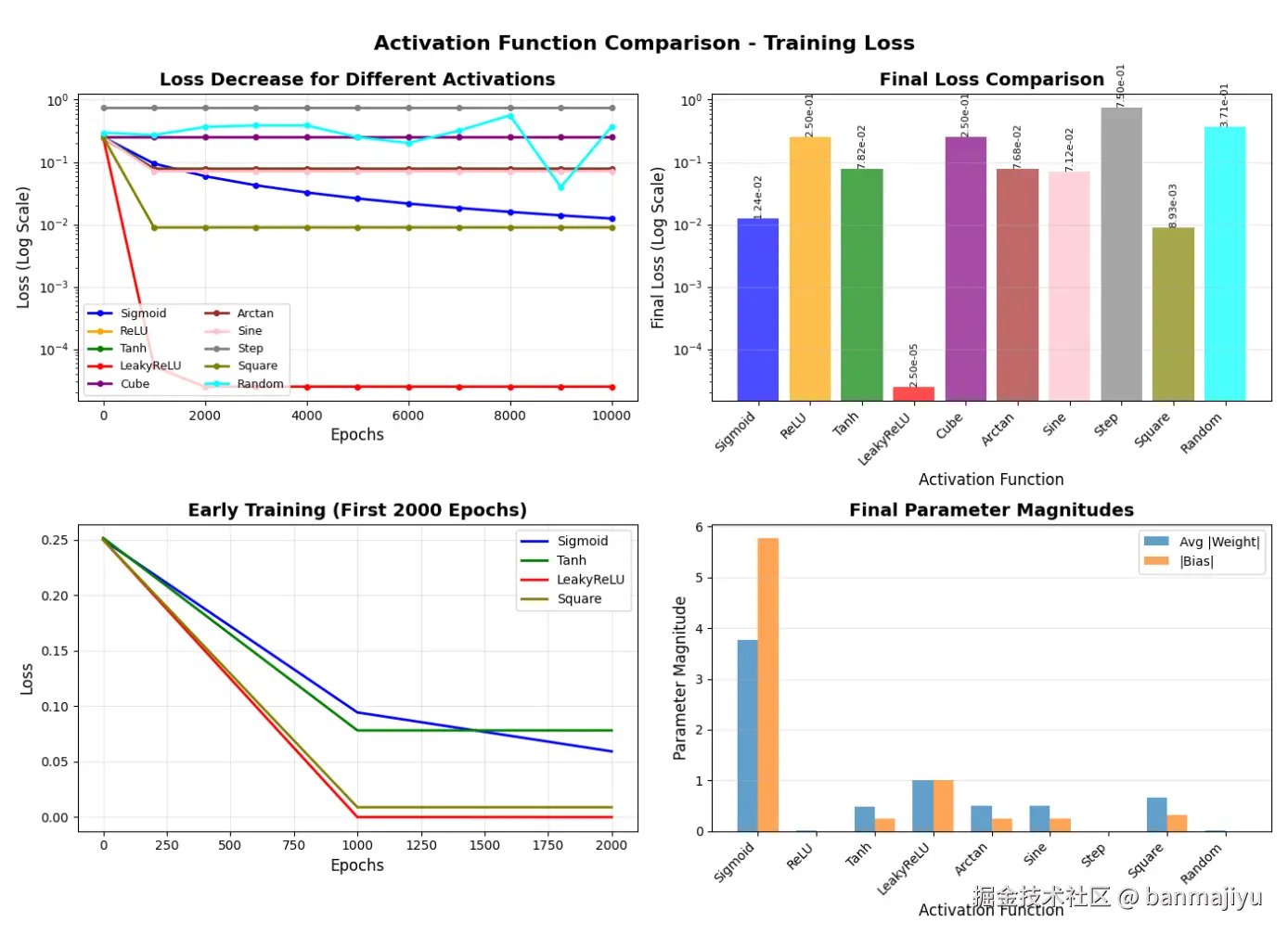
📊 整体评分表
| 激活函数 | 收敛性 | 正确性 | 稳定性 | 学习效率 | 综合评分 | 备注 |
|---|---|---|---|---|---|---|
| Sigmoid | 3/5 | 4/5 | 5/5 | 3/5 | 15/20 | 稳定收敛,正确分类但不够精确 |
| ReLU | 1/5 | 1/5 | 5/5 | 1/5 | 8/20 | 神经元死亡,完全无法学习 |
| Tanh | 3/5 | 2/5 | 5/5 | 3/5 | 13/20 | 稳定收敛但分类错误 |
| LeakyReLU | 5/5 | 5/5 | 5/5 | 5/5 | 20/20 | 最佳表现:快速收敛,完美分类 |
| Cube | 1/5 | 1/5 | 5/5 | 1/5 | 8/20 | 几乎不学习,梯度太小 |
| Arctan | 3/5 | 2/5 | 5/5 | 3/5 | 13/20 | 稳定收敛但分类错误 |
| Sine | 3/5 | 2/5 | 5/5 | 3/5 | 13/20 | 稳定收敛但分类错误 |
| Step | 1/5 | 1/5 | 5/5 | 1/5 | 8/20 | 梯度为0,完全无法学习 |
| Square | 4/5 | 4/5 | 5/5 | 4/5 | 17/20 | 良好收敛,正确分类但不够精确 |
| Random | 1/5 | 1/5 | 1/5 | 1/5 | 4/20 | 完全随机,无学习能力 |
🔍 详细分析
-
Sigmoid-
收敛性:✅ 损失从 0.25稳步降至 0.012,下降趋势良好但速度较慢。
-
参数演变:权重从 ≈0增至 ≈3.77,偏置从 ≈0降至 ≈−5.76,持续增长。
-
正确性:预测值 0.0031,0.1201,0.1201,0.8558,以 0.5为阈值分类完全正确。
-
特点:典型的S形激活函数,输出范围 (0,1)天然适合概率解释。学习率 0.1较合适,但 10000轮仍未完全收敛,可增加轮数。
-
-
ReLU-
收敛性:❌ 完全失败!损失恒为 0.25,从未下降。
-
参数演变:参数几乎不变,训练一开始就停滞。
-
问题根源:神经元死亡。
ReLU在负输入时梯度为 0,而AND运算需要负偏置使 (0,0)、(0,1)、(1,0)输出为负。一旦线性输出为负,ReLU输出 0且梯度为 0,参数无法更新。 -
教训:
ReLU不适合用于单层感知机的输出层,特别当需要负输出时。
-
-
Tanh-
收敛性:✅ 损失从 0.252降至 0.078并稳定。
-
参数演变:权重稳定在 ≈0.49,偏置 ≈−0.245,对称但值较小。
-
正确性:预测值 −0.2405,0.2405,0.2405,0.6268,以0为阈值时分类错误( (0,1)和 (1,0)被预测为正)。
-
分析:Tanh输出范围 (−1,1),但标签为 {0,1},模型尝试将负例映射到负值,但未成功分离 (0,1)和 (1,0)。需要调整标签为 {−1,1}或修改决策阈值。
-
-
LeakyReLU⭐ 最佳表现-
收敛性:✅✅ 极佳!损失从 0.2501迅速降至 2.5e−5。
-
参数演变:权重快速收敛到 ≈1.0,偏置到 ≈−1.0,完美匹配
AND的线性边界 x1+x2−1.5。 -
正确性:预测值 −0.009997,0.0001,0.0001,0.9999,几乎完美匹配 0,0,0,1。
-
优势:
LeakyReLU( α=0.01)允许负梯度流动,避免了ReLU的死亡问题,且保持了ReLU的快速收敛特性。
-
-
Cube-
收敛性:❌ 几乎不学习,损失从 0.25000005降至 0.25000003,变化微乎其微。
-
参数演变:参数变化极小,权重 ≈0.0066,偏置 ≈0.0014。
-
问题:立方函数的梯度为 3x2,当x接近0时梯度极小,导致更新极其缓慢。这是梯度消失的典型案例。
-
教训:单调但导数变化剧烈的激活函数可能导致优化困难。
-
-
Arctan-
收敛性:✅ 类似
Tanh,损失从 0.241降至 0.077并稳定。 -
参数演变:权重 ≈0.498,偏置 ≈−0.249,与
Tanh非常相似。 -
正确性:预测值 −0.2441,0.2441,0.2441,0.6418,同样分类错误。
-
分析:
Arctan也是S形函数,输出范围 (−2π,2π),与Tanh面临相同问题:输出范围不匹配二进制标签。
-
-
Sine-
收敛性:✅ 损失从 0.2505降至 0.0712并稳定。
-
参数演变:权重 ≈0.4957,偏置 ≈−0.2478,与
Tanh/Arctan同一量级。 -
正确性:预测值 −0.2453,0.2453,0.2453,0.6769,分类错误。
-
特点:正弦函数的周期性没有被利用,反而收敛到一个类似
Tanh的平衡点。对于线性可分问题,周期性激活函数没有优势。
-
-
Step-
收敛性:❌ 完全失败,损失恒为 0.75(最差可能值)。
-
参数演变:参数几乎不变,梯度处处为 0。
-
问题:阶跃函数的导数(除 x=0外)为 0,梯度下降完全失效。这是感知机原始算法使用的激活函数,但无法用梯度下降训练。
-
历史意义:1958年
Rosenblatt的感知机使用此函数,但需要特殊学习规则。
-
-
Square-
收敛性:✅ 损失从 0.250 降至 0.00893,收敛良好。
-
参数演变:权重收敛到 ≈−0.6547,偏置 ≈0.3273(注意权重为负)。
-
正确性:预测值 0.1071,0.1071,0.1071,0.9643,以0.5为阈值分类正确。
-
特点:平方函数总是输出非负值,但模型找到了一个解:使 (0,0)、(0,1)、(1,0)输出较小正值, (1,1)输出接近 1。虽然数学上可行,但不够直观。
-
-
Random🤣-
收敛性:❌ 完全随机,损失在 0.04到 0.56之间随机波动。
-
参数演变:参数不变(梯度为 0),但输出每次随机。
-
问题:这不是真正的激活函数,输出与输入无关,完全没有学习能力。仅作为反例存在。
-
📈 警示
-
输出范围的重要性
-
匹配标签范围:
Sigmoid(0,1)、LeakyReLU(允许负值)表现最佳,因为输出范围与二进制标签 {0,1}兼容或能跨越0点。 -
范围不匹配问题:
Tanh、Arctan、Sine输出包含负值,但模型未能将负例映射到负值,因为MSE损失对称惩罚正负误差。
-
-
梯度特性决定学习能力
-
梯度消失:
Cube在 0 附近梯度极小,导致学习停滞。 -
梯度截断:
ReLU在负区间梯度为 0,导致神经元死亡。 -
梯度保持:
LeakyReLU、Sigmoid在所有区域都有非零梯度,学习顺利。
-
-
决策边界可视化
-
成功的激活函数学习到的决策函数:
-
LeakyReLU: f(x)=leaky_relu(x1+x2−1),阈值清晰 -
Sigmoid: f(x)=σ(w1x1+w2x2+b),平滑过渡 -
Square: f(x)=(w1x1+w2x2+b)2,抛物线决策
-
-
-
学习率敏感性
-
所有实验中学习率固定为 0.1
-
Cube需要更小的学习率(梯度变化大) -
ReLU可能需要更大的初始权重避免死亡
-
🎯 实用建议
-
对于简单二分类:
LeakyReLU或Sigmoid是最佳选择。 -
避免使用:
Step(无法梯度下降)、Random(无意义)、Cube(梯度问题)。 -
输出层选择:二分类输出层应用
Sigmoid,配合交叉熵损失而非MSE。 -
初始化重要性:
ReLU的失败部分源于不良初始化,可尝试He初始化。 -
标签编码:使用
Tanh类激活函数时,考虑将标签改为 {−1,1}。
这个实验展示了激活函数对神经网络学习能力的决定性影响。LeakyReLU在本任务中表现完美,而ReLU则因神经元死亡完全失败------这正是深度学习实践中ReLU需要谨慎使用的原因。
🤣谁说Random不行?🤣
激活函数是不会写代码的猴子才需要的,
Random()才是永远的神!
python
import numpy as np

class MonkeyPerceptron:
    def init(self):
        self.weights = None
        self.bias = None
        self.Loss = None

    def sigmoid(self, z):
        return 1 / (1 + np.exp(-z))

    def fit(self, X, y):
        num_samples, num_features = X.shape
        self.weights = np.zeros(num_features)
        self.bias = 0
        _ = 0
        while True:
            rand_weights = np.random.rand(num_features) * 10 # 随机权重
            rand_bias = - np.random.rand() * 50  # 随机偏置
            linear_model = np.dot(X, rand_weights) + rand_bias
            y_predicted = self.sigmoid(linear_model)    # 预测概率
            _ += 1
            loss = -np.mean(y * np.log(y_predicted + 1e-15) + (1 - y) * np.log(1 - y_predicted + 1e-15)) # 计算损失
            if self.Loss is None or loss < self.Loss:  # 更新权重和偏置
                self.Loss = loss
                self.weights = rand_weights
                self.bias = randbias

            print(f"===Epoch {}=== \nLoss: {loss:.6f}, Weight: {rand_weights}, Bias: {randbias}\nBestLoss: {self.Loss:.6f}, BestWeights: {self.weights}, BestBias: {self.bias}")

            if self.Loss is not None and self.Loss < 0.01:  # 如果损失足够小,停止训练
                print(f"最终:Epoch {}, Loss: {self.Loss:.6f}, Weights: {self.weights}, Bias: {self.bias}")
                break

    def predict(self, X):
        linear_model = np.dot(X, self.weights) + self.bias
        y_predicted = self.sigmoid(linear_model)
        y_predicted_cls = [i for i in y_predicted]
        return np.array(y_predicted_cls)

if name == "main":
    X = np.array([[0, 0],
                  [0, 1],
                  [1, 0],
                  [1, 1]])
    y = np.array([0, 0, 0, 1])  # labels

    perceptron = MonkeyPerceptron()
    perceptron.fit(X, y)
    res = perceptron.predict(X)
    print("Predictions:", res)
训练结果(训练用时 0.0s)(别问我刷了多久🤣):
python
===Epoch 1===
Loss: 1.972791, Weight: [5.30602216 5.40416736], Bias: -1.5292279253220298
BestLoss: 1.972791, BestWeights: [5.30602216 5.40416736], BestBias: -1.5292279253220298
===Epoch 2===
Loss: 0.287885, Weight: [3.10076394 2.30376275], Bias: -6.063241275953091
BestLoss: 0.287885, BestWeights: [3.10076394 2.30376275], BestBias: -6.063241275953091
===Epoch 3===
Loss: 1.992203, Weight: [0.74941079 6.26557104], Bias: -14.983283585555174
BestLoss: 0.287885, BestWeights: [3.10076394 2.30376275], BestBias: -6.063241275953091
===Epoch 4===
Loss: 0.241579, Weight: [9.79877349 2.36787043], Bias: -12.55242733698611
BestLoss: 0.241579, BestWeights: [9.79877349 2.36787043], BestBias: -12.55242733698611
===Epoch 5===
Loss: 4.968945, Weight: [3.57131294 2.20885872], Bias: -25.65595066981524
BestLoss: 0.241579, BestWeights: [9.79877349 2.36787043], BestBias: -12.55242733698611
===Epoch 6===
Loss: 6.923904, Weight: [7.98137279 6.85191969], Bias: -42.529975532939034
BestLoss: 0.241579, BestWeights: [9.79877349 2.36787043], BestBias: -12.55242733698611
===Epoch 7===
Loss: 1.595178, Weight: [0.18703687 6.04751624], Bias: -0.6114760434528632
BestLoss: 0.241579, BestWeights: [9.79877349 2.36787043], BestBias: -12.55242733698611
===Epoch 8===
Loss: 1.949835, Weight: [7.42283631 4.89233456], Bias: -2.344499180233811
BestLoss: 0.241579, BestWeights: [9.79877349 2.36787043], BestBias: -12.55242733698611
===Epoch 9===
Loss: 4.815745, Weight: [1.33092208 7.4939571 ], Bias: -28.087861342745196
BestLoss: 0.241579, BestWeights: [9.79877349 2.36787043], BestBias: -12.55242733698611
===Epoch 10===
Loss: 8.634688, Weight: [0.03286126 3.13750956], Bias: -48.27619183591643
BestLoss: 0.241579, BestWeights: [9.79877349 2.36787043], BestBias: -12.55242733698611
===Epoch 11===
Loss: 8.628221, Weight: [0.08143696 7.54346519], Bias: -45.804449939873436
BestLoss: 0.241579, BestWeights: [9.79877349 2.36787043], BestBias: -12.55242733698611
===Epoch 12===
Loss: 0.543617, Weight: [2.68455094 3.80666757], Bias: -8.53157179318768
BestLoss: 0.241579, BestWeights: [9.79877349 2.36787043], BestBias: -12.55242733698611
===Epoch 13===
Loss: 0.807674, Weight: [8.3456054  3.90103381], Bias: -5.376559159273797
BestLoss: 0.241579, BestWeights: [9.79877349 2.36787043], BestBias: -12.55242733698611
===Epoch 14===
Loss: 1.459065, Weight: [1.39063704 4.99957087], Bias: -12.222789575320242
BestLoss: 0.241579, BestWeights: [9.79877349 2.36787043], BestBias: -12.55242733698611
===Epoch 15===
Loss: 0.850952, Weight: [3.25187802 4.58642412], Bias: -2.513101815708141
BestLoss: 0.241579, BestWeights: [9.79877349 2.36787043], BestBias: -12.55242733698611
===Epoch 16===
Loss: 0.007776, Weight: [8.68447349 9.90531883], Bias: -14.71906951169743
BestLoss: 0.007776, BestWeights: [8.68447349 9.90531883], BestBias: -14.71906951169743
最终:Epoch 16, Loss: 0.007776, Weights: [8.68447349 9.90531883], Bias: -14.71906951169743
Predictions: [4.05125105e-07 8.05199600e-03 2.38874388e-03 9.79582275e-01]
嘻嘻☺️
单层感知机的缺陷
小实验
我们来用刚刚的单层感知机来训练异或问题,训练一百万轮,学习率为 0.1,激活函数用
Sigmoid。
python
import numpy as np

class LogisticRegression:
    def init(self, learning_rate=0.1, epochs=100):
        self.learning_rate = learning_rate
        self.epochs = epochs
        self.weights = None
        self.bias = None

    def sigmoid(self, z):
        return 1 / (1 + np.exp(-z))

    def fit(self, X, y):
        num_samples, num_features = X.shape
        self.weights = np.zeros(num_features)
        self.bias = 0

        for _ in range(self.epochs+1):    # 迭代训练
            linear_model = np.dot(X, self.weights) + self.bias
            y_predicted = self.sigmoid(linear_model)

            dw = (1 / num_samples) * np.dot(X.T, (y_predicted - y))
            db = (1 / num_samples) * np.sum(y_predicted - y)

            self.weights -= self.learning_rate * dw
            self.bias -= self.learning_rate * db

            if _ % 100000 == 0:  # 每10万次迭代输出一次损失
                loss = -np.mean(y * np.log(y_predicted + 1e-15) + (1 - y) * np.log(1 - ypredicted + 1e-15)) # 加上小常数避免log(0)
                print(f'Epoch {}, Loss: {loss}, Weights: {self.weights}, Bias: {self.bias}, predicted: {y_predicted}')

    def predict(self, X):
        linear_model = np.dot(X, self.weights) + self.bias
        y_predicted = self.sigmoid(linear_model)
        y_predicted_cls = [i for i in y_predicted]
        return np.array(y_predicted_cls)

# 训练异或问题
if name == "main":
    # dataset
    X = np.array([[0, 0],
                  [0, 1],
                  [1, 0],
                  [1, 1]])
    y = np.array([0, 1, 1, 0])  # labels

    model = LogisticRegression(epochs=1000000, learning_rate=0.1)
    model.fit(X, y)
    predictions = model.predict(X)
    print("Predictions:", predictions)
训练时长 7.5s,结果如下:
python
Epoch 0, Loss: 0.6931471805599433, Weights: [0. 0.], Bias: 0.0, predicted: [0.5 0.5 0.5 0.5]
Epoch 100000, Loss: 0.6931471805599433, Weights: [0. 0.], Bias: 0.0, predicted: [0.5 0.5 0.5 0.5]
Epoch 200000, Loss: 0.6931471805599433, Weights: [0. 0.], Bias: 0.0, predicted: [0.5 0.5 0.5 0.5]
Epoch 300000, Loss: 0.6931471805599433, Weights: [0. 0.], Bias: 0.0, predicted: [0.5 0.5 0.5 0.5]
Epoch 400000, Loss: 0.6931471805599433, Weights: [0. 0.], Bias: 0.0, predicted: [0.5 0.5 0.5 0.5]
Epoch 500000, Loss: 0.6931471805599433, Weights: [0. 0.], Bias: 0.0, predicted: [0.5 0.5 0.5 0.5]
Epoch 600000, Loss: 0.6931471805599433, Weights: [0. 0.], Bias: 0.0, predicted: [0.5 0.5 0.5 0.5]
Epoch 700000, Loss: 0.6931471805599433, Weights: [0. 0.], Bias: 0.0, predicted: [0.5 0.5 0.5 0.5]
Epoch 800000, Loss: 0.6931471805599433, Weights: [0. 0.], Bias: 0.0, predicted: [0.5 0.5 0.5 0.5]
Epoch 900000, Loss: 0.6931471805599433, Weights: [0. 0.], Bias: 0.0, predicted: [0.5 0.5 0.5 0.5]
Epoch 1000000, Loss: 0.6931471805599433, Weights: [0. 0.], Bias: 0.0, predicted: [0.5 0.5 0.5 0.5]
Predictions: [0.5 0.5 0.5 0.5]单层感知机一败涂地😰,完全无法学习XOR(异或)运算。
观察:
-
损失纹丝不动:
-
100万次迭代后,
Loss始终保持在 0.693147(交叉熵损失的初始值) -
这是完全随机猜测的损失值(预测概率恒为 0.5)
-
参数从未更新:
-
权重始终为 0,0,偏置始终为 0
-
梯度下降从未发生,模型完全没有学习
-
-
预测值恒定:
-
对所有输入 (0,0),(0,1),(1,0),(1,1)都输出 0.5
-
相当于抛硬币随机猜测
-
根本原因
XOR问题是线性不可分 的。单层感知机(无隐藏层)只能学习线性决策边界 ,而XOR的真值表:
(0,0)→0(0,1)→1(1,0)→1(1,1)→0
在二维平面上无法用一条直线将 0 和 1 分开。无论怎么调整权重和偏置,单层感知机永远无法解决XOR。🤔
数学解释
对于XOR,不存在权重 w1,w2 和偏置 b 使得:
sigmoid(w1⋅0+w2⋅0+b)≈0sigmoid(w1⋅0+w2⋅1+b)≈1sigmoid(w1⋅1+w2⋅0+b)≈1sigmoid(w1⋅1+w2⋅1+b)≈0
同时成立
历史意义
这正是
Marvin Minsky在1969年指出的单层感知机的根本局限,直接导致了AI的第一个寒冬。要解决XOR,必须引入隐藏层(多层感知机),这也是深度学习兴起的起点。
多层感知机
一、基本概念
1. 什么是MLP?
MLP(Multi-Layer Perceptron,多层感知机)是最基础的深度学习模型,也是全连接神经网络 (FNN) 的典型代表,由多层感知机神经元 堆叠而成,核心作用是拟合复杂的非线性映射关系,可完成分类、回归、特征学习等任务。
-
本质:
MLP突破了单层感知机只能拟合线性边界的局限,通过隐藏层 +非线性激活函数,实现对任意复杂非线性函数的逼近。 -
MLP是层级化、全连接 的神经网络结构,层与层之间无跳过、无循环,神经元之间全连接(相邻层的任意两个神经元都有连接),是最基础的前馈神经网络,由至少三层神经元组成:-
输入层:接收原始数据
-
至少一个隐藏层:进行特征变换,把原始输入空间变换到另一个特征空间,使得在新空间中数据变得线性可分
-
输出层:产生最终预测
-
2. 为什么需要MLP?
刚才的实验完美展示了单层感知机的致命缺陷:无法解决线性不可分问题(如XOR)。MLP通过引入隐藏层和非线性激活函数,可以学习任意复杂的非线性决策边界。
二、MLP的数学原理
1. 网络结构
python
输入层 (d维) → 隐藏层 (h维) → 输出层 (k维)
      x ∈ ℝ^d     h ∈ ℝ^h     y ∈ ℝ^k
2. 前向传播公式
对于两层MLP(一个隐藏层):
第1层(输入→隐藏):
python
z[1] = W[1]·x + b[1]      # 线性变换
a[1] = σ(z[1])           # 非线性激活
第2层(隐藏→输出):
python
z[2] = W[2]·a[1] + b[2]    # 线性变换
a[2] = σ(z[2])           # 输出激活
其中:
-
W1∈Rh×d,b1∈Rh:隐藏层参数
-
W2∈Rk×h,b2∈Rk:输出层参数
-
σ:激活函数(如
ReLU、Sigmoid等)
3. 为什么能解决XOR问题?
-
几何解释:单层感知机只能画一条直线分割平面,而
MLP可以画多条直线组合成曲线。 -
XOR的MLP解决方案(最小结构):
python
输入(2) → 隐藏层(2神经元) → 输出(1)
激活函数:ReLU
权重配置:
隐藏层:
  神经元1: w = [1, -1], b = -0.5  → 检测 x1=1且x2=0
  神经元2: w = [-1, 1], b = -0.5  → 检测 x1=0且x2=1
输出层:
  神经元: w = [1, 1], b = -1  → 组合隐藏层结果
三、核心组件
1. 激活函数(关键突破)
| 函数 | 公式 | 特点 | 适用场景 |
|---|---|---|---|
ReLU |
max(0,x) | 计算简单,缓解梯度消失 | 隐藏层默认选择 |
Sigmoid |
1+e−x1 | 输出 (0,1),易饱和 | 二分类输出层 |
Tanh |
ex+e−xex−e−x | 输出 (−1,1),以 0为中心 | RNN隐藏层 |
Leaky ReLU |
max(αx,x) | 解决"死亡ReLU" |
深度网络 |
-
激活函数的作用:
-
引入非线性 → 使网络能拟合任意函数
-
决定信息如何传递 → 不同的激活函数有不同的特性
-
2. 损失函数
| 任务类型 | 常用损失函数 | 公式 |
|---|---|---|
| 二分类 | 二元交叉熵 | L=−y⋅log(y\^)+(1−y)⋅log(1−y\^) |
| 多分类 | 交叉熵 | L=−∑yi⋅log(y^i) |
| 回归 | 均方误差 | L=n1∑(y−y^i)2 |
3. 反向传播算法
反向传播(Backpropagation) 是MLP训练的核心:
python
# 前向传播
z1 = W1·x + b1
a1 = σ(z1)
z2 = W2·a1 + b2
a2 = σ(z2)
loss = L(a2, y)

# 反向传播(链式法则)
dL/dz2 = dL/da2 * σ'(z2)      # 输出层梯度
dL/dW2 = dL/dz2 · a1ᵀ          # 输出层权重梯度
dL/db2 = dL/dz2               # 输出层偏置梯度

dL/dz1 = (W2ᵀ·dL/dz2) * σ'(z1) # 隐藏层梯度
dL/dW1 = dL/dz1 · xᵀ           # 隐藏层权重梯度
dL/db1 = dL/dz1               # 隐藏层偏置梯度

# 参数更新(梯度下降)
W1 = W1 - η·dL/dW1
b1 = b1 - η·dL/db1
W2 = W2 - η·dL/dW2
b2 = b2 - η·dL/db2
四、MLP的Python实现
框架(纯手工,丑勿喷):
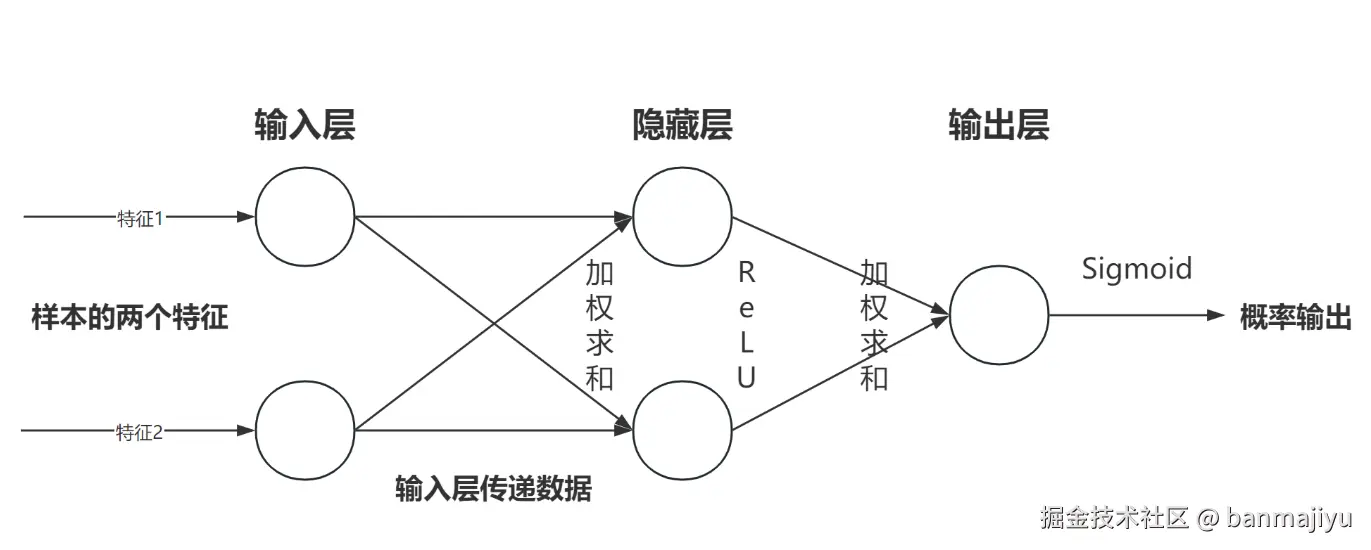
输入层 包含两个神经元,它们的功能是将数据直接传递给隐藏层神经元 ,由于XOR问题有两个输入数据( 2个特征),所以需要两个输入层神经元。
隐藏层 也包含两个神经元,每个神经元相当于一个单层感知机 ,激活函数是ReLU。
输出层 包含一个神经元,激活函数是Sigmoid,作用是最终输出预测概率。
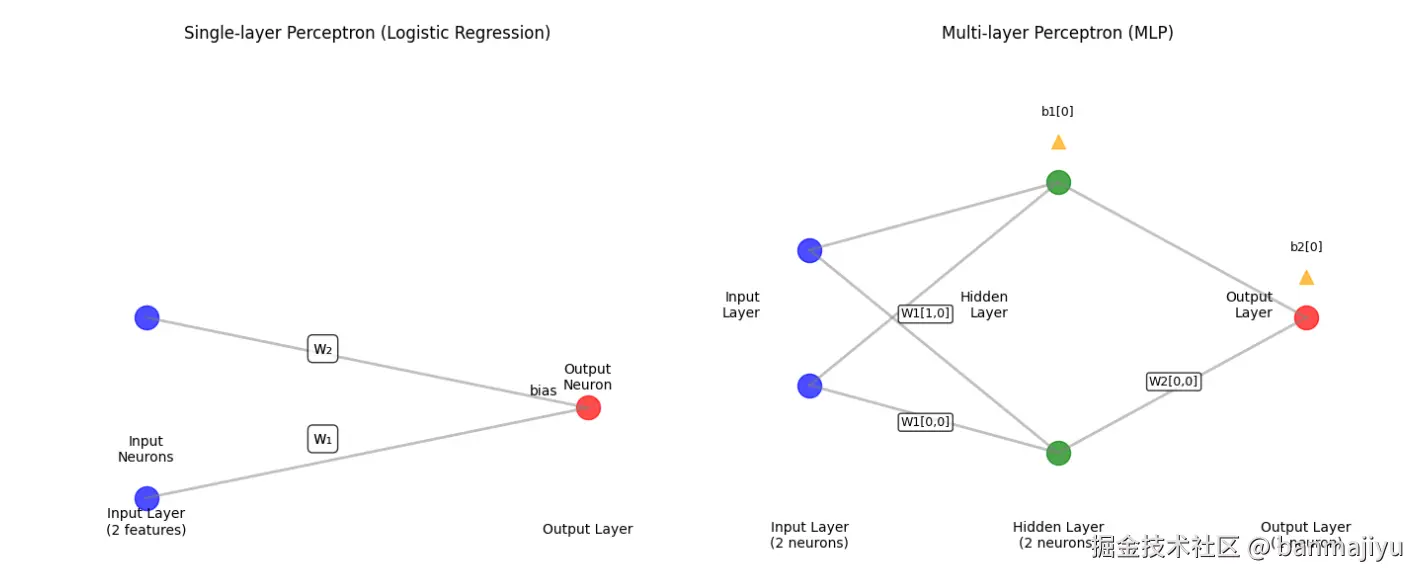
参数的作用是建立层与层之间的联系 。在单层感知机中,参数简单地连接了输入和输出,也就是说参数属于整个模型。而MLP中,输入层和输出层之间还有一个隐藏层,因此需要两组参数来分别连接输入层与隐藏层、隐藏层与输出层,参数属于层与层之间的连接,形成层级结构。
-
每个权重矩阵负责将前一层的输出转换为下一层的输入
-
W1将输入特征转换为隐藏层特征
-
W2将隐藏层特征转换为最终输出
-
这种设计允许网络学习多层特征表示
python
import numpy as np

class MLP:
    def init(self, input_size, hidden_size, output_size, learning_rate=0.1):
        # 初始化参数
        self.W1 = np.random.randn(hidden_size, input_size) * 0.01   # 输入层到隐藏层的权重
        self.b1 = np.zeros((hidden_size, 1))                        # 输入层到隐藏层的偏置
        self.W2 = np.random.randn(output_size, hidden_size) * 0.01  # 隐藏层到输出层的权重
        self.b2 = np.zeros((output_size, 1))                        # 隐藏层到输出层的偏置
        self.lr = learning_rate                                     # 学习率

    def relu(self, x):  # ReLU激活函数,用于隐藏层
        return np.maximum(0, x)

    def relu_derivative(self, x):   # ReLU导数
        return (x > 0).astype(float)

    def sigmoid(self, x):   # Sigmoid函数,用于输出层
        return 1 / (1 + np.exp(-x))

    def forward(self, X):
        # 前向传播
        self.Z1 = np.dot(self.W1, X) + self.b1  # 隐藏层线性变换
        self.A1 = self.relu(self.Z1)    # 隐藏层激活
        self.Z2 = np.dot(self.W2, self.A1) + self.b2    # 输出层线性变换
        self.A2 = self.sigmoid(self.Z2) # 输出层激活
        return self.A2  # 返回输出层的激活值

    def backward(self, X, y, output):
        # 计算样本数
        m = X.shape[1]

        # 输出层梯度
        dZ2 = output - y    # 输出层误差
        dW2 = (1/m) * np.dot(dZ2, self.A1.T)    # 输出层权重梯度
        db2 = (1/m) * np.sum(dZ2, axis=1, keepdims=True)    # 输出层偏置梯度

        # 隐藏层梯度
        dA1 = np.dot(self.W2.T, dZ2)    # 输出层误差反向传播到隐藏层
        dZ1 = dA1 * self.relu_derivative(self.Z1)   # 隐藏层误差乘以ReLU导数
        dW1 = (1/m) * np.dot(dZ1, X.T)  # 隐藏层权重梯度
        db1 = (1/m) * np.sum(dZ1, axis=1, keepdims=True)    # 隐藏层偏置梯度

        # 更新参数
        self.W2 -= self.lr * dW2    # 更新隐藏层到输出层的权重
        self.b2 -= self.lr * db2    # 更新隐藏层到输出层的偏置
        self.W1 -= self.lr * dW1    # 更新输入层到隐藏层的权重
        self.b1 -= self.lr * db1    # 更新输入层到隐藏层的偏置

    def compute_loss(self, y, output):
        # 交叉熵损失
        m = y.shape[1]  # 样本数量
        loss = -(1/m) * np.sum(y * np.log(output) + (1-y) * np.log(1-output))
        return loss

    def train(self, X, y, epochs=10000):
        losses = []
        for epoch in range(epochs):
            # 前向传播
            output = self.forward(X)

            # 计算损失
            loss = self.compute_loss(y, output)
            losses.append(loss)

            # 反向传播,更新参数
            self.backward(X, y, output)

            if epoch % 1000 == 0:
                print(f"Epoch {epoch}, Loss: {loss:.6f}")

        return losses

# 测试XOR问题
def test_xor():
    # XOR数据
    X = np.array([[0, 0, 1, 1],
                  [0, 1, 0, 1]])  # 2×4
    y = np.array([[0, 1, 1, 0]])  # 1×4

    # 创建MLP:2输入 → 2隐藏神经元 → 1输出
    mlp = MLP(input_size=2, hidden_size=2, output_size=1, learning_rate=0.1)

    # 训练
    losses = mlp.train(X, y, epochs=10000)

    # 预测
    predictions = mlp.forward(X)
    print("\nXOR预测结果:")
    print(f"输入 (0,0): {predictions[0,0]:.4f} → 舍入: {round(predictions[0,0])}")
    print(f"输入 (0,1): {predictions[0,1]:.4f} → 舍入: {round(predictions[0,1])}")
    print(f"输入 (1,0): {predictions[0,2]:.4f} → 舍入: {round(predictions[0,2])}")
    print(f"输入 (1,1): {predictions[0,3]:.4f} → 舍入: {round(predictions[0,3])}")

if name == "main":
    test_xor()
训练结果:
python
Epoch 0, Loss: 0.693131
Epoch 1000, Loss: 0.061531
Epoch 2000, Loss: 0.013892
Epoch 3000, Loss: 0.007434
Epoch 4000, Loss: 0.005013
Epoch 5000, Loss: 0.003756
Epoch 6000, Loss: 0.002995
Epoch 7000, Loss: 0.002485
Epoch 8000, Loss: 0.002121
Epoch 9000, Loss: 0.001847

XOR预测结果:
输入 (0,0): 0.0028 → 舍入: 0
输入 (0,1): 0.9995 → 舍入: 1
输入 (1,0): 0.9995 → 舍入: 1
输入 (1,1): 0.0028 → 舍入: 0五、MLP的优缺点
优点
-
万能近似定理:单隐藏层
MLP可近似任意连续函数 -
可解释性:相比
CNN/RNN更易理解 -
灵活架构:可任意调整层数、神经元数
-
并行计算友好:全连接结构适合GPU加速
缺点
-
参数量爆炸:输入维度高时,参数量巨大(全连接)
-
容易过拟合:需要大量正则化技术
-
梯度问题:深层网络易梯度消失/爆炸
-
局部最优:非凸优化,易陷局部最小值
总结
XOR问题揭示了单层感知机的缺陷,也凸显了多层感知机的强大。然后没什么好总结的了......
预告:下一篇文章将聚焦MLP的应用......