目录
[路径总和 III](#路径总和 III)
【LeetCode | 第五篇】算法笔记 https://blog.csdn.net/h52412224/article/details/159043914
【LeetCode | 第四篇】算法笔记https://blog.csdn.net/h52412224/article/details/159018487【LeetCode | 第三篇】算法笔记https://blog.csdn.net/h52412224/article/details/158689782?spm=1001.2014.3001.5502【LeetCode | 第二篇】算法笔记https://blog.csdn.net/h52412224/article/details/158467673?spm=1001.2014.3001.5502【LeetCode | 第一篇】算法笔记https://blog.csdn.net/h52412224/article/details/157903186
二叉树
二叉树二叉树展开为链表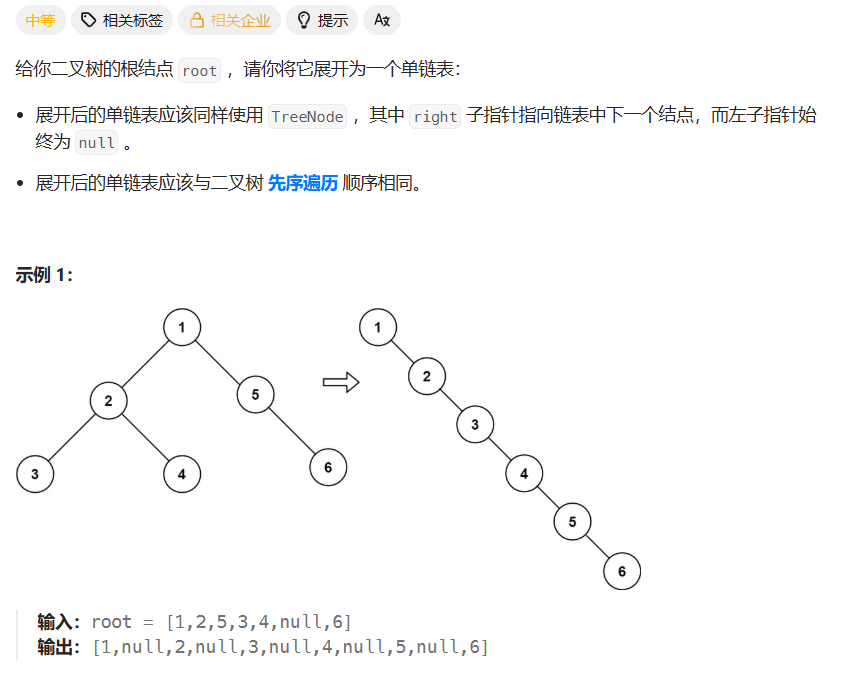
思路1: 递归
java
class Solution {
    public void flatten(TreeNode root) {
        // 递归终止条件:空节点或叶子节点无需处理
        if (root == null ) {
            return;
        }
        // 1. 递归展开左子树
        flatten(root.left);
        // 2. 递归展开右子树
        flatten(root.right);
        // 3. 保存原右子树(后续要接到左子树的最右侧)
        TreeNode tempRight = root.right;
        // 4. 将展开后的左子树移到右指针位置,左指针置空
        root.right = root.left;
        root.left = null;

        // 5. 找到新右子树(原左子树)的最右侧节点
        TreeNode current = root;
        while (current.right != null) {
            current = current.right;
        }
        // 6. 将原右子树接到最右侧节点的右指针上
        current.right = tempRight;
    }
}
思路2: 递归 后序
-
展开规则:原树 → 单链表,顺序为前序遍历,所有右指针串联,左指针为 null。
-
后序递归:先处理右子树,再处理左子树,最后处理根。
-
记录上一个节点,将当前节点右指针指向上一节点,左指针置空。
java
class Solution {
    private TreeNode prev = null;
    public void flatten(TreeNode root) {
        if (root == null) return;
        flatten(root.right); // 先右
        flatten(root.left);  // 再左
        // 拼接
        root.right = prev;
        root.left = null;
        prev = root;
    }
}
从前序与中序遍历序列构造二叉树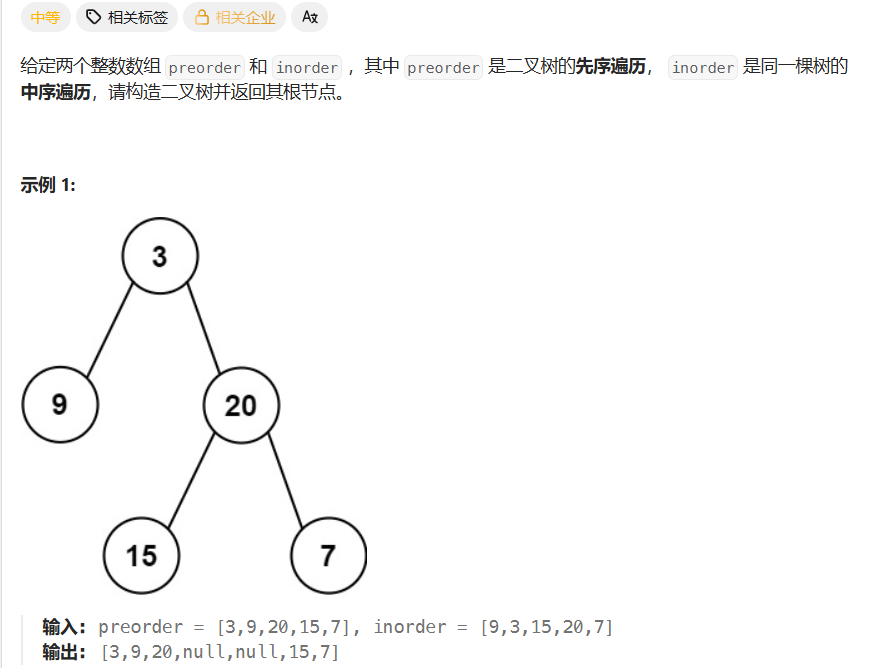
思路: 递归 分治
-
前序遍历:根 → 左 → 右;中序遍历:左 → 根 → 右。
-
前序第一个节点为根,在中序中找到根的位置,划分左、右子树区间。
-
递归构建左、右子树,用哈希表快速定位根在中序的下标。
java
class Solution {
    private Map<Integer, Integer> inMap;
    public TreeNode buildTree(int[] preorder, int[] inorder) {
        inMap = new HashMap<>();
        for (int i = 0; i < inorder.length; i++) {
            inMap.put(inorder[i], i); // 中序值→下标
        }
        return build(preorder, 0, preorder.length-1, inorder, 0, inorder.length-1);
    }
    // pre: [preL, preR], in: [inL, inR]
    private TreeNode build(int[] pre, int preL, int preR, int[] in, int inL, int inR) {
        if (preL > preR) return null;
        int rootVal = pre[preL]; // 前序首为根
        TreeNode root = new TreeNode(rootVal);
        int mid = inMap.get(rootVal); // 中序根位置
        int leftLen = mid - inL;      // 左子树长度

        // 递归左、右
        root.left = build(pre, preL+1, preL+leftLen, in, inL, mid-1);
        root.right = build(pre, preL+leftLen+1, preR, in, mid+1, inR);
        return root;
    }
}
路径总和 III
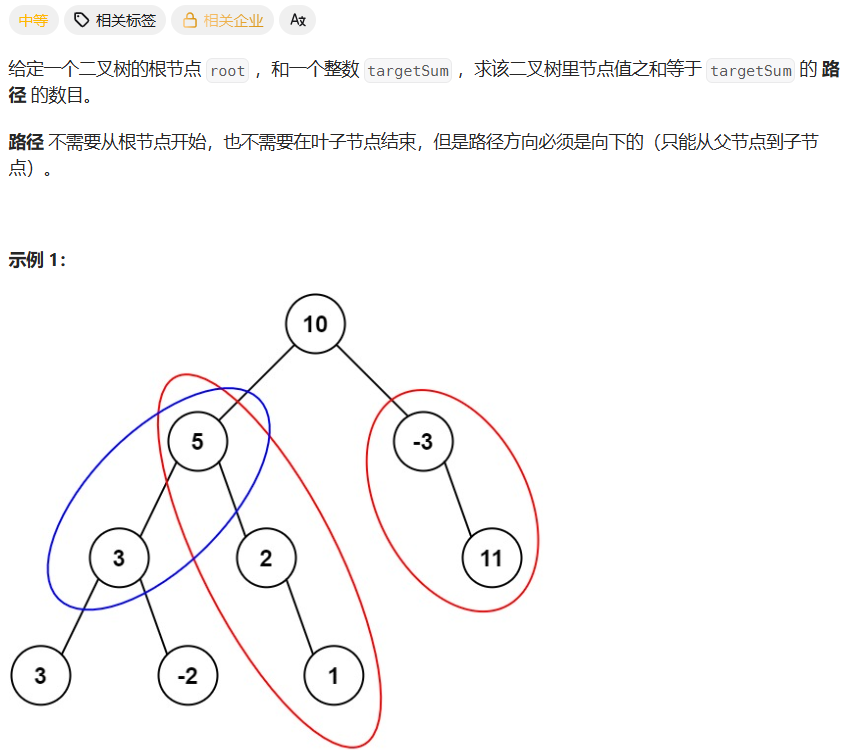

思路1:前缀和 + 哈希表
-
路径为任意向下路径,用前缀和记录从根到当前节点的和。
-
哈希表存储前缀和出现次数,当前和 - 目标和 = 历史前缀和,次数即为路径数。
-
回溯:递归返回时移除当前前缀和,避免影响其他分支。
java
class Solution {
    private Map<Long, Integer> preMap;
    private int count;
    public int pathSum(TreeNode root, int targetSum) {
        preMap = new HashMap<>();
        preMap.put(0L, 1); // 前缀和0出现1次
        count = 0;
        dfs(root, 0, targetSum);
        return count;
    }

    private void dfs(TreeNode node, long sum, int target) {
        if (node == null) return;
        sum += node.val;
        // 查找历史前缀和
        count += preMap.getOrDefault(sum - target, 0);
        preMap.put(sum, preMap.getOrDefault(sum, 0) + 1);

        dfs(node.left, sum, target);
        dfs(node.right, sum, target);

        // 回溯
        preMap.put(sum, preMap.get(sum) - 1);
    }
}
思路2:双重 递归
-
外层递归遍历每个节点作为路径起点。
-
内层递归从起点向下,累加和,等于目标则计数。
-
时间复杂度 O (n²),空间 O (h)。
java
class Solution {
    public int pathSum(TreeNode root, int targetSum) {
        if (root == null) return 0;
        // 当前节点为起点 + 左子树 + 右子树
        return dfs(root, targetSum)
             + pathSum(root.left, targetSum)
             + pathSum(root.right, targetSum);
    }
    // 以node为起点,向下找路径
    private int dfs(TreeNode node, long target) {
        if (node == null) return 0;
        int res = 0;
        if (node.val == target) res++;
        res += dfs(node.left, target - node.val);
        res += dfs(node.right, target - node.val);
        return res;
    }
}
二叉树的最近公共祖先
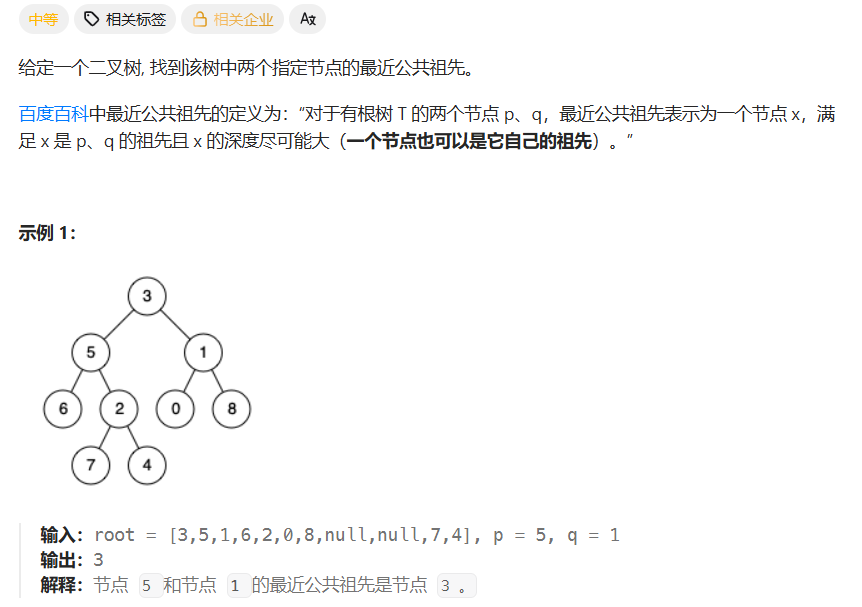
思路1: 递归
-
后序遍历:左、右、根。
-
若当前节点为 p/q,返回当前节点;若左右子树各找到一个,当前为祖先;否则返回找到的一侧。
java
class Solution {
    public TreeNode lowestCommonAncestor(TreeNode root, TreeNode p, TreeNode q) {
        if(root == null || root == p || root == q){
            return root;
        }
        TreeNode left = lowestCommonAncestor(root.left, p, q);
        TreeNode right = lowestCommonAncestor(root.right, p, q);
        if(left == null && right == null) { // 若未找到节点 p 或 q
            return null;
        }else if(left == null && right != null) { // 若找到一个节点
            return right;
        }else if(left != null && right == null) { // 若找到一个节点
            return left;
        }else { // 若找到两个节点
            return root;
        }
    }
}
二叉树中的最大路径和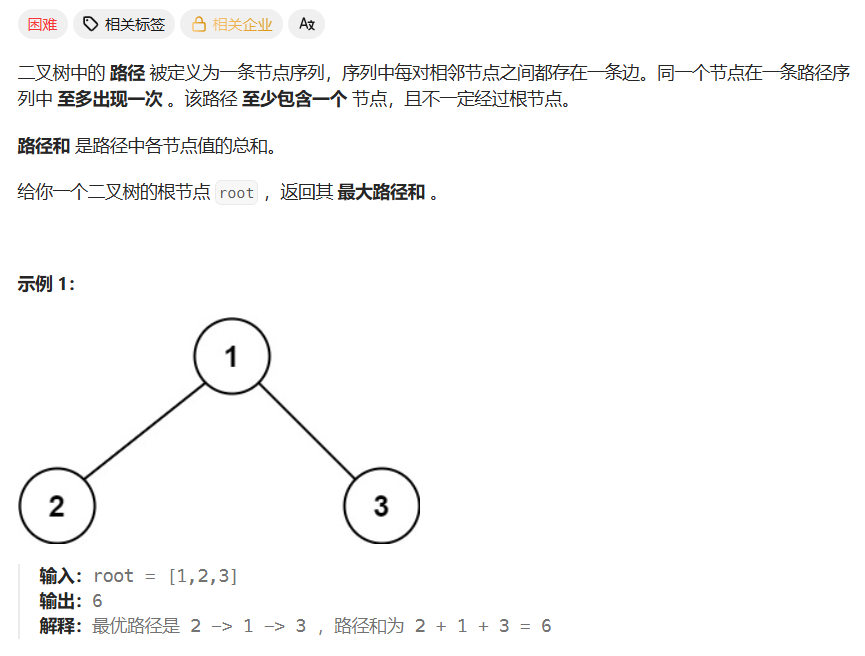
思路: 递归 后序
-
路径可任意拐弯,最大路径 = 左贡献 + 根 + 右贡献。
-
递归返回当前节点向上的最大贡献(max (左,右)+ 根)。
-
全局变量记录遍历过程中的最大路径和。
java
class Solution {
    private int maxSum = Integer.MIN_VALUE;
    public int maxPathSum(TreeNode root) {
        dfs(root);
        return maxSum;
    }
    private int dfs(TreeNode node) {
        if (node == null) {
            return 0;
        }
        // 计算左子树最大贡献值(若为负数则取0,舍弃该子树)
        int leftGain = Math.max(dfs(node.left), 0);
        // 计算右子树
        int rightGain = Math.max(dfs(node.right), 0);
        // 计算以当前节点为顶点的路径和(左右子树都包含,是一个完整的路径)
        int currentPathSum = node.val + leftGain + rightGain;
        // 更新全局最大路径和
        maxSum = Math.max(maxSum, currentPathSum);
        // 返回以当前节点为起点的最大贡献值(只能选左或右一个方向,因为路径是单向的)
        return node.val + Math.max(leftGain, rightGain);
    }
}
上述内容也同步在我的飞书,欢迎访问
https://my.feishu.cn/wiki/QLauws6lWif1pnkhB8IcAvkhncc?from=from_copylink
如果我的内容对你有帮助,请点赞,评论,收藏。创作不易,你们的支持就是我坚持下去的动力!