目录
[single recursion和multi recursion](#single recursion和multi recursion)
认识递归
递归的定义
计算机科学中,递归是一种解决计算问题的方法,其中解决方案取决于同一类问题的更小子集
三个重点,如下
- 自己调用自己,如果每个函数对应着一种解决方案,那么自己调用自己代表着解决方案一样
- 每次调用,函数处理的数据量和上次比较会缩减,且最后会缩减至无需继续递归(即要有结束条件)
- 子集(内层函数)处理完成,外层函数才能算是调用完成
利用递归实现几个小案例
链表的遍历
java
package algorithm.list;

import java.util.function.Consumer;

/**
 * 这里主要介绍两种遍历方法
 * 1、方式一:通过Consumer函数式接口
 * 2、方式二:递归
 */
public class ListForEach {
    public static void main(String[] args) {
        // 获取到链表的头节点,然后进行遍历
        Node head = getHead();
        // 遍历方式一
        foreachOneWay(head, System.out::println);
        System.out.println("-------------");
        // 遍历方式二
        foreachTwoWay(head);
    }

    /**
     * 遍历方式一:通过调用方控制,传入一个函数式接口
     */
    public static void foreachOneWay(Node head, Consumer<Integer> consumer) {
        if (head == null) return;
        for (Node p = head; p != null; ) {
            consumer.accept(p.val);
            p = p.next;
        }
    }

    /**
     * 遍历方式二:递归
     */
    public static void foreachTwoWay(Node head) {
        if (head == null) return;
        recursion(head);
    }

    /**
     * 递归函数
     */
    private static void recursion(Node curr) {
        if (curr == null)
            return;
        System.out.println(curr.val);
        recursion(curr.next);
        // 如果在这里打印,就是倒序遍历的结果
        // System.out.println(curr.val);
    }

    /**
     * 返回链表的头节点
     */
    public static Node getHead() {
        Node head = new Node(5);
        Node node1 = new Node(2);
        head.next = node1;
        Node node2 = new Node(1);
        node1.next = node2;
        Node node3 = new Node(3);
        node2.next = node3;
        Node node4 = new Node(4);
        node3.next = node4;
        return head;
    }

    private static class Node {
        int val;
        Node next;

        public Node() {
        }

        public Node(int val) {
            this.val = val;
        }

        public Node(int val, Node next) {
            this.val = val;
            this.next = next;
        }
    }
}
反转字符串
java
package algorithm.recursion;

/**
 * 通过递归的方式反转字符串
 */
public class ReserveString {
    public static void main(String[] args) {
        String oldData = "zxvcd463c3iou";
        String newData = reserveString(oldData);
        System.out.println(newData);
    }

    /**
     * 实现字符串的反转
     * 返回值是一个新的字符串,是参数反转后的结果
     */
    public static String reserveString(String data) {
        if (data == null || data.length() == 0)
            return data;
        StringBuilder result = recursion(new StringBuilder(), data, 0);
        return result.toString();
    }

    /**
     * 递归函数
     */
    private static StringBuilder recursion(StringBuilder builder, String data, int index) {
        if (index >= data.length()) {
            return builder;
        }
        recursion(builder, data, index + 1);
        builder.append(data.charAt(index));
        return builder;
    }
}
求N的阶乘
java
package algorithm.recursion;

public class Factorial {
    public static void main(String[] args) {
        for (int i = 0; i < 10; i++) {
            System.out.println(factorial(i));
        }
    }

    /**
     * 求非负整数的阶乘
     */
    public static int factorial(int n) {
        if (n < 0) {
            throw new IllegalArgumentException("非法参数");
        }
        if (n == 0 || n == 1) {
            return 1;
        }
        return n * factorial(n - 1);
    }
}
思路总结
- 确定能否使用递归进行求解
- 推导出递推关系,即父问题和子问题的关系以及递归的结束条件
多路递归
single recursion和multi recursion
- 上述使用递归实现的几个小案例中,都是每个递归函数只包含一个自身的调用,称之为单路递归(single recursion)
- 如果每个递归函数包含多个自身调用,称为多路递归(multi recursion)
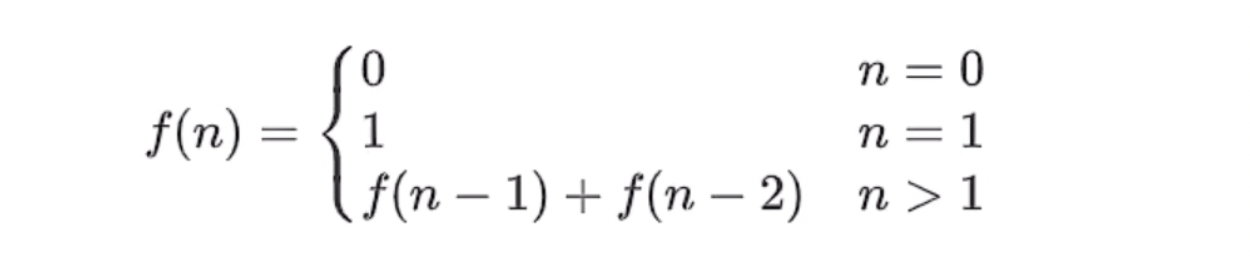
斐波那契数列
递推公式
编码实现
java
package algorithm.recursion;

/**
 * 斐波那契数列:每一个数字等于前两项数字之和
 */
public class FibonacciSequence {
    public static void main(String[] args) {
        // 展示前12项数字
        for (int i = 0; i < 13; i++) {
            System.out.print(fibonacciSequence(i) + "\t");
        }
    }

    /**
     * 获取第n项数字
     */
    public static int fibonacciSequence(int n) {
        if (n < 0) {
            throw new IllegalArgumentException("参数异常");
        }
        return recursion(n);
    }

    /**
     * 递归函数
     */
    private static int recursion(int n) {
        if (n == 0 || n == 1) {
            return n;
        }
        // 这里就是多路递归(multi recursion)
        return recursion(n - 1) + recursion(n - 2);
    }
}
代码优化
优化思路:使用缓存进行优化,记忆法空间换时间
java
package algorithm.recursion;

import java.util.HashMap;
import java.util.Map;

/**
 * 斐波那契数列:每一个数字等于前两项数字之和
 */
public class FibonacciSequence {
    // 缓存:key为第n项,value为第n项的值
    private static final Map<Integer, Integer> cache = new HashMap<>();

    public static void main(String[] args) {
        // 展示前12项数字
        for (int i = 0; i < 13; i++) {
            System.out.print(fibonacciSequence(i) + "\t");
        }
    }

    /**
     * 获取第n项数字
     */
    public static int fibonacciSequence(int n) {
        if (n < 0) {
            throw new IllegalArgumentException("参数异常");
        }
        return recursion(n);
    }

    /**
     * 递归函数
     */
    private static int recursion(int n) {
        if (n == 0 || n == 1) {
            return n;
        }
        // 查缓存,如果缓存中有第n项的数字,直接返回
        Integer numOfN = cache.get(n);
        if (numOfN != null) {
            return numOfN;
        }
        // 缓存中没有,就计算第n项的数字
        numOfN = recursion(n - 1) + recursion(n - 2);
        // 将第n项的数字放入缓存中
        cache.put(n, numOfN);
        // 这里就是多路递归(multi recursion)
        return numOfN;
    }
}
LeetCode-70题
题解
java
class Solution {
    // 缓存
    private Map<Integer, Integer> climbStairsCache = new HashMap<>();

    public int climbStairs(int n) {
        // 递归结束条件
        if (n <= 2)
            return n;
        //查缓存
        Integer nr = climbStairsCache.get(n);
        if (nr != null)
            return nr;
        // 多路递归
        nr = climbStairs(n - 1) + climbStairs(n - 2);
        // 放入缓存
        climbStairsCache.put(n, nr);
        return nr;
    }
}
测试结果