本篇文章介绍如何定义线程模型,以及如何在GPU上利用并行计算方式实现矩阵相加
大部分代码利用了之前代码中的部分完整代码如下:
#include "../common/common.h"
#include <stdio.h>

//***********矩阵初始化函数 */
void initialData(float *ip,int size)
{
    time_t t;
    srand((unsigned)time(&t));
    printf("Matrix is :");
    for (int i=0;i<size;i++)
    {
        ip[i]=(float)(rand() & 0xFF) / 10.0f;
        printf("%.2f,",ip[i]);
    }
    printf("\n");
    return;
}
//***********GPU加法函数 */
__global__ void sumArraryOnGPU(float *A, float *B, float *C, const int N)
{
    int i = threadIdx.x;
    if (i < N)
    {
        C[i] = A[i] + B[i];
    }
}
//***********主函数 */
int main(int argc, char **argv)
{
    //***********GPU检测 */
    int nDeviceNumber = 0;
    cudaError_t error = ErrorCheck(cudaGetDeviceCount(&nDeviceNumber), __FILE__, __LINE__);
    if (error != cudaSuccess || nDeviceNumber == 0)
    {
        printf("No CUDA campatable GPU found!\n");
        return -1;
    }
    int dev = 0;
    error = ErrorCheck(cudaSetDevice(dev), __FILE__, __LINE__);
    if (error != cudaSuccess)
    {
        printf("fail to set GPU 0 for computing\n");
        return -1;
    }
    else
    {
        printf("successfully allocate memory for GPU\n");
    }

    //***********内存分配 */
    int nElem = 16;
    size_t nBytes = nElem * sizeof(float);

    float *h_A, *h_B, *gpuRef;
    h_A = (float *)malloc(nBytes);
    h_B = (float *)malloc(nBytes);
    gpuRef = (float *)malloc(nBytes);
    if (NULL != h_A && NULL != h_B && NULL != gpuRef)
    {
        printf("allocate memory successfully\n");
    }
    else
    {
        printf("fail to allocate memory\n");
        return -1;
    }
    initialData(h_A, nElem);
    initialData(h_B, nElem);
    memset(gpuRef, 0, nBytes);

    //***********显存分配 */
    float *d_A, *d_B, *d_C;
    cudaMalloc((float **)&d_A, nBytes);
    cudaMalloc((float **)&d_B, nBytes);
    cudaMalloc((float **)&d_C, nBytes);
    if (d_A == NULL || d_B == NULL || d_C == NULL)
    {
        printf("fail to allocate memory for GPU\n");
        free(h_A);
        free(h_B);
        free(gpuRef);
        return -1;
    }
    else
    {
        printf("successfully allocate memory for GPU\n");
    }

    //***********拷贝数据,主机到设备 */
    cudaMemcpy(d_A, h_A, nBytes, cudaMemcpyHostToDevice);
    cudaMemcpy(d_B, h_B, nBytes, cudaMemcpyHostToDevice);
    cudaMemcpy(d_C, gpuRef, nBytes, cudaMemcpyHostToDevice);

    //***********线程模型定义 */
    dim3 block(nElem);
    dim3 grid(1);

    sumArraryOnGPU<<<grid,block>>>(d_A,d_B,d_C,nElem);
    cudaMemcpy(gpuRef,d_C,nBytes,cudaMemcpyDeviceToHost);


    for (int i=0;i<nElem;i++)
    {
        printf("idx=%d,matrix_A:%.2f,matrix_B:%.2f,result=%.2f\n",i+1,h_A[i],h_B[i],gpuRef[i]);

    }

    free(h_A);
    free(h_B);
    free(gpuRef);
    cudaFree(d_A);
    cudaFree(d_B);
    cudaFree(d_C);
    cudaDeviceReset();

    return 0;
}
第一部分,仍然是定义CPU上的初始化矩阵函数
//***********矩阵初始化函数 */
void initialData(float *ip,int size)
{
    time_t t;//获取系统当前时间
    srand((unsigned)time(&t));//设置随机数字种子
    printf("Matrix is :");
    for (int i=0;i<size;i++)
    {
        ip[i]=(float)(rand() & 0xFF) / 10.0f;//给数组赋初值,取低8位
        printf("%.2f,",ip[i]);
    }
    printf("\n");
    return;
}
第二部分,定义设备代码(或者kernel函数)
//***********GPU加法函数 */
//设备代码和主机代码最大的区别:主机代码实现矩阵加法需要通过双循环遍历每个元素进行相加
//设备代码只需要定义一次加法,然后后续设计线程模型,让多个线程同时执行即可
__global__ void sumArraryOnGPU(float *A, float *B, float *C, const int N)
{
    int i = threadIdx.x;
    if (i < N)
    {
        C[i] = A[i] + B[i];
    }
}
第三部分,GPU设备检测
//***********GPU检测 */
    int nDeviceNumber = 0;
    cudaError_t error = ErrorCheck(cudaGetDeviceCount(&nDeviceNumber), __FILE__, __LINE__);
     //利用CUDA运行时库检测是否有可用
    if (error != cudaSuccess || nDeviceNumber == 0)
    {
        printf("No CUDA campatable GPU found!\n");
        return -1;
    }
     //用默认设别编号,给编号为0的设备分配显存
    int dev = 0;
    error = ErrorCheck(cudaSetDevice(dev), __FILE__, __LINE__);
    if (error != cudaSuccess)
    {
        printf("fail to set GPU 0 for computing\n");
        return -1;
    }
    else
    {
        printf("successfully allocate memory for GPU\n");
    }
第三部分,主机内存分配
    //***********内存分配 */
    int nElem = 16;
    size_t nBytes = nElem * sizeof(float);

    float *h_A, *h_B, *gpuRef;
    h_A = (float *)malloc(nBytes);
    h_B = (float *)malloc(nBytes);
    gpuRef = (float *)malloc(nBytes);
    if (NULL != h_A && NULL != h_B && NULL != gpuRef)
    {
        printf("allocate memory successfully\n");
    }
    else
    {
        printf("fail to allocate memory\n");
        return -1;
    }
    //先分配内存,然后对内存上指定范围的数据进行初始化
    initialData(h_A, nElem);
    initialData(h_B, nElem);
    memset(gpuRef, 0, nBytes);
第四部分,显存分配
    //***********显存分配 */
    float *d_A, *d_B, *d_C;
    //调用cudaMalloc分配显存,传参类型必须是指向指针的指针
    //因为只传d_A本身无法改变其上面的值
    cudaMalloc((float **)&d_A, nBytes);
    cudaMalloc((float **)&d_B, nBytes);
    cudaMalloc((float **)&d_C, nBytes);
    if (d_A == NULL || d_B == NULL || d_C == NULL)
    {
        printf("fail to allocate memory for GPU\n");
        free(h_A);
        free(h_B);
        free(gpuRef);
        return -1;
    }
    else
    {
        printf("successfully allocate memory for GPU\n");
    }
第五部分:数据拷贝
    //***********拷贝数据,主机到设备 */
    //把定义并分配好数据的矩阵,从主机拷贝到设备上
    cudaMemcpy(d_A, h_A, nBytes, cudaMemcpyHostToDevice);
    cudaMemcpy(d_B, h_B, nBytes, cudaMemcpyHostToDevice);
    cudaMemcpy(d_C, gpuRef, nBytes, cudaMemcpyHostToDevice);

    //***********线程模型定义 */
    //一个graid含有1个block,一个block含有nElem个Thread
    dim3 block(nElem);
    dim3 grid(1);
    //用1个grid上的1个block中的nElem个Thread同时执行kernel函数
    sumArraryOnGPU<<<grid,block>>>(d_A,d_B,d_C,nElem);
    //将运行结果拷贝回主机上
    cudaMemcpy(gpuRef,d_C,nBytes,cudaMemcpyDeviceToHost);
第六部分:释放内存:
    //在主机上显示计算结果
    for (int i=0;i<nElem;i++)
    {
        printf("idx=%d,matrix_A:%.2f,matrix_B:%.2f,result=%.2f\n",i+1,h_A[i],h_B[i],gpuRef[i]);

    }

    free(h_A);
    free(h_B);
    free(gpuRef);
    cudaFree(d_A);
    cudaFree(d_B);
    cudaFree(d_C);
    cudaDeviceReset();

    return 0;
}
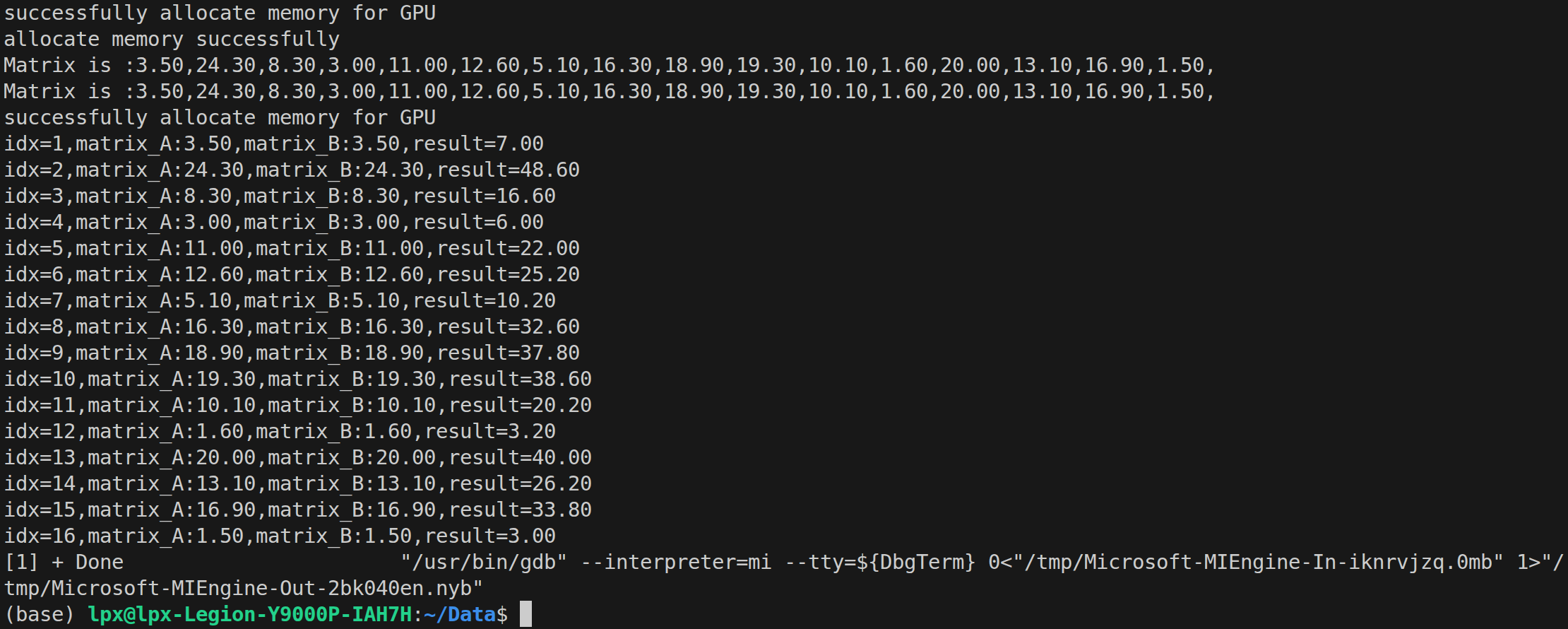
查看执行结果: