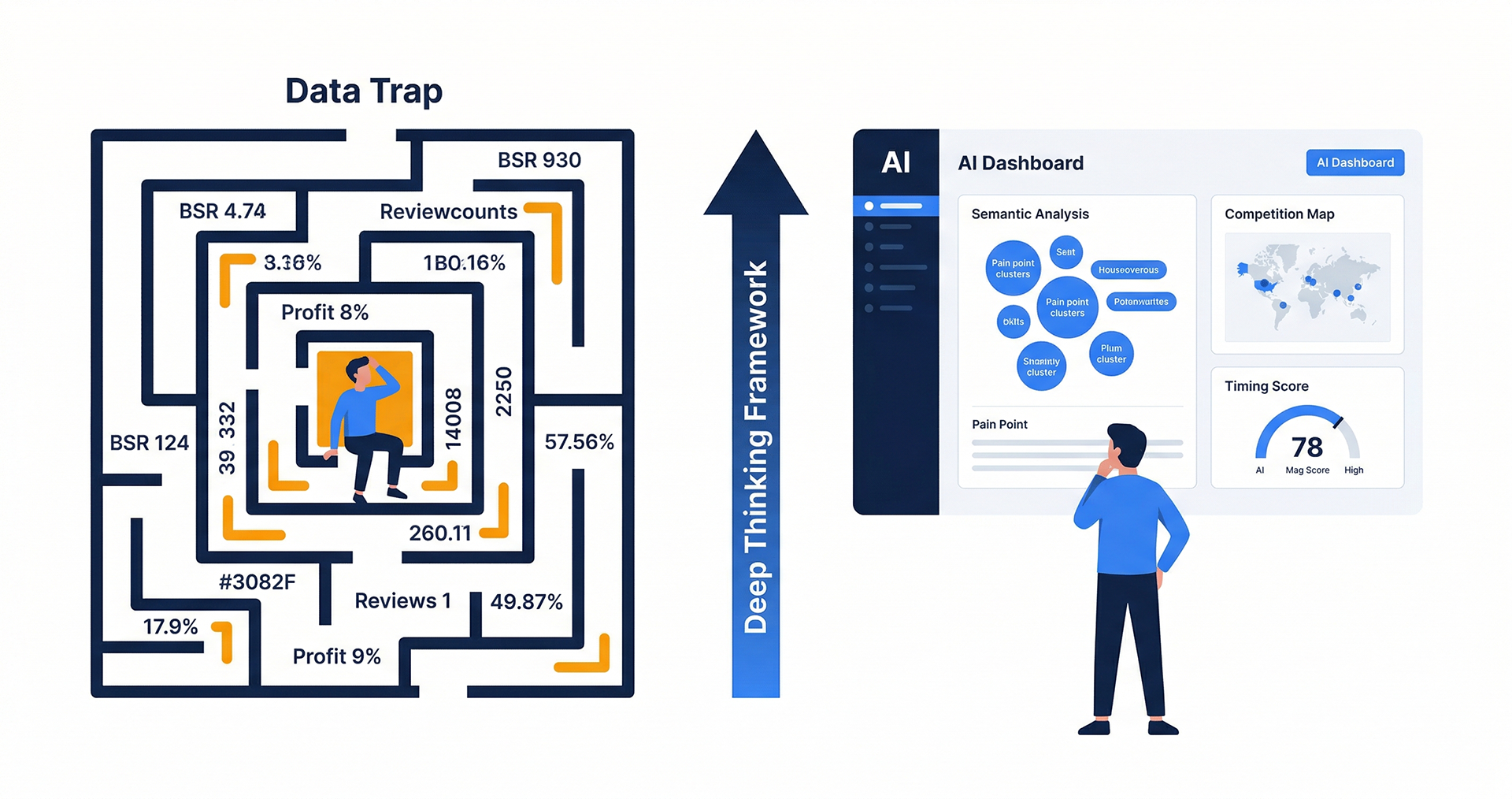
本文从工程视角系统讲解如何用数据管道+AI工具构建真正具有竞争壁垒的亚马逊选品分析体系。包含:评论语义分析、竞争位置数据采集、AI Agent工作流设计,以及完整的Python代码示例。
为什么说大多数AI选品工具没用到核心
当前市场上的AI选品工具停留在两个层次:数据聚合(把公开数据整合成Dashboard)和统计分析(在聚合数据上跑预设算法)。这两个层次解决的是效率问题,不是判断深度问题。
真正的竞争壁垒来自第三个层次:语义理解+自定义分析框架。具体来说,就是把原始的评论文本、搜索结果HTML、广告位分布数据,送入语义理解引擎,提取出比BSR和搜索量更接近市场真相的信号。
这需要三个技术组件:高质量的数据采集API(解决数据获取问题)、语义分析引擎(解决数据理解问题)、信号触发机制(解决时效性问题)。下文逐一展开。
组件一:评论语义分析系统
设计思路
评论是目前亚马逊生态中信噪比最高的用户反馈数据。比搜索量更能反映真实需求状态,比专家意见更有规模代表性。但原始评论文本需要处理才能变成可用的信号。
完整的评论分析pipeline如下:
原始URL列表
    → Reviews Scraper API(批量获取评论JSON)
    → 预处理(清洗、去重、日期过滤)
    → LLM语义分析(痛点分类、价值主题提取)
    → 结构化输出(供选品决策层消费)
代码实现
python
import asyncio
import json
from dataclasses import dataclass, field
from typing import Optional
import httpx
import anthropic

PANGOLINFO_API_KEY = "your_api_key_here"
CLAUDE_API_KEY = "your_claude_key_here"

@dataclass
class ReviewBatch:
    asin: str
    reviews: list[dict]
    total_count: int
    avg_rating: float

@dataclass
class ReviewAnalysis:
    asin: str
    pain_points: list[dict]          # [{theme: str, frequency: int, severity: float}]
    positive_themes: list[dict]       # [{theme: str, frequency: int}]
    unmet_needs: list[str]            # 现有产品未满足的核心需求
    user_persona_insights: list[str]  # 用户画像洞察
    differentiation_opportunities: list[str]  # 差异化机会

async def fetch_reviews(asin: str, pages: int = 5) -> ReviewBatch:
    """
    通过 Pangolinfo Reviews Scraper API 获取指定 ASIN 的评论
    支持分页采集,每页约10条评论
    """
    all_reviews = []

    async with httpx.AsyncClient(timeout=30) as client:
        for page in range(1, pages + 1):
            payload = {
                "url": f"https://www.amazon.com/product-reviews/{asin}/?pageNumber={page}",
                "output_format": "json",
                "parse_template": "amazon_reviews",
                "geo": {"country": "US"}
            }

            response = await client.post(
                "https://api.pangolinfo.com/v1/scrape",
                json=payload,
                headers={"Authorization": f"Bearer {PANGOLINFO_API_KEY}"}
            )

            if response.status_code == 200:
                data = response.json()
                reviews = data.get("parsed_data", {}).get("reviews", [])
                all_reviews.extend(reviews)

            await asyncio.sleep(0.5)  # 礼貌性延迟

    if not all_reviews:
        return ReviewBatch(asin=asin, reviews=[], total_count=0, avg_rating=0.0)

    avg_rating = sum(r.get("rating", 3) for r in all_reviews) / len(all_reviews)
    return ReviewBatch(
        asin=asin,
        reviews=all_reviews,
        total_count=len(all_reviews),
        avg_rating=avg_rating
    )

async def analyze_reviews_with_ai(batch: ReviewBatch) -> ReviewAnalysis:
    """
    用 Claude 对评论批次进行语义分析
    聚焦提取:用户痛点、遗漏需求、差异化机会
    """
    client = anthropic.Anthropic(api_key=CLAUDE_API_KEY)

    # 准备评论文本(按评分分层,优先负面)
    negative_reviews = [r for r in batch.reviews if r.get("rating", 5) <= 2]
    positive_reviews = [r for r in batch.reviews if r.get("rating", 5) >= 4]

    negative_text = "\n---\n".join([
        f"Rating: {r.get('rating')}/5\nTitle: {r.get('title', '')}\nBody: {r.get('body', '')[:400]}"
        for r in negative_reviews[:30]  # 最多30条负面评论
    ])

    positive_text = "\n---\n".join([
        f"Rating: {r.get('rating')}/5\nTitle: {r.get('title', '')}\nBody: {r.get('body', '')[:300]}"
        for r in positive_reviews[:20]
    ])

    prompt = f"""
    Analyze these Amazon product reviews for ASIN {batch.asin}.

    NEGATIVE REVIEWS (total: {len(negative_reviews)}):
    {negative_text}

    POSITIVE REVIEWS (sample of {len(positive_reviews[:20])}):
    {positive_text}

    Provide a structured analysis in valid JSON with these exact fields:
    {{
        "pain_points": [
            {{"theme": "string", "frequency_pct": float, "severity": "high|medium|low", "specific_examples": ["string"]}}
        ],
        "positive_themes": [
            {{"theme": "string", "frequency_pct": float}}
        ],
        "unmet_needs": ["string"],
        "user_persona_insights": ["string"],
        "differentiation_opportunities": ["string"]
    }}

    Be specific. Use exact language from reviews where possible. Return ONLY the JSON, no other text.
    """

    message = client.messages.create(
        model="claude-opus-4-5",
        max_tokens=2048,
        messages=[{"role": "user", "content": prompt}]
    )

    try:
        analysis_data = json.loads(message.content[0].text)
    except json.JSONDecodeError:
        # 如果JSON解析失败,返回空结构
        analysis_data = {
            "pain_points": [],
            "positive_themes": [],
            "unmet_needs": [],
            "user_persona_insights": [],
            "differentiation_opportunities": []
        }

    return ReviewAnalysis(asin=batch.asin, **analysis_data)

async def batch_analyze_category(asin_list: list[str]) -> list[ReviewAnalysis]:
    """
    并发分析品类内多个ASIN的评论
    控制并发数避免API限速
    """
    semaphore = asyncio.Semaphore(5)  # 最多5个并发请求

    async def analyze_single(asin: str) -> Optional[ReviewAnalysis]:
        async with semaphore:
            try:
                batch = await fetch_reviews(asin, pages=3)
                if batch.total_count < 5:
                    return None
                analysis = await analyze_reviews_with_ai(batch)
                return analysis
            except Exception as e:
                print(f"Error analyzing {asin}: {e}")
                return None

    tasks = [analyze_single(asin) for asin in asin_list]
    results = await asyncio.gather(*tasks)
    return [r for r in results if r is not None]

def aggregate_category_insights(analyses: list[ReviewAnalysis]) -> dict:
    """
    聚合品类级别的分析结论
    从多个ASIN的分析中提取共性痛点和差异化机会
    """
    from collections import Counter

    # 聚合所有痛点
    all_pain_points = []
    for analysis in analyses:
        for pp in analysis.pain_points:
            all_pain_points.append(pp["theme"])

    pain_point_counter = Counter(all_pain_points)
    common_pain_points = pain_point_counter.most_common(5)

    # 聚合所有差异化机会
    all_opportunities = []
    for analysis in analyses:
        all_opportunities.extend(analysis.differentiation_opportunities)

    # 聚合所有未满足需求
    all_unmet_needs = []
    for analysis in analyses:
        all_unmet_needs.extend(analysis.unmet_needs)

    return {
        "category_pain_points": common_pain_points,
        "differentiation_pool": list(set(all_opportunities)),
        "unmet_needs_pool": list(set(all_unmet_needs)),
        "asins_analyzed": len(analyses)
    }
组件二:竞争位置数据采集
SP广告位分布分析
SP广告位的覆盖率是竞争结构分析最核心的数据之一,但这类数据必须实时采集才有意义(广告位是实时竞拍的)。
python
import asyncio
from dataclasses import dataclass
from collections import defaultdict
import httpx

PANGOLINFO_API_KEY = "your_api_key"

@dataclass
class SearchResultSlot:
    position: int
    asin: str
    is_sponsored: bool
    slot_type: str  # "top_banner" | "inline" | "sidebar" | "organic"
    title: str
    price: Optional[float]
    rating: Optional[float]
    review_count: Optional[int]

@dataclass
class KeywordCompetitionProfile:
    keyword: str
    total_slots: int
    sponsored_slots: list[SearchResultSlot]
    organic_top10: list[SearchResultSlot]
    top_advertisers: list[str]  # ASIN列表,按广告位数量排序
    sp_concentration: float     # 前三大广告主的SP占有率之和
    organic_difficulty: float   # 0-1,基于头部有机位ASIN的评论数量估算

async def fetch_search_result_page(
    keyword: str,
    page: int = 1,
    zip_code: str = "10001"
) -> dict:
    """
    采集亚马逊搜索结果页,包含SP广告位和有机排名
    zip_code 参数确保获取特定地区的广告展示(亚马逊广告是地域定向的)
    """
    url = f"https://www.amazon.com/s?k={keyword.replace(' ', '+')}&page={page}"

    async with httpx.AsyncClient(timeout=30) as client:
        response = await client.post(
            "https://api.pangolinfo.com/v1/scrape",
            json={
                "url": url,
                "render_js": True,           # 需要JS渲染才能加载SP广告
                "output_format": "json",
                "parse_template": "amazon_search",
                "geo": {"country": "US", "zip_code": zip_code}
            },
            headers={"Authorization": f"Bearer {PANGOLINFO_API_KEY}"}
        )

        if response.status_code != 200:
            return {}

        return response.json()

def parse_competition_profile(keyword: str, raw_data: dict) -> KeywordCompetitionProfile:
    """从原始采集数据提取竞争结构分析"""
    parsed = raw_data.get("parsed_data", {})
    results = parsed.get("results", [])

    sponsored_slots = []
    organic_slots = []

    for i, result in enumerate(results):
        slot = SearchResultSlot(
            position=i + 1,
            asin=result.get("asin", ""),
            is_sponsored=result.get("is_sponsored", False),
            slot_type=result.get("slot_type", "organic"),
            title=result.get("title", ""),
            price=result.get("price"),
            rating=result.get("rating"),
            review_count=result.get("review_count")
        )

        if slot.is_sponsored:
            sponsored_slots.append(slot)
        else:
            organic_slots.append(slot)

    # 计算SP集中度(前三大广告主的占有率)
    advertiser_counts = defaultdict(int)
    for slot in sponsored_slots:
        if slot.asin:
            advertiser_counts[slot.asin] += 1

    top_advertisers = sorted(advertiser_counts.items(), key=lambda x: x[1], reverse=True)
    top_3_count = sum(count for _, count in top_advertisers[:3])
    sp_concentration = top_3_count / max(len(sponsored_slots), 1)

    # 估算有机排名难度(基于头部有机位的评论数量)
    organic_review_counts = [
        slot.review_count or 0
        for slot in organic_slots[:10]
        if slot.review_count
    ]
    avg_top_organic_reviews = (
        sum(organic_review_counts) / len(organic_review_counts)
        if organic_review_counts else 0
    )
    organic_difficulty = min(avg_top_organic_reviews / 5000, 1.0)  # 归一化到0-1

    return KeywordCompetitionProfile(
        keyword=keyword,
        total_slots=len(results),
        sponsored_slots=sponsored_slots,
        organic_top10=organic_slots[:10],
        top_advertisers=[asin for asin, _ in top_advertisers[:5]],
        sp_concentration=sp_concentration,
        organic_difficulty=organic_difficulty
    )

async def multi_keyword_competition_scan(
    keywords: list[str],
    days: int = 7
) -> dict[str, list[KeywordCompetitionProfile]]:
    """
    多关键词竞争扫描
    连续多天采集,观察竞争格局的时间变化
    """
    results = defaultdict(list)

    for keyword in keywords:
        daily_profiles = []
        for day in range(days):
            raw = await fetch_search_result_page(keyword)
            if raw:
                profile = parse_competition_profile(keyword, raw)
                daily_profiles.append(profile)
            await asyncio.sleep(24 * 3600 / days)  # 均匀分布在时间轴上(实际使用时应用定时任务替代)

        results[keyword] = daily_profiles

    return dict(results)
组件三:Agent工作流------把分析流程自动化
通过 Pangolinfo Amazon Scraper Skill 接入 MCP 协议,可以让 AI Agent 自主触发数据采集和分析,无需人工干预每个步骤。
python
# Agent工作流的核心设计:信号检测 → 自动触发分析 → 推送决策建议

class MarketSignalDetector:
    """
    市场信号检测器
    当预设条件满足时,自动触发深度分析
    """

    def __init__(self, thresholds: dict):
        # thresholds 示例:
        # {"search_volume_growth_weekly": 0.15, "new_listings_monthly": 50}
        self.thresholds = thresholds
        self.triggered_analyses = []

    def check_entry_opportunity(self, keyword: str, metrics: dict) -> bool:
        """检测是否出现入场机会信号"""
        conditions = [
            # 搜索量周增长超过阈值
            metrics.get("search_volume_growth_weekly", 0) >= self.thresholds["search_volume_growth_weekly"],
            # 新品上架速度低于威胁阈值
            metrics.get("new_listings_monthly", 999) <= self.thresholds["new_listings_monthly"],
            # 头部广告主SP集中度低(说明市场尚未被垄断)
            metrics.get("sp_concentration", 1.0) <= 0.6,
        ]

        # 至少满足两个条件才触发
        return sum(conditions) >= 2

    def check_competitor_weakness(self, competitor_asin: str, recent_reviews: list) -> bool:
        """检测竞品是否出现负面爆发(潜在市场机会)"""
        if len(recent_reviews) < 10:
            return False

        # 最近30天的评论平均评分
        recent_avg = sum(r.get("rating", 3) for r in recent_reviews[-30:]) / 30
        # 历史评分基线
        historical_avg = sum(r.get("rating", 3) for r in recent_reviews[:-30]) / max(len(recent_reviews) - 30, 1)

        # 评分下降超过0.5分视为负面爆发
        return (historical_avg - recent_avg) > 0.5

# 使用示例
async def run_monitoring_cycle(watchlist: list[str]) -> list[dict]:
    """
    定时运行的监控周期
    对 watchlist 中的关键词执行完整的信号检测
    """
    detector = MarketSignalDetector(thresholds={
        "search_volume_growth_weekly": 0.12,
        "new_listings_monthly": 40,
    })

    alerts = []

    for keyword in watchlist:
        # 获取最新搜索结果
        raw_data = await fetch_search_result_page(keyword)
        profile = parse_competition_profile(keyword, raw_data)

        # 这里简化了 metrics 的来源,实际需要有历史数据作为基线
        mock_metrics = {
            "search_volume_growth_weekly": 0.18,  # 模拟数据
            "new_listings_monthly": 32,
            "sp_concentration": profile.sp_concentration
        }

        if detector.check_entry_opportunity(keyword, mock_metrics):
            alerts.append({
                "type": "entry_opportunity",
                "keyword": keyword,
                "sp_concentration": profile.sp_concentration,
                "organic_difficulty": profile.organic_difficulty,
                "top_advertisers": profile.top_advertisers,
                "recommended_action": "initiate_deep_analysis"
            })

    return alerts
三层分析结论输出示例
python
def generate_sourcing_decision_brief(
    category: str,
    review_insights: dict,
    competition_profiles: list[KeywordCompetitionProfile]
) -> str:
    """
    生成结构化选品决策摘要
    供选品团队直接用于决策
    """

    # 提取关键指标
    avg_sp_concentration = sum(p.sp_concentration for p in competition_profiles) / len(competition_profiles)
    avg_organic_difficulty = sum(p.organic_difficulty for p in competition_profiles) / len(competition_profiles)
    top_pain_points = review_insights.get("category_pain_points", [])[:3]
    opportunities = review_insights.get("differentiation_pool", [])[:3]

    brief = f"""
    ====== 选品决策摘要:{category} ======

    📊 竞争结构评估
    - SP广告集中度:{avg_sp_concentration:.1%}({'高' if avg_sp_concentration > 0.6 else '中' if avg_sp_concentration > 0.4 else '低'})
    - 有机排名难度:{avg_organic_difficulty:.1%}({'高' if avg_organic_difficulty > 0.7 else '中' if avg_organic_difficulty > 0.4 else '低'})

    😤 用户核心痛点(频率排序)
    {chr(10).join(f'  {i+1}. {pp[0]} ({pp[1]}个ASIN提及)' for i, pp in enumerate(top_pain_points))}

    💡 差异化切入机会
    {chr(10).join(f'  • {opp}' for opp in opportunities)}

    🎯 入场决策建议
    {'建议入场' if avg_sp_concentration < 0.65 and avg_organic_difficulty < 0.7 else '谨慎评估'}
    - 差异化方向:{opportunities[0] if opportunities else '待进一步分析'}
    - 评论获取目标:前60天内完成首批高质量评论积累(建议目标50+条)
    - 广告策略参考:{'优先长尾精准词' if avg_sp_concentration > 0.5 else '可考虑适度的宽泛匹配'}
    """

    return brief
总结
构建真正有竞争壁垒的AI选品系统,需要三个层次的工程工作:
| 层次 | 核心工具 | 输出 |
|---|---|---|
| 数据采集 | Pangolinfo Scrape API + Reviews Scraper API | 评论JSON、搜索结果页、广告位分布 |
| 语义分析 | Claude/GPT 等LLM | 痛点分类、差异化机会、用户洞察 |
| 信号自动化 | Agent工作流 + Amazon Scraper Skill | 实时机会警报、触发式深度分析 |
这套系统的竞争壁垒来源:你的分析频率(实时)远高于依赖平台订阅工具的竞争对手,你的分析维度(自定义语义分析)比通用算法更深,你的判断框架内嵌了自己对市场的独特认知。
Tags: #Python #亚马逊选品 #AI选品 #数据分析 #爬虫 #LLM #Agent #API #电商