1026. Maximum Difference Between Node and Ancestor
Given the root of a binary tree, find the maximum value v for which there exist different nodes a and b where v = |a.val - b.val| and a is an ancestor of b.
A node a is an ancestor of b if either: any child of a is equal to b or any child of a is an ancestor of b.
Example 1:
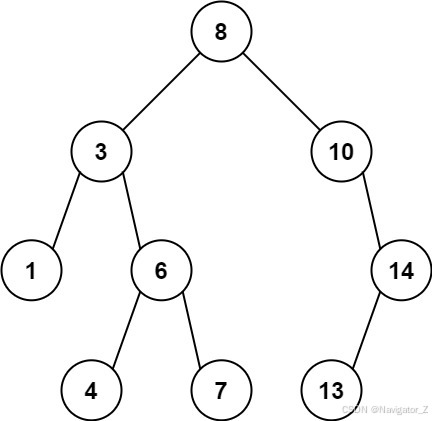
Input: root = 8,3,10,1,6,null,14,null,null,4,7,13
Output: 7
Explanation: We have various ancestor-node differences, some of which are given below :|8 - 3| = 5
|3 - 7| = 4
|8 - 1| = 7
|10 - 13| = 3
Among all possible differences, the maximum value of 7 is obtained by |8 - 1| = 7.
Example 2:
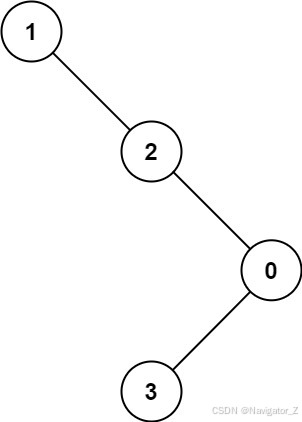
Input: root = 1,null,2,null,0,3
Output: 3
Constraints:
- The number of nodes in the tree is in the range 2, 5000.
- 0 < = N o d e . v a l < = 10 5 0 <= Node.val <= 10^5 0<=Node.val<=105
From: LeetCode
Link: 1026. Maximum Difference Between Node and Ancestor
Solution:
Ideas:
For each node, keep track of:
- the minimum value seen on the path from the root to this node
- the maximum value seen on the path from the root to this node
Then the maximum ancestor difference on that path is:
- curMax - curMin
So during DFS:
- update curMin and curMax with the current node value
- continue to left and right children
- when reaching NULL, return the difference for that path
Code:
c
/**
 * Definition for a binary tree node.
 * struct TreeNode {
 *     int val;
 *     struct TreeNode *left;
 *     struct TreeNode *right;
 * };
 */

static int max(int a, int b) {
    return a > b ? a : b;
}

static int min(int a, int b) {
    return a < b ? a : b;
}

static int dfs(struct TreeNode* node, int curMin, int curMax) {
    if (node == NULL) {
        return curMax - curMin;
    }

    curMin = min(curMin, node->val);
    curMax = max(curMax, node->val);

    int leftAns = dfs(node->left, curMin, curMax);
    int rightAns = dfs(node->right, curMin, curMax);

    return max(leftAns, rightAns);
}

int maxAncestorDiff(struct TreeNode* root) {
    return dfs(root, root->val, root->val);
}