全局坐标转局部坐标
问题定义:
设全局坐标系为 OworldO_{world}Oworld,自车当前状态为:
- 位置:(xc,yc)(x_c, y_c)(xc,yc)
- 朝向:θc\theta_cθc(与全局 X 轴的夹角,逆时针为正)
目标点状态为:
- 位置:(xt,yt)(x_t, y_t)(xt,yt)
- 朝向:θt\theta_tθt
Step1: 平移
先将原点平移到自车位置,得到目标点在全局系下的相对偏移:
dx dy\]=\[xt−xc yt−yc\] \\begin{bmatrix} dx \\ dy \\end{bmatrix} = \\begin{bmatrix} x_t - x_c \\ y_t - y_c \\end{bmatrix} \[dx dy\]=\[xt−xc yt−yc
Step 2:旋转
全局坐标系旋转 θc\theta_cθc 后与自车局部坐标系对齐。要把全局偏移量转到局部系,需要反向旋转 −θc-\theta_c−θc,即乘以旋转矩阵 R(−θc)R(-\theta_c)R(−θc):
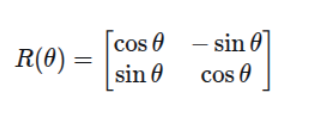
R(θ)=cosθ−sinθ sinθcosθ⇒R(−θc)=cosθcsinθc −sinθccosθc R(\theta) = \begin{bmatrix} \cos\theta & -\sin\theta \ \sin\theta & \cos\theta \end{bmatrix} \quad \Rightarrow \quad R(-\theta_c) = \begin{bmatrix} \cos\theta_c & \sin\theta_c \ -\sin\theta_c & \cos\theta_c \end{bmatrix} R(θ)=cosθ−sinθ sinθcosθ⇒R(−θc)=cosθcsinθc −sinθccosθc
因此:
xlocal ylocal\]=R(−θc)\[dx dy\]=\[cosθcsinθc −sinθccosθc\]\[dx dy\] \\begin{bmatrix} x_{local} \\ y_{local} \\end{bmatrix} = R(-\\theta_c) \\begin{bmatrix} dx \\ dy \\end{bmatrix} = \\begin{bmatrix} \\cos\\theta_c \& \\sin\\theta_c \\ -\\sin\\theta_c \& \\cos\\theta_c \\end{bmatrix} \\begin{bmatrix} dx \\ dy \\end{bmatrix} \[xlocal ylocal\]=R(−θc)\[dx dy\]=\[cosθcsinθc −sinθccosθc\]\[dx dy
展开得:
xlocal=dx⋅cosθc+dy⋅sinθc \boxed{ x_{local} = dx \cdot \cos\theta_c + dy \cdot \sin\theta_c } xlocal=dx⋅cosθc+dy⋅sinθc
ylocal=−dx⋅sinθc+dy⋅cosθc \boxed{ y_{local} = -dx \cdot \sin\theta_c + dy \cdot \cos\theta_c } ylocal=−dx⋅sinθc+dy⋅cosθc
代码实现如下:
python
def to_local_coords(target_x, target_y, target_yaw, curr_x, curr_y, curr_yaw):
    """全局坐标转换到自车局部坐标系"""
    curr_yaw = np.deg2rad(curr_yaw)
    target_yaw = np.deg2rad(target_yaw)
    dx = target_x - curr_x
    dy = target_y - curr_y
    local_x = dx * np.cos(curr_yaw) + dy * np.sin(curr_yaw)
    local_y = -dx * np.sin(curr_yaw) + dy * np.cos(curr_yaw)
    local_yaw = target_yaw - curr_yaw
    return np.array([local_x, local_y, np.cos(local_yaw), np.sin(local_yaw)])
旋转矩阵的推导
问题设定
设有一个向量 v⃗\vec{v}v ,其在原坐标系中的坐标为 (x,y)(x, y)(x,y),与 X 轴的夹角为 α\alphaα,模长为 rrr:
x=rcosα,y=rsinα x = r\cos\alpha, \quad y = r\sin\alpha x=rcosα,y=rsinα
现在将坐标系逆时针旋转 θ\thetaθ 角 (等价于向量顺时针旋转 θ\thetaθ 角 ),求新坐标 (x′,y′)(x', y')(x′,y′)。
Step 1:用极坐标表示原向量
v⃗=(rcosα, rsinα) \vec{v} = (r\cos\alpha,\ r\sin\alpha) v =(rcosα, rsinα)
Step 2:旋转后用极坐标表示新向量
旋转后,向量与 X 轴夹角变为 α+θ\alpha + \thetaα+θ,模长不变:
x′=rcos(α+θ) x' = r\cos(\alpha + \theta) x′=rcos(α+θ)
y′=rsin(α+θ) y' = r\sin(\alpha + \theta) y′=rsin(α+θ)
Step 3:展开三角函数
x′=rcos(α+θ)=r(cosαcosθ−sinαsinθ) x' = r\cos(\alpha + \theta) = r(\cos\alpha\cos\theta - \sin\alpha\sin\theta) x′=rcos(α+θ)=r(cosαcosθ−sinαsinθ)
y′=rsin(α+θ)=r(sinαcosθ+cosαsinθ) y' = r\sin(\alpha + \theta) = r(\sin\alpha\cos\theta + \cos\alpha\sin\theta) y′=rsin(α+θ)=r(sinαcosθ+cosαsinθ)
将 rcosα=xr\cos\alpha = xrcosα=x,rsinα=yr\sin\alpha = yrsinα=y 代入:
x′=xcosθ−ysinθ x' = x\cos\theta - y\sin\theta x′=xcosθ−ysinθ
y′=xsinθ+ycosθ y' = x\sin\theta + y\cos\theta y′=xsinθ+ycosθ
Step 4:写成矩阵形式
x′ y′\]=\[cosθ−sinθ sinθcosθ\]⏟R(θ)\[x y\]\\begin{bmatrix} x' \\ y' \\end {bmatrix} =\\underbrace{\\begin{bmatrix} \\cos\\theta \& -\\sin\\theta \\ \\sin\\theta \& \\cos\\theta \\end{bmatrix}}_{R(\\theta)} \\begin{bmatrix} x \\ y \\end{bmatrix} \[x′ y′\]=R(θ) \[cosθ−sinθ sinθcosθ\]\[x y
这就是逆时针旋转 θ\thetaθ 的旋转矩阵 R(θ)R(\theta)R(θ)。