链表的分类
一、链表整体分类(8 种组合,重点掌握 3 类)
分类维度:单向 / 双向 + 带头结点 / 不带头结点 + 循环 / 非循环
- 单向链表(4 种)
- 不带头:普通单向链表、单向循环链表
- 带头:普通单向链表、单向循环链表
- 双向链表(4 种)
- 不带头:普通双向链表、双向循环链表
- 带头:普通双向链表、双向循环链表
💡考试 & 工程重点:带头单链表、不带头单链表、带头双向循环链表(掌握后剩余 5 种可快速举一反三)
二、单向链表 vs 双向链表
1. 单向链表局限
结点仅存**data+next后继指针:**
- 找后继:O(1);找前驱:必须从头遍历O(n)
- 仅知道当前结点
pos时,无法在pos前插入 / 删除结点
2. 双向链表结构
结点定义:
typedef int DLDataType;
typedef struct DLListNode {
    DLDataType data;
    struct DLListNode* prev;  // 前驱指针
    struct DLListNode* next; // 后继指针
}DNode, *DLinkList;- 每个结点多
prev前驱指针,前驱 / 后继访问均(O(1)),可就地前插、就地删除 - 短板:尾结点查找仍(O(n)),头尾增删边界处理繁琐(循环链表优化此问题)
三、循环链表(单向循环 / 双向循环)
1. 单向循环链表
尾结点**next不再指向NULL** ,而是指向头结点; 短板:查找尾结点仍需遍历**(O(n))**。
2. 带头双向循环链表(工程首选,STL::list 底层)
- 尾结点
next = 头结点,头结点prev = 尾结点 - 核心优势:头插、尾插、任意位置插入删除全为(O(1)),不需要尾指针
✅C++ STL 容器
std::list底层就是带头双向循环链表
四、三种重点链表核心对比
| 链表类型 | 头尾插入效率 | 任意结点删除 | 工程场景 |
|---|---|---|---|
| 带头单向链表 | 头插(O(1)),尾插(O(n)) | 删后继O(1),删自身O(n) | 栈、队列底层实现 |
| 带头双向链表 | 头插(O(1)),尾插(O(n)) | 删自身(O(1)) | 需要频繁找前驱的场景 |
| 带头双向循环链表 | 头尾均(O(1) | 删自身(O(1)) | STL list、内存池、环形缓冲 |
💡补充考点
- 头结点作用:统一空链表、非空链表的插入删除逻辑,不用特殊处理首结点边界;
- 循环链表判空 :
head->next == head(带头);head == NULL(不带头)。
2. 单链表 + 单向循环链表 + 带头双向循环链表
一、普通带头单链表
#include <stdio.h>
#include <stdlib.h>
#include <assert.h>

typedef int SLDataType;
// 结点结构体
typedef struct SListNode
{
    SLDataType data;
    struct SListNode* next;
}SNode, *SLList;

// 创建新结点
SNode* BuyListNode(SLDataType x)
{
    SNode* newnode = (SNode*)malloc(sizeof(SNode));
    if (newnode == NULL)
    {
        perror("malloc fail");
        exit(-1);
    }
    newnode->data = x;
    newnode->next = NULL;
    return newnode;
}

// 初始化:带头结点,头结点next=NULL
void InitList(SLList* L)
{
    *L = BuyListNode(-1);
    (*L)->next = NULL;
}

// 求链表有效结点个数
int ListSize(SLList L)
{
    assert(L);
    int size = 0;
    SNode* cur = L->next;
    while (cur) // 单链表:cur!=NULL结束
    {
        size++;
        cur = cur->next;
    }
    return size;
}

// 头插
void SLPushFront(SLList L, SLDataType x)
{
    assert(L);
    SNode* newnode = BuyListNode(x);
    newnode->next = L->next;
    L->next = newnode;
}

// 尾插
void SLPushBack(SLList L, SLDataType x)
{
    assert(L);
    SNode* cur = L;
    while (cur->next != NULL)
        cur = cur->next;
    cur->next = BuyListNode(x);
}

// 遍历打印
void SLPrint(SLList L)
{
    assert(L);
    SNode* cur = L->next;
    while (cur)
    {
        printf("%d->", cur->data);
        cur = cur->next;
    }
    printf("NULL\n");
}

// 销毁
void SLDestroy(SLList L)
{
    assert(L);
    SNode* cur = L;
    while (cur)
    {
        SNode* next = cur->next;
        free(cur);
        cur = next;
    }
}
二、带头单向循环链表(对照讲义初始化 / 遍历区别)
typedef int CLDataType;
typedef struct CListNode
{
    CLDataType data;
    struct CListNode* next;
}CNode, *CLinkList;

CNode* BuyCListNode(CLDataType x)
{
    CNode* newnode = (CNode*)malloc(sizeof(CNode));
    newnode->data = x;
    newnode->next = NULL;
    return newnode;
}

// 循环链表初始化:头结点自环 next指向自己
void InitCList(CLinkList* L)
{
    *L = BuyCListNode(-1);
    (*L)->next = *L;
}

// 统计结点:循环链表结束条件 cur != L(头结点)
int CListSize(CLinkList L)
{
    assert(L);
    int size = 0;
    CNode* cur = L->next;
    while (cur != L)
    {
        size++;
        cur = cur->next;
    }
    return size;
}

// 尾插 O(n)
void CLPushBack(CLinkList L, CLDataType x)
{
    assert(L);
    CNode* cur = L;
    while (cur->next != L)
        cur = cur->next;
    CNode* newnode = BuyCListNode(x);
    cur->next = newnode;
    newnode->next = L;
}

// 遍历
void CLPrint(CLinkList L)
{
    assert(L);
    CNode* cur = L->next;
    while (cur != L)
    {
        printf("%d->", cur->data);
        cur = cur->next;
    }
    printf("(回到头)\n");
}

// 销毁
void CLDestroy(CLinkList L)
{
    assert(L);
    CNode* cur = L->next;
    while (cur != L)
    {
        CNode* next = cur->next;
        free(cur);
        cur = next;
    }
    free(L);
}💡单链表与循环单链表核心区别(讲义考点)
- 初始化:普通单链表
head->next=NULL;循环单链表head->next=head- 遍历终止:普通
cur != NULL;循环cur != head
三、带头双向循环链表
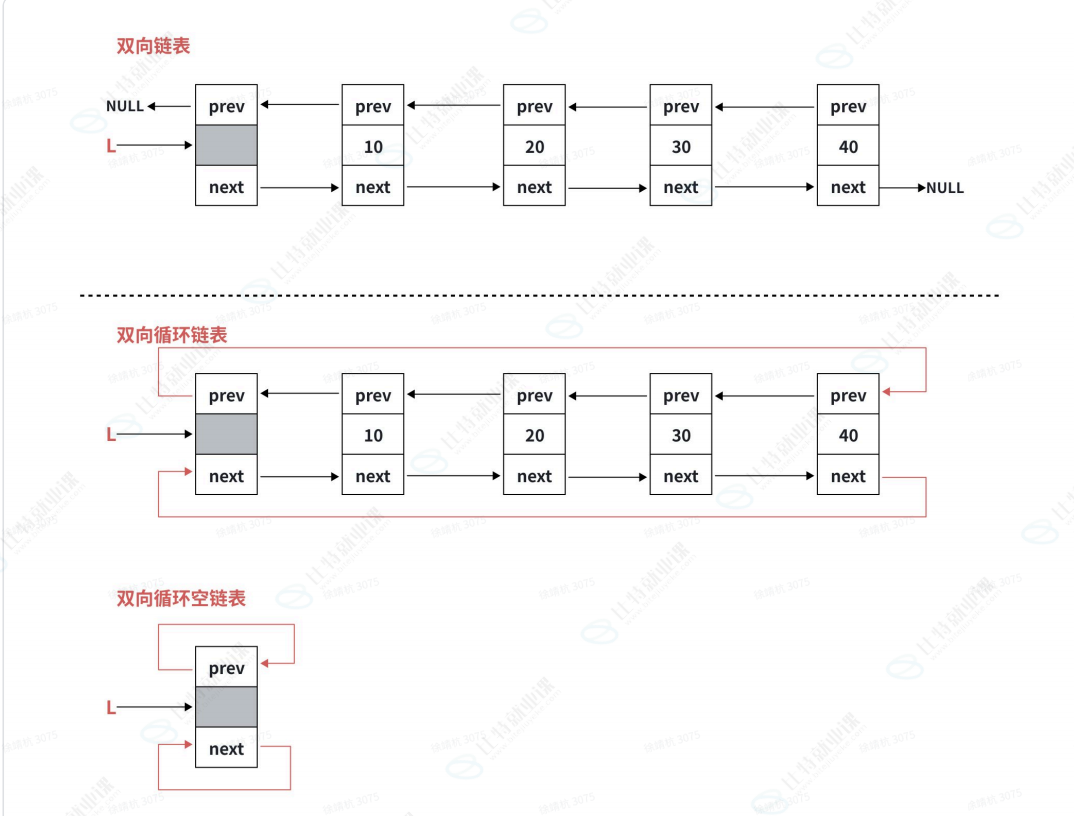
头文件 DCLList.h
#include <stdio.h>
#include <stdlib.h>
#include <assert.h>

typedef int DCLDataType;
typedef struct DCListNode
{
    DCLDataType data;
    struct DCListNode* prev;
    struct DCListNode* next;
}DCListNode;

// 接口声明
DCListNode* DCListInit(); // 初始化
void DCListDestroy(DCListNode* L); // 销毁
DCListNode* DCListGetElem(DCListNode* L, int i); // 取第i个结点
void DCListInsert(DCListNode* pos, DCLDataType x); // pos前插入
void DCListErase(DCListNode* pos); // 删除pos结点
void DCListPushFront(DCListNode* L, DCLDataType x); // 头插
void DCListPushBack(DCListNode* L, DCLDataType x); // 尾插
void DCListPopFront(DCListNode* L); // 头删
void DCListPopBack(DCListNode* L); // 尾删
void DCListPrint(DCListNode* L); // 打印
源文件实现
#include "DCLList.h"

DCListNode* BuyDCNode(DCLDataType x)
{
    DCListNode* newnode = (DCListNode*)malloc(sizeof(DCListNode));
    newnode->data = x;
    newnode->prev = NULL;
    newnode->next = NULL;
    return newnode;
}

// 初始化:头结点自环 prev=next=自己
DCListNode* DCListInit()
{
    DCListNode* L = BuyDCNode(-1);
    L->prev = L;
    L->next = L;
    return L;
}

// 销毁
void DCListDestroy(DCListNode* L)
{
    assert(L);
    DCListNode* cur = L->next;
    while (cur != L)
    {
        DCListNode* next = cur->next;
        free(cur);
        cur = next;
    }
    free(L);
}

// 查找第i个下标结点(i从0开始)
DCListNode* DCListGetElem(DCListNode* L, int i)
{
    assert(L && i >= 0);
    DCListNode* cur = L->next;
    int j = 0;
    while (cur != L && j < i)
    {
        j++;
        cur = cur->next;
    }
    if (j < i) return NULL; // 下标越界
    return cur;
}

// 在pos结点前插入x O(1)
void DCListInsert(DCListNode* pos, DCLDataType x)
{
    assert(pos);
    DCListNode* prev = pos->prev;
    DCListNode* newnode = BuyDCNode(x);

    prev->next = newnode;
    newnode->prev = prev;
    newnode->next = pos;
    pos->prev = newnode;
}

// 删除pos结点 O(1)
void DCListErase(DCListNode* pos)
{
    assert(pos);
    DCListNode* p = pos->prev;
    DCListNode* n = pos->next;
    p->next = n;
    n->prev = p;
    free(pos);
}

// 头插:在头结点后面插入
void DCListPushFront(DCListNode* L, DCLDataType x)
{
    DCListInsert(L->next, x);
}

// 尾插:在头结点前插入
void DCListPushBack(DCListNode* L, DCLDataType x)
{
    DCListInsert(L, x);
}

// 头删
void DCListPopFront(DCListNode* L)
{
    assert(L && L->next != L);
    DCListErase(L->next);
}

// 尾删
void DCListPopBack(DCListNode* L)
{
    assert(L && L->next != L);
    DCListErase(L->prev);
}

// 遍历打印
void DCListPrint(DCListNode* L)
{
    assert(L);
    DCListNode* cur = L->next;
    printf("头结点->");
    while (cur != L)
    {
        printf("%d->", cur->data);
        cur = cur->next;
    }
    printf("(回到头)\n");
}
main 测试示例
int main()
{
    DCListNode* dcl = DCListInit();
    DCListPushBack(dcl,1);
    DCListPushBack(dcl,2);
    DCListPushFront(dcl,0);
    DCListPrint(dcl); //头结点->0->1->2->(回到头)

    DCListNode* pos = DCListGetElem(dcl,2);
    DCListInsert(pos,99);
    DCListPrint(dcl); //头结点->0->1->99->2->(回到头)

    DCListPopBack(dcl);
    DCListPrint(dcl);

    DCListDestroy(dcl);
    return 0;
}
💡核心考点总结
- 双向循环链表优势
L->prev直接拿到尾结点,尾插 / 尾删 O (1),无需遍历找尾;- 任意
pos前插、删除都 O (1),不用查找前驱(对比单向链表删结点需要遍历找前驱\(O(n));
- 判空条件 :
L->next == L(带头双向循环链表) - STL::list 底层就是该结构,工程高频使用。