Integer 的缓存不是业务层优化,而是 JLS 对自动装箱对象同一性 的硬要求:一定范围内的 int 装箱后必须是同一个 Integer 实例。实现落在私有静态内部类 Integer.IntegerCache,对外入口是 Integer.valueOf(int)。下文依据 JDK 17 的 java.lang.Integer 源码展开。
类上的 ValueBased
JDK 17 的 Integer 声明为:
scala
@jdk.internal.ValueBased
public final class Integer extends Number
        implements Comparable<Integer>, Constable, ConstantDesc {
@ValueBased 提醒:这类对象更宜按值 使用。缓存让小整数在引用层面也「碰巧」同一,但业务比较仍应以 equals / 拆箱后的 int 为准,不要把 == 当成通用相等判断。
自动装箱实际调用 valueOf
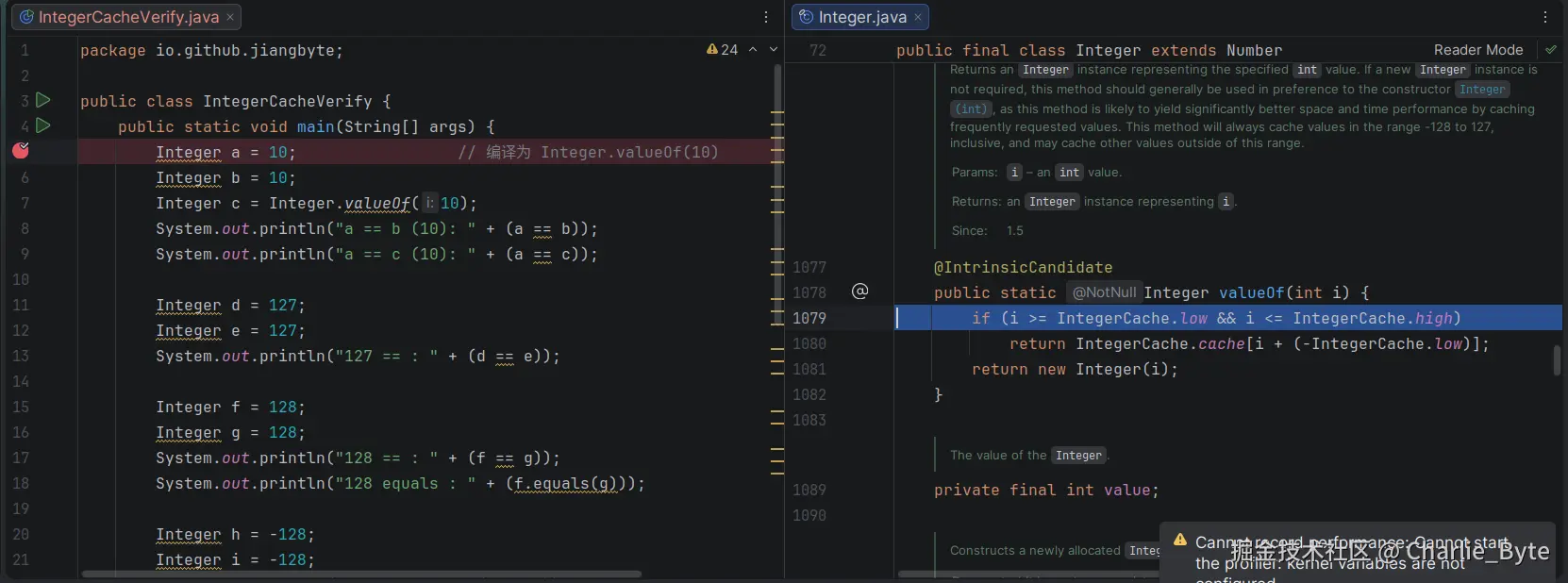
编译器对 Integer a = 10; 这类赋值会插入 Integer.valueOf(10),不会走已废弃的构造器。完整验证如下(覆盖缓存边界、new、equals、抬高上界):
java
public class IntegerCacheVerify {
    public static void main(String[] args) {
        Integer a = 10;                 // 编译为 Integer.valueOf(10)
        Integer b = 10;
        Integer c = Integer.valueOf(10);
        System.out.println("a == b (10): " + (a == b));
        System.out.println("a == c (10): " + (a == c));

        Integer d = 127;
        Integer e = 127;
        System.out.println("127 == : " + (d == e));

        Integer f = 128;
        Integer g = 128;
        System.out.println("128 == : " + (f == g));
        System.out.println("128 equals : " + (f.equals(g)));

        Integer h = -128;
        Integer i = -128;
        System.out.println("-128 == : " + (h == i));

        Integer j = -129;
        Integer k = -129;
        System.out.println("-129 == : " + (j == k));

        @SuppressWarnings("removal")
        Integer n = new Integer(10);
        System.out.println("new(10) == valueOf(10): " + (n == Integer.valueOf(10)));

        Integer p = 1000;
        Integer q = 1000;
        System.out.println("1000 == : " + (p == q));
    }
}
输出:
ini
a == b (10): true
a == c (10): true
127 == : true
128 == : false
128 equals : true
-128 == : true
-129 == : false
new(10) == valueOf(10): false
1000 == : false
抬高缓存上界后再跑同一程序:
ini
-XX:AutoBoxCacheMax=1000输出:
ini
a == b (10): true
a == c (10): true
127 == : true
128 == : true
128 equals : true
-128 == : true
-129 == : false
new(10) == valueOf(10): false
1000 == : true
对照结论:
| 表达式 | 默认 | AutoBoxCacheMax=1000 |
原因 |
|---|---|---|---|
10 / 127 / -128 的 == |
true |
true |
落在默认 [low, high]=[-128, 127] |
128 / 1000 的 == |
false |
true |
默认超出 high;抬高后命中缓存 |
-129 的 == |
false |
false |
low 写死为 -128,下界抬不了 |
new Integer(10) == valueOf(10) |
false |
false |
构造器总是新对象 |
128 的 equals |
true |
true |
equals 比值,不依赖缓存 |
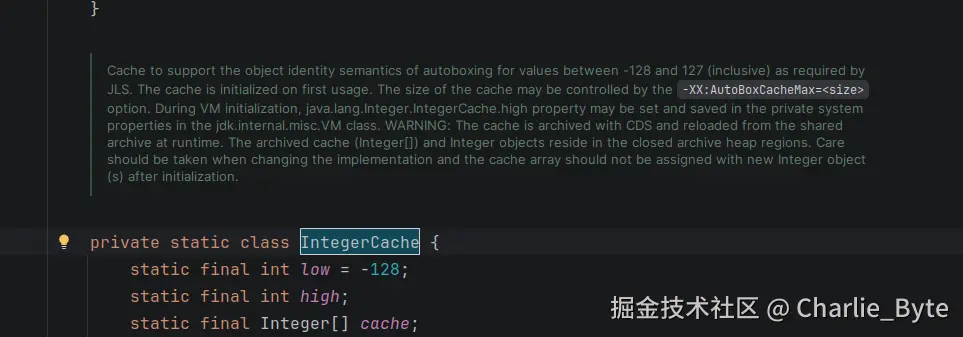
IntegerCache 类注释
valueOf(int) 上方、IntegerCache 定义前的注释:
vbnet
/**
 * Cache to support the object identity semantics of autoboxing for values between
 * -128 and 127 (inclusive) as required by JLS.
 *
 * The cache is initialized on first usage.  The size of the cache
 * may be controlled by the {@code -XX:AutoBoxCacheMax=<size>} option.
 * During VM initialization, java.lang.Integer.IntegerCache.high property
 * may be set and saved in the private system properties in the
 * jdk.internal.misc.VM class.
 *
 * WARNING: The cache is archived with CDS and reloaded from the shared
 * archive at runtime. The archived cache (Integer[]) and Integer objects
 * reside in the closed archive heap regions. Care should be taken when
 * changing the implementation and the cache array should not be assigned
 * with new Integer object(s) after initialization.
 */
拆开看:
| 要点 | 含义 |
|---|---|
| JLS | -128, 127 装箱必须具备对象同一性 |
| 首次使用初始化 | 静态块在类首次用到时执行 |
-XX:AutoBoxCacheMax |
可抬高缓存上界 |
IntegerCache.high 属性 |
VM 初始化时写入 jdk.internal.misc.VM 的私有系统属性 |
| CDS WARNING | 缓存可随 CDS 归档;初始化后不要再往数组里塞新的 Integer |
静态块末尾还有断言注释:range [-128, 127] must be interned (JLS7 5.1.7)。
IntegerCache 静态初始化
ini
private static class IntegerCache {
    static final int low = -128;
    static final int high;
    static final Integer[] cache;
    static Integer[] archivedCache;

    static {
        // high value may be configured by property
        int h = 127;
        String integerCacheHighPropValue =
            VM.getSavedProperty("java.lang.Integer.IntegerCache.high");
        if (integerCacheHighPropValue != null) {
            try {
                h = Math.max(parseInt(integerCacheHighPropValue), 127);
                // Maximum array size is Integer.MAX_VALUE
                h = Math.min(h, Integer.MAX_VALUE - (-low) -1);
            } catch( NumberFormatException nfe) {
                // If the property cannot be parsed into an int, ignore it.
            }
        }
        high = h;

        // Load IntegerCache.archivedCache from archive, if possible
        CDS.initializeFromArchive(IntegerCache.class);
        int size = (high - low) + 1;

        // Use the archived cache if it exists and is large enough
        if (archivedCache == null || size > archivedCache.length) {
            Integer[] c = new Integer[size];
            int j = low;
            for(int i = 0; i < c.length; i++) {
                c[i] = new Integer(j++);
            }
            archivedCache = c;
        }
        cache = archivedCache;
        // range [-128, 127] must be interned (JLS7 5.1.7)
        assert IntegerCache.high >= 127;
    }

    private IntegerCache() {}
}
low / high
low:写死-128,没有对应的「AutoBoxCacheMin」high:默认127;若属性存在,则
h = max(解析值, 127),再
h = min(h, Integer.MAX_VALUE - (-low) - 1)
保证数组长度(high - low) + 1不超过Integer.MAX_VALUE
因此:
- 上界可以抬高(例如
AutoBoxCacheMax=1000→high至少到 1000) - 上界不能 通过该属性降到 127 以下(
Math.max(..., 127)) - 下界永远是 -128,所以
-129 == -129在引用意义上仍是false
属性从哪来
注释写明:VM 启动时可能把 -XX:AutoBoxCacheMax 转成
java.lang.Integer.IntegerCache.high,存进 jdk.internal.misc.VM 的 saved properties;
静态块用 VM.getSavedProperty(...) 读取,而不是普通 System.getProperty。
属性解析失败(NumberFormatException)时直接忽略,退回默认 127。
CDS 与 archivedCache
流程是:
- 先定好
high CDS.initializeFromArchive(IntegerCache.class)尝试从共享归档恢复archivedCache- 若归档不存在,或归档长度
< size(当前配置需要更大缓存),则现场new Integer[size]并填充 cache = archivedCache:对外只读用的就是这份数组
「归档不够大就重建」解释了:抬高 AutoBoxCacheMax 后,可能用不上旧归档里那份较小的 Integer[]。
WARNING 的含义也清楚了:归档堆区域里的 Integer 实例初始化后不应再被替换;cache 指向的数组槽位在静态块结束后视为只读。
填充时为何仍用 new Integer
循环里是 c[i] = new Integer(j++)。
这里是构建缓存本身 ,不能再调 valueOf,否则会在 IntegerCache 尚未就绪时回头依赖缓存。
同文件里 parseInt 也有类似警告:
arduino
/*
 * WARNING: This method may be invoked early during VM initialization
 * before IntegerCache is initialized. Care must be taken to not use
 * the valueOf method.
 */
VM 极早阶段只能用基本类型路径,不能碰依赖缓存的 valueOf。
valueOf(int)
java
/**
 * Returns an {@code Integer} instance representing the specified
 * {@code int} value.  If a new {@code Integer} instance is not
 * required, this method should generally be used in preference to
 * the constructor {@link #Integer(int)}, as this method is likely
 * to yield significantly better space and time performance by
 * caching frequently requested values.
 *
 * This method will always cache values in the range -128 to 127,
 * inclusive, and may cache other values outside of this range.
 *
 * @param  i an {@code int} value.
 * @return an {@code Integer} instance representing {@code i}.
 * @since  1.5
 */
@IntrinsicCandidate
public static Integer valueOf(int i) {
    if (i >= IntegerCache.low && i <= IntegerCache.high)
        return IntegerCache.cache[i + (-IntegerCache.low)];
    return new Integer(i);
}
命中与未命中
| 条件 | 行为 |
|---|---|
low <= i <= high |
返回 cache[i - low](写法是 i + (-low)) |
| 否则 | new Integer(i),每次新对象 |
默认 low = -128 时下标:
| 值 | 下标 |
|---|---|
| -128 | 0 |
| 0 | 128 |
| 127 | 255 |
| 128 | 超出,走 new |
文档句 always cache -128, 127,may cache other values 与 high 可配置完全一致。
@IntrinsicCandidate
注解定义在 jdk.internal.vm.annotation.IntrinsicCandidate:
indicates that an annotated method may be (but is not guaranteed to be) intrinsified by the HotSpot VM. A method is intrinsified if the HotSpot VM replaces the annotated method with hand-written assembly and/or hand-written compiler IR
要点:
- HotSpot 可能用手工汇编 / IR 替换该方法
- 不保证一定 intrinsify,与平台和 VM 配置有关
- 改库方法语义时,VM 侧 intrinsic 必须同步
- 应用代码可忽略该注解;语义仍以 Java 源码为准
valueOf(int) 标了它,说明这是热点路径;读源码仍按上面的 if 理解即可。
构造器:为何不该 new Integer
ini
@Deprecated(since="9", forRemoval = true)
public Integer(int value) {
    this.value = value;
}since="9",forRemoval = true:JDK 17 里仍可用,但已标明将删除- 总是新对象,不进缓存
- 所以
new Integer(10) == Integer.valueOf(10)为false
缓存初始化循环里仍调用该构造器,是 JDK 内部建池的特例;业务代码应只用 valueOf 或自动装箱。
equals:比的是值
typescript
public boolean equals(Object obj) {
    if (obj instanceof Integer) {
        return value == ((Integer)obj).intValue();
    }
    return false;
}
equals 只比包装的 int,与是否同一缓存实例无关。前文示例里默认配置下 128 == 为 false,而 128 equals 为 true,就是这个原因。
valueOf(String) 也会进缓存
vbnet
public static Integer valueOf(String s) throws NumberFormatException {
    return Integer.valueOf(parseInt(s, 10));
}
先 parseInt 得到 int,再走 valueOf(int),因此 "10" 同样可能命中缓存。
parseInt 本身返回的是基本类型,不涉及 Integer 同一性。
其它包装类缓存(对照)
同一套 JDK 17 源码里:
| 类型 | 缓存范围(实现) | 上界是否可配 |
|---|---|---|
Byte.valueOf |
全部 byte(-128, 127) | 否 |
Short.valueOf |
-128, 127 | 否(源码写死) |
Integer.valueOf |
至少 -128, 127,high 可抬高 |
是(AutoBoxCacheMax) |
Long.valueOf |
-128, 127 | 否(源码写死) |
Character.valueOf |
'\u0000'~'\u007F' |
否 |
Boolean |
TRUE / FALSE 两个常量 |
--- |
Float / Double |
无同类小值缓存池 | --- |
Long / Short 的 Javadoc 也写了 "may cache other values",但 JDK 17 源码里区间是写死的 ;真正能通过 VM 选项拉高的是 Integer。
对照源码时可看 $JAVA_HOME/lib/src.zip 中的 java.base/java/lang/Integer.java,重点是 IntegerCache 静态块与 valueOf(int)。
附
CDS (Class Data Sharing)是 HotSpot 的类数据共享机制:把部分类元数据和只读对象提前打进共享归档(shared archive),下次启动直接映射加载,少做重复初始化。
在 IntegerCache 里,它干两件事相关的活:
- 启动时可能已经把「缓存数组 + 里面的
Integer实例」写进归档 - 运行时用
CDS.initializeFromArchive(IntegerCache.class)试图把这些东西再加载回来
archivedCache 是 IntegerCache 里的一个静态字段:static Integer[] archivedCache。
- 给 CDS 用的「归档侧」数组引用
CDS.initializeFromArchive(...)成功时,VM 会把归档里那份Integer[]填到这个字段上- 静态块再判断:没有归档,或归档长度不够当前
high需要的size,就现场new Integer[size]填一遍,赋给archivedCache - 最后
cache = archivedCache:对外真正用的是cache,它和archivedCache指向同一份数组
可以记成:
| 名字 | 角色 |
|---|---|
| CDS | JVM 的归档/共享能力 |
archivedCache |
从归档恢复(或本地新建)的缓存数组容器 |
cache |
valueOf 实际读取的那份数组(赋值自 archivedCache) |
注释里的 WARNING 也是这个原因:这些 Integer 可能住在归档堆的封闭区域,初始化后再往槽位里塞新对象不安全。