金属蛋白的动力学模拟3

背景

书接上文金属蛋白的动力学模拟2,我们在做好了预处理前的一切准备之后,之后就是正式做拓扑体系的准备了,并展开模拟了。

力场和水模型选择

我们在开始正式模拟之前,选用确定体系所使用的力场和水模型,也无非是两个:

  • 我们要模拟的复合物,这里是蛋白质和核酸,要选择什么力场
  • 溶剂一般是水,选择什么模型

经过简单的文献和经验调研,对于蛋白质+核酸这样经典的模拟任务而言,大多数人选择的配套体系如下(大概率为以下三种组合之一):

  • CHARMM36m/CHARMM36 + CHARMM36 NA + CHARMM-TIP3P
  • Amber-ff19SB + OL24/OL21 + OPC
  • Amber-ff14SB + OL15/bsc1 + TIP3P

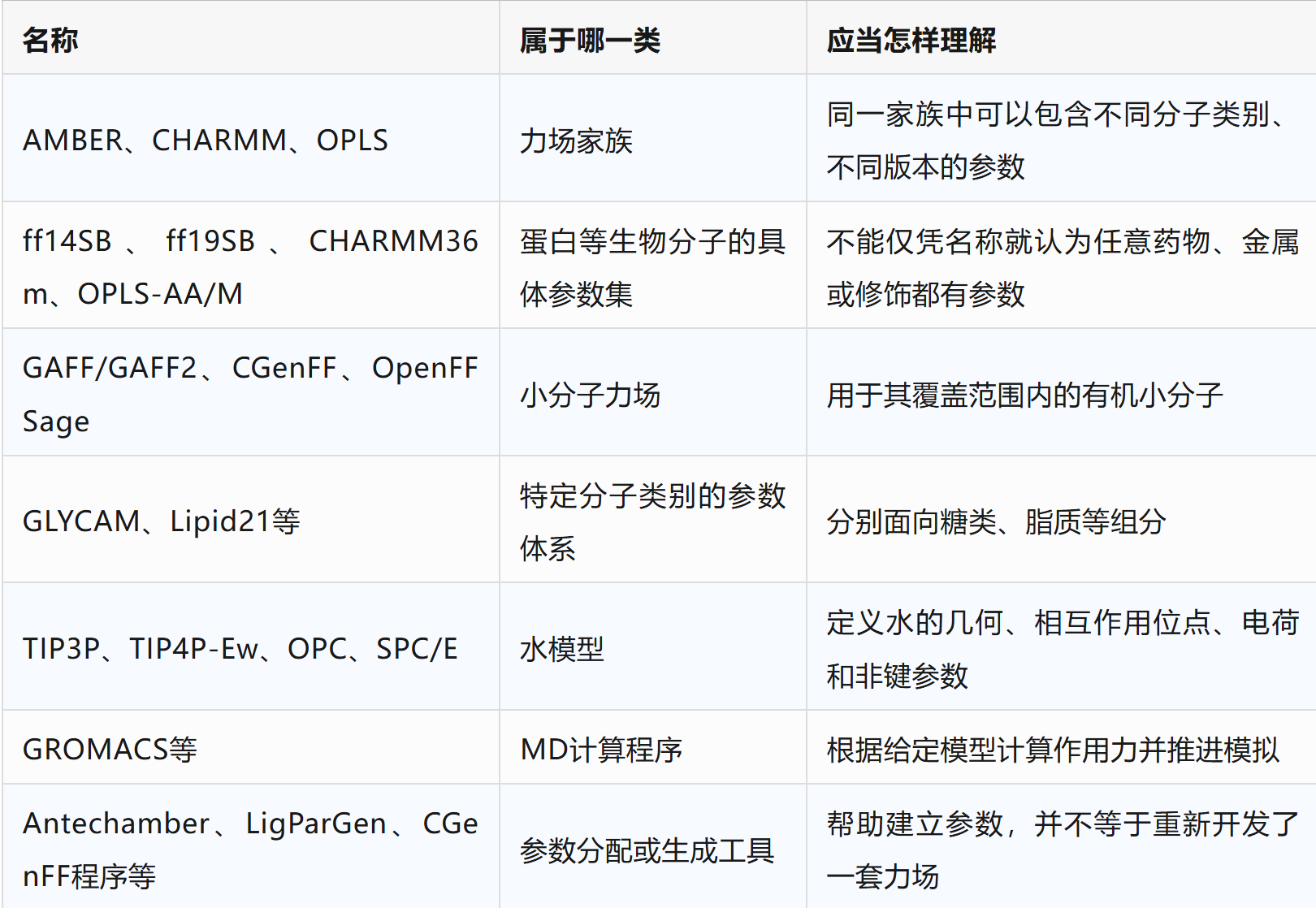
对于生物分子体系,一般是先辨认组分,再查对应参数
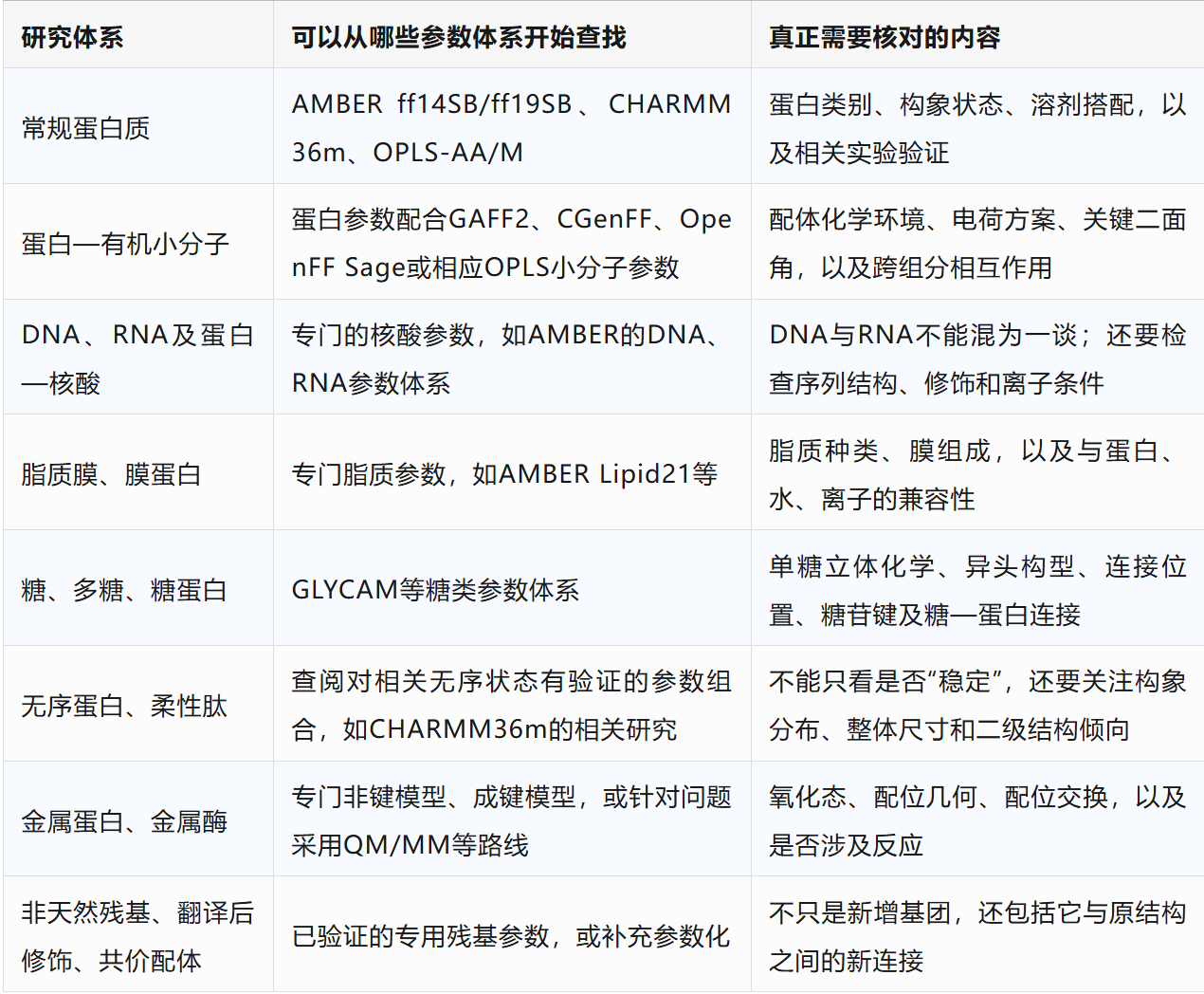
蛋白、小分子与专用组分的选型依据,可分别查阅ff19SB、CHARMM36m、OPLS-AA/M的原始研究,以及AMBER官方的组分参数说明。

选好了蛋白+核酸力场,我们还不能直接开始模拟
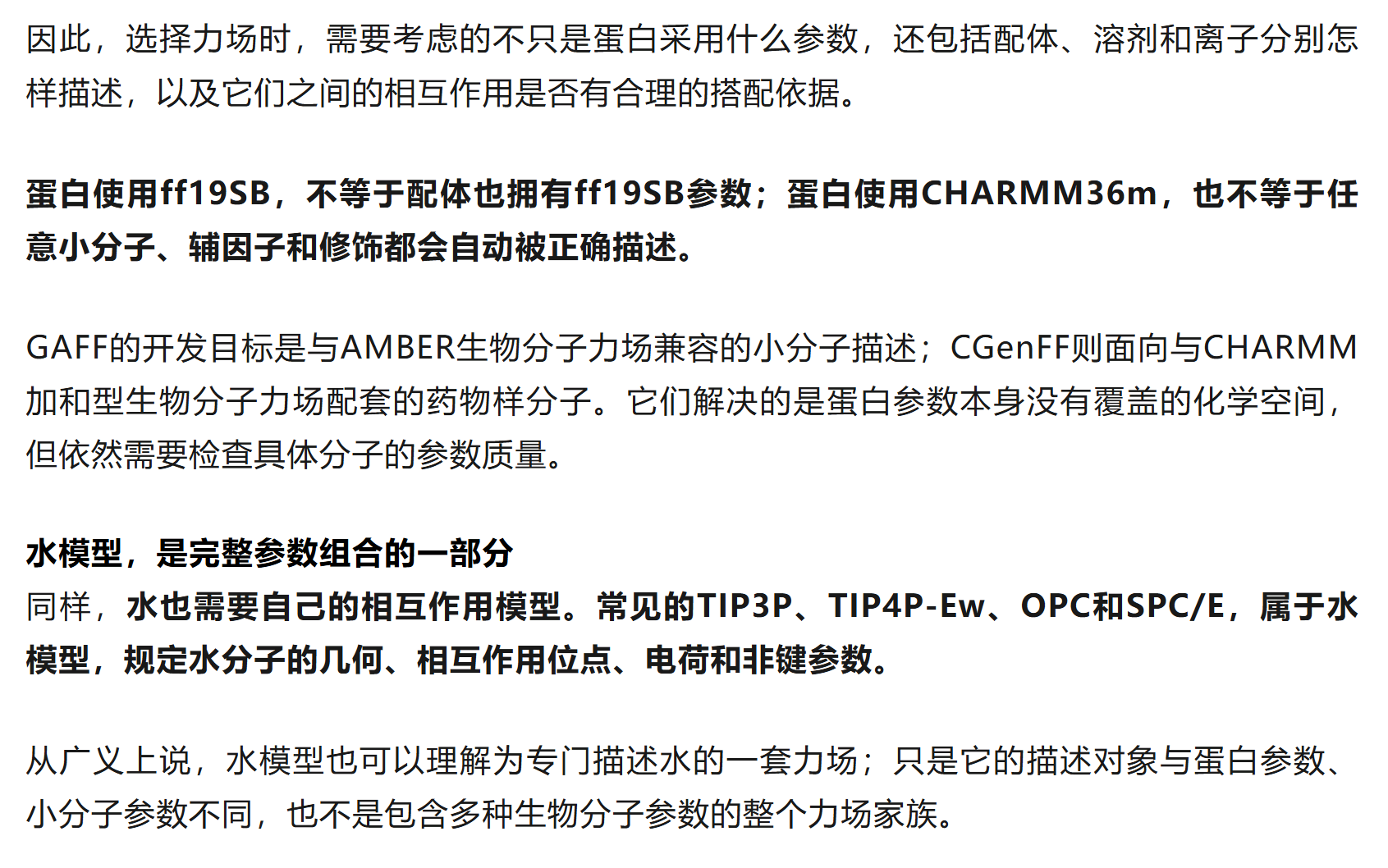
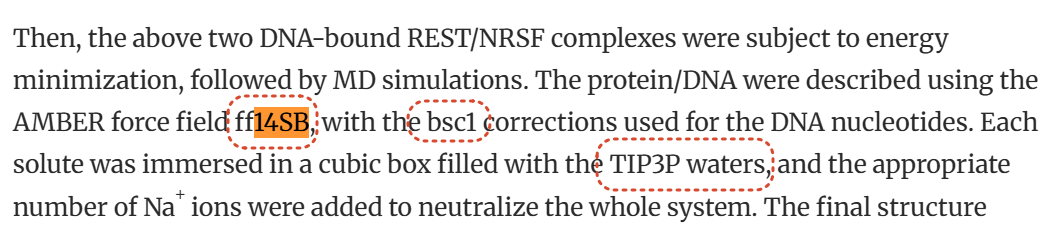
此处我们参考:https://www.nature.com/articles/s41388-023-02751-1

这篇文献并没有使用更新的ff18sb,而是用了14+tip3p,也就是ZAFF教程中的经典搭配方案,当然这篇文献是23年的,只能说方案上 性能和效率需要权衡,选14也是计算节省
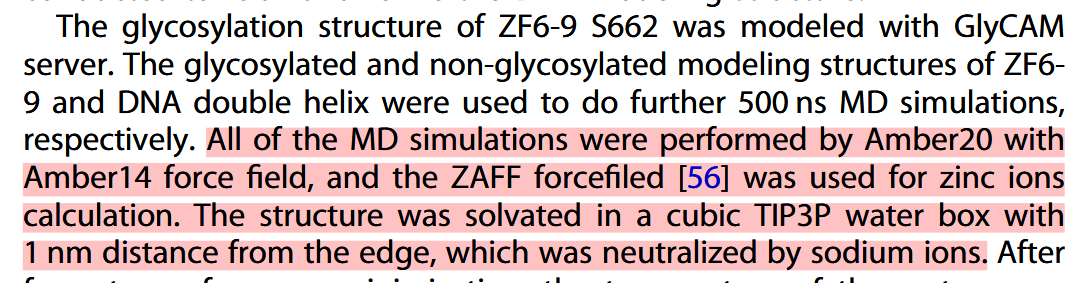
另外参考:https://github.com/nagarh/amber-md-agent/blob/4257f129caaa8c7dfc49fc609a1d21458633a6ea/Benchmark/studies/study_023/PLAN.md

这里需要注意的一个点,就是ZAFF,ZAFF 是 AMBER 原生参数、用 TIP3P 标定的,所以水模型不好改定位 OPC
我们可以看一下装了ambertools26之后,

plain 复制代码
ls $AMBERHOME/dat/leap/cmd/ | grep -i dna
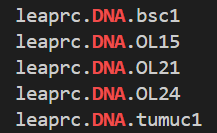
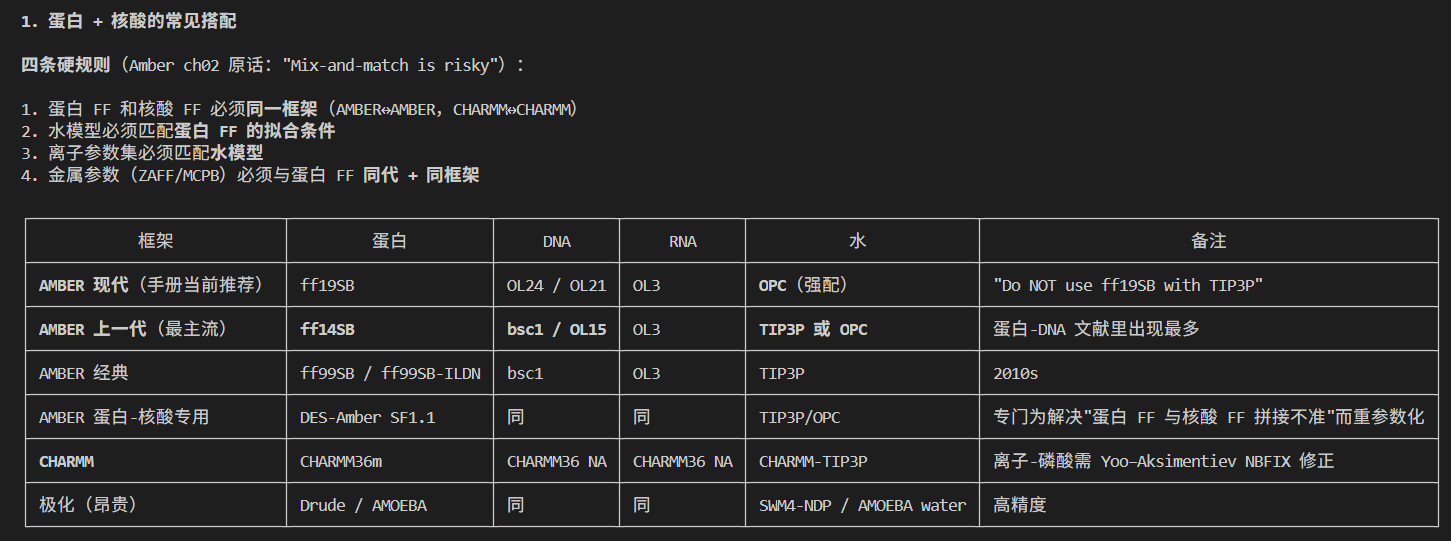
那么我们也选择ff14sb+bsc1+tip3p的经典体系,也是为了节省开支(我们演示教程的目的是为了尽快动起来,迭代决策的事情后面再说)

我们先来看看官方ZAFF这个教程,
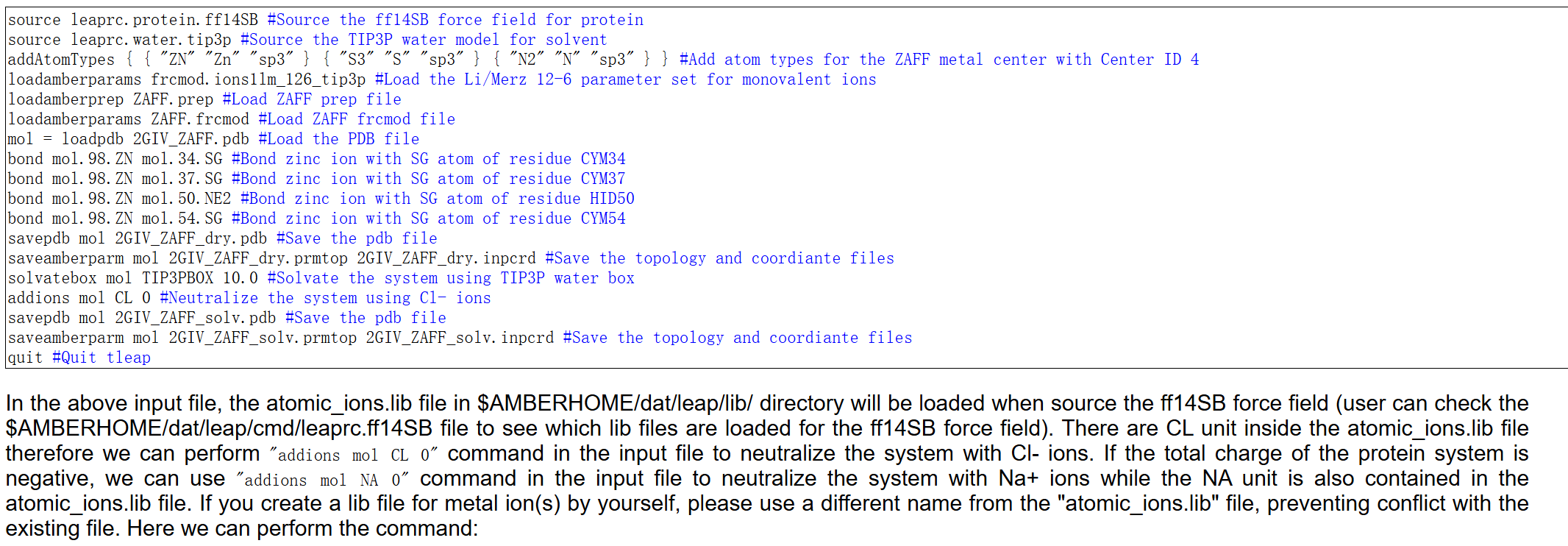
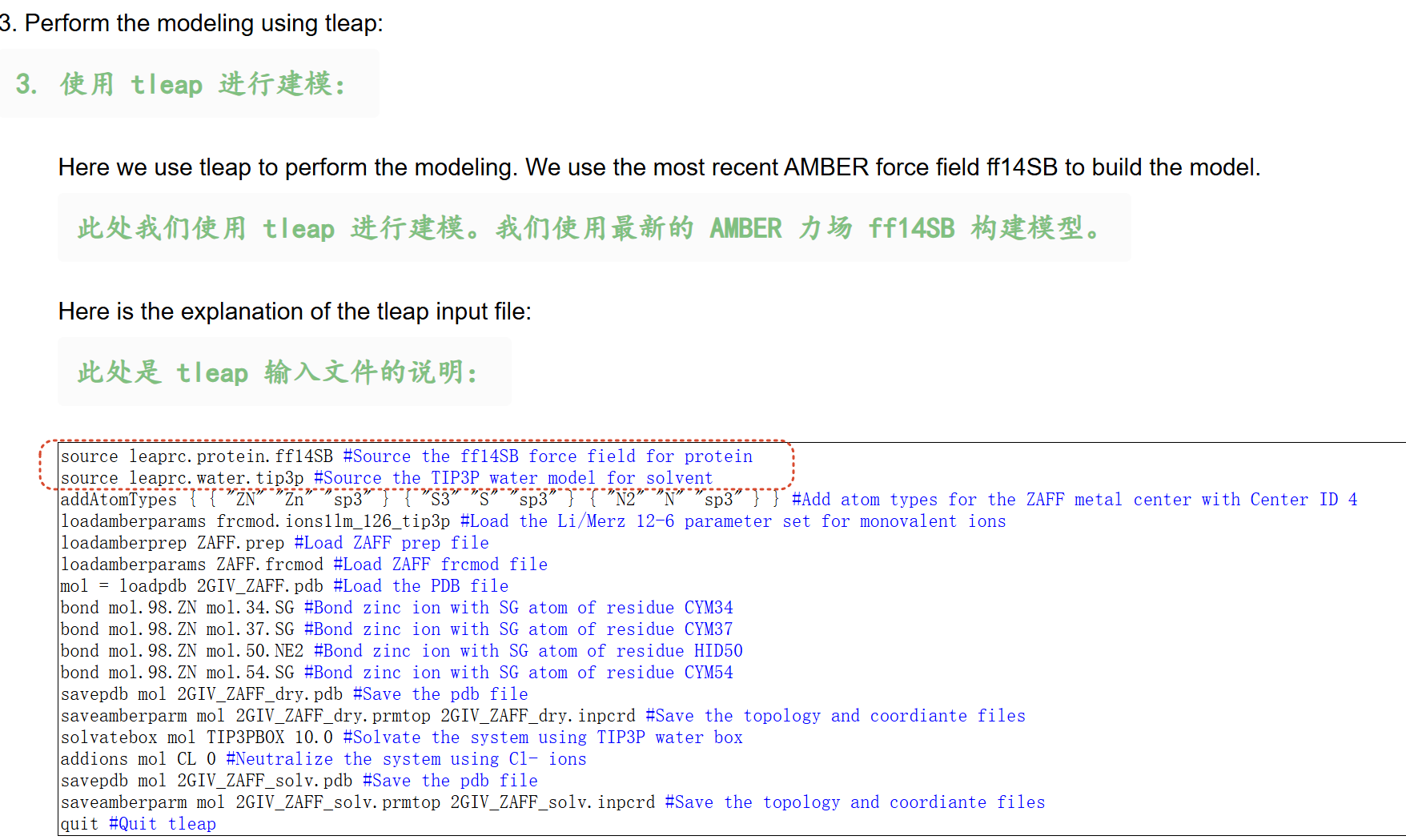
首先是力场加载,也就是两个source不用改,对source leaprc.water.tip3p我们需要依据特定目的思考一下,如果我们只是在amber中构建pdb结构处理,不做额外的拓扑体系构建(也就是不溶剂化,不加离子等),那么我们其实只要产出拓扑文件和坐标文件就可以了,具体的可以转化为gromacs适配格式再处理,再加水。

这里我们选择:在ZAFF中做完拓扑体系构建,然后从em、nvt、npt开始用gromacs进行模拟

然后是addAtomTypes:

原教程这里说错了,原教程使用的是center ID3的蛋白2GIV,所以用的是S3/N2

所以我们是C2H2也就是center ID4的类型,应该用

addAtomTypes { { "ZN" "Zn" "sp3" } { "S4" "S" "sp3" } { "N3" "N" "sp3" } }

然后是下面三行:

loadamberparams frcmod.ions1lm_126_tip3p

loadamberprep ZAFF.prep

loadamberparams ZAFF.frcmod

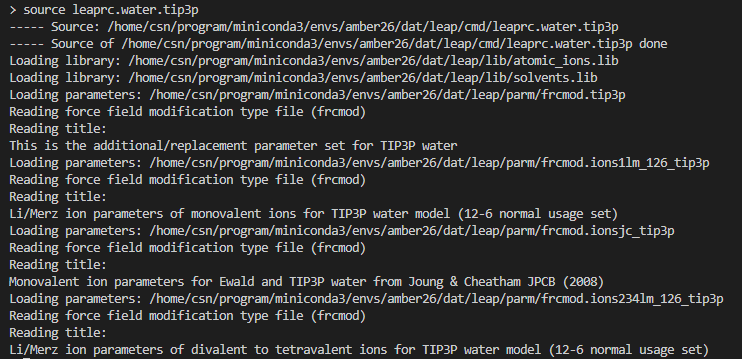
如果我们只是在amber ZAFF中构建拓扑体系,其余溶剂化加离子和模拟都给gromacs引擎,那么我们其实没有可以删掉source leaprc.water.tip3p 和 loadamberparams frcmod.ions1lm_126_tip3p;

如果我们构建拓扑体系全都在在amber中进行,然后后续所有模拟步骤都给gromacs,那么我们这里有必要补上 source leaprc.water.tip3p 和 loadamberparams frcmod.ions1lm_126_tip3p
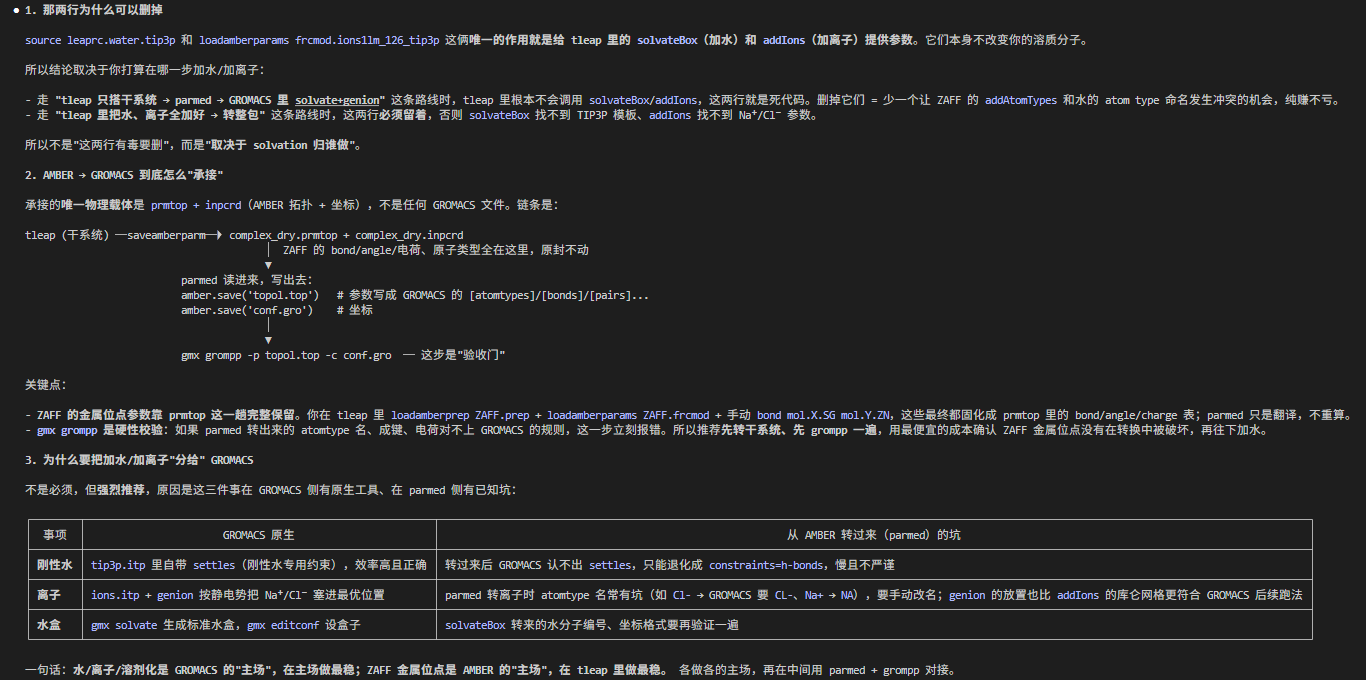
总而言之,我们原本的操作目的是:use ambertools to build an amber topology, which can then be converted into GROMACS topology

need Tleap to build the topology and parmed to turn it into something GROMACS can work with

使用 ambertools 构建 amber 拓扑,然后可以转换为 GROMACS 拓扑

需要 Tleap 来构建拓扑结构,并通过 Parmed 将其转化为 GROMACS 可操作的结构。

参考:https://github.com/pgbarletta/locuaz/blob/92298259874c087f46dbd911ca1bdb354ad9fcea/docs/source/tutorialtleap.rst

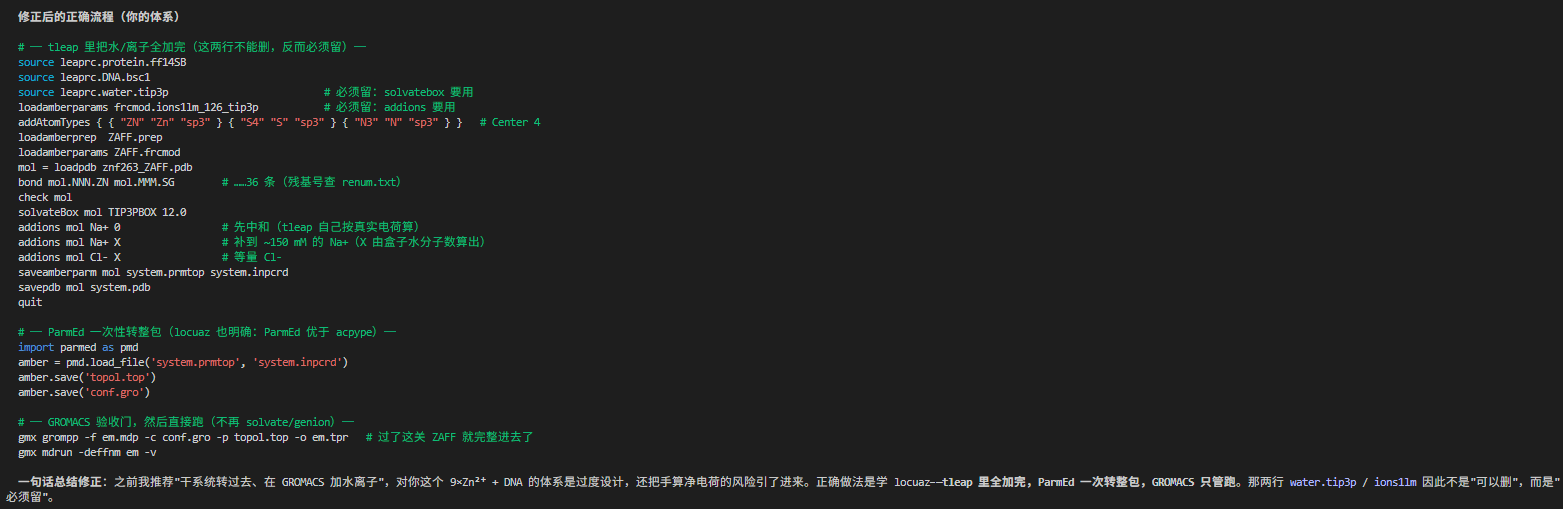
我们选择所有的拓扑构建都在ZAFF中处理完毕,所以我们这两行照搬

mol也照搬

成键这一块需要依据我们自己的序号修改,因为rename没有修改pdb4amber中的num序号,所以我们不需要再次进行renum;直接沿用旧序号即可

这一块就是mol.残基序列号.原子name (成键的残基与配位ZN之间),注意我们这里ZN4是残基name,原子名就是ZN没问题
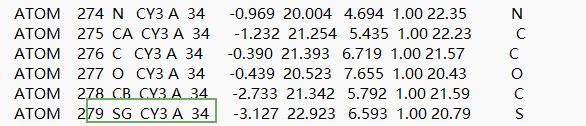
然后这里有一个问题,就是这9个zn离子,我们并没有确定哪个是zf1还是zf2等,需要确定这些zn离子都在哪里?也就是我们这里的ZN到底是哪个ZN和哪些配位残基靠近

对于配位原子,我们已经依据锌指蛋白的背景知识先验确定了,所以我们现在要做的就是明确到底哪个zn是和哪些配位原子对应的。

方法有很多:
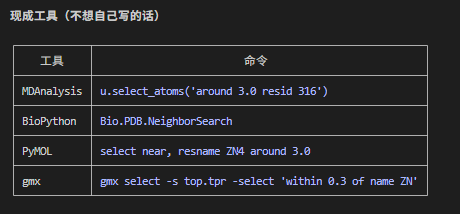
我们这里给pdb-md新写了一个模块,neighbor,简单来说就是给定1个ZN离子,我们查看一下其给定距离范围内的原子有哪些,按照周边几何配位环境,我们把这些ZN离子分配给最近的C2H2配位残基中,

按照我们前面ZAFF中提到的,ZN-S和ZN-N一般距离在2-2.5A左右,如果太远了,可能就是初始几何结构不对,需要进行矫正

情况比较糟糕,alphafold3预测出来的初始结构中ZN离子都是乱放的,9个都是错放的。

一些需要注意的地方参考:https://docs.bioexcel.eu/2020_06_09_online_ambertools4cp2k/05-leap/index.html

https://computecanada.github.io/molmodsim-amber-md-lesson/12-Adding_Ions/index.html

就是加水溶剂化,然后加离子中和、构建生理盐浓度这一块需要手动计算离子数目,不像gromacs那样可以直接设置生理盐浓度参数

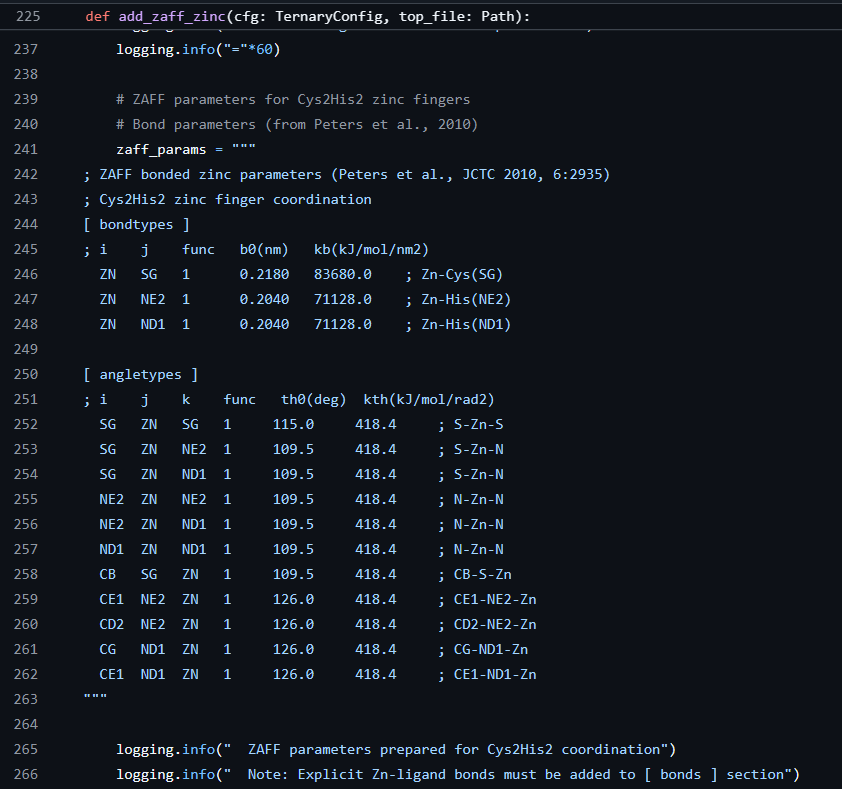
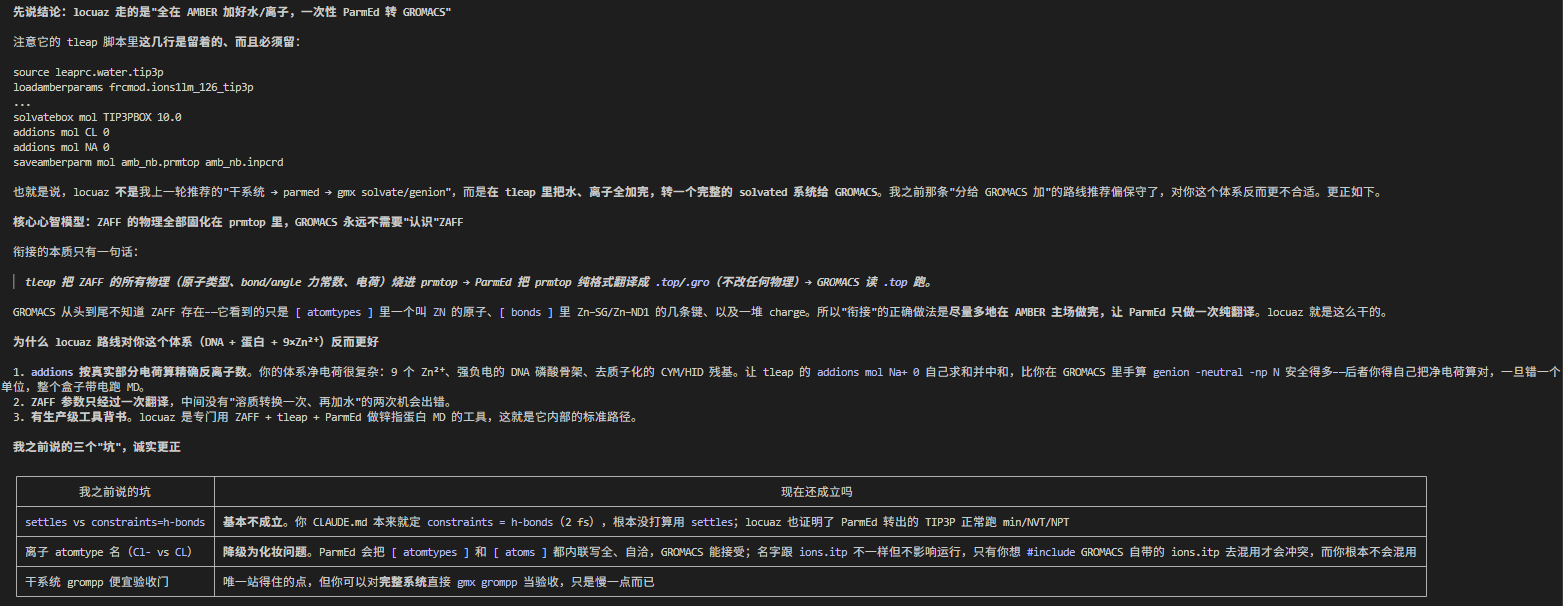
现在再回过头来看:https://github.com/a-chahal/GLI-final-model/blob/dc1bc6852ce1d1e44b057fb8607b0c3b72052a02/ternary_md/run_ternary_pipeline.py#L225

这里其实是将ZAFF的参数全部抽取出来,全部使用gromacs体系建模模拟
plain 复制代码
  ---                                                                                                                                                                                 
  A. 逐行               
                                                                                                                                                                                      
  ① 力场加载                                                                                                想·                                                                        
                                                                                                                                                                                      
  source leaprc.protein.ff14SB                                                                                                                                                        
  source leaprc.water.tip3p                                                                                                                                                           
                                                                                                                                                                                      
  - source = 执行另一个 LEaP 脚本(等价于"把那个文件的内容读进来")。                                                                                                                 
  - leaprc.protein.ff14SB:载入蛋白库(all_amino94.lib、amino12.lib、N/C 端库...)+ 参数(parm10.dat + frcmod.ff14SB),建立 残基名 → 模板 的映射。教程后文说它顺带载入了               
  atomic_ions.lib(所以后面能用 CL)------这点值得我们自己 list 验一下,因为 addions 能不能找到 CL 全靠它。                                                                                 
  - leaprc.water.tip3p:载入 3 点水模型(残基 WAT/TP3,电荷 ±0.834、O--H 0.9572 Å)+ TIP3PBOX------一个预先平衡好的水盒子坐标(solvatebox 就是拿它去填),并建立 HOH → TP3 的映射。      
  - ⚠️  顺序不能反:水模型必须在蛋白力场之后(ch02:「The water model must be loaded after the protein force field」)。另注:ch02 提醒现在必须显式 source 水模型,TIP3P 不再是默认。  
                                                                                                                                                                                      
  ② 把 ZAFF 的参数喂进去(4 行,核心)                                                                                                                                                
                                                                                                                                                                                      
  addAtomTypes { { "ZN" "Zn" "sp3" } { "S3" "S" "sp3" } { "N2" "N" "sp3" } }                                                                                                          
  - ch03 的定义:addAtomTypes { {type element hybrid} ... } = 为原子类型声明"元素 + 杂化"。                                                                                           
  - 三个新原子类型:ZN(元素 Zn)、S3(S)、N2(N)。ZAFF.prep 里会用这些名字,不先声明,LEaP 就不知道它们是锌/硫/氮,建 3D 结构和补原子时会出错。                                          
  - "sp3" 对 Zn 没有物理意义(d¹⁰ 无杂化),只是占位标签。                                                                                                                            
  - ⚠️  这是整个脚本最容易抄错的一行(见 B-1、B-2)。                                                                                                                                  
                                                                                                                                                                                      
  loadamberparams frcmod.ions1lm_126_tip3p                                                                                                                                            
  - 载入 Li/Merz 12-6 单价离子参数集,_tip3p 后缀表示这组参数是在 TIP3P 水里拟合的。它定义 Na⁺/K⁺/Cl⁻ 等的 vdW(R*, ε)。                                                             
  - 换水模型就得换这个文件,否则离子-水相互作用不自洽。这就是"离子参数集必须匹配水模型"那条硬规则。                                                                                   
                                                                                                                                                                                      
  loadamberprep ZAFF.prep                                                                                                                                                             
  - prep 文件 = 一个残基模板:定义 ZAFF 新残基的残基名、原子名、原子类型、每个原子的电荷、残基内部的成键树。                                                                          
  - 这是 ZAFF 引入自定义残基(教程里的 CY3/HD1/ZN3)的地方。没有它,loadpdb 会因"不认识的残基名"报错或乱建。                                                                          
                                                                                                                                                                                      
  loadamberparams ZAFF.frcmod                                                                                                                                                         
  - frcmod = force-constants modification:标准参数文件里没有的成键项(键长/键角力常数、二面角、improper),外加新原子类型的 vdW。                                                    
  - ZAFF.frcmod 提供的正是 Zn--S / Zn--N 的键、S--Zn--S / S--Zn--N 的角------这才是"键合金属位点"的本质。                                                                                       
  - 分工:prep 管电荷+拓扑,frcmod 管力常数。两个缺一不可。                                                                                                                           
                                                                                                                                                                                      
  ③ 建体系                                                                                                                                                                            
                                                                                                                                                                                      
  mol = loadpdb 2GIV_ZAFF.pdb                                                                                                                                                         
  信息量最大的一行。LEaP 会做五件事:                                                                                                                                                 
                                                                                                                                                                                      
  1. 按 PDB 里的残基名去找模板 → 所以 CYS 必须已经改成 CY3、HIS→HD1、ZN→ZN3                                                                                                           
  2. 自动补缺失原子(氢,以及模板有而 PDB 缺的重原子),用模板内坐标摆位 → 日志里出现 Added missing heavy atom / Created a new atom                                                   
  3. 按文件顺序把残基重编号 1..N ← 这就是前面必须先跑 pdb4amber、renum.txt 重要的原因                                                                                                 
  4. 把 TER 认成链断裂,绝不跨 TER 自动成键                                                                                                                                           
  5. 结果存进一个叫 mol 的 UNIT                                                                                                                                                       
                                                                                                                                                                                      
  bond mol.98.ZN mol.34.SG                                                                                                                                                            
  bond mol.98.ZN mol.37.SG                                                                                                                                                            
  bond mol.98.ZN mol.50.NE2                                                                                                                                                           
  bond mol.98.ZN mol.54.SG                                                                                                                                                            
  - ch03:bond atom1 atom2 [order] = 显式建立一根键。                                                                                                                                 
  - 寻址是 mol.<残基号>.<原子名>,残基号是 LEaP 的"文件顺序编号",与原 PDB 的 resSeq 无关、也不带 chain。                                                                             
  - 为什么必须手写:教程刻意在蛋白和 Zn 之间放了 TER,LEaP 因此认为它们本来没有键。不写这几行 → Zn 变成游离离子(会漂走、把配位残基拉变形)。写了才是 ZAFF 的键合位点。               
  - 这 4 行是 CCCH:3×SG(Cys) + 1×NE2(His)。                                                                                                                                          
  - ⚠️  残基号写错 = 接到别的原子上,而 tleap 不一定报错。                                                                                                                             
                                                                                                                                                                                      
  ④ 存干体系                                                                                                                                                                          
                                                                                                                                                                                      
  savepdb mol 2GIV_ZAFF_dry.pdb                                                                                                                                                       
  saveamberparm mol 2GIV_ZAFF_dry.prmtop 2GIV_ZAFF_dry.inpcrd                                                                                                                         
  - savepdb 把当前 unit 写成 PDB,带上 LEaP 刚补进去的原子、用 LEaP 的编号 → 这是给我们目视 QC 用的(看 Zn 的四配位对不对)。                                                           
  - saveAmberParm unit top crd 写拓扑 + 坐标 = "干体系":蛋白+Zn,无水无离子。                                                                                                        
  - ⚠️  教程这里漏了一步,我们应该在 saveamberparm 之前插:                                                                                                                              
  check mol                                                                                                                                                                           
  - ch03 定义:check unit = 检查电荷、键、原子类型、近距接触。这是 MD 之前唯一能发现"电荷非整数 / 某原子类型没参数"的地方。                                                           
                                                                                                                                                                                      
  ⑤ 溶剂化 + 中和                                                                                                                                                                     
                                                                                                                                                                                      
  solvatebox mol TIP3PBOX 10.0                                                                                                                                                        
  - ch03:solvateBox solute solvent dist ["iso"] [closeness]                                                                                                                          
  - 用 TIP3PBOX 填满 mol;10.0 = 溶质原子到盒子边的最小距离(Å)。                                                                                                                    
  - 另一种是 solvateoct mol TIP3PBOX 10.0 iso(截角八面体)。我们的体系是细长的 ZF--DNA 棒,solvateoct ... iso 更省水。                                                                  
  - 执行后 mol 原地变成含水的 unit。                                                                                                                                                  
                                                                                                                                                                                      
  addions mol CL 0                                                                                                                                                                    
  - ch03:addIons unit ion1 numIon1 ... = "Add ions using Coulombic grid"                                                                                                             
  - CL = 氯离子(LEaP 接受 CL/Cl- 这类写法,映射到 atomic_ions.lib 的单元);第二个参数的 0 不是"加 0 个",而是"加到体系净电荷为 0"。                                                 
  - 实现方式:把已有的水分子替换成离子。                                                                                                                                              
  - 三个变体:addIons(库仑网格,默认)、addIons2(溶剂+溶质同等对待)、addIonsRand(随机替换水,可设最小间距)。                                                                     
  - ⚠️  教程只用 Cl⁻ 是因为 2GIV 蛋白带正电。我们正好反过来(DNA 磷酸骨架带大量负电)→ 要用 Na⁺/K⁺。                                                                                     
                                                                                                                                                                                      
  ⑥ 存溶剂体系 + 退出                                                                                                                                                                 
                                                                                                                                                                                      
  savepdb mol 2GIV_ZAFF_solv.pdb                                                                                                                                                      
  saveamberparm mol 2GIV_ZAFF_solv.prmtop 2GIV_ZAFF_solv.inpcrd                                                                                                                       
  quit                                                                                                                                                                                
  - 同上,但存的是溶剂化+中和后的体系。在纯 AMBER 流程里,MD 就用这两个文件。                                                                                                         
  - quit = 退出 LEaP。                                                                                                                                                                
                                                                                                                                                                                    
  ⑦ 命令行                                                                                                                                                                            
                                                                                                                                                                                      
  tleap -s -f 2GIV_ZAFF_tleap.in > 2GIV_ZAFF_tleap.out                                                                                                                                
  - -f <file> = 从文件读命令。                                                                                                                                                        
  - > ...out = 把 LEaP 的全部输出存下来。这个必须做------LEaP 的警告和"补了哪些原子"的信息全在 stdout,不存就只能滚屏找。                                                                 
  - -s:(两个官方教程都用 tleap -s -f x.in)。建议 tleap -h 确认或直接照抄。                                                               
  - 结尾那段话的意思:atomic_ions.lib(在 $AMBERHOME/dat/leap/lib/)提供了 CL/NA 单元,所以 addions ... CL 能用;如果我们自建金属 lib,文件名千万别叫 atomic_ions.lib,会跟 Amber       
  自带的冲突。                                                                                                                                                                        
                                                                                                                                                                                      
  ---                                                                                                                                                                                 
  B. 对你这套体系必须改的 7 处                                                                                                                                                        
                                                                                                                                                                                      
  1. addAtomTypes 应该用 Center 4 的那一套,不是教程这行。                                                                                                                          
                                                                                                                                                                                      
  归纳出来的规律(来自教程正文 + 邮件列表里的各 Center 例子):                                                                                                                       
                                                                                                                                                                                      
  ┌───────────┬────────────────┬───────────────────────────────────┐                                                                                                                  
  │ Center ID │    位点类型    │           addAtomTypes            │                                                                                                                
  ├───────────┼────────────────┼───────────────────────────────────┤                                                                                                                  
  │ 1         │ CCCC           │ {ZN, S1}                          │                                                                                                                
  ├───────────┼────────────────┼───────────────────────────────────┤                                                                                                                
  │ 2         │ CCCH (HIE)     │ {ZN, S2, N1}                      │                                                                                                                  
  ├───────────┼────────────────┼───────────────────────────────────┤                                                                                                                  
  │ 3         │ CCCH (HID)     │ {ZN, S3, N2} ← 教程这行其实是这个 │                                                                                                                  
  ├───────────┼────────────────┼───────────────────────────────────┤                                                                                                                  
  │ 4         │ CCHH (HID/HID) │ {ZN, S4, N3} ← 你要用这个         │                           
  └───────────┴────────────────┴───────────────────────────────────┘                                                                                                                  
                                                                                                                                                                                    
  规律:S 的下标 = Center ID,N 的下标 = Center ID − 1。教程注释写"Center ID 4"是标错了,正文才自洽(正文说 2GIV 是 CCCH、Center 3,残基名 CY3/HD1/ZN3)。                            
                                                                                               
  → 你的 9 个位点全是标准 C2H2 = Center 4 → { "ZN" "Zn" "sp3" } { "S4" "S" "sp3" } { "N3" "N" "sp3" }。(仍以教程表为准。)                                                           
                                                                                               
  2. ⚠️  N2/N3 和 ff14SB 的既有原子类型重名。                                                                                                                                          
                                                                                               
  N2/N3 在 Amber 蛋白力场里本来就是氮原子类型(ARG 胍基 N 是 N2,LYS 的 NZ / N 端 N 是 N3)。addAtomTypes 会重新声明它们的"元素+杂化",而 ZAFF.frcmod 里如果也定义了同名类型的        
  vdW,有可能把蛋白里所有 N3 原子的参数换掉。教程能跑不等于你不会中招(2GIV 没有 DNA,体系也小得多)。
                                                                                                                                                                                      
  检查:把 ZAFF.frcmod 里 N3 的 R*/ε 和 $AMBERHOME/dat/leap/parm/parm10.dat 里 N3 的对一下,不一致就是踩上了。                                                                        
                                                                                                                                                                                    
  3. 残基改名:18 个 Cys → Center 4 的 Cys 名、18 个 His → Center 4 的 His 名、9 个 Zn → ZN4。名字去教程表里查,别信我的记忆。                                                        
                                                                                                                                                                                    
  4. bond 要 36 行(9 位点 × 2 SG + 2 NE2),残基号用 LEaP 顺序编号,查 renum.txt。                                                                                                   
                                                                                               
  5. 你还有 DNA → 在蛋白 FF 之后加 source leaprc.DNA.bsc1;5′-端那个决定要在 loadpdb 之前定下来。                                                                                     
                                                                                               
  6. 你不要 solvatebox / addions。 按上一轮的交接方案,tleap 只做到干体系为止 → 脚本在 saveamberparm ..._dry 之后就停。这样 source leaprc.water.tip3p 和 loadamberparams              
  frcmod.ions1lm_126_tip3p 两行也可以删掉(少两个出错点),水盒和离子留给 GROMACS。            
                                                                                                                                                                                      
  7. addions 的对象反了:教程用 Cl⁻(蛋白带正电);你用 Na⁺/K⁺(DNA 带负电)。                                                                                                        
                                                                                                                                                                                    
  ---                                                                                                                                                                                 
  你的版本大概是(骨架)                                                                                                                                                            
                                                                                                                                                                                      
  source leaprc.protein.ff14SB                                                                 
  source leaprc.DNA.bsc1                                              # ← 你多这行                                                                                                    
  addAtomTypes { { "ZN" "Zn" "sp3" } { "S4" "S" "sp3" } { "N3" "N" "sp3" } }   # ← Center 4                                                                                           
  loadamberprep  ZAFF.prep                                                                                                                                                            
  loadamberparams ZAFF.frcmod                                                                                                                                                         
  mol = loadpdb znf263_ZAFF.pdb                                       # 已改名 CY4/?/ZN4                                                                                              
  # 36 条 bond(残基号查 renum.txt)                                                                                                                                                  
  check mol                                                          # ← 教程漏了这步                                                                                                 
  saveamberparm mol complex_dry.prmtop complex_dry.inpcrd                                                                                                                             
  savepdb mol complex_dry.pdb                                                                                                                                                         
  quit                                                                                                                                                                                

为了保险起见,我们还是顺便参考一下如今amber论坛中使用ZAFF的新范式和新经验:https://cse.google.com/cse?cx=partner-pub-9700140137778662:8927431201&ie=UTF-8&q=ZAFF&sa=Search&ref=
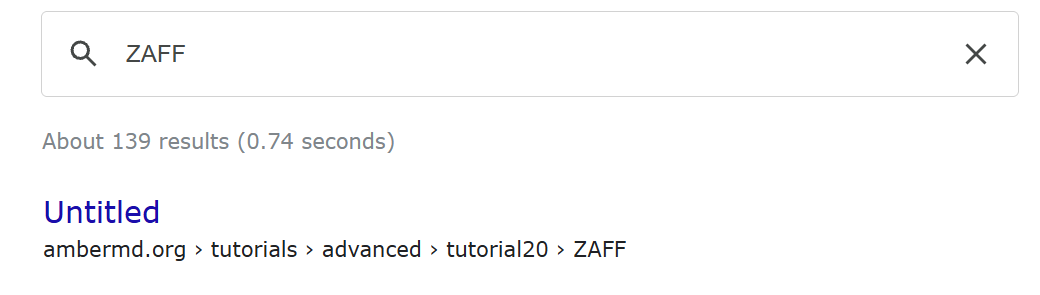
一共是139个帖子
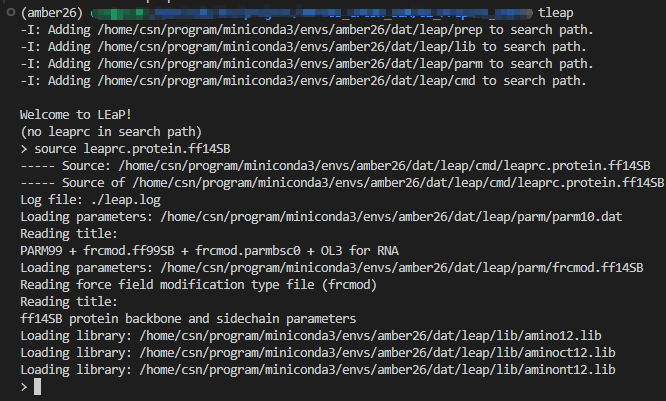
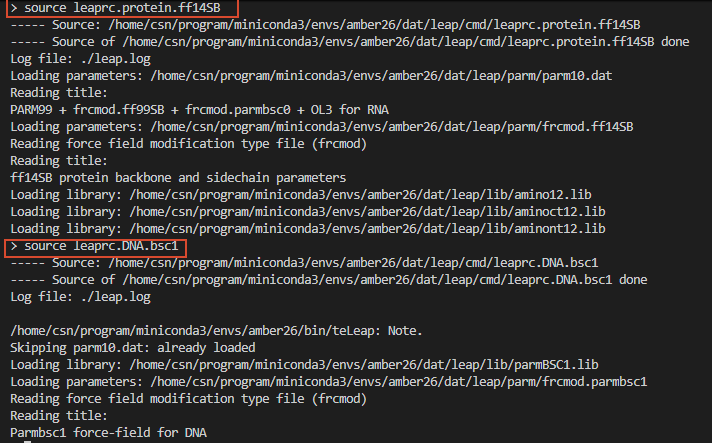
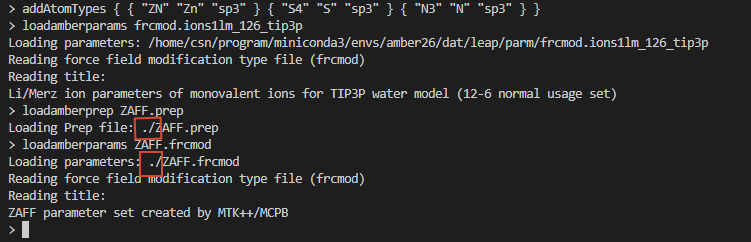
另外从这里我们可以看到这个是相对目录,相对tleap交互命令行的当前目录;

我这里图方便就用绝对路径了

重点是这里的check mol

plain 复制代码
> check mol
Checking 'mol'....

Warning: There is a bond of 28.057 angstroms between SG and ZN atoms:
-------  .R<CY4 12>.A<SG 8> and .R<ZN4 316>.A<ZN 1>

Warning: There is a bond of 27.821 angstroms between SG and ZN atoms:
-------  .R<CY4 15>.A<SG 8> and .R<ZN4 316>.A<ZN 1>

Warning: There is a bond of 25.406 angstroms between NE2 and ZN atoms:
-------  .R<HD2 28>.A<NE2 13> and .R<ZN4 316>.A<ZN 1>

Warning: There is a bond of 25.624 angstroms between NE2 and ZN atoms:
-------  .R<HD2 32>.A<NE2 13> and .R<ZN4 316>.A<ZN 1>

Warning: There is a bond of 36.920 angstroms between SG and ZN atoms:
-------  .R<CY4 68>.A<SG 8> and .R<ZN4 317>.A<ZN 1>

Warning: There is a bond of 33.315 angstroms between SG and ZN atoms:
-------  .R<CY4 71>.A<SG 8> and .R<ZN4 317>.A<ZN 1>

Warning: There is a bond of 33.780 angstroms between NE2 and ZN atoms:
-------  .R<HD2 84>.A<NE2 13> and .R<ZN4 317>.A<ZN 1>

Warning: There is a bond of 34.613 angstroms between NE2 and ZN atoms:
-------  .R<HD2 88>.A<NE2 13> and .R<ZN4 317>.A<ZN 1>

Warning: There is a bond of 38.012 angstroms between SG and ZN atoms:
-------  .R<CY4 96>.A<SG 8> and .R<ZN4 318>.A<ZN 1>

Warning: There is a bond of 39.909 angstroms between SG and ZN atoms:
-------  .R<CY4 99>.A<SG 8> and .R<ZN4 318>.A<ZN 1>

Warning: There is a bond of 37.006 angstroms between NE2 and ZN atoms:
-------  .R<HD2 112>.A<NE2 13> and .R<ZN4 318>.A<ZN 1>

Warning: There is a bond of 39.177 angstroms between NE2 and ZN atoms:
-------  .R<HD2 116>.A<NE2 13> and .R<ZN4 318>.A<ZN 1>

Warning: There is a bond of 38.231 angstroms between SG and ZN atoms:
-------  .R<CY4 152>.A<SG 8> and .R<ZN4 320>.A<ZN 1>

Warning: There is a bond of 40.080 angstroms between SG and ZN atoms:
-------  .R<CY4 155>.A<SG 8> and .R<ZN4 320>.A<ZN 1>

Warning: There is a bond of 37.264 angstroms between NE2 and ZN atoms:
-------  .R<HD2 168>.A<NE2 13> and .R<ZN4 320>.A<ZN 1>

Warning: There is a bond of 39.435 angstroms between NE2 and ZN atoms:
-------  .R<HD2 172>.A<NE2 13> and .R<ZN4 320>.A<ZN 1>

Warning: There is a bond of 28.684 angstroms between SG and ZN atoms:
-------  .R<CY4 209>.A<SG 8> and .R<ZN4 321>.A<ZN 1>

Warning: There is a bond of 28.985 angstroms between SG and ZN atoms:
-------  .R<CY4 212>.A<SG 8> and .R<ZN4 321>.A<ZN 1>

Warning: There is a bond of 26.463 angstroms between NE2 and ZN atoms:
-------  .R<HD2 225>.A<NE2 13> and .R<ZN4 321>.A<ZN 1>

Warning: There is a bond of 26.536 angstroms between NE2 and ZN atoms:
-------  .R<HD2 229>.A<NE2 13> and .R<ZN4 321>.A<ZN 1>

Warning: There is a bond of 28.858 angstroms between SG and ZN atoms:
-------  .R<CY4 237>.A<SG 8> and .R<ZN4 322>.A<ZN 1>

Warning: There is a bond of 29.195 angstroms between SG and ZN atoms:
-------  .R<CY4 240>.A<SG 8> and .R<ZN4 322>.A<ZN 1>

Warning: There is a bond of 26.485 angstroms between NE2 and ZN atoms:
-------  .R<HD2 253>.A<NE2 13> and .R<ZN4 322>.A<ZN 1>

Warning: There is a bond of 26.700 angstroms between NE2 and ZN atoms:
-------  .R<HD2 257>.A<NE2 13> and .R<ZN4 322>.A<ZN 1>

Warning: There is a bond of 37.032 angstroms between SG and ZN atoms:
-------  .R<CY4 265>.A<SG 8> and .R<ZN4 323>.A<ZN 1>

Warning: There is a bond of 39.492 angstroms between SG and ZN atoms:
-------  .R<CY4 268>.A<SG 8> and .R<ZN4 323>.A<ZN 1>

Warning: There is a bond of 36.670 angstroms between NE2 and ZN atoms:
-------  .R<HD2 281>.A<NE2 13> and .R<ZN4 323>.A<ZN 1>

Warning: There is a bond of 38.543 angstroms between NE2 and ZN atoms:
-------  .R<HD2 285>.A<NE2 13> and .R<ZN4 323>.A<ZN 1>

Warning: The unperturbed charge of the unit (-72.000180) is not zero.

Warning: Close contact of 1.488 angstroms between nonbonded atoms HG and H42
-------  .R<SER 23>.A<HG 9> and .R<DC 384>.A<H42 21>

Warning: Close contact of 1.482 angstroms between nonbonded atoms HB3 and HB3
-------  .R<PHE 47>.A<HB3 7> and .R<ASN 50>.A<HB3 7>

Warning: Close contact of 1.422 angstroms between nonbonded atoms HE1 and HD12
-------  .R<HIE 57>.A<HE1 11> and .R<LEU 61>.A<HD12 12>

Warning: Close contact of 1.453 angstroms between nonbonded atoms HG22 and H5
-------  .R<THR 79>.A<HG22 9> and .R<DC 387>.A<H5 17>

Warning: Close contact of 1.447 angstroms between nonbonded atoms HZ1 and H5''
-------  .R<LYS 101>.A<HZ1 18> and .R<DG 349>.A<H5'' 7>

Warning: Close contact of 1.449 angstroms between nonbonded atoms HH12 and N7
-------  .R<ARG 161>.A<HH12 19> and .R<DG 346>.A<N7 16>

Warning: Close contact of 1.145 angstroms between nonbonded atoms HE3 and H72
-------  .R<MET 220>.A<HE3 15> and .R<DT 403>.A<H72 19>

Warning: Close contact of 1.448 angstroms between nonbonded atoms HE3 and H71
-------  .R<MET 220>.A<HE3 15> and .R<DT 403>.A<H71 18>

Warning: Close contact of 0.948 angstroms between nonbonded atoms HE3 and C7
-------  .R<MET 220>.A<HE3 15> and .R<DT 403>.A<C7 17>

Warning: Close contact of 1.245 angstroms between nonbonded atoms HE3 and C5
-------  .R<MET 220>.A<HE3 15> and .R<DT 403>.A<C5 16>

Warning: Close contact of 1.263 angstroms between nonbonded atoms HE2 and C5
-------  .R<MET 220>.A<HE2 14> and .R<DT 403>.A<C5 16>

Warning: Close contact of 1.381 angstroms between nonbonded atoms HE1 and H42
-------  .R<MET 220>.A<HE1 13> and .R<DC 404>.A<H42 21>

Warning: Close contact of 1.382 angstroms between nonbonded atoms CE and C5
-------  .R<MET 220>.A<CE 12> and .R<DT 403>.A<C5 16>

Warning: Close contact of 1.449 angstroms between nonbonded atoms SD and H71
-------  .R<MET 220>.A<SD 11> and .R<DT 403>.A<H71 18>

Warning: Close contact of 1.481 angstroms between nonbonded atoms CG and H71
-------  .R<MET 220>.A<CG 8> and .R<DT 403>.A<H71 18>

Warning: Close contact of 1.497 angstroms between nonbonded atoms HB3 and H72
-------  .R<MET 220>.A<HB3 7> and .R<DT 403>.A<H72 19>

Warning: Close contact of 0.834 angstroms between nonbonded atoms HH12 and OP2
-------  .R<ARG 247>.A<HH12 19> and .R<DC 405>.A<OP2 3>

Warning: Close contact of 0.841 angstroms between nonbonded atoms HH12 and P
-------  .R<ARG 247>.A<HH12 19> and .R<DC 405>.A<P 1>

Warning: Close contact of 1.385 angstroms between nonbonded atoms HH11 and OP2
-------  .R<ARG 247>.A<HH11 18> and .R<DC 405>.A<OP2 3>

Warning: Close contact of 0.614 angstroms between nonbonded atoms NH1 and OP2
-------  .R<ARG 247>.A<NH1 17> and .R<DC 405>.A<OP2 3>

Warning: Close contact of 1.344 angstroms between nonbonded atoms HH22 and N7
-------  .R<ARG 280>.A<HH22 22> and .R<DG 331>.A<N7 16>

Warning: Close contact of 0.553 angstroms between nonbonded atoms HH22 and H73
-------  .R<ARG 302>.A<HH22 22> and .R<DT 330>.A<H73 20>

Warning: Close contact of 0.868 angstroms between nonbonded atoms NH2 and H73
-------  .R<ARG 302>.A<NH2 20> and .R<DT 330>.A<H73 20>

Warning: Close contact of 1.368 angstroms between nonbonded atoms NH1 and H72
-------  .R<ARG 302>.A<NH1 17> and .R<DT 330>.A<H72 19>

Warning: Close contact of 1.255 angstroms between nonbonded atoms CZ and H72
-------  .R<ARG 302>.A<CZ 16> and .R<DT 330>.A<H72 19>

Warning: Close contact of 0.920 angstroms between nonbonded atoms HH22 and H2'
-------  .R<ARG 305>.A<HH22 22> and .R<DG 328>.A<H2' 31>
Checking parameters for unit 'mol'.
Checking for bond parameters.
Checking for angle parameters.
check:  Warnings: 55
Unit is OK.

转投同源建模

前面的道路没有走通,alphafold3预测暂时无法顺利做下去,

还是转为同源建模测试,

详情见后续博客:

从同源建模到模拟1

从同源建模到模拟2

相关推荐
纪伊路上盛名在1 个月前
BioIR:生物大分子结构预测推理库
nvidia·工程化·软件·蛋白质·结构预测·推理库
纪伊路上盛名在1 个月前
Gen-COMPAS 蛋白质稀有构象转变路径采样工具
扩散模型·采样·分子动力学模拟·蛋白质·稀有构象·转变路径·自由能鞍点
纪伊路上盛名在1 个月前
PLACER 局部预测蛋白 - 配体构象集合
深度学习·生成式模型·对接·蛋白构象·蛋白-配体·局部·se3
纪伊路上盛名在1 个月前
Omni-Mol:用多模态大语言模型构建通用多任务分子模型
人工智能·语言模型·自然语言处理·蛋白质·通用模型·生物大分子·混合专家moe
纪伊路上盛名在1 个月前
Kabsch算法的Julia实现
开发语言·算法·julia·序列分析·蛋白质·rmsd
hui-梦苑1 个月前
[Gromacs]核心性能梯度测试:GROMACS 多线程性能调优实验
缓存·性能优化·多线程·gromacs·动力学模拟
2401_841495643 个月前
【数据结构】B+树
数据结构·数据库·c++·b+树·概念·结构·操作原理
纪伊路上盛名在4 个月前
意大利米兰大学结构生物信息学教程-02 生物分子动力学的统计力学视角
数据分析·分子动力学·结构·蛋白质·统计力学·统计物理·能量
湖南精循科技5 个月前
线上研讨会 | Ansys Mechanical & nCode 车灯振动疲劳分析
汽车·仿真·ansys·有限元分析·cae·结构·工程师