Mean Absolute Error {MAE} Loss Function - Derivatives and Gradients {导数和梯度}
- [1. torch.nn.L1Loss](#1. torch.nn.L1Loss)
-
- [1.1. Parameters](#1.1. Parameters)
- [1.2. Shape](#1.2. Shape)
- [1.3. `torch.nn.L1Loss(size_average=None, reduce=None, reduction='mean')`](#1.3.
torch.nn.L1Loss(size_average=None, reduce=None, reduction='mean')) - [1.4. `torch.nn.L1Loss(size_average=None, reduce=None, reduction='sum')`](#1.4.
torch.nn.L1Loss(size_average=None, reduce=None, reduction='sum'))
- [2. sign function or signum function](#2. sign function or signum function)
-
- [2.1. Basic properties](#2.1. Basic properties)
- [2.2. numpy.sign](#2.2. numpy.sign)
- [3. Mean Absolute Error (MAE) Loss Function - Derivatives and Gradients (导数和梯度)](#3. Mean Absolute Error (MAE) Loss Function - Derivatives and Gradients (导数和梯度))
- [4. Mean Absolute Error (MAE) Loss Function - Derivatives and Gradients (导数和梯度)](#4. Mean Absolute Error (MAE) Loss Function - Derivatives and Gradients (导数和梯度))
-
- [4.1. PyTorch `torch.nn.L1Loss(size_average=None, reduce=None, reduction='mean')`](#4.1. PyTorch
torch.nn.L1Loss(size_average=None, reduce=None, reduction='mean')) - [4.2. PyTorch `torch.nn.L1Loss(size_average=None, reduce=None, reduction='mean')`](#4.2. PyTorch
torch.nn.L1Loss(size_average=None, reduce=None, reduction='mean')) - [4.3. Python `torch.nn.L1Loss(size_average=None, reduce=None, reduction='mean')`](#4.3. Python
torch.nn.L1Loss(size_average=None, reduce=None, reduction='mean')) - [4.4. Python `torch.nn.L1Loss(size_average=None, reduce=None, reduction='mean')`](#4.4. Python
torch.nn.L1Loss(size_average=None, reduce=None, reduction='mean'))
- [4.1. PyTorch `torch.nn.L1Loss(size_average=None, reduce=None, reduction='mean')`](#4.1. PyTorch
- References
1. torch.nn.L1Loss
https://docs.pytorch.org/docs/stable/generated/torch.nn.L1Loss.html
https://github.com/pytorch/pytorch/blob/main/torch/nn/modules/loss.py
class torch.nn.L1Loss(size_average=None, reduce=None, reduction='mean')
Creates a criterion that measures the mean absolute error (MAE) between each element in the input x x x and target y y y.
The unreduced (i.e. with reduction set to 'none') loss can be described as:
ℓ ( x , y ) = L = { l 1 , ... , l N } ⊤ , l n = ∣ x n − y n ∣ , \ell(x, y) = L = \{l_1,\dots,l_N\}^\top, \quad l_n = \left| x_n - y_n \right|, ℓ(x,y)=L={l1,...,lN}⊤,ln=∣xn−yn∣,
where N N N is the batch size.
If reduction is not 'none' (default 'mean'), then:
ℓ ( x , y ) = { mean ( L ) , if reduction = 'mean'; sum ( L ) , if reduction = 'sum'. \ell(x, y) = \begin{cases} \operatorname{mean}(L), & \text{if reduction} = \text{'mean';}\\ \operatorname{sum}(L), & \text{if reduction} = \text{'sum'.} \end{cases} ℓ(x,y)={mean(L),sum(L),if reduction='mean';if reduction='sum'.
x x x and y y y are tensors of arbitrary shapes with a total of N N N elements each.
The sum operation still operates over all the elements, and divides by N N N.
The division by N N N can be avoided if one sets reduction = 'sum'.
Supports real-valued and complex-valued inputs.
1.1. Parameters
-
size_average (bool, optional): Deprecated (see
reduction). By default, the losses are averaged over each loss element in the batch. Note that for some losses, there are multiple elements per sample. If the fieldsize_averageis set toFalse, the losses are instead summed for each minibatch. Ignored whenreduceisFalse. Default:True -
reduce (bool, optional): Deprecated (see
reduction). By default, the losses are averaged or summed over observations for each minibatch depending onsize_average. WhenreduceisFalse, returns a loss per batch element instead and ignoressize_average. Default:True -
reduction (str, optional): Specifies the reduction to apply to the output:
'none'|'mean'|'sum'.'none': no reduction will be applied,'mean': the sum of the output will be divided by the number of elements in the output,'sum': the output will be summed. Note:size_averageandreduceare in the process of being deprecated, and in the meantime, specifying either of those two args will overridereduction. Default:'mean'
1.2. Shape
-
Input : (
*), where*means any number of dimensions. -
Target : (
*), same shape as the input. -
Output : scalar. If
reductionis'none', then (*), same shape as the input.
1.3. torch.nn.L1Loss(size_average=None, reduce=None, reduction='mean')
y_true: Ground truth values with shape = [d1, d2, ..., dN].
y_pred: The predicted values with shape = [d1, d2, ..., dN]. (Tensor of the same shape as y_true)
MAELoss (mean) = np.mean(np.abs(y_pred - y_true))Mean Absolute Error (MAE):
MAE (mean) = 1 d 1 × d 2 × . . . × d N ∑ i = 1 d 1 × d 2 × . . . × d N ∣ y _ p r e d i − y _ t r u e i ∣ \begin{aligned} \text{MAE (mean)} &= \frac{1}{d1 \times d2 \times ... \times dN} \sum_{i=1}^{d1 \times d2 \times ... \times dN} |\boldsymbol{y\pred}{i} - \boldsymbol{y\true}{i}| \\ \end{aligned} MAE (mean)=d1×d2×...×dN1i=1∑d1×d2×...×dN∣y_predi−y_truei∣
The MAE function gradient (Tensor of the same shape as y_pred):
J ( mean ) = ∂ L ∂ y ^ = 1 d 1 × d 2 × . . . × d N sgn ( y _ p r e d − y _ t r u e ) \begin{aligned} \boldsymbol{J (\text{mean})} &= \frac{\partial{L}}{\partial{\boldsymbol{\hat{y}}}} \\ &= \frac{1}{d1 \times d2 \times ... \times dN} \text{sgn}(\boldsymbol{y\_pred} - \boldsymbol{y\_true}) \\ \end{aligned} J(mean)=∂y^∂L=d1×d2×...×dN1sgn(y_pred−y_true)
1.4. torch.nn.L1Loss(size_average=None, reduce=None, reduction='sum')
y_true: Ground truth values with shape = [d1, d2, ..., dN].
y_pred: The predicted values with shape = [d1, d2, ..., dN]. (Tensor of the same shape as y_true)
MAELoss (sum) = np.sum(np.abs(y_pred - y_true))Mean Absolute Error (MAE):
MAE (sum) = ∑ i = 1 d 1 × d 2 × . . . × d N ∣ y _ p r e d i − y _ t r u e i ∣ \begin{aligned} \text{MAE (sum)} &= \sum_{i=1}^{d1 \times d2 \times ... \times dN} |\boldsymbol{y\pred}{i} - \boldsymbol{y\true}{i}| \\ \end{aligned} MAE (sum)=i=1∑d1×d2×...×dN∣y_predi−y_truei∣
The MAE function gradient (Tensor of the same shape as y_pred):
J ( sum ) = ∂ L ∂ y ^ = sgn ( y _ p r e d − y _ t r u e ) \begin{aligned} \boldsymbol{J (\text{sum})} &= \frac{\partial{L}}{\partial{\boldsymbol{\hat{y}}}} \\ &= \text{sgn} (\boldsymbol{y\_pred} - \boldsymbol{y\_true}) \\ \end{aligned} J(sum)=∂y^∂L=sgn(y_pred−y_true)
2. sign function or signum function
In mathematics, the sign function or signum function is a function that has the value -1, +1 or 0 according to whether the sign of a given real number is positive or negative, or the given number is itself zero.
In mathematical notation the sign function is often represented as sgn x \text{sgn} \ x sgn x or sgn ( x ) \text{sgn} (x) sgn(x).
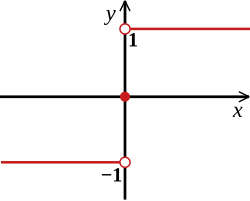
sgn ( x ) = { − 1 if x < 0 0 if x = 0 1 if x > 0 \text{sgn} (x) = \begin{cases} -1 & \text{if} \ x < 0 \\ 0 & \text{if} \ x = 0 \\ 1 & \text{if} \ x > 0 \\ \end{cases} sgn(x)=⎩ ⎨ ⎧−101if x<0if x=0if x>0
For example:
sgn ( 2 ) = + 1 sgn ( π ) = + 1 sgn ( − 8 ) = − 1 sgn ( − 1 2 ) = − 1 sgn ( 0 ) = 0 \begin{aligned} \text{sgn}(2) &=& +1 \\ \text{sgn}(\pi) &=& +1 \\ \text{sgn}(-8) &=& -1 \\ \text{sgn}(-\frac{1}{2}) &=& -1 \\ \text{sgn}(0) &=& 0 \\ \end{aligned} sgn(2)sgn(π)sgn(−8)sgn(−21)sgn(0)=====+1+1−1−10
2.1. Basic properties
Any real number can be expressed as the product of its absolute value and its sign:
x = ∣ x ∣ sgn x x = |x| \text{sgn} x x=∣x∣sgnx
It follows that whenever x {x} x is not equal to 0 we have
sgn x = x ∣ x ∣ = ∣ x ∣ x \text{sgn} x = \frac{x}{|x|} = \frac{|x|}{x} sgnx=∣x∣x=x∣x∣
Similarly, for any real number x x x,
∣ x ∣ = x sgn x |x| = x \text{sgn} x ∣x∣=xsgnx
2.2. numpy.sign
https://numpy.org/doc/stable/reference/generated/numpy.sign.html
Returns an element-wise indication of the sign of a number.
The sign function returns -1 if x < 0, 0 if x==0, 1 if x > 0. nan is returned for nan inputs.
Notes
There is more than one definition of sign in common use for complex numbers. The definition used here, x / ∣ x ∣ x/|x| x/∣x∣, is the more common and useful one, but is different from the one used in numpy prior to version 2.0, x / x × x x/\sqrt{x \times x} x/x×x , which is equivalent to sign(x.real) + 0j if x.real != 0 else sign(x.imag) + 0j.
3. Mean Absolute Error (MAE) Loss Function - Derivatives and Gradients (导数和梯度)
Predicted values:
y _ p r e d = y ^ = y \^ 1 , y \^ 2 , ... , y \^ N \boldsymbol{y\_pred} = \boldsymbol{\hat{y}} = \left \\hat{y}_{1}, \\hat{y}_{2}, \\dots, \\hat{y}_{N} \\right y_pred=y^=y\^1,y\^2,...,y\^N
True values:
y _ t r u e = y = y 1 , y 2 , ... , y N \boldsymbol{y\_true} = \boldsymbol{y} = \left {y}_{1}, {y}_{2}, \\dots, {y}_{N} \\right y_true=y=y1,y2,...,yN
Mean Absolute Error (MAE):
MAE = L = 1 N ∑ i = 1 N ∣ y _ p r e d i − y _ t r u e i ∣ = 1 N ∑ i = 1 N ∣ y ^ i − y i ∣ = 1 N ( ∣ y ^ 1 − y 1 ∣ + ∣ y ^ 2 − y 2 ∣ + ... + ∣ y ^ N − y N ∣ ) \begin{aligned} \text{MAE} = L &= \frac{1}{N} \sum_{i=1}^{N}|\boldsymbol{y\pred}{i} - \boldsymbol{y\true}{i}| \\ &= \frac{1}{N} \sum_{i=1}^{N} |\boldsymbol{\hat{y}}{i} - \boldsymbol{y}{i}| \\ &= \frac{1}{N} (|\hat{y}{1} - {y}{1}| + |\hat{y}{2} - {y}{2}| + \ldots + |\hat{y}{N} - {y}{N}|) \\ \end{aligned} MAE=L=N1i=1∑N∣y_predi−y_truei∣=N1i=1∑N∣y^i−yi∣=N1(∣y^1−y1∣+∣y^2−y2∣+...+∣y^N−yN∣)
其中 MAE = L \text{MAE} = L MAE=L 是标量, N N N 是常量。
The partial derivative with respect to y ^ j \hat{y}_{j} y^j is:
∂ L ∂ y ^ j = ∂ ∂ y ^ j 1 N ∑ i = 1 N ∣ y ^ i − y i ∣ = 1 N ∂ ∂ y ^ j ∑ i = 1 N ∣ y ^ i − y i ∣ = 1 N ∑ i = 1 N ∂ ∂ y ^ j ∣ y ^ i − y i ∣ \begin{aligned} \frac{\partial{L}}{\partial{\hat{y}{j}}} &= \frac{\partial{}}{\partial{\hat{y}{j}}} \frac{1}{N} \sum_{i=1}^{N} |\boldsymbol{\hat{y}}{i} - \boldsymbol{y}{i}| \\ &= \frac{1}{N} \frac{\partial{}}{\partial{\hat{y}{j}}} \sum{i=1}^{N} |\boldsymbol{\hat{y}}{i} - \boldsymbol{y}{i}| \\ &= \frac{1}{N} \sum_{i=1}^{N} \frac{\partial{}}{\partial{\hat{y}{j}}} |\boldsymbol{\hat{y}}{i} - \boldsymbol{y}_{i}| \\ \end{aligned} ∂y^j∂L=∂y^j∂N1i=1∑N∣y^i−yi∣=N1∂y^j∂i=1∑N∣y^i−yi∣=N1i=1∑N∂y^j∂∣y^i−yi∣
If i ≠ j i\neq j i=j, then ∣ y ^ i − y i ∣ |\hat{y}i - y_i| ∣y^i−yi∣ is not a function of y ^ j \hat{y}{j} y^j, so ∂ ∂ y ^ j ∣ y ^ i − y i ∣ = 0 \frac{\partial}{\partial \hat{y}_{j}}|\hat{y}_i - y_i| = 0 ∂y^j∂∣y^i−yi∣=0. We can remove the summation because the partial derivative of L L L for i ≠ j i\neq j i=j is 0. We are left with only one term in the sum, where i = j i=j i=j:
∂ L ∂ y ^ j = ∂ ∂ y ^ j 1 N ∑ i = 1 N ∣ y ^ i − y i ∣ = 1 N ∂ ∂ y ^ j ∑ i = 1 N ∣ y ^ i − y i ∣ = 1 N ∑ i = 1 N ∂ ∂ y ^ j ∣ y ^ i − y i ∣ = 1 N ∂ ∂ y ^ j ∣ y ^ j − y j ∣ = 1 N sgn ( y ^ j − y j ) ∂ ∂ y ^ j ( y ^ j − y j ) = 1 N sgn ( y ^ j − y j ) = 1 N y ^ j − y j ∣ y ^ j − y j ∣ = 1 N ∣ y ^ j − y j ∣ y ^ j − y j \begin{aligned} \frac{\partial{L}}{\partial{\hat{y}{j}}} &= \frac{\partial{}}{\partial{\hat{y}{j}}} \frac{1}{N} \sum_{i=1}^{N} |\boldsymbol{\hat{y}}{i} - \boldsymbol{y}{i}| \\ &= \frac{1}{N} \frac{\partial{}}{\partial{\hat{y}{j}}} \sum{i=1}^{N} |\boldsymbol{\hat{y}}{i} - \boldsymbol{y}{i}| \\ &= \frac{1}{N} \sum_{i=1}^{N} \frac{\partial{}}{\partial{\hat{y}{j}}} |\boldsymbol{\hat{y}}{i} - \boldsymbol{y}{i}| \\ &= \frac{1}{N} \frac{\partial{}}{\partial{\hat{y}{j}}} |\hat{y}{j} - y{j}| \\ &= \frac{1}{N} \text{sgn}(\hat{y}{j} - y{j}) \frac{\partial{}}{\partial{\hat{y}{j}}} (\hat{y}{j} - y_{j}) \\ &= \frac{1}{N} \text{sgn}(\hat{y}{j} - y{j}) \\ &= \frac{1}{N} \frac{\hat{y}{j} - y{j}}{|\hat{y}{j} - y{j}|} \\ &= \frac{1}{N} \frac{|\hat{y}{j} - y{j}|}{\hat{y}{j} - y{j}} \\ \end{aligned} ∂y^j∂L=∂y^j∂N1i=1∑N∣y^i−yi∣=N1∂y^j∂i=1∑N∣y^i−yi∣=N1i=1∑N∂y^j∂∣y^i−yi∣=N1∂y^j∂∣y^j−yj∣=N1sgn(y^j−yj)∂y^j∂(y^j−yj)=N1sgn(y^j−yj)=N1∣y^j−yj∣y^j−yj=N1y^j−yj∣y^j−yj∣
Finally, the gradient ∂ L ∂ y ^ \frac{\partial{L}}{\partial{\hat{\boldsymbol{y}}}} ∂y^∂L is the vector whose j j j-th component is ∂ L ∂ y ^ j \frac{\partial{L}}{\partial{\hat{y}{j}}} ∂y^j∂L, so we have ∂ L ∂ y ^ = 1 N sgn ( y ^ j − y j ) \frac{\partial{L}}{\partial{\hat{\boldsymbol{y}}}} = \frac{1}{N} \text{sgn}(\boldsymbol{\hat{y}}{j} - \boldsymbol{y}_{j}) ∂y^∂L=N1sgn(y^j−yj).
The MAE function gradient (Jacobian for MAE):
MAE = L = f ( y ^ 1 , y ^ 2 , ... , y ^ N ) \begin{aligned} \text{MAE} = L &= f({\hat{y}}{1}, {\hat{y}}{2}, \ \ldots, {\hat{y}}_{N}) \\ \end{aligned} MAE=L=f(y^1,y^2, ...,y^N)
J = ∂ L ∂ y ^ = ∂ L ∂ ( y ^ 1 , y ^ 2 , ... , y ^ N ) = ∂ L ∂ y \^ 1 , ∂ L ∂ y \^ 2 , ... , ∂ L ∂ y \^ N = 1 N sgn ( y \^ 1 − y 1 ) , 1 N sgn ( y \^ 2 − y 2 ) , ... , 1 N sgn ( y \^ N − y N ) = 1 N sgn ( y \^ 1 − y 1 ) , sgn ( y \^ 2 − y 2 ) , ... , sgn ( y \^ N − y N ) = 1 N sgn ( y ^ − y ) = 1 N sgn ( y _ p r e d − y _ t r u e ) = 1 N y ^ − y ∣ y ^ − y ∣ = 1 N ∣ y ^ − y ∣ y ^ − y \begin{aligned} \boldsymbol{J} &= \frac{\partial{L}}{\partial{\boldsymbol{\hat{y}}}} \\ &= \frac{\partial{L}}{\partial{({\hat{y}}{1}, {\hat{y}}{2}, \ \ldots, {\hat{y}}_{N})}} \\ &= \left\\frac{\\partial{L}}{\\partial{\\hat{y}_{1}}}, \\frac{\\partial{L}}{\\partial{\\hat{y}_{2}}}, \\ \\ldots, \\frac{\\partial{L}}{\\partial{\\hat{y}_{N}}} \\right \\ &= \left\\frac{1}{N} \\text{sgn}(\\hat{y}_{1} - y_{1}), \\frac{1}{N} \\text{sgn}(\\hat{y}_{2} - y_{2}), \\ \\ldots, \\frac{1}{N} \\text{sgn}(\\hat{y}_{N} - y_{N}) \\right \\ &= \frac{1}{N} \left\\text{sgn}(\\hat{y}_{1} - y_{1}), \\text{sgn}(\\hat{y}_{2} - y_{2}), \\ \\ldots, \\text{sgn}(\\hat{y}_{N} - y_{N}) \\right \\ &= \frac{1}{N} \text{sgn}(\boldsymbol{\hat{y}} - \boldsymbol{y}) \\ &= \frac{1}{N} \text{sgn}(\boldsymbol{y\_pred} - \boldsymbol{y\_true}) \\ &= \frac{1}{N} \frac{\boldsymbol{\hat{y}} - \boldsymbol{y}}{|\boldsymbol{\hat{y}} - \boldsymbol{y}|} \\ &= \frac{1}{N} \frac{|\boldsymbol{\hat{y}} - \boldsymbol{y}|}{\boldsymbol{\hat{y}} - \boldsymbol{y}} \\ \end{aligned} J=∂y^∂L=∂(y^1,y^2, ...,y^N)∂L=∂y\^1∂L,∂y\^2∂L, ...,∂y\^N∂L=N1sgn(y\^1−y1),N1sgn(y\^2−y2), ...,N1sgn(y\^N−yN)=N1sgn(y\^1−y1),sgn(y\^2−y2), ...,sgn(y\^N−yN)=N1sgn(y^−y)=N1sgn(y_pred−y_true)=N1∣y^−y∣y^−y=N1y^−y∣y^−y∣
4. Mean Absolute Error (MAE) Loss Function - Derivatives and Gradients (导数和梯度)
4.1. PyTorch torch.nn.L1Loss(size_average=None, reduce=None, reduction='mean')
#!/usr/bin/env python
# coding=utf-8

import torch
import torch.nn as nn

predictions = torch.tensor([1, 2, 3, 4], dtype=torch.float, requires_grad=True)
targets = torch.tensor([0, 2, 4, 2], dtype=torch.float)

print(f"predictions.requires_grad: {predictions.requires_grad}, targets.requires_grad: {targets.requires_grad}")
print(f"predictions.shape: {predictions.shape}, targets.shape: {targets.shape}")

# Compute MAE loss
mae_loss = nn.L1Loss(size_average=None, reduce=None, reduction='mean')
loss = mae_loss(predictions, targets)
print(f"MAE loss: {loss}")

# Compute gradients
loss.backward()

# Access the gradients of 'predictions'
print(f"\ngradients of predictions:\n{predictions.grad}")
print(f"predictions.shape: {predictions.shape}")
Predicted values:
y _ p r e d = y ^ = y \^ 1 , y \^ 2 , ... , y \^ N = 1 , 2 , 3 , 4 \begin{aligned} \boldsymbol{y\_pred} = \boldsymbol{\hat{y}} &= \left \\hat{y}_{1}, \\hat{y}_{2}, \\dots, \\hat{y}_{N} \\right \\ &= \left 1, 2, 3, 4 \\right \\ \end{aligned} y_pred=y^=y\^1,y\^2,...,y\^N=1,2,3,4
True values:
y _ t r u e = y = y 1 , y 2 , ... , y N = 0 , 2 , 4 , 2 \begin{aligned} \boldsymbol{y\_true} = \boldsymbol{y} &= \left {y}_{1}, {y}_{2}, \\dots, {y}_{N} \\right \\ &= \left 0, 2, 4, 2 \\right \\ \end{aligned} y_true=y=y1,y2,...,yN=0,2,4,2
Mean Absolute Error (MAE):
MAE = L = 1 N ∑ i = 1 N ∣ y _ p r e d i − y _ t r u e i ∣ = 1 N ∑ i = 1 N ∣ y ^ i − y i ∣ = 1 N ( ∣ y ^ 1 − y 1 ∣ + ∣ y ^ 2 − y 2 ∣ + ... + ∣ y ^ N − y N ∣ ) = 1 4 ( ∣ 1 − 0 ∣ + ∣ 2 − 2 ∣ + ∣ 3 − 4 ∣ + ∣ 4 − 2 ∣ ) = 1.0 \begin{aligned} \text{MAE} = L &= \frac{1}{N} \sum_{i=1}^{N} |\boldsymbol{y\pred}{i} - \boldsymbol{y\true}{i}| \\ &= \frac{1}{N} \sum_{i=1}^{N} |\boldsymbol{\hat{y}}{i} - \boldsymbol{y}{i}| \\ &= \frac{1}{N} (|\hat{y}{1} - {y}{1}| + |\hat{y}{2} - {y}{2}| + \ldots + |\hat{y}{N} - {y}{N}|) \\ &= \frac{1}{4} (|1 - 0| + |2 - 2| + |3 - 4| + |4 - 2|) \\ &= 1.0 \\ \end{aligned} MAE=L=N1i=1∑N∣y_predi−y_truei∣=N1i=1∑N∣y^i−yi∣=N1(∣y^1−y1∣+∣y^2−y2∣+...+∣y^N−yN∣)=41(∣1−0∣+∣2−2∣+∣3−4∣+∣4−2∣)=1.0
The MAE function gradient (Jacobian for MAE):
J = ∂ L ∂ y ^ = ∂ L ∂ ( y ^ 1 , y ^ 2 , ... , y ^ N ) = ∂ L ∂ y \^ 1 , ∂ L ∂ y \^ 2 , ... , ∂ L ∂ y \^ N = 1 N sgn ( y \^ 1 − y 1 ) , 1 N sgn ( y \^ 2 − y 2 ) , ... , 1 N sgn ( y \^ N − y N ) = 1 N sgn ( y \^ 1 − y 1 ) , sgn ( y \^ 2 − y 2 ) , ... , sgn ( y \^ N − y N ) = 1 4 sgn ( 1 − 0 ) , sgn ( 2 − 2 ) , sgn ( 3 − 4 ) , sgn ( 4 − 2 ) = 1 4 1 , 0 , − 1 , 1 = 0.25 , 0 , − 0.25 , 0.25 \begin{aligned} \boldsymbol{J} &= \frac{\partial{L}}{\partial{\boldsymbol{\hat{y}}}} \\ &= \frac{\partial{L}}{\partial{({\hat{y}}{1}, {\hat{y}}{2}, \ \ldots, {\hat{y}}_{N})}} \\ &= \left\\frac{\\partial{L}}{\\partial{\\hat{y}_{1}}}, \\frac{\\partial{L}}{\\partial{\\hat{y}_{2}}}, \\ \\ldots, \\frac{\\partial{L}}{\\partial{\\hat{y}_{N}}} \\right \\ &= \left\\frac{1}{N} \\text{sgn}(\\hat{y}_{1} - y_{1}), \\frac{1}{N} \\text{sgn}(\\hat{y}_{2} - y_{2}), \\ \\ldots, \\frac{1}{N} \\text{sgn}(\\hat{y}_{N} - y_{N}) \\right \\ &= \frac{1}{N} \left\\text{sgn}(\\hat{y}_{1} - y_{1}), \\text{sgn}(\\hat{y}_{2} - y_{2}), \\ \\ldots, \\text{sgn}(\\hat{y}_{N} - y_{N}) \\right \\ &= \frac{1}{4} \left\\text{sgn}(1 - 0), \\text{sgn}(2 - 2), \\text{sgn}(3 - 4), \\text{sgn}(4 - 2) \\right \\ &= \frac{1}{4} \left1, 0, -1, 1 \\right \\ &= \left0.25, 0, -0.25, 0.25 \\right \\ \end{aligned} J=∂y^∂L=∂(y^1,y^2, ...,y^N)∂L=∂y\^1∂L,∂y\^2∂L, ...,∂y\^N∂L=N1sgn(y\^1−y1),N1sgn(y\^2−y2), ...,N1sgn(y\^N−yN)=N1sgn(y\^1−y1),sgn(y\^2−y2), ...,sgn(y\^N−yN)=41sgn(1−0),sgn(2−2),sgn(3−4),sgn(4−2)=411,0,−1,1=0.25,0,−0.25,0.25
/home/yongqiang/miniconda3/bin/python /home/yongqiang/quantitative_analysis/mae.py
predictions.requires_grad: True, targets.requires_grad: False
predictions.shape: torch.Size([4]), targets.shape: torch.Size([4])
MAE loss: 1.0

gradients of predictions:
tensor([ 0.2500,  0.0000, -0.2500,  0.2500])
predictions.shape: torch.Size([4])

Process finished with exit code 0
4.2. PyTorch torch.nn.L1Loss(size_average=None, reduce=None, reduction='mean')
#!/usr/bin/env python
# coding=utf-8

import torch
import torch.nn as nn

predictions = torch.tensor([[1, 2, 3], [4, 5, 6], [7, 8, 9]], dtype=torch.float, requires_grad=True)
targets = torch.tensor([[2, 2, 2], [6, 5, 4], [9, 9, 9]], dtype=torch.float)

print(f"predictions.requires_grad: {predictions.requires_grad}, targets.requires_grad: {targets.requires_grad}")
print(f"predictions.shape: {predictions.shape}, targets.shape: {targets.shape}")

# Compute MAE loss
mae_loss = nn.L1Loss(size_average=None, reduce=None, reduction='mean')
loss = mae_loss(predictions, targets)
print(f"MAE loss: {loss}")

# Compute gradients
loss.backward()

# Access the gradients of 'predictions'
print(f"\ngradients of predictions:\n{predictions.grad}")
print(f"predictions.shape: {predictions.shape}")
Predicted values:
y _ p r e d = y ^ = 1 , 2 , 3 4 , 5 , 6 7 , 8 , 9 \begin{aligned} \boldsymbol{y\_pred} &= \boldsymbol{\hat{y}} \\ &= \begin{bmatrix} 1, 2, 3 \\ 4, 5, 6 \\ 7, 8, 9 \\ \end{bmatrix} \end{aligned} y_pred=y^= 1,2,34,5,67,8,9
True values:
y _ t r u e = y = 2 , 2 , 2 6 , 5 , 4 9 , 9 , 9 \begin{aligned} \boldsymbol{y\_true} &= \boldsymbol{y} \\ &= \begin{bmatrix} 2, 2, 2 \\ 6, 5, 4 \\ 9, 9, 9 \\ \end{bmatrix} \end{aligned} y_true=y= 2,2,26,5,49,9,9
Mean Absolute Error (MAE):
MAE = L = 1 N ∑ i = 1 N ∣ y _ p r e d i − y _ t r u e i ∣ = 1 N ∑ i = 1 N ∣ y ^ i − y i ∣ = 1 3 × 3 ( ∣ 1 − 2 ∣ + ∣ 2 − 2 ∣ + ∣ 3 − 2 ∣ + ∣ 4 − 6 ∣ + ∣ 5 − 5 ∣ + ∣ 6 − 4 ∣ + ∣ 7 − 9 ∣ + ∣ 8 − 9 ∣ + ∣ 9 − 9 ∣ ) = 1 9 × 9 = 1.0 \begin{aligned} \text{MAE} = L &= \frac{1}{N} \sum_{i=1}^{N} |\boldsymbol{y\pred}{i} - \boldsymbol{y\true}{i}| \\ &= \frac{1}{N} \sum_{i=1}^{N} |\boldsymbol{\hat{y}}{i} - \boldsymbol{y}{i}| \\ &= \frac{1}{3 \times 3} (|1 - 2| + |2 - 2| + |3 - 2| + |4 - 6| + |5 - 5| + |6 - 4| + |7 - 9| + |8 - 9| + |9 - 9|) \\ &= \frac{1}{9} \times 9 \\ &= 1.0 \\ \end{aligned} MAE=L=N1i=1∑N∣y_predi−y_truei∣=N1i=1∑N∣y^i−yi∣=3×31(∣1−2∣+∣2−2∣+∣3−2∣+∣4−6∣+∣5−5∣+∣6−4∣+∣7−9∣+∣8−9∣+∣9−9∣)=91×9=1.0
The MAE function gradient (Jacobian for MAE):
J = ∂ L ∂ y ^ = ∂ L ∂ ( y ^ 1 , y ^ 2 , ... , y ^ N ) = ∂ L ∂ y \^ 1 , ∂ L ∂ y \^ 2 , ... , ∂ L ∂ y \^ N = 1 N sgn ( y \^ 1 − y 1 ) , 1 N sgn ( y \^ 2 − y 2 ) , ... , 1 N sgn ( y \^ N − y N ) = 1 3 × 3 sgn ( 1 − 2 ) , 1 3 × 3 sgn ( 2 − 2 ) , 1 3 × 3 sgn ( 3 − 2 ) 1 3 × 3 sgn ( 4 − 6 ) , 1 3 × 3 sgn ( 5 − 5 ) , 1 3 × 3 sgn ( 6 − 4 ) 1 3 × 3 sgn ( 7 − 9 ) , 1 3 × 3 sgn ( 8 − 9 ) , 1 3 × 3 sgn ( 9 − 9 ) = 1 3 × 3 ( − 1 ) , 1 3 × 3 ( 0 ) , 1 3 × 3 ( 1 ) 1 3 × 3 ( − 1 ) , 1 3 × 3 ( 0 ) , 1 3 × 3 ( 1 ) 1 3 × 3 ( − 1 ) , 1 3 × 3 ( − 1 ) , 1 3 × 3 ( 0 ) = − 0.1111 , 0.0000 , 0.1111 − 0.1111 , 0.0000 , 0.1111 − 0.1111 , − 0.1111 , 0.0000 \begin{aligned} \boldsymbol{J} &= \frac{\partial{L}}{\partial{\boldsymbol{\hat{y}}}} \\ &= \frac{\partial{L}}{\partial{({\hat{y}}{1}, {\hat{y}}{2}, \ \ldots, {\hat{y}}_{N})}} \\ &= \left\\frac{\\partial{L}}{\\partial{\\hat{y}_{1}}}, \\frac{\\partial{L}}{\\partial{\\hat{y}_{2}}}, \\ \\ldots, \\frac{\\partial{L}}{\\partial{\\hat{y}_{N}}} \\right \\ &= \left\\frac{1}{N} \\text{sgn}(\\hat{y}_{1} - y_{1}), \\frac{1}{N} \\text{sgn}(\\hat{y}_{2} - y_{2}), \\ \\ldots, \\frac{1}{N} \\text{sgn}(\\hat{y}_{N} - y_{N}) \\right \\ &= \begin{bmatrix} \frac{1}{3 \times 3} \text{sgn}(1 - 2), \frac{1}{3 \times 3} \text{sgn}(2 - 2), \frac{1}{3 \times 3} \text{sgn}(3 - 2) \\ \frac{1}{3 \times 3} \text{sgn}(4 - 6), \frac{1}{3 \times 3} \text{sgn}(5 - 5), \frac{1}{3 \times 3} \text{sgn}(6 - 4) \\ \frac{1}{3 \times 3} \text{sgn}(7 - 9), \frac{1}{3 \times 3} \text{sgn}(8 - 9), \frac{1}{3 \times 3} \text{sgn}(9 - 9) \\ \end{bmatrix} \\ &= \begin{bmatrix} \frac{1}{3 \times 3} (-1), \frac{1}{3 \times 3} (0), \frac{1}{3 \times 3} (1) \\ \frac{1}{3 \times 3} (-1), \frac{1}{3 \times 3} (0), \frac{1}{3 \times 3} (1) \\ \frac{1}{3 \times 3} (-1), \frac{1}{3 \times 3} (-1), \frac{1}{3 \times 3} (0) \\ \end{bmatrix} \\ &= \begin{bmatrix} -0.1111, \ \ 0.0000, \ \ 0.1111 \\ -0.1111, \ \ 0.0000, \ \ 0.1111 \\ -0.1111, -0.1111, \ \ 0.0000 \\ \end{bmatrix} \end{aligned} J=∂y^∂L=∂(y^1,y^2, ...,y^N)∂L=∂y\^1∂L,∂y\^2∂L, ...,∂y\^N∂L=N1sgn(y\^1−y1),N1sgn(y\^2−y2), ...,N1sgn(y\^N−yN)= 3×31sgn(1−2),3×31sgn(2−2),3×31sgn(3−2)3×31sgn(4−6),3×31sgn(5−5),3×31sgn(6−4)3×31sgn(7−9),3×31sgn(8−9),3×31sgn(9−9) = 3×31(−1),3×31(0),3×31(1)3×31(−1),3×31(0),3×31(1)3×31(−1),3×31(−1),3×31(0) = −0.1111, 0.0000, 0.1111−0.1111, 0.0000, 0.1111−0.1111,−0.1111, 0.0000
/home/yongqiang/miniconda3/bin/python /home/yongqiang/quantitative_analysis/mae.py
predictions.requires_grad: True, targets.requires_grad: False
predictions.shape: torch.Size([3, 3]), targets.shape: torch.Size([3, 3])
MAE loss: 1.0

gradients of predictions:
tensor([[-0.1111,  0.0000,  0.1111],
        [-0.1111,  0.0000,  0.1111],
        [-0.1111, -0.1111,  0.0000]])
predictions.shape: torch.Size([3, 3])

Process finished with exit code 0
PyTorch 中文文档
https://pytorch-cn.readthedocs.io/zh/latest/package_references/torch-nn/
torch.Tensor 默认 requires_grad=False,Variable 默认 requires_grad=False,torch.nn.parameter.Parameter 默认 requires_grad=True。
class torch.nn.parameter.Parameter(data=None, requires_grad=True)
https://docs.pytorch.org/docs/stable/generated/torch.nn.parameter.Parameter.html
Variable (deprecated)
https://docs.pytorch.org/docs/stable/autograd.html#variable-deprecated
4.3. Python torch.nn.L1Loss(size_average=None, reduce=None, reduction='mean')
# !/usr/bin/env python
# coding=utf-8

import numpy as np

predictions = np.array([1, 2, 3, 4], dtype=np.float32)
targets = np.array([0, 2, 4, 2], dtype=np.float32)

print(f"predictions.shape: {predictions.shape}, targets.shape: {targets.shape}")

assert (predictions.shape == targets.shape)


# Compute MAE loss
def mae_loss(predictions, targets):
    # Calculates the Mean Absolute Error loss
    return np.mean(np.abs(predictions - targets))


loss = mae_loss(predictions, targets)
print(f"MAE loss: {loss}")


# Compute gradients
def mae_grad(predictions, targets):
    # Calculates the subgradient of the MAE loss with respect to predictions
    return np.sign(predictions - targets) / np.prod(predictions.shape)


gradients = mae_grad(predictions, targets)

# Access the gradients of 'predictions'
print(f"\ngradients of predictions:\n{gradients}")
print(f"gradients.shape: {gradients.shape}")

/home/yongqiang/miniconda3/bin/python /home/yongqiang/quantitative_analysis/mae.py
predictions.shape: (4,), targets.shape: (4,)
MAE loss: 1.0

gradients of predictions:
[ 0.25  0.   -0.25  0.25]
gradients.shape: (4,)

Process finished with exit code 0
4.4. Python torch.nn.L1Loss(size_average=None, reduce=None, reduction='mean')
# !/usr/bin/env python
# coding=utf-8

import numpy as np

predictions = np.array([[1, 2, 3], [4, 5, 6], [7, 8, 9]], dtype=np.float32)
targets = np.array([[2, 2, 2], [6, 5, 4], [9, 9, 9]], dtype=np.float32)

print(f"predictions.shape: {predictions.shape}, targets.shape: {targets.shape}")

assert (predictions.shape == targets.shape)


# Compute MAE loss
def mae_loss(predictions, targets):
    # Calculates the Mean Absolute Error loss
    return np.mean(np.abs(predictions - targets))


loss = mae_loss(predictions, targets)
print(f"MAE loss: {loss}")


# Compute gradients
def mae_grad(predictions, targets):
    # Calculates the subgradient of the MAE loss with respect to predictions
    return np.sign(predictions - targets) / np.prod(predictions.shape)


gradients = mae_grad(predictions, targets)

# Access the gradients of 'predictions'
print(f"\ngradients of predictions:\n{gradients}")
print(f"gradients.shape: {gradients.shape}")

/home/yongqiang/miniconda3/bin/python /home/yongqiang/quantitative_analysis/mae.py
predictions.shape: (3, 3), targets.shape: (3, 3)
MAE loss: 1.0

gradients of predictions:
[[-0.11111111  0.          0.11111111]
 [-0.11111111  0.          0.11111111]
 [-0.11111111 -0.11111111  0.        ]]
gradients.shape: (3, 3)

Process finished with exit code 0
References
1 Yongqiang Cheng (程永强), https://yongqiang.blog.csdn.net/
2 Deep Learning Tutorials, https://neuralthreads.medium.com/i-was-not-satisfied-by-any-deep-learning-tutorials-online-37c5e9f4bea1
3 Gradient boosting performs gradient descent, https://explained.ai/gradient-boosting/descent.html
4 Matrix calculus, https://en.wikipedia.org/wiki/Matrix_calculus
5 tf.keras.losses.MSE, https://www.tensorflow.org/api_docs/python/tf/keras/losses/MSE
6 Half mean squared error, https://www.mathworks.com/help/deeplearning/ref/dlarray.mse.html