文章目录
- 【分布式算法之一致性哈希】
- 为什么需要一致性哈希?
- [GoCache 实现](#GoCache 实现)
- 一致性哈希是分布式算法吗?
- [GoCache 与 Redis 的不同之处](#GoCache 与 Redis 的不同之处)
- 一致性哈希的作用
- 适用于哪些场景?
- 【缓存对外服务化】
- 服务端模块
- 安装工具(只需要做一次)
- [gRPC 代码生成](#gRPC 代码生成)
- 节点选择器
在 VSCode 中,可以使用以下快捷键打开左边的文件树(资源管理器):
Windows/Linux: Ctrl + B
macOS: Cmd + B
【分布式算法之一致性哈希】
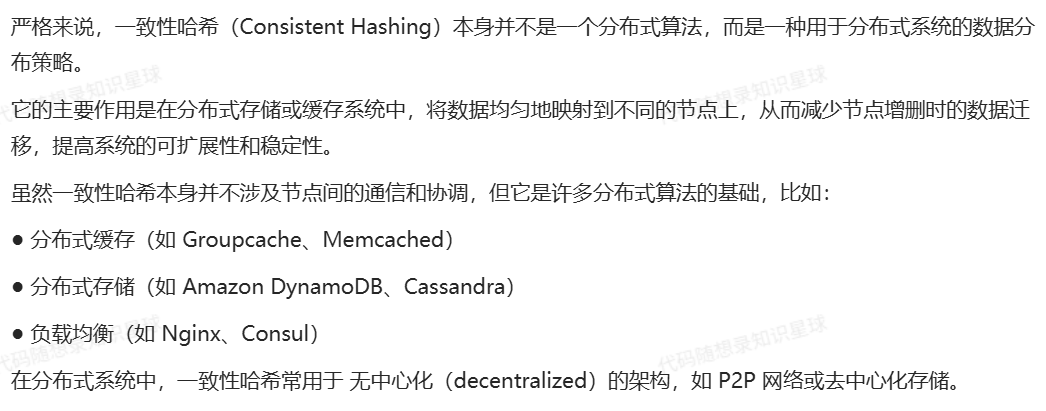
在分布式缓存系统中,一致性哈希(Consistent Hashing) 是一种常用的负载均衡策略,用于解决缓存节点的动态扩展和缩容问题。它可以减少缓存失效率,提高缓存命中率,从而提高系统的可扩展性和稳定性。
为什么需要一致性哈希?
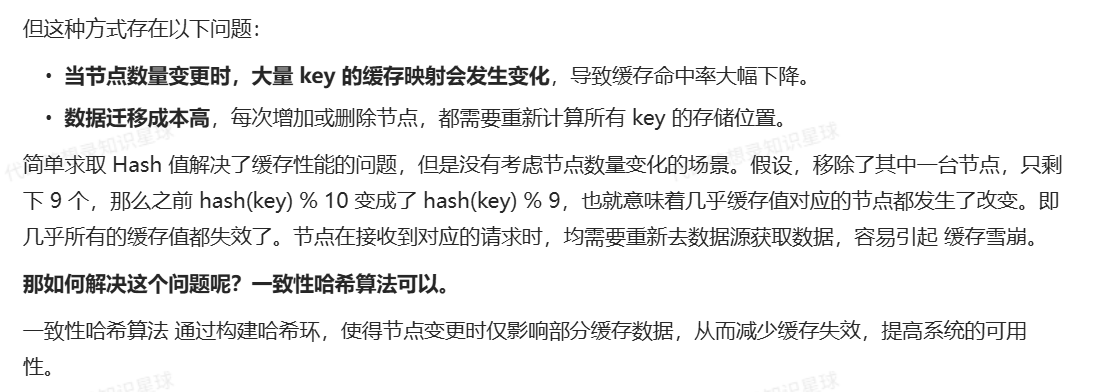
在分布式缓存系统中,多个服务器(缓存节点)存储不同的缓存数据,客户端需要决定将某个 key 存储在哪个缓存节点。最简单的方式是使用 取模(Modulo)分片:
对于分布式缓存来说,当一个节点接收到请求,如果该节点并没有存储缓存值,那么它面临的难题是,从谁那获取数据?自己,还是节点1, 2, 3, 4... 。假设包括自己在内一共有 10 个节点,当一个节点接收到请求时,随机选择一个节点,由该节点从数据源获取数据。
假设第一次随机选取了节点 1 ,节点 1 从数据源获取到数据的同时缓存该数据;那第二次,只有 1/10 的可能性再次选择节点 1, 有 9/10 的概率选择了其他节点,如果选择了其他节点,就意味着需要再一次从数据源获取数据,一般来说,这个操作是很耗时的。这样做,一是缓存效率低,二是各个节点上存储着相同的数据,浪费了大量的存储空间。
那有什么办法,对于给定的 key,每一次都选择同一个节点呢?使用 hash 算法能够做到这一点。那把 key 的每一个字符的 ASCII 码加起来,再除以 10 取余数可以吗?当然可以,这可以认为是自定义的 hash 算法。
go
// 传统哈希分片示例
func getShard(key string, nodeCount int) int {
    hash := crc32.ChecksumIEEE([]byte(key))
    return int(hash) % nodeCount
}
节点数量变化了怎么办?
算法原理

步骤
一致性哈希算法将 key 映射到 232 的空间中,将这个数字首尾相连,形成一个环。
● 计算节点/机器(通常使用节点的名称、编号和 IP 地址)的哈希值,放置在环上 。
● 计算 key 的哈希值,放置在环上,顺时针寻找到的第一个节点,就是应选取的节点/机器。
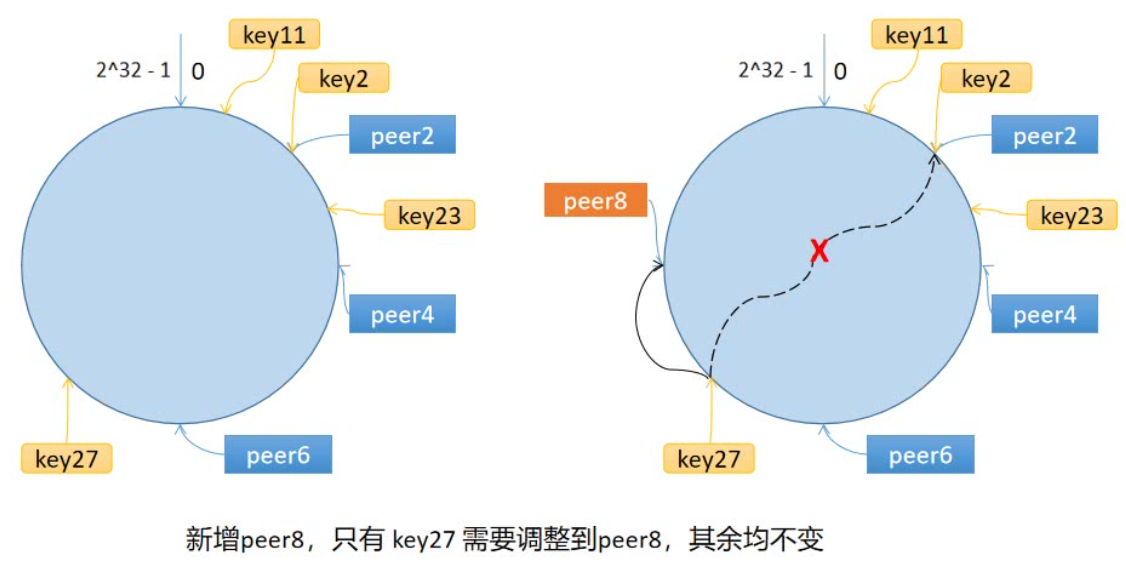
环上有 peer2,peer4,peer6 三个节点,key11,key2,key27 均映射到 peer2,key23 映射到 peer4。此时,如果新增节点/机器 peer8,假设它新增位置如图所示,那么只有 key27 从 peer2 调整到 peer8,其余的映射均没有发生改变。
也就是说,一致性哈希算法,在新增/删除节点时,只需要重新定位该节点附近的一小部分数据,而不需要重新定位所有的节点,这就解决了上述的问题。
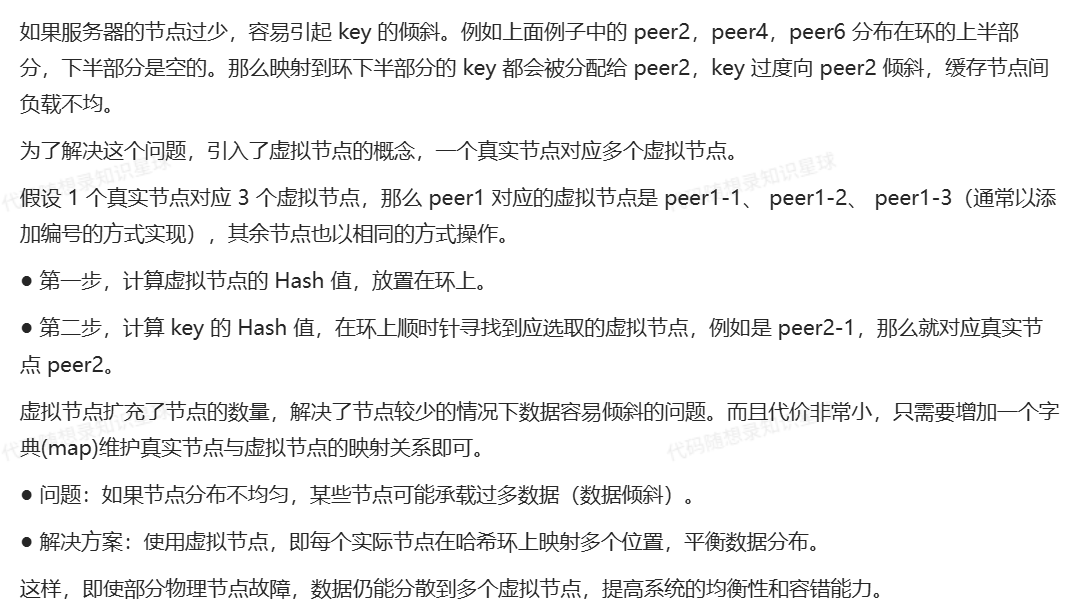
数据倾斜问题
GoCache 实现
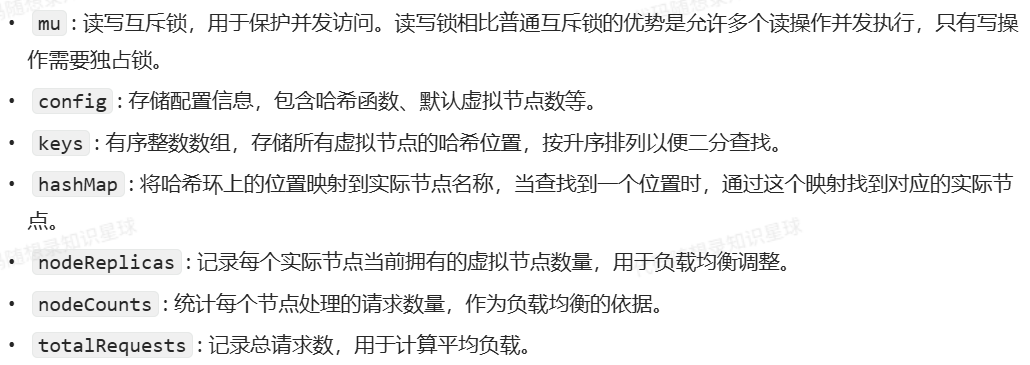
核心数据结构
go
type Map struct {
    mu sync.RWMutex           // 读写锁,保证并发安全
    config *Config            // 配置信息
    keys []int                // 哈希环上的所有虚拟节点位置,按顺序排列
    hashMap map[int]string    // 从哈希值到实际节点名称的映射
    nodeReplicas map[string]int // 每个实际节点对应的虚拟节点数量
    nodeCounts map[string]int64 // 记录每个节点处理的请求数
    totalRequests int64       // 记录总请求数,用于负载均衡计算
}
节点管理
go
func (m *Map) Add(nodes ...string) error {
    if len(nodes) == 0 {
        return errors.New("no nodes provided")
    }

    m.mu.Lock()
    defer m.mu.Unlock()

    for _, node := range nodes {
        if node == "" {
            continue
        }

        // 为节点添加虚拟节点
        m.addNode(node, m.config.DefaultReplicas)
    }

    // 重新排序
    sort.Ints(m.keys)
    return nil
}

func (m *Map) addNode(node string, replicas int) {
    for i := 0; i < replicas; i++ {
        hash := int(m.config.HashFunc([]byte(fmt.Sprintf("%s-%d", node, i))))
        m.keys = append(m.keys, hash)
        m.hashMap[hash] = node
    }
    m.nodeReplicas[node] = replicas
}

func (m *Map) Remove(node string) error {
    if node == "" {
        return errors.New("invalid node")
    }

    m.mu.Lock()
    defer m.mu.Unlock()

    replicas := m.nodeReplicas[node]
    if replicas == 0 {
        return fmt.Errorf("node %s not found", node)
    }

    // 移除节点的所有虚拟节点
    for i := 0; i < replicas; i++ {
        hash := int(m.config.HashFunc([]byte(fmt.Sprintf("%s-%d", node, i))))
        delete(m.hashMap, hash)
        for j := 0; j < len(m.keys); j++ {
            if m.keys[j] == hash {
                m.keys = append(m.keys[:j], m.keys[j+1:]...)
                break
            }
        }
    }

    delete(m.nodeReplicas, node)
    delete(m.nodeCounts, node)
    return nil
}
请求路由
go
// Get 获取节点
func (m *Map) Get(key string) string {
	// 空 key 直接返回空
	if key == "" {
		return ""
	}

	m.mu.RLock()

	// 没有节点时直接返回空
	if len(m.keys) == 0 {
		m.mu.RUnlock()
		return ""
	}

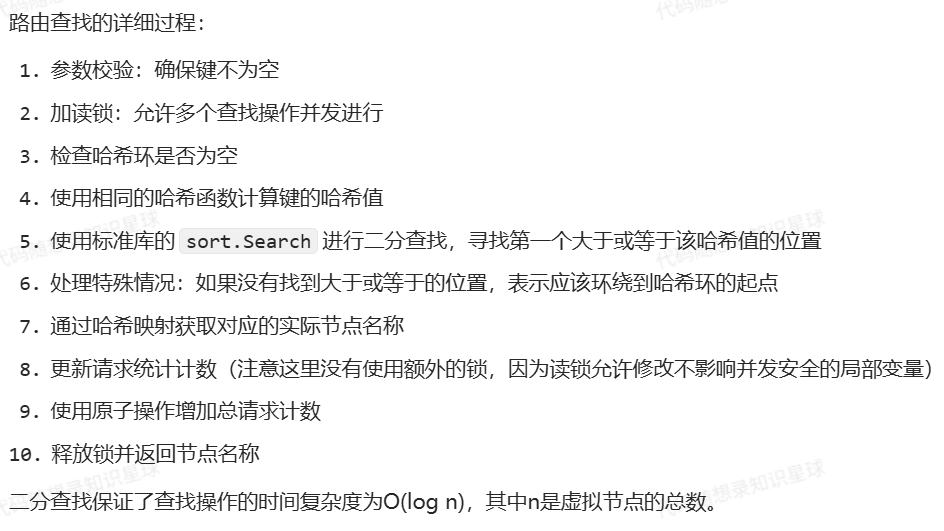
	// key 先变成一个哈希值,再沿着环顺时针找到第一个"虚拟节点",它所属的真实节点就是目标节点
	hash := int(m.config.HashFunc([]byte(key)))

	// 二分查找
	// 第一个满足 m.keys[i] >= hash 的下标 i,把它赋值给 idx
	// 如果没有这样的索引,搜索将返回 len(m.keys)
	idx := sort.Search(len(m.keys), func(i int) bool {
		return m.keys[i] >= hash
	})

	// 处理边界情况
	if idx == len(m.keys) {
		idx = 0
	}

	node := m.hashMap[m.keys[idx]]
	m.mu.RUnlock()

	m.mu.Lock()
    m.nodeCounts[node] = m.nodeCounts[node] + 1
    m.mu.Unlock()

    // 总请求数用 atomic,和 mu 解耦
    atomic.AddInt64(&m.totalRequests, 1)

	return node
}
负载均衡机制
go
// checkAndRebalance 检查并重新平衡虚拟节点
func (m *Map) checkAndRebalance() {
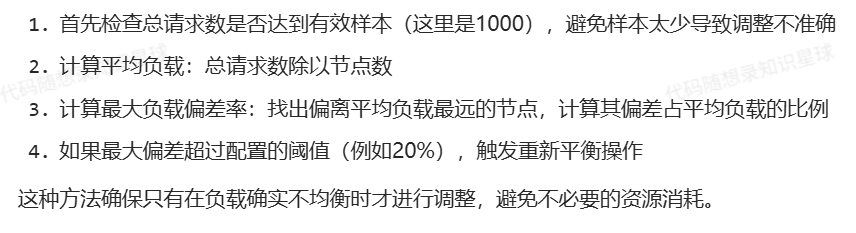
	// 1. 样本量检查(用 atomic 读)
	total := atomic.LoadInt64(&m.totalRequests)
	if total < 1000 {
		// 样本太少,不进行调整
		return
	}

	// 2. 读节点数量 & nodeCounts,需要用锁保护 map
	m.mu.RLock()

	nodeCount := len(m.nodeReplicas)
	if nodeCount == 0 {
		m.mu.RUnlock()
		return
	}

	// 计算负载情况
	// 计算理论平均负载
	avgLoad := float64(total) / float64(nodeCount)
	if avgLoad == 0 {
		m.mu.RUnlock()
		return
	}

	var maxDiff float64

	for _, count := range m.nodeCounts {
		diff := math.Abs(float64(count) - avgLoad)
		ratio := diff / avgLoad // 相对偏差比例
		if ratio > maxDiff {
			maxDiff = ratio
		}
	}

	m.mu.RUnlock()

	// 3. 判断是否超过不均衡阈值
	if maxDiff <= m.config.LoadBalanceThreshold {
		return
	}

	// 4. 负载不均衡,调整虚拟节点
	m.rebalanceNodes()

}

// rebalanceNodes 重新平衡节点
func (m *Map) rebalanceNodes() {
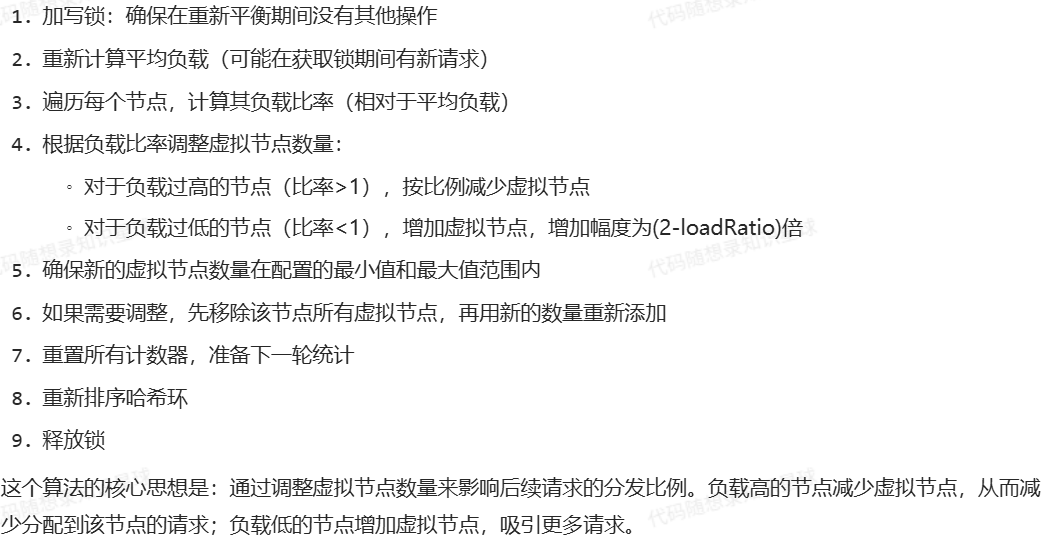
	// 独占整个 Map 的结构(keys / hashMap / nodeReplicas / nodeCounts)
	m.mu.Lock()
	defer m.mu.Unlock()

	// 没有节点就不用算了,避免除 0
	if len(m.nodeReplicas) == 0 {
		return
	}

	// 读取总请求数(之前是 atomic.AddInt64),这里用 atomic.Load 保持一致
	// total := atomic.LoadInt64(&m.totalRequests)
	total := m.totalRequests
	if total == 0 {
		// 没有请求,也没啥可平衡的
		return
	}

	// 理论上每个节点"应该"处理的平均请求数
	avgLoad := float64(total) / float64(len(m.nodeReplicas))
	if avgLoad == 0 {
		// 理论上 total>0 时 avgLoad 不会是 0,这里只是兜底
		return
	}

	// 先计算每个节点"应该"有多少虚拟节点,放在一个临时 map 里
	// 这样在这一步不会改动 nodeCounts / nodeReplicas,避免遍历时写 map
	newReplicas := make(map[string]int, len(m.nodeReplicas))

	for node, currentReplicas := range m.nodeReplicas {
		// 注意:这里从 nodeReplicas 遍历,而不是从 nodeCounts,
		// 避免 Remove 之类的操作影响正在遍历的 map。
		count := m.nodeCounts[node] // 如果没统计到就是 0
		loadRatio := float64(count) / avgLoad

		var replicas int
		if loadRatio > 1 {
			// 负载过高,减少虚拟节点
			// 比如当前 100 个虚拟节点,loadRatio=2(负载是平均的 2 倍),新虚拟节点数 ≈ 50,减半
			replicas = int(float64(currentReplicas) / loadRatio)
		} else {
			// 负载过低或刚好,增加一些虚拟节点
			// loadRatio=1 → replicas=current
			// loadRatio=0.5 → replicas≈1.5*current
			// loadRatio=0   → replicas≈2*current
			replicas = int(float64(currentReplicas) * (2 - loadRatio))
		}

		// 安全兜底:防止算出来 0 或负数
		if replicas < 1 {
			replicas = 1
		}

		// 限制在配置范围内
		if replicas < m.config.MinReplicas {
			replicas = m.config.MinReplicas
		}
		if replicas > m.config.MaxReplicas {
			replicas = m.config.MaxReplicas
		}

		newReplicas[node] = replicas
	}

	// 用新的虚拟节点数量"重建"哈希环:
	// 1. 清空 keys 和 hashMap
	// 2. 清空 nodeReplicas
	// 3. 再用 addNode 按 newReplicas 重建
	m.keys = nil
	m.hashMap = make(map[int]string, len(newReplicas)*m.config.MaxReplicas)
	m.nodeReplicas = make(map[string]int, len(newReplicas))

	for node, replicas := range newReplicas {
		// addNode 会:
		// - 按 node / i 生成虚拟节点 hash
		// - 填充 m.keys / m.hashMap
		// - 更新 m.nodeReplicas[node] = replicas
		m.addNode(node, replicas)
	}

	// 重置统计:从这次重平衡之后重新开始采样
	for node := range m.nodeCounts {
		m.nodeCounts[node] = 0
	}
	atomic.StoreInt64(&m.totalRequests, 0)

	// 最后把虚拟节点位置排个序,保证 Get 里的二分查找正常
	sort.Ints(m.keys)
}
负载均衡检查的详细流程:
重新平衡的详细算法:
一致性哈希是分布式算法吗?
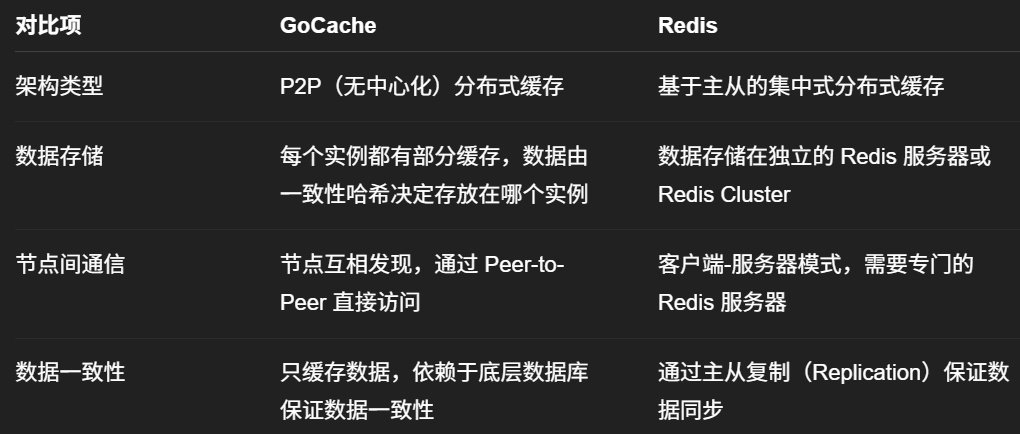
GoCache 与 Redis 的不同之处
一致性哈希的作用

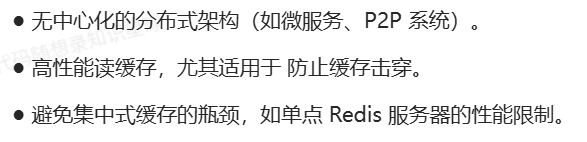
适用于哪些场景?
GoCache 是一个分布式缓存,适用于:
【缓存对外服务化】
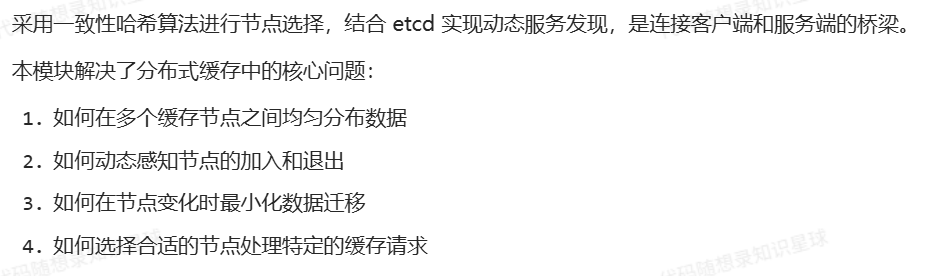
每个 GoCache 进程在哈希环中都是其中的一个节点,环中不同节点要互相通信,因此必须对外提供服务。
服务端模块
服务端模块是缓存系统对外提供服务的核心,负责接收和处理来自其他节点的请求 这里 GoCache 使用的是 grpc 来进行节点间的通信,同时集成了服务注册发现、健康检查和安全传输等特性。
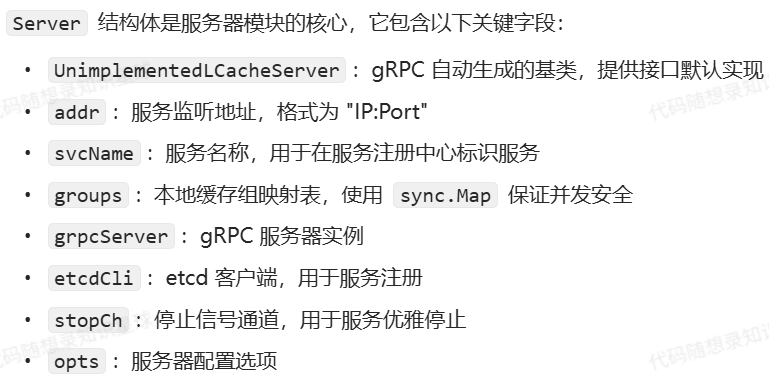
核心结构设计
go
// Server 定义缓存服务器
type Server struct {
    pb.UnimplementedLCacheServer
    addr       string           // 服务地址
    svcName    string           // 服务名称
    groups     *sync.Map        // 缓存组
    grpcServer *grpc.Server     // gRPC服务器
    etcdCli    *clientv3.Client // etcd客户端
    stopCh     chan error       // 停止信号
    opts       *ServerOptions   // 服务器选项
}
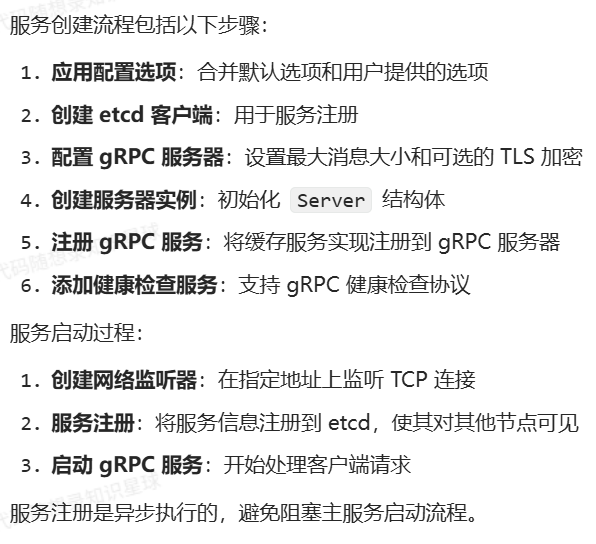
服务创建和生命周期管理
go
// NewServer 创建新的服务器实例
func NewServer(addr, svcName string, opts ...ServerOption) (*Server, error) {
    options := DefaultServerOptions
    for _, opt := range opts {
        opt(options)
    }

    // 创建etcd客户端
    etcdCli, err := clientv3.New(clientv3.Config{
        Endpoints:   options.EtcdEndpoints,
        DialTimeout: options.DialTimeout,
    })
    if err != nil {
        return nil, fmt.Errorf("failed to create etcd client: %v", err)
    }

    // 创建gRPC服务器
    var serverOpts []grpc.ServerOption
    serverOpts = append(serverOpts, grpc.MaxRecvMsgSize(options.MaxMsgSize))

    if options.TLS {
        creds, err := loadTLSCredentials(options.CertFile, options.KeyFile)
        if err != nil {
            return nil, fmt.Errorf("failed to load TLS credentials: %v", err)
        }
        serverOpts = append(serverOpts, grpc.Creds(creds))
    }

    srv := &Server{
        addr:       addr,
        svcName:    svcName,
        groups:     &sync.Map{},
        grpcServer: grpc.NewServer(serverOpts...),
        etcdCli:    etcdCli,
        stopCh:     make(chan error),
        opts:       options,
    }

    // 注册服务
    pb.RegisterLCacheServer(srv.grpcServer, srv)

    // 注册健康检查服务
    healthServer := health.NewServer()
    healthpb.RegisterHealthServer(srv.grpcServer, healthServer)
    healthServer.SetServingStatus(svcName, healthpb.HealthCheckResponse_SERVING)

    return srv, nil
}

// Start 启动服务器
func (s *Server) Start() error {
    // 启动gRPC服务器
    lis, err := net.Listen("tcp", s.addr)
    if err != nil {
        return fmt.Errorf("failed to listen: %v", err)
    }

    // 注册到etcd
    stopCh := make(chan error)
    go func() {
        if err := registry.Register(s.svcName, s.addr, stopCh); err != nil {
            logrus.Errorf("failed to register service: %v", err)
            close(stopCh)
            return
        }
    }()

    logrus.Infof("Server starting at %s", s.addr)
    return s.grpcServer.Serve(lis)
}
缓存操作接口
go
// Get 实现LCache服务的Get方法
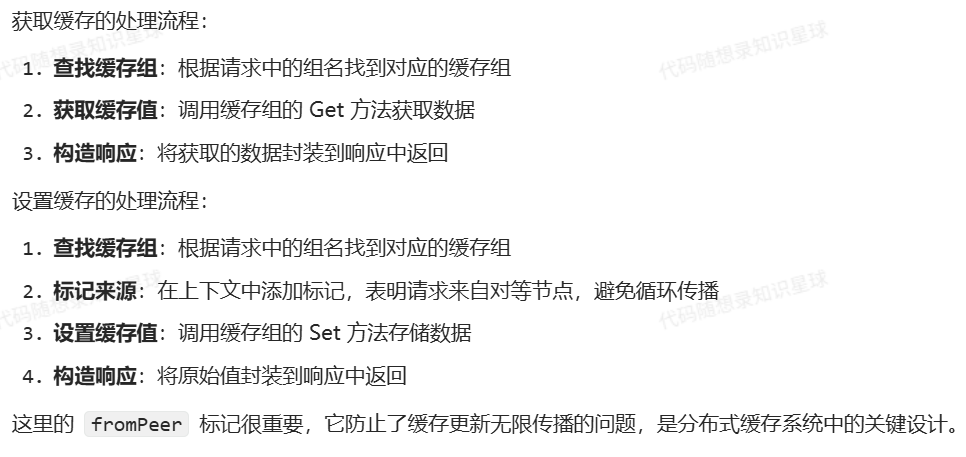
func (s *Server) Get(ctx context.Context, req *pb.Request) (*pb.ResponseForGet, error) {
    group := GetGroup(req.Group)
    if group == nil {
        return nil, fmt.Errorf("group %s not found", req.Group)
    }

    view, err := group.Get(ctx, req.Key)
    if err != nil {
        return nil, err
    }

    return &pb.ResponseForGet{Value: view.ByteSLice()}, nil
}

// Set 实现LCache服务的Set方法
func (s *Server) Set(ctx context.Context, req *pb.Request) (*pb.ResponseForGet, error) {
    group := GetGroup(req.Group)
    if group == nil {
        return nil, fmt.Errorf("group %s not found", req.Group)
    }

    // 从 context 中获取标记,如果没有则创建新的 context
    fromPeer := ctx.Value("from_peer")
    if fromPeer == nil {
        ctx = context.WithValue(ctx, "from_peer", true)
    }

    if err := group.Set(ctx, req.Key, req.Value); err != nil {
        return nil, err
    }

    return &pb.ResponseForGet{Value: req.Value}, nil
}
安装工具(只需要做一次)
bash
root@GoLang:~/proj1/GoDistributeCache# go install google.golang.org/protobuf/cmd/protoc-gen-go@latest
go: downloading google.golang.org/protobuf v1.36.10
root@GoLang:~/proj1/GoDistributeCache# go install google.golang.org/grpc/cmd/protoc-gen-go-grpc@latest
go: downloading google.golang.org/grpc/cmd/protoc-gen-go-grpc v1.6.0
go: downloading google.golang.org/grpc v1.77.0
bash
root@GoLang:~/proj1/GoDistributeCache# sudo apt-get update
sudo apt-get install -y protobuf-compiler
Hit:1 http://mirrors.cloud.aliyuncs.com/ubuntu jammy InRelease
Get:2 http://mirrors.cloud.aliyuncs.com/ubuntu jammy-updates InRelease [128 kB]
Get:3 http://mirrors.cloud.aliyuncs.com/ubuntu jammy-backports InRelease [127 kB]
Get:4 http://mirrors.cloud.aliyuncs.com/ubuntu jammy-security InRelease [129 kB]
Hit:5 https://download.docker.com/linux/ubuntu jammy InRelease
Get:6 http://mirrors.cloud.aliyuncs.com/ubuntu jammy-updates/main amd64 Packages [3,149 kB]
Get:7 http://mirrors.cloud.aliyuncs.com/ubuntu jammy-updates/main Translation-en [482 kB]
Get:8 http://mirrors.cloud.aliyuncs.com/ubuntu jammy-updates/main amd64 c-n-f Metadata [19.0 kB]
Get:9 http://mirrors.cloud.aliyuncs.com/ubuntu jammy-updates/restricted amd64 Packages [5,022 kB]
Get:10 http://mirrors.cloud.aliyuncs.com/ubuntu jammy-updates/restricted Translation-en [940 kB]
Get:11 http://mirrors.cloud.aliyuncs.com/ubuntu jammy-updates/universe amd64 Packages [1,245 kB]
Get:12 http://mirrors.cloud.aliyuncs.com/ubuntu jammy-updates/universe Translation-en [310 kB]
Get:13 http://mirrors.cloud.aliyuncs.com/ubuntu jammy-updates/universe amd64 c-n-f Metadata [30.0 kB]
Get:14 http://mirrors.cloud.aliyuncs.com/ubuntu jammy-security/main amd64 Packages [2,853 kB]
Get:15 http://mirrors.cloud.aliyuncs.com/ubuntu jammy-security/main Translation-en [411 kB]
Get:16 http://mirrors.cloud.aliyuncs.com/ubuntu jammy-security/restricted amd64 Packages [4,790 kB]
Get:17 http://mirrors.cloud.aliyuncs.com/ubuntu jammy-security/restricted Translation-en [897 kB]
Get:18 http://mirrors.cloud.aliyuncs.com/ubuntu jammy-security/universe amd64 Packages [1,007 kB]
Fetched 21.5 MB in 4s (5,437 kB/s)
Reading package lists... Done
Reading package lists... Done
Building dependency tree... Done
Reading state information... Done
The following packages were automatically installed and are no longer required:
  golang-1.18-go golang-1.18-src golang-src pkg-config
Use 'sudo apt autoremove' to remove them.
The following additional packages will be installed:
  libprotobuf-dev libprotobuf-lite23 libprotobuf23 libprotoc23
Suggested packages:
  protobuf-mode-el
The following NEW packages will be installed:
  libprotobuf-dev libprotobuf-lite23 libprotobuf23 libprotoc23 protobuf-compiler
0 upgraded, 5 newly installed, 0 to remove and 27 not upgraded.
Need to get 3,125 kB of archives.
After this operation, 17.5 MB of additional disk space will be used.
Get:1 http://mirrors.cloud.aliyuncs.com/ubuntu jammy-updates/main amd64 libprotobuf-lite23 amd64 3.12.4-1ubuntu7.22.04.4 [209 kB]
Get:2 http://mirrors.cloud.aliyuncs.com/ubuntu jammy-updates/main amd64 libprotobuf23 amd64 3.12.4-1ubuntu7.22.04.4 [878 kB]
Get:3 http://mirrors.cloud.aliyuncs.com/ubuntu jammy-updates/main amd64 libprotoc23 amd64 3.12.4-1ubuntu7.22.04.4 [662 kB]
Get:4 http://mirrors.cloud.aliyuncs.com/ubuntu jammy-updates/main amd64 libprotobuf-dev amd64 3.12.4-1ubuntu7.22.04.4 [1,347 kB]
Get:5 http://mirrors.cloud.aliyuncs.com/ubuntu jammy-updates/universe amd64 protobuf-compiler amd64 3.12.4-1ubuntu7.22.04.4 [29.2 kB]
Fetched 3,125 kB in 1s (3,793 kB/s)
Selecting previously unselected package libprotobuf-lite23:amd64.
(Reading database ... 94461 files and directories currently installed.)
Preparing to unpack .../libprotobuf-lite23_3.12.4-1ubuntu7.22.04.4_amd64.deb ...
Unpacking libprotobuf-lite23:amd64 (3.12.4-1ubuntu7.22.04.4) ...
Selecting previously unselected package libprotobuf23:amd64.
Preparing to unpack .../libprotobuf23_3.12.4-1ubuntu7.22.04.4_amd64.deb ...
Unpacking libprotobuf23:amd64 (3.12.4-1ubuntu7.22.04.4) ...
Selecting previously unselected package libprotoc23:amd64.
Preparing to unpack .../libprotoc23_3.12.4-1ubuntu7.22.04.4_amd64.deb ...
Unpacking libprotoc23:amd64 (3.12.4-1ubuntu7.22.04.4) ...
Selecting previously unselected package libprotobuf-dev:amd64.
Preparing to unpack .../libprotobuf-dev_3.12.4-1ubuntu7.22.04.4_amd64.deb ...
Unpacking libprotobuf-dev:amd64 (3.12.4-1ubuntu7.22.04.4) ...
Selecting previously unselected package protobuf-compiler.
Preparing to unpack .../protobuf-compiler_3.12.4-1ubuntu7.22.04.4_amd64.deb ...
Unpacking protobuf-compiler (3.12.4-1ubuntu7.22.04.4) ...
Setting up libprotobuf23:amd64 (3.12.4-1ubuntu7.22.04.4) ...
Setting up libprotobuf-lite23:amd64 (3.12.4-1ubuntu7.22.04.4) ...
Setting up libprotoc23:amd64 (3.12.4-1ubuntu7.22.04.4) ...
Setting up protobuf-compiler (3.12.4-1ubuntu7.22.04.4) ...
Setting up libprotobuf-dev:amd64 (3.12.4-1ubuntu7.22.04.4) ...
Processing triggers for man-db (2.10.2-1) ...
Processing triggers for libc-bin (2.35-0ubuntu3.11) ...
Scanning processes...
Scanning candidates...
Scanning linux images...

Running kernel seems to be up-to-date.

Restarting services...
 systemctl restart unattended-upgrades.service

No containers need to be restarted.

No user sessions are running outdated binaries.

No VM guests are running outdated hypervisor (qemu) binaries on this host.
root@GoLang:~/proj1/GoDistributeCache# 
gRPC 代码生成
通过 protoc 编译器,你可以生成与服务定义对应的 Go 代码。例如,执行以下命令:
bash
root@GoLang:~/proj1/GoDistributeCache# protoc \
  --go_out=. --go_opt=paths=source_relative \
  --go-grpc_out=. --go-grpc_opt=paths=source_relative \
  pb/gdc.proto
root@GoLang:~/proj1/GoDistributeCache#
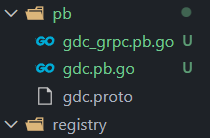
这会生成两个文件:
pb/gdc.pb.go:包含消息类型(CacheRequest 和 CacheResponse)的定义。
pb/gdc_grpc.pb.go:包含服务接口的定义。
节点选择器
核心接口设计
go
// PeerPicker 定义了peer选择器的接口
type PeerPicker interface {
    PickPeer(key string) (peer Peer, ok bool, self bool)
    Close() error
}
go
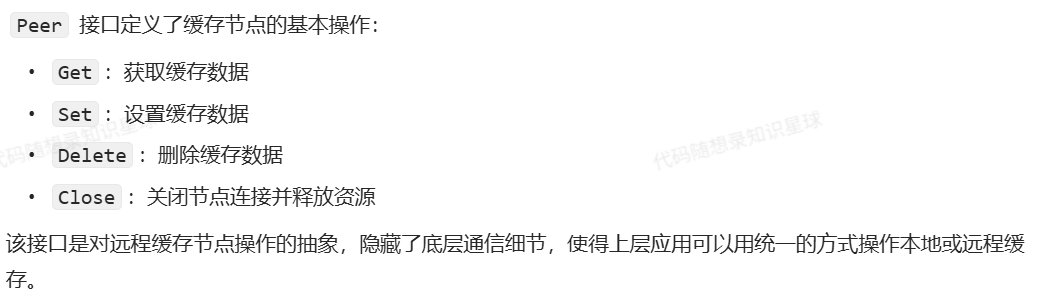
// Peer 定义了缓存节点的接口
type Peer interface {
    Get(group string, key string) ([]byte, error)
    Set(ctx context.Context, group string, key string, value []byte) error
    Delete(group string, key string) (bool, error)
    Close() error
}
go
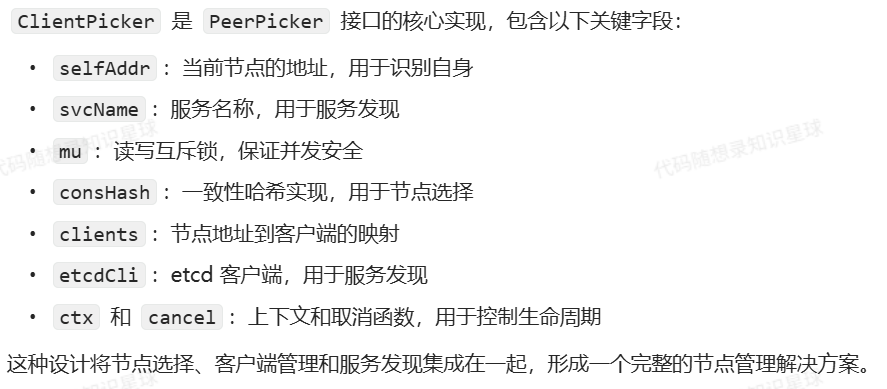
// ClientPicker 实现了PeerPicker接口
type ClientPicker struct {
    selfAddr string
    svcName  string
    mu       sync.RWMutex
    consHash *consistenthash.Map
    clients  map[string]*Client
    etcdCli  *clientv3.Client
    ctx      context.Context
    cancel   context.CancelFunc
}
服务发现与节点管理
go
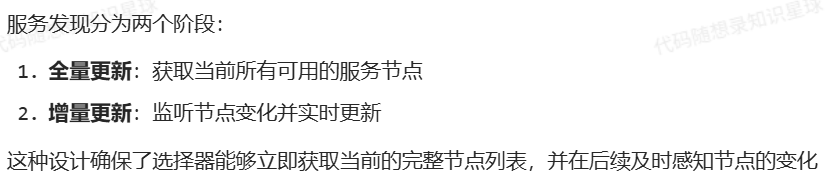
// startServiceDiscovery 启动服务发现
func (p *ClientPicker) startServiceDiscovery() error {
    // 先进行全量更新
    if err := p.fetchAllServices(); err != nil {
        return err
    }

    // 启动增量更新
    go p.watchServiceChanges()
    return nil
}
一致性哈希与节点选择
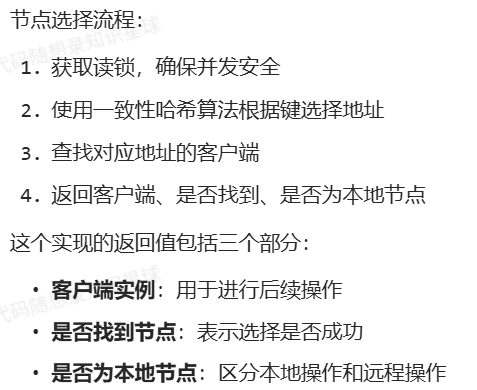
go
// PickPeer 选择peer节点
func (p *ClientPicker) PickPeer(key string) (Peer, bool, bool) {
    p.mu.RLock()
    defer p.mu.RUnlock()

    if addr := p.consHash.Get(key); addr != "" {
        if client, ok := p.clients[addr]; ok {
            return client, true, addr == p.selfAddr
        }
    }
    return nil, false, false
}
之后我会持续更新,如果喜欢我的文章,请记得一键三连哦,点赞关注收藏,你的每一个赞每一份关注每一次收藏都将是我前进路上的无限动力 !!!↖(▔▽▔)↗感谢支持!