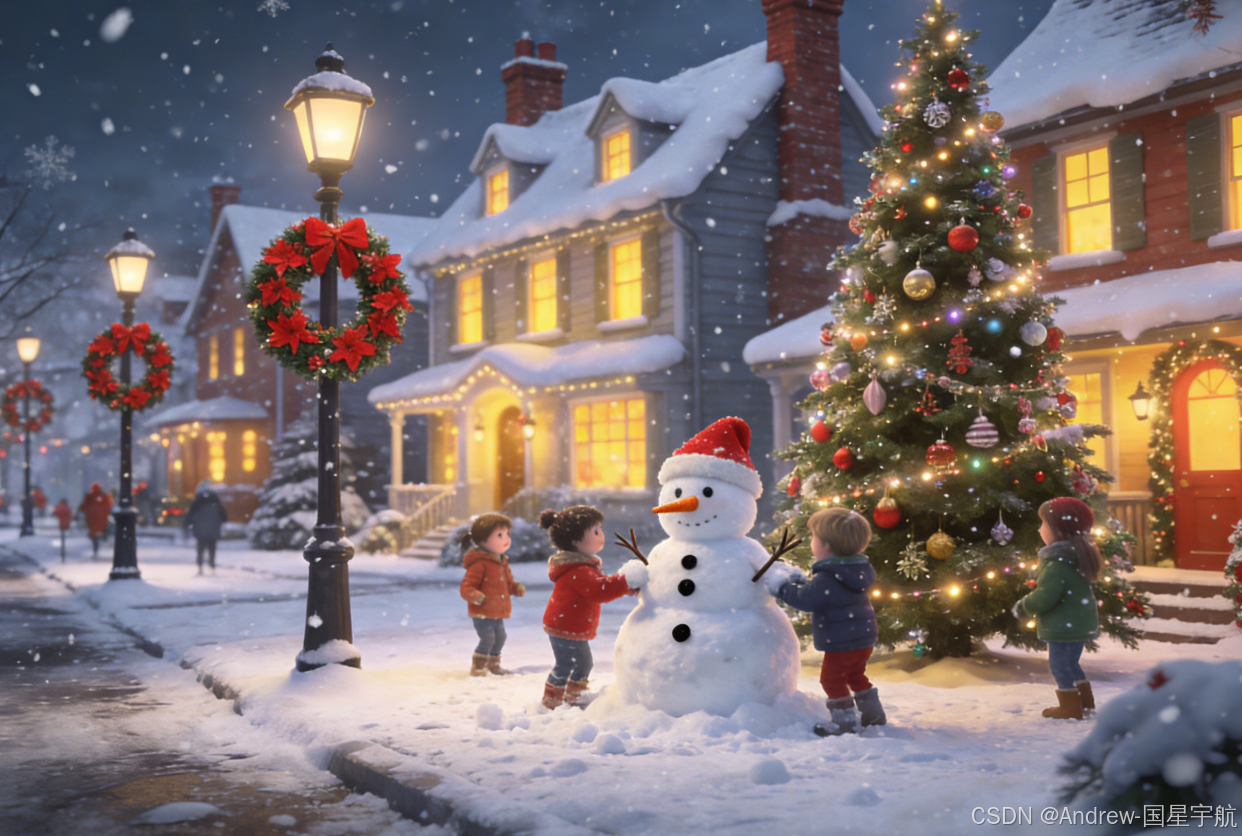
前言
圣诞季的数字世界总需要点"仪式感"------给照片加飘雪、识别圣诞树、给亲友头像P圣诞帽、把普通场景换成圣诞风...这些看似"一键生成"的效果,背后其实藏着满满的图像处理算法智慧。
作为程序员,与其用现成的滤镜APP,不如亲手实现这些圣诞特效!本文从传统计算机视觉(CV) 到现代AI算法,拆解10+圣诞主题图像处理算法,附可直接运行的代码片段,新手也能快速上手,让你的圣诞图片自带技术buff✨。
一、基础款:5分钟实现圣诞雪花特效(OpenCV版)
雪花是圣诞最经典的元素,用OpenCV+NumPy就能快速生成动态/静态雪花效果,核心思路是「噪声生成+模糊+融合」,步骤极简:
核心原理
- 生成高斯噪声层,转为白色(模拟雪花);
- 动感模糊模拟雪花飘落方向;
- 用"滤色(Screen)"模式将雪花层与原图融合;
- 调整不透明度,让雪花更自然。
代码实现(Python+OpenCV)
python
import cv2
import numpy as np

def add_snow_effect(image_path, snow_density=0.2, blur_strength=3):
    # 1. 读取原图
    img = cv2.imread(image_path)
    if img is None:
        raise ValueError("图片路径错误,请检查!")
    h, w, c = img.shape

    # 2. 生成雪花层(高斯噪声)
    snow_layer = np.random.normal(0, 255, (h, w))  # 高斯噪声
    # 二值化:保留高亮度区域(雪花)
    snow_layer = np.where(snow_layer > 255 * (1 - snow_density), 255, 0).astype(np.uint8)
    # 扩展为3通道,匹配原图
    snow_layer = cv2.merge([snow_layer, snow_layer, snow_layer])

    # 3. 动感模糊:模拟雪花飘落
    kernel = np.zeros((blur_strength * 2 + 1, blur_strength * 2 + 1))
    # 垂直方向模糊(飘落方向可改水平/斜向)
    kernel[:, blur_strength] = 1 / (blur_strength * 2 + 1)
    snow_layer = cv2.filter2D(snow_layer, -1, kernel)

    # 4. 融合雪花层与原图(滤色模式)
    # 滤色公式:result = 255 - (255 - img) * (255 - snow_layer) / 255
    result = 255 - (255 - img) * (255 - snow_layer) / 255
    result = result.astype(np.uint8)

    # 5. 显示/保存结果
    cv2.imshow("Christmas Snow Effect", result)
    cv2.imwrite("christmas_snow.jpg", result)
    cv2.waitKey(0)
    cv2.destroyAllWindows()
    return result

# 调用示例
add_snow_effect("your_photo.jpg", snow_density=0.15, blur_strength=4)
效果说明
snow_density:调整雪花密度(0.01.0),建议0.10.2;blur_strength:模糊强度越大,雪花"飘落感"越强;- 如需动态雪花,可循环生成不同位置的噪声层,结合帧率播放。
二、进阶款:圣诞元素检测与合成
1. 圣诞彩灯检测(Hough圆变换)
圣诞灯串的灯泡是规则圆形,用OpenCV的霍夫圆变换能精准识别,核心步骤:灰度化→模糊→边缘检测→霍夫圆检测。
代码实现
python
import cv2
import numpy as np

def detect_christmas_lights(image_path):
    img = cv2.imread(image_path)
    gray = cv2.cvtColor(img, cv2.COLOR_BGR2GRAY)
    # 高斯模糊去噪
    gray = cv2.GaussianBlur(gray, (9, 9), 2)

    # 霍夫圆变换(适配灯泡尺寸调整参数)
    circles = cv2.HoughCircles(
        gray,
        cv2.HOUGH_GRADIENT,
        dp=1.2,  # 分辨率缩放因子
        minDist=20,  # 灯泡最小间距
        param1=50,   # Canny边缘检测阈值
        param2=30,   # 圆心检测阈值(越小检测越多)
        minRadius=5, # 灯泡最小半径
        maxRadius=20 # 灯泡最大半径
    )

    # 绘制检测结果
    if circles is not None:
        circles = np.uint16(np.around(circles))
        for i in circles[0, :]:
            # 画圆心
            cv2.circle(img, (i[0], i[1]), 2, (0, 255, 0), 3)
            # 画圆轮廓
            cv2.circle(img, (i[0], i[1]), i[2], (0, 0, 255), 2)

    cv2.imshow("Christmas Lights Detection", img)
    cv2.imwrite("lights_detection.jpg", img)
    cv2.waitKey(0)
    cv2.destroyAllWindows()

# 调用示例
detect_christmas_lights("christmas_lights.jpg")
2. 圣诞帽精准贴合(人脸关键点+透视变换)
普通"贴纸式"圣诞帽会歪,用Dlib检测人脸关键点,结合透视变换让帽子贴合头部姿态,核心思路:
- 检测人脸68个关键点,定位头顶/额头区域;
- 估算头部姿态,计算圣诞帽的透视变换矩阵;
- 融合帽子与原图,边缘羽化更自然。
代码实现(需安装dlib)
python
import cv2
import dlib
import numpy as np

def add_christmas_hat(face_img_path, hat_img_path):
    # 1. 加载人脸检测器和关键点预测器
    detector = dlib.get_frontal_face_detector()
    predictor = dlib.shape_predictor("shape_predictor_68_face_landmarks.dat")  # 需下载该文件

    # 2. 读取图片
    face_img = cv2.imread(face_img_path)
    hat_img = cv2.imread(hat_img_path, cv2.IMREAD_UNCHANGED)  # 保留透明通道
    gray_face = cv2.cvtColor(face_img, cv2.COLOR_BGR2GRAY)

    # 3. 检测人脸和关键点
    faces = detector(gray_face)
    if len(faces) == 0:
        print("未检测到人脸!")
        return face_img

    # 取第一个人脸(多人可循环处理)
    face = faces[0]
    landmarks = predictor(gray_face, face)
    # 提取头顶关键点(19/24号)和额头关键点(17/26号)
    points = [(landmarks.part(n).x, landmarks.part(n).y) for n in [17, 26, 19, 24]]
    forehead_left = points[0]
    forehead_right = points[1]
    top_head1 = points[2]
    top_head2 = points[3]

    # 4. 计算帽子尺寸和位置
    hat_h, hat_w = hat_img.shape[:2]
    # 按额头宽度缩放帽子
    forehead_width = forehead_right[0] - forehead_left[0]
    scale = forehead_width / hat_w * 1.2  # 缩放系数
    hat_img = cv2.resize(hat_img, (0, 0), fx=scale, fy=scale)
    new_hat_h, new_hat_w = hat_img.shape[:2]

    # 5. 透视变换:让帽子贴合头部
    # 帽子的四个角点
    hat_points = np.array([[0, 0], [new_hat_w, 0], [0, new_hat_h], [new_hat_w, new_hat_h]], dtype=np.float32)
    # 人脸对应点(头顶+额头)
    face_points = np.array([
        [forehead_left[0] - 10, top_head1[1] - new_hat_h//3],
        [forehead_right[0] + 10, top_head2[1] - new_hat_h//3],
        [forehead_left[0] - 5, top_head1[1] + new_hat_h//2],
        [forehead_right[0] + 5, top_head2[1] + new_hat_h//2]
    ], dtype=np.float32)

    # 计算变换矩阵
    M = cv2.getPerspectiveTransform(hat_points, face_points)
    hat_warp = cv2.warpPerspective(hat_img, M, (face_img.shape[1], face_img.shape[0]))

    # 6. 融合帽子与原图(利用透明通道)
    mask = hat_warp[:, :, 3] / 255.0  # 透明通道转掩码
    hat_rgb = hat_warp[:, :, :3]
    # 羽化掩码,边缘更自然
    mask = cv2.GaussianBlur(mask, (7, 7), 0)

    for c in range(3):
        face_img[:, :, c] = (1 - mask) * face_img[:, :, c] + mask * hat_rgb[:, :, c]

    # 保存/显示结果
    cv2.imshow("Christmas Hat", face_img)
    cv2.imwrite("christmas_hat.jpg", face_img)
    cv2.waitKey(0)
    cv2.destroyAllWindows()
    return face_img

# 调用示例(需提前下载shape_predictor_68_face_landmarks.dat)
add_christmas_hat("your_face.jpg", "christmas_hat.png")  # 帽子图片需带透明通道(PNG)
注意事项
- 需下载Dlib的68点人脸关键点模型:shape_predictor_68_face_landmarks.dat;
- 圣诞帽图片建议用PNG格式(保留透明通道),效果更自然。
3. 圣诞树检测(色彩过滤+轮廓分析)
圣诞树以绿色为主,通过HSV色彩空间过滤绿色区域,再结合轮廓分析定位:
python
import cv2
import numpy as np

def detect_christmas_tree(image_path):
    img = cv2.imread(image_path)
    hsv = cv2.cvtColor(img, cv2.COLOR_BGR2HSV)

    # 定义绿色范围(可根据实际场景调整)
    lower_green = np.array([35, 40, 40])
    upper_green = np.array([77, 255, 255])
    mask = cv2.inRange(hsv, lower_green, upper_green)

    # 形态学操作去噪
    kernel = np.ones((5, 5), np.uint8)
    mask = cv2.morphologyEx(mask, cv2.MORPH_CLOSE, kernel)
    mask = cv2.morphologyEx(mask, cv2.MORPH_OPEN, kernel)

    # 轮廓检测
    contours, _ = cv2.findContours(mask, cv2.RETR_EXTERNAL, cv2.CHAIN_APPROX_SIMPLE)
    # 筛选大面积轮廓(排除小绿叶)
    for cnt in contours:
        area = cv2.contourArea(cnt)
        if area > 5000:  # 面积阈值,按需调整
            x, y, w, h = cv2.boundingRect(cnt)
            cv2.rectangle(img, (x, y), (x+w, y+h), (0, 255, 0), 3)
            cv2.putText(img, "Christmas Tree", (x, y-10), cv2.FONT_HERSHEY_SIMPLEX, 0.8, (0, 255, 0), 2)

    cv2.imshow("Tree Detection", img)
    cv2.imwrite("tree_detection.jpg", img)
    cv2.waitKey(0)
    cv2.destroyAllWindows()

# 调用示例
detect_christmas_tree("christmas_tree.jpg")
三、AI款:一键生成圣诞风格效果
如果觉得传统CV太繁琐,试试AI算法,几行代码就能实现"质的飞跃":
1. 圣诞风格迁移(Stable Diffusion)
用Stable Diffusion的图生图功能,将普通照片转为圣诞风格,核心提示词:
christmas style, warm tone, Christmas tree, snowflakes, fairy lights, cozy atmosphere, high detail --ar 16:9 --style realistic2. 圣诞老人GAN滤镜
基于CycleGAN/Pix2Pix,训练"人脸→圣诞老人"的映射模型,实现一键变身:
- 训练数据集:收集人脸图片+圣诞老人图片(约1000对);
- 框架:PyTorch/TensorFlow;
- 核心损失:对抗损失+循环一致性损失。
3. 文本生成圣诞场景(DALL-E/文心一格)
输入文本描述,AI直接生成圣诞场景,示例prompt:
温馨的圣诞客厅,壁炉里的火焰,圣诞树上挂满彩灯和礼物,窗外飘雪,暖黄色调,写实风格,8K分辨率
四、实用技巧:批量处理圣诞效果
如果需要给多张照片加圣诞特效,可封装上述算法为批量处理函数:
python
import os

def batch_christmas_effect(input_dir, output_dir, effect_func, **kwargs):
    # 创建输出目录
    if not os.path.exists(output_dir):
        os.makedirs(output_dir)
    # 遍历输入目录所有图片
    for filename in os.listdir(input_dir):
        if filename.endswith((".jpg", ".png", ".jpeg")):
            input_path = os.path.join(input_dir, filename)
            output_path = os.path.join(output_dir, filename)
            # 应用特效
            result = effect_func(input_path, **kwargs)
            cv2.imwrite(output_path, result)
            print(f"处理完成:{filename}")

# 批量添加雪花效果
batch_christmas_effect("input_photos", "christmas_photos", add_snow_effect, snow_density=0.15)
五、总结
圣诞主题图像处理算法,本质是「传统CV+AI」的组合拳:
- 快速上手:用OpenCV实现雪花、灯光检测、圣诞帽合成,5分钟出效果;
- 进阶玩法:基于Dlib/霍夫变换优化检测精度,让特效更自然;
- 高端定制:用GAN/Stable Diffusion实现风格迁移、场景生成,打造专属圣诞滤镜。
最后
如果本文对你有帮助,欢迎点赞+收藏+关注!🎅 你还知道哪些圣诞相关的图像处理算法?评论区聊聊~
附工具/资源清单:
- OpenCV官方文档:https://docs.opencv.org/5.x/
- Dlib人脸关键点模型:http://dlib.net/
- Stable Diffusion WebUI:https://github.com/AUTOMATIC1111/stable-diffusion-webui
- 圣诞素材(帽子/背景):可从PNGtree/千库网下载透明底素材。