operator() 在 C++ 中被称为 函数调用运算符 ,它允许类的对象像函数一样被调用。这种对象被称为 函数对象 或 仿函数。
一、基本语法
cpp
class MyFunctor {
public:
    // 重载 () 运算符
    return_type operator()(parameters) {
        // 实现代码
    }
};

// 使用
MyFunctor functor;
functor(arg1, arg2);  // 像函数一样调用
二、基础示例
示例 1:简单的仿函数
cpp
#include <iostream>

class Adder {
private:
    int value;
public:
    Adder(int v) : value(v) {}

    // 重载 () 运算符
    int operator()(int x) {
        return value + x;
    }
};

int main() {
    Adder add5(5);
    Adder add10(10);

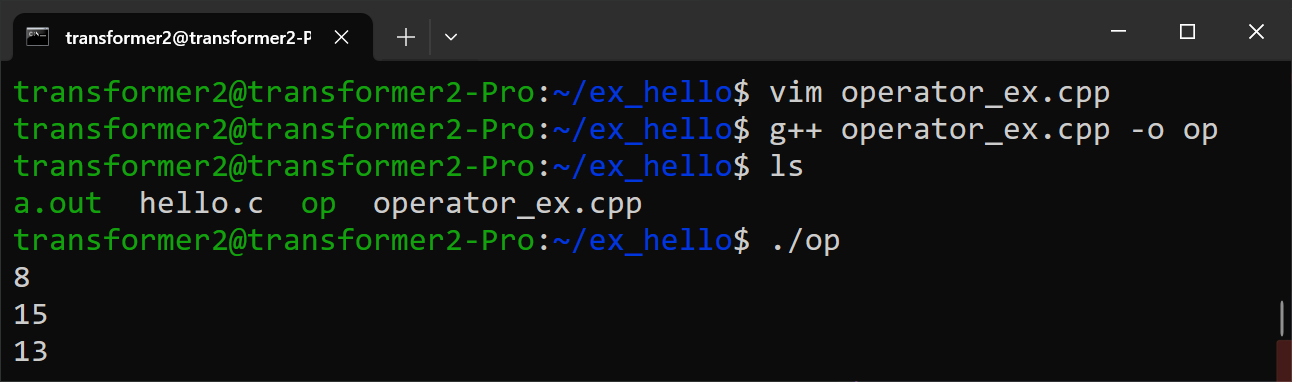
    std::cout << add5(3) << std::endl;   // 输出: 8
    std::cout << add5(10) << std::endl;  // 输出: 15
    std::cout << add10(3) << std::endl;  // 输出: 13

    return 0;
}
示例 2:带状态的计数器
cpp
#include <iostream>

class Counter {
private:
    int count;
public:
    Counter() : count(0) {}

    int operator()() {
        return ++count;
    }

    int operator()(int increment) {
        count += increment;
        return count;
    }

    void reset() { count = 0; }
};

int main() {
    Counter counter;

    std::cout << counter() << std::endl;  // 输出: 1
    std::cout << counter() << std::endl;  // 输出: 2
    std::cout << counter(5) << std::endl; // 输出: 7
    counter.reset();
    std::cout << counter() << std::endl;  // 输出: 1

    return 0;
}
三、在 STL 算法中的应用
operator() 在 STL 中非常有用,特别是与算法配合使用:
示例 3:自定义比较器
cpp
#include <iostream>
#include <vector>
#include <algorithm>

class CompareByLength {
public:
    bool operator()(const std::string& a, const std::string& b) const {
        return a.length() < b.length();
    }
};

class GreaterThan {
private:
    int threshold;
public:
    GreaterThan(int t) : threshold(t) {}

    bool operator()(int x) const {
        return x > threshold;
    }
};

int main() {
    // 1. 使用自定义比较器排序
    std::vector<std::string> words = {"apple", "banana", "cherry", "date"};
    std::sort(words.begin(), words.end(), CompareByLength());

    for (const auto& word : words) {
        std::cout << word << " ";  // 输出: date apple cherry banana
    }
    std::cout << std::endl;

    // 2. 使用自定义谓词
    std::vector<int> numbers = {1, 5, 10, 15, 20, 25};
    GreaterThan gt10(10);

    // 使用 find_if
    auto it = std::find_if(numbers.begin(), numbers.end(), gt10);
    if (it != numbers.end()) {
        std::cout << "First number > 10: " << *it << std::endl;  // 输出: 15
    }

    // 统计大于10的元素个数
    int count = std::count_if(numbers.begin(), numbers.end(), GreaterThan(10));
    std::cout << "Count > 10: " << count << std::endl;  // 输出: 3

    return 0;
}
四、Lambda 表达式与仿函数的关系
Lambda 表达式本质上是创建了一个匿名的仿函数类:
cpp
#include <iostream>
#include <vector>
#include <algorithm>

int main() {
    std::vector<int> numbers = {1, 2, 3, 4, 5};

    // Lambda 表达式
    auto lambda = [](int x) { return x * 2; };

    // 这等价于下面的仿函数
    class LambdaEquivalent {
    public:
        int operator()(int x) const {
            return x * 2;
        }
    };

    // 使用 lambda
    std::transform(numbers.begin(), numbers.end(), numbers.begin(), lambda);

    for (int n : numbers) {
        std::cout << n << " ";  // 输出: 2 4 6 8 10
    }
    std::cout << std::endl;

    return 0;
}
五、带捕获的 Lambda 对应的仿函数
cpp
#include <iostream>

int main() {
    int factor = 3;

    // Lambda 表达式捕获外部变量
    auto lambda = [factor](int x) { return x * factor; };

    // 对应的仿函数实现
    class LambdaWithCapture {
    private:
        int factor;  // 捕获的变量作为成员
    public:
        LambdaWithCapture(int f) : factor(f) {}

        int operator()(int x) const {
            return x * factor;
        }
    };

    std::cout << lambda(5) << std::endl;  // 输出: 15

    LambdaWithCapture functor(factor);
    std::cout << functor(5) << std::endl;  // 输出: 15

    return 0;
}
六、高级应用示例
示例 4:函数适配器
cpp
#include <iostream>
#include <functional>

// 自定义函数适配器:将二元函数转换为一元函数
template<typename Func, typename SecondArg>
class BindSecond {
private:
    Func func;
    SecondArg second;
public:
    BindSecond(Func f, SecondArg s) : func(f), second(s) {}

    template<typename FirstArg>
    auto operator()(FirstArg&& first) {
        return func(std::forward<FirstArg>(first), second);
    }
};

int multiply(int a, int b) {
    return a * b;
}

int main() {
    // 使用标准库的 bind
    using namespace std::placeholders;
    auto multiplyBy5 = std::bind(multiply, _1, 5);

    // 使用自定义的适配器
    BindSecond<decltype(&multiply), int> multiplyBy3(multiply, 3);

    std::cout << multiplyBy5(10) << std::endl;    // 输出: 50
    std::cout << multiplyBy3(10) << std::endl;    // 输出: 30

    return 0;
}
示例 5:记忆化(Memoization)
cpp
#include <iostream>
#include <unordered_map>
#include <functional>

class Memoizer {
private:
    std::function<int(int)> func;
    std::unordered_map<int, int> cache;

public:
    Memoizer(std::function<int(int)> f) : func(f) {}

    int operator()(int n) {
        if (cache.find(n) != cache.end()) {
            std::cout << "Cache hit for " << n << std::endl;
            return cache[n];
        }

        std::cout << "Computing for " << n << std::endl;
        int result = func(n);
        cache[n] = result;
        return result;
    }
};

int expensiveComputation(int n) {
    // 模拟耗时计算
    return n * n;
}

int main() {
    Memoizer memo(expensiveComputation);

    std::cout << memo(5) << std::endl;  // 计算并缓存
    std::cout << memo(5) << std::endl;  // 从缓存读取
    std::cout << memo(10) << std::endl; // 计算并缓存
    std::cout << memo(10) << std::endl; // 从缓存读取

    return 0;
}
示例 6:访问者模式中的应用
cpp
#include <iostream>
#include <vector>

class Circle;
class Square;

// 访问者基类
class ShapeVisitor {
public:
    virtual void operator()(Circle& circle) = 0;
    virtual void operator()(Square& square) = 0;
};

// 形状基类
class Shape {
public:
    virtual void accept(ShapeVisitor& visitor) = 0;
    virtual ~Shape() = default;
};

// 具体形状
class Circle : public Shape {
public:
    double radius;
    Circle(double r) : radius(r) {}

    void accept(ShapeVisitor& visitor) override {
        visitor(*this);
    }
};

class Square : public Shape {
public:
    double side;
    Square(double s) : side(s) {}

    void accept(ShapeVisitor& visitor) override {
        visitor(*this);
    }
};

// 具体访问者:面积计算器
class AreaCalculator : public ShapeVisitor {
public:
    double totalArea = 0;

    void operator()(Circle& circle) override {
        double area = 3.14159 * circle.radius * circle.radius;
        std::cout << "Circle area: " << area << std::endl;
        totalArea += area;
    }

    void operator()(Square& square) override {
        double area = square.side * square.side;
        std::cout << "Square area: " << area << std::endl;
        totalArea += area;
    }
};

int main() {
    std::vector<Shape*> shapes = {
        new Circle(5.0),
        new Square(4.0),
        new Circle(3.0)
    };

    AreaCalculator calculator;

    for (auto shape : shapes) {
        shape->accept(calculator);
    }

    std::cout << "Total area: " << calculator.totalArea << std::endl;

    // 清理
    for (auto shape : shapes) {
        delete shape;
    }

    return 0;
}七、operator() 的优点
-
可维护状态 与普通函数不同,仿函数可以有成员变量,可以保存状态
-
可内联 编译器更容易内联
operator()的调用,性能更好 -
可模板化 仿函数可以是模板类,提供更大的灵活性
-
STL兼容 STL算法通常要求函数对象,使用
operator()可以无缝集成 -
多态性 可以通过继承和虚函数实现多态行为
八、使用建议
-
对于简单的、一次性使用的函数对象,优先使用 Lambda
-
当需要复杂的状态管理、继承或多态时,使用显式的仿函数类
-
如果
operator()不修改对象状态,声明为const成员函数 -
在模板化的
operator()中使用完美转发
cpp
class GenericFunctor {
public:
    template<typename T, typename U>
    auto operator()(T&& t, U&& u) const {
        return std::forward<T>(t) + std::forward<U>(u);
    }
};
operator() 是 C++ 中实现函数对象的核心机制,它提供了比普通函数指针更强大、更灵活的功能,是现代 C++ 编程中的重要工具。