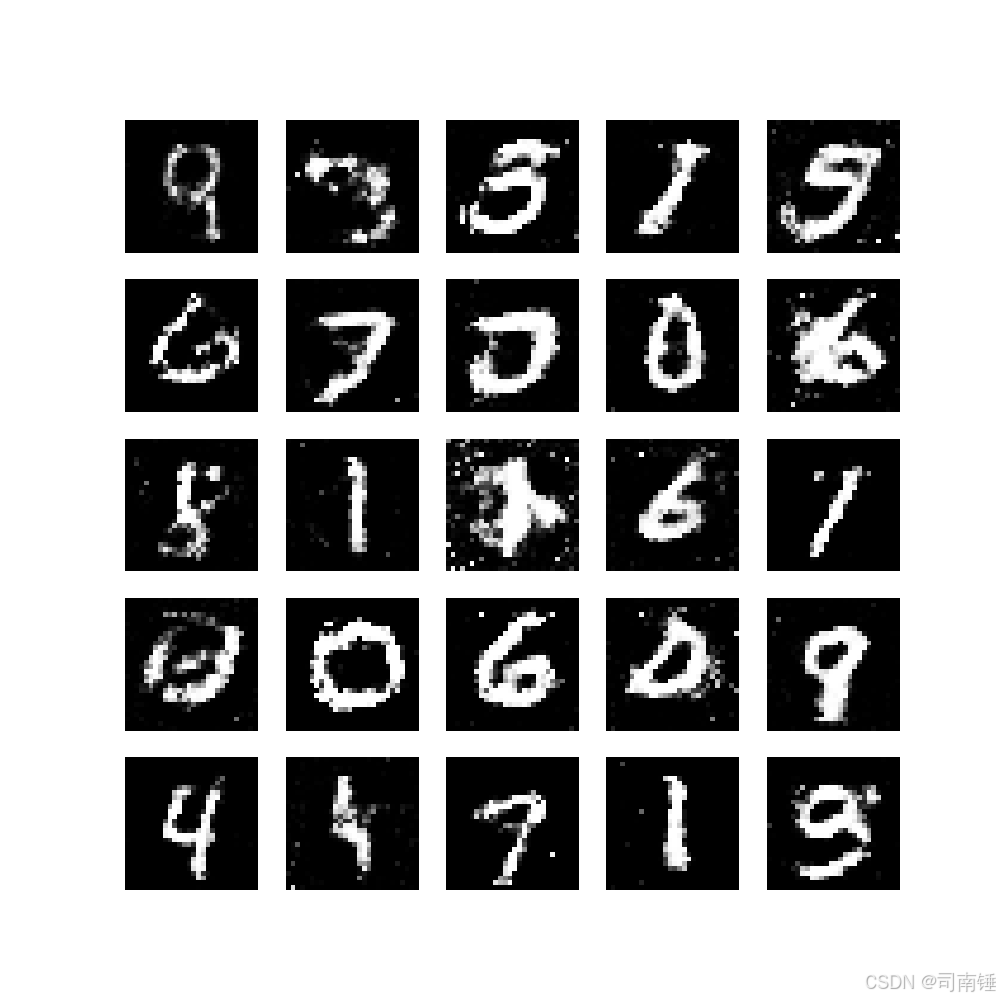
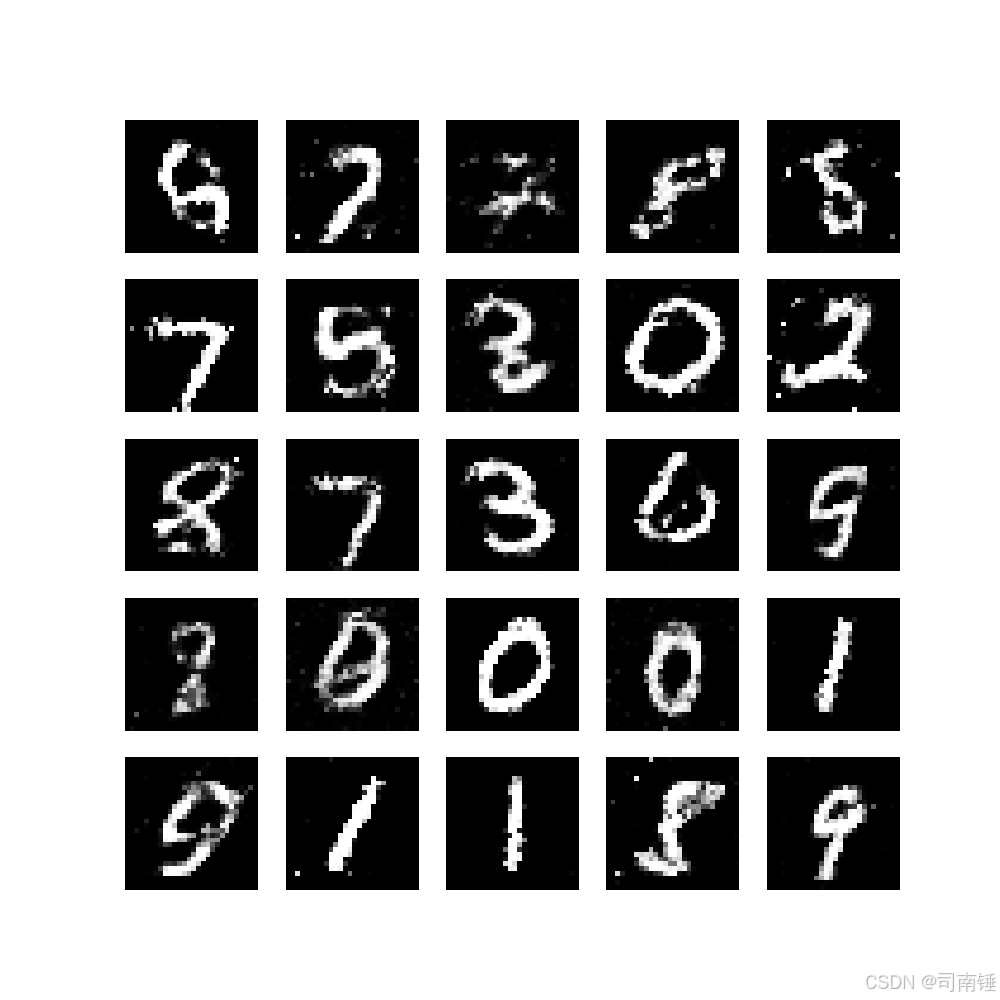
import torch
import torch.nn as nn
import torch.optim as optim
from torchvision import datasets, transforms
from torch.utils.data import DataLoader
import matplotlib.pyplot as plt
import numpy as np

# 定义生成器网络
class Generator(nn.Module):
    """
    生成器网络:将随机噪声转换为伪造的图像
    输入:随机噪声向量(维度为latent_dim)
    输出:生成的图像(1 x 28 x 28)
    """
    def __init__(self, latent_dim):
        super(Generator, self).__init__()
        self.model = nn.Sequential(
            nn.Linear(latent_dim, 256),
            nn.LeakyReLU(0.2),
            nn.BatchNorm1d(256),
            nn.Linear(256, 512),
            nn.LeakyReLU(0.2),
            nn.BatchNorm1d(512),
            nn.Linear(512, 1024),
            nn.LeakyReLU(0.2),
            nn.BatchNorm1d(1024),
            nn.Linear(1024, 28 * 28),
            nn.Tanh()
        )

    def forward(self, z):
        """
        前向传播
        参数:
            z: 随机噪声向量
        返回:
            生成的图像,形状为 [batch_size, 1, 28, 28]
        """
        img = self.model(z)
        img = img.view(img.size(0), 1, 28, 28)
        return img


# 定义判别器网络
class Discriminator(nn.Module):
    """
    判别器网络:判断输入的图像是真实的还是生成的
    输入:图像(1 x 28 x 28)
    输出:图像为真实的概率(0-1之间的标量)
    """
    def __init__(self):
        super(Discriminator, self).__init__()
        self.model = nn.Sequential(
            nn.Linear(28 * 28, 1024),
            nn.LeakyReLU(0.2),
            nn.Dropout(0.3),
            nn.Linear(1024, 512),
            nn.LeakyReLU(0.2),
            nn.Dropout(0.3),
            nn.Linear(512, 256),
            nn.LeakyReLU(0.2),
            nn.Dropout(0.3),
            nn.Linear(256, 1),
            nn.Sigmoid()
        )

    def forward(self, img):
        """
        前向传播
        参数:
            img: 输入图像,形状为 [batch_size, 1, 28, 28]
        返回:
            图像为真实的概率,形状为 [batch_size, 1]
        """
        img_flat = img.view(img.size(0), -1)
        validity = self.model(img_flat)
        return validity


def train_gan(epochs=100, batch_size=64, latent_dim=100, sample_interval=200):
    """
    训练GAN模型
    参数:
        epochs: 训练轮数
        batch_size: 批次大小
        latent_dim: 随机噪声向量的维度
        sample_interval: 生成并保存样本的间隔
    """
    # 设置设备(GPU或CPU)
    device = torch.device("cuda" if torch.cuda.is_available() else "cpu")
    print(f"使用设备: {device}")

    # 加载MNIST数据集
    transform = transforms.Compose([
        transforms.ToTensor(),
        transforms.Normalize([0.5], [0.5])
    ])
    dataset = datasets.MNIST(root="./data", train=True, download=True, transform=transform)
    dataloader = DataLoader(dataset, batch_size=batch_size, shuffle=True)

    # 初始化生成器和判别器
    generator = Generator(latent_dim).to(device)
    discriminator = Discriminator().to(device)

    # 定义损失函数和优化器
    adversarial_loss = nn.BCELoss()
    optimizer_G = optim.Adam(generator.parameters(), lr=0.0002, betas=(0.5, 0.999))
    optimizer_D = optim.Adam(discriminator.parameters(), lr=0.0002, betas=(0.5, 0.999))

    # 训练循环
    for epoch in range(epochs):
        for i, (imgs, _) in enumerate(dataloader):
            # 配置输入
            real_imgs = imgs.to(device)
            batch_size = real_imgs.size(0)

            # 创建标签
            real = torch.ones(batch_size, 1).to(device)
            fake = torch.zeros(batch_size, 1).to(device)

            # ---------------------
            #  训练判别器
            # ---------------------
            optimizer_D.zero_grad()

            # 计算真实图像的损失
            real_loss = adversarial_loss(discriminator(real_imgs), real)

            # 生成假图像
            z = torch.randn(batch_size, latent_dim).to(device)
            gen_imgs = generator(z)

            # 计算假图像的损失
            fake_loss = adversarial_loss(discriminator(gen_imgs.detach()), fake)

            # 总判别器损失
            d_loss = (real_loss + fake_loss) / 2

            d_loss.backward()
            optimizer_D.step()

            # ---------------------
            #  训练生成器
            # ---------------------
            optimizer_G.zero_grad()

            # 生成假图像
            z = torch.randn(batch_size, latent_dim).to(device)
            gen_imgs = generator(z)

            # 生成器希望判别器认为生成的图像是真实的
            g_loss = adversarial_loss(discriminator(gen_imgs), real)

            g_loss.backward()
            optimizer_G.step()

            # 打印训练进度
            if i % 50 == 0:
                print(
                    f"[Epoch {epoch}/{epochs}] [Batch {i}/{len(dataloader)}] "
                    f"[D loss: {d_loss.item():.4f}] [G loss: {g_loss.item():.4f}]"
                )

            # 定期保存生成的图像
            if i % sample_interval == 0:
                save_images(gen_imgs, epoch, i)

    # 训练完成后,生成最终样本
    print("\n训练完成!生成最终样本...")
    z = torch.randn(25, latent_dim).to(device)
    gen_imgs = generator(z)
    save_images(gen_imgs, epochs, 0, final=True)


def save_images(images, epoch, batch_idx, final=False):
    """
    保存生成的图像
    参数:
        images: 生成的图像张量
        epoch: 当前轮数
        batch_idx: 当前批次索引
        final: 是否为最终样本
    """
    images = images.detach().cpu().numpy()
    images = 0.5 * images + 0.5  # 反归一化到[0, 1]范围

    fig, axes = plt.subplots(5, 5, figsize=(10, 10))
    for i, ax in enumerate(axes.flat):
        if i < images.shape[0]:
            ax.imshow(images[i, 0], cmap='gray')
        ax.axis('off')

    if final:
        plt.savefig(f'gan_final_samples.png')
        print(f"最终样本已保存为: gan_final_samples.png")
    else:
        plt.savefig(f'gan_epoch{epoch}_batch{batch_idx}.png')
    plt.close()


if __name__ == "__main__":
    # 训练GAN模型
    train_gan(epochs=20, batch_size=64, latent_dim=100, sample_interval=200)