相关项目下载链接
本节内容详细解析基于二进制球面量化(BSQ, Binary Spherical Quantization) 的 Patch 级自编码器代码bsq.py,该代码是在基础 Patch 自编码器ae.py之上扩展,核心目标是将连续的图像特征量化为离散整数 Token,同时保留图像重构能力,为后续自回归模型训练打下基础。具体流程如下:
导入依赖库
python
import abc

import torch

from .ae import PatchAutoEncoder
定义模型加载函数
python
def load() -> torch.nn.Module:
    from pathlib import Path
    model_name = "BSQPatchAutoEncoder"
    model_path = Path(__file__).parent / f"{model_name}.pth"
    print(f"Loading {model_name} from {model_path}")
    return torch.load(model_path, weights_only=False)
定义可微分符号函数 diff_sign()
核心问题 :普通sign函数(x≥0→1,否则 - 1)是离散操作,梯度为 0,无法反向传播;
解决方案 :直通估计器(STE, Straight-Through Estimator):
作用:让 BSQ 的离散量化操作可训练,是端到端训练的核心。
python
def diff_sign(x: torch.Tensor) -> torch.Tensor:
    sign = 2 * (x >= 0).float() - 1  # 离散输出±1
    return x + (sign - x).detach()    # STE直通估计器
定义Tokenize抽象基类
python
class Tokenizer(abc.ABC):
    @abc.abstractmethod
    def encode_index(self, x: torch.Tensor) -> torch.Tensor:
        """图像→整数Token,形状(B,H,W,3)→(B,h,w)"""
    @abc.abstractmethod
    def decode_index(self, x: torch.Tensor) -> torch.Tensor:
        """整数Token→图像,形状(B,h,w)→(B,H,W,3)"""
BSQ 核心量化模块(BSQ 类)
python
class BSQ(torch.nn.Module):
    def __init__(self, codebook_bits: int, embedding_dim: int):
        super().__init__()

        self.codebook_bits = codebook_bits
        self.embedding_dim = embedding_dim

        self.down_proj = torch.nn.Linear(embedding_dim, codebook_bits)
        self.up_proj = torch.nn.Linear(codebook_bits, embedding_dim)

    def encode(self, x: torch.Tensor) -> torch.Tensor:
        """
        Implement the BSQ encoder:
        - A linear down-projection into codebook_bits dimensions
        - L2 normalization
        - differentiable sign
        """
        x = self.down_proj(x)	# 降维:将高维特征压缩到codebook_bits维
        x = torch.nn.functional.normalize(x, p=2, dim=-1) # L2 归一化:将特征投影到单位球面,保证量化后分布均匀
        x = diff_sign(x) # 可微分符号化:输出 ±1 的二进制量化码(离散值,可微分)

        return x

    def decode(self, x: torch.Tensor) -> torch.Tensor:
        """
        Implement the BSQ decoder:
        - A linear up-projection into embedding_dim should suffice
        """
        x = self.up_proj(x) # 通过线性层将二进制量化码升维回原特征维度

        return x

    def forward(self, x: torch.Tensor) -> torch.Tensor:
        return self.decode(self.encode(x))

	# 对外接口
    def encode_index(self, x: torch.Tensor) -> torch.Tensor:
        """
        Run BQS and encode the input tensor x into a set of integer tokens
        """
        return self._code_to_index(self.encode(x))

	# 对外接口
    def decode_index(self, x: torch.Tensor) -> torch.Tensor:
        """
        Decode a set of integer tokens into an image.
        """
        return self.decode(self._index_to_code(x))


	# 量化码→Token
    def _code_to_index(self, x: torch.Tensor) -> torch.Tensor:
   		x_bin = (x >= 0).int()  # ±1→0/1二进制(1对应≥0,0对应<0)
   		# 生成位权(如10比特→[1,2,4,...,512]),reshape适配广播
   		bit_weights = 2 ** torch.arange(self.codebook_bits).to(x.device).reshape(1, 1, 1, -1)
    	x_idx = (x_bin * bit_weights).sum(dim=-1)  # 二进制→整数,形状(B,h,w,codebook_bits)→(B,h,w)

    	return x_idx

	# Token→量化码
	def _index_to_code(self, x: torch.Tensor) -> torch.Tensor:
	    x_exp = x[..., None]  # (B,h,w)→(B,h,w,1),适配广播
    	bit_weights = 2 ** torch.arange(self.codebook_bits).to(x.device).reshape(1, 1, 1, -1)
    	x_bin = (x_exp & bit_weights) > 0  # 按位与判断每一位是否为1,得到0/1二进制
    	x_code = 2 * x_bin.float() - 1     # 0/1→±1,还原量化码
   	 	return x_code
BSQPatchAutoEncoder:AE+BSQ 的组合实现
python
class BSQPatchAutoEncoder(PatchAutoEncoder, Tokenizer):
    """
    Combine your PatchAutoEncoder with BSQ to form a Tokenizer.

    Hint: The hyper-parameters below should work fine, no need to change them
          Changing the patch-size of codebook-size will complicate later parts of the assignment.
    """

    def __init__(self, patch_size: int = 5, latent_dim: int = 128, codebook_bits: int = 10):
        super().__init__(patch_size=patch_size, latent_dim=latent_dim)

        self.bsq = BSQ(codebook_bits=codebook_bits, embedding_dim=latent_dim)
        self.codebook_bits = codebook_bits
        self.patch_size = patch_size
        self.latent_dim = latent_dim

    # 实现 Tokenizer 接口
    def encode_index(self, x: torch.Tensor) -> torch.Tensor:
        latent = super().encode(x)
        tokens = self.bsq.encode_index(latent)

        return tokens

	# 实现 Tokenizer 接口
    def decode_index(self, x: torch.Tensor) -> torch.Tensor:
        latent = self.bsq.decode_index(x)
        recon_img = super().decode(latent)

        return recon_img

	# 重写 encode:整合 BSQ
    def encode(self, x: torch.Tensor) -> torch.Tensor:
        patch_latent = super().encode(x)
        bsq_code = self.bsq.encode(patch_latent)

        return bsq_code

	# 重写 decode:整合 BSQ
    def decode(self, x: torch.Tensor) -> torch.Tensor:
        bsq_latent = self.bsq.decode(x)
        recon_img = super().decode(bsq_latent)

        return recon_img

	# 前向传播 返回重构图像 + 监控指标
    def forward(self, x: torch.Tensor) -> tuple[torch.Tensor, dict[str, torch.Tensor]]:
        """
        Return the reconstructed image and a dictionary of additional loss terms you would like to
        minimize (or even just visualize).
        Hint: It can be helpful to monitor the codebook usage with

              cnt = torch.bincount(self.encode_index(x).flatten(), minlength=2**self.codebook_bits)

              and returning

              {
                "cb0": (cnt == 0).float().mean().detach(),
                "cb2": (cnt <= 2).float().mean().detach(),
                ...
              }
        """
        recon_img = self.decode(self.encode(x))

        recon_loss = torch.nn.functional.mse_loss(recon_img, x)

        tokens = self.encode_index(x)
        cnt = torch.bincount(tokens.flatten(), minlength=2 ** self.codebook_bits)

        extra_metrics = {
            "recon_loss": recon_loss,
            "cb0": (cnt == 0).float().mean().detach(),  # 未使用的码本比例
            "cb2": (cnt <= 2).float().mean().detach(),  # 使用次数<=2的码本比例
            "avg_code_usage": cnt.float().mean().detach() # 平均码本使用次数
        }

        return recon_img, extra_metrics
模块测评
下面进行模型训练:
python
python -m homework.train BSQPatchAutoEncoder模型训练过程如图所示

将代码打包为压缩文件
python
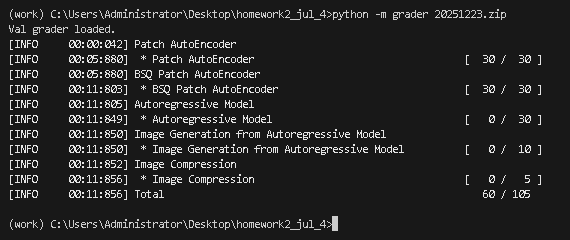
python bundle.py homework 20260104进行评分自测:
python
python -m grader 20260104.zip最终测试得分如下: