题目
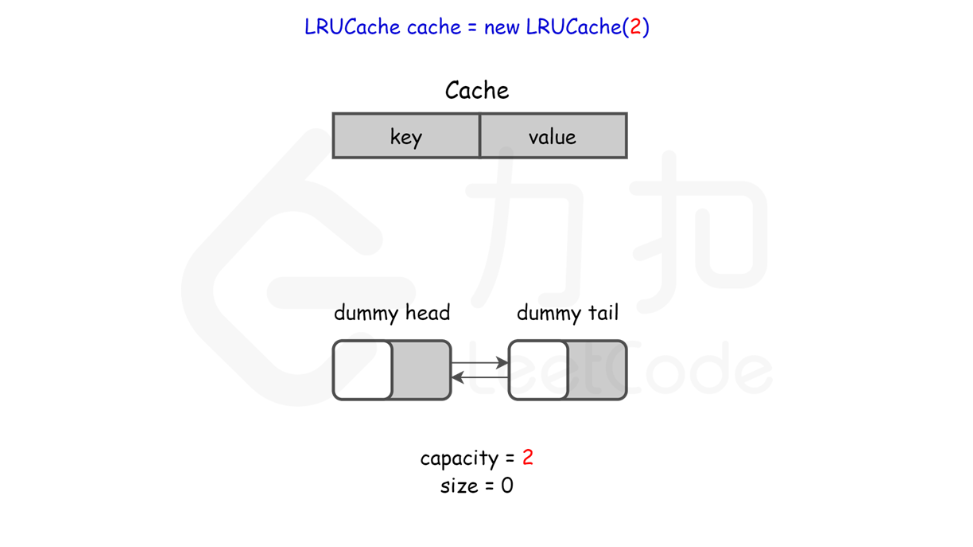
请你设计并实现一个满足 LRU (最近最少使用) 缓存 约束的数据结构。
实现 LRUCache 类:
- LRUCache(int capacity) 以 正整数 作为容量 capacity 初始化 LRU 缓存
- int get(int key) 如果关键字 key 存在于缓存中,则返回关键字的值,否则返回 -1 。
- void put(int key, int value) 如果关键字 key 已经存在,则变更其数据值 value ;如果不存在,则向缓存中插入该组 key-value 。如果插入操作导致关键字数量超过 capacity ,则应该 逐出 最久未使用的关键字。
函数 get 和 put 必须以 O(1) 的平均时间复杂度运行。
数据范围
1 <= capacity <= 3000
0 <= key <= 10000
0 <= value <= 105 最多调用 2 *
105 次 get 和 put
测试用例
java
输入
["LRUCache", "put", "put", "get", "put", "get", "put", "get", "get", "get"]
[[2], [1, 1], [2, 2], [1], [3, 3], [2], [4, 4], [1], [3], [4]]
输出
[null, null, null, 1, null, -1, null, -1, 3, 4]

解释
LRUCache lRUCache = new LRUCache(2);
lRUCache.put(1, 1); // 缓存是 {1=1}
lRUCache.put(2, 2); // 缓存是 {1=1, 2=2}
lRUCache.get(1);    // 返回 1
lRUCache.put(3, 3); // 该操作会使得关键字 2 作废,缓存是 {1=1, 3=3}
lRUCache.get(2);    // 返回 -1 (未找到)
lRUCache.put(4, 4); // 该操作会使得关键字 1 作废,缓存是 {4=4, 3=3}
lRUCache.get(1);    // 返回 -1 (未找到)
lRUCache.get(3);    // 返回 3
lRUCache.get(4);    // 返回 4
题解(官解,双向链表+哈希,对于get与put时间复杂度为O1,空间位O(capacity))
java
class LRUCache {
    class  DLinkNode{
        int key;
        int value;
        DLinkNode next;
        DLinkNode pre;
        public DLinkNode(){};
        public DLinkNode(int key,int value){
            this.key=key;
            this.value=value;
        }
    }

    HashMap<Integer,DLinkNode> map=new HashMap();
    int size;
    int capacity;
    DLinkNode head;
    DLinkNode tail;

    public LRUCache(int capacity) {
        head=new DLinkNode();
        tail=new DLinkNode();
        this.capacity=capacity;
        this.size=0;
        head.next=tail;
        tail.pre=head;
    }

    public int get(int key) {
        DLinkNode tl=map.getOrDefault(key,null);
        if(tl==null){
            return -1;
        }else{
            move(tl);
            return tl.value;
        }
    }

    public void put(int key, int value) {
        DLinkNode tl=map.getOrDefault(key,null);
        if(tl==null){
            add(key,value);
        }else{
            tl.value=value;
            move(tl);
        }
    }

    public void add(int key,int value){
        DLinkNode td=new DLinkNode(key,value);
        td.next=head.next;
        td.pre=head;
        head.next=td;
        td.next.pre=td;
        map.put(key,td);
        size++;
        if(size>capacity){
            remove();
        }
    }

    public void remove(){
        map.remove(tail.pre.key);
        tail.pre.pre.next=tail;
        tail.pre=tail.pre.pre;
        size--;
    }

    public void move(DLinkNode tnode){
        map.remove(tnode.key);
        tnode.pre.next=tnode.next;
        tnode.next.pre=tnode.pre;
        size--;
        add(tnode.key,tnode.value);
    }
}

/**
 * Your LRUCache object will be instantiated and called as such:
 * LRUCache obj = new LRUCache(capacity);
 * int param_1 = obj.get(key);
 * obj.put(key,value);
 */
题解2(博主垃圾题解,可以不用看,纯处刑自己,tle了)
java
class LRUCache {
    int capacity;
    int cnt=0;;
    PriorityQueue<tmap> queue=new PriorityQueue(new Comparator() {
            @Override
            public int compare(Object o1, Object o2) {
                return ((tmap)o1).times-((tmap)o2).times;
            }
        });
    public LRUCache(int capacity) {
        this.capacity=capacity;
    }

    public int get(int key) {
        int res=0;
        for(tmap a:queue){
            if(a.key==key){
                res=a.value;
                tmap t=new tmap(a.key,a.value,cnt++);
                queue.remove(a);
                queue.add(t);
                return res;
            }
        }
        return -1;
    }

    public void put(int key, int value) {
        for (tmap a : queue) {
            if (a.key == key) {
                queue.remove(a);
                queue.add(new tmap(key, value, cnt++));
                return;
            }
        }

        if (queue.size() == capacity) {
            queue.poll();
        }
        queue.add(new tmap(key, value, cnt++));
    }
}

class tmap{
    int key;
    int value;
    int times;

    public tmap(int key,int value,int times){
        this.key=key;
        this.value=value;
        this.times=times;
    }

}


/**
 * Your LRUCache object will be instantiated and called as such:
 * LRUCache obj = new LRUCache(capacity);
 * int param_1 = obj.get(key);
 * obj.put(key,value);
 */
思路
这道题要求get与put时间复杂度都为O1,那么方法已经锁死了,使用双向链表加上哈希表,哈希表可以在存取做到O1,双向链表可以做到添加与删除的O1。因为博主实在很少手写链表,更何况双向链表,所以一开始做题完全没往这方向考虑。导致产出了一个tle。
博主认为这道题官解讲的不错这里直接引用。具体代码实现博主添加了详细的备注,大家都应该能看懂。
实现本题的两种操作,需要用到一个哈希表和一个双向链表。在面试中,面试官一般会期望读者能够自己实现一个简单的双向链表,而不是使用语言自带的、封装好的数据结构。在 Python 语言中,有一种结合了哈希表与双向链表的数据结构 OrderedDict,只需要短短的几行代码就可以完成本题。在 Java 语言中,同样有类似的数据结构 LinkedHashMap。这些做法都不会符合面试官的要求,因此下面只给出使用封装好的数据结构实现的代码,而不多做任何阐述。
`class LRUCache extends LinkedHashMap<Integer, Integer>{
private int capacity;
public LRUCache(int capacity) {
    super(capacity, 0.75F, true);
    this.capacity = capacity;
}

public int get(int key) {
    return super.getOrDefault(key, -1);
}

public void put(int key, int value) {
    super.put(key, value);
}

@Override
protected boolean removeEldestEntry(Map.Entry<Integer, Integer> eldest) {
    return size() > capacity;
}
}
LRU 缓存机制可以通过哈希表辅以双向链表实现,我们用一个哈希表和一个双向链表维护所有在缓存中的键值对。
双向链表按照被使用的顺序存储了这些键值对,靠近头部的键值对是最近使用的,而靠近尾部的键值对是最久未使用的。
哈希表即为普通的哈希映射(HashMap),通过缓存数据的键映射到其在双向链表中的位置。
这样以来,我们首先使用哈希表进行定位,找出缓存项在双向链表中的位置,随后将其移动到双向链表的头部,即可在 O(1) 的时间内完成 get或者 put 操作。具体的方法如下:
对于 get 操作,首先判断 key 是否存在:
如果 key 不存在,则返回 −1;
如果 key 存在,则 key对应的节点是最近被使用的节点。通过哈希表定位到该节点在双向链表中的位置,并将其移动到双向链表的头部,最后返回该节点的值。
对于 put 操作,首先判断 key 是否存在:
如果 key 不存在,使用 key 和 value 创建一个新的节点,在双向链表的头部添加该节点,并将 key和该节点添加进哈希表中。然后判断双向链表的节点数是否超出容量,如果超出容量,则删除双向链表的尾部节点,并删除哈希表中对应的项;
如果 key 存在,则与 get 操作类似,先通过哈希表定位,再将对应的节点的值更新为 value,并将该节点移到双向链表的头部。
上述各项操作中,访问哈希表的时间复杂度为 O(1),在双向链表的头部添加节点、在双向链表的尾部删除节点的复杂度也为O(1)。而将一个节点移到双向链表的头部,可以分成「删除该节点」和「在双向链表的头部添加节点」两步操作,都可以在 O(1) 时间内完成。