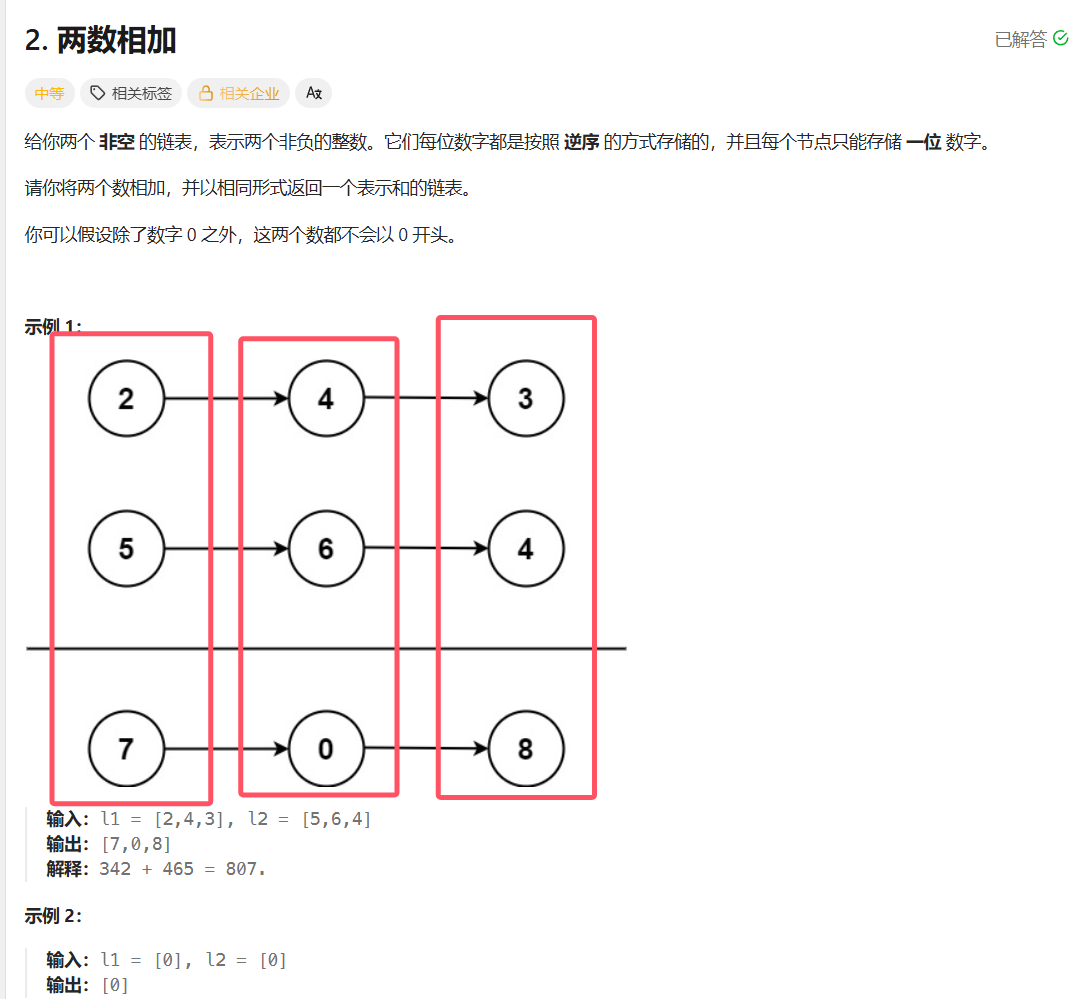
注意下方我圈出来的部分,一开始我采用了非常愚蠢的笨办法,就是将链表存储到动态数组中,但是一些很庞大的测试用例就过不去
通过下方我圈出来的红色部分,我们只要注意可以逐位相加,只要注意进位和循环结束的条件就可以了
这道题个人感觉非常不错,很有巧思,注释的部分是我一开始的笨方法,
java
/**
 * Definition for singly-linked list.
 * public class ListNode {
 *     int val;
 *     ListNode next;
 *     ListNode() {}
 *     ListNode(int val) { this.val = val; }
 *     ListNode(int val, ListNode next) { this.val = val; this.next = next; }
 * }
 */
class Solution {
    public ListNode addTwoNumbers(ListNode l1, ListNode l2) {
    //     List<Integer> arr1=new ArrayList<Integer>();
    //     List<Integer> arr2=new ArrayList<Integer>();
    //     while(l1!=null){
    //         arr1.add(l1.val);
    //         l1=l1.next;
    //     }
    //     while(l2!=null){
    //         arr2.add(l2.val);
    //         l2=l2.next;
    //     }
    //     long sum1=0,sum2=0;
    //     for(int i=arr1.size()-1;i>=0;i--){
    //         long a= (long) Math.pow(10,i);
    //         sum1=sum1+arr1.get(i)*a;
    //         a=a/10;
    //     }
    //     for(int i=arr2.size()-1;i>=0;i--){
    //         long a=  (long) Math.pow(10,i);
    //         sum2=sum2+arr2.get(i)*a;
    //         a=a/10;
    //     }
    //     long sum=sum1+sum2;
    //   // 特殊情况:如果和为0,直接返回一个节点值为0的链表
    //     if (sum == 0) {
    //         return new ListNode(0);
    //     }

    //     ListNode newarr = new ListNode(); // 创建链表的头节点
    //     ListNode current = newarr; // 当前节点,初始指向头节点
    //     while (sum > 0) {
    //         int b = (int) (sum % 10); // 取出个位数字
    //         sum = sum / 10; // 去掉个位数字
    //         current.next = new ListNode(b); // 创建新节点
    //         current = current.next; // 移动到下一个节点
    //     }

    //     return newarr.next; // 返回结果链表的有效部分,去掉虚拟头节点
        ListNode head=new ListNode(-1); //虚拟头结点,医院从current.next开始挂新结点,答案也从head.next开始
        ListNode current=head;
        int jinwei=0;  //记录是否进位,如果
        while(l1!=null || l2!=null || jinwei!=0){
            int sum=jinwei; //当前列的值要加上进位,所以如果是1+9,循环条件还有一个jinwei不为0
            if(l1!=null){
                sum=sum+l1.val;
                l1=l1.next;
            }
            if(l2!=null){
                sum=sum+l2.val;
                l2=l2.next;
            }
            jinwei=sum/10;  //计算是否有进位
            current.next=new ListNode(sum%10);  //创建新结点,并且赋值
            current=current.next;
        }
        return head.next;  //去掉虚拟头结点


    }
}