系列文章见
RVTLSSFPN类继承BaseLSSFPN,两个类中都有DepthNet,但两个是不一样的,可以查看代码,BaseLSSFPN的是这这样:
python
self.depth_conv = nn.Sequential(
            BasicBlock(mid_channels, mid_channels),
            BasicBlock(mid_channels, mid_channels),
            BasicBlock(mid_channels, mid_channels),
            ASPP(mid_channels, mid_channels),
            build_conv_layer(cfg=dict(
                type='DCN',
                in_channels=mid_channels,
                out_channels=mid_channels,
                kernel_size=3,
                padding=1,
                groups=4,
                im2col_step=128,
            )),
而RVTLSSFPN中是这样的:
python
self.context_conv = nn.Sequential(
            nn.Conv2d(mid_channels,
                      mid_channels,
                      kernel_size=3,
                      stride=1,
                      padding=1),
            nn.BatchNorm2d(mid_channels),
            nn.ReLU(inplace=True),
            nn.Conv2d(mid_channels,
                      context_channels,
                      kernel_size=1,
                      stride=1,
                      padding=0),
        )
我们最终调用的是RVTLSSFPN类中的网络,添加测试代码如下:
python
        ###### 测试代码,查看depth_net结构 ######
        dummy_input = torch.randn(1, kwargs['depth_net_conf']['in_channels'], 32, 32)
        mats_dict = {
            'intrin_mats': torch.randn(1, 1, 6, 4, 4),
            'ida_mats': torch.randn(1, 1, 6, 4, 4),
            'sensor2ego_mats': torch.randn(1, 1, 6, 4, 4),
            'bda_mat': torch.randn(1, 4, 4),
        }
        print("\n=== depth_net 模型结构 ===")
        print(self.depth_net)
        with torch.no_grad():
            output = self.depth_net(dummy_input, mats_dict)

        print(f"depth_net 输出形状: {output.shape}")
        total_params = sum(p.numel() for p in self.depth_net.parameters())
        print(f'depth_net 模型参数总数: {total_params}\n')
        # 导出为onnx格式
        torch.onnx.export(
            self.depth_net,                          # 要导出的模型
            (dummy_input, mats_dict),                # 模型的输入张量
            "depth_net_rvt.onnx",                    # 导出文件名
            export_params=True,                      # 是否导出训练好的参数
            opset_version=11,                        # ONNX算子集版本
        )
        ###### 测试代码结束 ######
可以看到打印出的模型结构和输出结构如下:
python
=== depth_net 模型结构 ===
DepthNet(
  (reduce_conv): Sequential(
    (0): Conv2d(256, 256, kernel_size=(3, 3), stride=(1, 1), padding=(1, 1))
    (1): BatchNorm2d(256, eps=1e-05, momentum=0.1, affine=True, track_running_stats=True)
    (2): ReLU(inplace=True)
  )
  (context_conv): Sequential(
    (0): Conv2d(256, 256, kernel_size=(3, 3), stride=(1, 1), padding=(1, 1))
    (1): BatchNorm2d(256, eps=1e-05, momentum=0.1, affine=True, track_running_stats=True)
    (2): ReLU(inplace=True)
    (3): Conv2d(256, 80, kernel_size=(1, 1), stride=(1, 1))
  )
  (depth_conv): Sequential(
    (0): BasicBlock(
      (conv1): Conv2d(256, 256, kernel_size=(3, 3), stride=(1, 1), padding=(1, 1), bias=False)
      (bn1): BatchNorm2d(256, eps=1e-05, momentum=0.1, affine=True, track_running_stats=True)
      (conv2): Conv2d(256, 256, kernel_size=(3, 3), stride=(1, 1), padding=(1, 1), bias=False)
      (bn2): BatchNorm2d(256, eps=1e-05, momentum=0.1, affine=True, track_running_stats=True)
      (relu): ReLU(inplace=True)
    )
    (1): BasicBlock(
      (conv1): Conv2d(256, 256, kernel_size=(3, 3), stride=(1, 1), padding=(1, 1), bias=False)
      (bn1): BatchNorm2d(256, eps=1e-05, momentum=0.1, affine=True, track_running_stats=True)
      (conv2): Conv2d(256, 256, kernel_size=(3, 3), stride=(1, 1), padding=(1, 1), bias=False)
      (bn2): BatchNorm2d(256, eps=1e-05, momentum=0.1, affine=True, track_running_stats=True)
      (relu): ReLU(inplace=True)
    )
    (2): BasicBlock(
      (conv1): Conv2d(256, 256, kernel_size=(3, 3), stride=(1, 1), padding=(1, 1), bias=False)
      (bn1): BatchNorm2d(256, eps=1e-05, momentum=0.1, affine=True, track_running_stats=True)
      (conv2): Conv2d(256, 256, kernel_size=(3, 3), stride=(1, 1), padding=(1, 1), bias=False)
      (bn2): BatchNorm2d(256, eps=1e-05, momentum=0.1, affine=True, track_running_stats=True)
      (relu): ReLU(inplace=True)
    )
    (3): Conv2d(256, 70, kernel_size=(1, 1), stride=(1, 1))
  )
)
depth_net 输出形状: torch.Size([1, 150, 32, 32])
depth_net 模型参数总数: 4761750
导出的onnx结构如下:
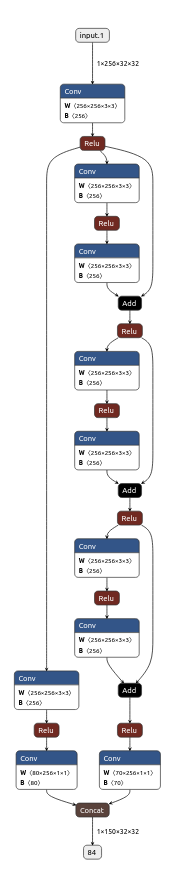
将代码copy至新文件中,可以生成一样的模型,这里BasicBlock使用了配置生成,可以参考Resnet18的BasicBlock,完整代码如下:
python
import torch
import torch.nn as nn
import torch.nn.functional as F


class BasicBlock(nn.Module):
    """搭建BasicBlock模块"""
    expansion = 1           # 不做扩展

    def __init__(self, in_channels, out_channels, stride=1, downsample=None):
        super(BasicBlock, self).__init__()      # 调用父类 nn.Module的构造函数

        # 使用BN层是不需要使用bias的,bias最后会抵消掉
        self.conv1 = nn.Conv2d(in_channels, out_channels, kernel_size=3,stride=stride, padding=1, bias=False)
        self.bn1 = nn.BatchNorm2d(out_channels) # BN层, BN层放在conv层和relu层中间使用
        self.relu = nn.ReLU(inplace=True)
        self.conv2 = nn.Conv2d(out_channels, out_channels, kernel_size=3,stride=1, padding=1, bias=False)
        self.bn2 = nn.BatchNorm2d(out_channels)
        self.downsample = downsample

    def forward(self, x):
        identity = x
        out = self.conv1(x)
        out = self.bn1(out)
        out = self.relu(out)
        out = self.conv2(out)
        out = self.bn2(out)
        if self.downsample is not None:         # 保证原始输入X的size与主分支卷积后的输出size叠加时维度相同
            identity = self.downsample(x)
        out += identity
        out = self.relu(out)
        return out
        """神经网络的前向传播函数:
            它接受一个输入张量X,然后通过一些卷积层和批量归一化层来计算输出张量Y。
            如果存在下采样层,它将对输入张量进行下采样以使其与输出张量的尺寸相同。
            最后,输出张量Y和输入张量X的恒等映射相加并通过ReLU激活函数进行激活。"""


class Mlp(nn.Module):
    def __init__(self,
                 in_features,
                 hidden_features=None,
                 out_features=None,
                 act_layer=nn.ReLU,
                 drop=0.0):
        super().__init__()
        out_features = out_features or in_features
        hidden_features = hidden_features or in_features
        self.fc1 = nn.Linear(in_features, hidden_features)
        self.act = act_layer()
        self.drop1 = nn.Dropout(drop)
        self.fc2 = nn.Linear(hidden_features, out_features)
        self.drop2 = nn.Dropout(drop)

    def forward(self, x):
        x = self.fc1(x)
        x = self.act(x)
        x = self.drop1(x)
        x = self.fc2(x)
        x = self.drop2(x)
        return x


class SELayer(nn.Module):
    def __init__(self, channels, act_layer=nn.ReLU, gate_layer=nn.Sigmoid):
        super().__init__()
        self.conv_reduce = nn.Conv2d(channels, channels, 1, bias=True)
        self.act1 = act_layer()
        self.conv_expand = nn.Conv2d(channels, channels, 1, bias=True)
        self.gate = gate_layer()

    def forward(self, x, x_se):
        x_se = self.conv_reduce(x_se)
        x_se = self.act1(x_se)
        x_se = self.conv_expand(x_se)
        return x * self.gate(x_se)


class DepthNet(nn.Module):
    def __init__(self, in_channels, mid_channels, context_channels, depth_channels,
                 camera_aware=True):
        super(DepthNet, self).__init__()
        self.camera_aware = camera_aware

        self.reduce_conv = nn.Sequential(
            nn.Conv2d(in_channels,
                      mid_channels,
                      kernel_size=3,
                      stride=1,
                      padding=1),
            nn.BatchNorm2d(mid_channels),
            nn.ReLU(inplace=True),
        )
        if self.camera_aware:
            self.bn = nn.BatchNorm1d(27)
            self.depth_mlp = Mlp(27, mid_channels, mid_channels)
            self.depth_se = SELayer(mid_channels)  # NOTE: add camera-aware
            self.context_mlp = Mlp(27, mid_channels, mid_channels)
            self.context_se = SELayer(mid_channels)  # NOTE: add camera-aware

        self.context_conv = nn.Sequential(
            nn.Conv2d(mid_channels,
                      mid_channels,
                      kernel_size=3,
                      stride=1,
                      padding=1),
            nn.BatchNorm2d(mid_channels),
            nn.ReLU(inplace=True),
            nn.Conv2d(mid_channels,
                      context_channels,
                      kernel_size=1,
                      stride=1,
                      padding=0),
        )
        self.depth_conv = nn.Sequential(
            BasicBlock(mid_channels, mid_channels),
            BasicBlock(mid_channels, mid_channels),
            BasicBlock(mid_channels, mid_channels),
            nn.Conv2d(mid_channels,
                      depth_channels,
                      kernel_size=1,
                      stride=1,
                      padding=0),
        )

    def forward(self, x, mats_dict):
        x = self.reduce_conv(x)

        if self.camera_aware:
            intrins = mats_dict['intrin_mats'][:, 0:1, ..., :3, :3]
            batch_size = intrins.shape[0]
            num_cams = intrins.shape[2]
            ida = mats_dict['ida_mats'][:, 0:1, ...]
            sensor2ego = mats_dict['sensor2ego_mats'][:, 0:1, ..., :3, :]
            bda = mats_dict['bda_mat'].view(batch_size, 1, 1, 4,
                                            4).repeat(1, 1, num_cams, 1, 1)
            mlp_input = torch.cat(
                [
                    torch.stack(
                        [
                            intrins[:, 0:1, ..., 0, 0],
                            intrins[:, 0:1, ..., 1, 1],
                            intrins[:, 0:1, ..., 0, 2],
                            intrins[:, 0:1, ..., 1, 2],
                            ida[:, 0:1, ..., 0, 0],
                            ida[:, 0:1, ..., 0, 1],
                            ida[:, 0:1, ..., 0, 3],
                            ida[:, 0:1, ..., 1, 0],
                            ida[:, 0:1, ..., 1, 1],
                            ida[:, 0:1, ..., 1, 3],
                            bda[:, 0:1, ..., 0, 0],
                            bda[:, 0:1, ..., 0, 1],
                            bda[:, 0:1, ..., 1, 0],
                            bda[:, 0:1, ..., 1, 1],
                            bda[:, 0:1, ..., 2, 2],
                        ],
                        dim=-1,
                    ),
                    sensor2ego.view(batch_size, 1, num_cams, -1),
                ],
                -1,
            )
            mlp_input = self.bn(mlp_input.reshape(-1, mlp_input.shape[-1]))
            context_se = self.context_mlp(mlp_input)[..., None, None]
            context_img = self.context_se(x, context_se)
            context = self.context_conv(context_img)
            depth_se = self.depth_mlp(mlp_input)[..., None, None]
            depth = self.depth_se(x, depth_se)
            depth = self.depth_conv(depth)
        else:
            context = self.context_conv(x)
            depth = self.depth_conv(x)

        return torch.cat([depth, context], dim=1)

def test_depth_net_model():
    """测试DepthNet模型的完整功能"""
    # 模型参数
    in_channels = 256
    mid_channels = 256
    output_channels = 80
    depth_channels = 70
    camera_aware = False

    print("=== 创建DepthNet模型 ===")
    model = DepthNet(in_channels=in_channels,
                     mid_channels=mid_channels,
                     context_channels=output_channels,
                     depth_channels=depth_channels,
                     camera_aware=camera_aware)

    dummy_input = torch.randn(1, in_channels, 32, 32)
    mats_dict = {
        'intrin_mats': torch.randn(1, 1, 6, 4, 4),
        'ida_mats': torch.randn(1, 1, 6, 4, 4),
        'sensor2ego_mats': torch.randn(1, 1, 6, 4, 4),
        'bda_mat': torch.randn(1, 4, 4),
    }
    print("\n=== depth_net 模型结构 ===")
    print(model)
    with torch.no_grad():
        output = model(dummy_input, mats_dict)

    print(f"depth_net 输出形状: {output.shape}")
    total_params = sum(p.numel() for p in model.parameters())
    print(f'depth_net 模型参数总数: {total_params}\n')
    # 导出为onnx格式
    torch.onnx.export(
        model,                          # 要导出的模型
        (dummy_input, mats_dict),                # 模型的输入张量
        "depth_net_new.onnx",                    # 导出文件名
        export_params=True,                      # 是否导出训练好的参数
        opset_version=11,                        # ONNX算子集版本
    )

# 主测试函数
if __name__ == "__main__":
    # 测试DepthNet模型
    test_depth_net_model()
view_aggregation_net有源代码,无需解析,直接使用即可。