屏幕上输入1〜10范围内的4个整数(可以有重复),对它们进行加、减、乘、除四则运算后(可以任意的加括号限定计算的优先级),寻找计算结果等于24的表达式。\n\n例如输入4个整数4、5、6、7,可得到表达式:4*((5-6)+7)=24。这只是一个解,要求输出全部的解。要求表达式中数字的顺序不能改变。\n\n思路:\n拼凑加减乘除,使4个数的运算结果等于24。\n\n由于四则运算中,乘除的优先级高于加减,所以必须"加括号"来限定4个数之间运算优先级。\n\n例如:A+B*C-D 这个式子,通过增加括号,可以产生多种结果,比如 (A+B)*(C-D) 和 A+(B*C-D)。\n\n那么总共有几种加括号的方法呢,该如何分类呢?\n\n要想将4个数字的运算优先级细分,必须使用两对括号。\n\n可以这么理解:我们的目的是将4个数的运算转换成两个"数"的运算(这里的"数"包括括号表达式),而每两个数运算,就能得出一个结果,即每对括号可以减少一个要计算的数字(如(A+B)*(C+D)中,A和B运算,使式子变成了3个数,C接着和D运算,使式子剩下两个数字)。4-2=2即为需要的括号数。\n\n下面列举所有可能的括号表达式:(#表示四则运算符)\n\n((A#B)#C)#D\n(A#(B#C))#D\nA#((B#C)#D)\nA#(B#(C#D))\n(A#B)#(C#D)\n具体思路:\n\n上面5种括号表达式都可以单独写成函数,函数内部按照括号的优先级+从左往右的顺序进行运算,最后返回计算结果。\n\n每个表达式中有3个'#'号,它们是四则运算符(+、-、*、/),可以定义一个全局字符数组,存放4这四个字符。\n\nchar my_oprator4 = {'+', '-', '*', '/'};\n
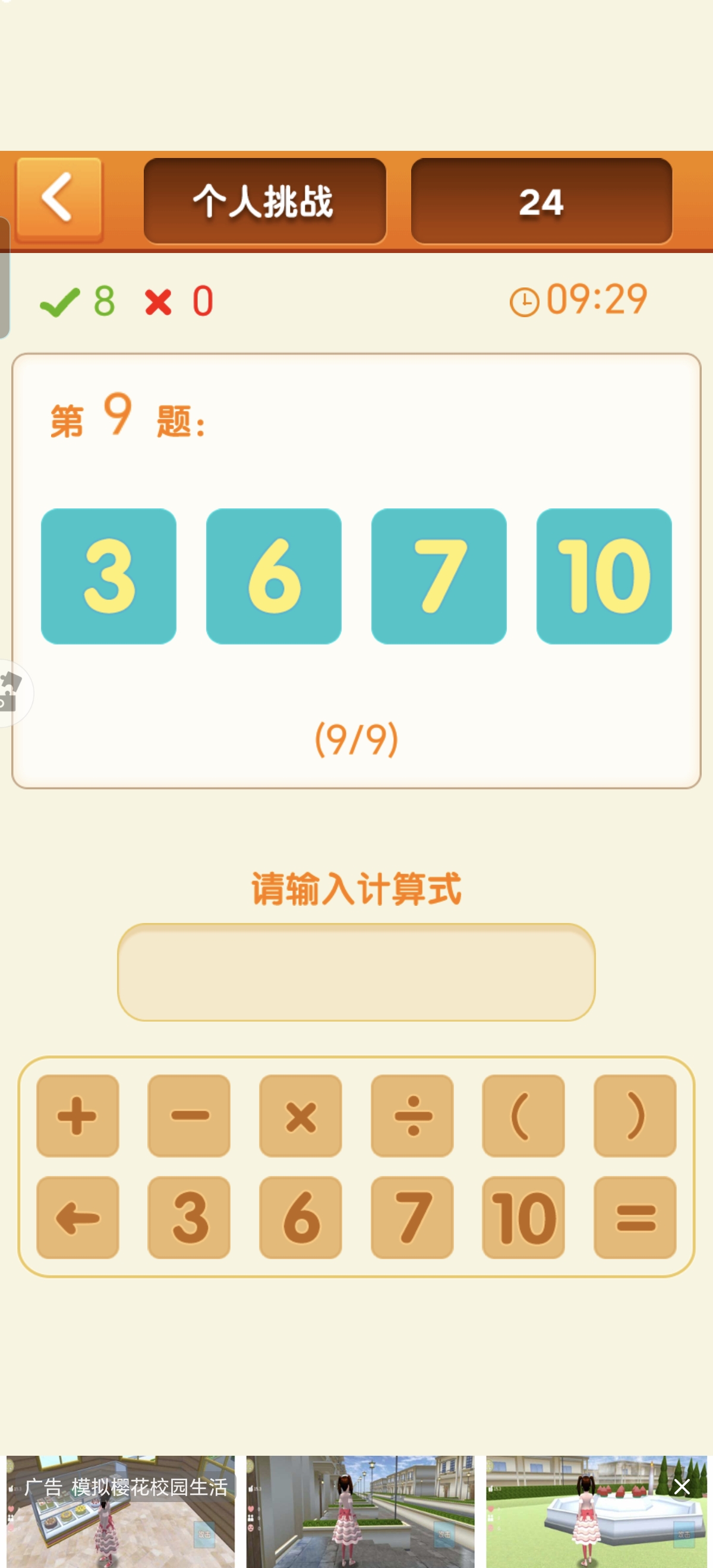
--24点游戏制作
--星空露珠工作室出品
local flag=false
local operator={'+','-','*','/'}
local nr,nr0,nrnew={},{},{}
local tb1,tb0,t0,t1,t2={},{},{},{},{}
local str,str0="",""
--运算两个数返回运算值
local function ce(nr1,nr2,operator0)
--print(nr1,nr2,operator0)
if operator0=='+' then return nr1+nr2
elseif operator0=='-' then return nr1-nr2
elseif operator0=='*' then return nr1*nr2
elseif operator0=='/' and nr2~=0 then return nr1/nr2
else return -1
end
end
--获取重复数组个数
local function c(t)
local t0={}
local t1={}
local t2={}
for _,v in ipairs(t)
if t0v==nil then t1#t1+1=v t0v=1 else t0v=t0v+1 end
end
if #t1==1 then t2={t11,t11,t11,t11}
elseif #t1==3 then
if t0t1\[1]==2 then t2={t12,t13,t11,t11}
elseif t0t1\[2]==2 then t2={t11,t13,t12,t12}
elseif t0t1\[3]==2 then t2={t11,t12,t13,t13}
end
elseif #t1==2 then
if t0t1\[1]==2 then t2={t11,t11,t12,t12}
elseif t0t1\[1]==1 then t2={t11,t12,t12,t12}
elseif t0t1\[1]==3 then t2={t12,t11,t11,t11}
end
elseif #t1==4 then t2={t11,t12,t13,t14}
end
return t1,t0,t2
end
--进行运算组合
local function c2(num1,num2,num3,num4)
for i=1,4 do
operator1=operatori
firstResult =ce(num1,num2,operator1)
midResult =ce(num2,num3,operator1)
tailResult =ce(num3,num4,operator1)
for j=1,4 do
operator2=operatorj
firstMidResult = ce(firstResult,num3,operator2)
firstTailResult= ce(num3,num4,operator2)
midFirstResult = ce(num1,midResult,operator2)
midTailResult = ce(midResult,num4,operator2)
tailMidResult = ce(num2,tailResult,operator2)
for k=1,4 do
operator3=operatork
if ce(firstMidResult,num4,operator3)==24 then
str0=str0.."(("..num1..operator1..num2..")"..operator2..num3..")"..operator3..num4..','
flag = true return
end
if ce(firstResult,firstTailResult,operator3) == 24
str0=str0.."("..num1..operator1..num2..")"..operator3.."("..num3..operator2..num4..")"..','
flag = true return
end
if ce(midFirstResult,num4,operator3) == 24
str0=str0.."("..num1..operator2.."("..num2..operator1..num3.."))"..operator3..num4..','
flag = true return
end
if ce(num1,midTailResult,operator3) == 24
str0=str0..num1..operator3.."(("..num2..operator1..num3..")"..operator2..num4..")"..','
flag = true return
end
if ce(num1,tailMidResult,operator3) == 24
str0=str0..num1..operator3.."("..num2..operator2.."("..num3..operator1..num4.."))"..','
flag = true return
end
end
end
end
end
--各种排序组合
local function c1(nrnew)
local tb1,tb0={},{}
local nr={}
local tb1,tb0,nr=c(nrnew)
--print(unpack(tb1))
print(unpack(nrnew))
str0="key="
if #tb1==1 then c2(nr1,nr2,nr3,nr4)
elseif #tb1==3 then c2(nr1,nr2,nr4,nr4)
c2(nr1,nr4,nr2,nr4)
c2(nr1,nr4,nr4,nr2)
c2(nr2,nr1,nr4,nr4)
c2(nr2,nr4,nr1,nr4)
c2(nr2,nr4,nr4,nr1)
c2(nr4,nr4,nr2,nr1)
c2(nr4,nr2,nr4,nr1)
c2(nr4,nr4,nr1,nr2)
c2(nr4,nr1,nr4,nr2)
c2(nr4,nr1,nr2,nr4)
c2(nr4,nr2,nr1,nr4)
elseif #tb1==2 then
if math.abs(tb0tb1\[1]-tb0tb1\[2])==0 then
c2(nr2,nr2,nr4,nr4)
c2(nr2,nr4,nr2,nr4)
c2(nr2,nr4,nr4,nr2)
c2(nr4,nr2,nr2,nr4)
c2(nr4,nr2,nr4,nr2)
c2(nr4,nr4,nr2,nr2)
elseif math.abs(tb0tb1\[1]-tb0tb1\[2])==2 then
c2(nr1,nr4,nr4,nr4)
c2(nr4,nr1,nr4,nr4)
c2(nr4,nr4,nr1,nr4)
c2(nr4,nr4,nr4,nr1)
end
elseif #tb1==4 then
for i=1,4 do
for j=1,4 do
if i~=j then
for m=1,4 do
if m~=i and m~=j then
for n=1,4 do
if n~=i and n~=j and n~=m then
c2(nri,nrj,nrm,nrn)
end
end
end
end
end
end
end
end
end
local game={}
--全部题目生成 也可不需要生成,生成时判断可否有解
local function main0()
local nr={}
for i=1,13 do
for j=i,13 do
for m=j,13 do
for n=m,13 do
flag = false
local nr={i,j,m,n}
c1(nr)
if flag==true then
table.insert(game,'{'..i..','..j..','..m..','..n..str0..',},')
--str=str..'{'..i..','..j..','..m..','..n..str0..'},'
end
end
end
end
end
end
--main0() --生成全部
c1({3,6,7,10}) --输入求解
print(str0)