#include<iostream>
#include<algorithm>

using namespace std;

int main(){
	int n;
	cin >> n;

	while(n --){
		int a;
		cin >> a;

		int res = a;
		for(int i = 2; i <= a / i; i ++){
			if(a % i == 0) {
				res = res / i * (i - 1);
				//等价于res = res * (1 - 1 / i)
				while(a % i == 0) a /= i;
			}
		}
			if(a > 1)res = res / a * (a -1);

		cout << res << endl;
	}

}
利用筛法求欧拉函数
这个其实不太好推
cpp复制代码
#include<iostream>
#include<algorithm>
using namespace std;

typedef long long LL;
const int N = 1000010;

int primes[N], cnt;  // 存储所有质数
int phi[N];         // 存储每个数的欧拉函数值
bool st[N];         // 标记是否是合数,st[i]=true表示i是合数

LL get_eulers(int n){
    phi[1] = 1;  // 规定φ(1)=1

    for(int i = 2; i <= n; i++){
        if(!st[i]){  // 如果i是质数
            primes[cnt ++] = i;  // 存储质数
            phi[i] = i - 1;      // 性质1:质数p的φ(p)=p-1
        }

        // 用当前已知的质数去筛i的倍数
        for(int j = 0; primes[j] <= n / i; j ++){
            st[primes[j] * i] = true;  // 标记合数

            if(i % primes[j] == 0){  // 如果primes[j]是i的质因子
                // 性质2:如果p整除n,则φ(p×n)=p×φ(n)
                phi[primes[j] * i] = primes[j] * phi[i];
                break;  // 保证每个合数只被最小质因子筛
            }
            // 性质3:如果p不整除n,则φ(p×n)=(p-1)×φ(n)
            phi[primes[j] * i] = (primes[j] - 1) * phi[i];
        }
    }

    // 计算前缀和
    LL res = 0;
    for(int i = 1; i <= n; i ++) res += phi[i];
    return res;
}
快速幂
先说一下快速幂是来处理什么问题的,他是用来快速求出 a ^ k mod P的结果,在o( log k)的时间复杂度求出结果
#include<iostream>
#include<algorithm>

using namespace std;

int main(){
	int n;
	cin >> n;

	while(n --){
		int a;
		cin >> a;

		int res = a;
		for(int i = 2; i <= a / i; i ++){
			if(a % i == 0) {
				res = res / i * (i - 1);
				//等价于res = res * (1 - 1 / i)
				while(a % i == 0) a /= i;
			}
		}
			if(a > 1)res = res / a * (a -1);

		cout << res << endl;
	}

}
快速幂求逆元
之前文章也讲过这个,具体可以看之前的文章,我们这里只给个求逆元的模板
cpp复制代码
#include<iostream>
#include<algorithm>

using namespace std;

typedef long long LL;

int n;

// a^k %p
int qmi(int a, int k, int p){
	int res = 1;
	while(k){
		if(k & 1) res = (LL)res * a % p;
		k >>= 1;
		a = (LL)a * a % p;
	}
	return res;
}

int main(){
	scanf("%d", &n);
	while(n --){
		int a, p;
		scanf("%d%d", &a, &p);

		int res = qmi(a, p - 2, p);

		if(a % p) printf("%d\n", res);
		else puts("impossible");
	}
}
裴蜀定理
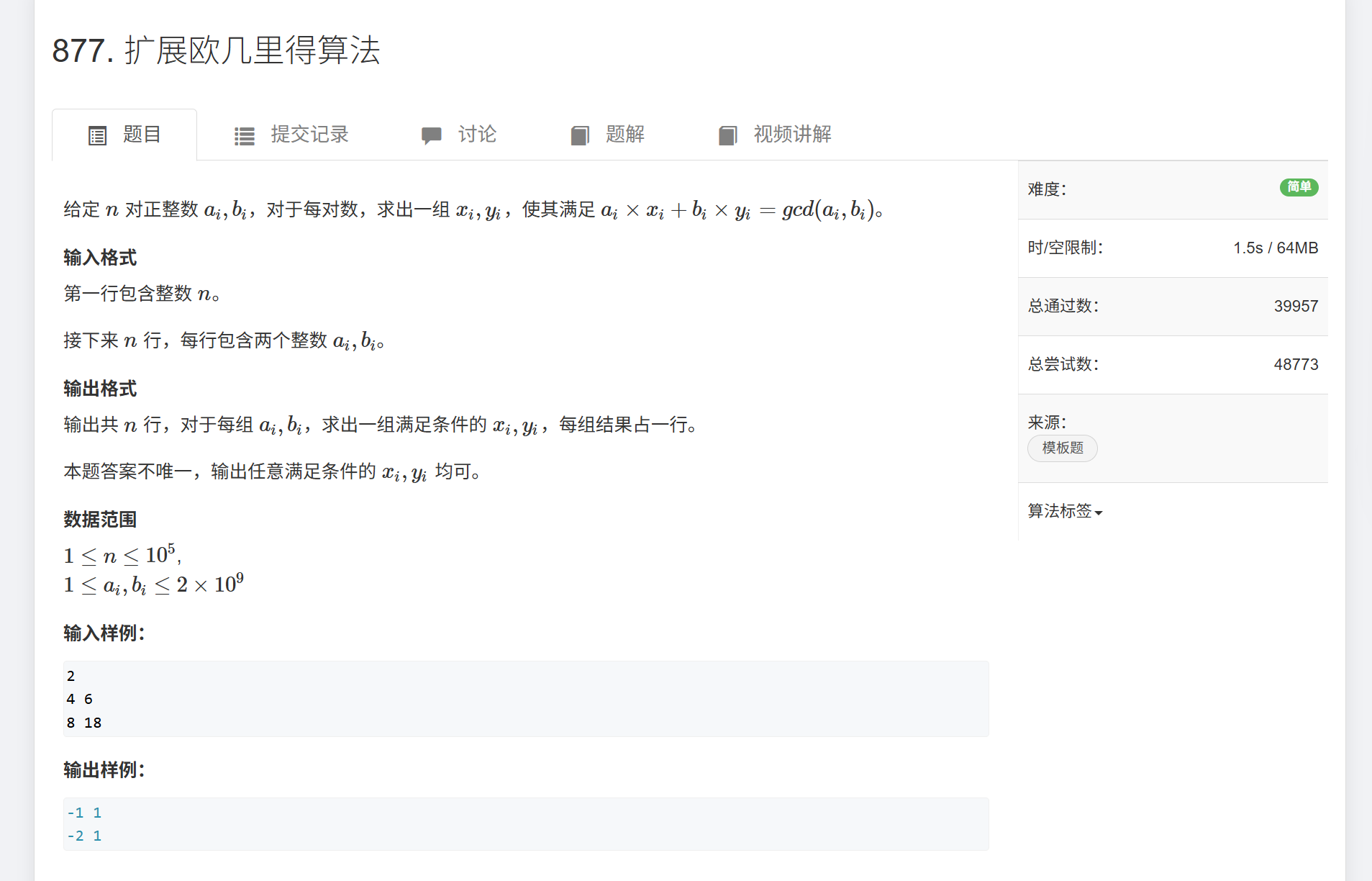
有一对正整数a, b,那么存在整数x, 使得ax + by = gcd(a, b)
如果ax + by = d,那么d一定是gcd(a, b)的倍数,所以可以凑出最小的a,b的系数正好是的=最大公约数
扩展欧几里得
看数学推导
我们要解:a × x + b × y = gcd(a, b)
假设我们已经递归计算了下一层: b × x₁ + (a % b) × y₁ = gcd(b, a % b)
根据欧几里得算法:gcd(a, b) = gcd(b, a % b)
展开 a % b = a - ⌊a/b⌋ × b:
复制代码
b × x₁ + (a % b) × y₁
= b × x₁ + (a - ⌊a/b⌋ × b) × y₁
= a × y₁ + b × (x₁ - ⌊a/b⌋ × y₁)
比较一下
复制代码
x = y₁
y = x₁ - ⌊a/b⌋ × y₁
所以就得到了下面这个
cpp复制代码
	int d =  exgcd(b, a % b, y, x);
	y -= a / b * x;
	return d;
cpp复制代码
#include<iostream>

using namespace std;

int exgcd(int a, int b, int &x, int &y){
	if(b == 0){
		x = 1, y = 0;
		return a;
	}
	int d = exgcd(b, a % b, y, x);
	y -= a / b * x;
	return d;
}

int main(){
	int n;
	scanf("%d", &n);

	while(n --){
		int a, b, x, y;
		scanf("%d%d", &a, &b);
		exgcd(a, b, x, y);
		printf("%d %d\n", x, y);
	}
}
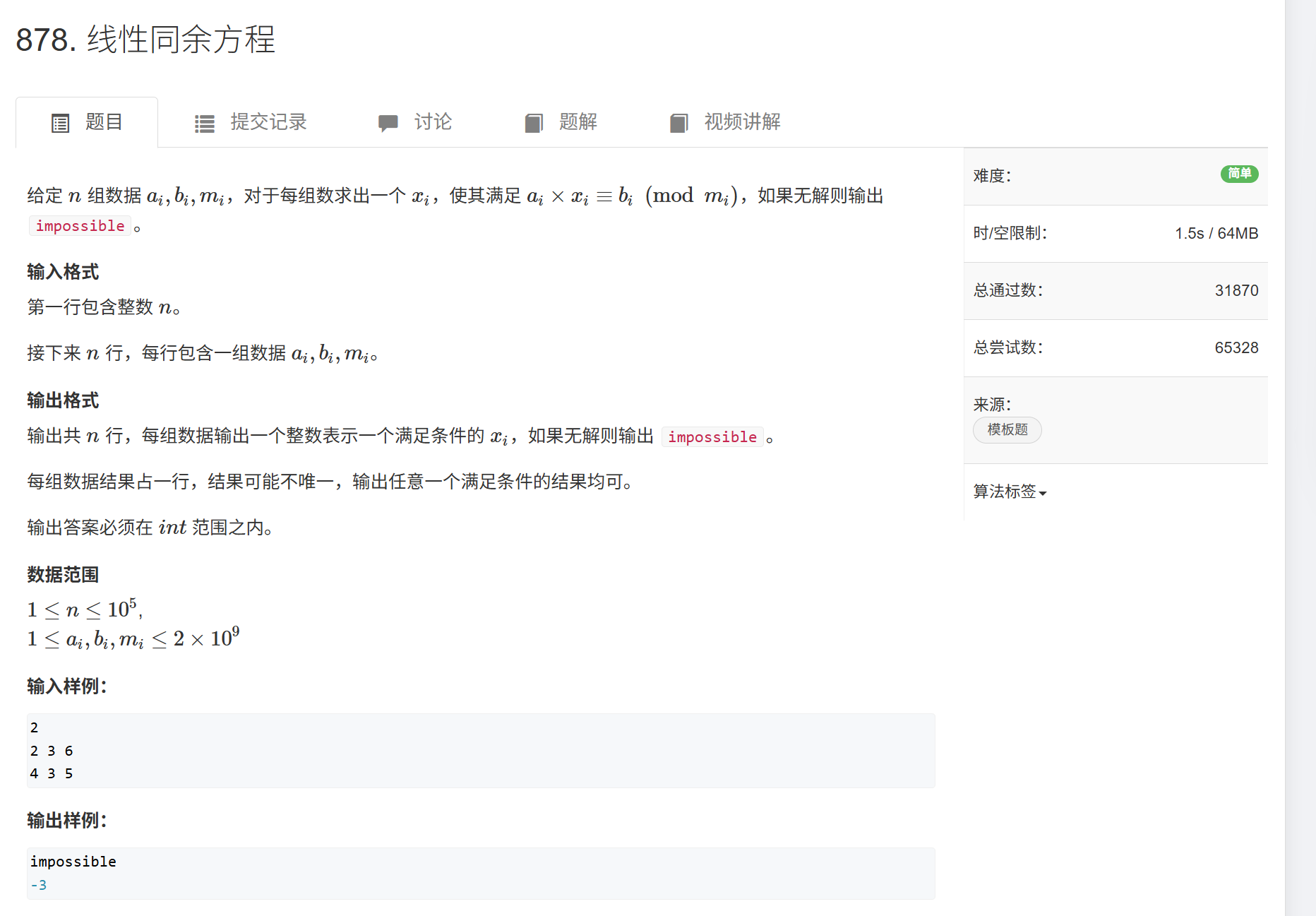
线性同余方程
这个就是转化为扩展欧几里得的形式去求
cpp复制代码
#include<iostream>

using namespace std;

typedef long long LL;


int exgcd(int a, int b, int &x, int &y){
	if(b == 0){
		x = 1, y = 0;
		return a;
	}
	int d = exgcd(b, a % b, y, x);
	y -= a / b * x;
	return d;
}

int main(){
	int n;
	scanf("%d", &n);

	while(n --){
		int a, b, m;
		scanf("%d%d%d", &a, &b, &m);
		int x, y;
		int d = exgcd(a, m, x, y);
		if(b % d) puts("impossible");
		else printf("%d\n", (LL)x * (b / d) % m);
	}
}

这个意思是 1 ~ n 内与 n 互质的个数