💡Yupureki:个人主页
✨个人专栏:《C++》 《算法》《Linux系统编程》《高并发内存池》
🌸Yupureki🌸的简介:

目录
[1. 使用基数树进行优化](#1. 使用基数树进行优化)
[2. 性能测试](#2. 性能测试)
完整项目链接 https://github.com/Yupureki-code/ConcurrentMemoryPool
1. 使用基数树进行优化
现内存池中存在一个比较严重的性能问题:PageCache需要加锁。特别是查找页ID到Span的映射时
因为PageCache中不断存在修改的情况,如果在一个线程查询的过程中,另一个线程同时把这个Span给拿走了,那就出大问题了。同时这把锁直接把整个PageCache给锁住了,因此对锁的竞争会很严重,同时没抢到锁的线程会一直在外面干瞪眼,这造成了严重的性能浪费
因此,Google的大佬们使用了一个新的数据结构:基数树
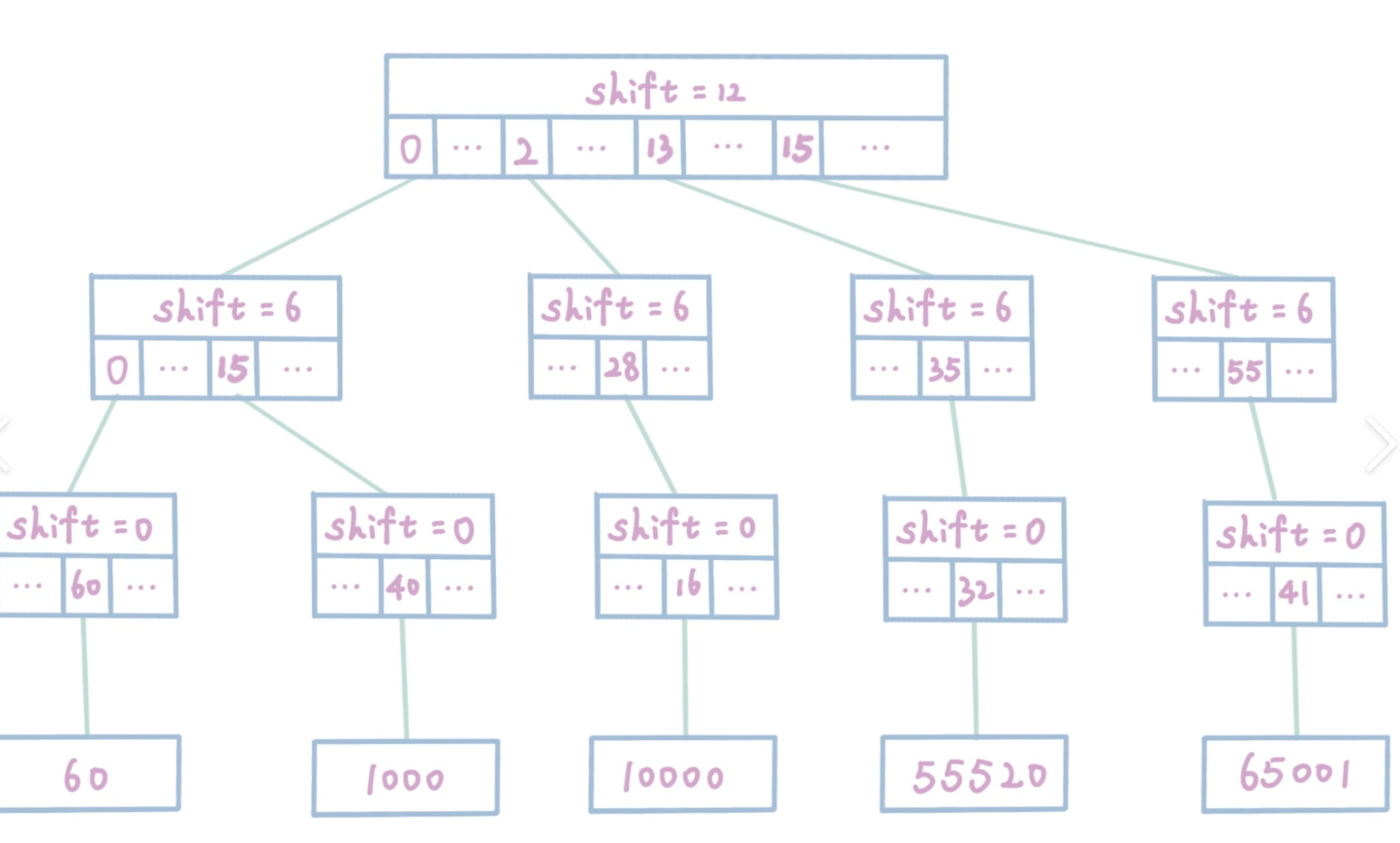
感兴趣的可以了解:Linux Kernel:内核数据结构之基数树(Radix Tree) - 知乎
基数树,写之前会提前开好空间,写数据过程中,不会动结构。
因为读写是分离的。线程1对一个位置读写的时候,线程2不可能对这个位置读写。
TCMalloc源码中有三个基数树的模板,适用于不同的场景,这里我们只使用前两个模板
注意:该项目暂时只能在32位平台下使用基数树
TCMalloc基数树(略微修改):
cpp
#pragma once

#include "Common.h"
#include "ObjectPool.h"

// Single-level array
template <int BITS>
class TCMalloc_PageMap1 {
private:
	static const int LENGTH = 1 << BITS;
	void** array_;

public:
	typedef uintptr_t Number;

	//explicit TCMalloc_PageMap1(void* (*allocator)(size_t)) {
	explicit TCMalloc_PageMap1() {
		//array_ = reinterpret_cast<void**>((*allocator)(sizeof(void*) << BITS));
		size_t size = sizeof(void*) << BITS;
		size_t alignSize = SizeClass::_RoundUp(size, 1 << PAGE_SHIFT);
		array_ = (void**)SystemAlloc(alignSize >> PAGE_SHIFT);
		memset(array_, 0, sizeof(void*) << BITS);
	}

	// Return the current value for KEY.  Returns NULL if not yet set,
	// or if k is out of range.
	void* get(Number k) const {
		if ((k >> BITS) > 0) {
			return NULL;
		}
		return array_[k];
	}

	// REQUIRES "k" is in range "[0,2^BITS-1]".
	// REQUIRES "k" has been ensured before.
	//
	// Sets the value 'v' for key 'k'.
	void set(Number k, void* v) {
		array_[k] = v;
	}
};


// Two-level radix tree
template <int BITS>
class TCMalloc_PageMap2 {
private:
	// Put 32 entries in the root and (2^BITS)/32 entries in each leaf.
	static const PAGE_ID ROOT_BITS = 5;
	static const PAGE_ID ROOT_LENGTH = (PAGE_ID)1 << ROOT_BITS;

	static const PAGE_ID LEAF_BITS = BITS - ROOT_BITS;
	static const PAGE_ID LEAF_LENGTH = (PAGE_ID)1 << LEAF_BITS;

	// Leaf node
	struct Leaf {
		void* values[LEAF_LENGTH];
	};

	Leaf* root_[ROOT_LENGTH];             // Pointers to 32 child nodes
	void* (*allocator_)(size_t);          // Memory allocator

public:
	typedef uintptr_t Number;

	//explicit TCMalloc_PageMap2(void* (*allocator)(size_t)) {
	explicit TCMalloc_PageMap2() {
		//allocator_ = allocator;
		memset(root_, 0, sizeof(root_));

		PreallocateMoreMemory();
	}

	void* get(Number k) const {
		const Number i1 = k >> LEAF_BITS;
		const Number i2 = k & (LEAF_LENGTH - 1);
		if ((k >> BITS) > 0 || root_[i1] == NULL) {
			return NULL;
		}
		return root_[i1]->values[i2];
	}

	void set(Number k, void* v) {
		const Number i1 = k >> LEAF_BITS;
		const Number i2 = k & (LEAF_LENGTH - 1);

		// Defensive checks: k must fit in BITS and i1 must be within root range
		if ((k >> BITS) != 0 || i1 >= ROOT_LENGTH) {
			// Out of range key: ignore or handle as appropriate
			return;
		}

		// Ensure leaf exists. Ensure() is responsible for allocating the leaf
		// and zero-initializing it. If Ensure fails, avoid writing.
		if (root_[i1] == NULL) {
			if (!Ensure(k, 1)) {
				return;
			}
		}

		// Final bounds check for i2 to avoid corrupting memory if constants
		// are misconfigured or subject to UB elsewhere.
		if (i2 >= LEAF_LENGTH) {
			return;
		}

		root_[i1]->values[i2] = v;
	}

	bool Ensure(Number start, size_t n) {
		for (Number key = start; key <= start + n - 1;) {
			const Number i1 = key >> LEAF_BITS;

			// Check for overflow
			if (i1 >= ROOT_LENGTH)
				return false;

			// Make 2nd level node if necessary
			if (root_[i1] == NULL) {
				//Leaf* leaf = reinterpret_cast<Leaf*>((*allocator_)(sizeof(Leaf)));
				//if (leaf == NULL) return false;
				static ObjectPool<Leaf>	leafPool;
				Leaf* leaf = (Leaf*)leafPool.New();

				memset(leaf, 0, sizeof(*leaf));
				root_[i1] = leaf;
			}

			// Advance key past whatever is covered by this leaf node
			key = ((key >> LEAF_BITS) + 1) << LEAF_BITS;
		}
		return true;
	}

	void PreallocateMoreMemory() {
		// Allocate enough to keep track of all possible pages
		Ensure(0, (PAGE_ID)1 << BITS);
	}
};

// Three-level radix tree
template <int BITS>
class TCMalloc_PageMap3 {
private:
	// How many bits should we consume at each interior level
	static const int INTERIOR_BITS = (BITS + 2) / 3; // Round-up
	static const int INTERIOR_LENGTH = 1 << INTERIOR_BITS;

	// How many bits should we consume at leaf level
	static const int LEAF_BITS = BITS - 2 * INTERIOR_BITS;
	static const int LEAF_LENGTH = 1 << LEAF_BITS;

	// Interior node
	struct Node {
		Node* ptrs[INTERIOR_LENGTH];
	};

	// Leaf node
	struct Leaf {
		void* values[LEAF_LENGTH];
	};

	Node* root_;                          // Root of radix tree
	void* (*allocator_)(size_t);          // Memory allocator

	Node* NewNode() {
		Node* result = reinterpret_cast<Node*>((*allocator_)(sizeof(Node)));
		if (result != NULL) {
			memset(result, 0, sizeof(*result));
		}
		return result;
	}

public:
	typedef uintptr_t Number;

	explicit TCMalloc_PageMap3(void* (*allocator)(size_t)) {
		allocator_ = allocator;
		root_ = NewNode();
	}

	void* get(Number k) const {
		const Number i1 = k >> (LEAF_BITS + INTERIOR_BITS);
		const Number i2 = (k >> LEAF_BITS) & (INTERIOR_LENGTH - 1);
		const Number i3 = k & (LEAF_LENGTH - 1);
		if ((k >> BITS) > 0 ||
			root_->ptrs[i1] == NULL || root_->ptrs[i1]->ptrs[i2] == NULL) {
			return NULL;
		}
		return reinterpret_cast<Leaf*>(root_->ptrs[i1]->ptrs[i2])->values[i3];
	}

	void set(Number k, void* v) {
		ASSERT(k >> BITS == 0);
		const Number i1 = k >> (LEAF_BITS + INTERIOR_BITS);
		const Number i2 = (k >> LEAF_BITS) & (INTERIOR_LENGTH - 1);
		const Number i3 = k & (LEAF_LENGTH - 1);
		reinterpret_cast<Leaf*>(root_->ptrs[i1]->ptrs[i2])->values[i3] = v;
	}

	bool Ensure(Number start, size_t n) {
		for (Number key = start; key <= start + n - 1;) {
			const Number i1 = key >> (LEAF_BITS + INTERIOR_BITS);
			const Number i2 = (key >> LEAF_BITS) & (INTERIOR_LENGTH - 1);

			// Check for overflow
			if (i1 >= INTERIOR_LENGTH || i2 >= INTERIOR_LENGTH)
				return false;

			// Make 2nd level node if necessary
			if (root_->ptrs[i1] == NULL) {
				Node* n = NewNode();
				if (n == NULL) return false;
				root_->ptrs[i1] = n;
			}

			// Make leaf node if necessary
			if (root_->ptrs[i1]->ptrs[i2] == NULL) {
				Leaf* leaf = reinterpret_cast<Leaf*>((*allocator_)(sizeof(Leaf)));
				if (leaf == NULL) return false;
				memset(leaf, 0, sizeof(*leaf));
				root_->ptrs[i1]->ptrs[i2] = reinterpret_cast<Node*>(leaf);
			}

			// Advance key past whatever is covered by this leaf node
			key = ((key >> LEAF_BITS) + 1) << LEAF_BITS;
		}
		return true;
	}

	void PreallocateMoreMemory() {
	}
};
我们使用基数树替换SpanMap原本的哈希表结构
cpp
TCMalloc_PageMap2<32 - PAGE_SHIFT> _id_span_map;同时部分接口也需要替换:
set(key,value)
如:
cpp
Span* PageCache::NewSpan(size_t k)
{
	assert(k > 0);
	if (k > NPAGES - 1)
	{
        ......
		_id_span_map.set(id, span);
		return span;
	}
	if (!_spanlists[k].Empty())
	{
		Span* kspan = _spanlists[k].PopFront();
		for (size_t i = 0; i < kspan->_num; i++)
			_id_span_map.set(kspan->_page_id + i, kspan);
		return kspan;
	}
	for (size_t i = k + 1; i < NPAGES; i++)
	{
		if (!_spanlists[i].Empty())
		{
			......
			_id_span_map.set(nspan->_page_id,nspan);
			_id_span_map.set(nspan->_page_id + nspan->_num - 1,nspan);
			for (size_t i = 0; i < kspan->_num; i++)
				_id_span_map.set(kspan->_page_id + i,kspan);
			return kspan;
		}
	}
	......
	return NewSpan(k);
}
get(key)返回值:value
如:
cpp
Span* PageCache::SpanMapFindObject(void* ptr)
{
	PAGE_ID id = ((PAGE_ID)ptr >> PAGE_SHIFT);
	Span* span = (Span*)_id_span_map.get(id);
	assert(span != nullptr);
	return span;
}
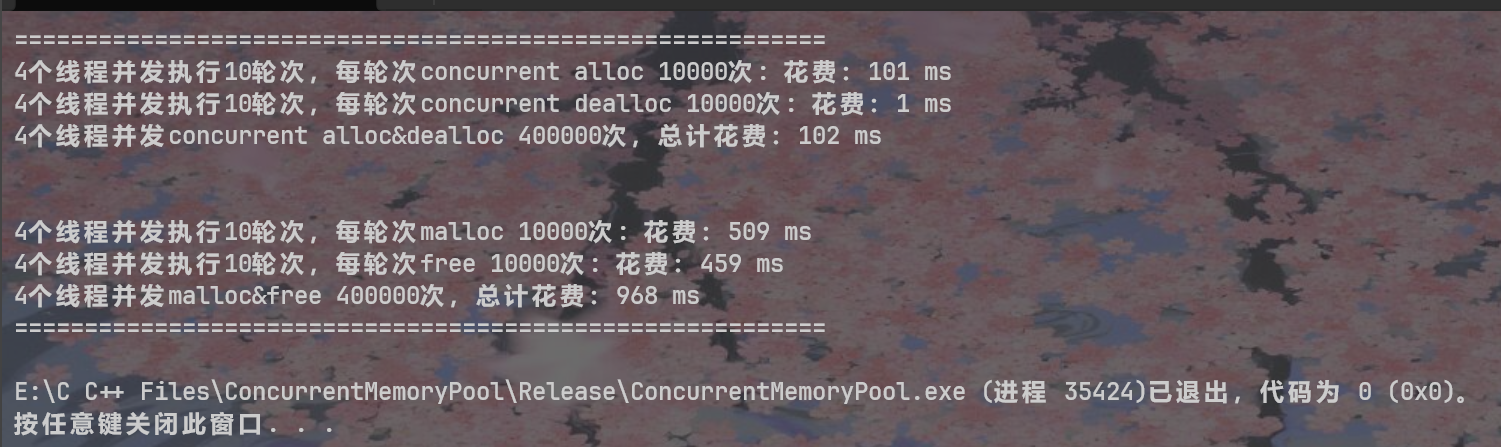
2. 性能测试
cpp
// ntimes 一轮申请和释放内存的次数
// rounds 轮次
void BenchmarkMalloc(size_t ntimes, size_t nworks, size_t rounds)
{
	std::vector<std::thread> vthread(nworks);
	std::atomic<size_t> malloc_costtime = 0;
	std::atomic<size_t> free_costtime = 0;

	for (size_t k = 0; k < nworks; ++k)
	{
		vthread[k] = std::thread([&, k]() {
			std::vector<void*> v;
			v.reserve(ntimes);

			for (size_t j = 0; j < rounds; ++j)
			{
				size_t begin1 = clock();
				for (size_t i = 0; i < ntimes; i++)
				{
					//v.push_back(malloc(16));
					v.push_back(malloc((16 + i) % 8192 + 1));
				}
				size_t end1 = clock();

				size_t begin2 = clock();
				for (size_t i = 0; i < ntimes; i++)
				{
					free(v[i]);
				}
				size_t end2 = clock();
				v.clear();

				malloc_costtime += (end1 - begin1);
				free_costtime += (end2 - begin2);
			}
			});
	}

	for (auto& t : vthread)
	{
		t.join();
	}

    printf("%zu个线程并发执行%zu轮次,每轮次malloc %zu次: 花费:%zu ms\n",
        nworks, rounds, ntimes, malloc_costtime.load());

    printf("%zu个线程并发执行%zu轮次,每轮次free %zu次: 花费:%zu ms\n",
        nworks, rounds, ntimes, free_costtime.load());

    printf("%zu个线程并发malloc&free %zu次,总计花费:%zu ms\n",
        nworks, nworks * rounds * ntimes, malloc_costtime.load() + free_costtime.load());
}


// 单轮次申请释放次数 线程数 轮次
void BenchmarkConcurrentMalloc(size_t ntimes, size_t nworks, size_t rounds)
{
	std::vector<std::thread> vthread(nworks);
	std::atomic<size_t> malloc_costtime = 0;
	std::atomic<size_t> free_costtime = 0;

	for (size_t k = 0; k < nworks; ++k)
	{
		vthread[k] = std::thread([&]() {
			std::vector<void*> v;
			v.reserve(ntimes);

			for (size_t j = 0; j < rounds; ++j)
			{
				size_t begin1 = clock();
				for (size_t i = 0; i < ntimes; i++)
				{
					//v.push_back(ConcurrentAlloc(16));
					v.push_back(ConcurrentAlloc((16 + i) % 8192 + 1));
				}
				size_t end1 = clock();

				size_t begin2 = clock();
				for (size_t i = 0; i < ntimes; i++)
				{
					ConcurrentDealloc(v[i]);
				}
				size_t end2 = clock();
				v.clear();

				malloc_costtime += (end1 - begin1);
				free_costtime += (end2 - begin2);
			}
			});
	}

	for (auto& t : vthread)
	{
		t.join();
	}

    printf("%zu个线程并发执行%zu轮次,每轮次concurrent alloc %zu次: 花费:%zu ms\n",
        nworks, rounds, ntimes, malloc_costtime.load());

    printf("%zu个线程并发执行%zu轮次,每轮次concurrent dealloc %zu次: 花费:%zu ms\n",
        nworks, rounds, ntimes, free_costtime.load());

    printf("%zu个线程并发concurrent alloc&dealloc %zu次,总计花费:%zu ms\n",
        nworks, nworks * rounds * ntimes, malloc_costtime.load() + free_costtime.load());
}

int main()
{
	size_t n = 10000;
	std::cout << "==========================================================" << std::endl;
	BenchmarkConcurrentMalloc(n, 4, 10);
	std::cout << std::endl << std::endl;

	BenchmarkMalloc(n, 4, 10);
	std::cout << "==========================================================" << std::endl;

	return 0;
}