目录
[三、模块 1:环境配置与基础库导入](#三、模块 1:环境配置与基础库导入)
[四、模块 2:核心工具函数(数据处理 + 激活函数)](#四、模块 2:核心工具函数(数据处理 + 激活函数))
[2.1 激活函数(神经网络核心)](#2.1 激活函数(神经网络核心))
[2.2 数据读取函数](#2.2 数据读取函数)
[2.3 文本预处理函数](#2.3 文本预处理函数)
[五、模块 3:BP 神经网络类(核心模型)](#五、模块 3:BP 神经网络类(核心模型))
[3.1 初始化方法(init)](#3.1 初始化方法(init))
[3.2 前向传播(forward)](#3.2 前向传播(forward))
[3.3 反向传播(backward)](#3.3 反向传播(backward))
[3.4 参数更新(update_params)](#3.4 参数更新(update_params))
[3.5 训练函数(train)](#3.5 训练函数(train))
[3.6 预测函数(predict)](#3.6 预测函数(predict))
[六、模块 4:可视化函数(模型分析核心)](#六、模块 4:可视化函数(模型分析核心))
[4.1 训练损失曲线(plot_train_loss)](#4.1 训练损失曲线(plot_train_loss))
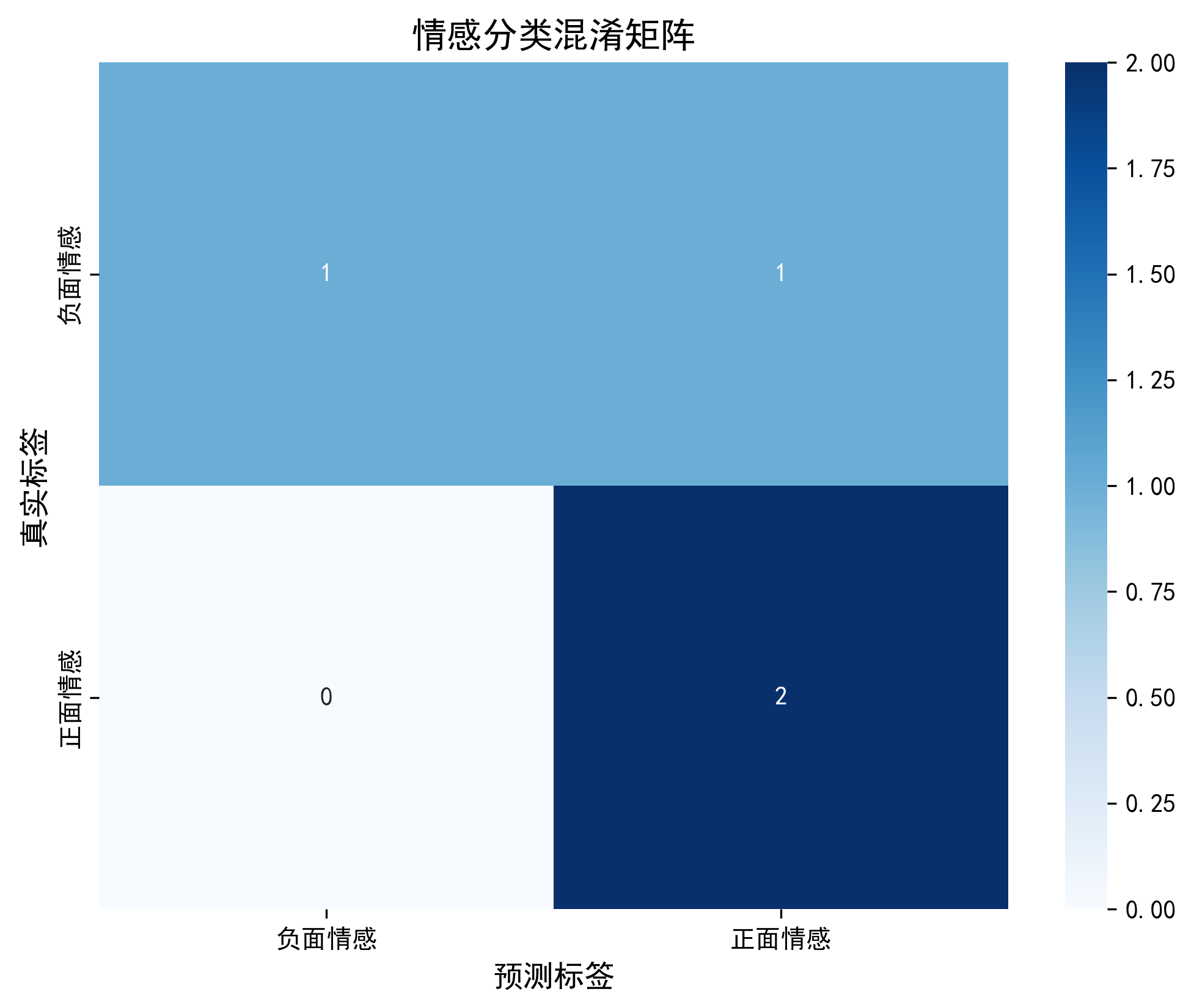
[4.2 混淆矩阵热力图(plot_confusion_matrix)](#4.2 混淆矩阵热力图(plot_confusion_matrix))
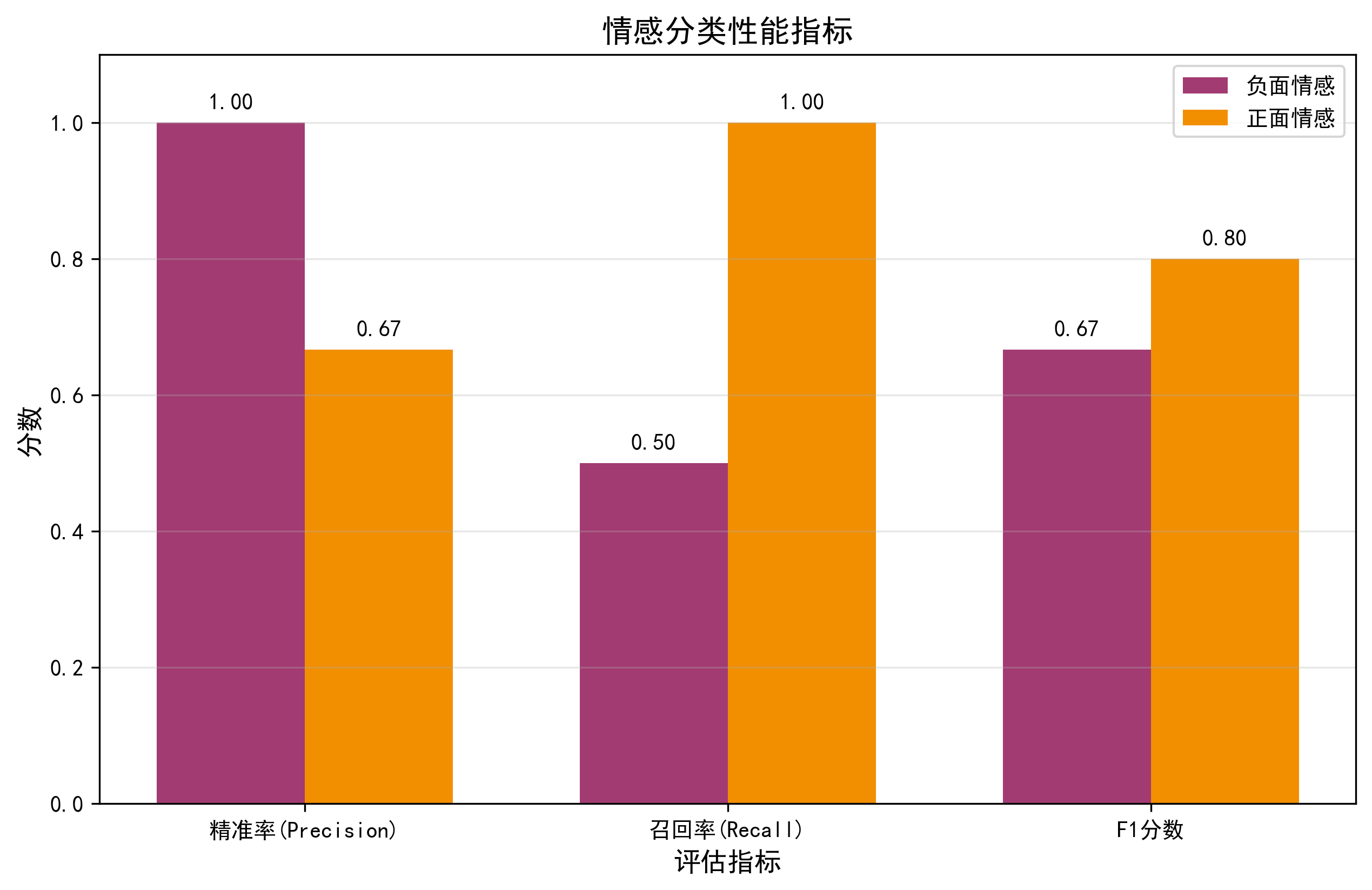
[4.3 分类性能指标可视化(plot_classification_report)](#4.3 分类性能指标可视化(plot_classification_report))
[4.4 情感词云(generate_wordcloud)](#4.4 情感词云(generate_wordcloud))
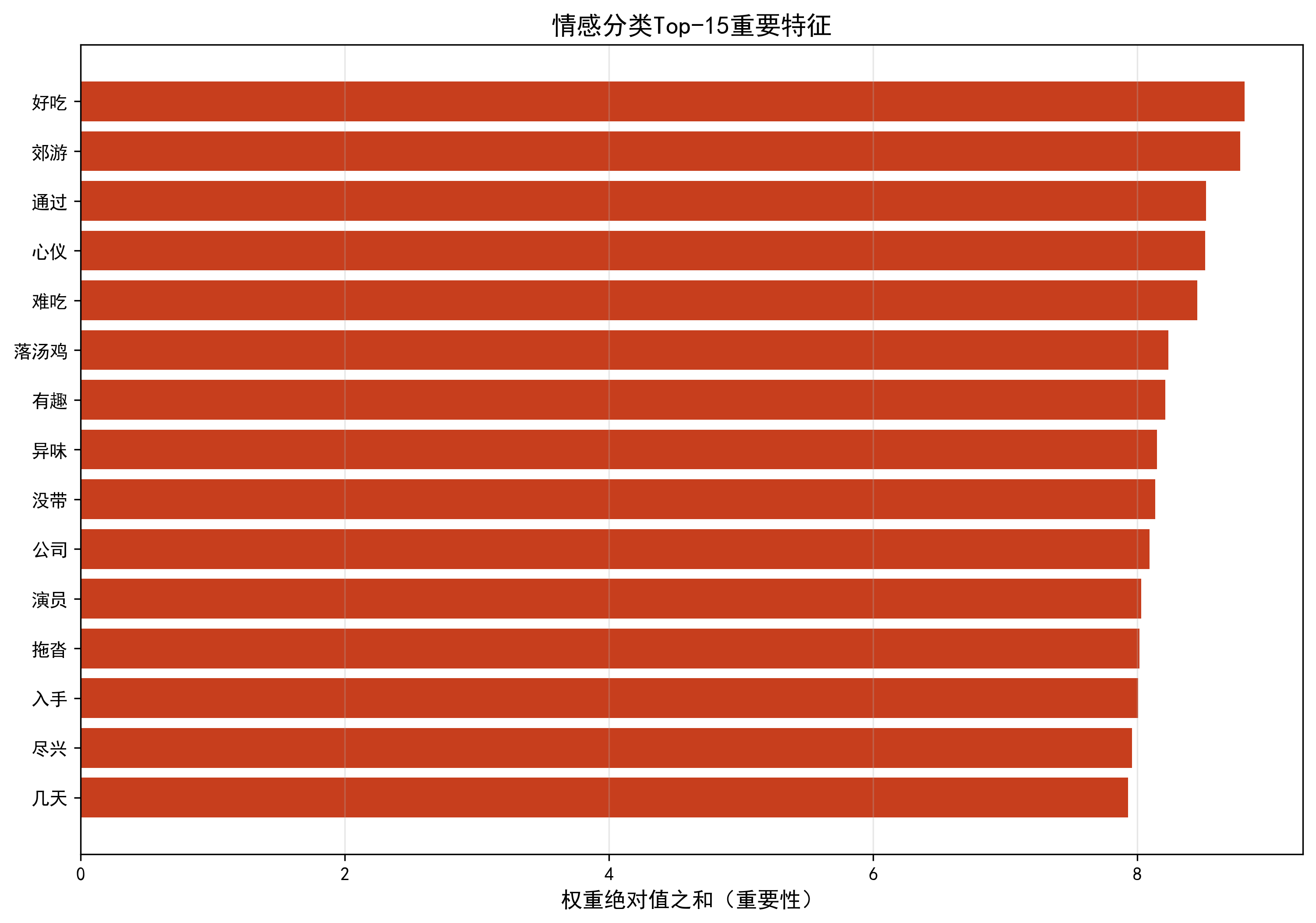
[4.5 特征重要性(plot_feature_importance)](#4.5 特征重要性(plot_feature_importance))
[七、模块 5:主流程(整合所有功能)](#七、模块 5:主流程(整合所有功能))
[九、基于 BP 神经网络的中文文本情感分类的Python代码完整实现](#九、基于 BP 神经网络的中文文本情感分类的Python代码完整实现)
一、引言
本文的自然语言处理实战项目是基于 BP 神经网络的中文文本情感分类,覆盖"数据读取→文本预处理→特征提取→模型训练→评估→多维度可视化→新样本预测"全流程,适配小数据集场景(如小型企业 / 个人的情感分析需求)。下面将详细讲解基于 BP 神经网络的中文文本情感分类的Python代码实现过程。
二、整体架构与核心目标
| 核心目标 | 区分中文文本的「正面情感」(如好评、开心)和「负面情感」(如差评、生气) |
|---|---|
| 技术栈 | 纯 Numpy 实现 BP 神经网络 + TF-IDF 文本特征提取 + 中文分词(jieba) + 多维度可视化 |
| 数据流转 | 原始文本文件 → 文本预处理(分词 / 去停用词) → TF-IDF 数值特征 → BP 网络训练 → 模型评估 → 可视化分析 → 新样本预测 |
三、模块 1:环境配置与基础库导入
python
import numpy as np
import jieba
import os
import warnings
warnings.filterwarnings('ignore')

# 可视化库
import matplotlib.pyplot as plt
import seaborn as sns
from wordcloud import WordCloud
from sklearn.metrics import confusion_matrix, classification_report, accuracy_score
from sklearn.feature_extraction.text import TfidfVectorizer
from sklearn.model_selection import train_test_split

# 设置中文字体(解决可视化中文乱码)
plt.rcParams['font.sans-serif'] = ['SimHei']  # 黑体
plt.rcParams['axes.unicode_minus'] = False  # 解决负号显示问题
功能说明:
- 基础库导入 :
numpy:手动实现 BP 神经网络的核心(矩阵运算、梯度计算);jieba:中文文本分词(解决中文无天然分隔符的问题);os:读取文本文件(路径处理);warnings:屏蔽无关警告(提升运行体验)。
- 可视化库导入 :
matplotlib/seaborn:绘制损失曲线、混淆矩阵、特征重要性等图表;WordCloud:生成情感文本词云(直观展示核心词汇)。
- SKlearn 工具导入 :
- 特征提取:
TfidfVectorizer(将文本转为数值特征); - 数据划分:
train_test_split(拆分训练 / 测试集); - 模型评估:
confusion_matrix/classification_report/accuracy_score(量化模型性能)。
- 特征提取:
- 中文显示配置:解决 Matplotlib 可视化时中文乱码、负号显示异常的问题。
四、模块 2:核心工具函数(数据处理 + 激活函数)
2.1 激活函数(神经网络核心)
python
def sigmoid(z):
    """Sigmoid激活函数(数值稳定版)"""
    z = np.clip(z, -500, 500)  # 防止exp(-z)溢出(z过大/过小导致计算错误)
    return 1 / (1 + np.exp(-z))

def sigmoid_derivative(z):
    """Sigmoid导数(反向传播需计算激活函数梯度)"""
    s = sigmoid(z)
    return s * (1 - s)

def relu(z):
    """ReLU激活函数(隐藏层用,缓解梯度消失)"""
    return np.maximum(0, z)

def relu_derivative(z):
    """ReLU导数(反向传播用)"""
return np.where(z > 0, 1, 0)| 函数 | 作用 | 应用场景 |
|---|---|---|
sigmoid |
将输出映射到 (0,1) 区间,适配二分类任务(情感分类的输出层) | 输出层激活(判断 0/1 情感) |
sigmoid_derivative |
计算 Sigmoid 的导数,用于反向传播的梯度计算 | 输出层误差项推导 |
relu |
隐藏层激活函数,计算快、缓解梯度消失(相比 Sigmoid 更适合深层网络) | 隐藏层激活 |
relu_derivative |
计算 ReLU 的导数,用于反向传播的梯度计算 | 隐藏层误差项推导 |
2.2 数据读取函数
python
def load_sentiment_data(data_dir):
    """读取情感分类文本数据(从txt文件读取)"""
    texts = []
    labels = []

    # 读取正面文本(标签1)
    pos_path = os.path.join(data_dir, 'positive.txt')
    with open(pos_path, 'r', encoding='utf-8') as f:
        for line in f:
            line = line.strip()
            if line:  # 跳过空行
                texts.append(line)
                labels.append(1)

    # 读取负面文本(标签0)
    neg_path = os.path.join(data_dir, 'negative.txt')
    with open(neg_path, 'r', encoding='utf-8') as f:
        for line in f:
            line = line.strip()
            if line:  # 跳过空行
                texts.append(line)
                labels.append(0)

    return texts, np.array(labels).reshape(-1, 1)
功能说明:
- 输入:数据文件夹路径(
sentiment_data); - 输出:文本列表(
texts)、标签数组(labels,1 = 正面,0 = 负面,形状为(n_samples, 1)); - 核心逻辑:
-
读取
positive.txt(正面文本),每行一条,标签设为 1;bash这家餐厅的菜品超好吃,服务也特别周到 今天收到了心仪的礼物,心情超级棒 这部电影剧情紧凑,演员演技在线,值得一看 新入手的手机续航超久,拍照效果也很好 周末和朋友去郊游,天气好风景美,太开心了 公司团建活动很有趣,同事们都玩得很尽兴 这家咖啡店的拿铁口感丝滑,环境也很温馨 网购的衣服尺码很准,面料也很舒服 终于通过了考试,付出的努力都值得了 家乡的变化真大,基础设施越来越完善了 -
读取
negative.txt(负面文本),每行一条,标签设为 0;bash这家外卖送得超级慢,饭菜都凉了 手机用了没几天就卡顿,体验太差了 餐厅的菜品又贵又难吃,性价比极低 今天上班迟到被批评,一整天心情都不好 电影剧情拖沓,特效粗糙,完全不值票价 网购的商品有瑕疵,客服还不处理,太气人了 下雨天出门没带伞,被淋成落汤鸡了 公交车晚点半小时,耽误了重要的约会 这家酒店卫生条件差,房间还有异味 快递员态度恶劣,包裹还破损了 -
跳过空行,避免无效数据;
-
标签转为 Numpy 数组并重塑为列向量(适配 BP 网络的矩阵运算)。
-
2.3 文本预处理函数
python
def preprocess_text(texts):
    """中文文本预处理:分词+去停用词"""
    # 简单停用词表(无实际语义,需过滤)
    stopwords = {'的', '了', '在', '是', '我', '你', '他', '她', '它', '们', '就', '都', '也', '还', '很', '太', '超',
                 '又', '和', '与', '及', '等', '有', '没', '不', '无', '为', '之', '于', '以', '对', '对于'}

    processed_texts = []
    for text in texts:
        # 分词(jieba.lcut:精确分词,返回列表)
        words = jieba.lcut(text)
        # 去停用词+去空字符(保留有语义的词汇)
        words = [w for w in words if w.strip() and w not in stopwords]
        processed_texts.append(' '.join(words))

    return processed_texts
功能说明:
- 输入:原始文本列表(如
["这家餐厅超好吃", ...]); - 输出:预处理后的文本列表(如
["这家 餐厅 好吃", ...]); - 核心价值:
- 分词:将连续中文拆分为独立词汇(如 "超好吃"→"超 好吃"),适配 TF-IDF 特征提取;
- 去停用词:过滤无语义的虚词(如 "的""了"),减少噪声,提升特征有效性;
- 格式转换:用空格分隔分词结果(TF-IDF 要求输入为 "词汇 词汇" 格式)。
五、模块 3:BP 神经网络类(核心模型)
python
class BPNeuralNetwork:
    def __init__(self, input_dim, hidden_dim, output_dim, learning_rate=0.01):
        # 初始化网络参数
        self.input_dim = input_dim  # 输入维度(TF-IDF特征数)
        self.hidden_dim = hidden_dim  # 隐藏层神经元数
        self.output_dim = output_dim  # 输出维度(二分类=1)
        self.lr = learning_rate  # 学习率(控制参数更新步长)

        # 权重初始化(Xavier初始化:适配ReLU,避免梯度消失/爆炸)
        self.W1 = np.random.normal(0, np.sqrt(2 / input_dim), (hidden_dim, input_dim))
        self.b1 = np.zeros((hidden_dim, 1))  # 隐藏层偏置(初始化为0)
        self.W2 = np.random.normal(0, np.sqrt(2 / hidden_dim), (output_dim, hidden_dim))
        self.b2 = np.zeros((output_dim, 1))  # 输出层偏置(初始化为0)

        # 记录训练损失(用于可视化损失曲线)
        self.train_loss_history = []
3.1 初始化方法(__init__)
- 核心参数:
input_dim:输入层维度(如 TF-IDF 的 100 维特征);hidden_dim:隐藏层神经元数(如 64,控制模型复杂度);output_dim:输出层维度(二分类 = 1);learning_rate:学习率(默认 0.01,控制参数更新速度);
- 关键逻辑:
- 权重初始化:采用 Xavier 初始化(针对 ReLU 优化),避免全 0 初始化(导致神经元输出相同);
- 偏置初始化:初始化为 0(不影响梯度计算,训练中自动调整);
- 损失记录:初始化空列表,保存每轮训练的损失值(用于可视化)。
3.2 前向传播(forward)
python
def forward(self, X):
    """前向传播:输入→隐藏层→输出层,计算预测值"""
    Z1 = np.dot(self.W1, X) + self.b1  # 隐藏层净输入(线性变换)
    H = relu(Z1)  # 隐藏层输出(ReLU激活)
    Z2 = np.dot(self.W2, H) + self.b2  # 输出层净输入(线性变换)
    Y = sigmoid(Z2)  # 输出层预测值(Sigmoid激活,范围0~1)
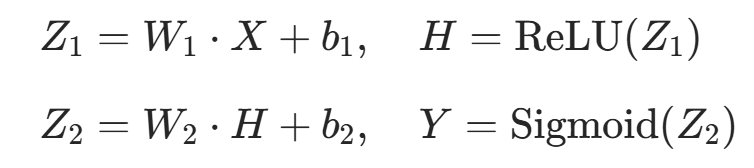
return H, Y- 输入:单个样本的特征向量(形状
(input_dim, 1)); - 输出:隐藏层输出(
H)、输出层预测值(Y,0~1 之间); - 核心逻辑:模拟信号在神经网络中的正向传递,公式对应:
3.3 反向传播(backward)
python
def backward(self, X, H, Y, Y_true):
    """反向传播:计算损失对权重/偏置的梯度"""
    delta2 = Y - Y_true  # 输出层误差项(二元交叉熵+Sigmoid简化版)
    Z1 = np.dot(self.W1, X) + self.b1  # 重新计算隐藏层净输入
    delta1 = np.dot(self.W2.T, delta2) * relu_derivative(Z1)  # 隐藏层误差项

    # 计算各参数的梯度
    dW2 = np.dot(delta2, H.T)  # W2的梯度
    db2 = delta2  # b2的梯度
    dW1 = np.dot(delta1, X.T)  # W1的梯度
    db1 = delta1  # b1的梯度

return dW1, db1, dW2, db2- 输入:输入向量
X、隐藏层输出H、预测值Y、真实标签Y_true; - 输出:权重 / 偏置的梯度(
dW1, db1, dW2, db2); - 核心逻辑(链式法则):
- 输出层误差项:
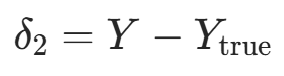 (二元交叉熵 + Sigmoid 的简化结果,无需复杂计算);
 - 隐藏层误差项:
 (通过输出层误差反向推导);
 - 梯度计算:损失对每个参数的偏导数(用于后续参数更新)。
- 输出层误差项:
3.4 参数更新(update_params)
python
def update_params(self, dW1, db1, dW2, db2):
    """梯度下降更新权重/偏置(沿梯度负方向调整,减小损失)"""
    self.W1 -= self.lr * dW1
    self.b1 -= self.lr * db1
    self.W2 -= self.lr * dW2
self.b2 -= self.lr * db2- 核心公式:
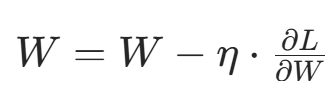 (η= 学习率,梯度负方向);
 - 作用:通过梯度下降最小化损失,让模型逐渐拟合数据规律。
3.5 训练函数(train)
python
def train(self, X_train, y_train, epochs=50, batch_size=4):
    """迭代训练网络,记录每轮损失"""
    n_samples = X_train.shape[0]
    self.train_loss_history = []  # 重置损失记录

    for epoch in range(epochs):
        # 打乱训练集(避免顺序影响,提升泛化)
        indices = np.random.permutation(n_samples)
        X_shuffled = X_train[indices]
        y_shuffled = y_train[indices]

        epoch_loss = 0.0
        batch_count = 0

        # 批量训练(按batch_size切分)
        for i in range(0, n_samples, batch_size):
            batch_X = X_shuffled[i:i + batch_size]
            batch_y = y_shuffled[i:i + batch_size]
            batch_count += 1

            batch_batch_loss = 0.0
            for X, y_true in zip(batch_X, batch_y):
                # 重塑为列向量(适配矩阵运算)
                X = X.reshape(self.input_dim, 1)
                y_true = y_true.reshape(self.output_dim, 1)

                # 前向传播
                H, Y = self.forward(X)
                # 计算损失(加1e-7避免log(0))
                loss = -y_true * np.log(Y + 1e-7) - (1 - y_true) * np.log(1 - Y + 1e-7)
                batch_batch_loss += loss.item()

                # 反向传播+参数更新
                dW1, db1, dW2, db2 = self.backward(X, H, Y, y_true)
                self.update_params(dW1, db1, dW2, db2)

            # 累加批量损失
            epoch_loss += batch_batch_loss / len(batch_X)

        # 记录每轮平均损失
        avg_epoch_loss = epoch_loss / batch_count
        self.train_loss_history.append(avg_epoch_loss)

        # 每5轮打印损失(监控训练进度)
        if (epoch + 1) % 5 == 0:
print(f"Epoch {epoch + 1}/{epochs}, Average Loss: {avg_epoch_loss:.4f}")- 核心参数:
epochs:训练轮数(默认 50,遍历训练集的次数);batch_size:批量大小(默认 4,小批量训练提升泛化);
- 核心逻辑:
- 每轮训练前打乱数据(避免顺序偏差);
- 按
batch_size切分训练集,逐批处理; - 对每个样本:重塑为列向量→前向传播→计算损失→反向传播→更新参数;
- 计算每轮平均损失并记录(用于可视化);
- 每 5 轮打印损失(方便监控训练收敛情况);
- 损失计算时加
1e-7(避免log(0)导致数值错误)。
3.6 预测函数(predict)
python
def predict(self, X):
    """预测函数:输入特征→输出情感标签(0/1)"""
    predictions = []
    for x in X:
        x = x.reshape(self.input_dim, 1)  # 重塑为列向量
        _, Y = self.forward(x)  # 前向传播获取预测值
        pred = 1 if Y > 0.5 else 0  # 阈值0.5:>0.5=正面,否则=负面
        predictions.append(pred)
return np.array(predictions)- 输入:测试集 / 新样本的特征矩阵(
n_samples, input_dim); - 输出:预测标签数组(0 = 负面,1 = 正面);
- 核心逻辑:
- 对每个样本前向传播,得到 0~1 的预测值;
- 以 0.5 为阈值,将连续值转为离散标签(二分类)。
六、模块 4:可视化函数(模型分析核心)
4.1 训练损失曲线(plot_train_loss)
python
def plot_train_loss(loss_history):
    """绘制训练损失曲线(监控模型收敛)"""
    plt.figure(figsize=(10, 6))
    plt.plot(range(1, len(loss_history) + 1), loss_history, color='#2E86AB', linewidth=2)
    plt.title('BP神经网络训练损失变化', fontsize=14)
    plt.xlabel('迭代轮数(Epoch)', fontsize=12)
    plt.ylabel('平均交叉熵损失', fontsize=12)
    plt.grid(alpha=0.3)
    plt.savefig('train_loss_curve.png', dpi=300, bbox_inches='tight')
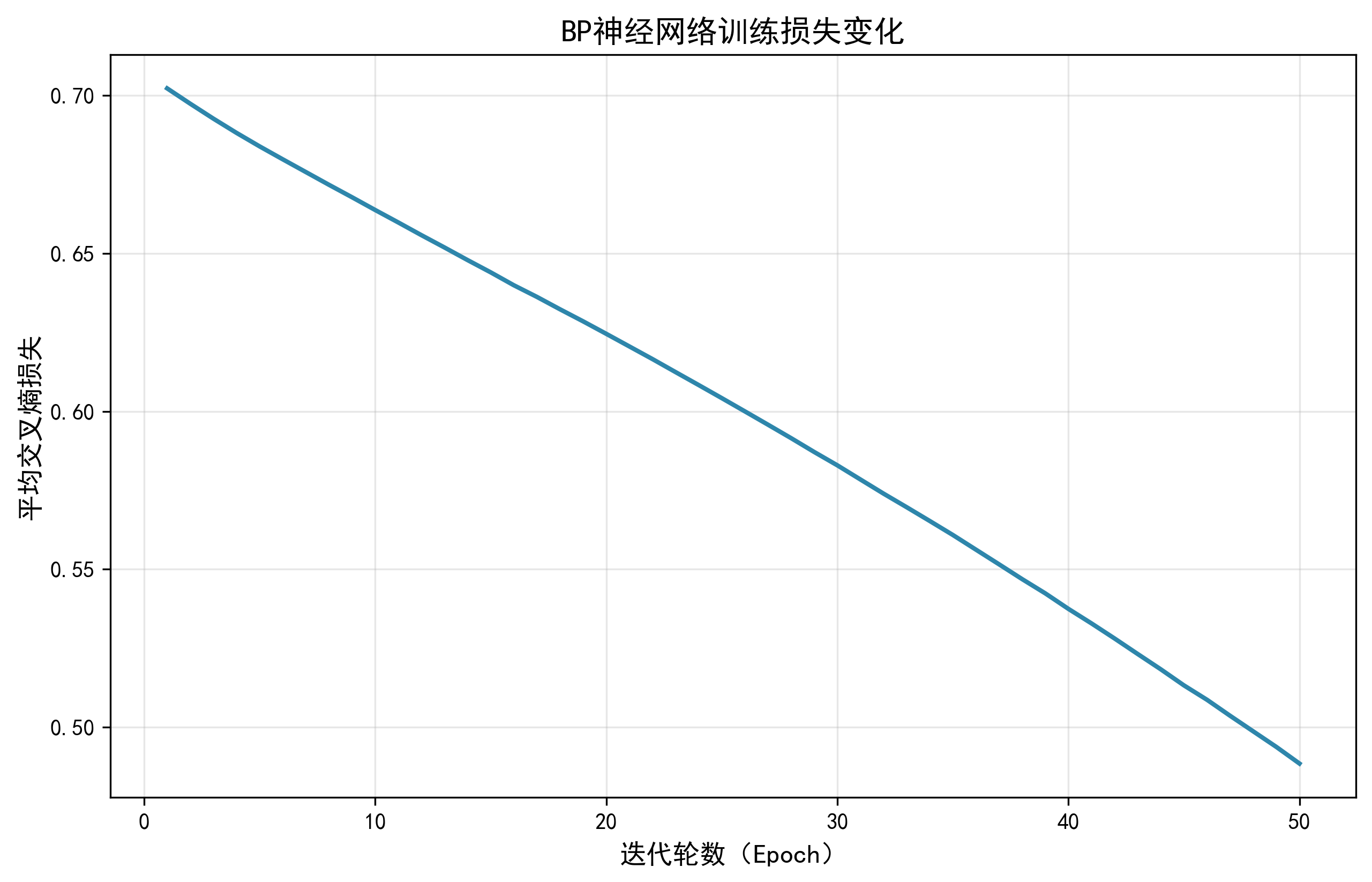
plt.show()- 功能:绘制 "迭代轮数→损失值" 曲线;
- 核心价值:
- 查看损失是否下降并收敛(损失逐渐降低→模型学习有效);
- 判断过拟合 / 欠拟合(损失骤降后反弹→过拟合;损失不降→欠拟合);
- 保存高清图片(
dpi=300),便于分析。
4.2 混淆矩阵热力图(plot_confusion_matrix)
python
def plot_confusion_matrix(y_true, y_pred):
    """绘制混淆矩阵(查看分类错误类型)"""
    cm = confusion_matrix(y_true, y_pred)
    plt.figure(figsize=(8, 6))
    sns.heatmap(cm, annot=True, fmt='d', cmap='Blues',
                xticklabels=['负面情感', '正面情感'],
                yticklabels=['负面情感', '正面情感'])
    plt.title('情感分类混淆矩阵', fontsize=14)
    plt.xlabel('预测标签', fontsize=12)
    plt.ylabel('真实标签', fontsize=12)
    plt.savefig('confusion_matrix.png', dpi=300, bbox_inches='tight')
plt.show()- 功能:可视化混淆矩阵(行 = 真实标签,列 = 预测标签);
- 核心价值:
- 直观查看 "真阳性(正面预测正确)、真阴性(负面预测正确)、假阳性(负面误判为正面)、假阴性(正面误判为负面)";
- 定位模型薄弱点(如假阴性多→模型漏判正面情感)。
4.3 分类性能指标可视化(plot_classification_report)
python
def plot_classification_report(y_true, y_pred):
    """可视化精准率、召回率、F1分数(量化模型性能)"""
    report = classification_report(y_true, y_pred, target_names=['负面情感', '正面情感'], output_dict=True)
    metrics = ['precision', 'recall', 'f1-score']
    pos_scores = [report['正面情感'][m] for m in metrics]
    neg_scores = [report['负面情感'][m] for m in metrics]

    x = np.arange(len(metrics))
    width = 0.35

    plt.figure(figsize=(10, 6))
    plt.bar(x - width / 2, neg_scores, width, label='负面情感', color='#A23B72')
    plt.bar(x + width / 2, pos_scores, width, label='正面情感', color='#F18F01')

    plt.title('情感分类性能指标', fontsize=14)
    plt.xlabel('评估指标', fontsize=12)
    plt.ylabel('分数', fontsize=12)
    plt.xticks(x, ['精准率(Precision)', '召回率(Recall)', 'F1分数'])
    plt.ylim(0, 1.1)
    plt.legend()

    # 添加数值标签(直观查看分数)
    for i, v in enumerate(neg_scores):
        plt.text(i - width / 2, v + 0.02, f'{v:.2f}', ha='center')
    for i, v in enumerate(pos_scores):
        plt.text(i + width / 2, v + 0.02, f'{v:.2f}', ha='center')

    plt.grid(alpha=0.3, axis='y')
    plt.savefig('classification_report.png', dpi=300, bbox_inches='tight')
plt.show()- 核心指标解释:
- 精准率(Precision):预测为某类的样本中,真实为该类的比例(如正面精准率 = 正面预测正确 / 所有预测为正面);
- 召回率(Recall):真实为某类的样本中,预测正确的比例(如正面召回率 = 正面预测正确 / 所有真实正面);
- F1 分数:精准率 + 召回率的调和平均(综合评估,越接近 1 越好);
- 核心价值:量化对比正负情感的分类效果(如正面 F1=0.95,负面 F1=0.90→模型对正面分类更准)。
4.4 情感词云(generate_wordcloud)
python
def generate_wordcloud(texts, label, save_path):
    """生成正负情感文本词云(直观展示核心词汇)"""
    text = ' '.join(texts)
    wc = WordCloud(
        font_path='simhei.ttf',  # 中文分词字体(需系统有该字体)
        width=800, height=600,
        background_color='white',
        max_words=100,
        colormap='RdYlGn' if label == 1 else 'RdYlBu_r'  # 正面=绿红,负面=蓝红
    ).generate(text)

    plt.figure(figsize=(10, 8))
    plt.imshow(wc, interpolation='bilinear')
    plt.axis('off')
    plt.title(f'{"正面" if label == 1 else "负面"}情感文本词云', fontsize=14)
    plt.savefig(save_path, dpi=300, bbox_inches='tight')
plt.show()- 功能:生成正负情感文本的词云(词汇越大→出现频率越高);
- 核心价值:
- 直观展示情感文本的核心词汇(如正面 ="好吃、开心、棒";负面 ="慢、差、气");
- 验证预处理效果(停用词是否过滤干净);
- 辅助业务分析(如负面词云多为 "慢"→优化配送效率)。
4.5 特征重要性(plot_feature_importance)
python
def plot_feature_importance(tfidf, model, top_k=15):
    """绘制Top-K重要特征(基于BP网络第一层权重)"""
    # 计算每个特征的权重绝对值之和(代表重要性)
    feature_importance = np.sum(np.abs(model.W1), axis=0)
    feature_names = tfidf.get_feature_names_out()  # 获取特征对应的词汇

    # 排序取Top-K
    indices = np.argsort(feature_importance)[-top_k:]
    top_importance = feature_importance[indices]
    top_features = feature_names[indices]

    # 绘制水平条形图
    plt.figure(figsize=(12, 8))
    plt.barh(range(len(top_features)), top_importance, color='#C73E1D')
    plt.yticks(range(len(top_features)), top_features)
    plt.title(f'情感分类Top-{top_k}重要特征', fontsize=14)
    plt.xlabel('权重绝对值之和(重要性)', fontsize=12)
    plt.grid(alpha=0.3, axis='x')
    plt.savefig('feature_importance.png', dpi=300, bbox_inches='tight')
plt.show()- 核心逻辑:BP 网络第一层权重的绝对值之和越大→该特征(词汇)对情感分类的影响越大;
- 核心价值:
- 找出对情感分类最关键的词汇(如 "好吃""难吃""开心""生气");
- 验证特征提取的有效性(关键词汇是否被选中)。
七、模块 5:主流程(整合所有功能)
python
if __name__ == "__main__":
    # 1. 配置参数
    DATA_DIR = 'sentiment_data'  # 数据文件夹
    HIDDEN_DIM = 64  # 隐藏层神经元数
    LEARNING_RATE = 0.01  # 学习率
    EPOCHS = 50  # 训练轮数
    BATCH_SIZE = 4  # 批量大小
    TEST_SIZE = 0.2  # 测试集比例

    # 2. 加载并预处理数据
    print("===== 加载情感数据 =====")
    texts, labels = load_sentiment_data(DATA_DIR)
    print(f"总样本数:{len(texts)}(正面:{sum(labels)[0]},负面:{len(labels) - sum(labels)[0]})")

    print("===== 文本预处理 =====")
    processed_texts = preprocess_text(texts)

    # 3. TF-IDF特征提取
    print("===== 提取TF-IDF特征 =====")
    tfidf = TfidfVectorizer(max_features=100)  # 限制特征数(适配小数据集)
    X = tfidf.fit_transform(processed_texts).toarray()

    # 划分训练/测试集(分层抽样,保证正负样本比例)
    X_train, X_test, y_train, y_test = train_test_split(
        X, labels, test_size=TEST_SIZE, random_state=42, stratify=labels
    )
    print(f"训练集样本数:{X_train.shape[0]},测试集样本数:{X_test.shape[0]}")
    print(f"特征维度:{X_train.shape[1]}")

    # 4. 训练BP网络
    print("\n===== 训练BP神经网络 =====")
    bp_model = BPNeuralNetwork(
        input_dim=X_train.shape[1],
        hidden_dim=HIDDEN_DIM,
        output_dim=1,
        learning_rate=LEARNING_RATE
    )
    bp_model.train(X_train, y_train, epochs=EPOCHS, batch_size=BATCH_SIZE)

    # 5. 模型评估
    print("\n===== 模型评估 =====")
    y_pred = bp_model.predict(X_test)
    y_test_flat = y_test.flatten()
    accuracy = accuracy_score(y_test_flat, y_pred)
    print(f"测试集准确率:{accuracy:.4f}")
    print("\n分类报告:")
    print(classification_report(y_test_flat, y_pred, target_names=['负面情感', '正面情感']))

    # 6. 可视化
    print("\n===== 生成可视化图表 =====")
    plot_train_loss(bp_model.train_loss_history)  # 损失曲线
    plot_confusion_matrix(y_test_flat, y_pred)    # 混淆矩阵
    plot_classification_report(y_test_flat, y_pred)  # 性能指标
    # 词云
    pos_texts = [processed_texts[i] for i in range(len(texts)) if labels[i] == 1]
    neg_texts = [processed_texts[i] for i in range(len(texts)) if labels[i] == 0]
    generate_wordcloud(pos_texts, 1, 'positive_wordcloud.png')
    generate_wordcloud(neg_texts, 0, 'negative_wordcloud.png')
    # 特征重要性
    plot_feature_importance(tfidf, bp_model, top_k=15)

    # 7. 新样本预测演示
    print("\n===== 新样本情感预测 =====")
    new_texts = [
        "这家奶茶店的饮品甜度适中,用料很实在",
        "今天打车遇到了绕路的司机,特别生气",
        "新上映的动画电影画面精美,剧情感人",
        "网购的水果烂了一半,售后还不处理"
    ]
    new_processed = preprocess_text(new_texts)
    new_X = tfidf.transform(new_processed).toarray()
    new_pred = bp_model.predict(new_X)
    for text, pred in zip(new_texts, new_pred):
        sentiment = "正面情感" if pred == 1 else "负面情感"
        print(f"文本:{text} → 预测结果:{sentiment}")
核心流程拆解:
- 参数配置:定义数据路径、模型超参数(隐藏层神经元数、学习率等);
- 数据加载 + 预处理:读取 txt 文件→分词 + 去停用词;
- TF-IDF 特征提取:将预处理后的文本转为 100 维数值特征(限制维度,适配小数据集);
- 数据划分 :按 20% 比例拆分训练 / 测试集,
stratify=labels保证正负样本比例一致; - 模型训练:初始化 BP 网络→迭代训练 50 轮,记录损失;
- 模型评估:计算测试集准确率、打印分类报告(精准率 / 召回率 / F1);
- 可视化:生成 5 类图表(损失曲线、混淆矩阵、性能指标、词云、特征重要性);
- 新样本预测:对 4 个新文本预处理→提取特征→预测情感→输出结果。
八、代码的扩展与适配能力
- 数据集扩展 :只需向
positive.txt/negative.txt添加更多文本,无需修改核心代码; - 多分类适配:修改输出层为 Softmax 激活、标签为多分类(如 0 = 负面,1 = 中性,2 = 正面);
- 模型优化:调整隐藏层神经元数、学习率、训练轮数,或添加 Dropout(防过拟合);
- 预处理增强:扩展停用词表、加入词性过滤(如只保留名词 / 形容词)、同义词替换;
- 部署适配:可将训练好的模型权重保存为 NPY 文件,部署时直接加载(无需重新训练)。
九、基于 BP 神经网络的中文文本情感分类的Python代码完整实现
python
import numpy as np
import jieba
import os
import warnings

warnings.filterwarnings('ignore')

# 可视化库
import matplotlib.pyplot as plt
import seaborn as sns
from wordcloud import WordCloud
from sklearn.metrics import confusion_matrix, classification_report, accuracy_score
from sklearn.feature_extraction.text import TfidfVectorizer
from sklearn.model_selection import train_test_split

# 设置中文字体(解决可视化中文乱码)
plt.rcParams['font.sans-serif'] = ['SimHei']  # 黑体
plt.rcParams['axes.unicode_minus'] = False  # 解决负号显示问题


# ======================== 1. 核心工具函数 ========================
def sigmoid(z):
    """Sigmoid激活函数(数值稳定版)"""
    z = np.clip(z, -500, 500)  # 防止exp溢出
    return 1 / (1 + np.exp(-z))


def sigmoid_derivative(z):
    """Sigmoid导数"""
    s = sigmoid(z)
    return s * (1 - s)


def relu(z):
    """ReLU激活函数"""
    return np.maximum(0, z)


def relu_derivative(z):
    """ReLU导数"""
    return np.where(z > 0, 1, 0)


def load_sentiment_data(data_dir):
    """
    读取情感分类文本数据
    :param data_dir: 数据文件夹路径
    :return: texts(list) - 文本列表, labels(list) - 标签列表(1=正面,0=负面)
    """
    texts = []
    labels = []

    # 读取正面文本
    pos_path = os.path.join(data_dir, 'positive.txt')
    with open(pos_path, 'r', encoding='utf-8') as f:
        for line in f:
            line = line.strip()
            if line:  # 跳过空行
                texts.append(line)
                labels.append(1)

    # 读取负面文本
    neg_path = os.path.join(data_dir, 'negative.txt')
    with open(neg_path, 'r', encoding='utf-8') as f:
        for line in f:
            line = line.strip()
            if line:  # 跳过空行
                texts.append(line)
                labels.append(0)

    return texts, np.array(labels).reshape(-1, 1)


def preprocess_text(texts):
    """
    中文文本预处理:分词+去停用词
    :param texts: 原始文本列表
    :return: 预处理后的文本列表(空格分隔的分词结果)
    """
    # 简单停用词表(可扩展)
    stopwords = {'的', '了', '在', '是', '我', '你', '他', '她', '它', '们', '就', '都', '也', '还', '很', '太', '超',
                 '又', '和', '与', '及', '等', '有', '没', '不', '无', '为', '之', '于', '以', '对', '对于'}

    processed_texts = []
    for text in texts:
        # 分词
        words = jieba.lcut(text)
        # 去停用词+去空字符
        words = [w for w in words if w.strip() and w not in stopwords]
        processed_texts.append(' '.join(words))

    return processed_texts


# ======================== 2. BP神经网络类(适配情感分类) ========================
class BPNeuralNetwork:
    def __init__(self, input_dim, hidden_dim, output_dim, learning_rate=0.01):
        self.input_dim = input_dim
        self.hidden_dim = hidden_dim
        self.output_dim = output_dim
        self.lr = learning_rate

        # 初始化权重和偏置(Xavier初始化)
        self.W1 = np.random.normal(0, np.sqrt(2 / input_dim), (hidden_dim, input_dim))
        self.b1 = np.zeros((hidden_dim, 1))
        self.W2 = np.random.normal(0, np.sqrt(2 / hidden_dim), (output_dim, hidden_dim))
        self.b2 = np.zeros((output_dim, 1))

        # 记录训练损失(用于可视化)
        self.train_loss_history = []

    def forward(self, X):
        """前向传播"""
        Z1 = np.dot(self.W1, X) + self.b1
        H = relu(Z1)
        Z2 = np.dot(self.W2, H) + self.b2
        Y = sigmoid(Z2)
        return H, Y

    def backward(self, X, H, Y, Y_true):
        """反向传播计算梯度"""
        delta2 = Y - Y_true
        Z1 = np.dot(self.W1, X) + self.b1
        delta1 = np.dot(self.W2.T, delta2) * relu_derivative(Z1)

        dW2 = np.dot(delta2, H.T)
        db2 = delta2
        dW1 = np.dot(delta1, X.T)
        db1 = delta1

        return dW1, db1, dW2, db2

    def update_params(self, dW1, db1, dW2, db2):
        """参数更新"""
        self.W1 -= self.lr * dW1
        self.b1 -= self.lr * db1
        self.W2 -= self.lr * dW2
        self.b2 -= self.lr * db2

    def train(self, X_train, y_train, epochs=50, batch_size=4):
        """训练网络,记录损失"""
        n_samples = X_train.shape[0]
        self.train_loss_history = []  # 重置损失记录

        for epoch in range(epochs):
            indices = np.random.permutation(n_samples)
            X_shuffled = X_train[indices]
            y_shuffled = y_train[indices]

            epoch_loss = 0.0
            batch_count = 0

            for i in range(0, n_samples, batch_size):
                batch_X = X_shuffled[i:i + batch_size]
                batch_y = y_shuffled[i:i + batch_size]
                batch_count += 1

                batch_batch_loss = 0.0
                for X, y_true in zip(batch_X, batch_y):
                    X = X.reshape(self.input_dim, 1)
                    y_true = y_true.reshape(self.output_dim, 1)

                    H, Y = self.forward(X)
                    # 计算损失
                    loss = -y_true * np.log(Y + 1e-7) - (1 - y_true) * np.log(1 - Y + 1e-7)
                    batch_batch_loss += loss.item()

                    # 反向传播+更新
                    dW1, db1, dW2, db2 = self.backward(X, H, Y, y_true)
                    self.update_params(dW1, db1, dW2, db2)

                epoch_loss += batch_batch_loss / len(batch_X)

            # 记录每轮平均损失
            avg_epoch_loss = epoch_loss / batch_count
            self.train_loss_history.append(avg_epoch_loss)

            if (epoch + 1) % 5 == 0:
                print(f"Epoch {epoch + 1}/{epochs}, Average Loss: {avg_epoch_loss:.4f}")

    def predict(self, X):
        """预测函数"""
        predictions = []
        for x in X:
            x = x.reshape(self.input_dim, 1)
            _, Y = self.forward(x)
            pred = 1 if Y > 0.5 else 0
            predictions.append(pred)
        return np.array(predictions)


# ======================== 3. 可视化函数 ========================
def plot_train_loss(loss_history):
    """绘制训练损失曲线"""
    plt.figure(figsize=(10, 6))
    plt.plot(range(1, len(loss_history) + 1), loss_history, color='#2E86AB', linewidth=2)
    plt.title('BP神经网络训练损失变化', fontsize=14)
    plt.xlabel('迭代轮数(Epoch)', fontsize=12)
    plt.ylabel('平均交叉熵损失', fontsize=12)
    plt.grid(alpha=0.3)
    plt.savefig('train_loss_curve.png', dpi=300, bbox_inches='tight')
    plt.show()


def plot_confusion_matrix(y_true, y_pred):
    """绘制混淆矩阵热力图"""
    cm = confusion_matrix(y_true, y_pred)
    plt.figure(figsize=(8, 6))
    sns.heatmap(cm, annot=True, fmt='d', cmap='Blues',
                xticklabels=['负面情感', '正面情感'],
                yticklabels=['负面情感', '正面情感'])
    plt.title('情感分类混淆矩阵', fontsize=14)
    plt.xlabel('预测标签', fontsize=12)
    plt.ylabel('真实标签', fontsize=12)
    plt.savefig('confusion_matrix.png', dpi=300, bbox_inches='tight')
    plt.show()


def plot_classification_report(y_true, y_pred):
    """可视化分类报告(准确率、召回率、F1)"""
    report = classification_report(y_true, y_pred, target_names=['负面情感', '正面情感'], output_dict=True)
    metrics = ['precision', 'recall', 'f1-score']
    pos_scores = [report['正面情感'][m] for m in metrics]
    neg_scores = [report['负面情感'][m] for m in metrics]

    x = np.arange(len(metrics))
    width = 0.35

    plt.figure(figsize=(10, 6))
    plt.bar(x - width / 2, neg_scores, width, label='负面情感', color='#A23B72')
    plt.bar(x + width / 2, pos_scores, width, label='正面情感', color='#F18F01')

    plt.title('情感分类性能指标', fontsize=14)
    plt.xlabel('评估指标', fontsize=12)
    plt.ylabel('分数', fontsize=12)
    plt.xticks(x, ['精准率(Precision)', '召回率(Recall)', 'F1分数'])
    plt.ylim(0, 1.1)
    plt.legend()

    # 添加数值标签
    for i, v in enumerate(neg_scores):
        plt.text(i - width / 2, v + 0.02, f'{v:.2f}', ha='center')
    for i, v in enumerate(pos_scores):
        plt.text(i + width / 2, v + 0.02, f'{v:.2f}', ha='center')

    plt.grid(alpha=0.3, axis='y')
    plt.savefig('classification_report.png', dpi=300, bbox_inches='tight')
    plt.show()


def generate_wordcloud(texts, label, save_path):
    """
    生成情感类别词云
    :param texts: 文本列表
    :param label: 标签(1=正面,0=负面)
    :param save_path: 保存路径
    """
    # 拼接所有文本
    text = ' '.join(texts)
    # 生成词云
    wc = WordCloud(
        font_path='simhei.ttf',  # 中文分词字体(系统需有该字体)
        width=800, height=600,
        background_color='white',
        max_words=100,
        colormap='RdYlGn' if label == 1 else 'RdYlBu_r'  # 正面用绿红,负面用蓝红
    ).generate(text)

    # 绘制词云
    plt.figure(figsize=(10, 8))
    plt.imshow(wc, interpolation='bilinear')
    plt.axis('off')
    plt.title(f'{"正面" if label == 1 else "负面"}情感文本词云', fontsize=14)
    plt.savefig(save_path, dpi=300, bbox_inches='tight')
    plt.show()


def plot_feature_importance(tfidf, model, top_k=15):
    """
    绘制TF-IDF特征重要性(基于BP网络第一层权重)
    :param tfidf: TF-IDF向量化器
    :param model: 训练好的BP模型
    :param top_k: 显示前k个特征
    """
    # 计算每个特征的权重绝对值之和(代表重要性)
    feature_importance = np.sum(np.abs(model.W1), axis=0)
    # 获取特征名称(词汇)
    feature_names = tfidf.get_feature_names_out()

    # 排序
    indices = np.argsort(feature_importance)[-top_k:]
    top_importance = feature_importance[indices]
    top_features = feature_names[indices]

    # 绘制条形图
    plt.figure(figsize=(12, 8))
    plt.barh(range(len(top_features)), top_importance, color='#C73E1D')
    plt.yticks(range(len(top_features)), top_features)
    plt.title(f'情感分类Top-{top_k}重要特征', fontsize=14)
    plt.xlabel('权重绝对值之和(重要性)', fontsize=12)
    plt.grid(alpha=0.3, axis='x')
    plt.savefig('feature_importance.png', dpi=300, bbox_inches='tight')
    plt.show()


# ======================== 4. 主流程:情感分类+可视化 ========================
if __name__ == "__main__":
    # 1. 配置参数
    DATA_DIR = 'sentiment_data'  # 数据文件夹路径
    HIDDEN_DIM = 64  # 隐藏层神经元数
    LEARNING_RATE = 0.01  # 学习率
    EPOCHS = 50  # 训练轮数
    BATCH_SIZE = 4  # 批量大小
    TEST_SIZE = 0.2  # 测试集比例

    # 2. 加载并预处理数据
    print("===== 加载情感数据 =====")
    texts, labels = load_sentiment_data(DATA_DIR)
    print(f"总样本数:{len(texts)}(正面:{sum(labels)[0]},负面:{len(labels) - sum(labels)[0]})")

    print("===== 文本预处理 =====")
    processed_texts = preprocess_text(texts)

    # 3. TF-IDF特征提取
    print("===== 提取TF-IDF特征 =====")
    tfidf = TfidfVectorizer(max_features=100)  # 限制特征数,适配小数据集
    X = tfidf.fit_transform(processed_texts).toarray()

    # 划分训练集/测试集
    X_train, X_test, y_train, y_test = train_test_split(
        X, labels, test_size=TEST_SIZE, random_state=42, stratify=labels
    )
    print(f"训练集样本数:{X_train.shape[0]},测试集样本数:{X_test.shape[0]}")
    print(f"特征维度:{X_train.shape[1]}")

    # 4. 初始化并训练BP网络
    print("\n===== 训练BP神经网络 =====")
    bp_model = BPNeuralNetwork(
        input_dim=X_train.shape[1],
        hidden_dim=HIDDEN_DIM,
        output_dim=1,
        learning_rate=LEARNING_RATE
    )
    bp_model.train(X_train, y_train, epochs=EPOCHS, batch_size=BATCH_SIZE)

    # 5. 模型评估
    print("\n===== 模型评估 =====")
    y_pred = bp_model.predict(X_test)
    y_test_flat = y_test.flatten()
    accuracy = accuracy_score(y_test_flat, y_pred)
    print(f"测试集准确率:{accuracy:.4f}")
    print("\n分类报告:")
    print(classification_report(y_test_flat, y_pred, target_names=['负面情感', '正面情感']))

    # 6. 可视化(核心功能)
    print("\n===== 生成可视化图表 =====")
    # 6.1 训练损失曲线
    plot_train_loss(bp_model.train_loss_history)

    # 6.2 混淆矩阵
    plot_confusion_matrix(y_test_flat, y_pred)

    # 6.3 分类性能指标
    plot_classification_report(y_test_flat, y_pred)

    # 6.4 词云(正面/负面)
    # 分离正面/负面文本
    pos_texts = [processed_texts[i] for i in range(len(texts)) if labels[i] == 1]
    neg_texts = [processed_texts[i] for i in range(len(texts)) if labels[i] == 0]
    generate_wordcloud(pos_texts, 1, 'positive_wordcloud.png')
    generate_wordcloud(neg_texts, 0, 'negative_wordcloud.png')

    # 6.5 特征重要性
    plot_feature_importance(tfidf, bp_model, top_k=15)

    # 7. 新样本预测演示
    print("\n===== 新样本情感预测 =====")
    new_texts = [
        "这家奶茶店的饮品甜度适中,用料很实在",
        "今天打车遇到了绕路的司机,特别生气",
        "新上映的动画电影画面精美,剧情感人",
        "网购的水果烂了一半,售后还不处理"
    ]
    # 预处理新样本
    new_processed = preprocess_text(new_texts)
    new_X = tfidf.transform(new_processed).toarray()
    # 预测
    new_pred = bp_model.predict(new_X)
    # 输出结果
    for text, pred in zip(new_texts, new_pred):
        sentiment = "正面情感" if pred == 1 else "负面情感"
        print(f"文本:{text} → 预测结果:{sentiment}")
十、程序运行结果展示
===== 加载情感数据 =====
总样本数:20(正面:10,负面:10)
===== 文本预处理 =====
===== 提取TF-IDF特征 =====
训练集样本数:16,测试集样本数:4
特征维度:100
===== 训练BP神经网络 =====
Epoch 5/50, Average Loss: 0.6839
Epoch 10/50, Average Loss: 0.6638
Epoch 15/50, Average Loss: 0.6440
Epoch 20/50, Average Loss: 0.6246
Epoch 25/50, Average Loss: 0.6042
Epoch 30/50, Average Loss: 0.5829
Epoch 35/50, Average Loss: 0.5609
Epoch 40/50, Average Loss: 0.5375
Epoch 45/50, Average Loss: 0.5133
Epoch 50/50, Average Loss: 0.4885
===== 模型评估 =====
测试集准确率:0.7500
分类报告:
precision recall f1-score support
负面情感 1.00 0.50 0.67 2
正面情感 0.67 1.00 0.80 2
accuracy 0.75 4
macro avg 0.83 0.75 0.73 4
weighted avg 0.83 0.75 0.73 4
===== 生成可视化图表 =====


===== 新样本情感预测 =====
文本:这家奶茶店的饮品甜度适中,用料很实在 → 预测结果:负面情感
文本:今天打车遇到了绕路的司机,特别生气 → 预测结果:负面情感
文本:新上映的动画电影画面精美,剧情感人 → 预测结果:正面情感
文本:网购的水果烂了一半,售后还不处理 → 预测结果:正面情感
十一、总结
本文介绍了一个基于BP神经网络的中文文本情感分类实战项目,完整实现了从数据预处理到模型评估的全流程。通过jieba分词、TF-IDF特征提取和纯NumPy实现的BP神经网络,构建了一个能够区分中文文本正负面情感的分类模型。项目包含数据预处理、模型训练、评估指标计算和多维度可视化(包括损失曲线、混淆矩阵、词云和特征重要性分析)等功能模块。实验结果显示模型在测试集上达到75%的准确率,并通过可视化工具直观展示了分类效果和关键特征。该方案特别适合小数据集场景,具有代码简洁、可解释性强等特点,为中小企业或个人开发者提供了实用的情感分析解决方案。