引言
stack和queue有一点需要注意的是,虽然stack和queue中也可以存放元素,但在STL中并没有将其划分在容器的行列,而是将其称为容器适配器,这是因为stack和queue只是对其他容器的接口进行了包装,STL中stack和queue默认使用deque容器。
在stack和queue的类模板声明当中我们就可以看到,它们的模板参数有两个,第一个是stack和queue当中所存储的元素类型,而另一个就是指定使用的容器类型。只不过当我们不指定使用何种容器的情况下,stack和queue都默认使用deque作为指定容器。


stack的模拟实现
有了容器适配器的思路后,stack的模拟实现就显得相当简单,我们只需要调用所指定容器的各个成员函数即可实现stack的各个函数接口。
cpp
#pragma once
#include <iostream>
#include <vector>
#include <queue>
#include <deque>

namespace wzn
{
	template<class T, class Container = deque<T>>
	class stack
	{
	public:
		void push(const T& val)
		{
			_con.push_back(val);
		}
		void pop()
		{
			_con.pop_back();
		}
		// 库里引用的top后是可以修改的,不用+const
		T& top()
		{
			return _con.back();
		}
		const T& top() const
		{
			return _con.back();
		}
		size_t size() const
		{
			return _con.size();
		}
		bool empty() const
		{
			return _con.empty();
		}
	private:
		Container _con;
	};

	void test1()
	{
		stack<int> s1;
		s1.push(0);
		s1.push(1);
		s1.push(2);
		s1.push(3);
		s1.push(4);
		cout << s1.size() << endl;
		while (!s1.empty())
		{
			cout << s1.top() << endl;
			s1.pop();
		}
	}
}
queue的模拟实现
cpp
#pragma once
#include <iostream>
#include <vector>
#include <list>
#include <deque>
namespace wzn
{
    template<class T, class Container = deque<T>>
    class queue
    {
    public:
        void push(const T& x)
        {
            _con.push_back(x);
        }
        void pop()
        {
            _con.pop_front();
        }
        T& back()
        {
            return _con.back();
        }
        const T& back() const
        {
            return _con.back();
        }
        T& front()
        {
            return _con.front();
        }
        const T& front() const
        {
            return _con.front();
        }
        size_t size() const
        {
            return _con.size();
        }
        bool empty() const
        {
            return _con.empty();
        }
    private:
        Container _con;
    };

    void test1()
    {
        queue<int> q;
        q.push(0);
        q.push(1);
        q.push(2);
        q.push(3);
        q.push(4);
        cout << q.size() << endl;
        cout << q.back() << endl;
        while (!q.empty())
        {
            cout << q.front() << " ";
            q.pop();
        }
        cout << endl;
    }
}
priority_queue的模拟实现
在模拟实现priority_queue前,我们得先了解仿函数
仿函数
- 概念:
仿函数,即函数对象。一种行为类似函数的对象,调用者可以像函数一样使用该对象,其实现起来也比较简单:用户只需要实现一种新类型,在类中重载operator()即可,参数根据用户所要进行的操作选择匹配。
上层调用者往往以仿函数operator()的结果为true,则进行运行代码为逻辑
- 样例:
内置类型比较大小关系:
cpp
//仿函数/函数对象 --- 对象可以像调用函数一样去使用
struct less
{
	//()运算符重载--用于比较大小
	bool operator()(int x, int y)
	{
		return x < y;
	}
};
自定义类型比较less:
cpp
template<class T>
struct less//用于 < 的比较
{
	bool operator()(const T& x, const T& y) const
	{
		return x < y;
	}
};
自定义类型比较greater
cpp
template<class T>
struct greater//用于  > 的比较
{
	bool operator()(const T& x, const T& y) const
	{
		return x > y;
	}
};
less和greater的测试:
cpp
//测试less
less<int> LessCom;
cout << LessCom(1, 2) << endl;//1
//测试greater
greater<int> GreaterCom;
cout << GreaterCom(1, 5) << endl;//0
priority_queue的底层类似于堆
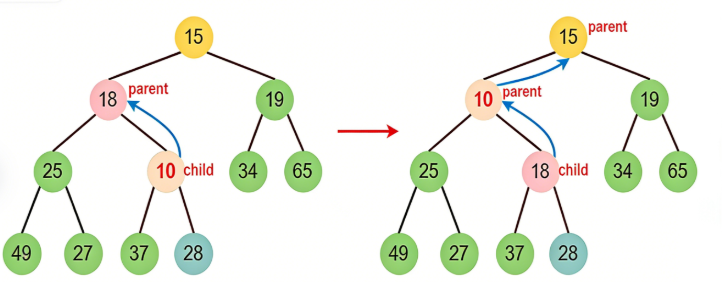
堆的向上调整算法
以小堆为例子,下面这张图的节点10,需要往上调整
cpp
		//向上调整
		void AdjustUp(int child)
		{
			Compare com;  // 仿函数对象
			int parent = (child - 1) / 2;
			while (child > 0)
			{
				if (com(_con[parent], _con[child]))
				{
					std::swap(_con[parent], _con[child]);
					child = parent;
					parent = (child - 1) / 2;
				}
				else
				{
					break;
				}
			}
		}
向下调整算法
cpp
		// 向下调整
		void AdjustDown(int parent)
		{
			Compare com;
			int child = parent * 2 + 1;
			while (child < _con.size())
			{
				// 升序是大根堆,排升序,建大堆,然后和数组最后一个元素交换位置,这样才不会改变二叉树节点的父子关系
				// less,升序,因此左右孩子找大的那个和parent比较
				if (child + 1 < _con.size() && com(_con[child], _con[child + 1]))
				{
					child += 1;
				}
				if (com(_con[parent], _con[child]))
				{
					std::swap(_con[parent], _con[child]);
					parent = child;
					child = parent * 2 + 1;
				}
				else
				{
					break;
				}
			}
		}
有了这两个算法的基础,就很好实现了
完整的priority_queue
cpp
#pragma once
#include <iostream>
#include <vector>
#include <deque>

namespace wzn
{
	// less是升序,greater是升序,记法: less和greater 指的是 < 和 >
	template<class T>
	struct less
	{
		bool operator()(const T& x, const T& y)
		{
			return x < y;
		}
	};

	template<class T>
	struct greater
	{
		bool operator()(const T& x, const T& y)
		{
			return x > y;
		}
	};

	template<class T, class Container = vector<T>, class Compare = less<T>>
	class priority_queue
	{
		// 向下调整
		void AdjustDown(int parent)
		{
			Compare com;
			int child = parent * 2 + 1;
			while (child < _con.size())
			{
				// 升序是大根堆,排升序,建大堆,然后和数组最后一个元素交换位置,这样才不会改变二叉树节点的父子关系
				// less,升序,因此左右孩子找大的那个和parent比较
				if (child + 1 < _con.size() && com(_con[child], _con[child + 1]))
				{
					child += 1;
				}
				if (com(_con[parent], _con[child]))
				{
					std::swap(_con[parent], _con[child]);
					parent = child;
					child = parent * 2 + 1;
				}
				else
				{
					break;
				}
			}
		}
//////////////////////////////////////////
		//向上调整
		void AdjustUp(int child)
		{
			Compare com;
			int parent = (child - 1) / 2;
			while (child > 0)
			{
				if (com(_con[parent], _con[child]))
				{
					std::swap(_con[parent], _con[child]);
					child = parent;
					parent = (child - 1) / 2;
				}
				else
				{
					break;
				}
			}
		}

	public:
		priority_queue()
		{}
//////////////////////////////////////////
		template<class InputIterator>
		priority_queue(InputIterator first, InputIterator last)
		{
			// 先全部push进去再调整
			while (first != last)
			{
				_con.push_back(*first);
				++first;
			}
			//向上建堆,向下调整,O(N)
			for (int i = (_con.size() - 1 - 1) / 2; i > 0; --i)
			{
				AdjustDown(i);
			}
		}
//////////////////////////////////////////
		void push(const T& val)
		{
			_con.push_back(val);
			AdjustUp(_con.size() - 1);
		}
//////////////////////////////////////////
		void pop()
		{
			std::swap(_con[0], _con[_con.size() - 1]);
			_con.pop_back();
			AdjustDown(0);
		}
//////////////////////////////////////////
		const T& top() const
		{
			return _con[0];
		}

		size_t size() const
		{
			return _con.size();
		}
//////////////////////////////////////////
		bool empty() const
		{
			return _con.empty();
		}


	private:
		Container _con;
	};

	void test1()
	{
		priority_queue<int> q;
		q.push(5);
		q.push(1);
		q.push(0);
		q.push(7);
		q.push(9);
		cout << "size:  " << q.size() << endl;
		cout << "empty: " << q.empty() << endl;
		while (!q.empty())
		{
			cout << q.top() << " ";
			q.pop();
		}
		cout << endl;

		priority_queue<int,vector<int>,greater<int>> q1;
		q1.push(5);
		q1.push(1);
		q1.push(0);
		q1.push(7);
		q1.push(9);
		cout << "size:  " << q1.size() << endl;
		cout << "empty: " << q1.empty() << endl;
		while (!q1.empty())
		{
			cout << q1.top() << " ";
			q1.pop();
		}
		cout << endl;
	}
}