C-176(AbMole,M9893)是一种具血脑屏障渗透性的STING抑制剂,能够选择性抑制STING通路的激活,从而发挥广泛的抗炎作用1。C-176可通过抑制STING信号传导,减少下游炎症因子(如IL-1β、iNOS、IL-6、TNF-α、MCP-1和NLRP3炎症小体)的产生,并调控免疫细胞极化2。在细胞模型中,C-176(CAS No.:314054-00-7)显著抑制了脂多糖(LPS)诱导的M1型巨噬细胞极化(如小鼠BV2小胶质细胞系和GMI-R1小胶质细胞),同时促进M2型极化,降低促炎因子的蛋白水平和基因表达水平3。此外,在破骨细胞前体细胞中,C-176通过抑制STING激活,阻断了核因子κB受体激活剂配体(RANKL)诱导的破骨细胞分化4。
在动物实验中,C-176的应用效果在多类小鼠模型中得到了验证。例如,C-176(15-30 mg/kg,腹腔注射)在LPS(Lipopolysaccharides诱导的急性肺损伤(ALI)模型中,剂量依赖性地抑制肺组织中STING表达,减少炎症介质释放,并改善肺损伤5。在缺血再灌注损伤模型中,C-176通过激活AMPK信号通路减轻组织损伤6。此外,C-176在Streptozotocin(链脲佐菌素,STZ)诱导的糖尿病小鼠中,通过抑制STING-TBK1-NF-κB轴,改善了血管内皮功能障碍7。C-176不仅能在创伤性脑损伤(TBI)模型(C57BL/6雄性小鼠)中缩小皮质损伤面积8,还能在小鼠银屑病样炎症模型(由Imiquimod诱导)中,通过抑制树突状细胞活化,减少IL-17和IFN-γ分泌性T细胞的增殖,从而减轻皮肤炎症。综上,C-176作为一种高效的STING抑制剂,在多种疾病模型中展现出核心调控作用,其机制涵盖AMPK激活、巨噬细胞极化调节及炎症小体抑制等。
范例详解
ACS Nano. 2025 Jan 21;19(2):2726-2741.
四川大学的科研团队在上述文献中使用了AbMole的C-176(AbMole,M9893),实验人员开发了具有pH/氧化还原双重响应特性的铂(IV)骨架聚合物前药功能化氧化锰纳米颗粒(DHP/MnO2NP)。体外实验表明,该纳米颗粒能有效诱导肿瘤细胞DNA损伤并促使其泄漏到细胞质中,与Mn2+协同促进STING激活,显著上调促炎细胞因子表达。体内实验中,DHP/MnO2NP通过诱导STING激活和启动强大的抗肿瘤免疫,展现出对肿瘤的抑制效果,能将肿瘤相关巨噬细胞向促炎表型倾斜,使肿瘤中促炎细胞因子表达上调高达99倍,同时显著增加CD8+ T细胞浸润。C-176作为STING抑制剂,可抑制DHP/MnO2NP的抗肿瘤和免疫刺激功效,用于验证纳米粒子对STING通路的激活和作用机理。
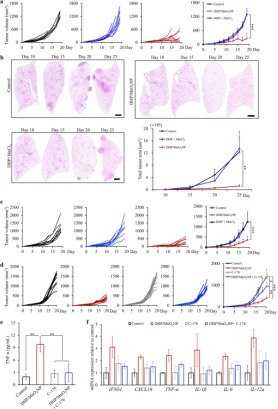
Therapeutic efficacy of DHP/MnO2NP after intravenous administration
参考文献及鸣谢
1 Yu, Z. C.; Fu, R.; Li, Y.; et al. The STING inhibitor C-176 attenuates osteoclast-related osteolytic diseases by inhibiting osteoclast differentiation. FASEB journal : official publication of the Federation of American Societies for Experimental Biology 2023, 37 (4), e22867.
2 Hu, S.; Gao, Y.; Gao, R.; et al. The selective STING inhibitor H-151 preserves myocardial function and ameliorates cardiac fibrosis in murine myocardial infarction. International immunopharmacology 2022, 107, 108658.
3 Zhang, X.; Li, X.; Wang, W.; et al. STING Contributes to Cancer-Induced Bone Pain by Promoting M1 Polarization of Microglia in the Medial Prefrontal Cortex. Cancers 2022, 14 (21).
4 Mao, H. Q.; Zhou, L.; Li, J. Q.; et al. STING inhibition alleviates bone resorption in apical periodontitis. International endodontic journal 2024, 57 (7), 951-965.
5 Wu, B.; Xu, M. M.; Fan, C.; et al. STING inhibitor ameliorates LPS-induced ALI by preventing vascular endothelial cells-mediated immune cells chemotaxis and adhesion. Acta pharmacologica Sinica 2022, 43 (8), 2055-2066.
6 Yang, M.; Ma, Y. X.; Zhi, Y.; et al. Inhibitors of IFN gene stimulators (STING) improve intestinal ischemia-reperfusion-induced acute lung injury by activating AMPK signaling. European journal of medical research 2022, 27 (1), 79.
7 Pham, P. T.; Bavuu, O.; Kim-Kaneyama, J. R.; et al. Innate Immune System Regulated by Stimulator of Interferon Genes, a Cytosolic DNA Sensor, Regulates Endothelial Function. Journal of the American Heart Association 2023, 12 (22), e030084.
8 Fryer, A. L.; Abdullah, A.; Mobilio, F.; et al. Pharmacological inhibition of STING reduces neuroinflammation-mediated damage post-traumatic brain injury. British journal of pharmacology 2024, 181 (17), 3118-3135.