MySQL
sql
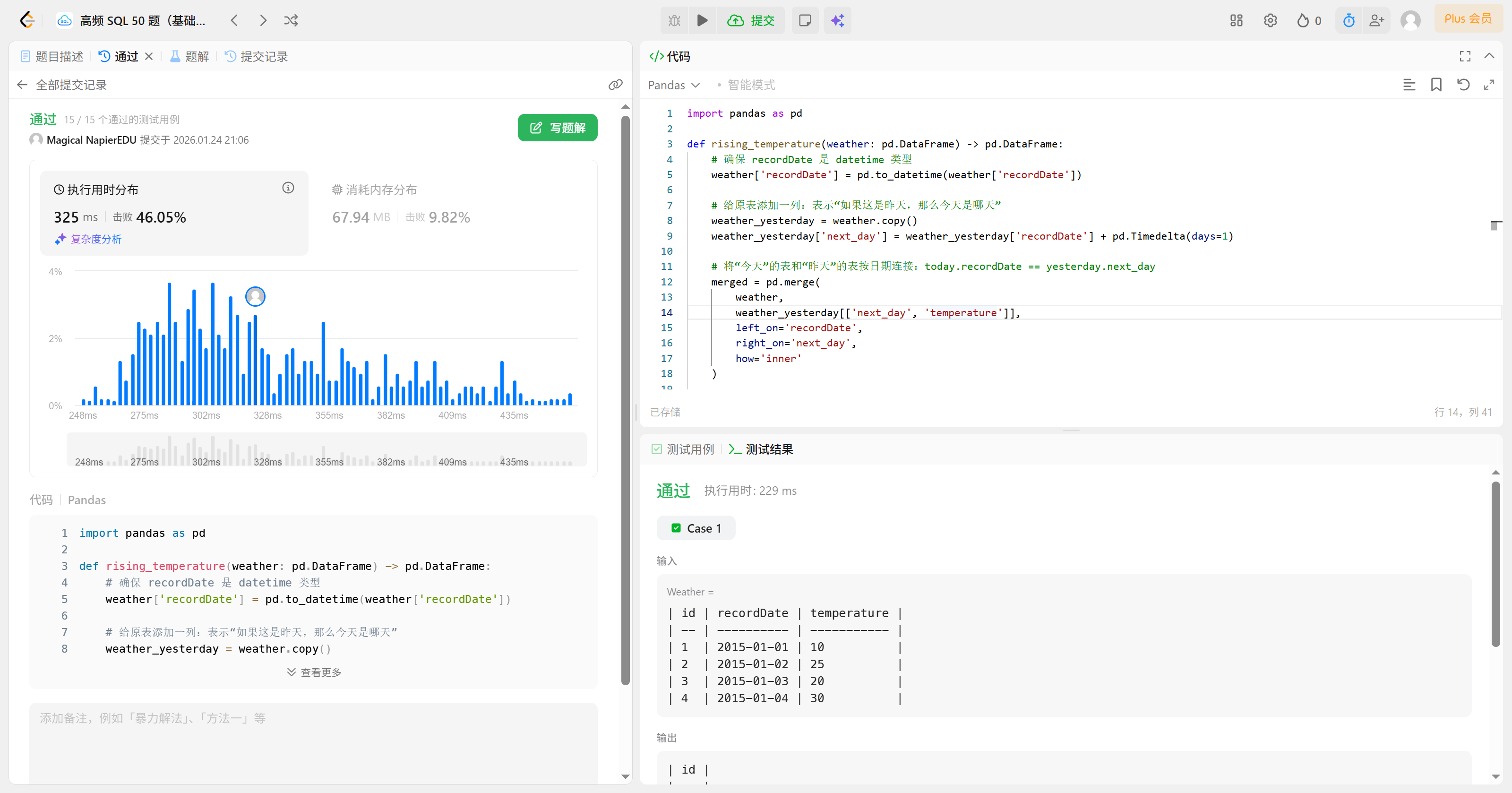
# Write your MySQL query statement below
SELECT w1.id
FROM Weather w1, Weather w2
WHERE DATEDIFF(w1.recordDate, w2.recordDate) = 1 and w1.temperature > w2.temperature;DATEDIFF(date1, date2)- 返回的是
date1 - date2的天数差(只考虑日期部分,忽略时间)。 - 结果是一个整数 :
- 正数:
date1在date2之后 - 负数:
date1在date2之前 - 0:两个日期相同
- 正数:
结果
解题步骤:
Pandas
python
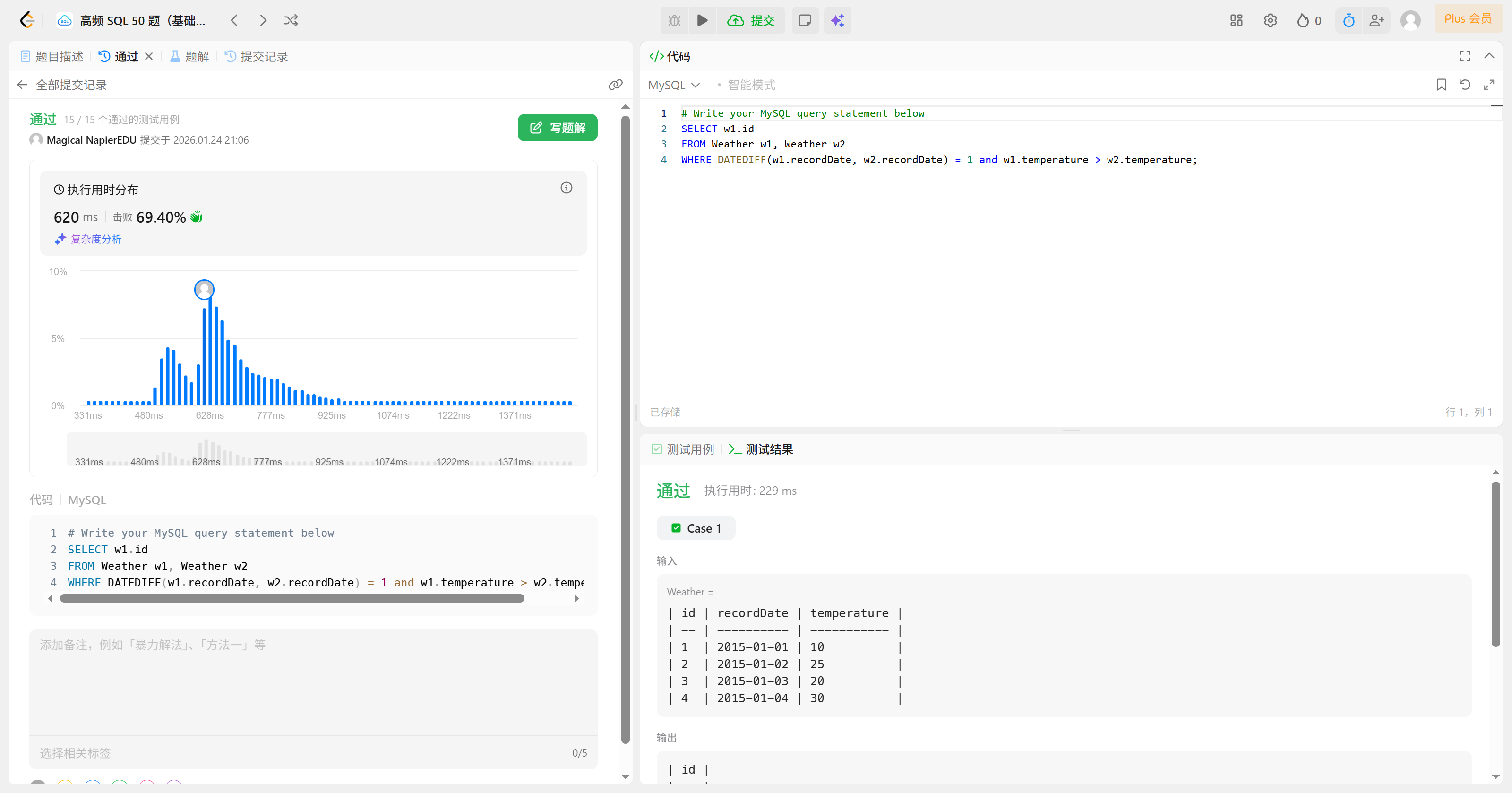
import pandas as pd

def rising_temperature(weather: pd.DataFrame) -> pd.DataFrame:
    # 确保 recordDate 是 datetime 类型
    weather['recordDate'] = pd.to_datetime(weather['recordDate'])

    # 给原表添加一列:表示"如果这是昨天,那么今天是哪天"
    weather_yesterday = weather.copy()
    weather_yesterday['next_day'] = weather_yesterday['recordDate'] + pd.Timedelta(days=1)

    # 将"今天"的表和"昨天"的表按日期连接:today.recordDate == yesterday.next_day
    merged = pd.merge(
        weather,
        weather_yesterday[['next_day', 'temperature']],
        left_on='recordDate',
        right_on='next_day',
        how='inner'
    )

    # 筛选今天温度 > 昨天温度的记录
    result = merged[merged['temperature_x'] > merged['temperature_y']]

    # 返回 id 列,并重命名为符合要求的格式(只保留 id)
    return result[['id']].rename(columns={'id': 'id'})
步骤1:日期格式转换
weather['recordDate'] = pd.to_datetime(weather['recordDate'])-
将
recordDate列转换为 pandas 的datetime类型 -
这样才能进行日期加减运算
步骤2:创建"昨天"数据表
weather_yesterday = weather.copy()
weather_yesterday['next_day'] = weather_yesterday['recordDate'] + pd.Timedelta(days=1)-
复制原始数据,创建
weather_yesterday副本 -
添加新列
next_day= 原日期 + 1天 -
逻辑:如果某行是昨天的记录,那么它的
next_day就是今天
示例:
原始数据:
id | recordDate  | temperature
1  | 2023-01-01 | 25
2  | 2023-01-02 | 28  # 假设这是今天

处理后:
id | recordDate  | temperature | next_day
1  | 2023-01-01 | 25          | 2023-01-02  # 昨天记录,next_day是今天
步骤3:合并两张表
merged = pd.merge(
    weather,  # 左表:今天的记录
    weather_yesterday[['next_day', 'temperature']],  # 右表:只保留需要的列
    left_on='recordDate',    # 左表的连接键:今天的日期
    right_on='next_day',     # 右表的连接键:next_day(即今天)
    how='inner'              # 内连接:只保留匹配成功的行
)-
逻辑:找到"今天"的记录和它对应的"昨天"的记录
-
连接条件 :
今天的日期 = 昨天的日期 + 1天
连接结果示例:
左表(今天)              右表(昨天)
id | recordDate  | temp   next_day  | yesterday_temp
2  | 2023-01-02 | 28   +  2023-01-02| 25
                    ↓
连接后:
id | recordDate  | temp_x | next_day  | temp_y
2  | 2023-01-02 | 28     | 2023-01-02| 25
# temp_x: 今天的温度(28)
# temp_y: 昨天的温度(25)
步骤4:筛选温度上升的记录
result = merged[merged['temperature_x'] > merged['temperature_y']]-
temperature_x: 今天的温度(来自左表) -
temperature_y: 昨天的温度(来自右表) -
条件:今天温度 > 昨天温度
步骤5:返回结果
return result[['id']].rename(columns={'id': 'id'})-
只返回
id列 -
重命名列(其实不变,为了格式一致性)
可视化流程
原始数据:
┌────┬─────────────┬─────────────┐
│ id │ recordDate  │ temperature │
├────┼─────────────┼─────────────┤
│ 1  │ 2023-01-01 │     25      │ ← 昨天
│ 2  │ 2023-01-02 │     28      │ ← 今天
│ 3  │ 2023-01-03 │     26      │ ← 明天
└────┴─────────────┴─────────────┘

步骤1-2:创建昨天表
昨天表添加 next_day:
┌────┬─────────────┬─────────────┬─────────────┐
│ id │ recordDate  │ temperature │  next_day   │
├────┼─────────────┼─────────────┼─────────────┤
│ 1  │ 2023-01-01 │     25      │ 2023-01-02  │ ← next_day=今天
└────┴─────────────┴─────────────┴─────────────┘

步骤3:连接
匹配条件:今天.recordDate = 昨天.next_day
连接后:
┌─────┬─────────────┬───────────────┬─────────────┬───────────────┐
│ id  │ recordDate  │ temperature_x │  next_day   │ temperature_y │
├─────┼─────────────┼───────────────┼─────────────┼───────────────┤
│  2  │ 2023-01-02 │      28       │ 2023-01-02  │      25       │
└─────┴─────────────┴───────────────┴─────────────┴───────────────┘

步骤4:筛选
28 (今天) > 25 (昨天) ✓ → 保留

步骤5:返回
┌─────┐
│ id  │
├─────┤
│  2  │
└─────┘
结果
解题步骤: